DATE :
Vintage Martin 0-18, 00-18 & 000-18 Value Guide
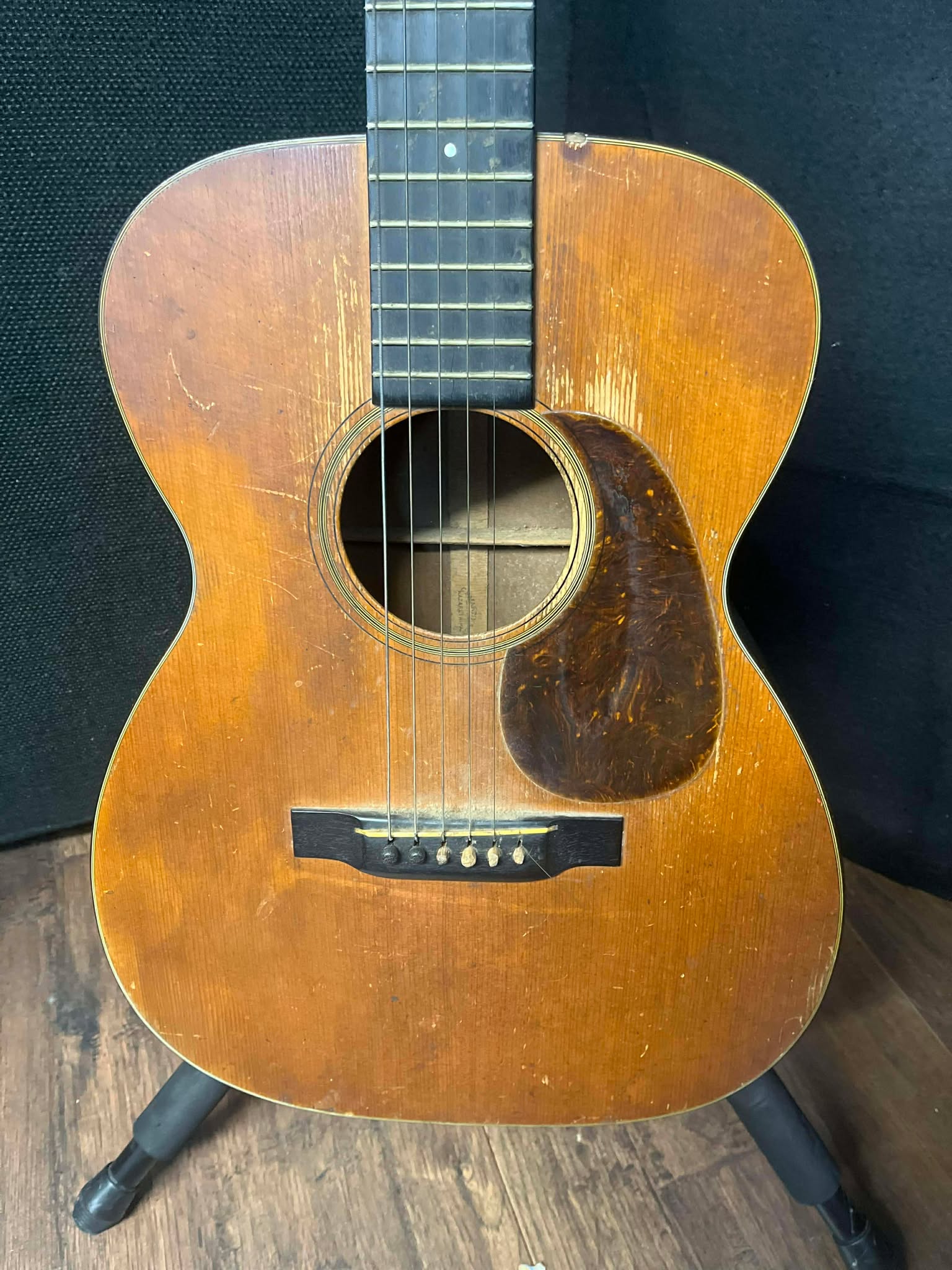
Martin’s mahogany small-body flat-tops, the parlor-size 0-18, the grand concert 00-18, and the auditorium 000-18, are among the most musical and collectible pre-war American acoustics. Clean pre-war examples bring strong four to five figures. Edgewater recently paid $11,000 for a 1937 00-18 and over $10,000 for a 1940. Body size, era, originality, and condition set where any single guitar lands.
Last updated: October 2026
What Is a Vintage Martin Small-Body Worth? (Year by Year, 2026)
The values below are reference points for clean, all-original examples. They reflect what a fair buyer like Edgewater pays, not best-case auction results. Pre-war scalloped-braced examples sit at the top, and the larger 00 and 000 bodies generally bring more than the parlor-size 0.
Year and model | What defines it | Reference value for a clean example |
|---|---|---|
1935 0-18 | Pre-war parlor, mahogany, intimate body | Around $7,500 |
1936 0-18 | Pre-war parlor, mahogany | Around $7,500 |
1936 00-18 | Pre-war grand concert, mahogany | Around $10,500 |
1937 00-18 | Pre-war grand concert, scalloped bracing | Around $11,000 |
1940 00-18 | Golden-era grand concert, mahogany | Over $10,000 |
1942 00-18 | Wartime grand concert | Around $9,500 |
1942 000-18 | Pre-war auditorium, mahogany | Around $11,000 |
1947 000-17 | Post-war all-mahogany auditorium | Around $4,500 |
Current market note (2026): clean pre-war small-body Martins with original scalloped bracing have appreciated strongly, and the larger 00 and 000 bodies are especially sought after. Re-braced, refinished, or cracked guitars trade lower, and the all-mahogany 000-17 sits below the spruce-top 18-style guitars. As a buyer, Edgewater prices to the honest, all-in condition of the actual guitar, not the best-case auction headline.
The table above focuses on the 1935 to 1947 window, where most of the small-body Martins we see and buy fall. Earlier examples from the early 1900s through the mid-1930s and later examples from the late 1940s through 1965 exist too and we buy those as well; see our complete 1900 to 1965 dating guide to identify and place a guitar from outside this window.
What Is a 1950s Martin 00-18 or 000-18 Worth?
A clean, original 1950s Martin 00-18 or 000-18 typically sells for about $3,500 to $6,000 in 2026, with the best-preserved 000-18s reaching about $7,000. Edgewater Guitars, near Cleveland, Ohio, buys them nationwide and usually offers about 20% under those sold prices. Call or text (440) 219-3607 for a free appraisal.
Where those numbers come from: Reverb's sold-price guide for the 1946 to 1964 Martin 00-18 shows an estimated range of $3,080 to $5,859 across 179 orders, and its guide for the 1946 to 1964 000-18 shows $3,014 to $7,000 across 145 orders (both viewed October 2026, Good to Mint condition only). Recent sales on those pages ran $3,500 to $5,800 for 00-18s and mostly $3,500 to $4,550 for 000-18s, with one 000-18 at $8,449. Asking prices for 1950s examples often run $6,000 to $10,500, but asking is not selling, so use sold prices as the benchmark.
Edgewater's cash offer on a guitar like that would typically land around 20% under those sold figures, and lower for refinished, cracked or heavily repaired examples. A well-done neck reset is normal maintenance on a guitar this old and does not take it out of that range. Condition and originality move the number more than the exact year, so the accurate answer for yours is a free appraisal.
Postwar 1950s Small-Body Martins: What Changed
These are the details that separate a 1950s 00-18 or 000-18 from the prewar guitars in the table above:
Bracing: scalloped top bracing ended by 1945. A 1950s 00-18 or 000-18 has straight, non-scalloped X-bracing, which is the main reason it sells below a prewar example.
Top: Martin moved from Adirondack to Sitka spruce starting in 1946, so a 1950s guitar normally has a Sitka top. A batch of 1953 guitars used Engelmann spruce.
Back and sides: mahogany, as on every Style 18 since 1917.
Fingerboard and bridge: Brazilian rosewood. The small Style 18 bodies went to rosewood as standard in 1940.
Neck: a non-adjustable steel T-bar, used from 1934 until Martin switched to a square steel tube in 1967.
Pickguard: tortoise-pattern celluloid. From the late 1950s the guards show large swirls and a reddish tone; black pickguards did not arrive until 1967.
Tuners: open-back Kluson tuners were common on 1950s small bodies.
Scale: the 14-fret 000-18 uses a 24.9-inch scale.
Serial numbers, 1950 to 1960
The serial number is stamped on the neck block, visible through the soundhole. From Martin's published list: 1950 guitars run from 112,962 to 117,961, 1955 from 141,346 to 147,328, 1959 from 165,577 to 171,047, and 1960 from 171,048 to 175,689. Check yours with our Martin serial number lookup or the small-body Martin dating guide.
A 1960 000-18 Edgewater bought this fall
In September 2026 Edgewater bought a 1960 Martin 000-18. That month we also answered an appraisal request for a 1960 000-18 from an owner in West Virginia whose grandfather had bought the guitar in 1960. From the photos it was an honest, original example: original finish with some wear here and there, the original pickguard intact, and the original tuners. The first thing Gavin looked at was the neck angle. A lot of 1950s and early-1960s 000-18s need a neck reset by now, and a reset or any top cracks pull the number down, so that is the main question on any guitar from this era.
What Drives a Vintage Martin Small-Body’s Value?
Body size: the auditorium 000 and grand concert 00 generally bring more than the parlor-size 0, with the 000 the most sought after.
Pre-war specs: original scalloped bracing (through about 1944) is a major value driver on these small-body Martins.
Style: the spruce-top, mahogany-body Style 18 outvalues the all-mahogany Style 17 such as the 000-17.
Originality: original bracing, bridge, finish, and the interior label matter far more than shine.
Condition: no top cracks, a solid neck angle, and original frets all add up.
Completeness: the original case and paperwork add confidence and value.
How to Identify and Date a Vintage Martin Small-Body
Three things pin down the model, year, and value: the serial number, the body size, and the bracing and style. Here is how to read them.
Serial numbers
Martin stamped a continuous serial number on the neck block inside the body, so these guitars are straightforward to date. Read the number and confirm the year with our Martin serial number lookup.
Body size: 0 versus 00 versus 000
The 0 is the small parlor size, the 00 is the grand concert, and the 000 is the larger auditorium body. Body size is the first thing to confirm, since it separates the models and affects both tone and value, with the 000 generally the most valuable.
Style 18 versus Style 17
Style 18 has a spruce top with mahogany back and sides, while Style 17 such as the 000-17 is all mahogany, including the top. The spruce-top 18-style guitars generally bring more than the all-mahogany 17-style, so confirm the top wood when valuing one of these Martins.
Scalloped bracing and originality
Pre-war small-body Martins used scalloped top bracing, phased out around 1944. Original scalloped bracing, an unaltered bridge, and an uncracked top support the value, while a re-braced or repaired top pulls it down.
Small-Body Martin Year Pages and Guides
Drill into a specific year or our Martin dating guide:
Sell your vintage Martin small-body
Edgewater Guitars buys vintage Martin 0-18, 00-18, and 000-18 guitars nationwide, pre-war and post-war, original and repaired. We give free, no-pressure estimates and pay fairly. To sell yours, request a free estimate.
How much is a vintage Martin 00-18 worth?
A clean, all-original pre-war 00-18 typically brings strong four to low five figures; Edgewater recently paid $11,000 for a 1937 and over $10,000 for a 1940. Post-war and all-mahogany 17-style examples bring less, and we still buy those.
What is the difference between a 0, 00, and 000 Martin?
They are body sizes: the 0 is a small parlor, the 00 is a grand concert, and the 000 is the larger auditorium body. The larger 00 and 000 are generally more valuable than the parlor-size 0, all else being equal.
How do I date my small-body Martin?
Read the serial number stamped on the neck block inside the body and confirm the year with our Martin serial number lookup. Then confirm the body size and style to identify the exact model.
What is a 1950s Martin 000-18 worth?
Clean, original 1950s 000-18s mostly sold for about $3,500 to $4,600 on Reverb in 2026, inside Reverb's guide range of $3,014 to $7,000 for 1946 to 1964 examples. Edgewater's offer usually lands about 20% under sold prices, lower for refinished or cracked guitars.