DATE :
Vintage Martin Acoustic Guitar Value Guide
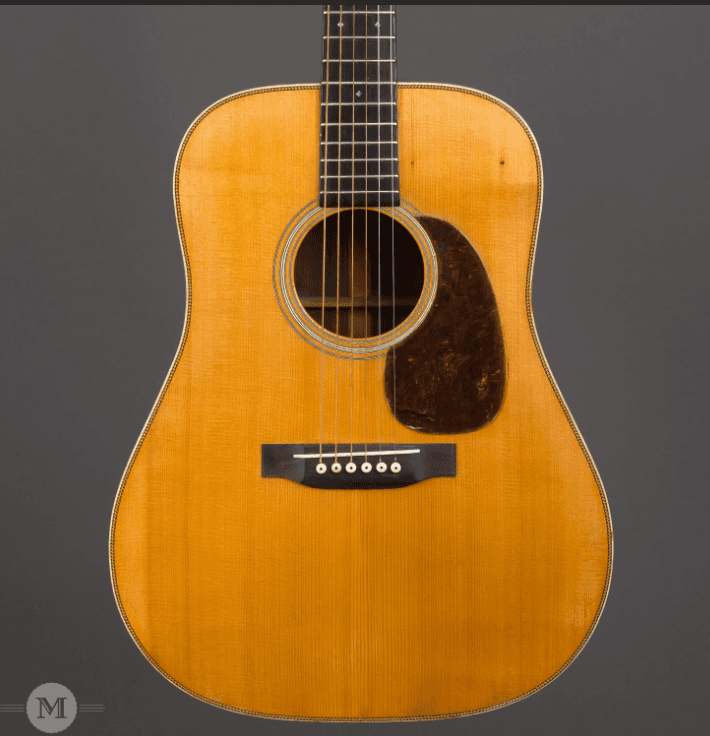
Vintage Martin Acoustic Guitar Value Guide
Vintage Martin flat-tops set the standard for the American steel-string guitar, from the rosewood D-28 dreadnought to the pre-war mahogany small-bodies and the rare Orchestra Models. Values run from solid four figures for a post-war mahogany Martin to six figures for a pre-war herringbone D-28 or an early OM. Edgewater recently paid $11,000 for a 1937 00-18 and $9,300 for a 1958 D-28. Model, era, wood, and originality set where any single guitar lands. Not sure what model you have? Try our free guitar identification tool for an instant, no-obligation read, or use the model guides below to value yours.
Last Updated: July 2026
What Are Vintage Martin Acoustic Guitars Worth? (By Model, 2026)
The ranges below are reference points for clean, all-original examples and reflect what a fair buyer like Edgewater pays, not best-case auction results. Pre-war Brazilian rosewood, herringbone trim, and scalloped bracing push the most desirable Martins into five and six figures.
Model | Era and body | Reference value for a clean example |
|---|---|---|
D-28 | Brazilian rosewood dreadnought, 1930s to 1969 | Around $8,000 to $11,000 |
D-18 | Mahogany dreadnought, pre-war and golden era | Around $10,000 |
D-35 | Three-piece Brazilian rosewood back, 1965 to 1969 | Around $4,550 to $7,800 |
0-18, 00-18, and 000-18 | Pre-war mahogany small-body | Around $7,500 to $11,000 |
000-17 | Post-war all-mahogany auditorium | Around $4,500 |
Orchestra Model (OM-18, OM-28, OM-45) | 1929 to 1933, the rarest production Martins | Five to six figures depending on style and condition |
Pre-1934 herringbone D-28 | The earliest, rarest dreadnoughts | Five to six figures |
Current market note (2026): the single biggest value divide on a vintage Martin is pre-war versus post-war, followed by Brazilian rosewood versus mahogany and original versus altered bracing. A pre-1934 herringbone D-28 or an original Orchestra Model is a six-figure instrument; a clean post-war mahogany Martin is far more attainable. As a buyer, Edgewater prices to the honest, all-in condition of the actual guitar, not the best-case auction headline.
Martin Dreadnought Values: D-28 and D-18 (1931 to 1969)
The D-28 and D-18 are the models most people picture when they think of a Martin dreadnought. The figures below are reference points for a clean, all-original example.
Year and model | What defines it | Reference value |
|---|---|---|
1936 D-18 | Pre-war mahogany dreadnought, scalloped bracing | Around $10,000 |
1957 D-28 | Brazilian rosewood, golden-era dreadnought | Around $9,500 |
1958 D-28 | Brazilian rosewood, golden-era dreadnought | Around $9,300 |
1964 D-28 | Last full Brazilian rosewood year | Around $8,500 |
1965 D-28 | Last year of the golden era | Around $8,000 |
A Brazilian rosewood D-28 (through 1969) outvalues both the post-1969 East Indian rosewood D-28 and the mahogany D-18, though a clean pre-war D-18 is highly collectible in its own right. See the full Martin D-28 and D-18 value guide for the complete year-by-year breakdown and dating details.
Martin Small-Body Values: 0-18, 00-18, and 000-18
Small-body Martins, the intimate 0, the grand concert 00, and the larger auditorium 000, are some of the most underrated vintage flat-tops on the market. Pre-war examples with original scalloped bracing sit at the top of the range.
Year and model | What defines it | Reference value |
|---|---|---|
1935 0-18 | Pre-war parlor, mahogany, intimate body | Around $7,500 |
1936 00-18 | Pre-war grand concert, mahogany | Around $10,500 |
1937 00-18 | Pre-war grand concert, scalloped bracing | Around $11,000 |
1940 00-18 | Golden-era grand concert, mahogany | Over $10,000 |
1942 000-18 | Pre-war auditorium, mahogany | Around $11,000 |
1947 000-17 | Post-war all-mahogany auditorium | Around $4,500 |
The auditorium 000 and grand concert 00 generally bring more than the parlor-size 0, and the spruce-top Style 18 outvalues the all-mahogany Style 17 such as the 000-17. See the full Martin 0-18, 00-18, and 000-18 value guide for the complete breakdown.
Martin D-35 Values: The Three-Piece-Back Dreadnought (1965 to 1969)
Martin introduced the D-35 in 1965 specifically to make better use of narrower Brazilian rosewood stock, giving it a distinctive three-piece back. Every D-35 from this window carries genuine Brazilian rosewood, since Martin exhausted its Brazilian stock by late 1969 and switched permanently to East Indian rosewood on January 1, 1970.
Year | What defines it | Reference value |
|---|---|---|
1965 (first year) | Only about 207 made, genuine rarity | $5,850 to $7,800 |
1966 to 1969 | Full Brazilian rosewood production years | $4,550 to $5,850 |
See the full Martin D-35 value guide for dating details and what separates it from a D-28.
Martin Orchestra Model (OM) Values: The Rarest and Most Valuable Vintage Martins
Martin built the Orchestra Model for only four years, 1929 to 1933, before discontinuing it. That short run, combined with features collectors prize most today, an Adirondack spruce top, Brazilian rosewood, and the original 12-fret-to-14-fret scale length, makes an authentic OM the single most valuable vintage Martin body style.
Style | Excellent, all original | Good, honestly repaired |
|---|---|---|
OM-18 | Ultra-premium tier | Mid tier |
OM-28 | Extraordinary tier, often six figures | Upper-mid tier |
OM-45 | Museum tier | Premium tier |
All-original condition, an untouched Adirondack top, and original bracing are essential to OM value; a re-topped example loses 40 to 60 percent versus an all-original one. See the full Martin OM value guide for the complete authentication and value breakdown.
What Drives a Vintage Martin’s Value?
Era: pre-war Martins (before 1942) carry the highest premium, with the herringbone D-28 trim that ended in 1947 and scalloped bracing that ended in 1944 as key markers.
Wood: Brazilian rosewood (used through 1969) is worth far more than the East Indian rosewood that replaced it, and rosewood models outvalue mahogany.
Model and size: the D-28 and D-18 dreadnoughts, the three-piece-back D-35, the small-body 0 to 000 sizes, and the rare Orchestra Models each have their own value tier.
Bracing: original scalloped bracing and an unaltered top are major value drivers; a re-braced or repaired top cuts value sharply.
Originality: original finish, bridge, tuners, and the interior paper label all matter. Never remove a Martin label, as it is part of the guitar’s documentation.
Condition: no top cracks, a solid neck angle, and original frets all add up.
How to Identify and Date a Vintage Martin
Four things place a Martin and set the value: the serial number, the wood, the bracing, and the trim. Here is how to read them.
Serial numbers
Martin has used a continuous serial number sequence since 1898, stamped on the neck block inside the body, which makes Martins easier to date than most brands. Confirm the year with our Martin serial number lookup.
Brazilian versus East Indian rosewood
Martin used Brazilian rosewood through 1969, then switched to East Indian rosewood. Brazilian rosewood, with its tighter, spider-web grain, is a major value driver, so identifying the wood species is essential when valuing a rosewood Martin such as a D-28 or D-35.
Scalloped bracing and herringbone trim
Pre-war Martins used scalloped top bracing, discontinued during the war around 1944, and the D-28 wore herringbone trim until 1947. A genuine scalloped-braced, herringbone-era D-28 sits at the top of the value range, so confirm both before valuing a 1930s or 1940s example.
Model size and the paper label
Body size runs from the small 0 through 00 and 000 up to the D dreadnought and the OM. The interior paper label and the stamp on the neck block confirm the model and year, so leave the label in place and read it rather than removing it.
Complete Value Reduction Reference Guide
Modifications and repairs affect vintage Martin values differently depending on what was changed and how well the work was done. This table gives a general sense of how common alterations affect value versus an all-original example.
Modification | Typical value impact |
|---|---|
Refinished top, back, or sides | Meaningful reduction, often 25 to 40 percent |
Re-topped (especially loses original Adirondack spruce) | Severe reduction, 40 to 60 percent |
Re-braced or over-braced top | Significant reduction, 30 to 50 percent |
Replaced bridge | Moderate reduction |
Replaced tuners | Minor to moderate reduction |
Professionally repaired top crack | Modest reduction, 15 to 35 percent depending on severity |
Neck reset (a common, expected repair on old dreadnoughts) | Small reduction, 10 to 15 percent; often necessary rather than a defect |
What Does NOT Reduce Value
Honest playing wear, a period-correct replacement case, and light finish checking from age do not meaningfully hurt a vintage Martin’s value. Collectors distinguish between honest wear on an all-original guitar and structural modification; the first is expected, the second is what actually costs money.
How to Get Maximum Value for Your Vintage Martin
Step 1: Identify Your Model Accurately
Confirm the body size (0, 00, 000, D, or OM) and style (17, 18, 28, 35, 45) before assuming a value range. A D-28 and a D-35 look similar at a glance but occupy different value tiers.
Step 2: Assess Originality Honestly
Check the bridge, tuners, bracing, and finish against factory specification. An honest assessment upfront avoids surprises later and helps you understand which value tier your guitar actually falls into.
Step 3: Get Multiple Expert Opinions
Vintage Martin values vary by source. Compare a free expert appraisal against price guides and completed sales, not just asking prices, which are often inflated.
Step 4: Gather Documentation
Original case, receipts, past repair records, and any provenance you have all support a stronger, more confident offer.
Step 5: Contact Edgewater for Free Expert Valuation
Send clear photos of the front, back, headstock, serial number, and any damage. You will get a fair, honest read on your specific guitar, not a generic estimate.
Selling Options: Where to Get the Best Price for Your Vintage Martin
You have a few ways to sell a vintage Martin: a local guitar shop, an online marketplace like Reverb, a consignment shop, or a specialist buyer. Local shops often lowball vintage instruments they do not specialize in. Marketplaces can get a higher headline price but come with fees, scams, shipping risk on a fragile pre-war acoustic, and months of waiting. Edgewater Guitars buys directly, nationwide, with a free expert appraisal and same-day payment, no consignment wait and no marketplace fees.
Martin Model Value Guides and Resources
Drill into a model or a value topic to value your guitar:
Martin herringbone binding: the detail that disappeared in 1934
Brazilian vs East Indian rosewood: identify your Martin’s wood
Sell your vintage Martin acoustic
Edgewater Guitars buys vintage Martin acoustics nationwide, from pre-war herringbone D-28s and small-body mahogany Martins to rare Orchestra Models and post-war dreadnoughts. We give free, no-pressure estimates and pay fairly for clean, original, and even repaired guitars. Visit our dedicated sell your Martin guitar page or request a free estimate to get started.
Which vintage Martin is most valuable?
The pre-war Brazilian rosewood models, especially the Orchestra Model. A pre-1934 herringbone D-28, an early OM-45, or a clean pre-war 000 brings the most, often into five or six figures, while post-war mahogany Martins are more attainable. Within any model, originality and condition drive the final number.
How do I date my Martin?
Martins are unusually easy to date thanks to a continuous serial sequence stamped on the neck block since 1898. Read that number and confirm the year with our Martin serial number lookup.
Does a repair or refinish hurt a vintage Martin’s value?
Yes. A refinish, a re-braced top, or a replaced bridge lowers the value, but a vintage Martin is still very much worth selling. We make fair offers on original, repaired, and project guitars alike.
What is a Martin Orchestra Model (OM) worth?
An authentic 1929 to 1933 OM in excellent, all-original condition is the most valuable vintage Martin body style, with an OM-45 reaching museum tier and an OM-28 often into six figures. Condition, wood, and originality of the top and bracing matter enormously; see our full Martin OM value guide for the complete breakdown.
Does Brazilian rosewood affect a Martin’s value?
Yes, significantly. Martin used Brazilian rosewood through 1969, and its tight, figured grain makes it the single biggest value driver on a rosewood Martin like the D-28 or D-35. Models built from 1970 onward use East Indian rosewood, which is common today and worth considerably less.