DATE :
1967 Gibson ES-330 Value Guide: Sparkling Burgundy Identification and Worth
A 1967 Gibson ES-330 is a fully hollow P-90 thinline; clean originals have recently listed or sold between $7,250 and $8,950, and the rare Sparkling Burgundy metallic finish only adds to the appeal. Edgewater Guitars in Valley City, Ohio buys 1967 ES-330s nationwide with free expert appraisals and same-day cash offers. Call or text (440) 219-3607.
The late-1960s ES-330: why 1967 needs its own guide
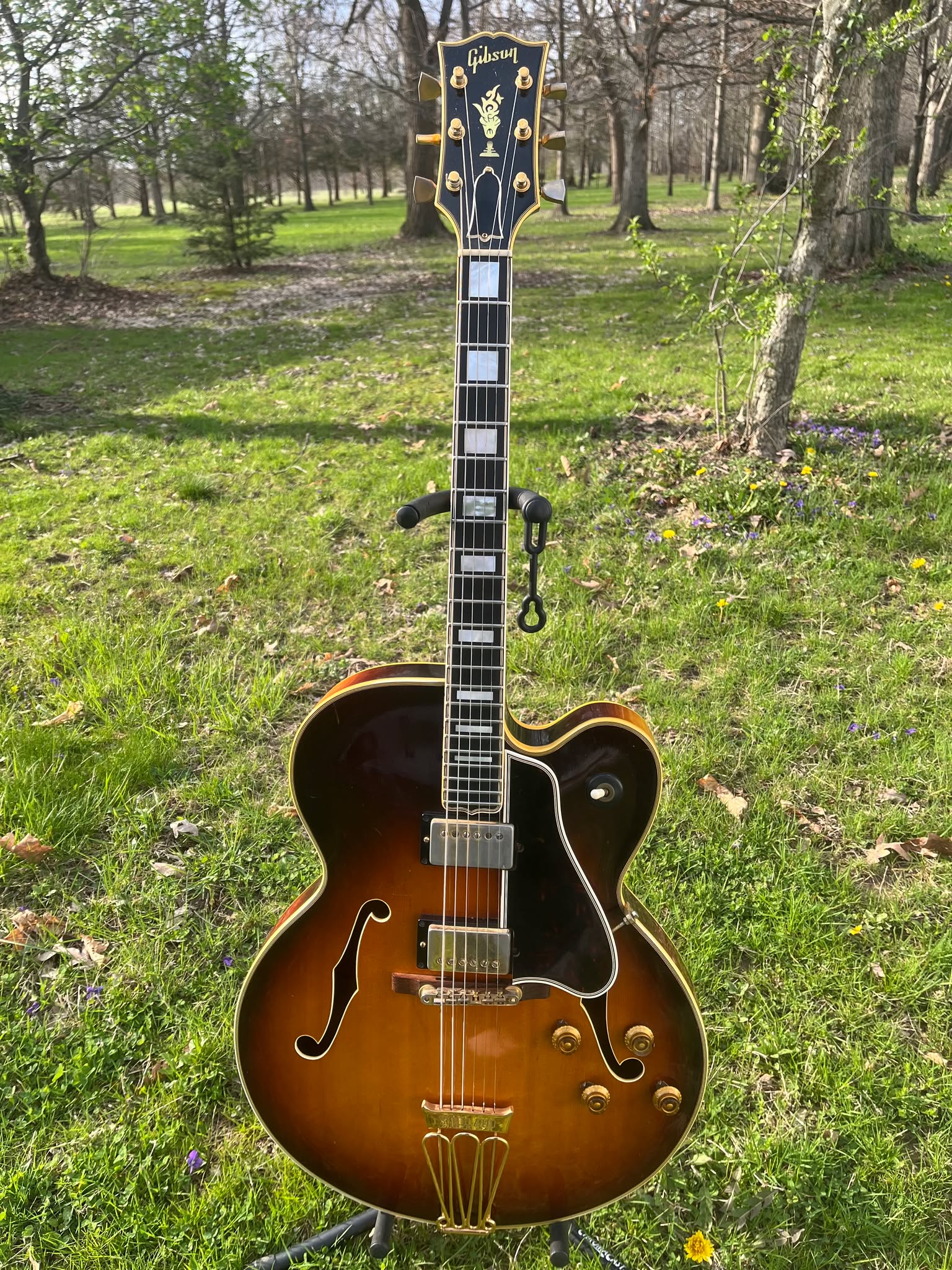
Edgewater's ES-330 value guide covers 1959 through 1965, the model's first and best-documented run, and our ES-330 dating guide doesn't get into the neck, nut or finish changes that came after. By 1967 the guitar had moved on in ways that matter for both dating and money: a narrower nut, chrome hardware in place of nickel, and a new Sparkling Burgundy metallic finish on Gibson's thinline electrics. Edgewater bought and sold a 1967 ES-330 in Sparkling Burgundy in the summer of 2026. This guide picks up where the pillar and the 1961 and 1960 year spokes leave off.
Most 1967 examples are the two-pickup ES-330TD; Edgewater's 1959 ES-330T guide covers the earlier single-pickup version. Both are fully hollow, with no center block, unlike the semi-hollow ES-335.
1965 to 1969 Gibson ES-330 feature changes
The nut width and hardware plating settle down by 1966 and hold through 1967. The bigger structural change, the move from a 16th-fret to a 19th-fret neck joint, lands in 1968, after Edgewater's guitar was built. Treat any of these as approximate: Gibson's own documentation from this decade is thin, and dealers disagree at the edges.
Year | Neck joint | Nut width | Pickup covers | What's notable |
|---|---|---|---|---|
1965 | 16th fret | Narrows during the year, from 1 11/16 in to 1 9/16 in | Changes from nickel to chrome plating | The last nickel-hardware ES-330s; the narrow nut arrives |
1966 | 16th fret | 1 9/16 in | Chrome | Block inlays and chrome hardware are the norm; one dealer dates a genuine Sparkling Burgundy example to this year |
1967 | 16th fret (the last full year) | 1 9/16 in | Chrome | Vintage Guitar magazine dates Gibson's addition of Sparkling Burgundy as a regular finish to this year; Edgewater's guitar is from this year |
1968 | Changes to 19th fret ("long neck") during the year | Narrow; not separately documented past 1967 in the sources we checked | Chrome | Short-neck and long-neck 1968s both exist; date by features, not the serial |
1969 | 19th fret | Narrow; not separately documented past 1967 in the sources we checked | Chrome | The last year Sparkling Burgundy is commonly cited as available |
Sparkling Burgundy: Gibson's rare metallic option for the ES-330
Sparkling Burgundy is a metallic finish with a translucent red top coat, in the same family as Fender's Candy Apple Red. Stanley Rendell, who later served as Gibson's president, told Vintage Guitar magazine the color began as "a disguise mechanism": laminated ES bodies sometimes checked or cracked during construction, and the factory used Sparkling Burgundy to cover the repair. Whatever its origin, Gibson listed it from 1967 as a regular finish, not a custom option, on the thinline models: the ES-330, ES-335, ES-345, ES-355 and EB-2(D). It also replaced Fire Engine Red as standard on the Flying V reissue and the Melody Maker; practically no Firebird or Thunderbird got it.
At least one dealer, Andy Baxter Bass & Guitars, has dated a genuine Sparkling Burgundy ES-330 to 1966, ahead of that 1967 date, so the color may have reached a few guitars before Gibson formally listed it. ChasingGuitars places the finish's run on the ES-330 at 1967 through 1969.
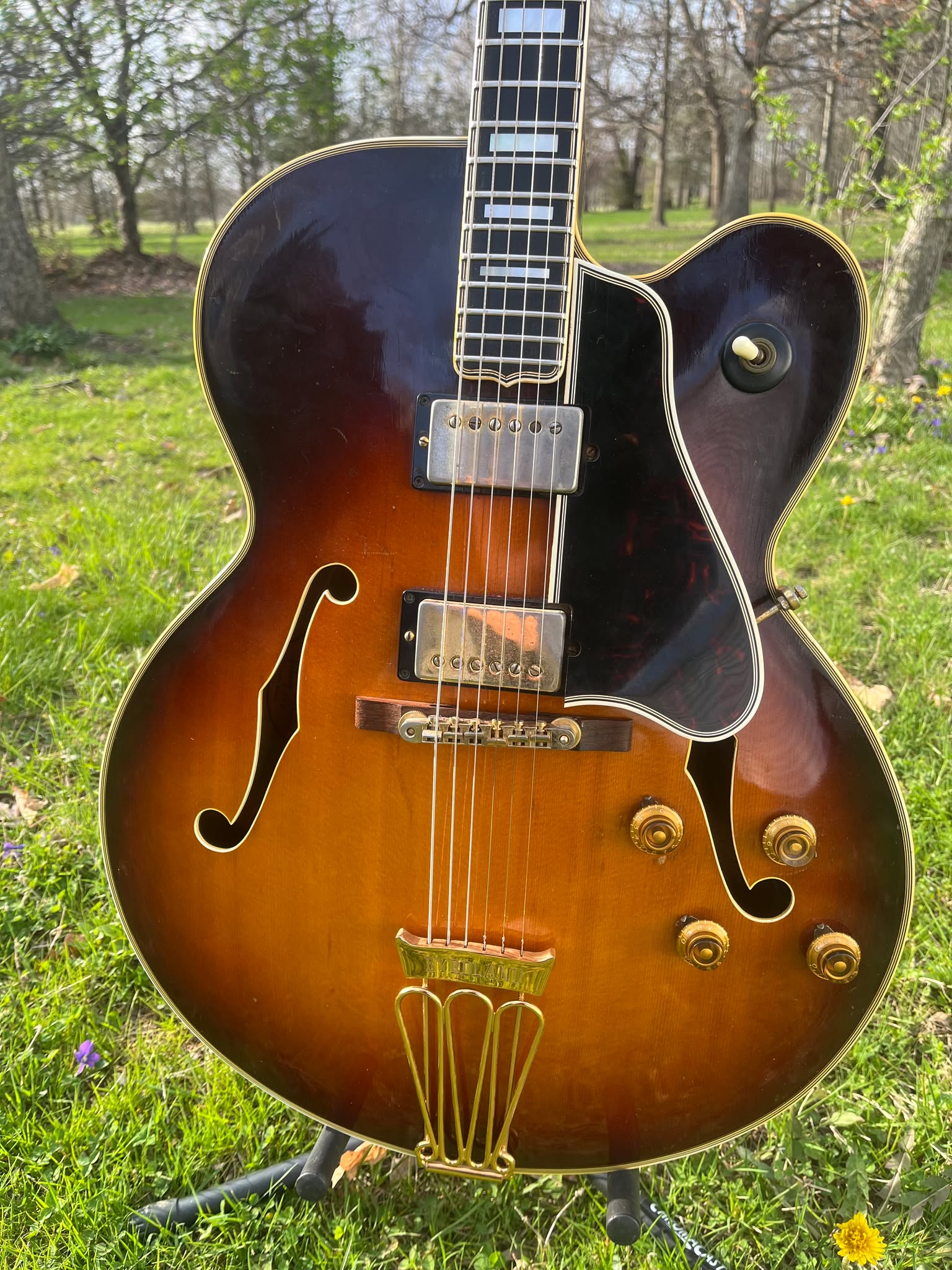
On the guitars that survive, the translucent red topcoat is the part that shows age. Well Strung Guitars' description of a 1967 example in this finish notes the body has kept "almost all of that translucent red top coat," while the neck, which gets handled the most, has worn to "a more bronze tone." That's the same finish reading a different amount of use, not a different color: Andy Baxter's near-mint 1966 example, by contrast, is described as showing "no fading" at all.
What a 1967 Gibson ES-330 is worth in 2026
These are real, named dealer listings, not estimates. Clean, original 1967 ES-330s bring solid money: Jimmy Wallace Guitars sold a 1967 ES-330TD in excellent original condition, with its factory hang tags and original case, for $8,950, and Carter Vintage currently lists a 1967 ES-330 TD in cherry, very good condition with original electronics, at $7,250 (the bridge was replaced, but the original ships with the guitar). A year earlier, Mahar's Vintage Guitars sold a 1966 ES-330 with a factory-installed Bigsby vibrato, described as all-original, for $7,499.95, though a factory Bigsby carries its own premium.
Modifications and heavy wear cut those numbers hard. Chicago Music Exchange sold a 1967 ES-330 in cherry with the pickup cavities routed for humbuckers, replaced tuners and a repaired headstock crack for $4,135, and separately sold a 1967 ES-330 in sunburst with a glued and bolted headstock repair, replaced tuners and heavy play wear for $2,595. Two modified or heavily repaired guitars, same year, same dealer, brought well below what the clean examples above sold for.
Sparkling Burgundy follows that same condition-driven pattern rather than commanding an automatic premium over sunburst or cherry. Andy Baxter's near-mint, all-original 1966 example in Sparkling Burgundy is listed at EUR 8,065, in the same range as the clean USD comps above. Yeahman's Guitars in Switzerland sold a 1967 Sparkling Burgundy ES-330 with small pickup routes from a since-reversed humbucker conversion for SFr 5,499, well below the clean examples, in line with the modified sunburst and cherry guitars. Rarity draws collector interest, but our comps show that originality and condition set the number.
What Edgewater offers. Our cash offer on a clean, original 1967 ES-330, Sparkling Burgundy or otherwise, typically lands around 20% under documented dealer market figures like the ones above, and meaningfully less for modified or refinished examples. Condition, originality and finish move the number, so the accurate answer for yours is a free appraisal: call or text (440) 219-3607.
The Sparkling Burgundy 1967 ES-330 Edgewater handled
Edgewater bought and sold a 1967 ES-330 in Sparkling Burgundy in the summer of 2026. The guitar was all original, and the finish was the story: Sparkling Burgundy is a rare color on this model, and an untouched, unrefinished, unrouted example doesn't turn up often. We don't publish what we paid or what a guitar like this sold for; our standard practice keeps those figures between Edgewater and the two parties in the deal. If you have an all-original ES-330 in Sparkling Burgundy, or think you might, that's exactly the guitar we want to see.
Dating a 1967 Gibson ES-330
Gibson's six-digit 1960s serial numbers are notoriously unreliable alone. True Vintage Guitar's own serial charts show the same six-digit blocks assigned to more than one year: the ranges 847499 to 858999 and 100000 to 106099, for example, both appear on the chart's lists for 1966 and 1967 alike. Genuine 1967 ES-330s we found for sale this year carry serials as different as 050947, 859346 and 877828, a spread consistent with that reuse. True Vintage Guitar's advice is to use nut width, knob style or potentiometer codes to break the tie, not the serial alone.
Potentiometer codes are the most reliable single clue. Gibson used CTS potentiometers, stamped with a code starting 137 (the CTS manufacturer code), followed by the year and the week of manufacture, for example a code reading 13767xx for the 1967 model year. Because Gibson bought pots in batches, a pot code is a not-earlier-than date, not a guarantee. Our Gibson serial number lookup will run your number, and Edgewater's ES-330 dating guide covers the factory order number system in more depth.
Dating clue | What it tells you | Caveat |
|---|---|---|
Serial number | Narrows the guitar to a handful of possible years | Blocks were reused across 1961 to 1969; never date on serial alone |
Potentiometer codes | A not-earlier-than date, accurate to the week the pot was made | Guitars were sometimes assembled months after the pot was made |
Neck joint | 16th fret is 1967 or earlier; 19th fret ("long neck") starts in 1968 | Early-1968 guitars can still show the short neck |
Nut width | 1 9/16 in is consistent with 1965 to 1967 | Not separately documented for 1968 to 1969 in the sources we checked |
Originality checklist for a 1967 ES-330
Before we quote a number on any ES-330, this is what we check:
Pickup routes. Lift the pickguard and look at the wood around both P-90 cavities. Enlarged or extra routing, usually from a humbucker conversion, is the single biggest value event on this model.
Pickup covers. Chrome dog-ear covers are correct for 1967; gold, nickel or black usually means a parts swap.
Neck joint. 16th fret is correct for 1967. A 19th-fret long neck on a 1967-range serial is a mismatch worth investigating.
Finish. Fine nitrocellulose checking is normal and expected. A thick, glossy, uncracked finish, or overspray in the neck pocket or control cavity, points to a refinish.
Tailpiece and bridge. A trapeze tailpiece and Tune-o-matic bridge are standard. A factory Bigsby is a rare, genuine option; an aftermarket Bigsby is not original.
Tuners. Kluson tuners are correct for the year. Replaced tuners, even good ones, count against originality, and enlarged post holes can't be undone.
Pot codes. Look for a stamped 137 code on the potentiometers. A date well after 1967 means a replaced pot.
Sell your 1967 Gibson ES-330
Edgewater Guitars buys 1967 ES-330s in every condition and finish, from a clean original in sunburst or cherry, to an all-original Sparkling Burgundy example like the one we handled, to a player-grade guitar that's been routed, refinished or repaired. We travel for the right guitar, pay by check or cash the same day, and show you the comps behind our offer. Get a free estimate or call or text (440) 219-3607. Our sell your Gibson page explains how the process works.
From a recent Google review: "Gavin ... provided speedy responses and a very honest and fair assessment of my 1963 Gibson SG Special. I highly recommend them!" (George Watts, August 2025)
Frequently asked questions
How much is a 1967 Gibson ES-330 worth?
Clean, original examples have recently listed or sold between $7,250 and $8,950 at named dealers: Jimmy Wallace Guitars sold one for $8,950, and Carter Vintage currently lists one at $7,250. Modified or heavily repaired examples bring much less, sometimes near half that. Edgewater gives free appraisals on any 1967 ES-330: call or text (440) 219-3607.
What makes Sparkling Burgundy valuable on an ES-330?
Sparkling Burgundy is a rare metallic finish Gibson listed as a regular option on the ES-330 starting in 1967, and surviving examples range from unfaded to heavily bronzed. Rarity draws collector interest, but our comps show condition and originality move the price more than color alone. An all-original example is what buyers pay for.
How do I tell if my ES-330's neck was replaced or altered?
Check where the neck meets the body. A 1967 should join at the 16th fret; a 19th-fret long neck on a guitar with a 1967-range serial is a mismatch. Also check the heel and pocket for finish inconsistency or extra screw holes, both signs of a non-factory neck. Our free appraisal will confirm it.
Does a humbucker conversion ruin a 1967 ES-330's value?
It lowers it but doesn't erase it. Routing the pickup cavities for humbuckers is permanent and shows up clearly under the pickguard; Chicago Music Exchange sold a routed 1967 ES-330 for roughly half what clean original examples bring. It's still a real, sellable guitar, just priced as a player's instrument instead of a collector's one.
Where can I sell my 1967 Gibson ES-330?
Edgewater Guitars buys 1967 ES-330s nationwide, in any finish or condition, with a free appraisal based on real comps like the ones in this guide. We travel to you and pay the same day. Start with our Gibson serial number lookup or call or text (440) 219-3607 for a free estimate.
Sources
1967 Gibson ES-330 overview, True Vintage Guitar: truevintageguitar.com
Gibson's ES-330 guitar from 1959 to 1969, True Vintage Guitar: truevintageguitar.com
Gibson serial number lookup and chart, True Vintage Guitar: truevintageguitar.com
How to date Fender and Gibson guitars with potentiometer codes, True Vintage Guitar: truevintageguitar.com
Vintage Vault: 1967 Gibson ES-330TD, Premier Guitar (specifications only): premierguitar.com
Gibson dating and spec changes, guitarhq.com: guitarhq.com/gibson.html
1967 Gibson ES-330, ChasingGuitars: chasingguitars.com
Gibson Custom Colors in the 1960s (Sparkling Burgundy history, Stanley Rendell quote), Vintage Guitar magazine: vintageguitar.com
1966 Gibson ES-330 with factory Bigsby ($7,499.95), Mahar's Vintage Guitars: maharsvintageguitars.com
1967 Gibson ES-330 with factory tags ($8,950), Jimmy Wallace Guitars: jimmywallaceguitars.com
1967 Gibson ES-330 TD, Cherry ($7,250), Carter Vintage: cartervintage.com
1967 Gibson ES-330 Cherry, modified ($4,135), Chicago Music Exchange: chicagomusicexchange.com
1967 Gibson ES-330 Sunburst, repaired ($2,595), Chicago Music Exchange: chicagomusicexchange.com
1966 Gibson ES-330 Sparkling Burgundy, near-mint (EUR 8,065), Andy Baxter Bass & Guitars: vintageandrare.com
1967 Gibson ES-330 Sparkling Burgundy, modified (SFr 5,499, sold), Yeahman's Vintage & Used Guitars: yeahmansguitars.com
1967 Gibson ES-330 Sparkling Burgundy, condition and fading detail, Davidson's Well Strung Guitars: wellstrungguitars.com
1967 Gibson ES-330 TD Sparkling Burgundy, serial 050947, Andy Baxter Bass & Guitars: andybaxterbass.com
Written by Stephen Pedone, co-owner of Edgewater Guitars, a vintage guitar buyer based in Valley City, Ohio with more than 140 Google reviews at a 5.0-star average. The firsthand section above is from Edgewater's own purchase and sale of the guitar; market figures are from the dealer listings cited above. Last updated: September 18, 2026.
Article