DATE :
Vintage Gibson ES-330 Value Guide (1959-1965)
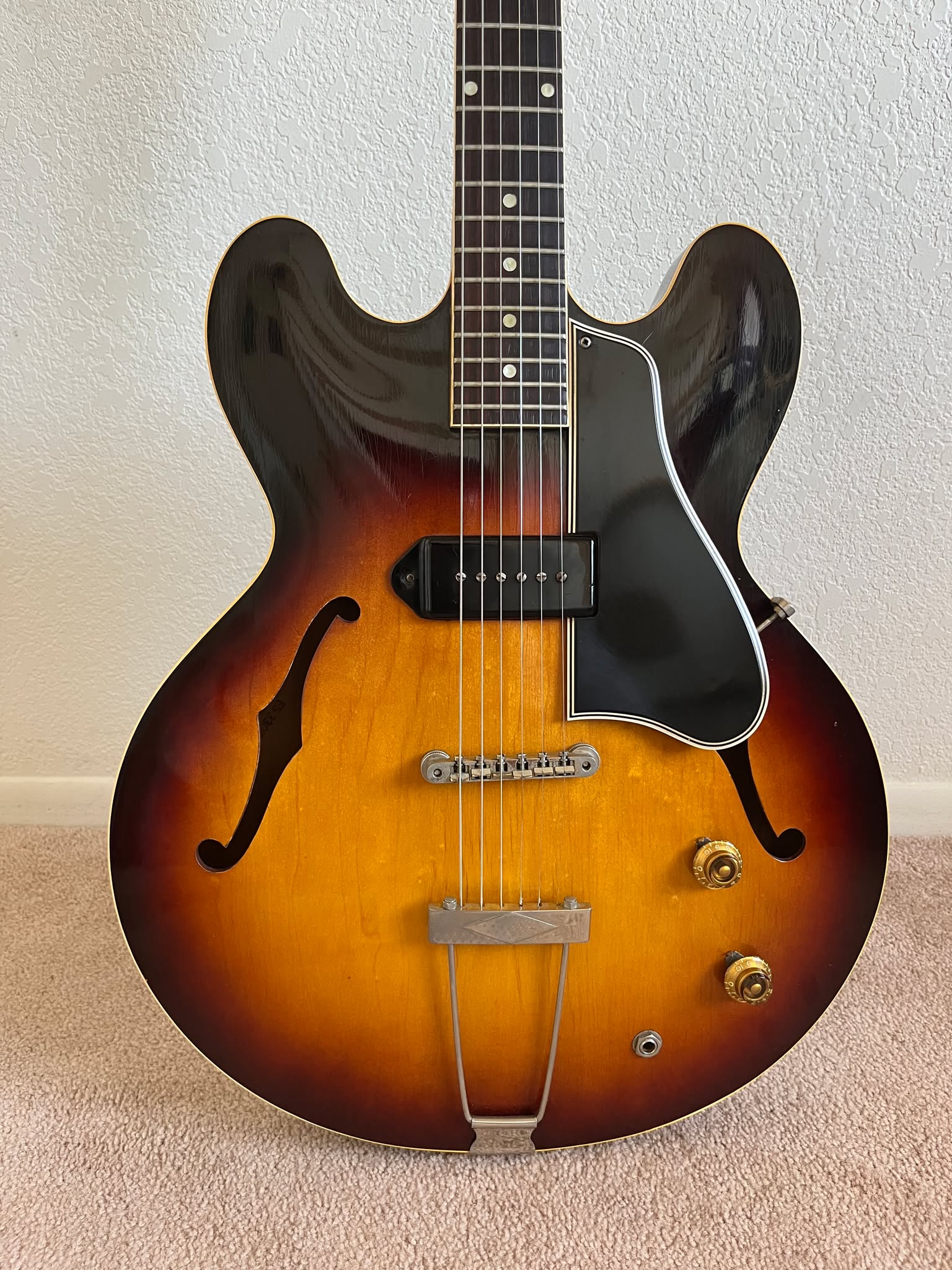
A vintage Gibson ES-330 built between 1959 and 1965 is worth roughly $6,000 to $13,000, depending on the year, whether it has one or two P-90 pickups, the neck join, and the condition. Unlike the ES-335, the ES-330 is fully hollow with P-90 pickups, which is why it sells for less than its semi-hollow siblings. This guide breaks down what each year is worth, how to identify yours, and what drives the price.
What Is a Vintage Gibson ES-330 Worth? (Year by Year, 2026)
The values below are reference points for clean, all-original examples, the kind of money a fair buyer like Edgewater Guitars pays, not retail asking prices. Because we buy directly and resell, we typically pay more than local shops or pawn stores. Condition and originality move every number up or down.
Year | What defines it | Reference value for a clean example |
|---|---|---|
1959 | Early thinline, fully hollow, P-90 pickups, dot inlays | Edgewater paid $12,200 for a clean 1959 (an unmodified guitar, not the modified 1959 described below) |
1960 | Dot-neck, dual P-90s, sixteenth-fret neck join | Clean examples near $9,000 |
1961 | Golden-era hollow body, dot inlays | Clean examples near $8,500 |
1962 to 1965 | Block inlays, later neck join changes | Clean examples near $6,500 |
Current market note (2026): the ES-330 sells below the ES-335 and ES-345 because it is fully hollow with P-90s rather than humbuckers and a center block. Early dot-neck examples are the most desirable, and original P-90s and an unbroken finish help value.
What Drives a Vintage ES-330’s Value?
One versus two pickups: dual P-90 ES-330s are generally worth more than single-pickup examples.
Dot-neck versus block-neck: 1959 to early-1962 dot-inlay guitars are the most desirable.
Original P-90s: original black or dog-ear P-90 pickups matter. Replaced pickups lower the value.
Neck join: the early sixteenth-fret neck join and later nineteenth-fret join affect both feel and collectibility.
Originality: original finish, pickups, pots, and tuners are essential. Refinishes and swapped parts cut the value.
Condition and structure: cracks, breaks, and repairs reduce value even on a correct guitar.
A 1959 ES-330 Edgewater bought this fall
In October 2026 Edgewater bought a 1959 Gibson ES-330 that shows the three changes we see most often on these early guitars. At some point an owner fitted a Bigsby vibrato. The original nickel trapeze tailpiece has since been put back on. And the guitar now wears Grover tuners, a common swap on Gibsons of this era, in place of the Kluson tuners it left the factory with. None of that makes it a bad guitar. It does change how a fair buyer prices it, and the reasons are below.
What mods do to a 1959 ES-330's value
Bigsby holes
A Bigsby added after the guitar left the factory leaves screw holes in the top, and removing the Bigsby does not remove the holes. Collectors treat them as a permanent modification. On the closely related ES-335, es-335.com puts the difference at roughly 15 to 25 percent against an unmodified guitar, and the Opporknockity vintage guitar blog cites about 25 percent as the common collector view. Those figures come from 335s, so treat them as a guide to the proportion, not a price: an ES-330 sells for less than a 335, so the dollar difference is smaller.
A restored original tailpiece
Having the original trapeze tailpiece back on the guitar is better than a reproduction or a missing part, because the guitar stays complete. It does not undo the holes, so a restored 1959 still prices as a modified example. Keep any original parts that came off the guitar and bring them to the appraisal.
Replaced tuners
A 1959 ES-330 left Kalamazoo with individual Kluson Deluxe tuners with white plastic buttons, as Premier Guitar's Vintage Vault describes on a 1959 ES-330TD. Grovers were a popular upgrade, but the swap often meant enlarging the peghead holes. es-335.com's parts timeline calls tuners the most frequently changed part on these Gibson thinlines and notes the shaft holes were often enlarged to fit Grovers. Collectors notice: Guitar World notes that a changed set of tuners can be a dealbreaker for vintage buyers, so replaced tuners lower collector value. If the original Klusons are still in the case, they help.
How we price a modified 1959
We start from documented sales of comparable guitars and adjust for what has been changed. Two recent examples with replaced parts: Chicago Music Exchange listed a 1959 ES-330 with replaced tuners, modified post holes and a replaced bridge at $7,300 (now sold), and Empire Guitars listed a 1959 ES-330T with replacement tuners and a refret at $4,499 (now sold). Edgewater's offer is usually about 20 percent under the documented market figure for a guitar in the same condition, and a little further under for modified examples, because we carry the cost and the risk of reselling it. If yours has a Bigsby, Bigsby holes or swapped tuners, request a free estimate and tell us what has changed; modified guitars are a normal part of what we buy.
How to Identify and Date a Vintage Gibson ES-330
Three things pin down the year: the serial number, the factory order number, and the features. Cross-check all three, because parts and pickups were sometimes changed over the decades.
Serial numbers and factory order numbers
Gibson stamped or inked a serial number on the back of the headstock and a factory order number inside the body. Late-1950s and early-1960s numbers are not strict year codes, so treat them as a range and confirm the year with our Gibson serial number lookup.
Fully hollow body and P-90s
The ES-330 has no center block, which makes it fully hollow and more prone to feedback than an ES-335. It uses P-90 single-coil pickups rather than humbuckers. Confirming the hollow body and P-90s is the fastest way to tell an ES-330 from an ES-335.
Single versus dual pickup and neck join
ES-330s came with one or two P-90s, and the neck joined the body at the sixteenth fret early on, then later at the nineteenth fret. Both details affect value and help date the guitar.
Headstock, inlays, and hardware
Look at the dot or block inlays, the crown headstock inlay, the pickguard, and the nickel hardware. A 1959 to 1964 guitar should show period-correct parts and knobs for its year.
ES-330 Year Pages and Guides
Drill into a specific year or authentication topic:
Sell your vintage Gibson ES-330
Edgewater Guitars buys vintage Gibson ES-330s nationwide, from early single-pickup examples to dual P-90 and later models. We give free, no-pressure estimates and pay fairly for clean, original, and even modified guitars. To sell yours, request a free estimate.
How much is a vintage Gibson ES-330 worth?
It ranges by year and pickups. Early dot-neck examples bring the most, and Edgewater paid $12,200 for a clean, unmodified 1959, a different guitar from the modified 1959 described above. Most dot-neck guitars from 1960 to 1961 land in the $8,500 to $9,000 range, and later block-neck examples are usually around $6,500. Condition and original P-90s move every figure.
How do I tell what year my ES-330 is?
Cross-check the headstock serial number, the factory order number inside the body, and the features, which means dot versus block inlays, the neck join, and one versus two P-90 pickups. You can date yours with our Gibson serial number lookup.
Do refinished or modified ES-330s still sell?
Yes. A refinish or changed pickups lower the value, but vintage ES-330s remain in demand and Edgewater buys modified examples too. Get a free estimate before you sell.
Does a Bigsby hurt a vintage ES-330's value?
An added Bigsby, or the screw holes one leaves behind, usually lowers the value, because collectors pay most for unmodified guitars. On the related ES-335 the difference is often put at 15 to 25 percent; on an ES-330 the dollar figure is smaller because the guitar sells for less. A factory-original trapeze put back on the guitar helps it stay complete but does not undo the holes.
My ES-330 has Grover tuners. Should I change them back before I sell?
No. Do not change anything before an appraisal. A 1959 to early-1960s ES-330 left the factory with Kluson Deluxe tuners, and replacements lower the collector value, but a swap back can mean more work on the headstock. If you still have the original tuners, keep them with the guitar and mention them when you ask for an estimate.
Related Vintage Gibson Value Guides
See how the ES-330 compares to Gibson's other semi-hollow models:
Related: 1967 Gibson ES-330 value guide, including the Sparkling Burgundy finish.