DATE :
How to Date Your Gibson ES-330: Complete Vintage Authentication Guide
How to Date Your Gibson ES-330: Complete Vintage Authentication Guide
Why Dating Your Gibson ES-330 Matters
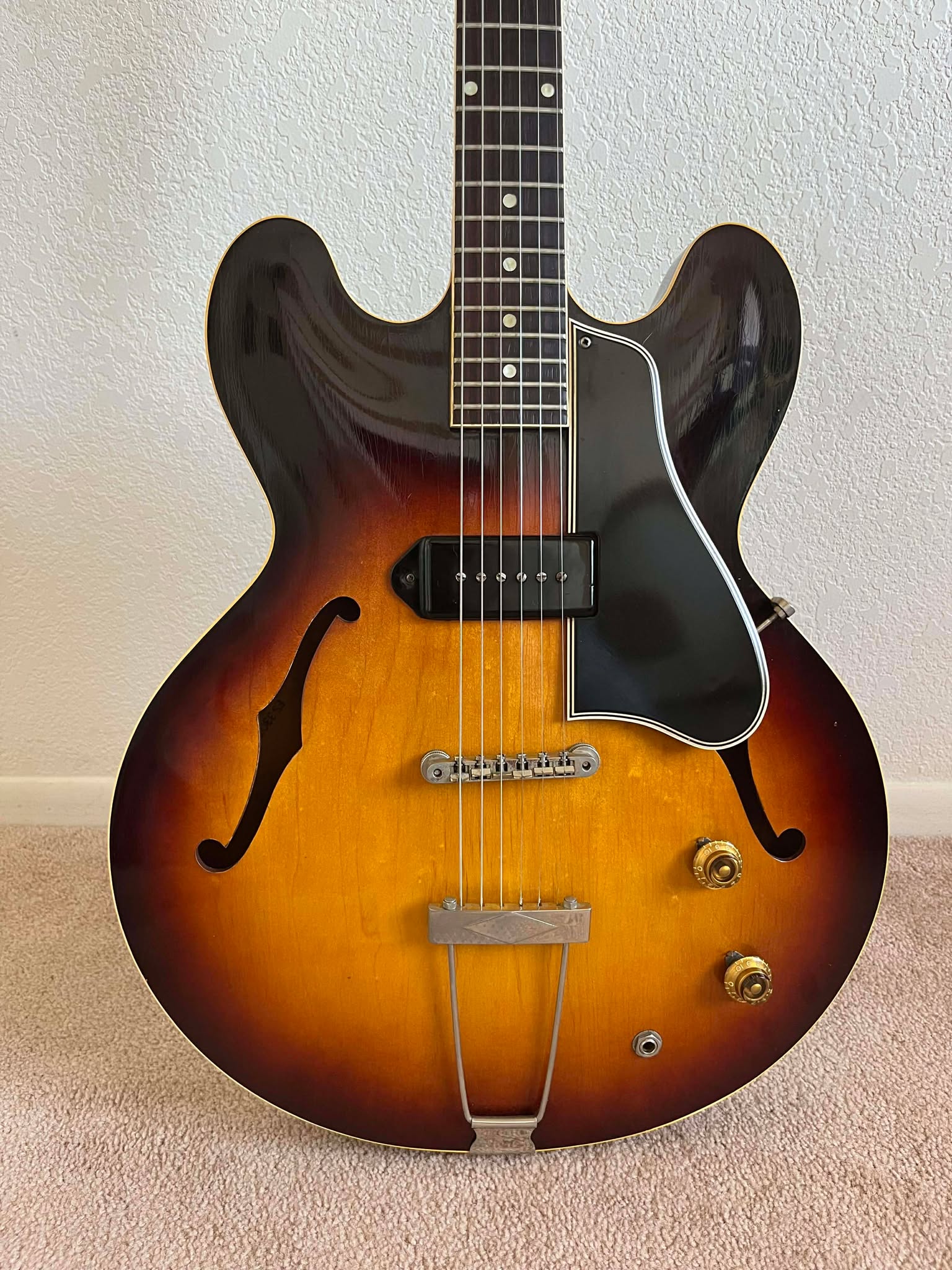
Learning how to date a Gibson ES-330 accurately is essential for authentication, proper valuation, insurance documentation, and understanding your instrument’s place in electric guitar history. The Gibson ES-330 represents a unique and often underappreciated guitar—a fully hollow body with a sharp, cutting tone that influenced countless blues, rock, and jazz players.
Whether you own a vintage ES-330 from the coveted 1960s era or a later model, determining its exact manufacturing year affects everything from market value to restoration approaches. Certain years and specifications command premium prices, particularly early examples with P-90 pickups, specific finish options, and original hardware. The ES-330’s association with legendary players like B.B. King, Grant Green, and Alvin Lee has elevated collector interest significantly.
This comprehensive guide teaches you how to date your Gibson ES-330 using multiple authentication methods, ensuring accuracy regardless of which era your instrument represents.
Understanding the Gibson ES-330 History
Before diving into dating methods, understanding the ES-330’s evolution provides crucial context:
The Birth of the ES-330 (1959)
Gibson introduced the ES-330T (Thinline) in 1959 as a fully hollow alternative to the semi-hollow ES-335:
Original Design:
Fully hollow body (no center block)
Thinline profile (1 5/8” depth)
Double cutaway design
P-90 pickups (not humbuckers)
Laminated maple construction
16” lower bout width
Key Distinction: Unlike the ES-335 with its solid center block, the ES-330 was completely hollow, creating different tonal characteristics—brighter, more acoustic-like tone with increased feedback potential at high volumes.
Target Market: Players wanting a more affordable thinline guitar with traditional single-coil tone, or those specifically seeking the hollow body character without the semi-hollow design.
Major ES-330 Evolution Periods
1959-1962: Early “Dot Neck” Era
Dot inlays on fingerboard
P-90 pickups standard
Mickey Mouse ear cutaways (rounded)
Long pickguard
Single pickup (ES-330T) and double pickup (ES-330TD) versions
1963-1968: “Block Neck” Era
Block inlays replace dots (1962-1963 transition)
P-90 pickups continue
Pointed cutaways (1963-1968)
Short pickguard
1969-1972: Return to Rounded Cutaways
Mickey Mouse ears return
P-90 pickups continue
Various specification changes
1970s-1990s: Various Production Periods
Discontinued and reintroduced multiple times
Various specifications
Reissues with vintage features
How to Date Your Gibson ES-330: Serial Number Systems
Understanding Gibson’s serial number systems is the foundation for dating your ES-330. However, serial numbers alone cannot definitively date these guitars—always use multiple verification methods.
Important Resource: For quick serial number reference, use our Gibson Serial Number Lookup Tool to find your guitar’s approximate year based on serial number ranges.
1959-1960: Ink-Stamped Serial Numbers
Early ES-330 guitars used Gibson’s ink-stamped serial number system:
Location: Inside guitar (visible through f-holes)
Stamped on internal bracing or top
May require good lighting and angle
Sometimes difficult to see
Format: 5-6 digits
Approximate Serial Number Ranges:
1959: 9xxxx - 0xxxx range (numbering restarted during year)
1960: 0xxxx - 1xxxx range
Critical Notes:
Significant overlap between years
Inconsistent numbering
Serial numbers alone insufficient
Factory Order Numbers more reliable
How to Find Your Serial Number:
Look through treble-side f-hole
Use flashlight for illumination
Serial number stamped inside guitar
May need to adjust viewing angle
Can be partially obscured by braces
Record complete number
Pro Tip: Use our Gibson Serial Number Lookup Tool for instant reference once you’ve found your serial number.
1961-1970: Impressed Serial Numbers
Gibson transitioned to impressed serial numbers on the back of the headstock:
Location: Back of headstock (stamped into wood)
Format: 5-6 digits
Approximate Ranges:
1961: 1xxxx - 2xxxx range (some with A prefix)
1962: 2xxxx - 3xxxx range
1963: 3xxxx - 4xxxx range
1964: 4xxxx - 7xxxx range
1965: 7xxxx - 9xxxx range
1966: 0xxxx - 1xxxx range (numbering restarted)
1967: 1xxxx - 8xxxx range
1968: 8xxxx - 0xxxx range (restarted again)
1969: 0xxxx - 9xxxx range
1970: 0xxxxx range (six digits)
Critical Challenge: Extensive overlap and duplication
Same serial numbers appear across multiple years
Extremely unreliable for precise dating
Must use Factory Order Numbers for accuracy
1970-1975: Six-Digit Serial Numbers
Format: Six digits
First digit indicates year (0=1970, 1=1971, etc.)
More reliable than 1960s system
“MADE IN USA” stamp appears
1977-Present: Modern Serial Number Systems
1977-2013: Eight-digit formats with letter prefixes
More consistent than earlier systems
2014-Present: YYMMXXXX format
First two digits = year
Second two digits = month
Most reliable system
Factory Order Numbers (FON): The Most Reliable Vintage ES-330 Dating Method
For vintage ES-330 guitars, Factory Order Numbers provide the most accurate dating:
What FON Tells You: Production batch and year of manufacture
Location: Inside guitar
Visible through f-holes
Stamped on bracing, top, or label
Orange label (1959-1961) or white label (1962+)
Format: Letter followed by 3-4 digits
Letter indicates year
Numbers indicate production batch
FON Letter Codes for Vintage ES-330 Era (1959-1970):
S = 1959
R = 1960
Q = 1961
P = 1962
O = 1963
N = 1964
M = 1965
L = 1966
K = 1967
J = 1968
I = 1969
Example: FON “P 2847” = 1962 production, batch 2847
How to Find FON:
Look through f-holes (both sides)
Check orange or white label inside
FON may be stamped on bracing
Use flashlight and mirror
May require string removal for better visibility
Photograph for documentation
Why FON Is Critical for ES-330:
Most reliable dating method for vintage examples
Minimal overlap between years
Essential for determining dot vs. block neck transition
Crucial for specific year identification
Dating Vintage ES-330 by Physical Features: Era-by-Era Guide
Physical characteristics changed significantly throughout ES-330 production, providing crucial dating evidence:
1959 ES-330T and ES-330TD (First Year)
The Original: First year of fully hollow thinline design
Body Construction:
Fully hollow (no center block unlike ES-335)
Laminated maple top, back, and sides
Thinline profile (1 5/8” body depth)
Double cutaway
“Mickey Mouse ear” rounded cutaways
16” lower bout width
Pickup Configuration:
ES-330T: Single P-90 pickup (neck position)
ES-330TD: Two P-90 pickups (TD = “Thinline Double” pickup)
Pickups:
P-90 single-coil pickups
Black covers standard
Dog-ear mounting
Screwed directly to top (no mounting rings)
Alnico magnets
DC resistance approximately 8k ohms
Neck and Fingerboard:
Dot inlays (small pearl dots)
Rosewood fingerboard (Brazilian rosewood)
22 frets
Bound fingerboard
1 11/16” nut width
Medium neck profile
Headstock:
Crown inlay
“Gibson” in pearl
17-degree headstock angle
Bound headstock
Pickguard:
Long pickguard (extends below bridge pickup on TD)
Single-layer initially
Tortoiseshell pattern
Hardware:
Kluson Deluxe tuners
Double-ring Klusons
ABR-1 bridge (Tune-o-matic)
Stop tailpiece or trapeze
Nickel-plated hardware
Finishes Available:
Natural (blonde)
Sunburst (most common)
Cherry (less common)
Label:
Orange label inside
Visible through f-holes
“ES-330T” or “ES-330TD” model designation
Binding:
Single-ply white binding on top and back
Bound f-holes
Neck binding
Serial Numbers: 9xxxx - 0xxxx range
FON: S prefix
Why 1959 Is Significant:
First year production
Dot neck
Mickey Mouse ears
Orange labels
P-90 pickups in fully hollow body
Historical significance
1960 ES-330T/TD
Refined Specifications:
All 1959 features continue
Production increased
Quality control excellent
Key Features:
P-90 pickups standard
Dot inlays
Mickey Mouse ear cutaways
Long pickguard
Sunburst, natural, or cherry finish
Neck:
Slim taper neck introduced late in year
Some transition to thinner neck profiles
Quality remains exceptional
Serial Numbers: 0xxxx - 1xxxx range
FON: R prefix
1961 ES-330T/TD (Transitional Year)
Key Transition: Dot to block inlay transition begins
Early 1961 (Dot Neck):
Dot inlays continue
P-90 pickups
Mickey Mouse ears
Long pickguard
Orange labels (early)
Late 1961 (Block Neck):
Block inlays introduced
P-90 pickups continue
Mickey Mouse ears maintained
Pickguard begins transition
White labels begin appearing
Why 1961 Is Significant:
Transitional features
Both dot and block inlays exist
Last year of orange labels (transition to white)
Dot neck ES-330s becoming scarce
Serial Numbers: 1xxxx - 2xxxx range (some with A prefix)
FON: Q prefix
1962 ES-330T/TD (Major Transition Year)
Critical Changes:
Block inlays become standard (dot neck discontinued)
Short pickguard becomes standard (above bridge only)
White labels replace orange labels
P-90 pickups continue
Dot Neck (very early 1962):
Rare examples with dot inlays
Long pickguard
Highly collectible
Block Neck (standard 1962):
Block inlays
Short pickguard
Mickey Mouse ears continue
P-90 pickups
Serial Numbers: 2xxxx - 3xxxx range
FON: P prefix
Significance: End of dot neck era
1963-1968 ES-330T/TD (Pointed Cutaway Era)
Major Body Change (1963):
Pointed cutaways replace Mickey Mouse ears
Sharper, more angular appearance
Different aesthetic
1963 Features:
Block inlays
P-90 pickups
Pointed cutaways (new)
Short pickguard
Cherry or sunburst finish
1964-1965 Features:
Pointed cutaways continue
P-90 pickups standard
Block inlays
Various neck profiles
Cherry, sunburst, or walnut finish
1966-1968 Features:
Pointed cutaways continue
P-90 pickups (no switch to humbuckers)
Various specification changes
Cherry or walnut finish common
Serial Numbers:
1963: 3xxxx - 4xxxx range
1964: 4xxxx - 7xxxx range
1965: 7xxxx - 9xxxx range
1966-1968: Various overlapping ranges
FON:
1963: O prefix
1964: N prefix
1965: M prefix
1966: L prefix
1967: K prefix
1968: J prefix
1969-1972 ES-330T/TD (Return to Rounded Cutaways)
Body Change (1969):
Return to Mickey Mouse ear rounded cutaways
More traditional ES-330 appearance
1970s Features:
Mickey Mouse ears
P-90 pickups continue
Block inlays
Volute on neck back (1970-1972)
“MADE IN USA” stamp
Six-digit serial numbers (1970+)
Production Changes:
ES-330 discontinued 1972
Reintroduced periodically in later decades
Various reissues
Potentiometer Date Codes: Essential ES-330 Verification
Potentiometer codes provide crucial verification for dating vintage ES-330 guitars:
Understanding Pot Codes
Standard Format: XXYYZZ
XX = Manufacturer code
YY = Year of manufacture
ZZ = Week of manufacture
Common Manufacturers:
137 = CTS
134 = Centralab
140 = Clarostat
How to Check Pot Codes on ES-330
Access Challenge: Fully hollow construction makes pot access more difficult than solid-body guitars
Methods:
Remove pickguard (provides some access)
Look through f-holes with flashlight and dental mirror
Some pots visible, some obscured
May require professional access for complete inspection
Record codes from accessible pots
Single Pickup ES-330T:
Two pots (volume and tone)
Easier access than two-pickup model
Double Pickup ES-330TD:
Four pots (two volume, two tone)
More difficult to access all pots
Example Codes:
137 6128 = CTS pot, 1961, 28th week
134 6415 = Centralab pot, 1964, 15th week
Interpreting Pot Dates for ES-330
Dating Rules:
Pots date component manufacture
Guitar assembled weeks/months after pots made
All pots should date similarly
1961 ES-330 might have late 1960 or early 1961 pots
Critical for Vintage ES-330:
Helps verify dot vs. block neck era
Confirms 1960s production year
Essential for transitional 1961-1962 dating
Red Flags:
Pots dated after supposed guitar year
Mixed pot dates from different years
Modern pots on supposedly vintage ES-330
How to Date Vintage ES-330: P-90 Pickup Identification
P-90 pickups remained standard throughout ES-330 production:
P-90 Single-Coil Pickups
Identification:
“Soap bar” style
Dog-ear mounting (screwed directly to top)
Black covers standard (cream rare)
Two metal pole pieces per string
Single-coil design
Alnico magnets
DC Resistance: Approximately 8k ohms typical
Construction Details:
Black bottom plate
Two mounting screws (ears)
Single-coil winding
Simple, robust design
Why P-90s Are Significant:
Distinctive tone (brighter than humbuckers)
Never changed to humbuckers (unlike ES-335)
Original P-90s authenticate vintage ES-330
Replacement pickups reduce value
Verification:
Check mounting style (dog-ear, not humbucker rings)
Verify screw placement
Examine construction visible through f-holes
Period-correct covers and hardware
Cutaway Styles: Critical Dating Feature
Cutaway shape helps date ES-330 guitars:
Mickey Mouse Ears (Rounded Cutaways)
Periods:
1959-1962 (original)
1969-1972 (returned)
Characteristics:
Rounded, symmetrical cutaways
Softer appearance
Traditional ES-330 look
What It Indicates:
1959-1962: Vintage dot or early block neck era
1969-1972: Later production
Pointed Cutaways
Period: 1963-1968
Characteristics:
Sharp, angular cutaways
More aggressive appearance
Distinctive look
What It Indicates:
1963-1968 production
Block neck
Mid-1960s era
Verification: Combine cutaway style with other features for accurate dating
Pickguard Length: Important Dating Clue
Pickguard design changed significantly:
Long Pickguard (1959-1962)
Characteristics:
Extends below bridge pickup (on TD models)
Reaches toward tailpiece area
Covers more of top
What It Indicates:
1959-1962 production
Dot neck era primarily
Early block neck (1961-early 1962)
Short Pickguard (1962-Present)
Characteristics:
Ends above bridge pickup
Smaller overall size
Less top coverage
What It Indicates:
1962 onward (transition mid-year)
Block neck era
Later production
Label Colors: Orange vs. White
Interior labels help date ES-330 guitars:
Orange Labels
Era: 1959-1961 (approximately)
Appearance:
Orange/gold colored oval label
“Gibson” script
Model designation “ES-330T” or “ES-330TD”
“Kalamazoo, Michigan”
What Orange Labels Indicate:
Dot neck era
Mickey Mouse ears
Long pickguard
Most collectible period
White Labels
Era: 1962 onward
Appearance:
White oval or rectangular label
“Gibson” text
Model information
What White Labels Indicate:
Block neck era (primarily)
Transition from orange labels
ES-330T vs. ES-330TD: Model Variations
Understanding the two main versions:
ES-330T (Single Pickup)
Features:
Single P-90 pickup (neck position)
Two controls (volume and tone)
Same body as ES-330TD
“T” = Thinline
Pickup Position:
Neck position standard
Warmer, jazzier tone
Preferred by some blues and jazz players
Value:
Generally less valuable than two-pickup model
Still collectible, especially dot neck examples
ES-330TD (Two Pickup)
Features:
Two P-90 pickups (neck and bridge)
Four controls (two volume, two tone)
3-way toggle switch
“TD” = Thinline Double (pickup)
Versatility:
More tonal options
Bridge pickup adds bite and clarity
More popular configuration
Value:
Typically more valuable than single-pickup
Dot neck examples highly sought after
ES-330 vs. ES-335: Key Differences
Understanding what makes the ES-330 unique:
Construction Differences
ES-330:
Fully hollow body
No center block
Lighter weight
More acoustic resonance
More feedback at high volumes
ES-335:
Semi-hollow with solid center block
Heavier construction
Less feedback
More sustain
Pickup Differences
ES-330:
P-90 single-coil pickups
Dog-ear mounting to top
Brighter, cutting tone
ES-335:
Humbucker pickups (PAF or patent number)
Mounted to center block
Warmer, fuller tone
Neck Joint Differences
ES-330:
Neck joins body at 16th fret
Shorter neck access
Different feel
ES-335:
Neck joins body at 19th fret
Better upper fret access
More modern feel
Red Flags: Identifying Non-Original or Modified ES-330
Recognizing modifications helps accurate assessment:
Refinished Vintage ES-330
Indicators:
Overspray inside through f-holes
Paint on bracing visible through f-holes
Wrong finish characteristics
Lack of proper checking
Modern paint types
Verification:
Look inside through f-holes
Check binding for overspray
Examine finish aging patterns
Verify nitrocellulose vs. polyurethane
Impact: Refinished ES-330s lose 40-60% of value
Replaced P-90 Pickups
Original Pickup Importance:
Original P-90s essential to vintage ES-330 value
Replacement pickups reduce value 20-40%
Replacement Indicators:
Modern pickups in vintage guitar
Wrong mounting style (humbucker rings)
Different screw placement
Modern wire visible through f-holes
Common Modification:
Converting to humbuckers (requires routing)
Significantly reduces collector value
Often irreversible modification
Hardware Changes
Original Hardware:
Kluson tuners (vintage)
ABR-1 bridge
Stop tailpiece or trapeze
Period-correct knobs
Common Replacements:
Modern tuners
Modern bridges
Aftermarket tailpieces
Wrong knob styles
Top Cracks and Repairs
Concerns:
Fully hollow construction more vulnerable to cracks
Top cracks near pickup mounting screws
Stress cracks along grain
Visible through f-holes
Impact:
Professional repairs minimize value reduction
Poor repairs significantly affect value
Multiple cracks more concerning
Dating Transitional ES-330 Models
Certain years produced transitional features:
1961 Dot to Block Transition
Early 1961:
Dot inlays
Long pickguard
Mickey Mouse ears
Orange labels
Late 1961:
Block inlays
Pickguard transitioning
White labels appearing
Authentication:
Check FON “Q” confirms 1961
Pot codes narrow timeframe
Inlay type indicates early vs. late
Label color helps
1962 Multiple Transitions
Early 1962:
Possible dot inlays (rare)
Long pickguard
Orange labels (early)
Mid-1962:
Block inlays
Pickguard transition
Orange to white label transition
Late 1962:
Block inlays standard
Short pickguard
White labels
Artist Association and Collectability
Notable ES-330 players have increased collector interest:
Famous ES-330 Players
Grant Green: Jazz guitarist who made ES-330 tone legendary in jazz B.B. King: Used ES-330 before switching to ES-355 Alvin Lee: Ten Years After, used ES-330 extensively Dan Auerbach: The Black Keys, modern ES-330 advocate
Market Impact: Artist association has elevated ES-330 values, particularly for dot neck examples
When You’re Ready to Sell Your Vintage ES-330
Accurate dating affects value significantly:
How Dating Affects ES-330 Value
Era-Specific Premiums:
1959-1960 dot neck: Highest values
1961 dot neck: Strong premiums
1962 early dot neck: Rare and valuable
1962-1965 block neck: Good values
1963-1968 pointed cutaways: Moderate values
All-original examples command highest prices
Feature-Specific Value:
Dot neck more valuable than block
Mickey Mouse ears preferred over pointed
Long pickguard early feature
Orange labels indicate early production
Natural finish rarer than sunburst
ES-330TD more valuable than ES-330T
Preparing Your ES-330 for Sale
Documentation:
Serial number (headstock or through f-holes)
FON documented
Pot codes from accessible pots
Label color and format photographed
Pickup details documented
Overall condition photographed
Photography:
Front and back overall views
Headstock (serial number)
Through both f-holes (FON, label, internal construction)
Cutaway style detail
Pickguard length shown
P-90 pickups (dog-ear mounting)
Hardware details
Any wear or damage
Why Choose Edgewater Guitars
When selling your vintage ES-330:
Our ES-330 Expertise:
Dot vs. block neck identification
FON verification and interpretation
Cutaway style dating
Transitional year recognition (1961-1962)
Original P-90 authentication
Original finish verification
Premium Offers:
30-40% higher than guitar shops
Dot neck premiums recognized
Early year (1959-1961) value properly compensated
Transitional features valued appropriately
Understanding of ES-330’s unique position in market
Streamlined Process:
Expert authentication
Immediate fair offers
No fees or commissions
Professional service throughout
Frequently Asked Questions
How is the ES-330 different from the ES-335?
The ES-330 is fully hollow (no center block) with P-90 single-coil pickups, while the ES-335 has a solid center block with humbucker pickups. ES-330 is lighter, more acoustic-sounding, and more prone to feedback. Use our Gibson Serial Number Lookup Tool to check your model.
What’s more valuable: ES-330T or ES-330TD?
Generally, the ES-330TD (two pickups) is more valuable than the ES-330T (single pickup) due to greater versatility. However, dot neck examples of both are highly collectible.
Are dot neck ES-330s more valuable than block neck?
Yes, dot neck ES-330s (1959-early 1962) are more valuable than block neck models (1962+), similar to other Gibson semi-hollow and hollow models. Dot neck examples with original features command strong premiums.
Did ES-330s ever have humbuckers?
No, factory ES-330s always had P-90 single-coil pickups. Any ES-330 with humbuckers has been modified, which significantly reduces collector value.
Are Mickey Mouse ear cutaways more valuable than pointed?
Generally yes. Mickey Mouse ears (1959-1962, 1969-1972) are preferred, especially on dot neck models. Pointed cutaways (1963-1968) are less desirable to collectors.
What’s the difference between long and short pickguards on ES-330TD?
Long pickguards (1959-1962) extend below the bridge pickup. Short pickguards (1962+) end above the bridge pickup. Long pickguards indicate earlier, more valuable production period.
Can I date my ES-330 just by serial number?
Not reliably for 1960s models. Use our Gibson Serial Number Lookup Tool as starting point, then verify with FON, pot codes, inlays, and cutaway style.
Why are ES-330s less expensive than ES-335s?
ES-330s were historically less expensive due to P-90 pickups (vs. humbuckers) and fully hollow construction. However, vintage ES-330 values have risen significantly as players and collectors recognize their unique tone and artist associations.
Contact Edgewater Guitars
For expert ES-330 authentication or to sell your vintage ES-330:
Phone: (440) 219-3607
Service Area: Ohio, Michigan, Pennsylvania, Indiana, West Virginia
Our Services:
Expert ES-330 authentication
Dot vs. block neck verification
FON and pot code analysis
Cutaway style dating
P-90 pickup verification
Fair market valuations
Immediate offers
Why Sellers Choose Us
✓ ES-330 Specialists: Deep knowledge of all vintage ES-330 variations
✓ Dot Neck Experts: Recognition of valuable early models
✓ P-90 Authentication: Proper identification and valuation
✓ Premium Offers: 30-40% higher than guitar shops
✓ Professional Service: Transparent, respectful evaluation
✓ Zero Fees: No commissions or hidden charges
✓ Immediate Payment: No waiting periods
Additional Resources
Gibson Serial Number Lookup Tool - Quick reference for your ES-330
Complete Gibson Dating Guide
How to Date Gibson Guitars - All Models
Sell Your Gibson Guitar
Vintage Gibson Semi-Hollow Authentication
Learning how to date a Gibson ES-330 accurately requires understanding serial numbers, Factory Order Numbers, pot codes, and physical features specific to each era. The ES-330 evolved from 1959 through the decades, with the dot neck era (1959-1962) commanding the highest values, particularly models with Mickey Mouse ear cutaways and original P-90 pickups.
Whether you own a rare 1959 first-year example, a coveted dot neck ES-330 from 1960-1961, or any other vintage ES-330 variation, proper authentication ensures you understand your instrument’s history and value. Use our Gibson Serial Number Lookup Tool as a starting point, then verify with Factory Order Numbers, pot codes, and physical feature identification for definitive dating.
Edgewater Guitars specializes in vintage Gibson hollow-body authentication and purchasing throughout the Midwest. Our comprehensive knowledge of ES-330 dating—from dot vs. block neck identification to P-90 authentication—ensures accurate assessments that reflect your guitar’s true age and value.
Contact us today at (440) 219-3607 for expert ES-330 authentication or professional valuation.
John Thompson, Vintage Guitar Specialist
Edgewater Guitars - Ohio’s Premier Guitar Buyer
Related: 1967 Gibson ES-330 value guide, including the Sparkling Burgundy finish.