DATE :
1959 Gibson ES-330T: The Early Single-Pickup Thinline Classic
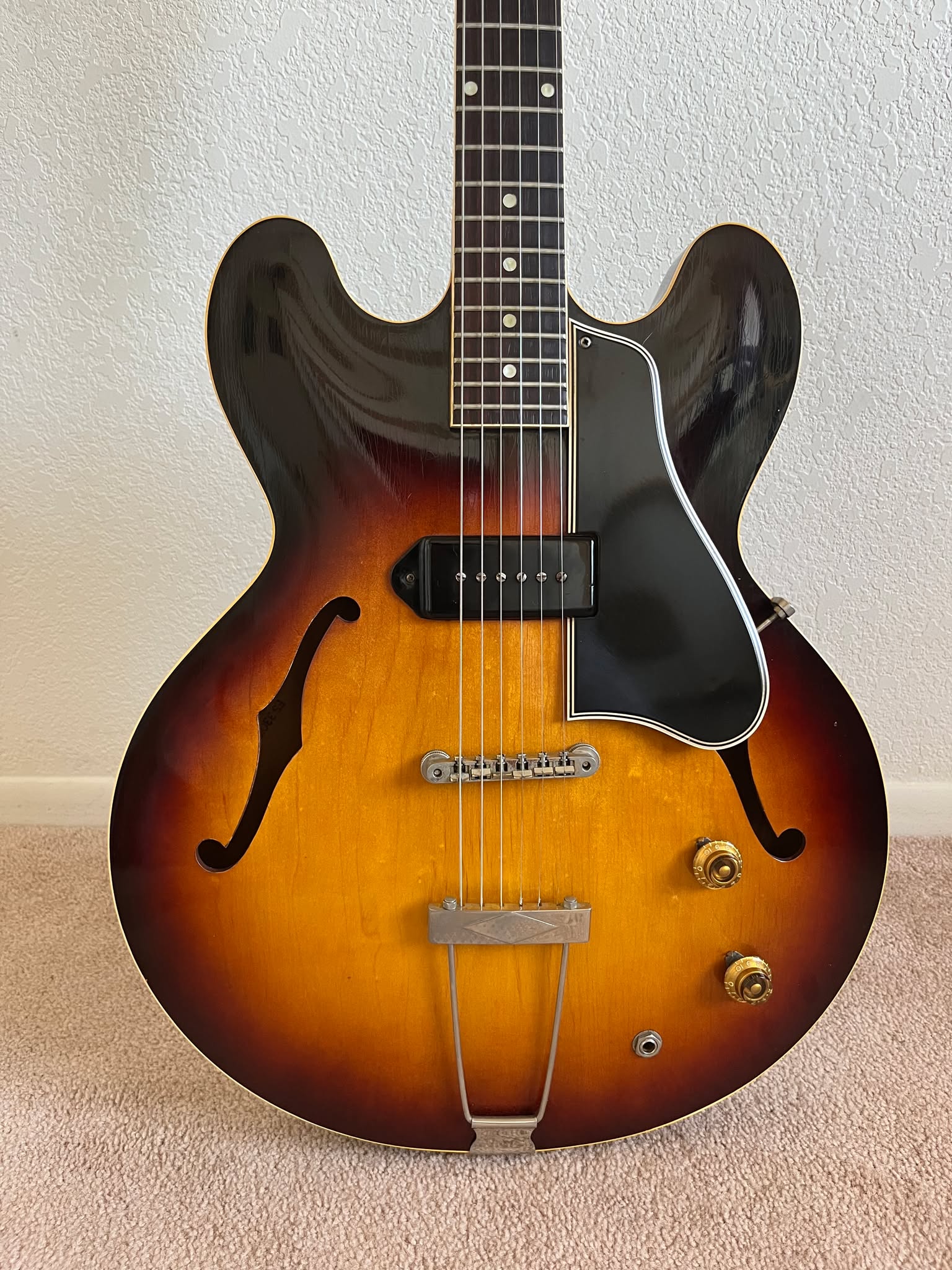
1959 Gibson ES-330T: The Early Single-Pickup Thinline Classic
The 1959 Gibson ES-330T is an early single-pickup thinline classic, a fully hollow cousin of the ES-335 prized for its airy tone and golden-era build quality. Edgewater Guitars buys vintage Gibson ES-330s nationwide with free expert appraisals and same-day cash offers. Call or text (440) 219-3607.
Why the 1959 ES-330T Matters
The 1959 Gibson ES-330T represents the inaugural year of one of Gibson’s most underrated thinline electric guitars. Introduced in 1959 as Gibson’s answer to the growing demand for lightweight, feedback-resistant hollow-body electrics, the ES-330T offered players a stripped-down, single-pickup version of the double-pickup ES-330TD that debuted the same year.
What makes the 1959 ES-330T historically significant:
First Year of Production: 1959 marked the very beginning of the ES-330 series, making these instruments the earliest examples
Pre-Merger Gibson Quality: Built before the Norlin era changes that would affect Gibson’s production standards
Single P-90 Simplicity: The single-pickup configuration offered a focused, no-nonsense tone ideal for blues and early rock
Fully Hollow Construction: Unlike the semi-hollow ES-335, the ES-330 series was fully hollow for maximum acoustic resonance
Lightweight Player’s Guitar: Designed as a working musician’s instrument rather than a jazz showpiece
Transitional Features: Early 1959 examples may show specifications carried over from development, making them particularly interesting to collectors
The ES-330T (the “T” designated the single-pickup “Tenor” model) was positioned as Gibson’s economy thinline, yet it was built with the same craftsmanship as the company’s more expensive models. Today, these first-year instruments represent an accessible entry point into vintage Gibson collecting while offering genuine historical significance.
Historical Context: Gibson’s Thinline Revolution
The Development of the ES-330 Series
In 1959, Gibson was responding to a rapidly changing market. Fender’s solid-body guitars were gaining popularity, and players wanted instruments that could handle higher stage volumes without the feedback issues plaguing traditional archtop guitars. Gibson had already introduced the revolutionary ES-335 in 1958 with its semi-hollow design and center block construction.
The ES-330 series, introduced in 1959, took a different approach. Rather than using a center block, Gibson created a fully hollow thinline body that was lighter and more acoustically resonant than the ES-335. The single-pickup ES-330T was designed as the most affordable model in the thinline series, aimed at working guitarists who wanted Gibson quality without the premium price of a dual-pickup model.
1959: A Pivotal Year at Gibson
1959 was an extraordinary year in Gibson’s history. The company was simultaneously producing:
The legendary “Burst” Les Paul Standards in their final year before discontinuation
The newly introduced ES-335 series in its second year
The brand-new ES-330 series
The modernized Flying V and Explorer models
Traditional archtop models like the L-5 and Super 400
The ES-330T represented Gibson’s commitment to offering professional-quality instruments across multiple price points. While it lacked the appointments of premium models, it received the same careful construction and quality control.
Notable Players and the ES-330’s Legacy
While the ES-330T specifically was less common than its dual-pickup sibling, the ES-330 series gained a devoted following. The fully hollow construction and P-90 pickups created a distinctive voice that appealed to blues players and early rock musicians. Players who would later champion ES-330 guitars included blues artists who appreciated the instrument’s raw, midrange-focused tone and lightweight feel.
Current Market Value: 1959 ES-330T (2025 Update)
The 1959 ES-330T occupies an interesting position in the vintage Gibson market. As a first-year model with relatively low production numbers, these instruments have steadily appreciated while remaining more accessible than the legendary ES-335 or Les Paul models from the same era.
Key Value Factors for 1959 ES-330T Guitars
Originality is Critical: All-original examples with factory P-90 pickup, original wiring, and untouched finish command significant premiums—often 40-50% more than modified examples.
Finish Condition: The thin nitrocellulose finishes used in 1959 are prone to checking, fading, and wear. While some finish wear is expected and accepted, refinished guitars lose 50-60% of their value.
Structural Integrity: Check for neck resets, top cracks, and binding separation. These repairs, if professionally done, reduce value by 20-30% but don’t destroy collectibility.
Original Electronics: The original P-90 pickup is a major value component. Replacement pickups can significantly reduce value unless the original is included.
Hardware Completeness: Original Kluson tuners, trapeze tailpiece, and bridge are all important. Replaced tuners (often swapped for Grovers) reduce value.
Why 1959 Commands a Premium
First-year ES-330T guitars from 1959 are particularly desirable because:
Lower production numbers compared to later years
Historical significance as the inaugural model year
Premium materials still being used before cost-cutting measures
Potential for transitional features from the development phase
Important Note: At Edgewater Guitars, we consistently pay 30-40% more than typical guitar shops for quality vintage Gibson instruments. We understand the nuances that make specific years like 1959 particularly valuable, and we pay accordingly.
Detailed Identification Guide: Authenticating Your 1959 ES-330T
Properly identifying a 1959 Gibson ES-330T requires examining multiple features. Gibson used several dating methods that, when cross-referenced, provide reliable authentication.
Serial Number Information
1959 Gibson ES-330T guitars typically carry serial numbers in the range of A 30000 to A 32000, stamped on the back of the headstock. However, Gibson’s serial number system had overlap between years, so the serial number alone cannot definitively date the instrument.
Critical Detail: The “A” prefix system was used from 1947-1961, with the numbers following a roughly sequential pattern. A serial number beginning with “A 3” followed by four digits strongly suggests 1959 production.
Factory Order Number (FON)
The most reliable dating method is the Factory Order Number, stamped inside the guitar (usually visible through the bass-side f-hole on the back of the headstock block or on a label inside the body). The FON follows this format:
Y DDD R
Y = Last digit of year (9 = 1959)
DDD = Day of year (001-365)
R = Ranking number (production sequence that day)
Example: 9 147 3 would indicate the 3rd ES-330T built on the 147th day of 1959 (late May 1959).
Potentiometer Codes
The potentiometers in 1959 ES-330T guitars provide crucial dating evidence. Gibson primarily used CTS (Chicago Telephone Supply) and Centralab potentiometers during this period.
Code Format: 137 YYWW
137 = CTS manufacturer code (or 134 for Centralab)
YY = Last two digits of year (59 = 1959)
WW = Week number of manufacture
The pot codes should show dates from late 1958 through 1959. If you see dates like “137 5840” (40th week of 1958), this is normal—components were typically manufactured weeks or months before guitar assembly.
Neck Construction and Dating
Neck Tenon: 1959 ES-330T guitars featured a long mortise-and-tenon neck joint extending deep into the body for stability.
Truss Rod Access: The truss rod is accessed from the headstock end, with a cover plate secured by two screws.
Visual Identification Features Specific to 1959
Headstock Logo: The pearl “Gibson” script logo with crown inlay, characteristic of late-1950s production.
Pickguard: The 1959 ES-330T came with a single-layer black pickguard with beveled edges, mounted with a floating bracket (not directly screwed to the top).
Pickup: Single P-90 “soapbar” pickup in the neck position, with black plastic covers featuring “P-90” embossed on early examples.
Control Layout:
Single volume knob
Single tone knob
Both with black “reflector” or “witch hat” knobs with silver/gold inserts
Binding: Single-ply white binding on the body top and back, fretboard, and headstock.
F-holes: Traditional Gibson f-holes with rounded shoulders (not pointed like later models).
Bridge: Floating ABR-1-style compensated bridge (sometimes called the ES-330 bridge), sitting on an ebony base.
Tailpiece: Trapeze tailpiece with raised Gibson logo and open diamond pattern.
Tuners: Kluson Deluxe single-line tuners with single-ring tulip-style buttons.
Finish Options and Their Rarity
The 1959 ES-330T was available in two standard finishes:
Natural (Blonde): Clear nitrocellulose finish showing the laminated maple top’s figure. This finish has typically aged to a warm amber/golden color.
Sunburst: Cherry or tobacco sunburst finish with dark edges fading to amber in the center. The sunburst was more popular and therefore more commonly found today.
Wood and Construction Details
Body: Laminated maple top, back, and sides (typically three-ply), fully hollow with no center block. The body depth is approximately 1-3/4 inches.
Neck: One-piece mahogany neck with rounded profile (fuller than later 1960s “slim taper” necks).
Fretboard: Bound rosewood fretboard with single-parallelogram (smaller “dot”) pearl inlays at most positions, with double parallelograms at the 12th fret.
Fret Wire: Original 1959 frets were medium-gauge wire, smaller than modern frets.
Detailed Physical Specifications
Understanding the exact specifications of the 1959 ES-330T helps with both authentication and appreciation of the instrument’s design.
Body Dimensions and Weight
Body Width: 16 inches at the widest point Body Depth: 1-3/4 inches (true thinline construction) Scale Length: 24-3/4 inches (standard Gibson scale) Weight Range: 5.5-6.5 pounds (notably lighter than ES-335 models due to fully hollow construction)
The lightweight nature of the ES-330T made it popular with players who performed long sets or suffered from back problems with heavier guitars.
Neck Specifications
Neck Profile: Medium-rounded “C” shape, fuller than the “slim taper” profile introduced in the 1960s Nut Width: 1-11/16 inches (standard Gibson width) Fretboard Radius: 12-inch radius (relatively flat compared to Fender’s 7.25-inch radius) Number of Frets: 20 frets (with neck joining body at the 16th fret) Headstock Angle: 17-degree angle (standard Gibson break angle)
Pickup Specifications
The P-90 pickup in the 1959 ES-330T is a critical component of the guitar’s voice and value.
Pickup Type: Gibson P-90 single-coil “soapbar” pickup in neck position Magnet Type: Alnico V bar magnets Pole Pieces: Six adjustable screw pole pieces Cover: Black plastic cover with cream/off-white plastic baseplate DC Resistance: Typically 7.5-8.5k ohms (vintage P-90s vary) Mounting: Screwed directly to the top of the guitar with height-adjustable screws
The neck position P-90 provides a warm, rich tone with strong midrange presence and smooth treble response—ideal for jazz, blues, and early rock styles.
Hardware Details
Bridge: ABR-1-style compensated bridge on ebony or rosewood base, fully adjustable for height and intonation Tailpiece: Trapeze tailpiece with raised “Gibson” logo, chrome-plated Tuners: Kluson Deluxe single-line tuners with single-ring tulip buttons, chrome-plated (3-per-side configuration) Strap Buttons: Small chrome buttons on heel and upper bass bout
Electronics Configuration
Volume Control: 500k CTS or Centralab potentiometer Tone Control: 500k CTS or Centralab potentiometer with 0.022µF capacitor Output Jack: Mounted on the side of the lower bout Wiring: Cloth-covered wiring throughout (typically yellow or brown cloth covering) Shielding: Minimal or no shielding in control cavity (typical for the era)
Case
Original 1959 ES-330T guitars came with a hardshell case:
Case Type: Brown hardshell case with pink or purple plush lining Gibson Logo: “Gibson” logo stamped on the exterior Latch Style: Two chrome latches (some variation in latch styles) Handle: Brown or black leather handle
An original case adds to the value of the guitar if it’s in good condition with matching case candy (warranty cards, literature, etc.).
Tonal Characteristics: The Voice of the 1959 ES-330T
The 1959 Gibson ES-330T delivers a distinctive sonic signature that sets it apart from other Gibson models and makes it particularly appealing for certain musical styles.
The P-90 Neck Pickup Sound
The single P-90 pickup in the neck position creates a warm, full-bodied tone with excellent clarity:
Low-End Response: Rich bass response without excessive boominess, thanks to the neck position and the guitar’s acoustic resonance
Midrange Character: Strong, focused midrange that cuts through a mix while remaining smooth and musical—this is the P-90’s signature characteristic
Treble Response: Smooth, articulate highs without the ice-pick brightness of some single-coil pickups; the neck position mellows the treble naturally
Harmonic Complexity: The P-90 produces complex harmonics with natural compression, particularly when pushed into mild overdrive
How Construction Affects Tone
Several construction details contribute to the ES-330T’s unique voice:
Fully Hollow Body: Unlike the semi-hollow ES-335 with its solid center block, the ES-330T is completely hollow, creating more acoustic resonance and a more “open” sound with noticeable acoustic qualities
Laminated Maple Construction: The laminated maple top, back, and sides provide stability while contributing to a bright, clear fundamental tone with controlled feedback
Thin Body Design: The 1-3/4-inch depth allows the guitar to project well acoustically while remaining feedback-resistant enough for moderate stage volumes
Lightweight Nature: The low mass allows the guitar to vibrate freely, enhancing resonance and sustain
Comparison to Other Gibson Models
vs. ES-335: The ES-330T sounds more acoustic and open, with less sustain but more complex harmonics. The ES-335’s center block provides more sustain and feedback resistance but less acoustic character.
vs. Les Paul: The fully hollow ES-330T has less sustain and weight than a solid-body Les Paul but offers more acoustic complexity and a lighter feel. The P-90 sounds warmer and less focused in the hollow body compared to a solid-body mounting.
vs. ES-330TD (Dual Pickup): The single-pickup ES-330T is simpler and more focused, lacking the bridge pickup’s bite but excelling in the warm, rounded tones that the neck P-90 provides.
Musical Applications
The 1959 ES-330T excels in:
Blues: The warm P-90 neck pickup tone is ideal for expressive blues playing with rich sustain and vocal-like qualities
Jazz: While not as warm as a full-depth archtop, the ES-330T provides excellent jazz tones with proper technique and settings
Early Rock & Roll: Perfect for rhythm guitar work and melodic lead lines in rock, rockabilly, and early rock styles
Country: The clear, articulate tone works well for country leads and rhythm playing
Amplification Characteristics
The ES-330T responds beautifully to various amplification scenarios:
Clean Tones: Produces warm, clear tones with excellent note definition and harmonic richness
Mild Overdrive: Breaks up smoothly with musical compression and enhanced midrange focus
Higher Gain: Can handle moderate distortion, though the fully hollow body makes high-gain playing more challenging due to feedback
Amp Pairing: Responds particularly well to low-to-medium wattage tube amplifiers (Fender Deluxe, Gibson GA-40, etc.) that allow the guitar’s natural voice to shine
Common Issues & Modifications to Watch For
When evaluating a 1959 ES-330T, certain issues and modifications are commonly encountered. Understanding these helps assess both playability and value.
Structural Issues
Neck Angle and Neck Resets: Over time, string tension can pull the neck forward, reducing the neck angle and making it difficult to achieve proper action. A professional neck reset is a common and acceptable repair but does reduce value by 20-30%. Look for:
Shims under the bridge (indicating neck angle problems)
Extremely low bridge (meaning no more adjustment room)
Signs of neck removal at the heel
Top Cracks: The fully hollow construction makes ES-330T guitars susceptible to cracks in the top, particularly:
Cracks radiating from the bridge posts
Cracks near the pickup mounting screws
Cracks along the binding line
Professional crack repairs are common and acceptable if done properly. Unrepaired cracks significantly reduce value.
Binding Separation: The celluloid binding can shrink and separate from the body over time. Minor separation is common; significant separation requires rebinding.
Seam Separation: The laminated body panels are glued together, and occasionally these seams separate. Professional regluing is a common repair.
Hardware Modifications
Tuner Replacements: Original Kluson tuners are frequently replaced with Grover or Schaller tuners. While this improves tuning stability, it reduces collector value. Look for:
Extra holes drilled in the headstock
Different tuner button styles
Mismatched tuners
Original Kluson tuners add to value if present and functional.
Bridge Modifications: The original floating bridge is sometimes replaced or modified:
Some players install compensated bridge saddles
The bridge base may be replaced or shimmed
Stop tailpiece conversions (rare but value-destroying)
Tailpiece Replacements: Original trapeze tailpieces are occasionally replaced with stop tailpieces (this is inappropriate and reduces value significantly).
Electronic Modifications
Pickup Replacements: The original P-90 pickup is sometimes replaced with:
Newer P-90 reproductions
Humbucker pickups (requiring routing—this destroys collector value)
Other single-coil pickups
An original P-90 in good working condition is a meaningful value component. Verify originality by checking:
Cover style and aging
Mounting hardware
DC resistance readings
Magnet type (should be Alnico V)
Wiring Harness Replacements: Original cloth-covered wiring is often replaced with modern plastic-covered wire during repairs. While this doesn’t drastically affect value if done well, all-original wiring is preferred.
Potentiometer Replacements: Check pot codes to verify originality. Replacement pots are common and reduce value slightly.
Finish Issues
Refinishing: Complete refinishes destroy 50-60% of a guitar’s value. Signs of refinishing include:
Overspray in binding channels
Paint in screw holes or under hardware
Unnaturally uniform finish without age-appropriate checking
Wrong finish color or sheen
Filled holes or repairs hidden under finish
Touch-ups: Minor professional touch-ups to small dings or scratches are acceptable and common, causing minimal value reduction if done expertly.
Checking: The original nitrocellulose finish develops fine checking (cracking) patterns over time. This is normal and even desirable, indicating original finish.
Fading: Sunburst finishes may fade unevenly, particularly the red tones. Natural fading is acceptable; however, extreme fading may reduce value slightly.
Playability Modifications
Fret Replacement: Most 1959 ES-330T guitars have had their frets replaced at least once due to normal wear. Proper fret replacement using period-correct wire has minimal impact on value.
Nut Replacement: Original bone nuts are frequently replaced. A proper replacement using bone or similar materials is acceptable.
Electronics Shielding: Some guitars have had shielding added to reduce noise. This is acceptable if done carefully.
Authenticity Concerns
Counterfeit Parts: The vintage guitar market has issues with reproduction parts being passed off as original:
Reproduction P-90 pickups with artificially aged covers
Reproduction Kluson tuners
Fake Gibson labels and stamps
Misrepresented Repairs: Sellers may not disclose neck resets, refinishes, or other value-affecting repairs.
Frankenstein Guitars: Occasionally guitars are assembled from parts from different years or models. Cross-reference all dating features to ensure consistency.
Why Players and Collectors Value the 1959 ES-330T
The 1959 Gibson ES-330T has earned its place in vintage guitar collecting and continues to attract players and collectors for several compelling reasons.
Playing Characteristics
Lightweight Comfort: At 5.5-6.5 pounds, the ES-330T is one of the lightest vintage Gibson electrics, making it comfortable for extended playing sessions or performances.
Neck Profile: The rounded neck profile is comfortable for most hand sizes, balancing modern playability with vintage character.
Acoustic Resonance: The fully hollow body resonates strongly when played unplugged, providing inspiration during practice and a connection between player and instrument.
Versatile Tone: While specialized toward warmer tones, the ES-330T is surprisingly versatile, handling jazz, blues, rock, and country with equal authenticity.
Simple, Direct Design: The single-pickup, minimal-control layout encourages players to focus on technique and tone rather than switching between multiple pickup combinations.
Collector Appeal
First-Year Significance: As an inaugural year model, 1959 ES-330T guitars represent the beginning of the ES-330 line, giving them historical importance.
Lower Production Numbers: The ES-330T was produced in smaller quantities than the dual-pickup ES-330TD, and 1959 had the lowest production of any year.
Pre-Norlin Quality: Gibson’s build quality and attention to detail in 1959 was at a peak before cost-cutting measures and ownership changes affected production.
Accessible Entry Point: Compared to 1959 Les Paul Bursts or ES-335s, the ES-330T offers genuine 1959 Gibson provenance at a fraction of the cost.
Undervalued Market Position: Many collectors view ES-330 guitars as undervalued compared to ES-335 models, suggesting strong appreciation potential.
Investment Potential
The vintage guitar market has shown consistent growth over the past several decades, with quality instruments appreciating steadily:
Historical Performance: ES-330 guitars have appreciated approximately 150-200% over the past 15 years, with first-year examples showing stronger growth.
Market Dynamics: As ES-335 prices continue to climb beyond most collectors’ budgets, attention has shifted to ES-330 models as more accessible alternatives.
Condition Premium: All-original, excellent-condition examples command increasing premiums as fewer unmolested examples remain available.
Long-Term Outlook: With only a finite number of 1959 ES-330T guitars in existence and increasing collector interest, values should continue appreciating steadily.
Historical Significance
Golden Era Gibson: 1959 represents Gibson at the peak of American guitar craftsmanship, before corporate acquisitions and market pressures changed manufacturing approaches.
Design Philosophy: The ES-330 series represented Gibson’s forward-thinking response to changing musical styles and player preferences.
Working Musician’s Instrument: Unlike some guitars built as showpieces, the ES-330T was designed as a practical, affordable professional instrument—making it a “guitar player’s guitar.”
Selling Your 1959 Gibson ES-330T to Edgewater Guitars
If you own a 1959 Gibson ES-330T, whether you’ve played it for decades or inherited it from a family member, Edgewater Guitars offers the most straightforward path to selling your vintage instrument for top dollar.
Why Choose Edgewater for Your Vintage Gibson
Premium Valuations: We consistently pay 30-40% more than typical guitar shops because we specialize in vintage instruments and understand their true market value.
Expert Authentication: Our team includes specialists in vintage Gibson guitars who can properly identify, date, and assess your ES-330T. We check:
Serial numbers and factory order numbers
Pot codes and neck dates
Originality of all components
Finish authenticity
Structural condition
Historical accuracy of all specifications
Immediate Cash Offers: Unlike consignment arrangements that can take months or online marketplaces where you wait for the right buyer, we make immediate purchase offers and pay cash.
Zero Hassle Process:
Contact us by phone (440) 219-3607 or through our website
Provide photos and basic information about your guitar
Receive a preliminary valuation within 24 hours
For high-value instruments, we travel to you for in-person evaluation
Accept our offer and receive immediate payment
No Hidden Fees: Unlike online marketplaces that charge 10-15% seller fees or shops that offer low-ball consignment percentages, our cash offer is exactly what you receive.
How Edgewater’s Process Compares
Selling to Local Guitar Shops:
Typically offer 40-50% of market value to ensure resale profit margins
May lack expertise in vintage Gibson authentication
Often don’t have buyers for higher-end vintage instruments
Edgewater pays 30-40% more than typical shops
Online Marketplaces (Reverb, eBay):
Require detailed photography and descriptions
Charge 10-15% seller fees
Require secure shipping and insurance arrangements
Risk of returns or fraudulent buyers
Payment can take weeks
Edgewater eliminates all hassle and fees
Private Sales:
Time-consuming process finding qualified buyers
Security concerns meeting strangers with valuable items
Payment verification issues
Potential for disputes or fraud
Edgewater provides professional, secure transactions
What We Look For in a 1959 ES-330T
We purchase ES-330T guitars in all conditions, but pay premium prices for:
All-original specifications (pickup, tuners, electronics, hardware)
Original finishes with natural aging (checking and wear are fine)
Guitars with original cases and documentation
Structurally sound instruments without major repairs
Well-maintained examples with playable frets and proper setup
Even if your ES-330T has been modified or needs repairs, we’re still interested. We have the resources to restore vintage instruments properly, so we can offer fair prices even for guitars that need work.
Our Service Area
Edgewater Guitars serves guitar sellers throughout the Midwest region:
Ohio: Columbus, Cleveland, Cincinnati, Toledo, Akron, Dayton
Michigan: Detroit, Grand Rapids, Ann Arbor, Lansing
Pennsylvania: Pittsburgh, Erie, State College
Indiana: Indianapolis, Fort Wayne, South Bend
West Virginia: Charleston, Huntington, Morgantown
For particularly valuable instruments like original 1959 Gibson models, we travel to you for in-person evaluation, ensuring secure handling and immediate payment.
Ready to Sell Your 1959 ES-330T?
Contact Edgewater Guitars Today:
Phone: (440) 219-3607
Website: Get your free online valuation at EdgewaterGuitars.com
Email: info@edgewaterguitars.com
Don’t wait—vintage guitar values continue to rise, and now is an excellent time to sell. Get your free, no-obligation valuation today.
Related Resources for ES-330 Owners
Understanding your vintage Gibson ES-330T is easier with the right resources. We’ve compiled comprehensive guides to help you learn more about your instrument:
Authentication and Dating Guides
Complete Gibson Serial Number Lookup Tool: Cross-reference your serial number with production dates
Gibson Factory Order Number Decoder: Learn how to read and interpret FON stamps
Gibson Potentiometer Code Guide: Date your guitar’s electronics accurately
1959 Gibson Specifications Database: Compare your guitar’s features to factory specifications
Value and Market Information
Current Vintage Guitar Market Report: Updated valuations for ES-330 models by year
ES-330 vs. ES-335: Value Comparison: Understand the market dynamics between models
How Modifications Affect Value: Learn which changes impact your guitar’s worth
Investment Grade Vintage Guitars: Identify which features make guitars most collectible
Related Model Information
1959 Gibson ES-330TD: Learn about the dual-pickup version
1959 Gibson ES-335: Compare to the semi-hollow flagship model
Gibson P-90 Pickup Guide: Deep dive into the pickup that defines ES-330 tone
1960-1961 ES-330T Changes: Understand how the model evolved
Selling Resources
Sell Your Vintage Gibson: Complete guide to selling vintage Gibson guitars
What’s My Guitar Worth?: Free valuation request form
Vintage Guitar Authentication Checklist: Verify your guitar’s originality before selling
Testimonials from ES-330 Sellers: Read experiences from satisfied customers
Conclusion: The 1959 ES-330T Legacy
The 1959 Gibson ES-330T represents a fascinating chapter in Gibson’s history—a first-year model that combined innovative thinline construction with traditional craftsmanship and materials. These instruments offered working musicians a professional-quality Gibson electric at an accessible price point while delivering the warm, expressive P-90 tone that defines classic electric guitar music.
Today, these guitars occupy a special place in the vintage market. They’re rare enough to be collectible yet affordable enough to be played. They’re historically significant as first-year models yet practical enough for modern use. They represent the peak of American guitar manufacturing yet remain under the radar of mainstream collectors—for now.
If you own a 1959 Gibson ES-330T, you possess a piece of musical history from one of Gibson’s most significant years. Whether you’re considering selling, need authentication assistance, or simply want to understand your instrument’s value, Edgewater Guitars is here to help.
Contact Edgewater Guitars today for your free, expert valuation.
Phone: (440) 219-3607
Service Area: Ohio, Michigan, Pennsylvania, Indiana, and West Virginia
About the Author: Edgewater Guitars specializes in purchasing vintage and used guitars throughout the Midwest region. Our team has decades of combined experience in vintage Gibson authentication, valuation, and market analysis. We’ve handled hundreds of vintage Gibson transactions and pride ourselves on providing fair market valuations with immediate payment. Our expertise covers all aspects of vintage Gibson guitars, from pre-war acoustics to 1960s solid-bodies, with particular depth in ES-series instruments.
Sell your 1959 Gibson ES-330T
Edgewater Guitars buys vintage Gibson ES-330s and other vintage Gibsons nationwide. We give free, honest appraisals and fair same-day cash offers, with local pickup or insured nationwide shipping. Call or text (440) 219-3607 or request a free estimate.
How much is a 1959 Gibson ES-330T worth?
As a real reference point, Edgewater recently paid $12,200 for a clean, all-original 1959 ES-330T. Condition, originality, and finish move that figure up or down, so the most accurate number for your specific guitar is a free appraisal. Send a few photos and the serial number and we will give you an honest assessment.
Where can I sell a 1959 Gibson ES-330T?
Edgewater Guitars buys them directly, nationwide, with same-day cash offers and no obligation. You can also date yours with our Gibson serial number lookup.
See also: Vintage Gibson ES-330 Value Guide (1959-1965)
Related: 1967 Gibson ES-330 value guide, including the Sparkling Burgundy finish.