DATE :
Rickenbacker 360 and 360/12 Value Guide (1958 to 1969)
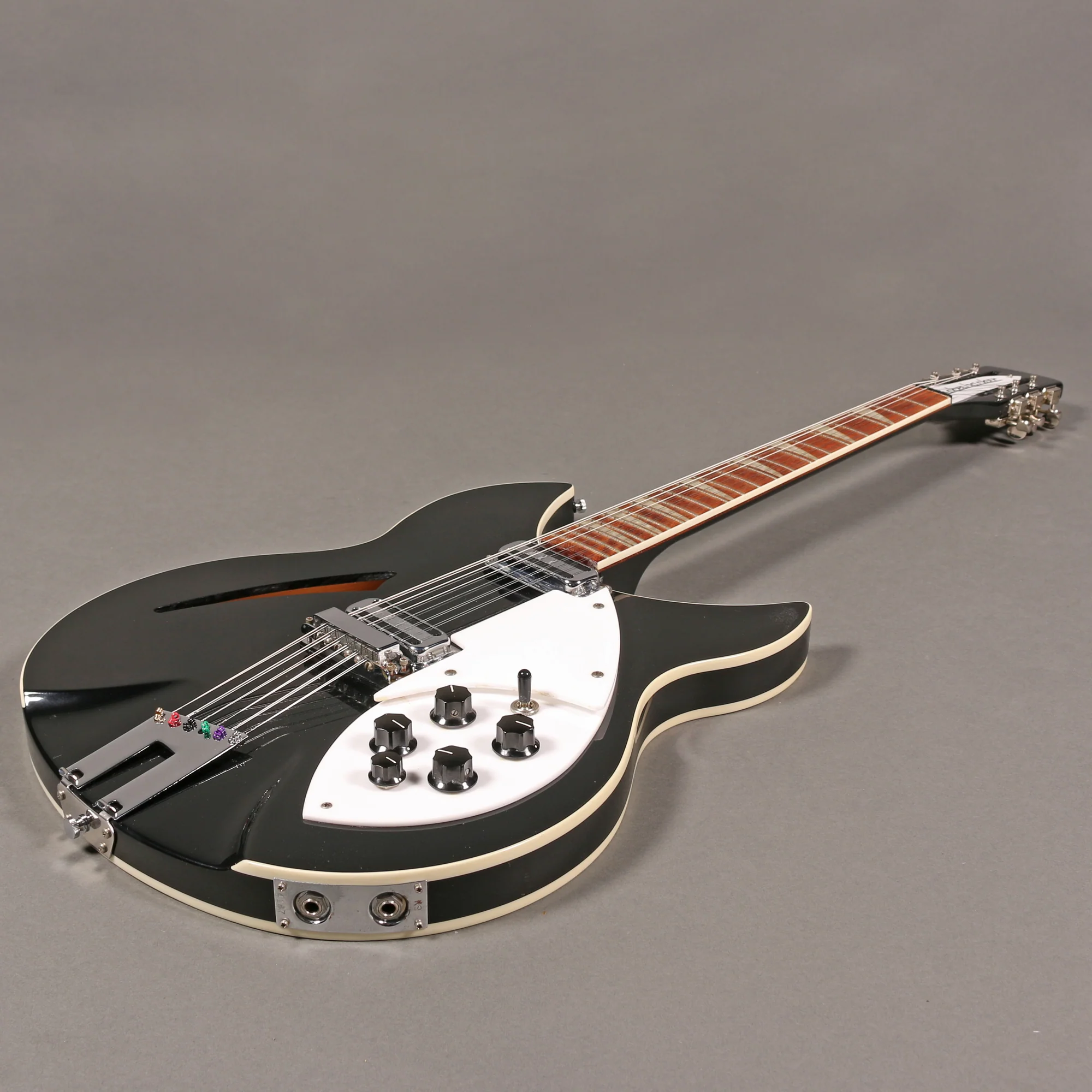
A Rickenbacker 360 is the bound, deluxe semi-hollow in the 300 series, and the 360/12 is its twelve-string. Guitars from 1964 on have a rounded top edge and checkered back binding. Original finish, toaster pickups and untouched parts decide value. Call or text (440) 219-3607 or text us photos.
How to tell a 360 from a 330
Both are thin, bright semi-hollows with a close outline. Look at the neck and the jack plate instead of the body shape.
Check | 330 | 360 |
|---|---|---|
Fretboard inlays | Dot inlays | Large triangle-style inlays |
Neck edge | No binding | Bound neck |
Body edges | Sharp, unbound edges | Binding on the back, and on the top of early guitars |
Output | One mono jack | Rick-O-Sound stereo jack, with mono also available |
If the neck is bound and the fretboard has triangles, you have a 360. The 330 is the plainer sibling and has its own page: our 330 value guide. The shorter-scale 325 is a different guitar again, covered in the 325 guide.
Old style and new style 360s
The 360 changed shape in 1964, and that is the first thing to check on any guitar you are trying to price.
Feature | Old style (1958 to 1964) | New style (1964 on) |
|---|---|---|
Top | Flat top with a bound top edge | Rounded top edge |
Binding | Bound on the top and the back | Bound soundhole and checkered binding on the back |
The binding did not simply move. The top edge lost its binding because the edge is now rounded, while the soundhole picked up binding and the back got the checkered pattern.
Old style guitars did not vanish overnight. Rickenbacker kept building them to special order after the change and marked them OS for old style, so a flat-top 360 with a mid-1960s serial is not automatically wrong. Date it with the Rickenbacker serial number guide and ask for photos of the back and the top edge.
The dealer comps below are all 1965 to 1967 new-style guitars. A true early old-style 360 has far fewer public comps, so it gets priced one guitar at a time.
The 360/12
Rickenbacker built its first 360/12 in July 1963, and regular production followed in 1964. George Harrison got the second one made.
The headstock gives it away from across the room. It is slotted, with six tuners mounted each way, which keeps a twelve-string headstock compact. Rickenbacker also reverses the usual order of the octave strings in each pair, so check how yours is strung before you judge its condition.
UK buyers in the 1960s were sold Rose-Morris export guitars under their own model numbers. The twelve-string in that line was the 1993, listed from July 1964. If the guitar in your case says 1993 instead of 360/12, tell us up front and send clear photos.
Finishes, stereo wiring and common changes
Fireglo is the cherry-to-amber sunburst that replaced the earlier brown two-tone sunburst in 1959. Mapleglo and Jetglo 360s turn up on dealer sites too. A finish that has mellowed and checked with age is normal. A glossy, even coat on a 60-year-old guitar is a question to ask.
Rick-O-Sound was added in 1960 and became standard across the 360 line. A guitar wired for mono only, or with the stereo jack replaced, no longer matches the factory spec.
Toaster pickups are the correct 1960s pickups and stayed in production into 1970. Hi-Gain pickups came after. A swap in either direction costs value.
Frets. Original small frets with life left are an asset. A refret is a fair repair, but it is one more change from the way the guitar left the factory.
Small parts. One of the dealer listings below admits the bridge cover is gone and the top of a knob has broken off. That is the kind of thing that adds up when a buyer is deciding between two guitars.
What to check before you sell
Hold the guitar up and sight down the neck. Check that the truss rod adjustment still works, and have a tech look at it if it does not. A neck that will not adjust is a repair bill a buyer will subtract. Look at the back of the headstock and the edges for finish checking and dings, and note which are honest wear and which are touch-up. Keep the original case. Every comp below mentions one.
What a Rickenbacker 360 or 360/12 is worth
These are asking prices from dealer listings we pulled on October 6, 2026. None is a sold price, and all three listing pages now show the guitar out of stock, so treat them as what a dealer was asking, not what anyone paid.
Telluride Music Co. listed a 1965 to 1966 360/12 in Fireglo at $7,999. The listing says "the bridge cover has been lost" and that the top has broken off a volume knob.
Cream City Music listed a 1966 360/12 in Fireglo at $5,999, with "good honest play wear" and "weather checking and some finish wear."
Chicago Music Exchange listed a 1967 360 in Jetglo at $3,995, with "moderate play wear" and "dents and scuffs throughout."
That is a spread from $3,995 to $7,999 for three 1960s guitars, all with honest wear. A cleaner, more complete guitar should be priced on its own photos rather than read off this list. Edgewater's cash offer usually lands about 20% under that market figure, and less for refinished or modified examples. For a read on your own guitar, send photos through the free estimate form or try what's my guitar worth first.
This guide stops at 1969, while our 330 guide runs to 1975, because the toaster pickup era closes here. Around 1970 the 360 moved to Hi-Gain pickups, and a 1970s 360 is priced as a separate group.
One seller wrote this about Edgewater in a Google review (it is not about a Rickenbacker): Madelyn K. said, "Gavin ... offered me a fair appraisal letting me know what it was worth fully ... timely ... knowledgeable and friendly."
How to sell your 360 or 360/12 to Edgewater
Send clear photos of the full front and back, the top edge, the headstock front and back (for a 360/12, show all twelve tuners), the neck binding and inlays, the pickups, the jack plate and the case. Tell us about anything replaced, refretted or refinished. We will ask anyway.
Our Rickenbacker selling page walks through the process. We buy nationwide from our base in Valley City, Ohio. If you also have a bass, see the 4001 guide. Ready to start? Use the free estimate form, or call or text (440) 219-3607.
Frequently asked questions
What is the difference between a Rickenbacker 360 and a 330?
The 360 has a bound neck, large triangle-style inlays and binding on the body, plus a Rick-O-Sound stereo jack. The 330 has small dot inlays, sharp unbound edges and a single mono jack. The body outline is close, so check the neck first.
What is the difference between an old style and new style 360?
Old style 360s, built from 1958 to about 1964, have binding on the top and back. New style guitars from 1964 have a rounded top edge, a bound soundhole and checkered binding on the back. Rickenbacker marked special-order old style guitars OS after the change.
What is a 1960s Rickenbacker 360/12 worth?
The two 1965 to 1966 twelve-strings we documented were listed by dealers at $5,999 and $7,999, both with play wear and their original cases. Those are asking prices, not sales, and condition moves the number a long way. Edgewater's cash offer usually lands about 20% under market, and less for refinished or modified examples.
How do I date a Rickenbacker 360?
Start with the serial number and use our Rickenbacker serial number guide. Then check the features. A rounded top edge means 1964 or later. Hi-Gain pickups in place of toasters point to about 1970 or later.
Does a rewire or refret hurt the value of a 360?
Yes, usually. A guitar rewired away from the factory mono and Rick-O-Sound setup, or with replaced pickups, no longer matches the original spec, and a refret is another change from factory. Buyers pay the most for guitars that kept their original parts, so the discount is real even when the work was done well.
How can I tell a 360/12 from a six-string 360?
Look at the headstock and count the strings. The 360/12 has a slotted headstock with six tuners mounted each way and twelve strings in pairs. The six-string 360 has a standard six-tuner headstock.
By Stephen Pedone, co-owner of Edgewater Guitars. Last updated: October 2026.
Sources
Guitar Player, "The History of Rickenbacker 360/365/370/375 Capris"
Rickenbacker101, "Timeline: The Evolution of the Rickenbacker 360"
The Unique Guitar Blog, "The Rickenbacker 360/12 and a Little History About RIC 12 String Guitars"
Telluride Music Co., 1965/66 Rickenbacker 360/12 Fireglo listing
Chicago Music Exchange, 1967 Rickenbacker 360 Jetglo listing