DATE :
Gibson Les Paul Deluxe Value Guide (1969 to 1985)

A Gibson Les Paul Deluxe is the mini-humbucker Les Paul Gibson built from 1969 into the mid 1980s, and it is the common 1970s Les Paul, not a rare one. Look for two small humbuckers in P-90-sized rings. Originality, finish and whether the body was routed for full-size pickups drive value. Call or text (440) 219-3607 or text us photos.
What the Gibson Les Paul Deluxe is
The Deluxe showed up in 1969, just as Gibson moved into the Norlin era. It took the place of the reissued Les Paul Standard, and Premier Guitar notes that no Standard was built from 1970 to 1975, with the Deluxe built in its place. The big change was the pickups. Gibson took the mini-humbucker it had been fitting to its Epiphone models and dropped a pair of them into the same-sized openings the P-90 used.
Tens of thousands left the factory in the early 1970s, which makes it the volume seller of its time. That is why they turn up in closets, estates and pawn cases. Most of them are worth a few thousand dollars, not a house payment, and the spread inside that range comes down to details you can check from photos.
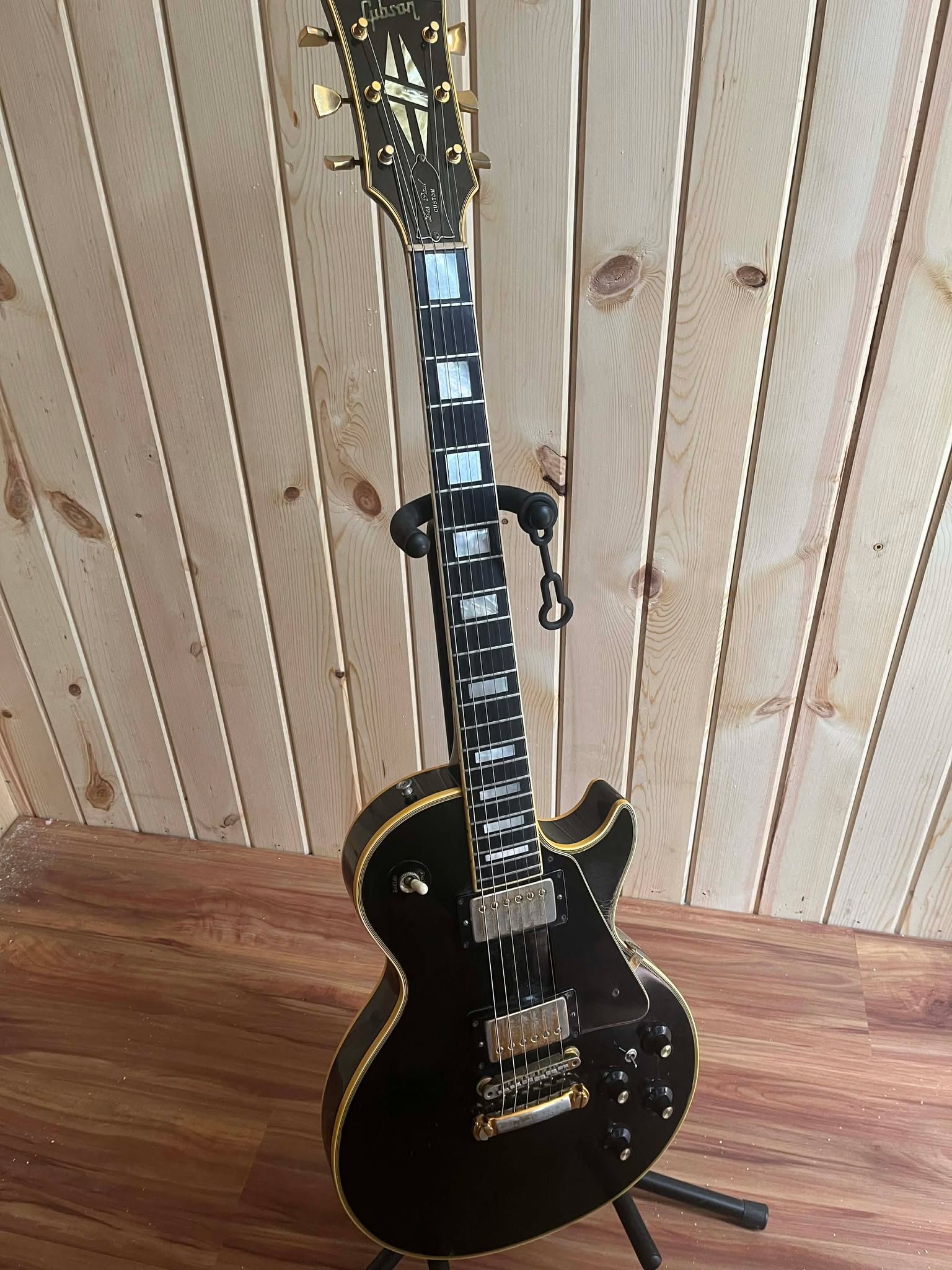
One quick sorting tip. The Deluxe has trapezoid fretboard inlays, as dealer listings of 1969 and 1972 examples show. A guitar with block inlays and gold hardware is more likely a Custom, and we have separate guides for the 1968 Les Paul Custom and the 1969 Les Paul Custom.
How the Les Paul Deluxe changed by era
Gibson kept changing how these were built, and the changes line up with value. This table is a buyer's cheat sheet, not a factory spec sheet. Gibson was not consistent in the 1970s and plenty of guitars straddle two rows.
Era | Body | Neck | Finishes | What to check |
|---|---|---|---|---|
1969 to about 1970 | Some early examples have a solid mahogany body under the carved maple top, not a laminated one | Three-piece mahogany | Goldtop | 1969-dated pots, original bezels, original tailpiece and bridge |
About 1970 to the mid 1970s | Many examples use the laminated "pancake" body: maple sandwiched between mahogany under the maple cap | Three-piece mahogany with a volute behind the headstock | Goldtop, then Cherry Sunburst, Cherry and Walnut from 1971 | Headstock cracks near the volute, original tuners and bridge |
About 1975 to the late 1970s | Mahogany and maple construction, check the weight and the back | Three-piece maple neck from about 1975 | Wine Red and Natural join the line by 1975 | Refinish on a Natural or Wine Red, replaced pickups |
Early 1980s to about 1985 | Late Norlin-era build | Check the neck wood against the serial | Check which finish is original | Original minis, case and paperwork |
Pickups are the quickest ID. Original Deluxes carry two mini-humbuckers with cream rings. Dealer listings for 1970s examples often mention patent-sticker minis and untouched solder joints, because that is what a buyer wants to see. Do not try to prove originality from pickup resistance numbers. Two dealer listings for 1972 and 1973 examples show quite different pickup readings, and both were described as original.
Dating a Les Paul Deluxe from the serial number
This is where sellers get stuck. Premier Guitar says that for most of the 1960s and 1970s Gibson used six-digit numbers pretty much at random, so a serial alone often gives a window, not a year. A Chicago Music Exchange listing for a 1972 Deluxe describes serial 770247 as fitting 1970 to 1972, and another for a 1973 guitar describes 892282 as fitting 1973 to 1975. Those windows are normal.
Starting in 1970, Gibson stamped "Made in USA" near the serial number on the back of the headstock, so a stamp on the back of the headstock is one more thing to check against the other details. Pot codes help, but they only tell you the earliest the guitar could have been built. Pair the serial with the volute, neck wood and finish.
We keep the serial tables in one place so we do not repeat them here. Use the Gibson serial number lookup for the number ranges. For how to read the headstock, truss rod cover and construction on any Les Paul, see our guide to dating a Gibson Les Paul, which mostly covers the 1950s models and has a short section on 1970 to 1975 serials.
Routed for full-size humbuckers: the common conversion
Mini-humbuckers fit the old P-90 openings, so a Deluxe needs no routing from the factory. Plenty of owners over the years did not like the smaller pickups and had a tech route the cavities for full-size humbuckers, which turns the guitar into what dealers call a "Standard conversion."
Routing cannot be undone. You can drop minis back in, but the wood is gone, and buyers who want a Deluxe want the original pickups in the original holes. A Vintage Guitar and Bass listings page shows a 1975 Cherry Deluxe described as a humbucker conversion at $3,900, next to a 1977 Cherry Sunburst with its original hard case at $3,999. The converted guitar is two years older and priced no higher, which tells you how little a conversion earns back.
Without factory paperwork, treat a Deluxe with full-size pickups as a conversion until proven otherwise. Check for fresh routing, a wrong-looking pickup ring and wiring that does not look factory.
What drives Les Paul Deluxe value
Factor | Effect on value |
|---|---|
Original mini-humbuckers in original cavities | The biggest single line. Routed or converted guitars sell at a clear discount. |
Early 1969 to 1970 build | First-year guitars list well above later ones. A 1969 solid-body goldtop sat at $11,999 at one dealer. |
Original finish | An untouched finish beats a refinish. Dealers flag even a partial refinish in their listings, and it lowers the price. |
Original hardware | Replaced tuners, bridge, tailpiece and knobs each take a bite. Dealers list them openly. |
Headstock cracks and repairs | Gibson added the volute to cut down on headstock breaks, and dealer listings still flag cracks near it. |
Original case and paperwork | Adds value and helps confirm the guitar has not been reworked. |
Finish rarity | Minor next to originality. Confirm the finish is the factory one. |
What a Gibson Les Paul Deluxe is worth
These are asking or listed prices from dealers, not confirmed sale prices. Some of the listings below are now marked sold or out of stock, and the final price was not published. Treat them as a read on where dealers price these guitars.
1969 to 1971. The only early comp we could verify is a first-year 1969 goldtop at Cream City Music with a solid mahogany body, original minis and 1969-dated pots, listed at $11,999 and now marked sold. It had a non-original stopbar tailpiece and bridge and a missing switch ring, and it still listed at that number. That is the ceiling for the model, not a typical price, and a 1969 listed at $18,900 on a classified page is the kind of outlier we cut.
Mid 1970s. This is the middle of the market. Cream City Music listed a 1972 goldtop with original minis, original pots and a headstock crack under the volute at $4,999, now marked sold. Chicago Music Exchange listed a 1972 goldtop with replaced Grover tuners at $4,395 and a 1973 goldtop with a replaced bridge at $4,995. Both are now out of stock. For a clean guitar with a few changes, think about $4,400 to $5,000 asking in the mid 1970s.
Late 1970s and 1980s. On the Vintage Guitar and Bass listings page, a 1977 Cherry Sunburst with its original hard case was listed at $3,999, a 1981 with its mini-humbuckers at $6,000, and a 1975 Natural fitted with full-size humbuckers at $3,999. The spread is wide because condition and completeness count more here than the year.
For contrast, Chicago Music Exchange has listed a used modern Gibson "Original" 70s Deluxe goldtop at $2,040. Modern reissues and 1970s originals look alike on a shelf and are priced in different worlds, so check the serial and the back of the headstock before you quote a number.
Edgewater's cash offer usually lands about 20% under that market figure, and less for refinished or modified examples, and less again for routed or converted guitars. The accurate number for your guitar is a free appraisal, and you can get a quick ballpark at what's my guitar worth.
Common problems on 1970s Les Paul Deluxes
Headstock cracks. Two of the listings we pulled flagged a crack near the headstock or under the volute. Look at the back of the headstock in raking light.
Replaced parts. Tuners, bridges and tailpieces are the usual swaps. Filled and enlarged tuner holes show on the headstock.
Refinish. On any Wine Red or Natural, look for paint in the routs and over the binding.
Replacement pickups. A 1975 Natural listed at $3,999 carries full-size humbuckers instead of minis. Ask what happened to the originals and look for routing.
Look-alikes. Modern Gibson reissues of the 70s Deluxe are in circulation. They carry long modern serial numbers, not the six-digit numbers of the Norlin era.
How to sell your Les Paul Deluxe to Edgewater
Send full front and back shots, the headstock front and back, the serial number, the control cavity and a clear picture of both pickups with the rings visible. Tell us about any routing, repaint or repair. We ask anyway, and it saves a round of emails.
A customer review from George W.: "Gavin ... provided speedy responses and a very honest and fair assessment of my 1963 Gibson SG Special. I highly recommend them!"
Start a free estimate or see our sell your Gibson page. We buy nationwide, cover shipping and pay the same day the guitar arrives and checks out. Call or text (440) 219-3607 or text us photos.
Frequently asked questions
When did Gibson make the Les Paul Deluxe?
Gibson introduced the Les Paul Deluxe in 1969 and built it into the mid 1980s, with sources giving an end date of either 1984 or 1985. Peak sales came in the early 1970s, when it was the Les Paul that Gibson was selling in volume.
How can I tell if my Les Paul Deluxe has been routed for humbuckers?
Look at the pickup openings. Original Deluxes have two small openings the size of a P-90 with cream mini-humbucker rings. A guitar with full-size humbuckers has had the cavities enlarged, and the wood around the rings is often cut or shimmed. Pull the rings if you can and look at the edges. If you cannot tell, send photos and we will look.
How can I date a Les Paul Deluxe?
Start with the six-digit serial number on the back of the headstock, then check for the volute, the neck wood and the finish. Gibson reused number ranges in the 1970s, so a serial usually gives a window of a few years. Our Gibson serial number lookup lists the ranges.
Is a routed Les Paul Deluxe worth less?
Yes. Dealers list routed or converted Deluxes at a visible discount to original examples, and the routing cannot be reversed. A 1975 humbucker conversion was listed at $3,900, below a 1977 example with its original case. Our offer on a converted guitar will sit below our offer on an original.
Is a goldtop Deluxe worth more than a sunburst?
The listings we found do not settle it. Dealer listings for 1972 and 1973 goldtops ran from about $4,400 to $5,000, while a 1977 Cherry Sunburst with its original case was listed at $3,999, but the years differ too. Condition and originality swing the number more than the finish.
How do I get an offer on my Les Paul Deluxe?
Send photos through the free estimate form linked above, or call or text (440) 219-3607. Include the serial number and tell us about any routing, repaint or repairs.
By Stephen Pedone, co-owner of Edgewater Guitars. Last updated: October 2026.