DATE :
How to Date Your Gibson Les Paul: Complete Vintage Authentication Guide
How to Date Your Gibson Les Paul: Complete Vintage Authentication Guide
Why Dating Your Gibson Les Paul Matters
Learning how to date a Gibson Les Paul accurately is essential for authentication, proper valuation, insurance documentation, and understanding your instrument’s place in rock and roll history. The Gibson Les Paul represents one of the most iconic and valuable electric guitars ever made, with certain years commanding six-figure prices in the vintage market.
Whether you own a vintage Les Paul from the coveted 1950s “golden era” or a later model, determining its exact manufacturing year affects everything from market value to restoration approaches. Certain years and specifications command premium prices—particularly 1958-1960 “Burst” models, early 1950s Goldtops, and transitional year guitars with unique features.
This comprehensive guide teaches you how to date your Gibson Les Paul using multiple authentication methods, ensuring accuracy regardless of which era your instrument represents.
Understanding the Gibson Les Paul History
Before diving into dating methods, understanding the Les Paul’s evolution provides crucial context:
The Birth of the Les Paul (1952)
Gibson introduced the Les Paul Model in 1952 in partnership with guitarist Les Paul:
Original Design:
Carved maple top on mahogany body
Gold finish (Goldtop)
P-90 pickups
Trapeze tailpiece (1952-1953)
Single-cutaway body
Revolutionary solid-body design
Target Market: Professional musicians wanting Gibson quality in a solid-body guitar to compete with Fender’s Telecaster and Stratocaster.
Major Les Paul Evolution Periods
1952-1957: Goldtop Era
Gold finish standard
P-90 pickups (PAF humbuckers introduced mid-1957)
Various bridge/tailpiece evolutions
Les Paul Custom introduced 1954
1958-1960: Sunburst “Burst” Era
Cherry Sunburst finish introduced
PAF humbuckers standard
Most collectible and valuable period
“Holy Grail” guitars (especially 1959)
1961-1963: SG Body Era
Les Paul name continued on SG body
Original Les Paul body discontinued 1961
1968-Present: Les Paul Returns
Les Paul body reintroduced 1968
Various models and specifications
Continuous production since
How to Date Your Gibson Les Paul: Serial Number Systems
Understanding Gibson’s serial number systems is the foundation for dating your Les Paul. However, serial numbers alone cannot definitively date these guitars—always use multiple verification methods.
Important Resource: For quick serial number reference, use our Gibson Serial Number Lookup Tool to find your guitar’s approximate year based on serial number ranges.
1952-1960: Ink-Stamped Serial Numbers
Vintage Les Paul guitars from the most collectible era used Gibson’s ink-stamped serial number system:
Location: Ink-stamped on the back of the headstock
Format: 5 digits (early examples) progressing to 6 digits
Approximate Serial Number Ranges:
1952: 0xxx - 2xxx range (very early, some no serial number)
1953: 2xxx - 4xxx range
1954: 4xxx - 5xxx range
1955: 5xxx - 6xxx range
1956: 6xxx - 7xxx range
1957: 7xxx - 8xxx range
1958: 8xxx - 9xxx range
1959: 9xxx - 0xxx range (numbering restarted)
1960: 0xxx - 1xxx range
Critical Notes:
Significant overlap between years
Same numbers appear across multiple years
Some guitars have no serial number (early 1952)
Numbers not strictly chronological
Serial numbers alone insufficient for accurate dating
How to Find Your Serial Number:
Turn the guitar over to view the back of the headstock
Look for the ink-stamped number below the tuners
Serial number stamped in ink on wood
May be faded or difficult to read
Use flashlight for better visibility
Record complete number exactly
Pro Tip: Use our Gibson Serial Number Lookup Tool for instant reference once you’ve found your serial number.
1961-1970: Impressed Serial Numbers
Gibson transitioned to impressed serial numbers:
Location: Back of headstock (stamped into wood)
Format: 5-6 digits
Approximate Ranges:
1961-1969: Various 5-6 digit numbers with extensive overlap
Same serial numbers used across multiple years
Extremely unreliable for precise dating
Factory Order Numbers essential for accuracy
1970-1975: Six-Digit Serial Numbers
Format: Six digits
First digit indicates year (0=1970, 1=1971, etc.)
More reliable than 1960s system
“MADE IN USA” stamp appears
1977-Present: Modern Serial Number Systems
1977-2013: Eight-digit formats with letter prefixes
More consistent systems
Specific prefixes decode to years
2014-Present: YYMMXXXX format
First two digits = year
Second two digits = month
Most reliable system
Factory Order Numbers (FON): The Most Reliable Vintage Les Paul Dating Method
For vintage Les Paul guitars, Factory Order Numbers provide the most accurate dating:
What FON Tells You: Production batch and year of manufacture
Location: Inside control cavity
Stamped on wood or written in pencil
Visible when removing control plate cover
Sometimes on small label
May be near serial number
Format: Letter followed by 3-4 digits
Letter indicates year
Numbers indicate production batch
FON Letter Codes for Vintage Les Paul Era (1952-1960):
Z = 1952
Y = 1953
X = 1954
W = 1955
V = 1956
U = 1957
T = 1958
S = 1959
R = 1960
Example: FON “S 4782” = 1959 production, batch 4782
How to Find FON:
Remove control plate cover
Inspect entire control cavity carefully
Look for stamped or written letter + numbers
Check all visible wood surfaces
May be partially obscured by wiring
Use flashlight and magnifying glass
Photograph for documentation
Why FON Is Critical for Les Paul:
Most reliable dating method for 1950s Les Pauls
Minimal overlap between years
Essential for differentiating valuable years
Crucial for Goldtop vs. Burst identification
Used to authenticate six-figure instruments
Dating Vintage Les Paul by Physical Features: Year-by-Year Guide
Physical characteristics changed significantly throughout Les Paul production, providing crucial dating evidence:
1952 Les Paul Goldtop (First Year)
The Original: First production year of revolutionary design
Body:
Carved maple top
Mahogany back and body
Gold finish with bronze powder undercoat
Single-cutaway
Deep dish carving
Cream binding on body only (no neck binding)
Pickups:
Two P-90 pickups
“Soap bar” style
Cream-colored covers (early 1952)
Dog-ear mounting
Single-coil design
Alnico magnets
Bridge/Tailpiece:
Trapeze tailpiece (strings wrap under)
Combined with tune-o-matic style bridge on some
No separate stop tailpiece
Neck:
Mahogany neck
Brazilian rosewood fingerboard
Dot inlays (pearl)
Unbound neck (1952 only)
Deep V profile (chunky)
1 11/16” nut width
Headstock:
“Les Paul Model” silkscreened in gold
Gibson logo
17-degree headstock angle
No binding on early examples
Hardware:
Kluson Deluxe tuners (single ring)
Plastic buttons
Gold-plated hardware
“Speed” knobs (gold with silver insert)
Serial Numbers: 0xxx - 2xxx range (some with no serial number)
FON: Z prefix
Why 1952 Is Significant:
First year production
Trapeze tailpiece (changed 1953)
Unbound neck (changed 1953)
Limited production
Historical significance
1953 Les Paul Goldtop
Key Changes from 1952:
Bridge/Tailpiece:
Stud tailpiece/bridge combination (wraparound)
Revolutionary design
Strings wrap over single-piece unit
Neck Binding:
Neck binding added
More refined appearance
Other Features:
Gold finish continues
P-90 pickups
Dot inlays
Carved maple top
Deep V neck profile
Serial Numbers: 2xxx - 4xxx range
FON: Y prefix
1954 Les Paul Goldtop and Custom
Goldtop Changes:
Bridge Evolution:
Tune-o-matic bridge introduced late 1954
Separate stop tailpiece
Improved intonation
Revolutionary design still used today
Other Features:
Gold finish
P-90 pickups
Dot inlays
Bound neck
Deep dish carving
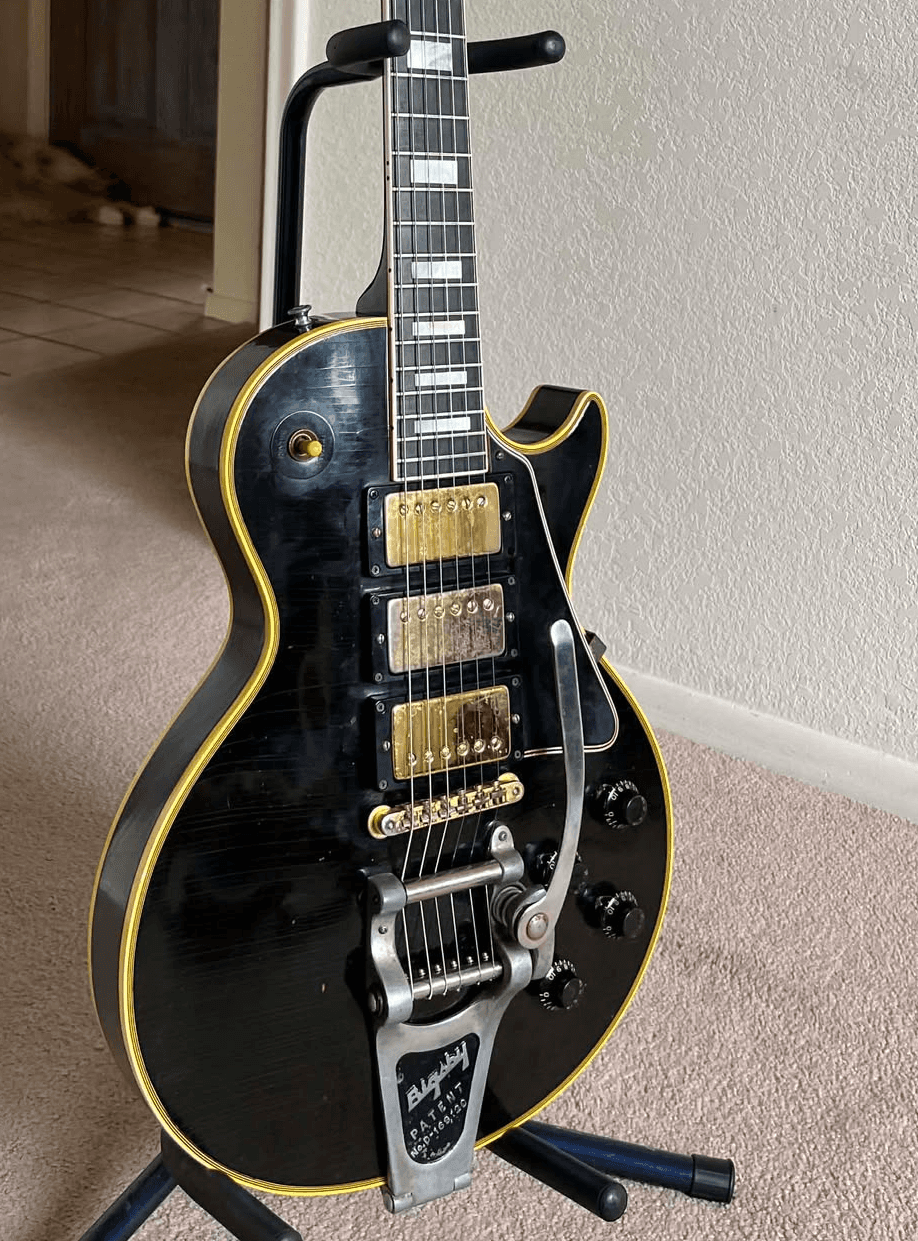
Les Paul Custom “Black Beauty” Introduced:
Distinctive Features:
Ebony finish (black)
Ebony fingerboard
Mother of pearl block inlays
Split-diamond headstock inlay
“Les Paul Custom” inlaid in pearl
Gold hardware throughout
Multi-ply binding (white/black/white/black/white)
P-90 in bridge, Alnico V “Staple” pickup in neck
Frets filed flush with binding
Serial Numbers: 4xxx - 5xxx range
FON: X prefix
1955-1956 Les Paul Goldtop
Refinements Continue:
1955 Features:
Tune-o-matic bridge standard (ABR-1)
No retainer wire on bridge
P-90 pickups
Gold finish
Dot inlays
1956 Features:
Similar to 1955
Some with compensated wraparound bridge
Tune-o-matic becoming standard
Amber-tinted Kluson tuners appear
Serial Numbers:
1955: 5xxx - 6xxx range
1956: 6xxx - 7xxx range
FON:
1955: W prefix
1956: V prefix
1957 Les Paul Goldtop (PAF Introduction)
Revolutionary Change: PAF humbucking pickups introduced mid-year
Critical Transition:
Early 1957: P-90 pickups
Mid-1957: PAF humbuckers introduced
Late 1957: PAF standard
PAF Features:
“Patent Applied For” sticker on underside
Double-coil design
Humbucking (noise-canceling)
Chrome or gold covers
Cream pickup mounting rings
DC resistance 7.5k-8.5k ohms
Other 1957 Features:
Gold finish continues
Tune-o-matic bridge with retainer wire
Stop tailpiece
Thicker body (approximately 1/8” thicker)
Dark back finish (brown to black)
Serial Numbers: 7xxx - 8xxx range
FON: U prefix
Significance: PAF introduction revolutionized electric guitar tone
1958 Les Paul Standard (First “Burst”)
The Beginning of the Legend: Cherry Sunburst finish introduced
Revolutionary Changes:
Cherry Sunburst finish debuts (replaces Goldtop)
Plain maple tops (little to no flame common)
PAF humbuckers standard
Renamed “Standard” (replacing Goldtop)
Construction:
Carved maple top
Mahogany body
Long neck tenon
Deep dish carving
Lightweight construction
Pickups:
PAF humbuckers
Chrome covers
Cream mounting rings
Hand-wound
Alnico magnets
Hardware:
Kluson Deluxe tuners (double ring)
ABR-1 bridge with retainer wire
Lightweight aluminum stopbar
Gold or nickel hardware
Electronics:
Orange “bumble bee” capacitors
Centralized “Rhythm/Treble” switch ring
Long-shaft 500k CTS pots
Switchcraft toggle and jack
Neck:
Chunky profile
Brazilian rosewood fingerboard
Trapezoid inlays
Bound fingerboard
Nibs where frets meet binding
Finish Characteristics:
Aniline dye (fades over time)
Red fades leaving “honey burst”
Two-tone to three-tone variations
Thin nitrocellulose application
Weight: Typically 8.5-11 lbs
Serial Numbers: 8xxx - 9xxx range
FON: T prefix
Why 1958 Standards Are Valuable:
First year of Sunburst finish
PAF pickups
Plain tops on many (some prefer over figured)
Beginning of “Burst” era
Limited production
1959 Les Paul Standard “The Holy Grail”
The Most Famous Guitar Year:
Why 1959 Is Special:
Figured maple tops more common
Improved book-matching
Slightly thinner neck profile (still chunky)
Individual variances in carving
Pronounced flame or “chevron” patterns
Perfect balance of aesthetics and playability
Top Characteristics:
Flame maple more prevalent
Book-matched tops
Better figured wood selection
Individual character to each guitar
Finish Variations:
“Lemon burst” (heavily faded)
“Honey burst” (moderately faded)
“Tobacco burst” (darker, less faded)
Fading due to UV-sensitive aniline dyes
PAF Pickups:
Varying DC resistance (7.5k-8.5k typical)
Long or short magnets
Sticker or no sticker
Double white, zebra, or double black bobbins
Other Features:
Factory Bigsby equipped versions exist
Brazilian rosewood fingerboard
Trapezoid inlays with nibs
Bumble bee capacitors
Long-shaft CTS pots
Neck Profile:
Slightly slimmer than 1958
Individual variations
Still substantial by modern standards
Serial Numbers: 9xxx - 0xxx range
FON: S prefix
Current Status: Six-figure values common for excellent examples
1960 Les Paul Standard (Final Year)
Last Year of Original Production:
Key Changes:
Slim taper neck introduced late in year
More pronounced flame maple common
Slightly thinner body
Some late examples with wider necks again
Neck Profiles:
Early 1960: Similar to 1959
Mid-1960: Transition begins
Late 1960: “Slim taper” appears
Other Features:
PAF pickups standard
Cherry Sunburst finish
Figured maple tops
Brazilian rosewood fingerboard
Inside Control Cavity:
FON (Factory Order Number) ink stamp; the serial number itself is on the back of the headstock
FON stamps
Pot codes crucial for dating
Serial Numbers: 0xxx - 1xxx range
FON: R prefix
Significance: Last year of original Les Paul production until 1968 reintroduction
Potentiometer Date Codes: Essential Les Paul Verification
Potentiometer codes provide crucial verification for dating vintage Les Paul guitars:
Understanding Pot Codes
Standard Format: XXYYZZ
XX = Manufacturer code
YY = Year of manufacture
ZZ = Week of manufacture
Common Manufacturers in Vintage Les Pauls:
137 = CTS (most common)
134 = Centralab
140 = Clarostat
How to Check Pot Codes on Les Paul
Process:
Remove control plate cover (back of guitar)
Locate four potentiometers (two volume, two tone)
Look for stamped codes on pot casings
May require gently moving wiring
Use flashlight and magnifying glass
Record codes from all four pots
Example Codes:
137 5928 = CTS pot, 1959, 28th week (July 1959)
137 6015 = CTS pot, 1960, 15th week (April 1960)
Interpreting Pot Dates for Les Paul
Dating Rules:
Pots date component manufacture
Guitar assembled weeks/months after pots
All four pots should date similarly
1959 Les Paul might have late 1958 or early 1959 pots
Critical for Burst Les Pauls:
Helps verify 1958 vs. 1959 vs. 1960
Confirms era for six-figure instruments
Essential authentication for valuable guitars
Red Flags:
Pots dated after supposed guitar year
Mixed pot dates from different years
Modern pots on supposedly vintage Les Paul
Pots dated before Les Paul production began
How to Date Vintage Les Paul: Pickup Identification
Pickup types provide crucial dating evidence:
P-90 Pickups (1952-1957)
Identification:
Single-coil “soap bar” design
Dog-ear mounting (screwed to body)
Cream or black covers
Two metal pole pieces per string
Alnico magnets
DC Resistance: Approximately 8k ohms
What P-90 Pickups Indicate:
1952-1957 Les Paul Goldtop
1954-1957 Les Paul Custom (some)
Pre-PAF era
PAF Humbuckers (1957-1960)
Identification:
“Patent Applied For” sticker (when present)
No patent number on cover
Double-coil design
Long or short magnet variations
Cream mounting rings typical
Bobbin Colors:
Double black bobbins
Zebra bobbins (black and white)
Double white bobbins (rare)
DC Resistance: 7.5k-8.5k ohms typical
What PAF Pickups Indicate:
Mid-1957 through 1960
Most valuable Les Paul period
“Burst” era guitars
Authentication:
Check for sticker on underside
No visible patent number on cover
Period-correct construction
Long-shaft pots (500k ohms)
Patent Number Pickups (1961+)
Identification:
Patent number “2,737,842” on cover
Post-1960 production
Different from PAFs
What They Indicate:
Post-original Les Paul production
SG-body “Les Paul” era
1968+ Les Paul reintroduction
Trapezoid Inlay Variations
Inlay details help date Les Paul guitars:
Early Trapezoid Inlays (1952-1960)
Characteristics:
Smaller trapezoid shapes
Nibs at fret ends (binding extends slightly)
Precise installation
Pearl inlays
Nibs:
Small extensions of binding where frets meet
Created by filing frets after binding installed
Characteristic of pre-1960s Gibsons
Authenticity indicator
Later Trapezoid Inlays
Changes:
Slightly different sizing
No nibs (post-1960s typically)
Installation methods changed
Finish Characteristics: Goldtop vs. Sunburst
Understanding finishes helps date Les Pauls:
Goldtop Finish (1952-1957)
Characteristics:
Gold-colored top
Bronze powder in early examples
All-gold finish in later examples
Natural mahogany back and sides
What It Indicates:
1952-1957 production
Pre-Sunburst era
P-90 or early PAF pickups
Cherry Sunburst Finish (1958-1960)
Characteristics:
Dark edges transitioning to lighter center
Aniline dye (fades with UV exposure)
Red fades more than yellow
Creates “lemon burst” or “honey burst”
Aging Patterns:
Fading indicates age
Unfaded areas under hardware
Natural checking develops
Authenticates vintage examples
What It Indicates:
1958-1960 production
PAF pickups
“Burst” era
Most collectible Les Pauls
Special Vintage Les Paul Models
Understanding variations helps identification:
Les Paul Custom (1954-1960)
Distinctive Features:
Ebony finish (“Black Beauty”)
Ebony fingerboard
Block inlays
Multi-ply binding
Split-diamond headstock inlay
Gold hardware
“Les Paul Custom” pearl inlay
Premium appointments
Pickups:
1954-1957: P-90 and Alnico V combinations
1957-1960: PAF humbuckers
Les Paul Junior (1954-1960)
Budget Model Features:
Single P-90 pickup
Flat mahogany body (no maple cap)
Dot inlays
Unbound fingerboard
Sunburst or TV Yellow finish
Single cutaway (1954-1958)
Double cutaway (mid-1958-1960)
Les Paul Special (1955-1960)
Two-Pickup Model:
Two P-90 pickups
Flat mahogany body
TV Yellow or Cherry finish
Dot inlays
Single or double cutaway
Red Flags: Identifying Non-Original or Modified Les Pauls
Recognizing modifications helps accurate assessment:
Refinished Vintage Les Paul
Indicators:
Overspray in control cavity
Paint on hardware
Wrong finish characteristics
Lack of proper checking
Overspray on serial numbers/FON
Impact: Refinished Burst Les Pauls lose 50-70% of value
Replaced Pickups
Original Pickup Importance:
PAF pickups extremely valuable
Wrong pickups reduce value 30-50%
Replacement Indicators:
Modern pickups
Wrong mounting rings
Different resistance readings
Headstock Repairs
Common Issue: Les Paul headstocks vulnerable to breaks
Impact: Professional repairs reduce value 30-50%
Top Modifications
Concerns:
Re-carved tops
Filled holes
Added routes
Changed binding
Dating Les Paul Transitional Models
1957 P-90 to PAF Transition
Early 1957: P-90 pickups Mid-1957: PAF introduction Late 1957: PAF standard
1960 Neck Profile Transition
Early 1960: 1959-style neck Late 1960: Slim taper introduced
When You’re Ready to Sell Your Vintage Les Paul
How Dating Affects Les Paul Value
Era-Specific Premiums:
1958-1960 “Burst” Standards: Highest values (six figures)
1957 Goldtop with PAFs: Strong premiums
1954-1956 Goldtops: Excellent values
1952-1953 early examples: Rare and valuable
All-original examples command highest prices
Why Choose Edgewater Guitars
Our Les Paul Expertise:
Burst authentication specialists
PAF pickup verification
FON analysis
Goldtop vs. Burst identification
Refinish detection
Transitional year recognition
Premium Offers: 30-40% higher than guitar shops
Frequently Asked Questions
How can I tell if my Les Paul is a valuable “Burst”?
Check for Cherry Sunburst finish, PAF pickups, trapezoid inlays, and serial numbers in 8xxxx-1xxxx range. Use our Gibson Serial Number Lookup Tool, verify FON (T, S, or R), and check pot codes dating 1958-1960.
What’s more valuable: 1958, 1959, or 1960 Burst?
1959 typically commands highest prices due to figured maple tops, but all three years are extremely valuable. Individual guitar characteristics (flame, weight, condition) matter more than year alone.
Are Goldtop Les Pauls valuable?
Yes, especially 1957 examples with PAF pickups. Early Goldtops (1952-1956) also command strong prices. All-original Goldtops from any year are collectible.
How much do PAF pickups add to Les Paul value?
PAF pickups are essential to Burst Les Paul value and add substantial premiums to any Les Paul. Replaced PAFs reduce value 30-50%.
Can I date my Les Paul just by serial number?
Not reliably. Use our Gibson Serial Number Lookup Tool as starting point, then verify with FON, pot codes, and physical features.
Contact Edgewater Guitars
For expert Les Paul authentication:
Phone: (440) 219-3607
Service Area: Ohio, Michigan, Pennsylvania, Indiana, West Virginia
Additional Resources
Complete Gibson Dating Guide
Sell Your Gibson Guitar
Learning how to date your Gibson Les Paul accurately requires understanding serial numbers, Factory Order Numbers, pot codes, and physical features. Whether you own a legendary 1959 Burst, a 1957 Goldtop with PAFs, or any vintage Les Paul, proper authentication ensures you understand your instrument’s value.
Use our Gibson Serial Number Lookup Tool as a starting point, then verify with FON, pot codes, and pickup identification.
Edgewater Guitars specializes in vintage Les Paul authentication and purchasing. Contact us at (440) 219-3607 for expert evaluation.
By Stephen Pedone, co-owner of Edgewater Guitars. Edgewater is a vintage guitar shop in Valley City, Ohio that buys pre-1970 Fender, Gibson, Martin and Gretsch guitars across Ohio and nationwide. Call or text (440) 219-3607 for a free appraisal.
Related: 1956 Gibson Les Paul Goldtop value guide: the green Goldtop.