DATE :
Vintage Epiphone Crestwood Value Guide (1958 to 1970): Crestwood Custom, Crestwood Deluxe and How to Identify One
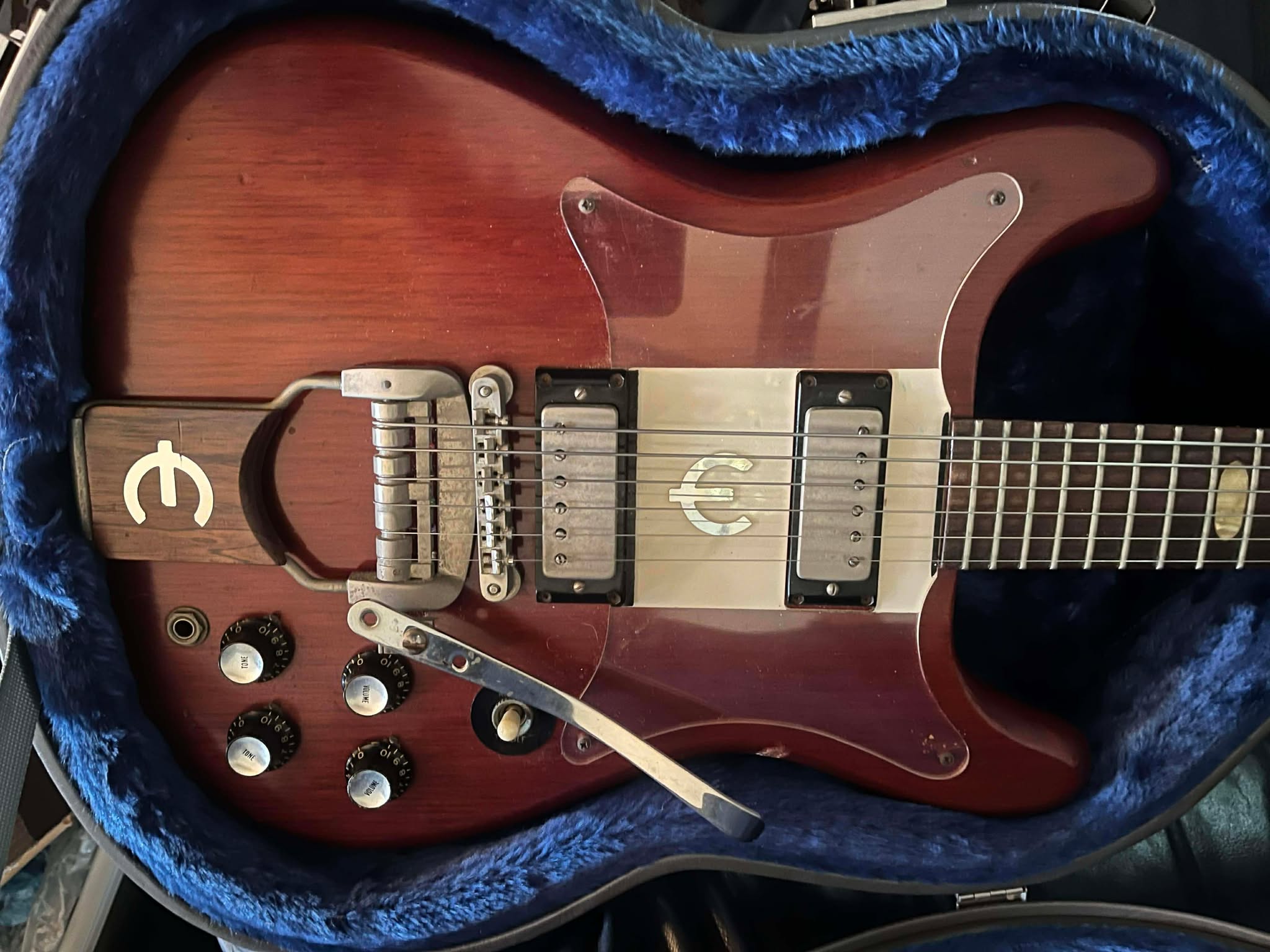
A vintage Epiphone Crestwood is a Kalamazoo-built mahogany double-cutaway solid body made from 1958 to 1970. The two-pickup Crestwood Custom is the common one. The three-pickup Crestwood Deluxe, sold from 1963, is far rarer. Originality, finish and the vibrato decide value. Call or text (440) 219-3607 or text us photos.
What the Epiphone Crestwood Custom is
Gibson bought Epiphone in 1957 and moved solid body production to Kalamazoo in 1958, where the Crestwood was built next to Gibson's early sixties solid bodies. The original 1958 Crestwood was a thick mahogany slab with two pickups. It became the Crestwood Custom in 1959, and for year-by-year dating we send people to our Epiphone dating guide rather than repeat the table here.
What matters when you are holding one is how the guitar changed. Three shifts show up in every source we checked, and each one tells you roughly where your guitar sits.
Area | What changed | What it tells you |
|---|---|---|
Body | The 1958 body was a 1 3/4 inch slab with squared edges. In 1959 it slimmed to 1 3/8 inch with rounded edges. In 1963 the shape went asymmetrical, with a longer upper bass horn. | A squared-edge slab is a very early example. A symmetrical rounded body points to 1959 through 1962. |
Headstock | Three tuners per side through 1962. From 1963, six in a row on the single-sided "batwing" headstock. | The fastest year-range check you can do from a photo. |
Pickups | Early guitars carry New York single-coil pickups. From 1961 they are mini-humbuckers, noticeably smaller than a Gibson humbucker. | New York pickups point to a 1958 to 1960 guitar. On a later guitar, check the pickup routes and solder before trusting the pickups as original. |
Vibrato | Most carry an Epiphone vibrato tailpiece. | Plugged holes around a stop bar mean the vibrato was removed. |
Finish | Sunburst early, cherry throughout, white from 1962. | A color that does not fit the year deserves a closer look for a refinish. |
Serial numbers on these guitars follow the Gibson system and overlap a lot in the sixties, so use the Gibson serial number lookup as a starting point and confirm with the features above.
Epiphone Crestwood Deluxe: the three-pickup model
The Crestwood Deluxe is the one we would most like to see in a seller's photos. It topped the Crestwood line. It is a niche model, so published detail is thinner than for the Custom, and we only state what at least two sources agree on.
How to tell a Deluxe from a Custom
Feature | Crestwood Custom | Crestwood Deluxe |
|---|---|---|
Pickups | Two mini-humbuckers | Three mini-humbuckers |
Fingerboard | Rosewood with pearl inlays | Bound ebony with pearl block inlays |
Headstock | Batwing from 1963 | Batwing, bound |
Vibrato | Epiphone vibrato tailpiece on most | Epiphone Tremotone as standard |
The pickup count is the quick test, and it is worth making because listings get it wrong. We found a sold dealer listing titled as a 1964 Crestwood Custom whose own description lists three mini-humbuckers and a bound ebony fingerboard. Those are Deluxe specs. Count the pickups before you decide what you have.
How rare the Crestwood Deluxe is
Vintage Guitar and Bass, Guitar Nerd and at least one dealer listing all put Deluxe production at about 219 guitars. The model appeared in 1963 and catalogs carried it until 1969, but the sources agree that nearly all of them were built from 1964 to 1967. Vintage Guitar and Bass calls it one of the most desirable Epiphones of the sixties, and we found only a handful of Deluxe listings across the dealer sites we checked.
Because we could find only one priced Deluxe from a dealer we are free to cite, we are not printing a Deluxe value figure. What we can say is that Deluxes list above Customs, and that the gap between an original example and one with a rewound pickup, replaced nut, refret or restoration is real. One sold 1965 Deluxe was disclosed as having a rewound neck pickup and a replaced nut, and another as professionally restored with 1970s tuners and a stop bar installed. Those are exactly the details we ask about.
What to photograph if you own a Deluxe
The full front and the full back, with the guitar flat and well lit.
The headstock, front and back. We want to see the binding, the logo and the batwing outline.
The whole fingerboard, so the ebony and block inlays are visible.
All three pickups, plus the bridge and the vibrato or any plugged holes where a tailpiece used to sit.
The inside of the control cavity if you can open it, and the case.
If you think you have a Deluxe, send those shots through our free estimate form or text them to us and we will tell you plainly what it is and what we would offer.
What drives Crestwood value
Originality. Original mini-humbuckers, bridge, tuners and vibrato carry the most weight. Listings show the typical swaps: a Gibson-style ABR-1 bridge, 1970s Grover tuners, a stop bar in place of the vibrato.
Finish. An untouched finish is worth more than a refinish, even a professional one. A 1965 Custom sold by an Australian dealer was disclosed as professionally refinished with a replaced bridge, and that disclosure sits at the top of the listing.
Pickups and electronics. Rewound or replaced pickups are common and are always worth disclosing.
Case and condition. An original hardshell case helps. Honest play wear costs less than a repair at the heel or headstock.
Two other things catch sellers out. A modern Epiphone Crestwood Custom import is not a Kalamazoo guitar, so check the features above before assuming you have a sixties original. And these guitars were built beside Gibson's SG, so people sometimes assume a Crestwood is simply a cheap SG. It is not, and the Epiphone headstock, name and mini-humbuckers matter to collectors.
If you also own a hollow or semi-hollow Epiphone from the same plant, our value guides for the Sheraton, Riviera and Casino cover those.
Its solid body siblings from the same plant have their own guides: the single-pickup Coronet and the two-pickup Wilshire.
What a vintage Epiphone Crestwood Custom is worth
Documented Custom comps are scattered, and condition explains most of the spread. Cream City Music sold a 1965 Crestwood in cherry with its original case, honest play wear and original Epiphone tremolo tailpiece for $2,999. Oyster Guitars in Germany is asking 5,500 euros for an unmolested 1964 Crestwood Custom with original electronics.
Edgewater's cash offer usually lands about 20% under that market figure, and less for refinished or modified examples. Condition, originality and finish move the number, so the accurate answer for your guitar is a free appraisal. For a quick ballpark first, use what's my guitar worth.
Benjamin, a seller who dealt with us on several vintage instruments, put it this way: "Very knowledgeable and professional shop ... made a good and fair offer on a few vintage instruments ... Highly recommend!" A straight offer with the reasoning behind it is what we aim to give on a Crestwood too.
How to sell your Crestwood
Send front, back, headstock front and back, the fingerboard, every pickup, and the vibrato area. Mention any refinish, rewound pickup or swapped part you know about, because we will ask anyway. We buy nationwide, cover shipping, and pay by PayPal, mailed check or cash in person. Start with the free estimate or see our sell your Epiphone page. Call or text (440) 219-3607 or text us photos.
Frequently asked questions
What is the difference between a Crestwood Custom and a Crestwood Deluxe?
Count the pickups. The Custom has two mini-humbuckers and a rosewood fingerboard. The Deluxe has three mini-humbuckers, a bound ebony fingerboard with pearl block inlays and a bound batwing headstock. The Deluxe also came with the Tremotone vibrato as standard.
What changed on the Crestwood in 1963?
The body went asymmetrical with a slightly longer upper bass horn, and the headstock changed from three tuners per side to six in a row in the single-sided batwing style. Mini-humbuckers had already replaced the New York pickups in 1961.
How many Crestwood Deluxe guitars were made?
About 219, according to Vintage Guitar and Bass and Guitar Nerd. The model appeared in 1963 and catalogs carried it until 1969, but most were built between 1964 and 1967.
Does a missing vibrato hurt a Crestwood's value?
Usually yes. Most Crestwoods left Kalamazoo with an Epiphone vibrato tailpiece. A stop bar installed later, with plugged holes where the vibrato sat, is a modification, and a guitar with its original tailpiece and arm is easier to sell.
Is an Epiphone Crestwood the same as a Gibson SG?
No. They were built at the same Kalamazoo plant with shared hardware and woods, but the Crestwood has an Epiphone headstock, name and mini-humbuckers that are smaller than Gibson's. Collectors value the Crestwood on its own terms.
How much is a vintage Crestwood Custom worth?
Recent documented comps run from $2,999 for a played 1965 example with its case to about 5,500 euros asking for an unmolested 1964. Refinished or modified guitars sit below the clean originals, so a photo review is the only way to pin down yours.
By Stephen Pedone, co-owner of Edgewater Guitars. Last updated: October 2026.