Sell Your Epiphone Guitar
Gavin is highly knowledgeable and experienced. Excellent customer service and a trusted individual. I highly recommend him to anyone looking for their next vintage instrument.
Kyle Skelly
If you own a vintage Epiphone guitar and are thinking about selling, Edgewater Guitars wants to hear from you. We buy pre-1969 Kalamazoo-era Epiphones — the years Gibson owned the brand and built them to full Gibson standards — and we pay fair, top-dollar prices. Call (440) 219-3607 for a free appraisal with no obligation to sell.
Which Epiphone Models We Buy
Not all Epiphones are equal. The instruments Edgewater targets are the Kalamazoo-made models from roughly 1957 to 1969, when Gibson owned the Epiphone name and produced them alongside its own guitars using the same craftspeople and materials.
Epiphone Casino — the fully hollow thinline that the Beatles made famous. The 1961-1969 Kalamazoo Casinos are the most collectible, particularly the natural-finish variants and sunburst models used by John Lennon.
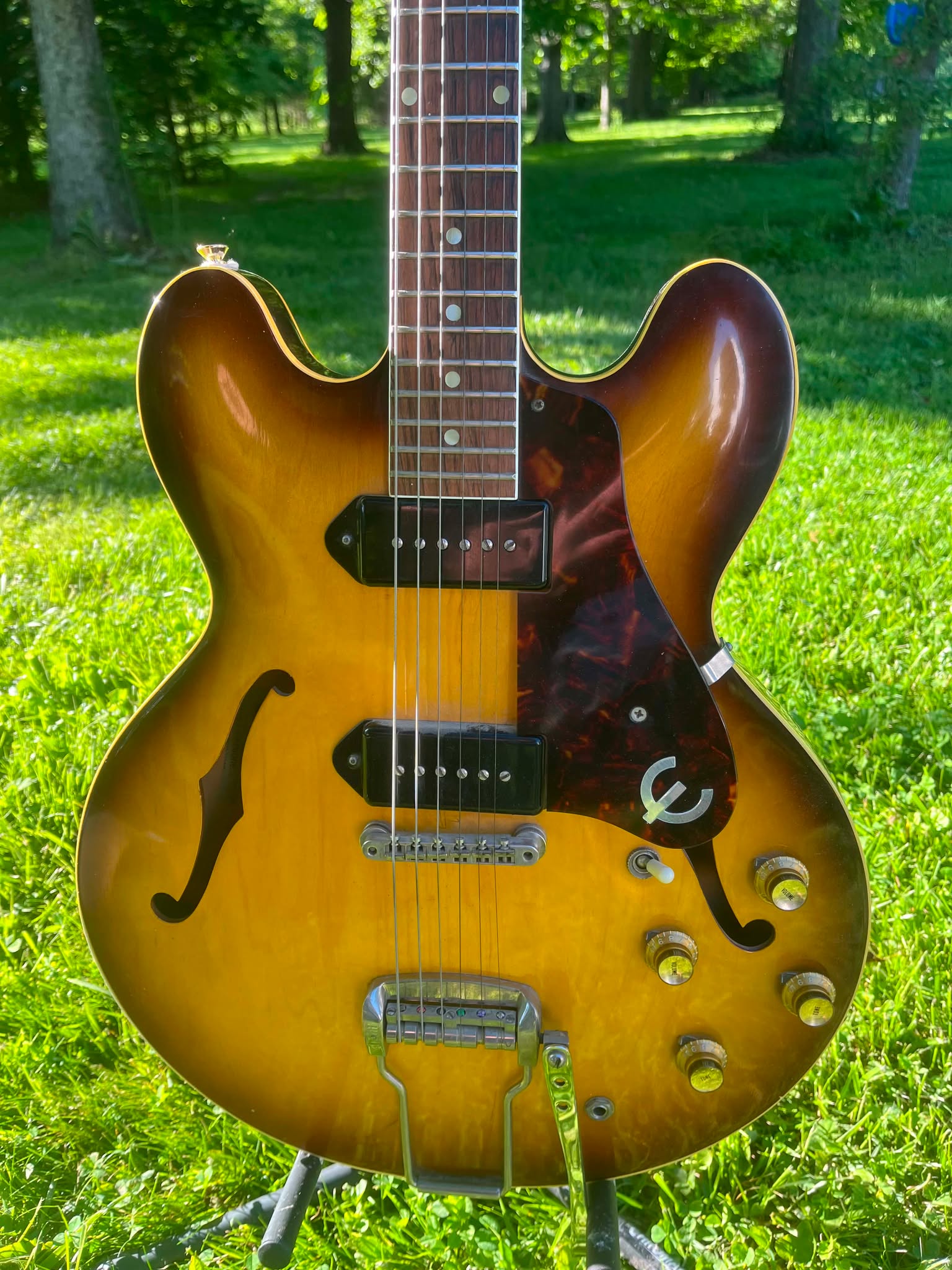
Epiphone Sheraton — Gibson's ES-335 equivalent under the Epiphone name, with binding and appointments the ES-335 did not carry. Semi-hollow body, double-cutaway, frequently mistaken for an ES-335 by non-specialists.
Epiphone Riviera — the thinline semi-hollow with the distinctive mini-humbucker pickups and block inlays. A significant collector piece in sunburst or cherry.
Epiphone Wilshire — the double-cutaway solid-body that competed with the SG. Less common than the Casino or Sheraton, which makes them interesting to collectors.
Epiphone Coronet — entry-level solid-body from the Kalamazoo era. Less valuable than the Sheraton or Casino but still a legitimate vintage instrument.
Epiphone Broadway and Zephyr — the pre-Gibson-era archtops from the 1930s and 1940s, before the New York factory closed. High collector interest for the right models.
We do not buy Korean or Chinese-made Epiphones from the 1980s onward unless they are part of a collection or have unusual provenance. The value gap between a 1965 Casino and a 1996 Casino is significant.
What Determines Your Epiphone's Value
Model | Era | Approximate value range | Key value drivers |
|---|---|---|---|
Casino | 1961-1969 (Kalamazoo) | $2,500 - $6,000+ | Originality, finish condition, Lennon-era configuration |
Sheraton | 1959-1969 (Kalamazoo) | $2,000 - $5,000 | Original binding intact, pickups original, finish |
Riviera | 1962-1969 (Kalamazoo) | $1,500 - $4,000 | Mini-humbuckers original, headstock straight |
Wilshire | 1959-1969 (Kalamazoo) | $800 - $2,500 | Color, all-original hardware |
Broadway / Zephyr archtops | 1930s - 1950s (New York) | $600 - $3,000+ | Condition, label, model variant |
These ranges reflect retail sale prices, not what we offer. We pay a fair wholesale rate, typically 70-80% of what the guitar would sell for in the current market, so you get cash now rather than waiting months for the right buyer to appear on Reverb or eBay.
From Our Buying Desk
The Casino is the Epiphone we see most often, and also the one most frequently misidentified. People bring us Casinos they describe as "1960s Gibsons" because of the Gibson headstock logo, which is accurate in a sense. Gibson owned the brand. The Kalamazoo Casinos were built to Gibson standards, by Gibson workers, in the Gibson factory. But they are Epiphones in name and in the records, and they have their own collector community and pricing structure.
The Sheraton is often confused with the ES-335. The body dimensions are similar, but the Sheraton carries more binding, different inlays, and Epiphone-specific appointments. A player who wants an ES-335 usually wants an ES-335. A Sheraton collector knows exactly what they are looking for. Both are real instruments worth real money.
If you are not sure whether your guitar is a Kalamazoo-era Epiphone or a later import, serial numbers and physical details will tell us. Send photos and we will identify it for you at no charge.
How to Sell Your Epiphone to Edgewater
Send photos or call. Email us photos of the front, back, headstock, serial number, and any visible wear. Or call (440) 219-3607 to describe what you have.
Get a free appraisal. We identify the instrument, date it, and give you a cash offer, typically within 24-48 hours of receiving photos.
Accept or decline. No pressure. If you accept, we arrange pickup or shipping and pay immediately.
We buy locally throughout Ohio, Michigan, Pennsylvania, and Indiana, and we buy nationally by ship. There is no cost to you for the appraisal.
How do you determine what my guitar is worth?
We evaluate each instrument based on brand, model, year, condition, originality, rarity, and current market demand. Our extensive knowledge of the vintage guitar market allows us to make competitive offers based on real-world values.
Do you buy guitars in any condition?
Yes! While mint condition guitars command premium prices, we purchase instruments in all conditions, including those with modifications, wear, or damage. Even project guitars can have value.
Do I need to clean or repair my guitar before selling it?
No, please don't make any repairs or even clean vintage instruments before contacting us. Original condition, even with dust, grime, or minor issues, is often preferable for accurate valuation. Improper cleaning can actually damage valuable finishes on vintage instruments.
How do I know if my vintage guitar is valuable?
Guitars built before 1970 by Gibson, Fender, Martin, Gretsch, Rickenbacker and Epiphone hold the highest value, especially Les Paul, SG, ES-335, Stratocaster, Telecaster, J-45, D-28 and Jazzmaster models. Key factors are the year of manufacture, the model, condition, originality and rarity of finish. An all-original example with its original finish and hardware commands a premium; replaced parts, a refinish or a repaired headstock lower the offer. The fastest way to find out is to send us a few photos and the serial number for a free, no-obligation estimate.
Do you offer more for guitars with original cases?
Yes, original cases, especially for vintage instruments, can significantly increase value. 'Case candy' such as original paperwork, warranty cards, tags, and accessories also adds value. Keep everything together when selling for maximum return.
What payment methods do you offer?
We offer several secure payment options including cash (for in-person transactions), certified check, bank wire transfer, PayPal, or direct deposit. For high-value instruments or collections, we can accommodate special arrangements to ensure your comfort and security.
Will you travel to my location to purchase guitars?
Yes, for valuable instruments or collections, we regularly travel throughout Ohio, Michigan, Pennsylvania, Indiana, and West Virginia. For exceptional pieces, we may travel nationally. This service is complimentary for instruments meeting certain value thresholds.
How long does the entire selling process take?
For most guitars, the entire process from initial contact to payment can be completed within 1-3 days. For rare or extremely valuable instruments requiring in-person evaluation, the timeline might extend to a week. We pride ourselves on efficiency and respect for your time.
What makes a guitar "vintage"?
Generally, guitars 30+ years old are considered vintage, with those from certain golden eras (1950s-1960s for many electric guitars, pre-1945 for acoustic instruments) being especially desirable. However, specific brands and models may be considered vintage or collectible from different periods based on construction changes, company ownership transitions, or historical significance.
Do modifications decrease my guitar's value?
Modifications typically do decrease value for collectible vintage instruments, with the impact varying based on the extent and reversibility of the changes. Original parts, finishes, and electronics command premium prices on vintage instruments. However, some professional modifications on player-grade instruments may have minimal impact, and certain period-correct modifications on specific models (like Parsons-White B-benders or Bigsby additions) can occasionally increase value.
Tools & Resources