DATE :
How to Date Your Vintage Epiphone Crestwood, Coronet, and Wilshire: Complete Pre-1970 Authentication Guide
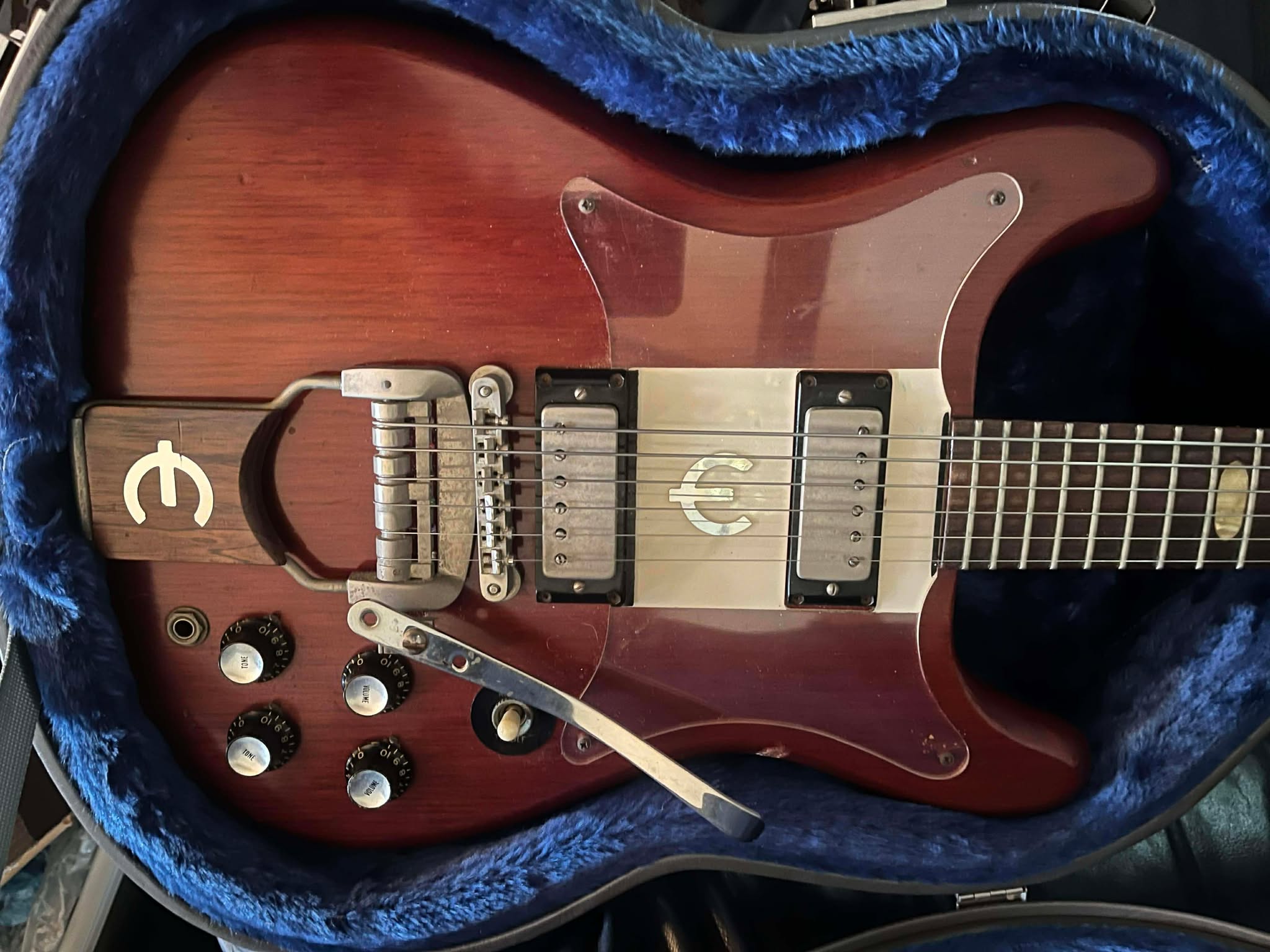
Why Dating Your Vintage Epiphone Matters
Learning how to date a vintage Epiphone Crestwood, Coronet, or Wilshire accurately is essential for authentication, proper valuation, insurance documentation, and understanding your instrument’s place in rock history. These American-made Epiphone solid-body guitars represent a unique and often underappreciated era—when Gibson owned Epiphone and produced innovative designs that rivaled Fender’s offset models.
Whether you own a rare 1958 first-year Coronet, a mid-1960s Crestwood Custom, or a distinctive Wilshire with mini-humbuckers, determining its exact manufacturing year affects everything from market value to restoration approaches. The pre-1970 American-made era (before production moved overseas) commands premium prices, particularly early examples with distinctive features and original appointments.
This comprehensive guide teaches you how to date your vintage American-made Epiphone solid-body guitars using multiple authentication methods, focusing exclusively on the pre-1970 Kalamazoo, Michigan production era.
Value guides by model: once you have a year, see what your guitar is worth in our Crestwood value guide (Custom and Deluxe), Coronet value guide and Wilshire value guide.
Understanding the Vintage Epiphone History
Before diving into dating methods, understanding these models’ evolution provides crucial context:
Gibson’s Acquisition of Epiphone (1957)
Gibson acquired Epiphone in 1957 and moved production from New York to the Gibson factory in Kalamazoo, Michigan:
Strategic Purpose:
Compete with Fender’s growing market share
Offer different designs under Epiphone brand
Expand Gibson’s product lineup
Maintain Epiphone’s historical reputation
Production Era: 1958-1970 (Kalamazoo, Michigan)
American-made guitars with Gibson quality
Unique designs distinct from Gibson models
Innovative features and aesthetics
After 1970, production moved overseas
The Three Classic Solid-Body Models
Epiphone Coronet:
Single pickup solid-body
Asymmetrical body design
Entry-level model
Simple but effective
Introduced 1958
Epiphone Crestwood:
Two pickup solid-body
Similar body to Coronet
Standard and Custom versions
More appointments than Coronet
Introduced 1958
Epiphone Wilshire:
Two pickup solid-body
Distinctive body shape with horns
Mini-humbucker pickups
Most elaborate appointments
Introduced 1959
Major Pre-1970 Evolution Periods
1958-1960: Introduction Era
First American-made Epiphone solid-bodies
New York pickups initially (transitional)
Kalamazoo production establishes
Establishing designs and specifications
1961-1964: Classic Era
Refined specifications
Mini-humbucker pickups standard
Quality construction peak
Pre-CBS competition with Fender
Most collectible period
1965-1970: Late American Era
Continued production in Kalamazoo
Various specification changes
Gibson manufacturing efficiencies
Final years of USA production
Before overseas move (1970+)
How to Date Your Vintage Epiphone: Serial Number Systems
Understanding Epiphone’s serial number systems is foundational for dating. However, serial numbers alone cannot definitively date these guitars—always use multiple verification methods.
Important Resource: Since Gibson acquired Epiphone in 1957 and moved production to Kalamazoo, vintage Epiphones often follow Gibson’s serial number systems. Use our Gibson Serial Number Lookup Tool to cross-reference your Epiphone’s serial number, as many USA-made Epiphones used Gibson’s numbering conventions.
1958-1961: Early Epiphone Serial Numbers
Location: Back of headstock (impressed) or inside control cavity
Format: Various formats during transition period
Some use Gibson-style serial numbers
Some use Epiphone-specific numbers
Letter prefixes on some models
Transitional numbering systems
Approximate Serial Number Ranges:
1958-1959: Transitional numbering (varied systems)
1960-1961: Gibson-style numbering begins
Serial numbers often in 1xxxx-2xxxx range (1960-1961)
Critical Notes:
Serial number systems inconsistent during early years
Gibson acquisition created numbering transition
Some guitars follow Gibson serial ranges
Factory Order Numbers often more reliable
How to Find Serial Number:
Check back of headstock first
Serial number impressed (stamped) into wood
May also be inside control cavity
Use flashlight for better visibility
Record complete number exactly
Pro Tip: Use our Gibson Serial Number Lookup Tool since Kalamazoo-made Epiphones often share Gibson’s serial number system.
1961-1970: Gibson-Style Serial Numbers
Integration with Gibson System:
Epiphone follows Gibson serial number system
Same numbering conventions
Produced in same Kalamazoo factory
Location: Back of headstock (impressed into wood)
Format: 5-6 digits
Approximate Ranges:
1961: 1xxxx-2xxxx range (some with A prefix)
1962: 2xxxx-3xxxx range
1963: 3xxxx-4xxxx range
1964: 4xxxx-7xxxx range
1965: 7xxxx-9xxxx range
1966: 0xxxx-1xxxx range (numbering restarted)
1967: 1xxxx-8xxxx range
1968: 8xxxx-0xxxx range (restarted again)
1969: 0xxxx-9xxxx range
1970: 0xxxxx range (six digits)
Critical Challenge: Extensive overlap and duplication
Same serial numbers appear across multiple years
Extremely unreliable for precise dating
Must use Factory Order Numbers and physical features
Reference: Use our Gibson Serial Number Lookup Tool for serial number ranges.
Factory Order Numbers (FON): The Most Reliable Dating Method
For vintage Epiphones, Factory Order Numbers provide the most accurate dating:
What FON Tells You: Production batch and year of manufacture
Location: Inside control cavity
Stamped on wood routing
Visible when removing control plate
Sometimes on internal label
Format: Letter followed by 3-4 digits
Letter indicates year
Numbers indicate production batch
FON Letter Codes (1958-1970):
T = 1958
S = 1959
R = 1960
Q = 1961
P = 1962
O = 1963
N = 1964
M = 1965
L = 1966
K = 1967
J = 1968
I = 1969
H = 1970
Example: FON “P 2847” = 1962 production, batch 2847
How to Find FON:
Remove control plate cover (typically on back)
Inspect control cavity carefully
Look for stamped letter + numbers
Check all visible wood surfaces
May be partially obscured by wiring
Use flashlight
Photograph for documentation
Why FON Is Critical for Epiphone:
Most reliable dating method for 1960s guitars
Minimal overlap between years
Essential for accurate year identification
Same system used by Gibson
Dating Vintage Epiphone by Physical Features: Model-by-Model Guide
Physical characteristics provide crucial dating evidence:
Epiphone Coronet (1958-1970)
The Entry-Level Solid-Body:
1958-1960 Coronet (First Years)
Body:
Asymmetrical slab body
Mahogany construction
Double cutaway slab design
Beveled edges
Contoured for comfort
Pickup:
Single pickup (bridge position initially, neck position later)
New York pickup (1958-1959 transitional)
P-90 style pickup (some early)
P-90 after the New York pickup years
Neck:
Mahogany neck
Rosewood fingerboard
Dot inlays
Bound fingerboard
Standard Gibson scale (24 3/4”)
Headstock:
“Epiphone” script logo
Crown headstock inlay
Smaller headstock shape
Hardware:
Tune-o-matic bridge
Stop tailpiece or vibrato
Nickel or chrome hardware
Kluson or other tuners
Finish Options:
Cherry
Sunburst
White (later)
Natural (some)
Serial Numbers: Transitional/early Gibson-style
FON: T, S, R prefixes
1961-1964 Coronet (Classic Era)
Refinements:
P-90 pickup (the 1960s Coronets we have seen for sale all carry one)
Single pickup configuration
Neck or bridge position (varied by year)
Body:
Same asymmetrical design
Mahogany body
Cherry finish most common
White finish available
Appointments:
Dot inlays
Bound fingerboard
Simple pickguard
Functional hardware
Serial Numbers: Gibson-style ranges
FON: Q, P, O, N prefixes
1965-1970 Coronet (Late American Era)
Continued Production:
Mini-humbucker pickup
Same basic design
Various finish options
Simplified appointments (some years)
Changes:
Some specification variations
Hardware changes
Finish options evolve
Serial Numbers: Gibson-style ranges
FON: M, L, K, J, I, H prefixes
Epiphone Crestwood (1958-1970)
The Two-Pickup Model:
1958-1960 Crestwood (First Years)
Body:
Similar to Coronet but two pickups
Asymmetrical slab body
Mahogany construction
Beveled edges
Double cutaway
Pickups:
Two pickups (neck and bridge)
New York pickups (1958-1959 transitional)
P-90 style (some early)
Mini-humbuckers (from 1961)
Versions:
Crestwood Standard
Crestwood Custom (upgraded appointments)
Crestwood Custom Features:
Gold hardware
Fancier inlays
Multi-ply binding
Premium appointments
Neck:
Mahogany neck
Rosewood fingerboard
Dot or block inlays (depending on version)
Bound fingerboard
Headstock:
“Epiphone” script logo
Crown inlay
Gold or nickel tuners
Hardware:
Tune-o-matic bridge
Stop tailpiece or Bigsby vibrato
Finish Options:
Cherry
Sunburst
White
Natural
Serial Numbers: Transitional/early Gibson-style
FON: T, S, R prefixes
1961-1964 Crestwood (Classic Era - Most Collectible)
Refined Specifications:
Mini-humbucker pickups standard
Two pickup configuration
Excellent build quality
Crestwood Standard:
Dot inlays
Nickel hardware
Standard appointments
Functional design
Crestwood Custom:
Gold hardware
Multi-ply binding
Premium features
Appointments:
Bound fingerboard
Bound headstock
Quality construction
Period-correct hardware
Finish Options:
Cherry (most common)
Sunburst
White
Custom colors (rare)
Serial Numbers: Gibson-style ranges
FON: Q, P, O, N prefixes
Why 1961-1964 Crestwoods Are Most Valuable:
Peak production quality
Mini-humbucker tone
Pre-CBS era
Classic specifications
1965-1970 Crestwood (Late American Era)
Continued Production:
Mini-humbucker pickups
Two pickup configuration
Standard and Custom versions continue
Changes:
Some appointment simplifications
Hardware variations
Finish options change
Serial Numbers: Gibson-style ranges
FON: M, L, K, J, I, H prefixes
Crestwood Deluxe (1963 to 1969)
The three-pickup Crestwood Deluxe is the rare one. It carries three mini-humbuckers, a bound ebony fingerboard with pearl block inlays, a bound batwing headstock and the Epiphone Tremotone vibrato, and Vintage Guitar and Bass puts production at about 219 guitars. Three pickups on a Crestwood point to a Deluxe; block inlays and a bound headstock go with it. See the Crestwood value guide for what each version is worth.
Epiphone Wilshire (1959-1970)
The Premium Solid-Body:
1959-1960 Wilshire (First Years)
Distinctive Body:
Double cutaway design with horns
Symmetrical body shape
Mahogany construction
More aggressive appearance than Coronet/Crestwood
Carved top (some examples)
Pickups:
Two P-90 pickups
P-90 style (some early 1959)
Mini-humbuckers later in the 1960s (sources differ on the year)
Appointments:
Premium features throughout
Headstock:
“Epiphone” script logo
Crown inlay
Hardware:
Tune-o-matic bridge
Stop tailpiece or Bigsby vibrato
Nickel or gold hardware
Finish Options:
Cherry
Sunburst
White
Natural
Serial Numbers: Early Gibson-style
FON: S, R prefixes
1961-1964 Wilshire (Classic Era - Highly Collectible)
Peak Specifications:
Mini-humbucker pickups standard
Double cutaway body
Premium appointments throughout
Features:
Multi-ply binding
Quality construction
Hardware Options:
Tune-o-matic bridge
Stop tailpiece
Bigsby vibrato (optional)
Maestro vibrato (some)
Finish Options:
Cherry (most common)
Sunburst
White
Custom colors (rare)
Serial Numbers: Gibson-style ranges
FON: Q, P, O, N prefixes
Why 1961-1964 Wilshires Are Most Valuable:
Distinctive body design
Mini-humbucker tone
Premium appointments
Pre-CBS era
Limited production
1965-1970 Wilshire (Late American Era)
Continued Premium Features:
Mini-humbucker pickups
Double cutaway body
Changes:
Some specification variations
Hardware changes
Simplified appointments (some years)
Serial Numbers: Gibson-style ranges
FON: M, L, K, J, I, H prefixes
Potentiometer Date Codes: Essential Verification
Potentiometer codes provide crucial verification:
Understanding Pot Codes
Standard Format: XXYYZZ
XX = Manufacturer code
YY = Year of manufacture
ZZ = Week of manufacture
Common Manufacturers:
137 = CTS
134 = Centralab
140 = Clarostat
How to Check Pot Codes on Epiphone
Process:
Remove control plate cover
Locate potentiometers (varies by model)
Look for stamped codes on pot casings
May require adjusting wiring to see codes
Use flashlight and magnifying glass
Record codes from all pots
Pot Count by Model:
Coronet: Two pots (volume and tone)
Crestwood Standard: Four pots (two volume, two tone)
Crestwood Custom: Four pots
Wilshire: Four pots
Example Codes:
137 6128 = CTS pot, 1961, 28th week
134 6415 = Centralab pot, 1964, 15th week
Interpreting Pot Dates
Dating Rules:
Pots date component manufacture
Guitar assembled weeks/months after pots made
All pots should date similarly
1963 Epiphone might have late 1962 or early 1963 pots
Red Flags:
Pots dated after supposed guitar year
Mixed pot dates from different years
Modern pots on supposedly vintage Epiphone
Mini-Humbucker Pickups: The Epiphone Signature
Understanding mini-humbuckers helps dating:
Mini-Humbucker Characteristics
Identification:
Smaller than regular Gibson humbuckers
Larger than single-coils
Distinctive size (between single-coil and full humbucker)
Chrome or nickel covers
P-90 style mounting (some routing)
What Mini-Humbuckers Indicate:
Crestwood from 1961, Wilshire later in the 1960s
Kalamazoo-made guitars
American production era
Not used on the early Coronet or the early Wilshire, which carry P-90s
Tone:
Brighter than full humbuckers
More articulate than P-90s
Distinctive Epiphone sound
Highly sought after today
Early Pickup Variations
New York Pickups (1958-1959):
Transitional feature
From pre-Gibson Epiphone era
Rare on Kalamazoo production
Extremely collectible
P-90 Style (early examples):
Some early Coronets and Crestwoods
Single-coil design
Gibson P-90 pickups
Transitional specification
Identifying Model Differences
Key distinctions between models:
Coronet vs. Crestwood Body
Similarities:
Same basic asymmetrical body shape
Double cutaway
Mahogany construction
Similar dimensions
Differences:
Coronet: Single pickup
Crestwood: Two pickups
Crestwood Custom: Premium appointments
Wilshire Distinctive Features
Unique Design:
Double cutaway with horns
Symmetrical body shape
More aggressive appearance
Premium Positioning:
Premium appointments
Higher price point than Crestwood
Red Flags: Identifying Non-Original or Modified Epiphones
Recognizing modifications:
Refinished Vintage Epiphone
Indicators:
Overspray in control cavity
Paint on routing wood
Wrong finish characteristics
Lack of proper checking
Modern paint types
Overspray on serial number
Impact: Refinished American Epiphones lose 40-60% of value
Replaced Pickups
Original Pickup Importance:
Mini-humbuckers essential to value
New York pickups extremely rare
Wrong pickups reduce value significantly
Replacement Indicators:
Modern pickups in vintage guitar
Wrong pickup type for model/year
Incorrect mounting style
Visible routing modifications
Hardware Changes
Original Hardware:
Period-correct tuners
Original bridge and tailpiece
Correct knobs and switches
Common Replacements:
Modern tuners
Different bridges
Wrong tailpieces
Incorrect knobs
American vs. Foreign: Critical Distinction
Understanding production location:
American-Made (1958-1970)
Kalamazoo, Michigan Production:
Same factory as Gibson
Gibson quality control
“Made in USA” or no country marking
Premium construction
Collectible and valuable
Identification:
Serial numbers match Gibson system
FON stamps present
Construction quality matches Gibson
Mini-humbuckers (Crestwood from 1961)
Period-correct features
Foreign Production (1970+)
After 1970:
Production moved overseas
Japan, Korea, China production
Different serial systems
Lower collector value
Different specifications
Not Covered in This Guide: This guide focuses exclusively on pre-1970 American-made Epiphones
When You’re Ready to Sell Your Vintage Epiphone
How Dating Affects Epiphone Value
Era-Specific Premiums:
1958-1960 first years: Strong premiums (especially New York pickups)
1961-1964 classic era: Highest values
1965-1970 late American: Good values
All-original examples command highest prices
Feature-Specific Value:
Mini-humbuckers essential to value
New York pickups (1958-1959) extremely rare
Crestwood Custom more valuable than Standard
Wilshire premium positioning
Original finish critical
Why Choose Edgewater Guitars
Our Epiphone Expertise:
American vs. foreign authentication
Mini-humbucker verification
FON analysis using Gibson system
Model-specific knowledge (Coronet, Crestwood, Wilshire)
New York pickup recognition
Understanding of Kalamazoo production era
Premium Offers: 30-40% higher than guitar shops
Streamlined Process:
Expert authentication
Immediate fair offers
No fees or commissions
Professional service
Contact: (440) 219-3607
Service Area: Ohio, Michigan, Pennsylvania, Indiana, West Virginia
Frequently Asked Questions
What’s the difference between American and foreign-made Epiphones?
American-made Epiphones (1958-1970) were produced in Gibson’s Kalamazoo, Michigan factory with Gibson quality control. After 1970, production moved overseas. American examples are significantly more valuable and collectible. Use our Gibson Serial Number Lookup Tool to check your serial number range.
What are mini-humbucker pickups?
Mini-humbuckers are smaller than regular humbuckers but larger than single-coils. Epiphone fitted them to the Crestwood from 1961 and to the Wilshire later in the 1960s, and they sound brighter than full humbuckers and more articulate than P-90s. Original mini-humbuckers are essential to vintage Epiphone value.
Are Crestwood Customs more valuable than Standards?
Yes, Crestwood Custom models with gold hardware, multi-ply binding, and premium appointments are more valuable than Crestwood Standard models.
How can I tell if my Epiphone is pre-1970 American-made?
Check for: Gibson-style serial numbers, FON stamps in control cavity, mini-humbucker pickups on a Crestwood from 1961, “Made in USA” or no country marking, construction quality matching Gibson standards, and correct vintage features. Serial numbers should align with Gibson’s system—check our Gibson Serial Number Lookup Tool.
What’s the most valuable vintage Epiphone solid-body?
All-original examples command the highest prices, and condition and originality move the number more than the model does. The three-pickup Crestwood Deluxe is the rarest version. First-year examples (1958-1959) with New York pickups are rare and sought after.
Did Epiphone solid-bodies have Gibson pickups?
Many did. Early Coronets and Wilshires carry Gibson P-90s, and the 1960s Coronets we have seen for sale all have a P-90. The Crestwood moved to mini-humbuckers in 1961 and the Wilshire later in the 1960s. Mini-humbuckers are P-90-sized humbucking pickups unique to Epiphone and some later Gibson models. They’re not the same as Gibson’s PAF or regular humbuckers.
Can I date my Epiphone just by serial number?
Not reliably for 1960s models. Epiphone used Gibson’s serial system which has significant overlap. Use our Gibson Serial Number Lookup Tool for the range, then verify with FON, pot codes, and physical features.
Additional Resources
Gibson Serial Number Lookup Tool - Epiphone serial numbers follow Gibson’s system
Complete Epiphone Dating Guide
Vintage Guitar Authentication Guide
Sell Your Vintage Guitar
Learning how to date your vintage Epiphone Crestwood, Coronet, or Wilshire accurately requires understanding serial numbers, Factory Order Numbers, pot codes, and physical features specific to each era. These American-made Epiphones evolved from 1958 through 1970, with the classic era (1961-1964) commanding the highest values, particularly all-original examples and the three-pickup Crestwood Deluxe.
Whether you own a rare first-year Coronet with New York pickups, a Crestwood Custom with its original mini-humbuckers, or a distinctive Wilshire, proper authentication ensures you understand your instrument’s history and value. Use our Gibson Serial Number Lookup Tool as a starting point (Epiphone followed Gibson’s system), then verify with Factory Order Numbers, pot codes, and physical feature identification for definitive dating.
Edgewater Guitars specializes in vintage American-made Epiphone authentication and purchasing throughout the Midwest. Our comprehensive knowledge of Epiphone solid-body dating—from pickup checks to serial and FON dating, ensures accurate assessments that reflect your guitar’s true age and value.
Contact us today at (440) 219-3607 for expert Epiphone authentication or professional valuation.
By Stephen Pedone, co-owner of Edgewater Guitars. Edgewater is a vintage guitar shop in Valley City, Ohio that buys pre-1970 Fender, Gibson, Martin and Gretsch guitars across Ohio and nationwide. Call or text (440) 219-3607 for a free appraisal.