DATE :
Gibson Hummingbird: Complete Guide to Gibson's First Square-Shoulder Dreadnought (1960-Present)
Gibson Hummingbird: Complete Guide to Gibson’s First Square-Shoulder Dreadnought (1960-Present)
Last Updated: May 2026
What Is the Gibson Hummingbird?
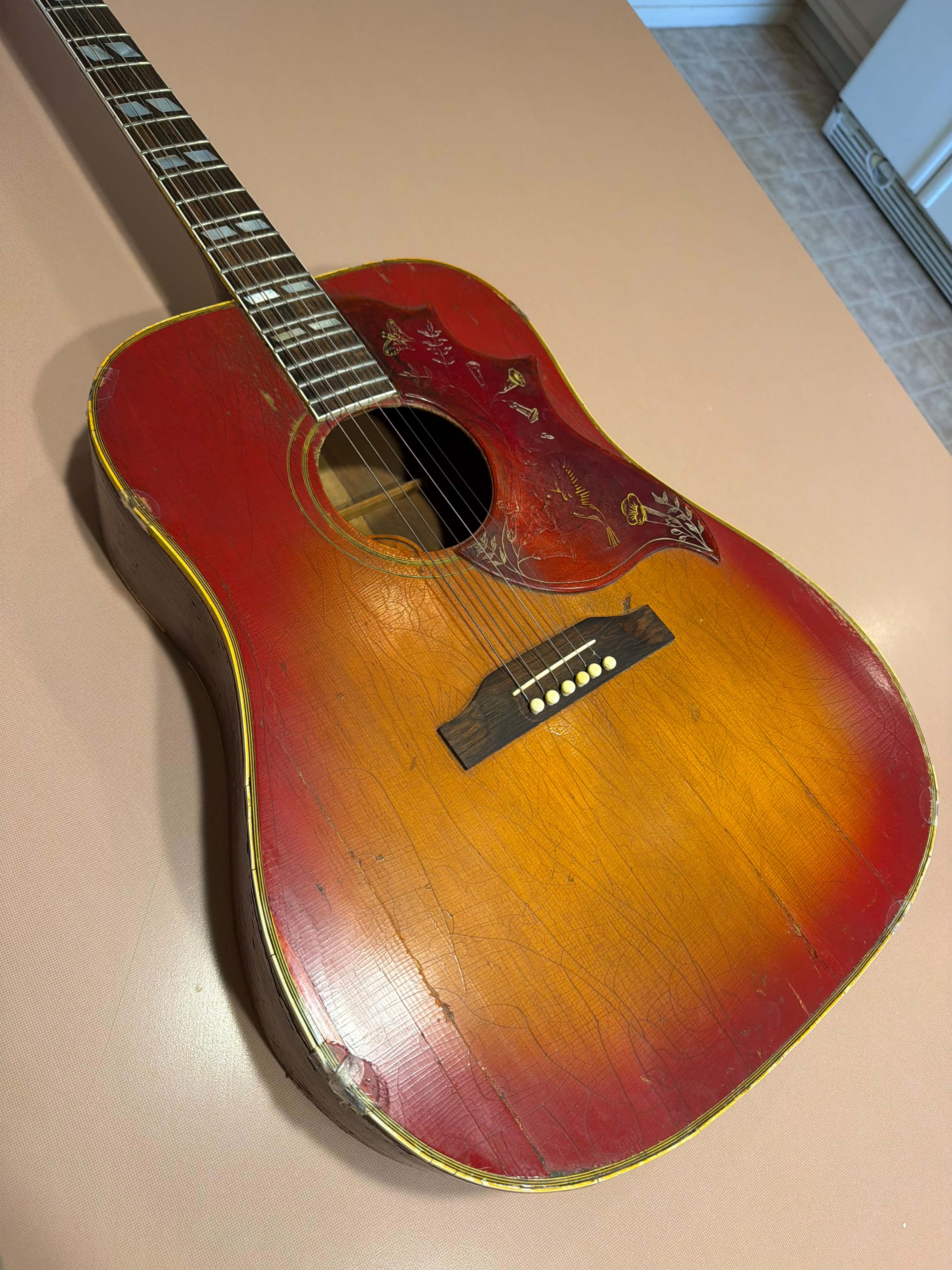
The Gibson Hummingbird is one of the most recognizable acoustic guitars ever produced — Gibson’s first square-shoulder dreadnought, introduced in 1960 with a distinctive hand-engraved hummingbird pickguard that makes it instantly identifiable from across any room. Featuring a spruce top, solid mahogany back and sides, cherry sunburst finish, parallelogram fingerboard inlays, and the bold square-shoulder body shape that departed radically from Gibson’s traditional round-shoulder dreadnought design (J-45, Southern Jumbo), the Hummingbird created a new category of Gibson acoustic that emphasized volume, projection, and visual drama.
What makes the Hummingbird significant:
First Square-Shoulder Gibson Dreadnought: Revolutionary departure from Gibson’s traditional round-shoulder shape — the square-shoulder design produces louder, more projecting voice with enhanced bass response
Iconic Hummingbird Pickguard: Hand-engraved (early) or silk-screened (later) floral pickguard featuring hummingbirds and flowers — the most recognizable acoustic pickguard in guitar history
Cherry Sunburst Standard: Distinctive cherry sunburst that fades beautifully with age — the Hummingbird’s signature visual identity
Spruce Top + Mahogany Back/Sides: Same tonewood combination as J-45 but in square-shoulder body — creating different acoustic response
Parallelogram Inlays: Distinctive position markers differentiating from J-45’s dots
Split-Parallelogram Headstock Inlay: Premium headstock appointment
Multiple Binding: More elaborate binding than J-45 — reflecting Hummingbird’s higher market position
Adjustable Bridge Saddle: Gibson’s ceramic or bone adjustable saddle
Natural Finish Option: Available alongside cherry sunburst — natural commands premiums
Artist Legacy: Keith Richards, Sheryl Crow, Noel Gallagher — the Hummingbird is a rock and country staple
Hummingbird Production Eras
Era | Years | Key Features | Relative Value |
|---|---|---|---|
First Era | 1960-1962 | Round-shoulder transitional (some claim first examples had round shoulders before square standardized), hand-engraved pickguard | Extraordinary to ultra-premium |
Golden Square-Shoulder | 1962-1969 | Established square-shoulder, hand-engraved pickguard, pre-Norlin | Ultra-premium to premium |
Early Norlin | 1969-1975 | Norlin ownership, some construction changes | Upper-mid to mid |
Late Norlin | 1975-1984 | Variable quality, Nashville transition | Mid to lower-mid |
Nashville Modern | 1985-present | Nashville production, various reissues | Variable |
What Is a Vintage Gibson Hummingbird Worth? (2026 Market Values)
Value by Era and Condition
Era | Excellent Original | Very Good | Modified |
|---|---|---|---|
1960-1962 (Earliest) | Ultra-premium to extraordinary | Premium | Upper-mid |
1963-1965 | Premium tier | Upper-mid | Mid-tier |
1966-1969 | Upper-mid to premium | Mid-tier | Lower-mid |
1970-1975 (Early Norlin) | Mid-tier | Lower-mid | Entry |
1976-1984 (Late Norlin) | Lower-mid to mid | Entry | Player grade |
Value by Feature
Feature | Premium/Impact | Notes |
|---|---|---|
Hand-Engraved Pickguard (Early) | 20-35% premium | Over silk-screened — early production indicator |
Natural Finish | 15-25% premium | Over cherry sunburst |
All-Original Condition | 60-120% premium | Over modified |
Original Spruce Top | Essential | Re-topped reduces 40-60% |
Original Pickguard | 15-25% premium | Hummingbird pickguard defines the model |
Pre-Norlin (Before 1969) | 30-50% premium | Over Norlin-era equivalents |
Clean Top | 20-35% premium | Over cracked |
Original Bridge/Saddle | 10-15% premium | |
Top Cracks | 15-35% reduction | |
Refinished | 25-40% reduction | Cherry fading correct |
Pickguard Missing/Replaced | 20-30% reduction | Defines Hummingbird identity |
Neck Reset | 10-15% reduction | Professional acceptable |
How to Identify a Vintage Gibson Hummingbird
Serial Numbers and FON
Location: Back of headstock (serial), neck block inside body (FON)
Gibson serial numbers are unreliable — always cross-reference with FON codes, pot codes, and physical features.
Key Visual Identifiers
Body: SQUARE-SHOULDER dreadnought (NOT round-shoulder — that’s J-45)
Body Width: ~16” lower bout
Top: Solid spruce
Back/Sides: Solid mahogany
Finish: Cherry sunburst (standard) or natural — nitrocellulose (pre-Norlin)
Pickguard: Hummingbird/floral engraved or silk-screened — THE defining feature
Inlays: Parallelogram position markers (NOT dots — dots = J-45)
Headstock: Split-parallelogram inlay
Binding: Multiple binding on body and neck
Bridge: Rosewood with adjustable saddle
Neck: Mahogany, 14-fret dovetail
Fingerboard: Rosewood
Tuners: Kluson (early) or Grover (later)
Scale Length: 24 3/4”
Nut Width: ~1 11/16”
Hummingbird vs J-45 vs Dove
Feature | Hummingbird | J-45 | Dove |
|---|---|---|---|
Body Shape | Square-shoulder | Round-shoulder | Square-shoulder |
Back/Sides | Mahogany | Mahogany | Maple |
Pickguard | Hummingbird engraved | Plain tortoiseshell | Dove engraved |
Inlays | Parallelogram | Dots | Parallelogram |
Binding | Multiple | Single | Multiple |
Finish | Cherry sunburst | Sunburst | Cherry/natural |
Introduced | 1960 | 1942 | 1962 |
Tone | Bright, projecting | Warm, balanced | Bright, cutting |
Pickguard Authentication
Hand-Engraved (Early Production ~1960-1968):
Individually hand-engraved floral/hummingbird design
Each slightly unique — visible engraving tool marks
Higher detail and depth than silk-screened
Commands 20-35% premiums
Silk-Screened (Later Production):
Machine-applied design — uniform, consistent
Less depth and individual character
Still attractive but mass-produced
Replacement/Missing Pickguard:
Missing hummingbird pickguard reduces value 20-30% — the pickguard DEFINES this model
Reproduction pickguards available but detectable through aging, material, printing method
Red Flags
Round-shoulder body: Hummingbird = SQUARE-SHOULDER. Round = J-45/Southern Jumbo.
Dot inlays: Hummingbird has PARALLELOGRAM. Dots = J-45.
Plain pickguard: Should have hummingbird engraving. Plain = different model or replacement.
Maple back/sides: Hummingbird = MAHOGANY. Maple = Gibson Dove.
Polyurethane finish: Pre-Norlin = nitrocellulose. Poly indicates Norlin-era or later.
Gibson Hummingbird Specifications (Pre-Norlin)
Specification | Detail |
|---|---|
Body | Square-shoulder dreadnought, ~16” lower bout |
Top | Solid spruce |
Back/Sides | Solid mahogany |
Bracing | X-bracing |
Finish | Cherry sunburst or natural, nitrocellulose |
Pickguard | Hummingbird/floral hand-engraved (early) or silk-screened |
Neck | Mahogany, 14-fret dovetail |
Fingerboard | Rosewood, parallelogram inlays |
Headstock | Split-parallelogram inlay |
Scale Length | 24 3/4” |
Nut Width | ~1 11/16” |
Bridge | Rosewood, adjustable saddle |
Binding | Multiple on body and neck |
Tuners | Kluson (early), Grover (later) |
What Does a Hummingbird Sound Like?
Square-Shoulder Projection: The square-shoulder body shape produces louder, more projecting voice than the round-shoulder J-45. Enhanced bass response with brighter treble — a more “modern” dreadnought voice that cuts through band mixes and fills rooms.
Mahogany Warmth + Square-Shoulder Power: Same mahogany back/sides as J-45 but the square-shoulder body shape redistributes acoustic energy — more volume, more bass, more forward projection. Less intimate than J-45 but more powerful.
Strumming Machine: The Hummingbird’s projection and tonal balance make it ideal for aggressive strumming — Keith Richards’ open-G acoustic work on Rolling Stones recordings demonstrates the Hummingbird’s power and clarity under heavy playing.
Common Issues
Pickguard shrinkage/damage: Celluloid pickguard shrinks, cracks, curls over decades. Replacement acceptable but reduces value 5-15%. Missing pickguard reduces 20-30%.
Top cracks: 15-35% reduction depending on severity.
Neck reset: Professional acceptable. 10-15% reduction.
Refinished: 25-40% reduction. Cherry fading correct.
Bridge replacement: 10-15% reduction.
Tuner replacement: 10-15% reduction.
Saddle replacement: 5-10% reduction. Original ceramic/bone preferred.
Frequently Asked Questions
Q: What is a vintage Gibson Hummingbird worth in 2026?
A: Pre-Norlin (1960-1969) examples in excellent all-original condition command premium to extraordinary tier depending on year. Earliest examples (1960-1962) with hand-engraved pickguards command highest premiums. Norlin-era (1970s) examples bring mid to lower-mid tier. Original pickguard essential.
Q: What is the difference between Hummingbird and J-45?
A: Body shape is the primary difference — Hummingbird has square shoulders (louder, more projecting), J-45 has round shoulders (warmer, more balanced). Both have mahogany back/sides. Hummingbird has engraved pickguard, parallelogram inlays, and more binding. J-45 has plain pickguard and dot inlays.
Q: What is the difference between Hummingbird and Dove?
A: Back and side wood. Hummingbird has MAHOGANY (warmer, more focused). Dove has MAPLE (brighter, more cutting). Both are square-shoulder with engraved pickguards (hummingbird design vs dove design). Both have parallelogram inlays.
Q: How can I tell if my Hummingbird pickguard is hand-engraved?
A: Hand-engraved (early ~1960-1968) shows visible tool marks, slight irregularities, greater depth — each individually unique. Silk-screened (later) is uniform, consistent, machine-applied. Hand-engraved commands 20-35% premiums.
Q: Does Edgewater buy Gibson Hummingbirds?
A: Yes — free evaluation including pickguard authentication (hand-engraved vs silk-screened), pre-Norlin vs Norlin dating, condition assessment. Ohio, Michigan, Pennsylvania, Indiana, West Virginia. Call (440) 219-3607.
Related Resources
How to Date Gibson Acoustic
Recently Purchased: Hummingbird Case Study
The Guitar: 1964 Gibson Hummingbird in cherry sunburst — pre-Norlin example with hand-engraved hummingbird pickguard (visible tool marks, individual character confirmed), original spruce top, mahogany back/sides, square-shoulder body, parallelogram inlays, original Kluson tuners, original adjustable bridge, original cherry sunburst with 62-year fading. Two small professionally repaired top cracks.
The Seller: Family in Youngstown, Ohio. Inherited from father who played country music.
The Transaction: Edgewater verified hand-engraved pickguard (pre-1968 production indicator), confirmed pre-Norlin manufacture through physical features and dating, assessed top crack repairs, authenticated cherry sunburst finish.
The Outcome: “The shop said ‘Hummingbirds aren’t as valuable as J-45s.’ Edgewater explained pre-Norlin Hummingbirds with hand-engraved pickguards actually command premiums ABOVE equivalent J-45s — the engraved pickguard alone adds 20-35%. Their offer was more than double the shop’s quote.”
Edgewater Guitars: OH, MI, PA, IN, WV. Contact us: request a free appraisal online | (440) 219-3607.
Related: 1965 Gibson Hummingbird value guide: wide nut vs narrow nut.