DATE :
1959 Gibson J-45: The Golden Era of American Acoustic Guitar Craftsmanship
1959 Gibson J-45: Peak Kalamazoo Round-Shoulder Dreadnought Craftsmanship
The 1959 Gibson J-45 is a golden-era round-shoulder dreadnought from Kalamazoo, with a solid spruce top and mahogany body that define the classic Gibson acoustic voice. Originality, finish, and condition drive value. Edgewater Guitars buys vintage Gibson J-45s nationwide with free expert appraisals and same-day cash offers. Call or text (440) 219-3607.
Last Updated: May 2026
What Makes the 1959 Gibson J-45 Significant?
The 1959 Gibson J-45 represents the pinnacle of Gibson’s most successful acoustic guitar — a round-shoulder dreadnought with spruce top, solid mahogany back and sides, X-bracing, and Kalamazoo craftsmanship at the end of Gibson’s most celebrated decade of acoustic production. The J-45 earned the nickname “the workhorse” for its versatility, durability, and consistently musical voice — and 1959 captures this iconic model at peak maturity, ten years before the Norlin acquisition changed Gibson’s manufacturing trajectory.
What makes 1959 particularly special:
End of Golden Decade: 1959 concludes Gibson’s most celebrated decade of acoustic production — mature construction methods, premium materials, fully optimized design
Round-Shoulder Dreadnought: Original Gibson dreadnought body shape — rounder, warmer voice than later square-shoulder designs (square-shoulder Hummingbird not introduced until 1960)
Solid Spruce Top: Sitka spruce standard by 1959 (some early production may retain Adirondack spruce) — excellent tonal properties with 67 years of aging
Solid Mahogany Back and Sides: Premium mahogany providing warm, focused, midrange-rich tone — the defining J-45 tonal signature
Pre-Norlin Quality: Built ten years before ECL/Norlin acquisition (1969) — traditional manufacturing without cost-cutting compromises
Folk Revival Era: 1959 J-45s were the instruments of the emerging folk revival — Bob Dylan, Joan Baez, and countless singer-songwriters relied on J-45s during this era
Adjustable Bridge Saddle: Gibson’s adjustable saddle providing intonation flexibility
“The Workhorse” Reputation: Built for professional daily use — reliable, versatile, musically balanced across all playing styles
67 Years of Aging: Spruce and mahogany after 67 years produce complex, mature tone impossible in new instruments
In Edgewater’s experience, 1959 J-45s are among the most commonly inherited Gibson acoustics — families frequently own “Dad’s old Gibson” without recognizing its significance as a peak golden-era production instrument. Many shops undervalue late 1950s J-45s relative to pre-war Gibsons, but the growing appreciation for post-war golden-era acoustics is driving values higher.
Call (440) 219-3607 for free evaluation.
What Is a 1959 Gibson J-45 Worth? (2026 Market Values)
Value by Condition
Condition | Sunburst (Original) | Natural (Rarer) | Modified |
|---|---|---|---|
Excellent | Premium tier | Premium-plus | Upper-mid |
Very Good | Upper-mid tier | Premium | Mid-tier |
Good | Mid-tier | Upper-mid | Lower-mid |
Player Grade | Lower-mid | Mid-tier | Entry |
Value by Feature
Feature | Premium/Impact | Notes |
|---|---|---|
All-Original Condition | 60-120% premium | Over modified |
Original Spruce Top | Essential | Re-topped reduces 40-60% |
Original Bracing Intact | Essential | Re-braced reduces 30-50% |
Natural Finish | 15-25% premium | Rarer than sunburst |
Adirondack Top (If Confirmed) | 10-20% premium | Over Sitka |
Original Bridge | 10-15% premium | |
Original Tuners | 10-15% premium | |
Clean Top (No Cracks) | 20-35% premium | Over cracked |
Top Cracks | 15-35% reduction | Depending on severity |
Neck Reset | 10-15% reduction | Professional acceptable |
Refinished | 25-40% reduction | Sunburst fading correct |
Replaced Bridge | 10-15% reduction |
How 1959 J-45 Compares
Model/Year | Key Difference | Relative Value |
|---|---|---|
Pre-War J-45 (1942-1945) | Adirondack, banner headstock | 80-150% higher |
1946-1955 J-45 | Post-war, round-shoulder | 10-30% higher (earlier post-war) |
1959 J-45 | Peak golden decade, round-shoulder | Baseline (premium) |
1960-1962 J-45 | Continuing round-shoulder | Similar to 5% lower |
1962-1968 J-45 | Square-shoulder transition | 10-20% lower |
1969+ J-45 | Norlin era | 30-50% lower |
How to Identify a 1959 Gibson J-45
Serial Numbers
Range for 1959: Approximately A-41000 to A-44000 (ink stamped on headstock back)
FON Codes
1959 FON Letter: N (the most reliable dating method)
Location: Inside body on neck block, visible through soundhole
Key Visual Identifiers
Body: Round-shoulder dreadnought (NOT square-shoulder — that’s 1960s Hummingbird)
Top: Solid spruce (Sitka standard, some Adirondack possible)
Back/Sides: Solid mahogany
Finish: Sunburst (standard) or natural (rarer) — nitrocellulose
Bracing: X-bracing (non-scalloped — Gibson never used scalloped like Martin)
Bridge: Upper-belly rosewood with adjustable saddle
Neck: Mahogany, 14-fret dovetail joint
Fingerboard: Rosewood with dot inlays
Headstock: “Gibson” script logo, crown inlay (NO banner — banner ended ~1945)
Tuners: Kluson
Pickguard: Tortoiseshell teardrop
Scale Length: 24 3/4”
Nut Width: ~1 11/16”
Body Width: ~16” lower bout
J-45 vs Other Gibson Acoustics
Model | Key Difference |
|---|---|
J-45 | Mahogany back/sides, sunburst, round-shoulder |
J-50 | Same as J-45 but NATURAL finish |
J-200 | Jumbo body (17”), flame maple, ornate |
Hummingbird | Square-shoulder (1960+), ornate pickguard |
Dove | Square-shoulder (1962+), maple back/sides, dove pickguard |
Southern Jumbo | Similar to J-45 but with specific SJ appointments |
Red Flags
Square-shoulder body: 1959 J-45 = ROUND shoulder. Square = later model or misidentified.
Banner headstock: Banner ended ~1945. Not present on 1959.
Laminated back/sides: Should be SOLID mahogany.
Modern adjustable truss rod: Gibson used non-adjustable reinforcement through most of this era.
“Made in USA” stamp: Not until ~1970.
1959 Gibson J-45 Specifications
Specification | Detail |
|---|---|
Body | Round-shoulder dreadnought |
Body Width | ~16” lower bout |
Top | Solid spruce (Sitka standard) |
Back/Sides | Solid mahogany |
Bracing | X-bracing |
Neck | Mahogany, 14-fret dovetail |
Fingerboard | Rosewood, dot inlays |
Scale Length | 24 3/4” |
Nut Width | ~1 11/16” |
Bridge | Rosewood, upper-belly, adjustable saddle |
Finish | Sunburst or natural, nitrocellulose |
Tuners | Kluson |
Pickguard | Tortoiseshell teardrop |
Headstock | “Gibson” script, crown inlay |
Label | Orange interior |
What Does a 1959 J-45 Sound Like?
“The Workhorse” Voice: Balanced, warm, projecting — the J-45 sits perfectly behind vocals without overwhelming. Strong midrange with warm bass and clear treble. Responds dynamically to playing technique — gentle for fingerpicking, powerful for strumming.
Round-Shoulder Character: Rounder, warmer, more complex than square-shoulder dreadnoughts. Less bass-heavy than Martin dreadnoughts — more midrange focus. The round-shoulder shape creates the J-45’s distinctively balanced voice.
Mahogany Warmth: All-mahogany back/sides produce the J-45’s signature warm compression and focused midrange. Different from rosewood’s wider frequency range — more intimate, more vocal.
67-Year Aging: Spruce and mahogany after 67 years produce harmonic complexity, dynamic responsiveness, and tonal maturity impossible in new instruments.
Common Issues
Top cracks: 67-year spruce susceptible. Professional repair acceptable. 15-35% reduction.
Neck reset: Dovetail shifts over decades. Professional reset acceptable. 10-15% reduction.
Bridge lifting/replacement: Common over 67 years. 10-15% reduction for replacement.
Refinished: 25-40% reduction. Original sunburst fading is correct.
Pickguard shrinkage: Celluloid pickguards shrink, crack, curl. Replacement acceptable. 5-10% impact.
Tuner replacement: 10-15% reduction.
Bracing issues: Loose or detached braces. Re-gluing acceptable. Rebracing reduces 30-50%.
Frequently Asked Questions
Q: What is a 1959 Gibson J-45 worth in 2026?
A: All-original sunburst in excellent condition commands premium tier. Natural finish commands additional premiums. Clean top (no cracks) adds 20-35%. Values have appreciated as collectors recognize late 1950s as peak golden era for Gibson acoustics.
Q: What is the difference between J-45 and J-50?
A: Same guitar, different finish. J-45 = sunburst. J-50 = natural finish. Natural (J-50) is rarer and typically commands 15-25% premiums over sunburst (J-45).
Q: Is a 1959 J-45 round-shoulder or square-shoulder?
A: Round-shoulder. The J-45 maintained the original round-shoulder dreadnought body through the early 1960s. Square-shoulder appeared on the Hummingbird (1960) and later some J-45 variants. Round-shoulder is the iconic J-45 shape.
Q: Does Edgewater buy Gibson J-45s?
A: Yes — free evaluation including top wood verification, bracing inspection, condition assessment. We recognize golden-era J-45 significance. Ohio, Michigan, Pennsylvania, Indiana, West Virginia. Call (440) 219-3607.
Related Resources
1939 Gibson L-00
Recently Purchased: 1959 J-45 Case Study
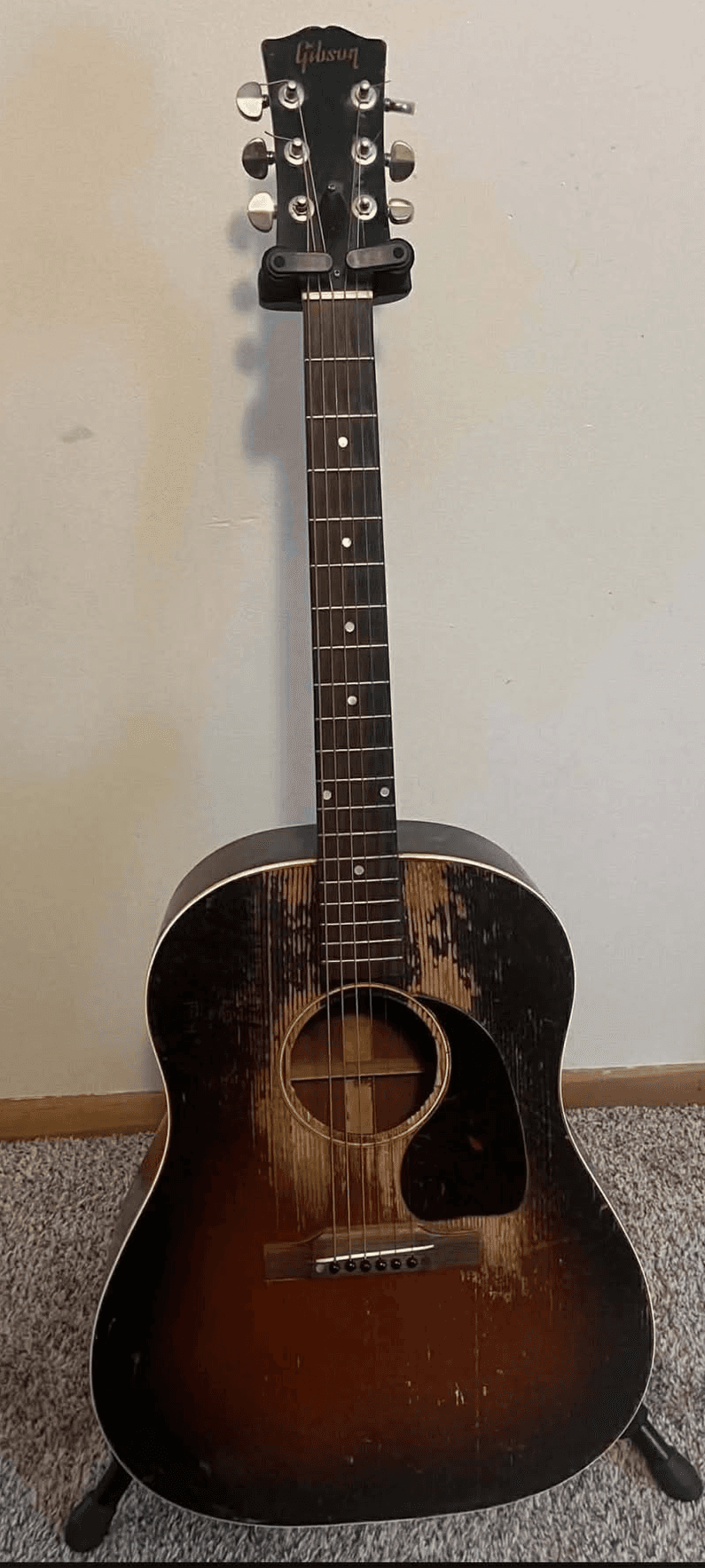
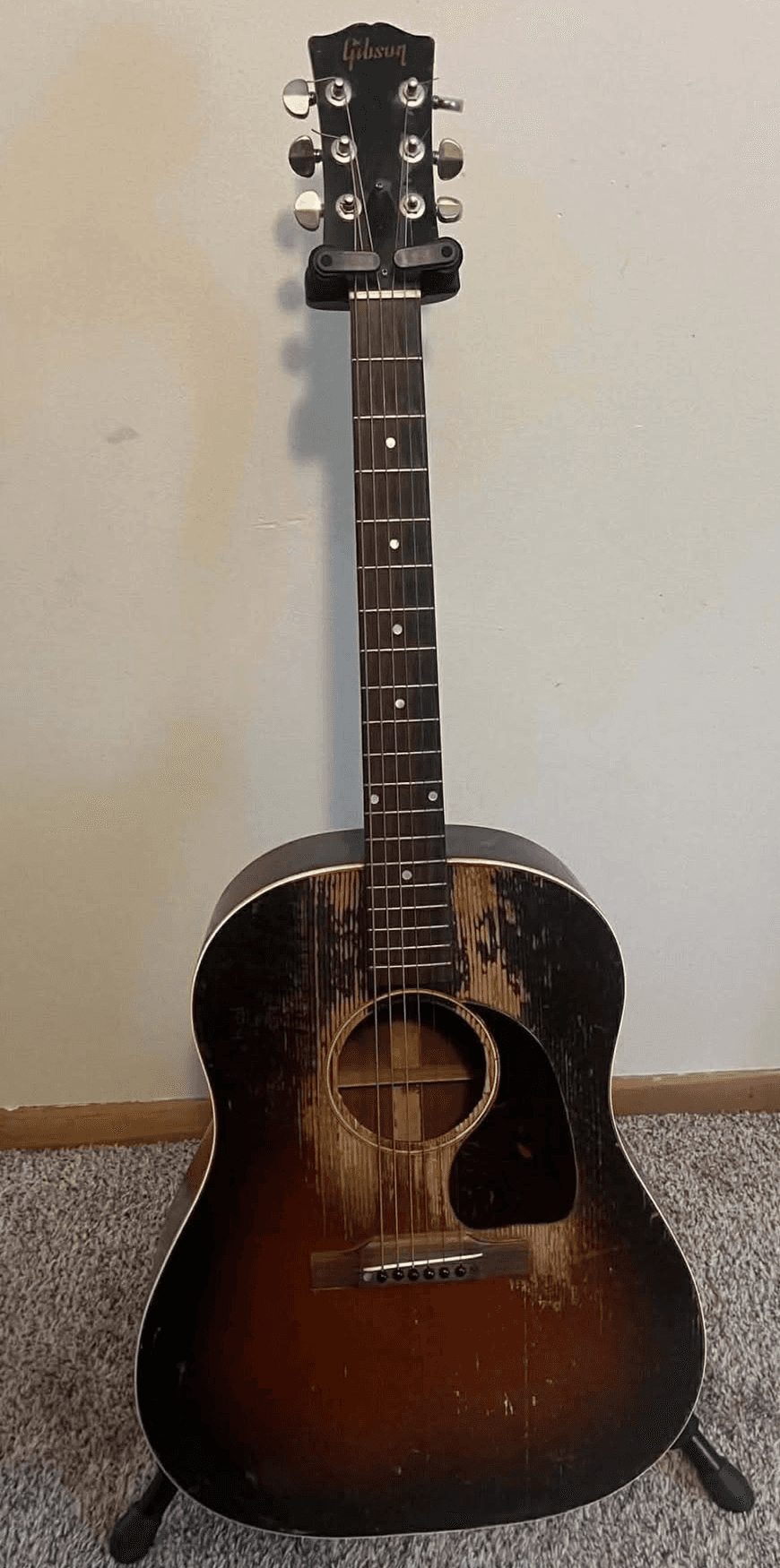
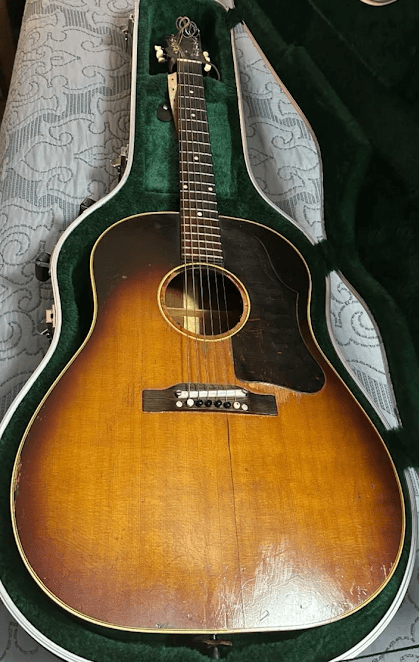
The Guitar: 1959 Gibson J-45 in sunburst — all-original with solid spruce top, mahogany back/sides, round-shoulder body, original rosewood bridge with adjustable saddle, original Kluson tuners, tortoiseshell teardrop pickguard, original sunburst nitrocellulose with 67-year aging. FON letter “N” confirmed 1959. Serial in A-42000 range. Two small professionally repaired top cracks. Original case.
The Seller: Family in Lima, Ohio. Inherited from father who played folk music.
The Transaction: Edgewater traveled to Lima. We verified round-shoulder body (confirms pre-square-shoulder era), confirmed solid spruce top and mahogany back/sides, inspected bracing through soundhole, assessed top crack repairs, verified original finish.
The Outcome: “The shop said ‘it’s a nice old Gibson but nothing special.’ Edgewater explained the 1959 J-45 is from the final year of Gibson’s golden decade — the same factory simultaneously producing the legendary Les Paul Standards and ES-335s. Their offer was nearly three times the shop’s quote.”
Edgewater Guitars: OH, MI, PA, IN, WV. Contact us: [link] | (440) 219-3607.
Sell your 1959 Gibson J-45
Edgewater Guitars buys vintage Gibson J-45s and other vintage Gibsons nationwide. We give free, honest appraisals and fair same-day cash offers, with local pickup or insured nationwide shipping. Call or text (440) 219-3607 or request a free estimate.
How much is a 1959 Gibson J-45 worth?
Value depends on originality, condition, finish, and whether the pickups and hardware are original. The most accurate way to find out is a free appraisal. Send a few photos and the serial number and we will give you an honest market assessment.
Where can I sell a 1959 Gibson J-45?
Edgewater Guitars buys them directly, nationwide, with same-day cash offers and no obligation. You can also date yours with our Gibson serial number lookup.