DATE :
Gibson Headstock Logo History: How to Date a Gibson by Its Logo

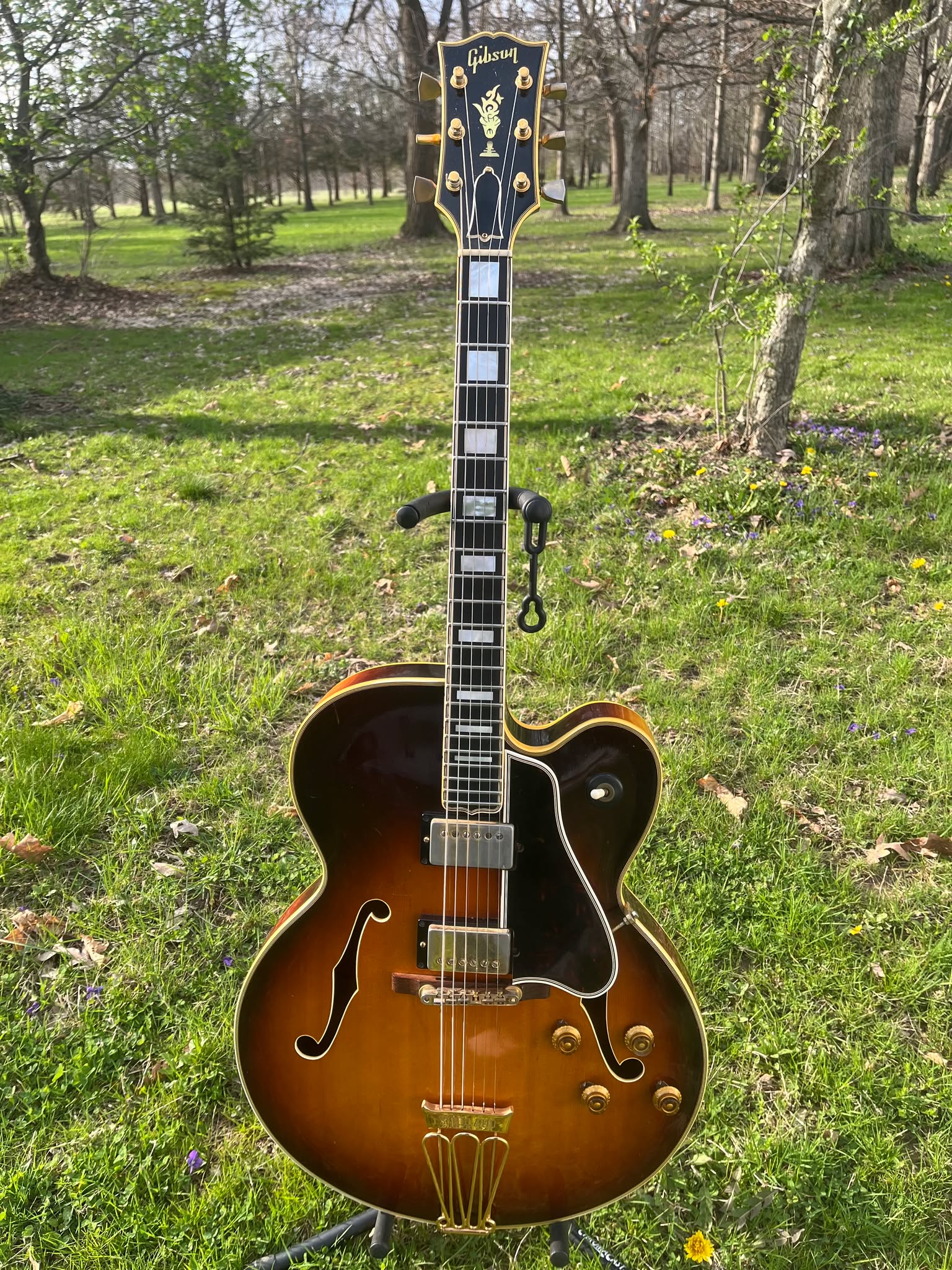
Gibson's headstock logo changed in a few clear steps: the slanted "The Gibson" script of the 1920s, the plain "Gibson" script of the 1930s and 1940s, the wartime banner, then the 1947 to 1948 block logo, which lost its dotted i in the late 1960s. Edgewater Guitars in Valley City, Ohio buys vintage Gibsons nationwide: call or text (440) 219-3607.
Gibson headstock logo chronology at a glance
The logo won't give you a year, but it narrows a Gibson to a decade or less before you touch a serial number. Dates below are approximate: Gibson phased changes in model by model and used up old parts, so the references disagree by a year or two at the edges.
Era | Logo | Other headstock tells | Usual dating read |
|---|---|---|---|
1900s to late 1920s | Slanted "The Gibson" script, pearl on better models | Narrow "snakehead" peghead from 1923; flowerpot on the L-5 | 1920s or earlier |
Late 1920s to mid-1930s | "The Gibson" set straight, then plain "Gibson" in thin script | White silkscreened logos on budget models from about 1928 | About 1928 to 1936 |
Mid-1930s to 1942 | Thick "Gibson" script; pearl on higher models, white silkscreen on budget ones | Pearl script on the Super 400, SJ-100 and ES-300 | About 1936 to 1942 |
1942 to 1945, some say early 1946 | Gold script over a gold banner: "Only a Gibson Is Good Enough" | Flat-tops only (J-45, Southern Jumbo, LG models) | World War II; the factory order number gives the year |
1946 to 1947 | Slanted, heavy gold "Gibson" script, no banner | Pearl on better models | The short postwar script window |
1947 or 1948 to 1951 | First block logo: dot over the i touching the G, open b and o, n joined to the o at the bottom | Gold silkscreen or decal logos on budget models | Dot touching the G: about 1948 to 1951 |
1951 to about 1968 | Block logo, dot floating free, open b and o | Crown drops about 3/4 inch on the ES-335 and ES-345 in late 1966 | 1950s through the late 1960s |
About 1968 to 1972 | No dot over the i on most models; b and o closed; pantograph logos from late 1968 | Volute from late 1969 or 1970; "MADE IN USA" stamp from 1970 | The dotless years, the strongest single logo tell |
1972 to 1981 | Dot back on most models from 1972; b and o still closed | Volute to 1981; eight-digit serials from 1977 | Norlin era; the serial gives the year |
1981 to present | Dotted i, open b and o, n joined to the o at the top | Volute gone by 1982 | Modern Gibson; the serial gives day and year |
"The Gibson" script logo: 1900s to the mid-1930s
The oldest Gibson logo reads "The Gibson" in flowing script, inlaid in pearl on a slant. The slant went first: by the late 1920s "The Gibson" sat straight across the peghead, and the pre-war L-5 archive at prewargibsonl-5.com has found no slanted example shipped after 1928.
Then "The" went, and here the references spread: guitarhq says 1928 to 1934 depending on the model, Wikipedia's L-5 entry 1929 to 1935, True Vintage Guitar's chart 1933 or 1934, and the L-5 archive shows its first plain-script L-5 shipped in 1930 and its last "The Gibson" L-5 in 1936. Net: a slanted "The Gibson" is 1920s or earlier, a straight one about 1928 to the mid-1930s, a thin "Gibson" script early 1930s.
The narrow "snakehead" peghead, which tapers toward the tuners, is a companion tell: 1923 to 1934 per guitarhq, gone from most models by 1927 and from the L-5 in August 1935 per the L-5 archive. And logo material follows the price list: pearl on the better models, a white silkscreened "Gibson" on budget guitars from about 1928 into the early 1940s, "the old stark white silkscreened 'Gibson' of the thirties" in Wikipedia's J-45 entry.
"Gibson" script and the wartime banner: mid-1930s to 1947
The script thickened in the mid-1930s, top models first and all models by the late 1930s (guitarhq; the L-5 archive calls the thick script standard after 1936). Vintage Guitar magazine describes "a thick pearl script Gibson logo" on a 1941 SJ-100 and a pearl script on the pre-war ES-300.
Then the war. From 1942, Gibson's flat-tops got a gold banner under the script reading "Only a Gibson Is Good Enough." Gibson's own brand history lists "The Banner Guitars (1942)" and calls the banner a decal. Every reference we checked shows it only on low and mid-priced flat-tops, the J-45, Southern Jumbo and LG models among them (American Songwriter's list adds the J-50, LG-1 and LG-3), built largely by women, the "Kalamazoo Gals."
The end date splits the references. Bannergibsons.com and True Vintage Guitar's serial chart say 1942 through 1945; True Vintage Guitar's banner article, Chicago Music Exchange and American Songwriter run it into early 1946; guitarhq starts it in 1943, and one Danish dealer guide ends it in 1947. Take 1942 to 1945 as the core, allow early 1946, and let the factory order number settle the year.
After the banner came a short postwar script, a slanted, heavy, gold "Gibson" with nothing under it: 1946 to 1947 on True Vintage Guitar's chart, shown slanted again in the mid-1940s by AntiquiTone and Thalia. Our 1946 Gibson LG-2 guide covers that window.
The block logo: 1947 to 1948, and the 1951 change
Gibson replaced the script with block letters right after the war: "phased in during 1947-'48" per Vintage Guitar magazine, 1947 per Thalia, Guitar Hunter and True Vintage Guitar, 1948 per guitarhq. Phased in by model is the honest answer, which is why two 1947 Gibsons can wear different logos.
Three traits mark the first block logo. The G and the n have tails that drop below the other letters (guitarhq). The dot over the i touches the G: 1948 to 1951 per guitarhq, "separated" by 1951 per Thalia. And the b and o are open, with the n joined to the o at the bottom. From 1951 the dot floats free, and that logo runs with small changes until the late 1960s.
Material still follows the price list: pearl inlay on better models, a gold silkscreen or decal on budget models (guitarhq dates the switch to decal at 1954). A gold logo on a budget model is original, not a refinish.
The late 1960s: the dot disappears and the pantograph arrives
The most useful change, and the most disputed. Between 1967 and 1969 the dot over the i vanished on most models and the b and o closed up: 1967 per Thalia, "between 1968 and 1972" on certain models per Guitar Hunter, "mostly in 1969" per Charlie Gelber's ES-335 blog. Read it as: no dot means roughly 1968 through the early 1970s, edges depending on the model.
The pantograph logo arrived in the same window. Instead of inlaying each pearl letter, Gibson inlaid a flat pearloid slab and painted over it so only the letters showed. Gelber says it "comes into common usage in late 1968"; Guitar Center's ES-335 timeline has inlaid logos giving way to "pantograph painted logos" in 1968; guitarhq dates the "pantograph style" closed-letter logo 1969 to 1984. Two dotless versions exist: open b and o, about 1968 to 1969, and closed b and o, 1969 into the 1970s.
1970 to 1981: Made in USA, the volute and the dot's return
Turn the guitar over. From 1970, Gibson stamped "MADE IN USA" into the back of the peghead under the serial number; guitarhq, True Vintage Guitar, Guitar Hunter and mycoolguitars.com's Norlin history all put the start at 1970. That settles the question Gibson's reused six-digit numbers create: a "1960s" serial with the stamp is a 1970s guitar.
The volute, a carved ridge on the back of the neck below the peghead, arrives at the same time, late 1969 (Guitar Hunter), 1969 (guitarhq) or 1970 (mycoolguitars, Guitar Center), and runs to 1981 (guitarhq, mycoolguitars) or about 1982 (Wikipedia's Les Paul Custom entry). The headstock also grew slightly wider, in 1968 per Guitar Center and the Les Paul Custom entry, 1969 per mycoolguitars.
On the front, the dot came back in 1972 on most models (Thalia, Guitar Hunter). "Most" is Guitar Hunter's word, so a dotless early-1970s Gibson is not automatically wrong; Thalia dates the current dotted, open-letter logo to 1981. The b and o stayed closed through the decade. From 1977 the eight-digit serial system makes the year easy; our Gibson serial number dating guide decodes it.
1981 to today: the modern logo
In 1981 the logo settled into the form Gibson still uses: dotted i, open b and o, the n joined to the o at the top. Thalia and Gelber both date it to 1981, Gelber adding that the older type "can be seen well into 1982"; guitarhq dates the open b and o from 1984. The volute was gone by 1982 and the 17-degree peghead angle back by 1983 (guitarhq). From here the logo stops helping: use the serial number.
Headstock shape and inlays as supporting tells
Peghead angle
Gibson cut the tilt-back angle from 17 to 14 degrees in the mid-1960s to reduce breaks: 1965 on the ES-335 family (Gelber, Guitar Center), 1966 (guitarhq), 1968 on the Les Paul Custom (Wikipedia). The return to 17 degrees is disputed too: 1973 on Les Pauls (59 Parts) or 1983 (guitarhq). Three degrees is hard to eyeball; treat it as a confirming detail.
The crown
The small pearl crown under the logo belongs to mid-line models such as the ES-335 and ES-345. Gelber documents a drop of about 3/4 inch in late 1966; Guitar Center has the crown "moved lower on the headstock" in 1966. A crown sitting low, near the middle tuners, says late 1966 or later.
The split diamond and the flowerpot
The split diamond marks the top of the line: the Super 400, and from it the 1953 Les Paul Custom and the ES-355 (Wikipedia). The flowerpot is the L-5's mark; Vintage Guitar magazine notes the 1970s L-5S borrowed one "similar to the L-5," and prewargibsonl-5.com traces it to the F-5 mandolin of 1922.
What the logo cannot tell you
Refinished headstocks
A refinish buries a silkscreen or decal under new lacquer, wipes it off, or hides the checking that should surround a pearl logo. A glossy, uncracked face on a 60-year-old guitar is a refinish until proven otherwise; look for overspray on the back of the peghead and the binding.
Replaced overlays
The logo sits in a veneer glued to the peghead face, and veneers get replaced. A replaced overlay carries whatever logo the repairer chose, so a period-correct logo on a repaired headstock proves nothing by itself.
Reissues that copy old logos
Gibson copies its own old logos on purpose. The banner returned on reissues in the 1990s (bannergibsons.com), and Gibson's own 1942 J-45 reissue page describes "the period-correct banner" under a gold logo. Reissues of 1950s and 1960s models copy the logo of the year they imitate; serial number and construction settle which is which.
So the logo starts the conversation and the numbers finish it: our Gibson serial number lookup, the serial number dating guide and the pot codes guide for the electronics, plus the Gibson acoustic dating guide and the Les Paul dating guide for those models. Or skip the homework and upload a photo for a free identification and value range.
Sell your vintage Gibson
Edgewater Guitars buys vintage Gibsons from every era in this guide, banner flat-tops and dotless ES-335s included, in any condition. Gavin Coe does the buying in Ohio, we travel for the right guitar, and we pay by check or cash the same day. We don't put values in a dating guide; the accurate answer for your guitar is a free appraisal. Get a free estimate or call or text (440) 219-3607. Our sell your Gibson page explains the process.
From a recent Google review: "Gavin was super helpful and fast in getting me a real world estimate for my vintage Gibson. I recommend using Edgewater." (Matt Clark, January 2026)
Frequently asked questions
When did Gibson switch from the script logo to the block logo?
Right after World War II. Vintage Guitar magazine says the block logo was phased in during 1947 and 1948; Thalia, Guitar Hunter and True Vintage Guitar start it in 1947, guitarhq in 1948. Phased in by model, so 1947 guitars turn up with either logo; the earliest block logos have the dot touching the G.
What does the dot over the i on a Gibson logo tell you?
Three things. A dot touching the G means the first block logo, about 1948 to 1951. A dot floating free means 1951 to the late 1960s, or 1972 onward. No dot means roughly 1968 to 1972 on most models, with exceptions. The references disagree on the exact edges by a year or two.
Is a Gibson with no logo, or no dot over the i, a fake?
Not on that evidence. A missing dot is a documented factory feature of the late 1960s and early 1970s. A missing logo is usually a worn silkscreen or decal on a budget model, or a refinished headstock. Judge the guitar by its serial number, factory order number, pot codes and construction, not the logo alone.
How do I date a Gibson with a banner headstock?
The banner puts it in World War II: 1942 through 1945 in most references, with some running into early 1946. For the year, find the factory order number stamped inside the body and check it against the FON section of our Gibson acoustic dating guide, or send us photos for a free appraisal: (440) 219-3607.
By Stephen Pedone, co-owner of Edgewater Guitars. Last updated: September 2026.
Sources
Gibson General Info (logos, pegheads, Made in USA), guitarhq / Vintage Guitars Info: guitarhq.com/gibson.html
Gibson ES-335 model info, guitarhq: guitarhq.com/es335.html
Gibson serial number lookup and guide, True Vintage Guitar: truevintageguitar.com
Gibson's golden banner "Only a Gibson is Good Enough", True Vintage Guitar: truevintageguitar.com
Banner Gibsons: bannergibsons.com
Gibson brand history (The Banner Guitars, 1942), Gibson: brandbook.gibson.com
1942 J-45 Legend features, Gibson (legacy site): legacy.gibson.com
Gibson ES-300, Vintage Guitar magazine: vintageguitar.com
1939-'42 Gibson SJ-100, Vintage Guitar magazine: vintageguitar.com
Gibson L-5S Ron Wood Signature, Vintage Guitar magazine: vintageguitar.com
Headstock Logos, Charlie Gelber, es-335.com: es-335.com
Headstock Angle, es-335.com: es-335.com
Early 58 to Early 59 Evolution, Part 2 (crown position), es-335.com: es-335.com
Head and neck, pre-war Gibson L-5 archive: prewargibsonl-5.com
The story of the Gibson flowerpot, pre-war Gibson L-5 archive: prewargibsonl-5.com
A Definitive History of Gibson Headstock Logos, AntiquiTone: antiquitone.com
The Evolution of the Gibson Logo, Thalia Capos: thaliacapos.com
How to date your vintage Gibson, Guitar Hunter: guitarhunter.dk
Gibson Norlin history, My Cool Guitars: mycoolguitars.com
The History of the Gibson ES-335, Guitar Center Riffs: guitarcenter.com
Vintage Vibes: 1945 Gibson Banner J-45, Chicago Music Exchange: chicagomusicexchange.com
"We Did Good Work": the Kalamazoo Gals and the WWII banner guitars, American Songwriter: americansongwriter.com
Gibson headstock angle, 59 Parts: 59parts.wordpress.com
Gibson J-45, Wikipedia: en.wikipedia.org
Gibson L-5, Wikipedia: en.wikipedia.org
Gibson ES-335, Wikipedia: en.wikipedia.org
Gibson Les Paul Custom, Wikipedia: en.wikipedia.org
Article