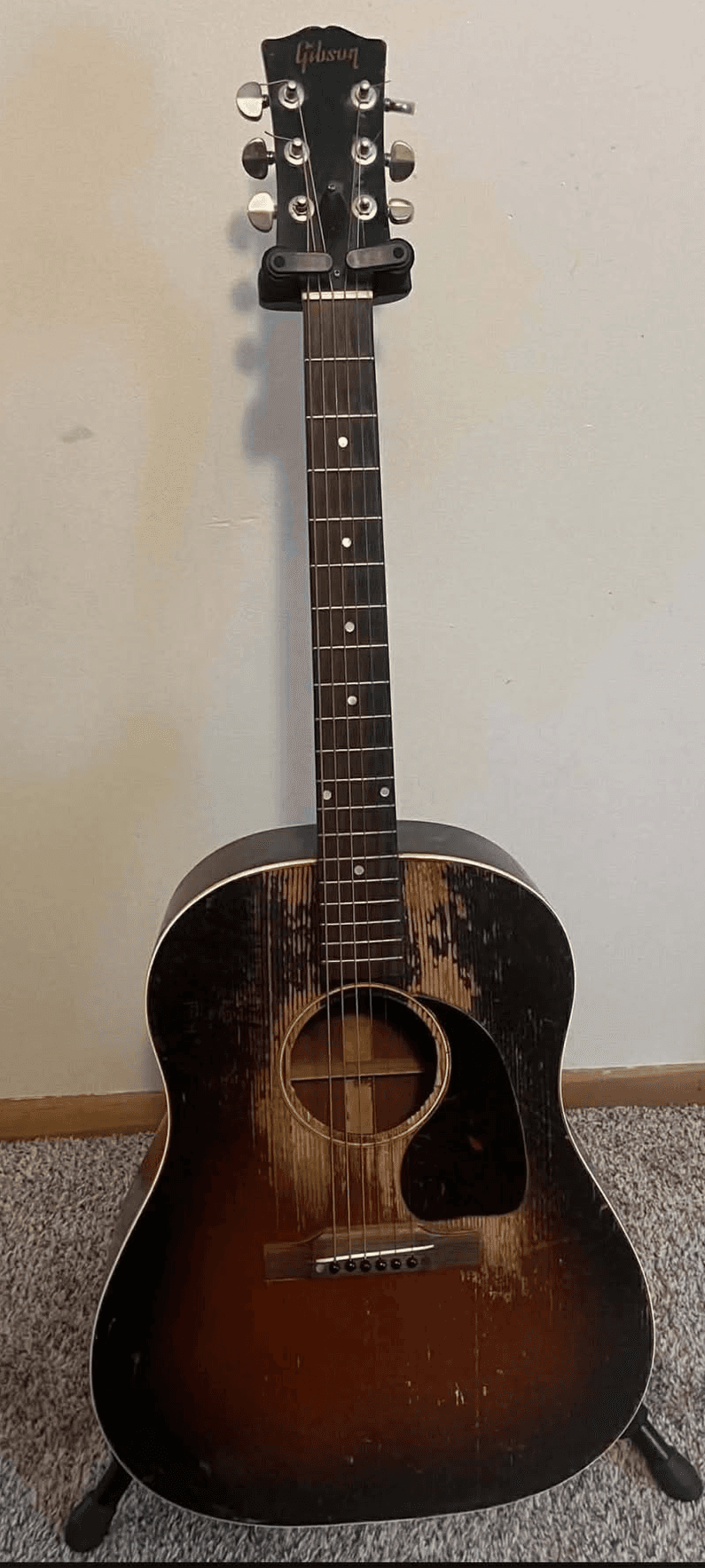
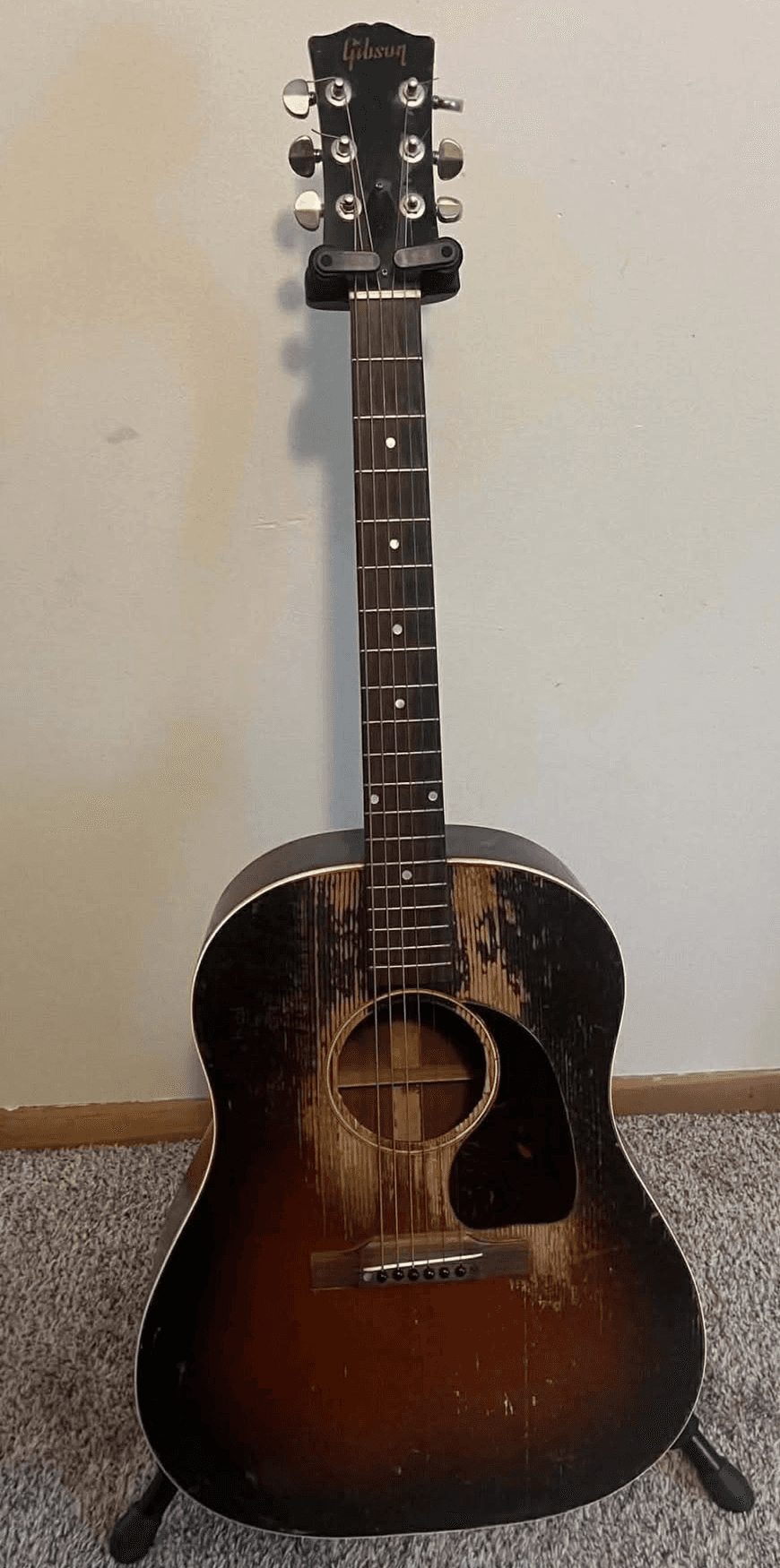
DATE :
How to Date Your Gibson Acoustic Guitar: Complete Identification Guide (1930s-1970s)
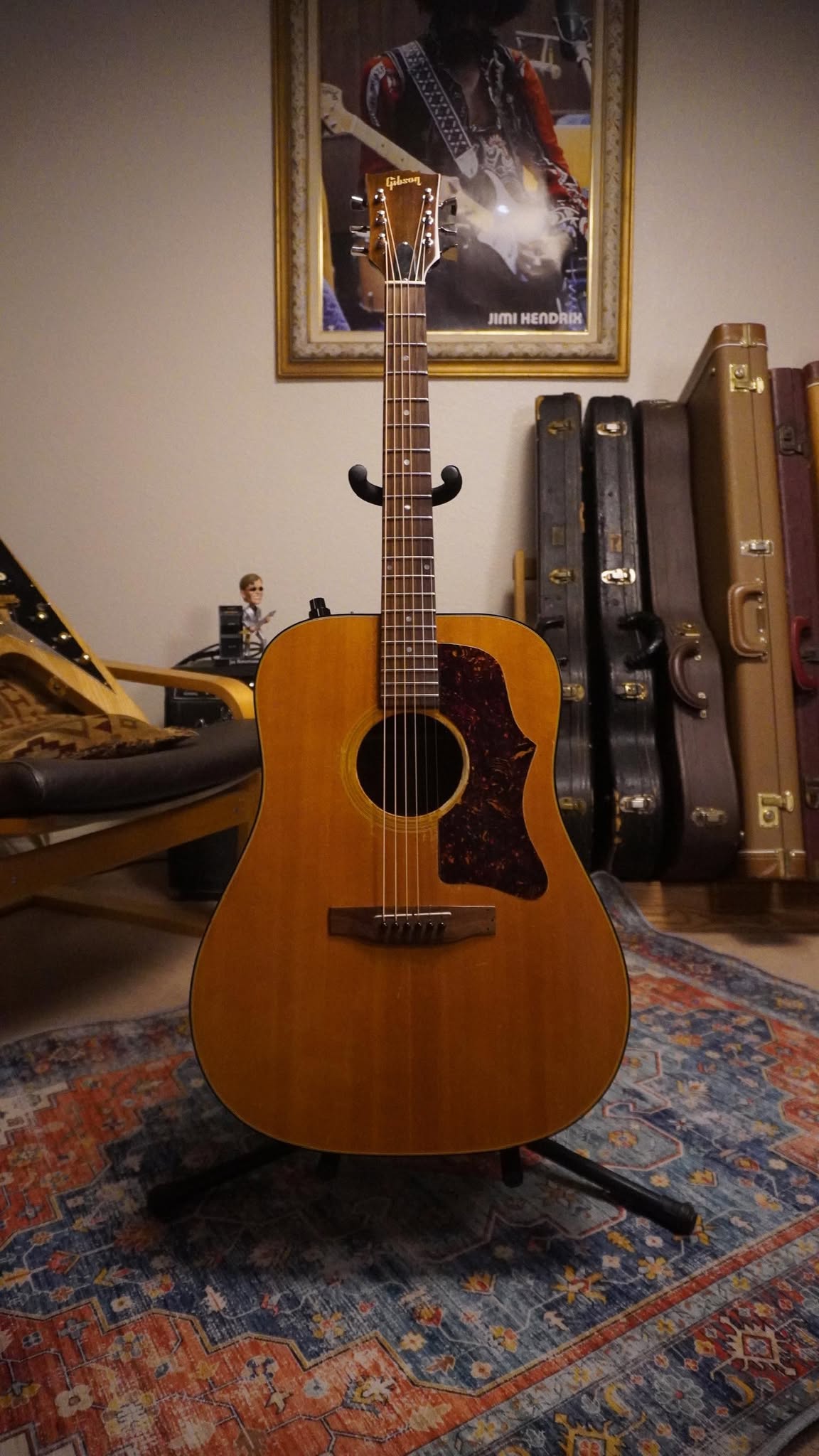
How to Date Your Gibson Acoustic Guitar: Complete Identification Guide (1930s-1970s)
Quick Answer: Dating Your Gibson Acoustic
To date your Gibson acoustic guitar, start by locating the serial number stamped inside the guitar body (visible through the soundhole on the neck block). Pre-1947 Gibsons use a straightforward numbering system, while 1947-1961 guitars have an impressed serial number on the back of the headstock. After 1961, Gibson switched to an ink-stamped system. Cross-reference the serial number with additional features like logo style, bracing pattern, and hardware to confirm the exact year.
Why Dating Your Gibson Acoustic Matters
If you’ve inherited a Gibson acoustic guitar, found one in an attic, or are simply curious about a guitar you’ve owned for years, knowing its exact age can reveal significant information about its value, authenticity, and historical importance.
Gibson acoustic guitars from the 1930s through 1970s represent some of the most valuable and sought-after instruments ever made. Pre-war (pre-1946) Gibson acoustics, particularly models like the Advanced Jumbo and Super Jumbo (later called the J-200), can be worth substantial sums even in played condition.
Understanding your guitar’s age helps you:
Assess its potential value in the vintage guitar market
Identify rare or desirable features that increase collectibility
Make informed decisions about selling, keeping, or restoring the instrument
Avoid being undervalued by buyers who may not recognize what you have
Understand its place in Gibson’s manufacturing history
Where to Find Serial Numbers on Gibson Acoustic Guitars
Inside the Guitar Body (1902-1947)
The most common location for Gibson acoustic serial numbers before 1947 is stamped on the neck block inside the guitar body.
How to find it:
Look through the soundhole (the round opening on the guitar’s front)
Direct a flashlight toward the body’s interior where the neck meets the body
You should see a stamped number on the wooden block
The number may be faint or partially obscured by finish
What you’ll see: A 3-digit to 5-digit number stamped into the wood
Back of the Headstock (1947-1961)
Starting in 1947, Gibson began impressing serial numbers on the back of the headstock (the top part of the guitar where the tuning pegs are located).
How to find it:
Turn the guitar over so you’re looking at the back
Look at the top portion where “Gibson” is inlaid on the front
The serial number will be impressed (pressed into the wood)
Numbers typically appear as 5 or 6 digits
These impressed numbers are harder to fake than ink stamps, making them more reliable for authentication.
Ink Stamp Inside (1961-1975)
In 1961, Gibson moved to an ink-stamped serial number system placed inside the guitar body.
How to find it:
Look through the soundhole
Check the underside of the top (the guitar’s “ceiling”)
You may need to angle the guitar to catch light on the stamp
Numbers appear in orange, red, or black ink
Factory Order Numbers (FON) may also appear stamped or written in pencil inside the guitar during this era, providing additional dating information.
Gibson Acoustic Serial Number Dating Guide
Pre-1902: No Serial Numbers
The earliest Gibson mandolins and guitars had no standardized serial number system. Dating relies entirely on construction features, labels, and provenance.
1902-1947: Sequential Numbering System
Gibson used a relatively straightforward sequential numbering system during this era, though some overlap exists and numbers weren’t perfectly sequential.
Approximate Serial Number Ranges:
Year Range | Serial Numbers | Notes |
|---|---|---|
1902-1906 | 100-1500 | Earliest numbered instruments |
1906-1909 | 1500-3000 | |
1910-1912 | 3000-8000 | |
1913-1915 | 8000-11000 | |
1916-1917 | 11000-16000 | |
1918-1922 | 16000-40000 | Production increased during WWI |
1923-1925 | 40000-47000 | |
1926-1927 | 47000-52000 | |
1928-1929 | 52000-62000 | Late 1920s boom |
1930-1934 | 62000-82000 | Depression era, slower production |
1935-1937 | 82000-96000 | Advanced Jumbo introduced 1936 |
1938-1940 | 96000-99999 | Super Jumbo (J-200) introduced 1938 |
1941-1943 | 99999-A1500 | “A” prefix introduced when 99999 reached |
1944-1945 | A1500-A2500 | Limited wartime production |
1946-1947 | A2500-A5000 | Post-war production resumption |
Important Notes:
Serial numbers from this era can have overlap between years
Some instruments received “batch” numbers rather than sequential numbers
L-5 models and other arch-top guitars sometimes followed different numbering
Always cross-reference with other dating features
1947-1961: Impressed Serial Numbers
In 1947, Gibson switched to impressing (stamping into the wood) serial numbers on the back of the headstock.
Serial Number Ranges:
Year | Serial Number Range |
|---|---|
1947 | A 5000 - A 9000 |
1948 | A 9000 - A 15000 |
1949 | A 15000 - A 18000 |
1950 | A 18000 - A 21000 |
1951 | A 21000 - A 24000 |
1952 | A 24000 - A 26000 |
1953 | A 26000 - A 29000 |
1954 | A 29000 - A 32000 |
1955 | A 32000 - A 35000 |
1956 | A 35000 - A 38000 |
1957 | A 38000 - A 42000 |
1958 | A 42000 - A 47000 |
1959 | A 47000 - A 54000 |
1960 | A 54000 - A 59000 |
1961 | 001 - 9999 (new system) |
What the “A” means: Simply a prefix indicating the new numbering system
1961 Transition: Late in 1961, Gibson began transitioning to a new numbering system without the “A” prefix, starting over at lower numbers.
1961-1970: Ink-Stamped Serial Numbers
Starting in 1961, Gibson moved to ink-stamped numbers inside the guitar body.
Serial Number Ranges:
Year | Serial Number Range |
|---|---|
1961 | 100-42440 |
1962 | 42441-61180 |
1963 | 61181-64220 |
1964 | 64221-70500 |
1962-1964 | Also some instruments with letter prefixes |
1963-1967 | Some “reversed” 6-digit numbers (read backwards) |
1967 | Numbers reach 999999 |
1967-1969 | System becomes unreliable, many duplicates |
1970 onwards | New letter prefix system implemented |
The “Crazy Years” (1967-1969): During this period, Gibson’s serial number system became chaotic. You may find:
Duplicate numbers on different guitars
Numbers that don’t correlate with production dates
Missing or illegible stamps
Inconsistent placement
If your guitar falls into this era, you’ll need to rely heavily on other dating features.
1970-1975: Letter Prefix System
In 1970, Gibson introduced a new system using letter prefixes to indicate the year.
Letter Codes:
Year | Letter Prefix | Example |
|---|---|---|
1970 | None or “A” | A123456 |
1971 | A | A234567 |
1972 | A | A345678 |
1973 | A | A456789 |
1974 | B, C, D, E, F | B123456 |
1975 | 00 prefix | 00123456 |
Additional Complexity: The letter didn’t always correspond perfectly to the production year. Some guitars made late in one year might have the next year’s prefix.
Factory Order Numbers (FON): A Backup Dating Method
In addition to serial numbers, Gibson used Factory Order Numbers (FON) to track batches of instruments through production.
Where to find FONs:
Stamped inside the guitar body
Written in pencil on internal braces
Stamped on the back of the headstock (some years)
How to read FONs:
The FON typically consists of a batch number followed by a ranking number.
Format: XXX Y ZZ
XXX = Batch number
Y = Ranking within the batch (letter or number)
ZZ = Year (last two digits)
Example: “865 3 57”
Batch 865
3rd instrument in batch
Year 1957
Why FONs matter: If the serial number is illegible, damaged, or missing, the FON can provide critical dating information. FONs are also harder to fake than serial numbers, making them valuable for authentication.
Visual Identification: Dating Features Beyond Serial Numbers
Serial numbers tell only part of the story. Gibson made numerous changes to construction, materials, and design over the decades. Cross-referencing multiple features gives you the most accurate dating.
Headstock Logo Evolution
The Gibson logo changed significantly over the years, making it one of the most reliable dating features.
Pre-1920s: “The Gibson” Script
Ornate, flowing script
Often accompanied by Mandolin-Guitar Mfg. Co. Ltd
“The Gibson” typically inlaid in pearl
1920s-1933: “The Gibson” Script Continues
Still the pearl-inlaid script logo; “The” was gradually dropped so plain “Gibson” became standard by 1933
Pearl inlay
Often larger and more prominent
1933-1947: Script “Gibson” Logo (Banner Decal, 1942-1946)
“The” was dropped, leaving the famous “Gibson” script logo
A gold “Only a Gibson Is Good Enough” banner decal appeared below the logo from about mid-1942 to early 1946, then was dropped
This style became iconic
1947-1950s: Script Logo
Script logo continues
Crown may or may not be present
The banner-era “Only a Gibson is Good Enough” decal had already ended by this period (it ran mid-1942 to early 1946)
1960s-1970s: Modern Script
Thinner, more refined script
Logo becomes more standardized
Body Bracing Patterns
The internal bracing (the wooden supports inside the guitar) changed over time and significantly affects tone and value.
Pre-1938: Standard X-Bracing
Centered X-bracing under the soundhole
Scalloped (carved) on high-end models
Non-scalloped on standard models
1938-1944: Forward-Shifted X-Bracing
X-bracing moved forward toward the bridge
Created louder, more powerful sound
Used on Advanced Jumbo and J-45 models
Highly desirable feature on vintage guitars
1944-1946: Large Soundhole Reinforcement
Added reinforcement around soundhole
Response to wartime material shortages
Post-War: Various Patterns
Return to more traditional patterns
Varies significantly by model
Why this matters: Forward-shifted bracing from the late 1930s-early 1940s is particularly valuable to collectors and significantly affects the guitar’s sound quality and market value.
Tuner Types and Evolution
The tuning machines (tuners/tuning pegs) changed over the decades and provide additional dating clues.
Pre-1930s: Individual Enclosed Tuners
Individual housings for each tuner
Often branded Waverly or Grover
1930s-1940s: Open-Gear Tuners
Grover or Kluson brand
Visible gears
Three-on-a-plate configuration common
1950s: Kluson Deluxe
Sealed tuners become more common
Kluson Deluxe style
Individual or strip mounting
1960s-1970s: Various Modern Tuners
Grover Rotomatics introduced
Enclosed tuners standard
Often gold-plated on high-end models
Bridge Styles
Pre-1930s: Pyramid Bridge
Pointed “pyramid” ends
Adjustable saddle
Ebony construction on high-end models
1930s-1950s: Belly Bridge
Rounded “belly” ends introduced around 1936
Became standard on most models
Pin-style (not adjustable saddle)
1960s-1970s: Modern Adjustable Bridge
Return to adjustable saddle bridges on some models
Rosewood more common than ebony
Fingerboard Inlays
Inlay patterns help identify models and eras:
Dot Inlays
Standard on entry and mid-level models
Used throughout Gibson’s history
Less valuable than fancier inlays
Slotted Diamond Inlays
Common on 1930s-1940s models
Associated with the Southern Jumbo
Distinctive parallelogram shape
Pearl Block Inlays
Used on higher-end models
Common on L-series guitars
Larger, rectangular blocks
Hexagon Inlays
Associated with high-end models like the J-200
Mother-of-pearl material
Very distinctive and valuable
Binding Materials
The decorative binding around the guitar’s edges changed over time:
Pre-War (Before 1946)
Multi-ply binding on high-end models
Ivoroid (celluloid) material
Black/white/black layering common
Post-War
Simpler binding on most models
Plastic binding becomes more common
Single-ply on entry models
Finish Characteristics
Pre-War Finishes (Before 1946)
Nitrocellulose lacquer (thin, breathable)
Natural “checking” (fine cracks in finish)
Often shows amber tinting with age
Sunburst finishes may show significant fading
Post-War Finishes
Initially continued nitrocellulose
Thicker applications over time
1970s saw introduction of thicker poly finishes
What to look for:
Fine checking/crazing indicates vintage nitrocellulose finish
Thick, plastic-feeling finish suggests later production or refinish
Original finishes show wear patterns consistent with age
How to Identify Specific Gibson Acoustic Models
Once you’ve dated your guitar, identifying the specific model helps assess value. Here are the most significant Gibson acoustic models from the 1930s-1970s:
J-45 (Introduced 1942)
Identifying Features:
Round-shouldered dreadnought body
Sunburst finish (standard)
Dot inlays
Simple binding
“Only a Gibson is Good Enough” banner pickguard (early years)
What makes them valuable:
Pre-war J-45s (1942-1946) extremely rare and valuable
Post-war “banner” J-45s (1946-early 1950s) highly collectible
1950s examples with forward-shifted bracing desirable
Natural finish versions from any era command premium
Common characteristics:
Mahogany back and sides
Spruce top
Entry-level model but beloved for tone
Southern Jumbo (Introduced 1942)
Identifying Features:
Round-shouldered dreadnought body
Sunburst finish standard
Slotted diamond (parallelogram) inlays
Multi-ply binding
Distinguished from J-45 by fancier appointments
What makes them valuable:
All pre-war Southern Jumbos extremely rare
Post-war examples through early 1950s highly collectible
Brazilian rosewood versions (some years) particularly valuable
Production note: Discontinued around 1943, making all examples quite rare
J-200/Super Jumbo (Introduced 1938)
Identifying Features:
Large jumbo body (17” wide)
Highly decorative “mustache” bridge
Elaborate pickguard with floral design
Hexagon (later block) fingerboard inlays
Multi-ply binding throughout
Gold-plated hardware
What makes them valuable:
Pre-war examples (1938-1942) exceptionally rare
Natural finish versions command significant premium
Celebrity-owned or associated J-200s particularly valuable
Maple back and sides standard
Name change: Originally called “Super Jumbo” until around 1939 when it became the J-200
Advanced Jumbo (1936-1940)
Identifying Features:
Round-shouldered dreadnought body
Sunburst finish
Hexagon fingerboard inlays
Fancy binding
“Advanced Jumbo” stamped inside
Why they’re exceptionally valuable:
Only produced for approximately 4 years
Total production estimated at fewer than 300 guitars
Featured revolutionary forward-shifted bracing
Considered among the finest flat-top guitars ever made
Brazilian rosewood back and sides
Pre-war construction at its finest
Market significance: These are among the most valuable vintage Gibson acoustics, with exceptional examples commanding prices similar to pre-war Martin D-45s
L-00 (1932-1946)
Identifying Features:
Small-bodied guitar (13.5” wide)
Flat-top design
Mahogany back and sides (standard)
Dot inlays
Sunburst or natural finish
What makes them valuable:
Robert Johnson association (blues history)
Pre-war examples particularly sought-after
Excellent recording guitars
Banner logo versions from 1940s collectible
SJ-200 (Later J-200 Production)
Identifying Features:
Similar to earlier J-200/Super Jumbo
Continued production post-war
Variations in appointments over the decades
Distinguishing different eras:
1950s: Brazilian rosewood, detailed appointments
1960s: Indian rosewood (late 1960s), simplified features
1970s: Modern appointments, less collectible than earlier
Hummingbird (Introduced 1960)
Identifying Features:
Square-shouldered dreadnought body
Cherry sunburst finish standard
Distinctive hummingbird pickguard design
Parallelogram inlays
Mahogany back and sides
Value considerations:
Early 1960s examples most desirable
Pre-1969 examples have better construction quality
1970s examples less collectible but still valuable
Dove (Introduced 1962)
Identifying Features:
Large square-shouldered dreadnought
Maple back and sides
Elaborate dove pickguard design
Natural or sunburst finish
Split-parallelogram inlays
Value points:
1960s examples more desirable than 1970s
Natural finish versions often preferred
Pre-1969 examples command premium
B-25 (1960s-1970s)
Identifying Features:
Budget model
Simple appointments
Mahogany back, sides, and top (many examples)
Minimal binding
Dot inlays
Market position:
Entry-level vintage Gibson
Still valuable as player-grade instruments
Not as collectible as higher-end models
Common Problems and Warning Signs
Authenticity Red Flags
When examining an older Gibson acoustic, watch for these warning signs that may indicate a fake, heavily modified, or misrepresented instrument:
Serial Number Issues
Serial number doesn’t match the guitar’s features or construction
Number appears fresh or recently re-stamped
Wrong font or style for the era
Number placement inconsistent with Gibson standards
Headstock Concerns
Logo style doesn’t match the supposed era
“Gibson” inlay appears newer than guitar
Evidence of removed or replaced logos
Repairs to headstock (common break point)
Finish Problems
Refinished guitars have significantly less value
Look for overspray on hardware
Check binding edges for signs of sanding
Modern finishes on supposedly vintage guitars
Inconsistent finish aging
Interior Inspection
Check for routed pickup cavities (indicates conversion to electric)
Look for added or removed bracing
Inspect for structural repairs
Check for water damage or cracks
Common Repairs That Affect Value
Acceptable Repairs (Minimal Impact)
Professional crack repairs (if done well)
Bridge reglue or replacement
Nut and saddle replacement
Fret replacement (if period-correct)
Stable headstock repair by reputable luthier
Value-Impacting Issues
Refinishing (-40-60% of value)
Headstock breaks (-20-40%)
Replaced neck (-50%+)
Major structural damage
Bridge plate replacement
Modified bracing
Condition Assessment
Understanding condition helps you communicate accurately with potential buyers:
Excellent Original Condition
All original parts and finish
Minimal play wear
No repairs beyond setup work
Original case (if applicable)
Clean interior
Very Good Condition
All original
Normal play wear
Possible minor repairs (reglued bridge, etc.)
Stable and playable
Good Condition
May have some replaced parts
Shows significant play wear
May have professional repairs
Still fully functional
Fair/Poor Condition
Heavy wear or damage
Needs significant repair work
May have incorrect parts
Still valuable if rare model
Why Pre-War Gibson Acoustics Are So Valuable
Understanding pre-war (pre-1946) Gibson acoustics helps you recognize if you have something exceptional.
Superior Materials
Brazilian Rosewood
Many pre-war Gibson models featured Brazilian rosewood backs and sides. This wood is:
Now protected and unavailable for new instruments
Highly resonant with complex overtones
Visually distinctive with deep color and tight grain
Significantly more valuable than Indian rosewood
Adirondack Spruce
Pre-war tops were often made from Adirondack (Red) spruce:
Stronger and lighter than modern Sitka spruce
Old-growth timber with tight grain
Contributes to powerful, complex tone
No longer commercially available in sufficient quantities
Mahogany
Old-growth Honduran mahogany:
Denser and more resonant than modern alternatives
Tighter grain structure
Contributes to richer tone
Construction Quality
Hand Craftsmanship
Individual attention to each instrument
Hand-carved braces
Hand-shaped necks
Careful wood selection
Scalloped Bracing
High-end pre-war models featured scalloped (hand-carved) bracing:
Removes excess mass while maintaining strength
Allows top to vibrate more freely
Creates more dynamic response
Labor-intensive process rarely used on modern production guitars
Forward-Shifted Bracing (1938-1944)
This revolutionary feature:
Moved X-bracing toward the bridge
Created unprecedented volume and projection
Distributed stress differently across the top
Became the template for modern dreadnought design
Limited Production Numbers
Great Depression reduced production
WWII halted civilian guitar production (1943-1945)
Many pre-war guitars didn’t survive
Attrition through damage, modification, or loss
Historical Significance
Pre-war Gibson acoustics represent:
The golden age of American guitar building
Innovation in acoustic guitar design
The pre-corporate era of guitar manufacturing
Instruments played by pioneering recording artists
Assessing Your Guitar’s Value Potential
While we cannot provide specific dollar figures (as values fluctuate), understanding what makes certain Gibson acoustics more valuable helps you assess what you have.
Factors That Significantly Increase Value
Originality
All-original finish, parts, and hardware
No modifications or repairs
Original case and documentation
Impact: Original condition can double or triple value compared to modified examples
Pre-War Production (Pre-1946)
Generally much more valuable than post-war
Advanced Jumbo, Southern Jumbo, early J-45 particularly sought-after
Pre-war J-200/Super Jumbo exceptionally rare
Impact: Pre-war examples often worth 3-10x more than 1950s equivalents
Rare Models
Limited production models
Models produced for only a few years
Special edition or custom-ordered instruments
Impact: Rarity can multiply value significantly
Desirable Features
Brazilian rosewood back and sides
Forward-shifted bracing (1938-1944)
Scalloped bracing
Sunburst finish (on most models)
Natural finish (on certain models like J-45)
Impact: Each desirable feature compounds value
Celebrity Association
Documented provenance linking to famous musicians
Photos or video of famous players with specific instrument
Original purchase documents from notable owners
Impact: Can multiply value many times over
Condition
Excellent original condition commands premium
Clean, crack-free examples
Minimal play wear
Functional and playable
Impact: Excellent condition vs. fair condition can mean 2-3x price difference
Factors That Decrease Value
Refinishing
Impact: -40% to -60% of value
Modern finishes on vintage guitars
Overspray visible on hardware
Loss of original patina
Headstock Repairs
Impact: -20% to -50% depending on quality
Common break point on vintage guitars
Well-done repairs less damaging than poor repairs
Clean breaks repaired professionally have less impact
Modified Bracing
Impact: -30% to -70%
Changed from original bracing pattern
Removed or modified scalloping
Amateur repairs
Replaced Neck
Impact: -50% or more
Nearly impossible to restore full value
Changes fundamental character of instrument
Incorrect Parts
Impact: -10% to -30%
Non-period-correct tuners
Wrong bridge
Incorrect pickguard
Structural Issues
Impact: Varies based on severity
Cracks that affect playability
Top bellying (warping)
Loose braces
Separated seams
What If Your Serial Number Doesn’t Match Expected Features?
Serial number discrepancies are more common than you might think. Here’s what might be happening:
Factory Order Numbers vs Serial Numbers
You may have found a Factory Order Number instead of the serial number. Recheck both inside the guitar and on the headstock.
Transitional Instruments
Guitars built during transitional periods (1947, 1961, 1970) may have features from multiple years:
Parts from previous year’s inventory
New features being phased in
Experimental changes
Special Orders or Custom Builds
Some instruments were built to special order with non-standard features:
Custom neck profiles
Unusual finish colors
Special inlays or appointments
Repair or Replacement Parts
The guitar may have had period-correct parts replaced:
Replaced necks (common with headstock breaks)
Replaced bridges
Replaced tuners
Deliberate Counterfeits
Unfortunately, valuable vintage Gibson acoustics are sometimes faked:
Serial numbers stamped to match valuable years
Period-incorrect parts
Refinished guitars made to look original
If something doesn’t add up, consult an expert. At Edgewater Guitars, we provide free authentication services and can help you determine exactly what you have.
Comprehensive FAQ: Gibson Acoustic Guitar Dating
How do I find the serial number on my Gibson acoustic guitar?
Look in three places: (1) Inside the guitar through the soundhole, stamped on the neck block (pre-1947), (2) On the back of the headstock, impressed into the wood (1947-1961), or (3) Inside the guitar, ink-stamped on the underside of the top (1961-1975). Use a flashlight to examine the inside carefully.
What does the serial number tell me about my Gibson acoustic?
The serial number primarily tells you the approximate year of manufacture. However, Gibson’s numbering systems changed several times, and there were periods (especially 1967-1969) where the system was unreliable. Always cross-reference the serial number with other dating features like logo style, bracing pattern, and hardware.
Are older Gibson acoustic guitars more valuable?
Generally, yes—particularly pre-war (pre-1946) Gibson acoustics. However, age alone doesn’t determine value. A 1970s Gibson in excellent original condition may be worth more than a refinished 1940s guitar with structural issues. Pre-war instruments command premium prices due to superior materials, craftsmanship, and rarity.
What if my Gibson doesn’t have a serial number?
Very early Gibson instruments (pre-1902) may lack serial numbers. If you have a guitar that appears vintage but has no number, it could be: (1) A very early example, (2) A guitar where the number has worn off or been obliterated, (3) A student or budget model that didn’t receive a number, or (4) Possibly not an authentic Gibson. Check for other identifying marks, labels, or stamps.
How can I tell if my Gibson acoustic has been refinished?
Check for these signs: overspray on hardware or binding, sanding marks visible under certain lighting, finish in unusual places (like inside the control cavity on later models), modern finish types (thick polyurethane on a supposedly vintage guitar), or lack of appropriate aging characteristics like checking/crazing. Refinishing significantly reduces value.
What is a Factory Order Number (FON) and how does it help?
A Factory Order Number is a batch tracking number Gibson used internally. It appears stamped or written in pencil inside the guitar and typically contains a batch number and year code. FONs provide a backup dating method when serial numbers are unclear or missing, and they’re harder to fake than serial numbers.
Why is forward-shifted bracing important?
Forward-shifted bracing (used 1938-1944) moved the X-bracing toward the bridge, creating more volume, better projection, and improved bass response. This innovation is considered one of Gibson’s greatest contributions to acoustic guitar design. Guitars with original forward-shifted bracing are significantly more valuable and desirable to players and collectors.
How much is my vintage Gibson acoustic worth?
Value depends on numerous factors: model, year, condition, originality, rarity, and market demand. Pre-war models in excellent original condition can be worth substantial sums, while common 1970s models in fair condition have modest value. For an accurate assessment, contact a reputable vintage guitar buyer who specializes in Gibson instruments. Edgewater Guitars offers free, no-obligation valuations.
Should I restore or repair my vintage Gibson before selling?
Generally no. Amateur repairs or modifications can reduce value significantly. Professional restoration might be appropriate for high-value instruments, but only if done by a reputable luthier who specializes in vintage instruments. For most sellers, presenting the guitar in original condition (even with issues) is better than attempting repairs yourself.
What’s the difference between Brazilian and Indian rosewood?
Brazilian rosewood (used pre-1969) is now protected and unavailable for new instruments. It’s denser, more resonant, and visually distinctive with tighter grain and richer color. Indian rosewood (used 1969 onward) is an excellent tonewood but less rare. Guitars with Brazilian rosewood backs and sides command significant premiums.
Are Gibson acoustic guitars from the 1960s and 1970s valuable?
Yes, though typically not as valuable as earlier instruments. Early 1960s Gibsons (1960-1965) are particularly desirable. Quality declined somewhat during the late 1960s-1970s under Norlin ownership, but models like the Hummingbird, Dove, and J-45 from this era still have significant value, especially in excellent original condition.
What does “banner” mean on vintage Gibson guitars?
The “banner” refers to a gold headstock decal used on many models (including the J-45) from about mid-1942 to early 1946. It features a banner graphic with “Only a Gibson is Good Enough” text below the logo. Banner-era J-45s are particularly collectible.
How do I know if I have an Advanced Jumbo?
Look inside the guitar for “Advanced Jumbo” stamped on the neck block. These guitars (made 1936-1940) have round-shouldered dreadnought bodies, hexagon fingerboard inlays, fancy binding, and sunburst finish. Total production was under 300 instruments, making them exceptionally rare and valuable.
Is my Gibson more valuable with or without repairs?
It depends on the repair. Well-executed professional repairs by reputable luthiers (bridge reglue, stable crack repair, professional fret work) have minimal impact on value and make the guitar more playable. Refinishing, amateur repairs, replaced necks, or modified bracing significantly reduce value. When in doubt, consult an expert before authorizing any work.
What’s the best way to sell my vintage Gibson acoustic?
You have several options: (1) Sell to a specialized vintage guitar dealer who can offer fair immediate payment, (2) Consignment through a reputable shop (lengthy process with fees), (3) Private sale through online platforms (time-consuming, requires expertise), or (4) Auction (appropriate for extremely rare/valuable pieces). Specialized dealers like Edgewater Guitars typically pay 30-40% more than general music shops because of their expertise in recognizing value.
How Edgewater Guitars Can Help
Expert Authentication and Dating Services
If you’re uncertain about your Gibson acoustic’s age, model, or authenticity, Edgewater Guitars offers free authentication and dating services. Our team of vintage guitar specialists can:
Verify serial numbers and cross-reference features
Identify your specific model and year
Assess originality and condition
Explain value factors specific to your instrument
Provide documentation of findings
Fair Market Valuations
Understanding your guitar’s value is crucial whether you’re selling or simply want to know what you own. We provide:
Free, no-obligation valuations
Market-based pricing that reflects current demand
Honest assessment of condition and originality
Explanation of value factors
Comparison to recent sales of similar instruments
Hassle-Free Selling Process
If you decide to sell your vintage Gibson acoustic, Edgewater offers:
Premium pricing: Consistently 30-40% higher than local music shops
Immediate payment: No consignment fees or waiting periods
Expert handling: We understand the value and treat instruments accordingly
Service area coverage: Ohio, Michigan, Pennsylvania, Indiana, and West Virginia
In-person evaluation: For high-value instruments, we come to you
Transparent process: No hidden fees or surprise deductions
Why Vintage Guitar Specialists Pay More
General music shops need to resell instruments at retail prices, requiring 50-60% margins. At Edgewater Guitars:
We have specialized buyer networks seeking specific vintage instruments
Our expertise allows us to recognize valuable features others might miss
We understand the vintage market and can accurately assess demand
We buy for both inventory and specific customer requests
Our reputation depends on fair dealings with sellers
Client Testimonials
“I inherited my father’s 1940s Gibson acoustic and had no idea what I had. Edgewater authenticated it as a rare Southern Jumbo and paid me considerably more than the three music shops I contacted. The whole process took one afternoon.” — Margaret T., Cleveland, OH
“After researching my grandfather’s old Gibson, I contacted several buyers. Edgewater not only offered the highest price but took time to explain exactly what made the guitar valuable. They really know their stuff.” — James R., Pittsburgh, PA
Next Steps: Getting Your Gibson Evaluated
Gather Information
Before contacting a buyer or appraiser, gather:
Photos:
Overall front and back views
Close-up of headstock (front and back)
Serial number location
Interior (through soundhole)
Any damage or repairs
Hardware close-ups
Documentation:
Original case (if you have it)
Purchase receipts or provenance
Repair records
Any previous appraisals
Condition Notes:
Observable cracks or damage
Finish condition
Playability
Original parts vs. replacements
Storage history
Contact Edgewater Guitars
Ready to learn what your vintage Gibson acoustic is worth?
📞 Call us directly: (440) 219-3607
📧 Email photos and information: [contact form on website]
🌐 Use our online valuation tool: [link to serial number lookup]
📍 Service Area: Ohio, Michigan, Pennsylvania, Indiana, West Virginia
We respond to all inquiries within 24 hours and can often provide preliminary valuations based on photos and serial numbers. For high-value instruments, we schedule in-person evaluations at your convenience.
What to Expect
Initial Contact: Send photos and basic information
Preliminary Assessment: We provide initial evaluation within 24 hours
Detailed Evaluation: For valuable instruments, we arrange in-person inspection
Written Offer: Clear, honest offer with explanation of value factors
Immediate Payment: If you accept, we handle payment same-day
Secure Transport: For high-value pieces, we arrange safe, insured shipping or pickup
Additional Resources
Gibson Serial Number Lookup Tools
Use our free online tools to research your guitar:
Gibson Acoustic Serial Number Decoder: Instant year identification
Factory Order Number Guide: Backup dating method
Model Identification Guide: Visual guides to Gibson models
Related Guides
Continue learning about vintage Gibson acoustics:
Complete Guide to Gibson J-45 Models (1942-1970)
Gibson J-200: History and Identification
Pre-War Gibson Acoustics: The Ultimate Buyer’s Guide
How to Spot Refinished Vintage Guitars
Market Insights
Stay informed about vintage guitar values:
2025 Vintage Guitar Market Report
Most Valuable Gibson Acoustic Models
Gibson vs. Martin: Value Comparison Guide
Conclusion: Knowledge Protects Your Investment
Whether you’re considering selling your vintage Gibson acoustic or simply want to understand what you own, accurate dating and authentication are essential. The difference between a 1938 Advanced Jumbo and a 1948 J-45 could be tens of thousands of dollars. The difference between an all-original 1962 Hummingbird and a refinished one could be more than half its value.
Key Takeaways:
✓ Serial numbers provide a starting point but must be cross-referenced with other features
✓ Pre-war Gibson acoustics (pre-1946) command significant premiums due to materials and craftsmanship
✓ Originality is paramount—modifications and refinishing substantially reduce value
✓ Forward-shifted bracing (1938-1944) is one of the most valuable features in vintage Gibson acoustics
✓ Certain models (Advanced Jumbo, Southern Jumbo, early J-45) are exceptionally rare and valuable
✓ Professional authentication protects you from undervaluation or fraud
✓ Specialized vintage guitar buyers typically pay significantly more than general music shops
Your vintage Gibson acoustic guitar represents both American manufacturing history and potentially significant financial value. Don’t rely on guesswork or general music shop estimates. Work with specialists who understand the nuances of Gibson’s production history and current market demand.
Edgewater Guitars has built our reputation on honest, expert evaluations and fair pricing. We’ve helped hundreds of vintage guitar owners throughout the Midwest understand the true value of their instruments and navigate the selling process with confidence.
Ready to discover what your Gibson acoustic is really worth?
Contact Edgewater Guitars today for your free, expert evaluation.
📞 (440) 219-3607
Serving Ohio, Michigan, Pennsylvania, Indiana, and West Virginia with honest expertise and fair prices for over [X] years.
This guide represents comprehensive dating criteria for vintage Gibson acoustic guitars from the 1930s through 1970s. While we’ve made every effort to provide accurate information, vintage guitar authentication can be complex. Always consult with qualified experts when dealing with potentially valuable instruments. Market values fluctuate based on condition, originality, rarity, and current demand.
Related: Gibson headstock logo chronology: dating a Gibson by its logo.