DATE :
1963 Gibson ES-175 Value Guide: Pickups, Originality and Real Comps
A 1963 Gibson ES-175 is a single-cutaway hollow-body jazz guitar from the years Gibson switched its humbuckers from PAF decals to patent-number decals. It came as a one-pickup ES-175 or a two-pickup ES-175D. Dealer listings we found for 1961 to 1965 examples run from about $3,900 for a modified one-pickup guitar to about $11,900 for a clean two-pickup one, so originality moves the number more than the year does. Call or text (440) 219-3607 or text us photos.
Why we wrote this
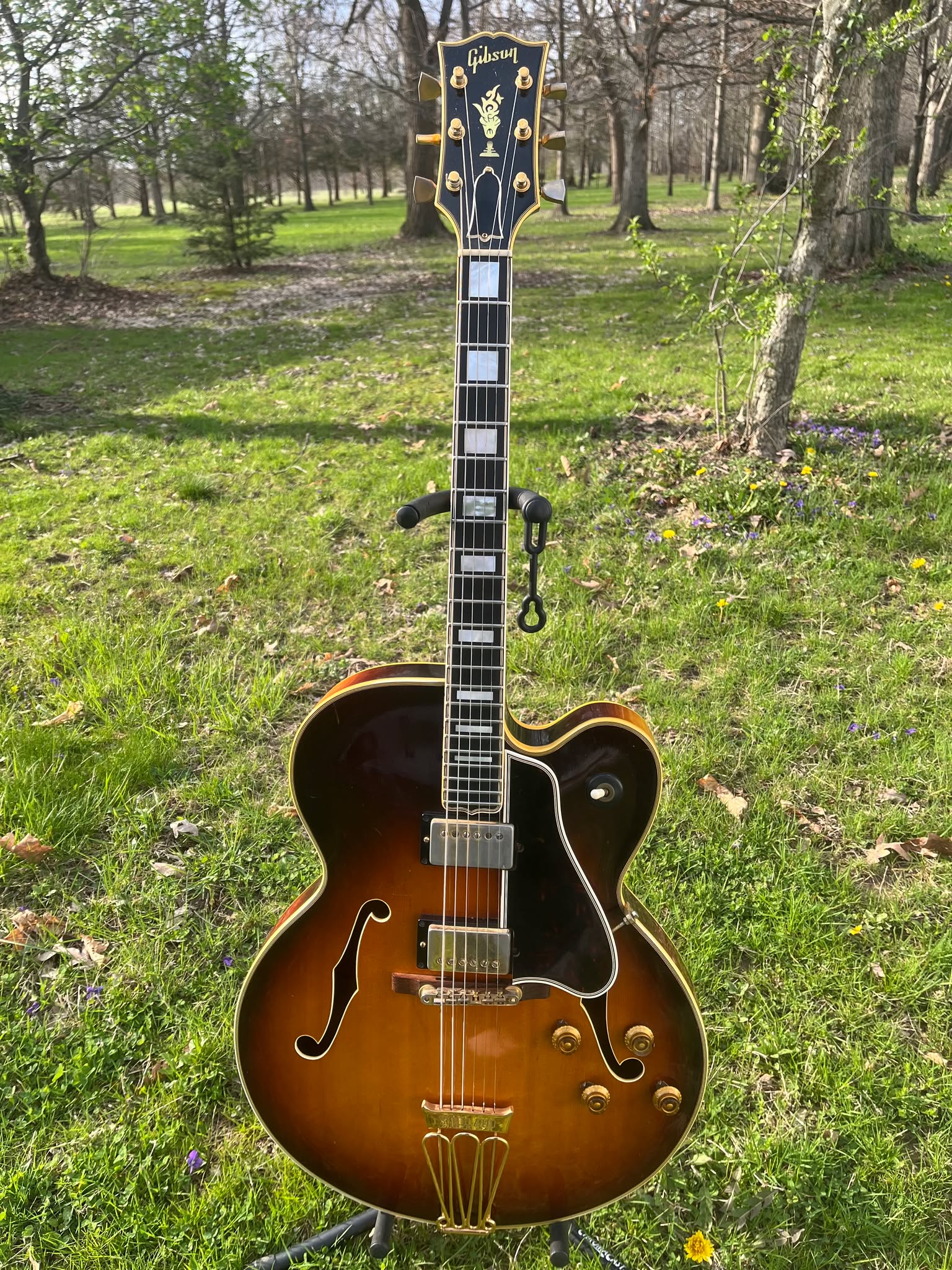
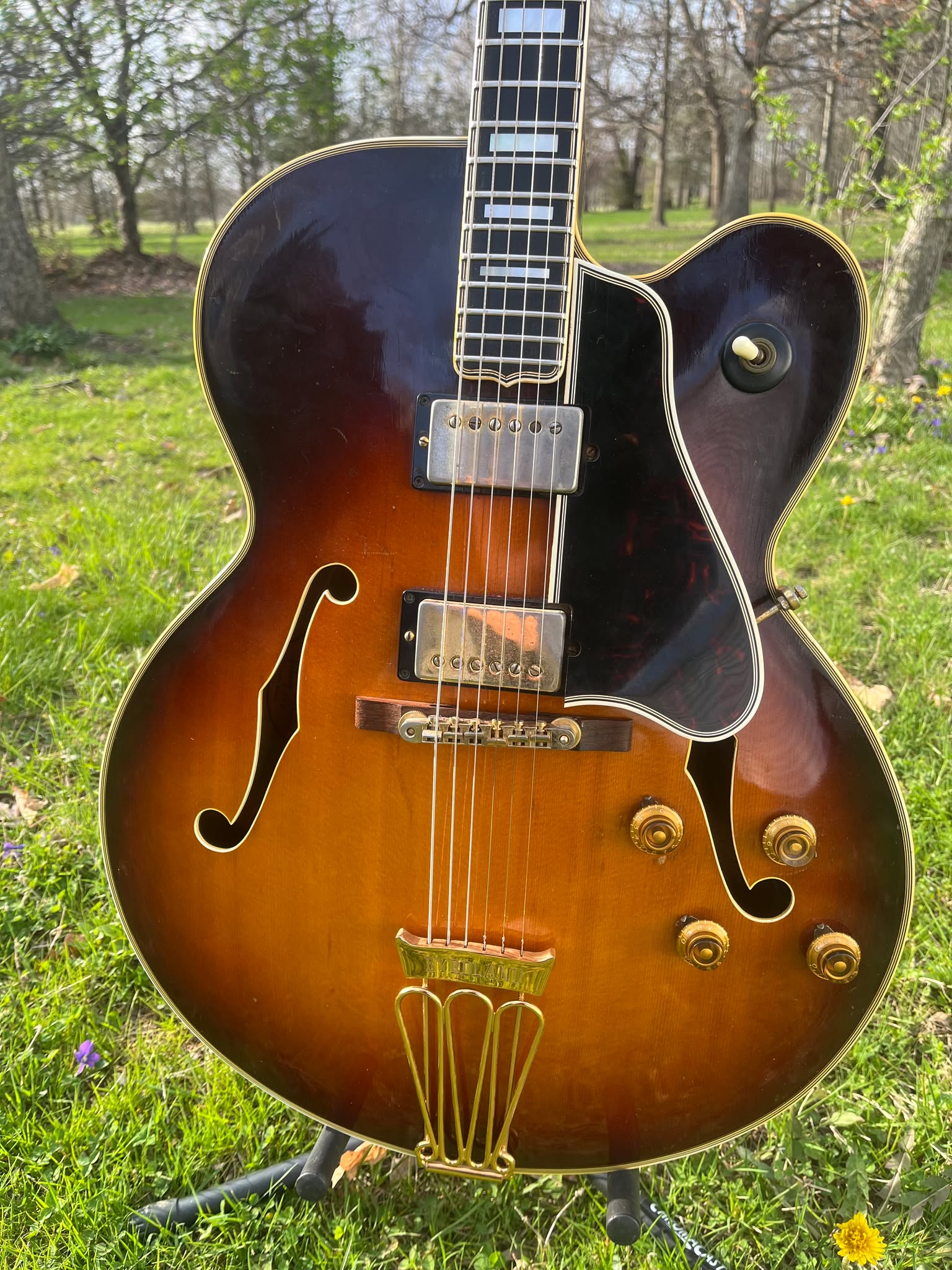
Edgewater recently bought a 1963 Gibson ES-175 from an estate in northeast Ohio, part of a late owner's collection, and it is in our inventory now. Its year puts it in the patent-number era, and the pickup question is the first thing that sets the value of an early-1960s ES-175. This guide is how we think about that question, written for someone who has one in a closet and wants to know where it sits.
What a 1963 Gibson ES-175 is
Gibson introduced the ES-175 in 1949 as a laminated-maple electric archtop with a single Florentine cutaway. It started with one P-90 pickup. In 1953 Gibson added the ES-175D, where the D means double pickup. It does not mean double cutaway. Gibson kept building the one-pickup version beside it until about 1970.
The ES-175 was the first Gibson electric Spanish guitar to ship with a humbucker, and the factory ledgers put that date at February 18, 1957. From then on the model carried PAF humbuckers, named for the "Patent Applied For" decal. By 1963 the pickups were in transition, which is why the year matters so much to a buyer.
A new ES-175D listed at $340 in 1962, and the one-pickup ES-175 at $275, according to the Vintage Guitar and Bass catalog page. Premier Guitar gives the same $340 for the D.
PAF to patent number: what changed by 1963
For the first five years or so the humbuckers wore a "Patent Applied For" decal. Vintage Guitar and Bass dates the switch to a "Patent Number" decal at 1962 to 1963. Wikipedia puts it around 1963 and has PAF use running from late 1956 until late 1962. The new decal reads 2,737,842. Patent-number pickups then ran into the mid 1960s, until the T-top humbuckers replaced them.
The sources do not agree on the exact month, and Premier Guitar lists PAFs as the standard on a 1962 ES-175D out to 1964. That is the practical point for a 1963 guitar. It could carry PAF decals, patent decals, or a mix. A dealer who lists a 1964 ES-175D with "untouched patent sticker humbuckers" is saying the pickups are original and have never been out of the guitar.
A decal alone does not prove the pickup is original, and pickups get swapped over sixty years. Reading one can mean taking a pickup out, so leave that to a tech. For a longer look at what each era's pickup should look like, see our PAF humbucker identification guide.
How to tell an early-1960s ES-175 from a 1950s one
Feature | 1950s | Early 1960s |
|---|---|---|
Pickups | P-90s through 1956, PAF humbuckers from 1957 | PAF decals into 1962, then patent-number decals into the mid 1960s |
Tuners | Single-ring Klusons | Double-ring Klusons, which Premier Guitar says replaced single-ring in 1960 |
Tailpiece | Zig-zag from 1957 | Zig-zag, so it does not separate a 1963 from a 1958 |
Cutaway | Single Florentine | Single Florentine, so cutaway shape will not date it |
Finish | Sunburst, natural as an option | Sunburst, with natural still offered as an upcharge in the 1962 catalog |
Because tailpiece and cutaway do not change, the pickup decals and tuners do most of the dating work, along with the serial number. Dealer listings of 1961 and 1964 guitars both describe double-ring Kluson tuners. The serial alone may only give you a range, so use our Gibson serial number lookup and read the full method in our ES-175 dating guide. For tuner and tailpiece details across eras, see our Gibson hardware dating guide.
One pickup or two: ES-175 versus ES-175D
This is the first sorting question on any ES-175. Vintage Guitar and Bass calls the two-pickup version by far the most familiar ES-175. A one-pickup 1961 with a single original PAF, all original, and its case sold at a dealer for a listed $10,000. That is in the same band as the two-pickup 1963 and 1964 guitars below.
Do not assume a two-pickup guitar is a D from the factory. One Chicago Music Exchange listing describes a 1960s ES-175 that started with one pickup and was later routed for a second, along with a refinished neck and replaced hardware. It listed at $2,696. A routed body cannot be put back, and a buyer prices it as a modified guitar.
Original versus modified: what it does to value
Factor | Effect on value |
|---|---|
Original pickups | The first thing a buyer checks. Replaced or rewound pickups take a clear bite. |
One pickup or two | Check whether the second pickup came from the factory. A routed body is a modification. |
Original finish | A sunburst with honest wear beats a refinish. Dealers flag refinish and neck refinish openly. |
Tailpiece, bridge, tuners, knobs | Each replacement counts. It counts less if the original comes with the guitar, as it did on a 1964 listed at $11,900. |
Cracks and repairs | A repaired headstock or body crack is listed as a repair and priced in. |
Original case | Helps the guitar sell and supports the story. A non-original case matters little. |
Natural finish | Gibson offered natural as an extra-cost option, so it is the less common finish. Confirm it is the factory one. |
What a 1963 Gibson ES-175 is worth
These are dealer asking or listed prices, not confirmed sale prices. Several listings are marked sold and the final price was not published. We did not find a published auction result for these years, so everything below is dealer listings.
Clean, original, two pickups. Drew Berlin's Vintage Guitars listed a 1963 ES-175D in excellent condition with its original hard case at $9,500, now marked sold. Rudy's Music listed a 1964 ES-175D with untouched patent-sticker humbuckers at $11,900. That guitar has a replaced tailpiece, with the original included. Premier Guitar's Vintage Vault feature on a 1962 ES-175D estimates its value at $10,000. For a clean, mostly original two-pickup guitar in this window, $9,500 to $12,000 is what dealers were asking.
One pickup. Walt Grace Vintage listed a 1961 one-pickup ES-175 with a single PAF, all original with its case, at $10,000, now marked sold. A 1963 one-pickup ES-175 with a patent-number humbucker, a changed bridge and a changed tailpiece, in good condition, was listed at $3,895 and marked sold at Rumble Seat Music. Part of that gap is the replaced hardware, and part is the condition grade and the year. The listings do not let us split it.
PAF versus patent number. We did not find a clean discount for patent-number pickups. The 1961 PAF one-pickup guitar at $10,000 and the 1963 and 1964 patent-era two-pickup guitars at $9,500 to $11,900 sit in the same band. A 1962 ES-175D with two original PAFs and a repaired crack near the jack was listed in Sweden at 12,400 euros. Condition and originality are doing as much work as the decal.
Modified. At the bottom, a Chicago Music Exchange ES-175 that was routed for a second pickup, refinished on the neck, refretted, re-hardwared and repaired at the headstock listed at $2,696. That is where heavily changed guitars land.
Edgewater's cash offer usually lands about 20% under that market figure, and less for refinished or modified examples. The accurate number for your guitar is a free appraisal, and you can get a quick ballpark at what's my guitar worth. For how the 1958 PAF example compares, see our 1958 ES-175 natural post, and for every year of the model see the ES-175 value guide for 1949 to 1970.
Common problems on early-1960s ES-175s
Swapped pickups. Ask if a tech has ever replaced or rewound them and look for cut or enlarged routs.
Second pickup added later. If the guitar has two pickups, check whether the body was routed for the second.
Cracks. The dealer listings we read flag a crack near the input jack, a repaired headstock crack, and a minor crack on the cutaway edge. Look at the headstock and cutaway in raking light.
Replaced hardware. Tailpieces, bridges and tuners are the usual swaps. Keep any original parts that come out of the case.
Refinish. Look for paint in the binding and f-hole edges.
Reissue confusion. Modern Gibson ES-175 reissues exist, and a PAF label on its own is not proof of age.
How to sell your 1963 Gibson ES-175 to Edgewater
Send front and back photos, a close shot of the headstock, the pickup covers and the control knobs, a look through the f-hole at the label and serial number, and any photo of the tailpiece. Tell us about any repair, refinish or replaced part and whether you have the original case. We ask anyway, and it saves a round of emails.
A customer review from Matt C.: "Gavin was super helpful and fast in getting me a real world estimate for my vintage Gibson. I recommend using Edgewater."
Start a free estimate or see our sell your Gibson page. We are in Valley City, Ohio, near Cleveland. We buy nationwide, cover shipping and pay the same day the guitar arrives and checks out. Local in-person closes in Ohio are preferred. Call or text (440) 219-3607 or text us photos.
Frequently asked questions
What is the difference between an ES-175 and an ES-175D?
The ES-175 has one pickup and the ES-175D has two. The D stands for double pickup, not double cutaway, and both models have a single Florentine cutaway. Gibson built the two-pickup model from 1953, and the one-pickup version stayed in the line until about 1970.
Does a 1963 ES-175 have PAF or patent-number pickups?
It could have either. Vintage Guitar and Bass dates the change from "Patent Applied For" to "Patent Number" decals at 1962 to 1963, and Wikipedia puts it around 1963, while Premier Guitar lists PAFs through 1964. A 1963 guitar with its original pickups is most likely to show patent-number decals, but pickups get swapped, so send photos and we will look.
How much is a 1963 Gibson ES-175 worth?
Dealer listings we found ran from $9,500 for a clean 1963 ES-175D with its case to $11,900 for a 1964 ES-175D, and from $3,895 for a 1963 one-pickup guitar with a changed bridge and tailpiece. Those are asking prices. Edgewater's offer lands about 20% under market, and less for refinished or modified guitars.
Is a one-pickup ES-175 worth less than an ES-175D?
Not in the listings we found. A one-pickup 1961 with a single original PAF and its case was listed at $10,000, in the same band as the two-pickup guitars. A one-pickup guitar with replaced hardware listed far lower, so condition and originality count more than the pickup count.
How do I find out what year my ES-175 is?
Start with the serial number and the pickup decals, then check the tuners. Double-ring Klusons point to 1960 or later, and the tailpiece and cutaway will not narrow it. Use our Gibson serial number lookup for the ranges.
How do I get an offer on my ES-175?
Send photos through the free estimate form linked above, or call or text (440) 219-3607. Include the serial number and tell us about any repairs, refinish, or replaced parts.
By Stephen Pedone, co-owner of Edgewater Guitars. Last updated: October 2026.
Sources
Article