DATE :
How to Date Vintage Gibson Hardware: Knobs, Tuners, Bridges, and Tailpieces
Gibson changed its knobs, tuners, bridges, and tailpieces many times between the 1950s and the 1970s, and each style points to a rough production window, though never an exact year on its own. Hardware narrows the range; the serial number and factory order number confirm it. Call or text (440) 219-3607 or text us photos.
Why hardware helps, and where it falls short
Gibson bought hardware in bulk and used up old stock before switching to new parts, so a "new" model year could ship with knobs, tuners, or a bridge left over from the prior style. Every date below is a usual range with overlap, not a hard line. A hardware clue can rule a guitar in or out of a decade, but it cannot pin a single year by itself, and it cannot prove originality, since 60 to 70 years gives plenty of time for a part to fail or get swapped by a repair shop.
The reliable way to date a Gibson is to read the hardware alongside the serial number and, where one was stamped, the factory order number, using our Gibson serial number lookup. If the guitar in question is a flat-top acoustic, most of the hardware below will not apply. See our guide to dating a Gibson acoustic guitar instead.
Gibson knobs by era
Knob shape is one of the easier hardware clues to spot in photos, and it tracks changes on Les Paul, ES, SG, and Firebird models fairly consistently, with the usual caveat about overlap.
Barrel knobs (early 1950s): Tall, gold plastic knobs, roughly 5/8 inch high, used on the first Les Paul Goldtops starting in 1952.
Speed knobs (usually 1953 to 1954, into 1955 on some guitars): A shorter version of the same barrel shape. Gibson reduced the height and kept the name "speed knob" for this squat gold style through the mid-1950s.
Bonnet knobs, the "gold hats" and "black hats" (usually mid to late 1950s): Rounded, hat-shaped knobs. On Les Pauls these generally ran from about 1955 to 1957. On the ES-335, ES-345, and early ES-355, all introduced in 1958, bonnet knobs carried on into early 1960, with black bonnets showing up on ES-355s and a handful of early 1960 ES-335 and ES-345 models in red finishes.
Reflector knobs, also called top hat knobs (usually 1960 to late 1966): A metal cap with "Volume" or "Tone" stamped into it replaced the plain bonnet top. Gibson used a short shaft version into about 1962 and a long shaft version after that, in both black and gold with silver or gold inserts.
Witch hat knobs (late 1966 into the 1970s): A pointed, Fender amp style knob that replaced the reflector on ES models by late 1966 and carried forward through most of the following decade.
Gibson tuners by era
Tuner history gets misquoted online more than any other hardware category on this list, mostly because two reference sources will give different years for the same changeover. Where that happened in our research, both years are given below rather than picking one.
Kluson Deluxe, single line stamp (mid-1950s to about 1964): "Kluson Deluxe" stamped once, in a single vertical line, on the back of the tuner. Single ring buttons ran into 1960, then double ring buttons continued with the single line stamp until the double line stamp took over around 1964.
Kluson Deluxe, double line stamp (from about mid-1964 into 1969): The words split into two lines on the tuner back. The changeover happened around mid-1964, with some overlap from parts on hand. From about 1969 to 1974, Gibson used a similar double line tuner stamped "Gibson Deluxe" instead of "Kluson Deluxe."
Keystone and tulip buttons: Collectors use both names for the shaped plastic buttons on vintage Kluson Deluxe tuners. Sources do not agree on a clean year split between the two, so treat the button shape as a general era marker, and look at the ring detail and the stamp for the date.
Grover Rotomatics: Grover's enclosed Rotomatic tuner appeared on some higher end Gibson models, most notably the Les Paul Custom, in the late 1950s, and became common across several Gibson lines through the 1960s and 1970s.
Schaller (mid to late 1970s): Gibson phased out Kluson and Grover tuners for German made Schaller tuners in the mid-1970s. Sources differ, with some citing 1974 or 1975 and others 1976, but either way a factory Schaller tuner points to the mid to late 1970s, around when Kluson's own business closed in 1981.
Gibson bridges by era
Wraparound or stud bridge and tailpiece (usually 1953 to 1955): A single lightweight aluminum bar that served as both bridge and tailpiece, designed under Gibson president Ted McCarty (the patent was filed in January 1953) and used on the Les Paul Goldtop from late 1953 into 1955. Gibson kept using this simpler combination bridge afterward on the Les Paul Junior, Special, and TV models well into the 1960s.
Tune-o-matic ABR-1 (introduced mid-1950s, standard by the late 1950s): The first individually adjustable six-saddle bridge, usually dated to 1954 or 1955 and became standard across most of Gibson's electric line by 1957. Early ABR-1 bridges had no wire holding the saddles in place, which is why they can pop out during a string change; Gibson added a retaining wire around 1962 to 1963. Some ABR-1 bridges from roughly the 1960s into the early 1970s used nylon rather than metal saddles, though sources vary on the exact years for that detail.
Nashville Tune-o-matic (1975 onward): A wider bridge with a greater range of saddle adjustment, introduced in 1975 when Gibson moved Les Paul production to its new Nashville plant. Unlike the ABR-1, whose posts usually thread directly into the body, the Nashville bridge's posts screw into metal bushings pressed into the top.
Tailpieces and vibratos
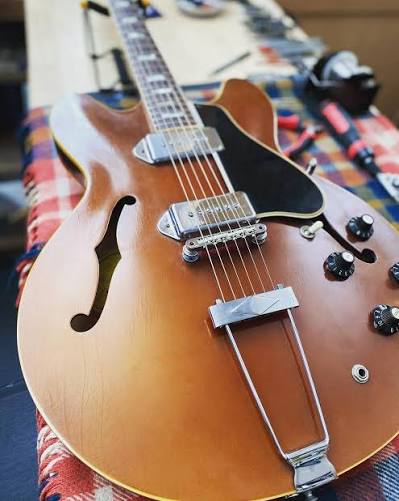
Trapeze tailpiece: A simple strings-over-bridge design used on archtop and semi-hollow models such as the ES-175 and early ES-330 through the 1950s, before higher end models moved to the stop tailpiece and Tune-o-matic combination.
Stop tailpiece, or stop bar: Paired with the ABR-1, and standard on Les Pauls and on the ES-335, ES-345, and ES-355 from the mid to late 1950s onward, mounted on two studs just below the bridge.
Bigsby, factory versus added: Gibson offered a Bigsby vibrato as a factory option on many models from the late 1950s through the 1960s, most visibly on the ES-335 family. A Bigsby does not automatically mean it was added later; check underneath for a stop tailpiece's stud holes, present or filled.
Gibson Vibrola and the Maestro "lyre" Vibrola: Gibson's earlier side pull "sideways" Vibrola gave way to the long frame Maestro Vibrola starting in 1963. Its cover plate carried an engraved lyre graphic, hence "lyre Vibrola," and Gibson used it on SG Standard, SG Custom, SG Special, and related models into 1971.
Quick reference: Gibson hardware by era
Hardware | Usual years | Notes |
|---|---|---|
Barrel knobs | 1952 | First year Les Paul Goldtop, tall gold plastic |
Speed knobs | 1953 to 1954, into 1955 | Shorter version of the barrel shape |
Bonnet knobs (gold hat, black hat) | 1955 to 1957 on Les Pauls, 1958 to early 1960 on ES-335 and ES-345 | Black bonnets seen on ES-355 |
Reflector (top hat) knobs | 1960 to late 1966 | Short shaft to about 1962, long shaft after |
Witch hat knobs | Late 1966 into the 1970s | Fender amp style point |
Kluson single line tuners | Mid-1950s to about 1964 | Overlap from parts on hand around the change |
Kluson double line tuners | About mid-1964 to 1969 | "Gibson Deluxe" double line ran about 1969 to 1974 |
Grover Rotomatics | Late 1950s onward | Notably on the Les Paul Custom |
Schaller tuners | Mid to late 1970s | Sources differ, 1974 to 1976 |
Wraparound stud bridge/tailpiece | 1953 to 1955, later on Junior and Special | Aluminum, one piece bridge and tailpiece |
ABR-1 Tune-o-matic | 1954 or 1955 introduced, standard by 1957 | No retaining wire until about 1962 to 1963 |
Nashville Tune-o-matic | 1975 onward | Wider, posts anchor into bushings |
Trapeze tailpiece | 1950s and 1960s | ES-175, ES-330, ES-125 and other hollow bodies |
Stop tailpiece | Mid to late 1950s onward | Paired with ABR-1 |
Bigsby (factory option) | Late 1950s through the 1960s | Common on ES-335 family |
Maestro "lyre" Vibrola | 1963 to 1971 | SG Standard, SG Custom, SG Special |
Original hardware versus replaced hardware
Replaced hardware is common on a 50 to 70 year old guitar. It does not disqualify a guitar from a fair offer, but it does change the offer, so it helps to know what we look for.
Screw holes: Extra, filled, or mismatched screw holes around the tuner posts, bridge studs, or under a pickguard usually mean a part was swapped.
Finish shadows and footprints: Original hardware sitting in one spot for decades leaves a faint outline in the finish underneath it. A clean, unmarked patch where a knob, bridge, or tailpiece has clearly sat for years means that piece is not original.
Plating wear that matches the guitar: Original hardware should show the same general age as the rest of the instrument. A bright, unworn bridge on a heavily worn top, or the reverse, is worth a second look.
Reissue parts markings: Modern reproduction Klusons, ABR-1 bridges, and Maestro Vibrolas are usually stamped or engraved differently than the vintage originals. If the knobs, tuners, bridge, and tailpiece do not all point to the same decade as the serial number, one or more has likely been replaced.
None of this is a reason to skip getting an offer. We buy plenty of honest, well loved Gibsons with replaced tuners or a non-original bridge. See our Gibson buying page for how that works.
How to get your Gibson dated and appraised
For a real answer instead of a guess, send clear photos of the headstock front and back, the full body front and back, and close-ups of the knobs, tuners, bridge, and tailpiece. Include the serial number and, if you can find one, the factory order number stamped inside the body. Start with our free estimate form, or use what's my guitar worth if you are not sure where to begin. We will read the hardware alongside the serial number and FON and tell you honestly what era it is from, and what we would offer.
Frequently asked questions
Can I date my Gibson from its tuners alone?
Not reliably. Gibson used up old tuner stock before switching to new styles, and the Kluson single line to double line switch around 1964 overlapped for a while. Tuners narrow the range; the serial number and factory order number confirm it.
What are "gold hat" and "black hat" knobs?
Nicknames for Gibson's rounded bonnet knobs from the mid to late 1950s. Gold hats are the gold colored version seen mostly on Les Pauls and early ES-335 and ES-345 models, and black hats are the black version seen on ES-355 and a few early 1960 red finish guitars.
Does replaced hardware lower what Edgewater will offer?
Usually, yes, some amount, since original hardware is part of what collectors and players pay for. It does not usually disqualify a guitar from a fair offer, and honest disclosure of what has been changed helps us give you an accurate number faster.
How can I tell if a Bigsby on my Gibson was original or added later?
Check underneath and around the current mounting screws for extra or filled holes, particularly for a stop tailpiece's stud holes, since Gibson offered the Bigsby as a factory option on many models rather than only as an aftermarket add-on.
What is the difference between an ABR-1 and a Nashville Tune-o-matic?
The ABR-1 is the earlier, narrower bridge, usually dated to the mid-1950s, with posts that thread directly into the body. The Nashville bridge, introduced in 1975, is wider, offers more saddle adjustment, and uses posts that screw into bushings.
Where do I start if I want a free appraisal?
Call or text (440) 219-3607, or fill out our free estimate form with photos of the guitar, its hardware, and its serial number.
By Stephen Pedone, co-owner of Edgewater Guitars. Last updated: September 2026.
Sources
Iron Age Accessories, "Les Paul Knobs Explained: History and Function"
Vintage Guitars Info, "Kluson Deluxe Tuners 1940s to 1960s used on Fender and Gibson Guitars"
Gibson.com, "True Pitch and Solid Tone: Gibson's Tune-O-Matic Bridge"
StewMac, "Tune-o-matic swap: going from Nashville to Kalamazoo"
Faber USA, "ABR-1 vs. Nashville vs. Wraparound: Guitar Bridge Differences"
Jazz Guitar, "The Gibson ES-175: History, Buying Tips and Price Guide"
MM Guitar Bar, "Maestros and Side-Pulls and Bigsbys, oh my!"
Reverb News, "How to Date a Gibson Using Serial Numbers, FONs and Logos"