DATE :
How to Identify Your Guitar's Age by Serial Number
You've found an old guitar in a closet, inherited one from a relative, or picked up a promising instrument at an estate sale—and now you're staring at a string of numbers stamped on the headstock wondering what they mean. That serial number holds the key to your guitar's production date, but decoding it requires knowing each manufacturer's specific system.
This guide covers where to find serial numbers on major brands, how to interpret the codes for Fender, Gibson, Martin, and others, plus alternative dating methods when the serial number is missing or illegible.
Where to Find Your Guitar's Serial Number
Guitar age identification starts with decoding the serial number—a sequence of letters and numbers that manufacturers stamp, print, or engrave during production. For U.S.-made Fenders, letters indicate decades (S=70s, E=80s, N=90s, Z=00s) followed by the year. Gibsons often use the first and fifth digits of an 8-digit code for the year, while older models from 1952 to 1960 use the first digit alone.
The location varies by brand and era. Knowing where to look saves time and prevents frustration when you're trying to pin down a production date.
Headstock and neck plate locations
Fender guitars typically display serial numbers on the metal neck plate (pre-1976) or on the front or back of the headstock (1976 onward). Gibson instruments almost always have the serial number stamped or impressed on the back of the headstock, though the format changed multiple times over the decades.
If you're examining an electric guitar with a bolt-on neck, check the metal plate where the neck meets the body first. Guitars with set necks—meaning the neck is glued in place—rarely have neck plates, so the headstock becomes your primary search area.
Inside the body and sound hole
Acoustic guitars often hide their serial numbers inside the body. Shine a flashlight through the soundhole and look at the neck block, which is the wooden piece where the neck joins the body. Martin guitars consistently place serial numbers here, stamped directly into the wood.
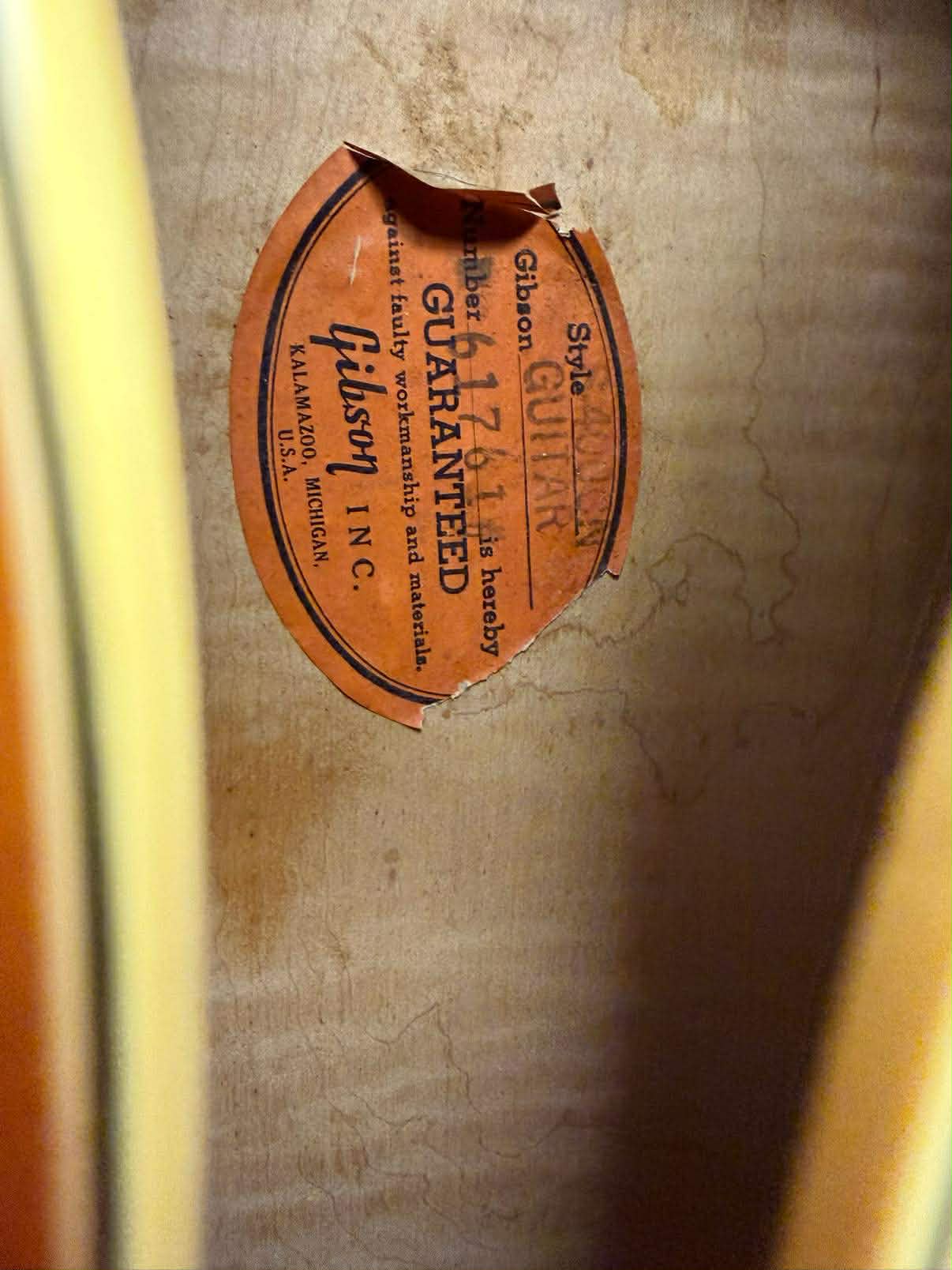
Gibson acoustics typically have paper labels glued to the inside back, visible through the soundhole. Labels often include both the serial number and model name, which makes identification considerably easier.
Other hidden serial number locations
Some guitars require more detective work. Less obvious places to check include:
Neck heel or pocket: Visible only when the neck is removed from the body
Pickup cavity: Under the pickguard or control plate on electric guitars
Bridge plate: Inside acoustic guitar bodies, on the wooden plate beneath the bridge
Peghead back: Sometimes stamped rather than printed, requiring good lighting to see
How to Read Guitar Serial Numbers
Serial number formats vary dramatically between manufacturers, and even within the same brand across different decades. Some companies use purely sequential numbering—guitar #50,000 was simply the fifty-thousandth instrument produced. Others encode the production date, factory location, or model information directly into the number itself.
A serial number like "S9" on a Fender tells you the guitar was made in 1979, while the same characters on another brand might indicate something entirely different. Here's what serial numbers can potentially reveal:
Production year or date range: The most common encoded information
Country or factory of origin: Especially important for brands with multiple manufacturing locations
Sequential production number: Where the guitar falls in the production run
Model designation: Some brands embed model codes in serial numbers
How to Date Your Guitar by Brand
Each major manufacturer uses a different serial number system, and many brands have changed their formats multiple times. For particularly valuable or unusual instruments, professional authentication provides the most reliable results.
Fender serial number dating
Fender's serial number system changed significantly in 1976 when the company moved numbers from the neck plate to the headstock. For guitars made after 1976, a letter prefix indicates the decade:
Prefix | Decade | Example |
|---|---|---|
S | 1970s | S9 + 5 digits = 1979 |
E | 1980s | E4 + 5 digits = 1984 |
N | 1990s | N8 + 5 digits = 1998 |
Z | 2000s | Z5 + 5 digits = 2005 |
US | 2010s+ | US11 + 5 digits = 2011 |
The second character typically indicates the specific year within that decade. Mexican-made Fenders use "MX" or "MN" prefixes, while Japanese models have "JV," "SQ," or "A" prefixes depending on the era.
Tip: Pre-1976 Fender serial numbers on neck plates are notoriously inconsistent. Cross-reference with pot codes and neck date stamps for accurate dating of earlier instruments.
Gibson serial number dating
Gibson's serial number history is, frankly, a mess. The company used inconsistent and sometimes overlapping systems for decades, which means physical features often matter more than the number itself for pre-1977 guitars.
The modern 8-digit system (1977 onward) works like this: the first and fifth digits indicate the year. For example, a serial number starting with "8" and having "2" as the fifth digit indicates 1982. The remaining digits encode the production day and factory ranking.
For guitars made between 1952 and 1960, the first digit typically indicates the year (a "5" means 1955), though Gibson didn't apply this system consistently.
Martin serial number dating
Martin uses the most straightforward system among major brands: purely sequential numbering with no embedded date information. Guitar #175,689 was simply the 175,689th Martin guitar ever made.
To date a Martin, you'll reference the company's published serial number chart. For example, serial numbers around 117,961 correspond to 1950, while numbers near 175,689 indicate 1960. Martin's website maintains an official lookup tool, and the numbers have remained consistent throughout the company's history.
Taylor serial number dating
Taylor guitars made after 1999 use an 11-digit format where the first two digits indicate the year and the third digit indicates the month. A serial number starting with "05" was made in 2005, and if the third digit is "7," the guitar was produced in July.
Pre-1993 Taylor guitars require a reference chart, as the company used a different system during its early years.
Epiphone serial number dating
Epiphone serial numbers vary based on manufacturing country—Japan, Korea, China, or Indonesia. Generally, the first one or two digits indicate the production year, but the specific format depends on which factory produced the instrument.
A serial number starting with "F" followed by two digits often indicates a guitar made at the Fuji-Gen factory in Japan, with those two digits representing the year. Korean and Chinese production use different prefixes and formats entirely.
PRS serial number dating
Paul Reed Smith guitars use a relatively consistent system where the first two digits indicate the production year for most standard models. A serial number starting with "15" indicates 2015 production.
Private Stock instruments and certain limited editions follow different conventions, so unusual PRS guitars may require direct verification with the company.
Gretsch serial number dating
Gretsch's dating system depends heavily on ownership era. Pre-Fender ownership guitars (before 2002) use various inconsistent formats that require cross-referencing with physical features. Modern Gretsch instruments made under Fender ownership follow Fender-style dating conventions.
Ibanez serial number dating
Ibanez serial numbers typically indicate both factory location and production year. The first letter often identifies the manufacturing facility (Japan, Korea, Indonesia, or China), while the first digit or digits indicate the year.
For example, "F" indicates the Fujigen factory in Japan, and a serial starting with "F81" would indicate August 1981 production. However, formats have changed over the years, so verification against Ibanez's documented systems is important.
How to Date a Guitar Without a Serial Number
Many older guitars have missing, worn, or completely illegible serial numbers. Some very early instruments were never numbered at all. When the serial number fails, experts turn to physical features and internal components to estimate production dates.
Potentiometer and component date codes
Potentiometers—the electronic components that control volume and tone—carry date codes stamped during manufacturing. The codes use the EIA (Electronic Industries Alliance) system, where the last three or four digits indicate the year and week of production.
A pot code ending in "6520" means the component was made in the 20th week of 1965. This gives you the earliest possible production date for the guitar, since the instrument couldn't have been assembled before its components existed. However, factories sometimes used older stock, so pot dates represent a floor rather than a definitive answer.
Neck stamps and body markings
Factory workers often penciled or stamped dates on components during production. Check the neck heel (the bottom of the neck where it meets the body), inside the neck pocket, and inside body cavities for handwritten dates or stamps.
A penciled "3/62" in a neck pocket strongly suggests March 1962 production.
Hardware and pickup style changes
Tuners, bridges, pickups, and other hardware evolved over time. Specific features can narrow date ranges considerably:
Kluson vs. Grover tuners: Kluson tuners were standard on many 1950s-60s guitars; Grover became more common later
Patent number vs. patent applied for pickups: "Patent Applied For" (PAF) pickups indicate late 1950s to early 1960s Gibson production
Bridge saddle materials: Brass, steel, and nylon saddles appeared in different eras
Pickup cover styles: Staggered vs. flat pole pieces, covered vs. uncovered humbuckers
Finish and logo evolution
Headstock logos, font styles, and finish types changed across eras. The transition from nitrocellulose lacquer to polyurethane finishes occurred at different times for different manufacturers, and logo designs evolved gradually.
Fender's "spaghetti" logo gave way to the "transition" logo in the mid-1960s. Visual changes like this help bracket production periods when other dating methods prove inconclusive.
Common Serial Number Problems and Solutions
Serial number dating isn't always straightforward. Here are the complications you're most likely to encounter.
Missing or illegible serial numbers
Serial numbers disappear for several reasons: natural wear over decades of playing, refinishing that sanded through the original stamping, or factory omission on certain models. When the number is gone, component dating methods become your primary tools.
Pot codes, neck stamps, and hardware analysis can still establish a reasonable date range.
Reused and overlapping numbers
Some manufacturers—Gibson being the most notorious—reused serial number sequences across different eras. A six-digit Gibson serial number might correspond to guitars made in the 1960s or the 1970s, depending on other features.
Physical characteristics like headstock shape, pickup style, and construction details help determine which era applies.
Replacement parts and refinished guitars
A replaced neck, refinished headstock, or swapped components can create significant dating confusion. The serial number on a replacement neck tells you when that neck was made, not when the original guitar was assembled.
Pot codes become crucial in this situation because they're rarely replaced. If the body's pot codes indicate 1964 but the neck serial suggests 1972, you're likely looking at a replacement neck on an older body.
Altered or counterfeit serial numbers
Forgeries exist, particularly for highly valuable vintage instruments, with average losses of $3,200 per fake purchase. Watch for red flags:
Serial number font inconsistent with era: Fonts changed over time; wrong fonts indicate problems
Number placement differs from authentic examples: Manufacturers were consistent about placement
Physical features don't match serial number date: A "1959" serial on a guitar with 1970s features is suspicious
Serial number format doesn't match brand's documented system: Research the correct format for the claimed era
When to Get Professional Guitar Authentication
DIY dating works well for many guitars, but vintage or high-value instruments benefit from expert authentication—particularly important given law enforcement's seizure of 3,000 counterfeit Gibsons valued at over $18 million in 2023.
If you're dealing with a pre-CBS Fender, early Gibson, rare variant, or any guitar where significant money is at stake, professional evaluation provides certainty that online research can't match.
Professional appraisers examine multiple data points beyond serial numbers—finish originality, hardware authenticity, construction details, and subtle era-specific features that require hands-on experience to recognize.
At Edgewater Guitars, we offer free expert assessments for owners who want confirmation of their guitar's age and value. Whether you're settling an estate, considering a sale, or simply curious about what you have, our vintage specialists can help.
Get Your Guitar Dated and Valued by Vintage Experts
Knowing your guitar's age is the first step toward understanding its true market value in a vintage guitar market worth $1.67 billion as of 2024. A 1959 or 1962 Stratocaster and a 1972 Stratocaster look similar to untrained eyes, but they occupy completely different collector categories—and price ranges.
Edgewater Guitars has served as Ohio's premier vintage guitar specialists since 2002, helping owners of vintage, rare, and quality instruments understand what they have. Our team brings decades of experience authenticating and valuing Fender, Gibson, Martin, and other collectible instruments.
The process is simple: submit photos and details through our website or call us at (440) 219-3607. You'll receive an expert assessment and fair cash offer with no obligation. We travel throughout Ohio, Michigan, Pennsylvania, Indiana, and West Virginia for valuable instruments.
FAQs About Guitar Age Identification
How accurate are free online serial number lookup tools?
Online serial number lookup tools provide helpful starting points but may have incomplete databases or fail to account for brand-specific quirks like Gibson's overlapping number sequences. Cross-reference results with multiple sources, and consider professional verification for valuable instruments.
Can a guitar's serial number tell me where it was manufactured?
Many modern serial numbers include factory codes or prefixes indicating country of origin—Fender's "MX" for Mexico or "JV" for Japan, for example. Older instruments typically require additional research to determine manufacturing location.
What if my guitar has two different serial numbers?
Some guitars have numbers on multiple components (neck and body). If the numbers differ significantly, one part may be a replacement, which affects both dating accuracy and value.
Do acoustic and electric guitars from the same brand use identical dating systems?
Not always. Acoustic and electric lines from the same manufacturer often use different serial number formats. Always verify which system applies to your specific instrument type.
How do I date a guitar from a brand not covered in this guide?
Contact the manufacturer directly if they're still in business—many maintain serial number lookup services. For defunct brands, search brand-specific forums or consult a professional appraiser who specializes in that era or type of instrument.
Does confirming my guitar's age affect its resale value?
Documented age verification typically increases buyer confidence and can positively impact resale value, especially for vintage instruments where authenticity matters.
What information do I gather before requesting a professional guitar appraisal?
Prepare clear photos of the serial number, headstock (front and back), body front and back, and any unique features or damage. Include any known history, provenance, or documentation like original receipts.