DATE :
How to Date Vintage Fender and Gibson Guitars Using Potentiometer Codes
How to Date Vintage Fender and Gibson Guitars Using Potentiometer Codes
If you’re trying to determine the age of your vintage Fender or Gibson guitar, potentiometer codes are one of your most reliable dating tools. While serial numbers can be confusing, duplicated, or even missing, the date codes stamped on your guitar’s potentiometers (pots) provide concrete evidence of when your instrument was manufactured.
Whether you’re a collector researching a potential purchase or an owner considering selling your vintage guitar, understanding how to read pot codes is essential for accurate dating and valuation. At Edgewater Guitars, we’ve authenticated thousands of vintage guitars throughout Ohio and the Midwest, and pot code verification is always a critical part of our evaluation process.
What Are Potentiometer Date Codes?
Potentiometers—commonly called “pots”—are the variable resistors underneath your guitar’s volume and tone knobs. These components control the electrical signal from your pickups, allowing you to adjust volume and tone.
Most vintage guitar pots have date codes stamped directly onto the component casing. These codes indicate when the manufacturer produced that specific potentiometer, providing a reliable timeline for dating your instrument.
Where to Find Pot Codes:
Remove the control cavity cover plate (back of guitar or pickguard)
Locate the cylindrical potentiometers attached to the control knobs
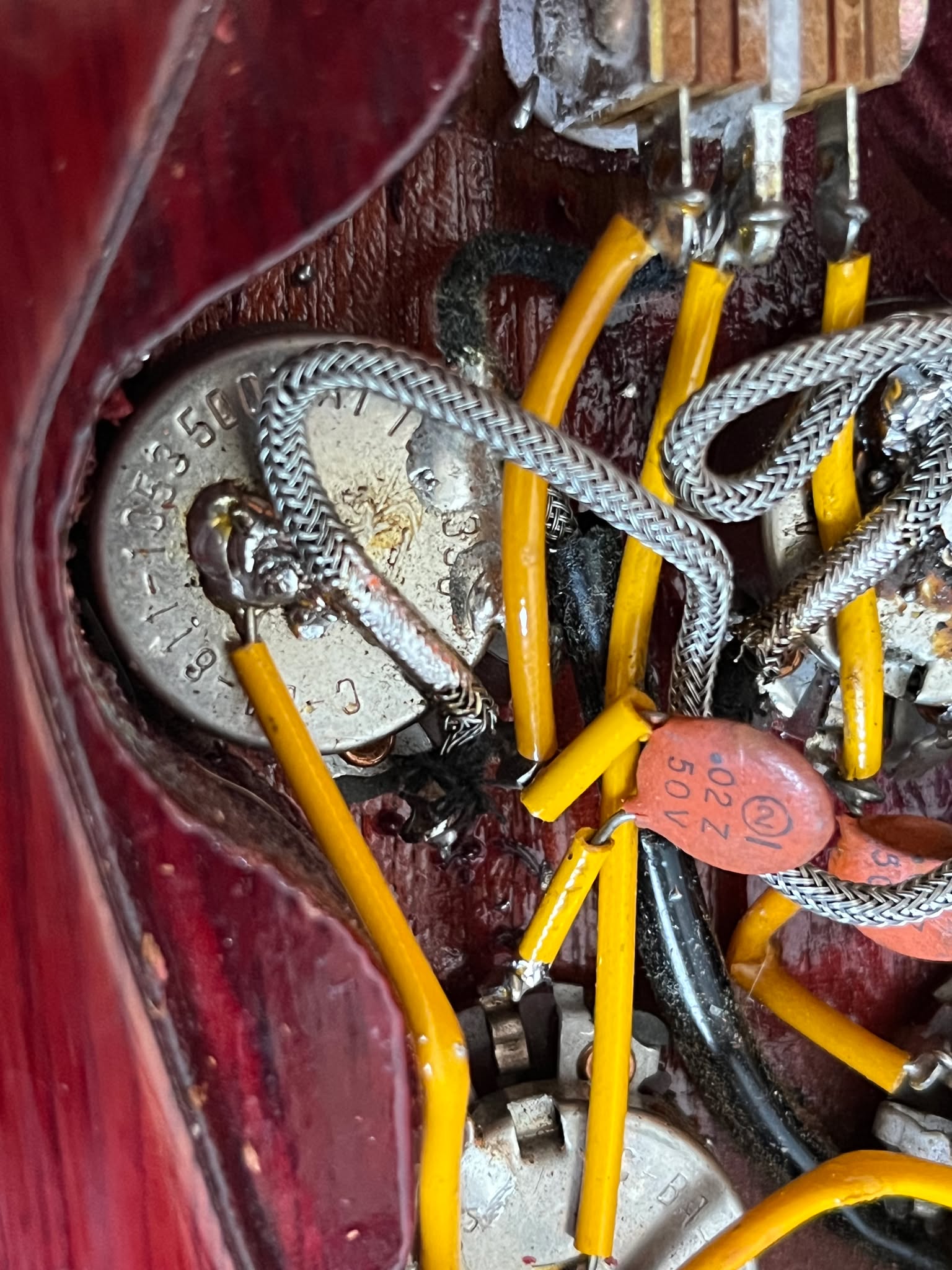
Look for a 6-7 digit number stamped on the metal casing
You may need to gently rotate the pot to see the full code
Use a flashlight for better visibility in dark cavities
Important Principle: The pot date represents when the component was manufactured, not necessarily when the guitar was assembled. Guitars were typically assembled within weeks or months after the pots were made, though components sometimes sat in inventory longer.
Understanding the Pot Code Format
Most potentiometer date codes follow the Electronic Industries Alliance (EIA) source-date code format:
Standard Format: XXXYYYZZ or XXXYZ
XXX = Manufacturer identification code (3 digits)
YY or Y = Year of manufacture (last 1-2 digits of year)
ZZ or Z = Week of manufacture (1-52)
Example Breakdown
Code: 1376428
137 = CTS (Chicago Telephone Supply) manufacturer
64 = Year 1964
28 = 28th week of 1964 (approximately July)
Code: 1372152
137 = CTS manufacturer
21 = Year 1921 or 2021? (See “Year Ambiguity” section below)
52 = 52nd week (late December)
Major Potentiometer Manufacturers
Understanding which manufacturers supplied which guitar companies helps verify authenticity:
CTS (Chicago Telephone Supply) - Code: 137
Primary User: Fender guitars and basses Years Used: 1950s through present (for Fender) Characteristics:
Most common on Telecasters (all years)
Found on Stratocasters (though less common than Stackpole)
Standard on Fender basses (Precision and Jazz)
Often bronze/brass colored casing
Typically 250K ohm (Fender guitars) or 500K ohm (some models)
Authentication Note: CTS pots on Fenders are completely correct and original. Some collectors mistakenly believe only Stackpole pots are “right” for vintage Fenders, but CTS was extensively used.
Stackpole - Code: 304
Primary User: Fender guitars (especially Stratocasters) Years Used: Mid-1950s through 1960s Characteristics:
Most associated with vintage Stratocasters
Common on pre-CBS Fenders (1954-1965)
Gray or silver-colored casing
Considered slightly more desirable by collectors (though functionally equivalent)
250K ohm standard resistance
Collector Appeal: Stackpole pots on pre-CBS Fenders are highly sought after and command premium prices when all-original.
Centralab - Code: 134
Primary User: Gibson guitars Years Used: 1940s through 1960s Characteristics:
Predominant manufacturer for Gibson during the “golden era”
Found on Les Pauls, SGs, ES-335s, and other Gibsons
Dark gray or black casing
500K ohm standard (Gibson used higher resistance than Fender)
Often installed in plastic “cup” housings
Critical for Dating: Centralab pots are essential for authenticating valuable vintage Gibsons like 1950s Les Pauls.
Other Manufacturers
IRC (International Resistance Company) - Code: 615
Used occasionally by both Fender and Gibson
More common in 1970s and later
Clarostat - Code: 137 (different from CTS despite same code)
Less common, primarily 1940s-1950s
Requires additional context to differentiate from CTS
Allen Bradley - Various codes
Higher-end pots used on premium models
Less common on production instruments
Year Ambiguity: The Century Problem
One challenge with pot codes is determining which century applies:
The Issue
A pot stamped “1375223” shows:
Manufacturer: CTS (137)
Year: 52
Week: 23
But is this 1952 or 2052?
How to Resolve Year Ambiguity
Use Context Clues:
Other Guitar Features
What style pickups does the guitar have?
What type of tuners are installed?
What’s the neck profile and headstock shape?
What finish style is used?
Multiple Pot Dating
Most guitars have 2-4 pots
All should have similar date codes
If one pot reads “52” and others read “64,” the “52” pot is likely a replacement
Serial Numbers and Neck Dates
Cross-reference with other dating methods
Serial numbers can provide century context
Neck date stamps (Fender) confirm the year
Visual Age Assessment
Genuine 70-year-old components show appropriate aging
Wire insulation degradation, solder joint oxidation
Natural patina and corrosion patterns
Common Sense Application
If the guitar appears to be:
A 1950s-style Fender or Gibson → “52” means 1952
A modern reissue → “52” could mean 2052 (though unlikely as we’re only in 2025)
A 1970s guitar → “72” means 1972
Pro Tip: Very few situations create genuine ambiguity. Visual assessment combined with pot date context makes the correct century obvious in 95% of cases.
Dating Vintage Fender Guitars with Pot Codes
Pre-CBS Fender Era (1950-1965)
Pre-CBS Fenders represent the most collectible American guitars, and pot codes are essential for authentication:
Expected Manufacturers:
Stackpole (304): Most common on Stratocasters
CTS (137): Most common on Telecasters and basses
Occasional others: IRC, Clarostat (less common)
Typical Date Correlation:
Guitar Model | Years | Expected Pot Code Range |
|---|---|---|
1954 Stratocaster | 1954 | 304-54-XX or 137-54-XX |
1959 Telecaster | 1959 | 137-59-XX |
1960 Jazz Bass | 1960 | 137-60-XX |
1964 Stratocaster | 1964 | 304-64-XX or 137-64-XX |
Authentication Example: 1959 Fender Stratocaster
What You Should Find:
3 pots total (1 volume, 2 tone)
Stackpole (304) or CTS (137) manufacturer codes
Date codes reading “59” with various week numbers
All pots should be within the same year or 1-2 months apart
Red Flags:
Pots dated 1962 in a supposedly all-original 1959 guitar
Mix of drastically different date codes (1959, 1967, 1983)
Wrong manufacturer (modern Asian pots in vintage guitar)
Pots dated after the guitar’s neck date or serial number
CBS Era Fender (1965-1981)
Changes After CBS Acquisition:
Quality control became less consistent
Some cost-cutting in component selection
Pot manufacturers remained largely the same initially
By the 1970s, more variation in pot manufacturers
Dating Considerations:
Early CBS (1965-1969) still used Stackpole and CTS extensively
Later CBS (1970-1981) saw more variety in manufacturers
Pot codes remain reliable for dating throughout this period
Reading Fender Pot Codes: Step-by-Step
Example Guitar: Vintage Fender Stratocaster
Step 1: Access the Pots
Remove the pickguard screws (Strat: 11 screws typically)
Carefully lift the pickguard to expose the control cavity
Identify the three pots (one volume, two tone)
Step 2: Locate the Codes
Find the stamped numbers on each pot’s metal casing
Use a flashlight and possibly rotate the pot slightly
Photograph the codes for reference
Step 3: Decode Each Pot
Pot 1: 3046127
304 = Stackpole manufacturer
61 = Year 1961
27 = 27th week of 1961 (early July)
Pot 2: 3046130
304 = Stackpole manufacturer
61 = Year 1961
30 = 30th week of 1961 (late July)
Pot 3: 3046133
304 = Stackpole manufacturer
61 = Year 1961
33 = 33rd week of 1961 (mid-August)
Conclusion: This guitar was likely assembled in late 1961 or early 1962, using pots manufactured across summer 1961.
Step 4: Cross-Reference
Check the neck date stamp (should read “1961” or early “1962”)
Verify the serial number falls in the 1961-1962 range (60000-80000)
Confirm other features match 1961-1962 specifications
Dating Vintage Gibson Guitars with Pot Codes
Golden Era Gibson Dating (1952-1965)
Gibson’s golden era—especially the 1958-1960 Les Paul “Burst” years—makes pot code authentication critical for six-figure instruments.
Expected Manufacturer:
Centralab (134): Overwhelmingly dominant during this period
Occasionally IRC or other manufacturers
500K ohm resistance standard for Gibson
Critical Models and Date Ranges
1958-1960 Les Paul Standard “Bursts”
These guitars command $250,000-$750,000+ depending on condition, making authentication essential:
Expected Pot Codes:
1958 Les Paul: Centralab pots dated late 1957 through 1958
1959 Les Paul: Centralab pots dated 1958 or 1959
1960 Les Paul: Centralab pots dated 1959 or 1960
Example: Authenticating a 1959 Les Paul
What You Should Find:
4 pots total (2 volume, 2 tone)
All Centralab (134) manufacturer codes
Date codes reading “58” or “59”
Pots typically within a few weeks/months of each other
Authentic 1959 Pot Code Examples:
1345825 (Centralab, 1958, week 25)
1345847 (Centralab, 1958, week 47)
1345901 (Centralab, 1959, week 01)
1345923 (Centralab, 1959, week 23)
Why This Matters: A genuine 1959 Les Paul with all original Centralab pots dated 1958-1959 might be worth $400,000+. The same guitar with 1970s replacement pots might drop to $200,000-250,000—a $150,000+ difference based on pot codes alone.
Other Valuable Gibson Models
1961-1964 Gibson SG Standard
Expected Pot Codes:
Centralab (134) manufacturer
Years 1961-1964 depending on model year
Should correlate with other dating features (serial number, pickup types)
1958-1964 Gibson ES-335
Expected Pot Codes:
Centralab (134) primary manufacturer
Should align with “dot” vs “block” inlay periods
PAF pickups (1958-1962) should correlate with appropriate pot dates
1952-1960 Les Paul Goldtop
Expected Pot Codes:
Centralab (134) throughout production
P-90 era (1952-1956): Centralab pots dated accordingly
PAF era (1957-1960): Centralab pots should match pickup transition
Reading Gibson Pot Codes: Step-by-Step
Example Guitar: 1959 Gibson Les Paul Standard
Step 1: Access the Control Cavity
Remove the back control cavity cover plate (2 screws)
Carefully expose the pots and wiring
Avoid disturbing original wiring if possible
Step 2: Identify All Four Pots
Two volume pots (typically lower position)
Two tone pots (typically upper position)
Note position and function of each
Step 3: Read and Document Codes
Neck Pickup Volume Pot: 1345847
134 = Centralab manufacturer ✓
58 = Year 1958 ✓
47 = 47th week of 1958 (late November) ✓
Neck Pickup Tone Pot: 1345851
134 = Centralab manufacturer ✓
58 = Year 1958 ✓
51 = 51st week of 1958 (late December) ✓
Bridge Pickup Volume Pot: 1345903
134 = Centralab manufacturer ✓
59 = Year 1959 ✓
03 = 3rd week of 1959 (mid-January) ✓
Bridge Pickup Tone Pot: 1345908
134 = Centralab manufacturer ✓
59 = Year 1959 ✓
08 = 8th week of 1959 (late February) ✓
Analysis: These pots span late 1958 through early 1959, indicating guitar assembly in early-to-mid 1959. This is perfectly consistent with a 1959 Les Paul Standard.
Step 4: Cross-Reference with Other Features
Serial number should be in 9xxxx range (1959)
PAF pickups should have appropriate date codes or stickers
Factory Order Number (FON) inside should correlate
Long neck tenon and other 1959-specific features should be present
Advanced Authentication: What Pot Codes Reveal
Original vs. Modified Guitars
Pot codes immediately reveal modification history:
Scenario 1: All-Original Guitar
All pots dated within same year or consecutive years
All pots from same manufacturer
Dates align with serial number and neck dates
Value Impact: Premium prices for all-original condition
Scenario 2: Electronic Overhaul
All pots dated significantly later than guitar
Modern manufacturer codes (Asian manufacturers)
May indicate complete rewiring
Value Impact: 15-30% reduction depending on guitar and replacement quality
Scenario 3: Mixed Replacement
Some pots original, some replaced
Various date codes spanning decades
Indicates piecemeal repairs over time
Value Impact: 10-25% reduction depending on which pots and when replaced
Scenario 4: Period-Correct Replacement
Replacement pots from same era as guitar
Correct manufacturer and specifications
May indicate professional restoration
Value Impact: 5-15% reduction, generally acceptable to collectors
Geographic Manufacturing Clues
Pot codes can reveal interesting manufacturing patterns:
Centralab Dating Patterns (Gibson):
Heavy production weeks align with Gibson’s production schedules
Seasonal patterns visible in week numbers
Some years show clustering around specific weeks
Stackpole/CTS Patterns (Fender):
Fender typically drew from multiple production runs
Pots within a guitar often span 2-6 weeks
Rare to find all pots from identical production week
Capacitor Dating
While not potentiometers, capacitors (caps) often have similar date codes:
Common Vintage Capacitor Types:
“Bumble Bee” Capacitors (Gibson):
Black and yellow striped
Used in vintage Les Pauls
Sometimes have date codes
Highly collectible when original
“Black Beauty” Capacitors (Gibson):
All-black appearance
Later period (1960s)
May have date markings
Ceramic Disc Capacitors (Fender):
Small ceramic disc shape
Color-coded values
Rarely dated but identifiable by style
Orange Drop Capacitors:
1970s introduction
Instant indicator of non-original electronics in earlier guitars
Common Pot Code Scenarios and Solutions
Scenario 1: Pot Dates Don’t Match Guitar Age
Question: “My 1965 Stratocaster has pots dated 1967. What does this mean?”
Answer: Your guitar has replacement pots, likely from a repair or modification done around 1967-1968. This is very common and doesn’t mean your guitar is fake—just that the electronics have been serviced.
Value Impact: Depends on the guitar and current market. For a 1965 transitional Strat, replacement pots might reduce value by 10-20%. However, if the neck and body are original and authentic, substantial value remains.
What To Do: Document the replacement, be transparent when selling, and price accordingly. At Edgewater Guitars, we account for these modifications and still offer fair market prices based on the guitar’s overall originality.
Scenario 2: Earlier Pot Dates Than Expected
Question: “My 1959 Les Paul has pots dated 1958. Is this normal?”
Answer: Yes, this is completely normal and actually expected. Pots manufactured in late 1958 would frequently be installed in guitars assembled in early 1959. This 2-6 month lag between component manufacture and guitar assembly is standard.
What’s NOT Normal: A 1959 Les Paul with pots dated 1960 or later would be suspicious, indicating either later assembly (possible) or replacement (more likely).
Scenario 3: One Different Pot
Question: “Three pots are dated 1964, but one is dated 1972. What happened?”
Answer: A single pot was replaced—perhaps it failed, became scratchy, or was damaged. This is extremely common, especially on guitars that have been played extensively.
Value Impact: Minimal for player-grade instruments (5-10% reduction). More significant for collector-grade instruments where originality is paramount (10-20% reduction).
Collector Perspective: Some collectors insist on all-original components. Others accept individual component replacement as part of a guitar’s “working instrument” history.
Scenario 4: All New Pots in Vintage Guitar
Question: “My supposed 1956 Telecaster has pots dated 1998. Is the guitar fake?”
Answer: Not necessarily. The guitar may have undergone complete electronic restoration. However, this requires careful authentication of neck, body, and hardware to confirm the guitar itself is genuine 1956.
Red Flags to Check:
Neck date should read 1956
Serial number should align
Body wood and finish should appear period-correct
Hardware should match 1956 specifications
Neck pocket fit and stampings should be authentic
Verdict: Complete rewiring doesn’t make a vintage guitar fake, but it does significantly impact value (30-40% reduction for complete electronics replacement).
Fender-Specific Pot Code Considerations
Stratocaster Pot Configurations
1954-1971 Stratocasters:
3 pots total (1 volume, 2 tone)
250K ohm resistance standard
Typically Stackpole (304) or CTS (137)
Expected Variation: Pots within the same Stratocaster commonly span 4-12 weeks of production:
Example:
Volume pot: 3045618 (week 18)
Tone pot 1: 3045622 (week 22)
Tone pot 2: 3045627 (week 27)
This 9-week span is completely normal and indicates Fender drew from rolling inventory.
Telecaster Pot Configurations
1950-1971 Telecasters:
3 pots total on most (1 volume, 1 tone, 1 blend or 3-way switch pot)
250K ohm resistance
CTS (137) more common than Stackpole
Early Telecaster Note: 1950-1951 Broadcasters and early Telecasters sometimes used different wiring schemes, affecting pot count and type.
Precision Bass Pot Codes
1951-1971 Precision Bass:
2 pots (1 volume, 1 tone)
250K ohm resistance
CTS (137) predominant manufacturer
Dating Consideration: With only 2 pots, you have less data for cross-reference. Neck date stamps become more critical for authentication.
Jazz Bass Pot Codes
1960-1971 Jazz Bass:
4 pots (2 volume, 2 tone) on stack-knob models
3 pots (2 volume, 1 tone) on later configurations
250K ohm resistance
CTS (137) standard manufacturer
Stack Knob Models (1960-1961): The earliest Jazz Basses used concentric “stack knob” controls—highly collectible. Correct pot dating is essential for authenticating these rare instruments.
Gibson-Specific Pot Code Considerations
Les Paul Configurations
All Les Paul Models (1952-1960):
4 pots (2 volume, 2 tone)
500K ohm resistance
Centralab (134) standard
Occasionally IRC or other manufacturers in transition periods
Pro Tip: Gibson used audio taper (logarithmic) pots for volume, linear taper for tone. Original pots show this differentiation.
SG Configurations
1961-1971 SG Models:
4 pots (2 volume, 2 tone)
500K ohm resistance
Centralab (134) through mid-1960s
Transitioning to other manufacturers by late 1960s
ES-335/ES-345/ES-355 Configurations
1958-1971 ES Series:
4 pots standard (2 volume, 2 tone)
6 pots on Varitone-equipped models (ES-345, ES-355)
500K ohm resistance
Centralab (134) predominant
Varitone Models: The additional 6-position rotary switch and associated circuitry makes authentication more complex. Look for period-correct Varitone components matching pot dates.
Pot Code Authentication Red Flags
Warning Signs of Counterfeits or Heavy Modification
Red Flag 1: Impossible Date Codes
Pot dates after the guitar’s known production period
Example: 1959 Les Paul with 1975-dated pots
Indicates either replacement or counterfeit guitar
Red Flag 2: Wrong Manufacturer
Asian manufacturer codes in supposedly vintage American guitar
Example: “ALPHA” pots in 1964 Stratocaster (Alpha didn’t supply Fender then)
Clear indicator of modern replacement
Red Flag 3: Too-Perfect Dates
All pots dated the exact same week
While possible, this is unusual and warrants extra scrutiny
Fender and Gibson typically drew pots from multi-week inventory
Red Flag 4: Inconsistent Aging
Pots show different levels of corrosion and aging
Some pots appear old, others appear new
Suggests piecemeal replacement over decades
Red Flag 5: Modern Pot Construction
Plastic-backed pots in supposedly vintage instrument
Split-shaft designs (rare in vintage)
Modern terminal configurations
How to Spot Fake Pot Codes
Counterfeiters have become sophisticated, sometimes creating fake pot codes:
Fake Pot Code Techniques:
Stamping modern pots with vintage dates
Installing genuinely old pots from different guitars
Artificially aging modern components
How to Detect Fakes:
Examine stamping quality (should be crisp, period-appropriate depth)
Check for aging consistency across all components
Verify pot construction matches era (metallurgy, backing type, shaft design)
Cross-reference with every other dating method available
Using Pot Codes with Other Dating Methods
Pot codes should never be your only authentication method:
Complete Authentication Checklist
1. Pot Codes
Verify manufacturer
Check date consistency
Confirm resistance values
2. Serial Numbers
Cross-reference with pot dates
Account for serial number overlap issues
Verify stamping style matches era
3. Neck Dates (Fender)
Should align within months of pot dates
Pencil markings show appropriate aging
Format matches production period
4. Pickup Dating
Gibson PAF stickers or codes
Fender pickup date stamps
Pickup construction matches era
5. Hardware Authentication
Tuners appropriate for year
Bridge/tremolo matches period
Screws and springs show correct aging
6. Finish Analysis
Nitrocellulose vs polyurethane
Checking patterns appropriate for age
Color fade consistent with year
7. Wood Assessment
Appropriate species for year and model
Body weight expectations
Wood grain and appearance
What Affects Guitar Value Beyond Pot Codes
While pot codes matter, they’re just one factor:
Value Hierarchy for Vintage Guitars
Tier 1: All-Original, Correct Pots (100% Value)
All pots period-correct and original
Complete originality across all components
Commands maximum collector premium
Tier 2: Period-Correct Replacement Pots (85-95% Value)
Replacement pots from same era
Correct manufacturer and specifications
Professional installation
Modest value reduction
Tier 3: Wrong-Era But Functional Pots (70-85% Value)
Modern replacement pots
Functionally correct but wrong vintage
Reduces collector appeal but maintains player value
Tier 4: Wrong Specs or Poor Installation (60-75% Value)
Incorrect resistance values
Wrong taper (audio vs linear)
Poor soldering or wiring
Both collector and player value reduced
When to Replace Pots vs. Keep Originals
Keep Original Pots If:
They’re still functional
They’re period-correct for the guitar
The guitar has collector value
Scratchy sound can be cleaned with contact cleaner
You’re considering selling (originality adds value)
Consider Replacement If:
Pots are completely non-functional
Guitar is a player-grade instrument (not collector-grade)
Existing pots are already incorrect replacements
You’re keeping the guitar long-term for playing
Best Practices for Replacement:
Save and store all original parts
Use period-correct replacement specifications
Document the replacement with photos and dates
Consider professional installation for valuable guitars
Keep original parts with the guitar for future buyers
Regional Selling Considerations: Ohio and the Midwest
If you own a vintage Fender or Gibson in Ohio or surrounding states, understanding pot codes directly impacts your selling options:
Why Pot Code Knowledge Matters When Selling
Local Guitar Shops:
May not have expertise to properly evaluate pot codes
Often make lowball offers assuming non-originality
Sometimes miss authentic features that add value
Online Sales:
Require detailed documentation and photos
Buyers demand pot code verification
Risk of returns if authentication issues arise
Edgewater Guitars Advantage:
Expert pot code authentication
Recognition of period-correct variations
Fair valuations based on complete assessment
Immediate cash offers without consignment waiting
How Edgewater Guitars Evaluates Your Instrument
When you contact Edgewater Guitars about selling your vintage Fender or Gibson, here’s our authentication process:
Step 1: Initial Assessment
Photos of serial number, neck date, and overall guitar
Information about known history and modifications
Initial pot code documentation if accessible
Step 2: Detailed Evaluation
For high-value instruments, we offer in-person evaluation throughout Ohio, Michigan, Pennsylvania, Indiana, and West Virginia:
Access control cavity to read pot codes
Verify manufacturer, dates, and resistance
Cross-reference with all other dating methods
Assess overall condition and originality
Step 3: Market Valuation
Current market research for specific model/year
Adjustment for condition and originality factors
Premium for all-original, correctly-dated examples
Transparent explanation of valuation factors
Step 4: Immediate Offer
Fair market price based on complete assessment
Typically 30-40% above local shop offers
Cash payment or secure transfer
Professional, respectful transaction
Real-World Examples: Pot Codes and Values
Example 1: All-Original 1964 Stratocaster
Pot Codes:
All Stackpole (304), dated 1964
Consistent aging across all pots
Original wiring harness intact
Other Features:
L-series serial number
Clay dot markers (pre-CBS)
Slab rosewood board (transitional)
Original case
Local Shop Offer: $14,000 Edgewater Guitars Offer: $19,500 Reason for Premium: Recognition of transitional features and complete originality, including correct pot dates
Example 2: 1959 Les Paul with Replaced Pots
Pot Codes:
Three Centralab pots dated 1958-1959 (original)
One CTS pot dated 1985 (replacement)
Other Features:
Correct serial number and FON
Original PAF pickups
Authentic finish and wood
Long neck tenon
Local Shop Offer: $225,000 (heavy discount for pot replacement) Edgewater Guitars Offer: $340,000 Reason for Premium: Understanding that single pot replacement is common and doesn’t indicate broader authenticity issues. Three original pots provide sufficient dating evidence.
Example 3: 1956 Telecaster with Complete Rewire
Pot Codes:
All modern CTS pots dated 2005
Professional installation, correct specs
Original pots not available
Other Features:
Authentic 1956 neck with correct date
Original ash body and finish
Period-correct hardware
Excellent condition
Local Shop Offer: $8,000 (heavy penalty for electronics) Edgewater Guitars Offer: $12,500 Reason for Premium: Recognition that a professionally rewired vintage guitar still has substantial value based on original wood and construction. Electronics are replaceable; authentic bodies and necks are not.
Frequently Asked Questions About Pot Codes
Q: Can pot codes be faked?
A: Yes, sophisticated counterfeiters can stamp modern pots with vintage dates or install genuinely old pots from donor guitars. This is why pot codes must be verified alongside every other authentication method.
Q: Do replacement pots kill a vintage guitar’s value?
A: No, but they do reduce it. The impact depends on:
Which guitar (more important on six-figure Les Pauls)
How many pots replaced (all vs. one)
What replaced them (period-correct vs. modern)
Overall originality of other components
Expect 10-30% value reduction depending on these factors.
Q: Should I never replace failing pots in my vintage guitar?
A: It depends on your goals:
If keeping long-term as a player: Replace for functionality
If selling soon: Consider repair before replacement
If it’s a high-value collector piece: Consult an expert first
Always save original parts even if you replace them.
Q: My pot codes don’t match the guitar’s serial number. Is it fake?
A: Not necessarily. Pot dates within 6-12 months of serial number dates are normal. Beyond that range suggests:
Replacement pots (common)
Factory assembly timing variations (possible)
Authentication issues (requires more investigation)
Check neck dates and other features before concluding.
Q: Are certain pot manufacturers more valuable?
A: In collector circles:
Stackpole pots on Fenders have slight prestige advantage
Centralab on Gibsons is expected and correct
CTS is equally correct on many Fenders
Functionally, these manufacturers are equivalent. The “premium” is psychological among collectors, not sonic.
Q: Can I date my guitar solely from pot codes?
A: Pot codes provide a date range (year and approximate quarter), but complete authentication requires:
Serial numbers
Neck dates (Fender)
Pickup dates
Hardware specifications
Construction details
Finish characteristics
Use pot codes as one piece of the dating puzzle, not the only piece.
Ready to Sell Your Vintage Fender or Gibson?
If you own a vintage Fender or Gibson guitar and are considering selling, proper pot code authentication ensures you receive fair market value.
Why Choose Edgewater Guitars:
Expert Authentication: We understand pot codes, date ranges, and period-correct specifications. We recognize authentic features that others might miss—and pay accordingly.
Premium Valuations: Our offers consistently exceed local guitar shops by 30-40% because we properly value correctly-dated, authenticated instruments.
Transparent Process: We explain our authentication findings and valuation factors. You understand exactly why your guitar is valued at the offer amount.
Immediate Payment: No consignment waiting, no seller fees, no uncertainty. Cash offers and professional transactions.
Regional Service: We serve Ohio, Michigan, Pennsylvania, Indiana, and West Virginia. For high-value instruments, we travel to you.
Get Your Free Valuation Today:
📞 Call: (440) 219-3607
📧 Online: free estimate form
📍 Service Area: Ohio and surrounding Midwest states
Free Resources:
Complete Fender Serial Number Lookup Tool
Gibson Serial Number Dating Guide
Vintage Guitar Authentication Checklist
How to Photograph Your Guitar for Appraisal
Conclusion: Pot Codes as Authentication Tools
Potentiometer date codes provide one of the most reliable methods for dating and authenticating vintage Fender and Gibson guitars. When combined with serial numbers, neck dates, pickup codes, and visual assessment, pot codes help establish a complete picture of your instrument’s age and originality.
Whether you’re researching a guitar in your collection, evaluating a potential purchase, or preparing to sell, understanding pot codes gives you the knowledge to make informed decisions and recognize fair value.
At Edgewater Guitars, we’ve built our reputation on expert authentication and fair dealing. We know that your vintage guitar represents both financial value and personal history, and we treat every evaluation with the professionalism and expertise it deserves.
Ready to learn what your vintage guitar is truly worth? Contact Edgewater Guitars today for your free, expert evaluation.
Edgewater Guitars specializes in purchasing vintage and used guitars throughout Ohio and the Midwest. Our authentication expertise and premium valuations have made us the preferred choice for guitar sellers who want fair prices and professional service. Contact us today at (440) 219-3607.