DATE :
How to Date Your Vintage Gibson ES-125: Complete 1941-1970 Authentication Guide
Why Dating Your Gibson ES-125 Matters
Learning how to date a Gibson ES-125 accurately is essential for authentication, proper valuation, insurance documentation, and understanding your instrument’s place in electric guitar history. The ES-125 was Gibson’s entry-level electric archtop for nearly 30 years, and that long production run means four distinct model variants overlap across the same decades: the single-pickup ES-125, the two-pickup ES-125T, the double-cutaway ES-125TD, and the three-quarter-size ES-125TDC.
Whether you own an early single-cutaway example from the late 1940s or a later double-cutaway model, determining the exact production year and variant affects everything from market value to what a fair offer looks like. Early pre-war and early post-war examples, all-original specimens, and less common variants like the ES-125TD command the strongest interest.
This guide teaches you how to date your Gibson ES-125 using serial numbers, physical features, and construction details, and how to tell the four variants apart with confidence.
Understanding the Gibson ES-125 History
Before diving into dating methods, understanding the ES-125’s long evolution provides crucial context.
The Birth of the ES-125 (1941)
Gibson introduced the ES-125 in 1941 as an affordable entry point into its electric archtop line, positioned below premium carved-top models like the ES-175 and L-5. Production was interrupted by wartime material restrictions and resumed in 1946. What started as a simple single-pickup budget archtop went on to become one of Gibson’s longest-running models, staying in the catalog until 1970.
Major ES-125 Evolution Periods
1941-1942: Pre-war production, extremely limited
1946-1955: Post-war single-cutaway ES-125, dot inlays transitioning to parallelogram
1956-1968: ES-125T introduced (two pickups), single-cutaway body continues alongside it
1957-1963: ES-125TD introduced, Gibson’s double-cutaway thinline version
1960-1968: ES-125TDC introduced, a three-quarter-size double-cutaway aimed at students
1970: ES-125 production ends
How to Date Your Gibson ES-125: Serial Number Systems
Gibson’s serial number systems changed several times across the ES-125’s 30-year run. Serial numbers alone rarely pin down an exact year on this model. Cross-reference the number with the physical features below for a confident date.
Important Resource: Use our Gibson Serial Number Lookup Tool to check your serial number against Gibson’s documented ranges.
1941-1942: Pre-War Production
Pre-war ES-125s are rare enough that any example needs careful authentication against Gibson’s general pre-war numbering practices of the period rather than a model-specific range. If you believe you have a 1941 or 1942 ES-125, treat it as a candidate for expert, in-person authentication before relying on the serial number alone.
1946-1959: Post-War A-Prefix System
Production resumed after WWII using Gibson’s A-prefix serial number system, which continued in use through the 1950s. Within this system, lower A-prefix numbers correspond to earlier post-war production and higher numbers to later 1950s production, but the ranges overlap across models Gibson built concurrently, so treat the A-prefix number as an approximate window, not an exact year.
1960-1970: Six-Digit Serial Numbers
Gibson moved to a six-digit serial number system in the early 1960s that remained in use through the end of ES-125 production in 1970. As with the models built alongside it in this period, these ranges overlap and sometimes restart, so a six-digit serial narrows an ES-125 to a multi-year window rather than a single year on its own.
Serial Number Location
Stamped inside the body, visible through the f-hole
Located on the neck block or back brace
A flashlight and small mirror make it much easier to read
On some 1960s-1970 examples, pickup removal may be needed to see it clearly
Factory Order Numbers (FON): A Secondary Dating Method
In addition to the serial number, Gibson stamped a separate Factory Order Number (FON) inside many ES-125s, typically on the neck block or a back brace. The FON is a letter-and-number combination that identifies the production batch and can help narrow a build to a more specific window than the serial number alone, especially for pre-1960s examples where serial ranges overlap heavily.
Finding and reading an FON requires looking inside the body through the f-hole with a flashlight, and it is not always present or legible. Because FON conventions varied across Gibson’s production eras and we have not independently verified a specific letter-to-year key for the ES-125 line, treat any FON you find as a data point to combine with serial number and physical features, not a standalone answer. A qualified appraiser can cross-reference an FON against Gibson’s documented shipping records for the most precise reading.
Dating Vintage ES-125 by Physical Features: Era-by-Era Guide
1941-1942 ES-125 (Pre-War, Extremely Rare)
Bound f-holes, dot inlays, single-bound body
Single P-90 pickup, trapeze tailpiece
Natural or sunburst finish
So rare that authentication should be handled by a specialist before assuming a pre-war date
1946-1955 ES-125 (Post-War Single-Cutaway)
Single-cutaway body, single P-90 in the neck position
Dot inlays through the early 1950s, transitioning to parallelogram inlays by 1953-1955
Trapeze tailpiece, sunburst finish standard
Laminated maple back and sides throughout
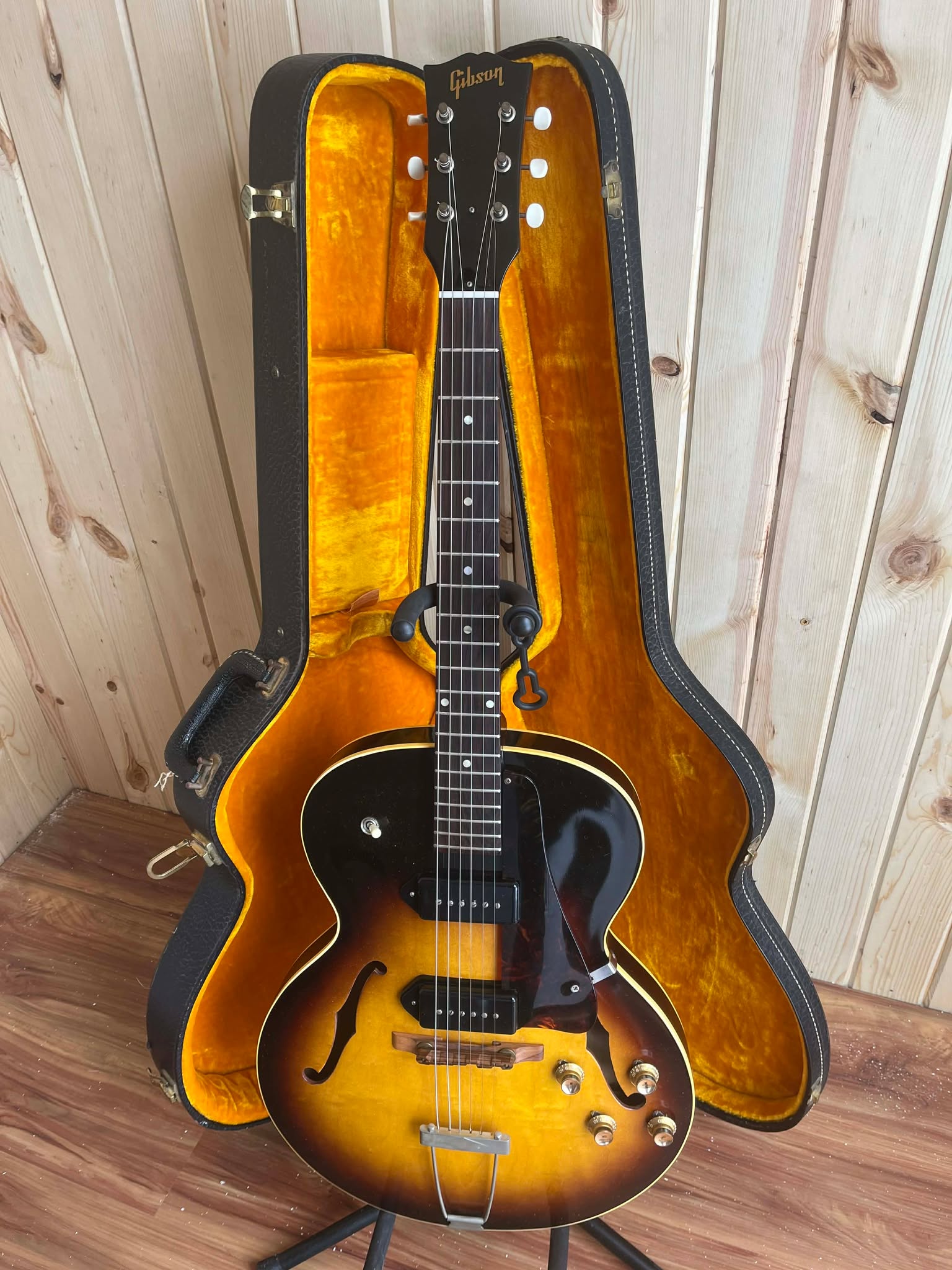
1956-1968 ES-125T (Two-Pickup Model)
Two P-90 pickups (neck and bridge) instead of one
Four-knob control layout with a three-way toggle switch
Single-cutaway body, parallelogram inlays
The “T” on the model designation means Two pickups, not Thinline
1957-1963 ES-125TD (Double-Cutaway)
Double Florentine (pointed) cutaways for improved upper-fret access
Thinline body depth, approximately 1 5/8 inches at the rim
Two P-90 pickups, four-knob controls, parallelogram inlays
“TD” stands for Thinline Double-cutaway
1960-1968 ES-125TDC (Three-Quarter Size)
Smaller three-quarter-size body with a shorter, roughly 23.5 inch scale length
Double-cutaway design, typically a single P-90 pickup
Dot inlays, simplified appointments
“TDC” stands for Three-quarter Double-Cutaway, originally marketed to students and smaller players
1960-1970: Final Production Years
Single-cutaway and two-pickup models remain available alongside the newer TD and TDC variants
Cherry finish becomes more common later in the decade
ES-125TDC discontinued in 1968
All ES-125 production ends in 1970
Model Variant Identification: ES-125 vs. ES-125T vs. ES-125TD vs. ES-125TDC
Four questions settle the variant every time:
How many pickups? One means ES-125. Two means ES-125T, ES-125TD, or ES-125TDC.
Single or double cutaway? Single-cutaway with two pickups is ES-125T. Double-cutaway is ES-125TD or ES-125TDC.
Full size or three-quarter size? Full-size double-cutaway is ES-125TD. Three-quarter-size double-cutaway is ES-125TDC.
Body depth? Full archtop depth (about 3.25 inches) is the standard ES-125. Thinline depth (about 1 5/8 inches) is ES-125T, ES-125TD, or ES-125TDC.
Inlay Markers: Dot vs. Parallelogram
Dot Inlays
Dot position markers are standard on the earliest ES-125 production (pre-1953) and remained standard on the smaller ES-125TDC throughout its run. Dot inlays on a standard-size ES-125 point toward earlier 1940s-early 1950s production.
Parallelogram Inlays
Parallelogram inlays become standard on the ES-125, ES-125T, and ES-125TD from the mid-1950s onward. On a full-size ES-125, parallelogram inlays point toward 1953 or later.
Pickup Identification
Single P-90 (Neck Position)
The standard ES-125 carries one P-90 in the neck position for its entire production run. A single-cutaway ES-125 with only a neck pickup is the base model, not a modified ES-125T.
Dual P-90s (Neck and Bridge)
The ES-125T, ES-125TD, and most ES-125TDC examples carry two P-90s. All ES-125 variants used P-90 single-coils, never humbuckers, from the factory. A humbucker on an ES-125 is always a later replacement.
ES-125 vs. ES-175: A Dating and Identification Clue
Players and sellers sometimes confuse an ES-125 for a lower-value ES-175 or vice versa. The construction is the fastest way to tell them apart: the ES-125 uses a laminated (plywood) maple back, sides, and top, while the ES-175 has a carved solid spruce top. A laminated top with visible plywood layering at the f-holes confirms ES-125 construction rather than ES-175. The ES-125 is also generally lighter and more feedback-resistant than the carved-top ES-175, a difference many players can hear as well as see.
Red Flags: Identifying Non-Original or Modified ES-125
Refinished Examples
Check inside the f-holes for overspray, and look in screw holes for finish that shouldn’t be there. Original sunburst finish shows natural checking and wear; a uniformly glossy, crack-free finish on an old guitar is a signal to look closer.
Replaced Pickups
Original P-90s significantly enhance both authenticity and value. Any humbucker, or a P-90 with mismatched mounting hardware or solder work, suggests a replacement.
Non-Original Tailpiece or Bigsby Modifications
Trapeze tailpieces are original to most ES-125 years. A Bigsby vibrato was a common period modification but requires drilling, which is irreversible and reduces collectibility on an otherwise all-original example.
Neck Repairs
Look for finish inconsistencies or filled screw holes near the headstock and heel, both signs of a past repair that affects value more than cosmetic wear does.
When You’re Ready to Sell Your Vintage ES-125
How Dating Affects ES-125 Value
Early post-war examples, all-original specimens with their original P-90s and finish, and the less common ES-125TD generally draw the strongest interest. Later player-grade examples still have real value to working musicians, even with typical wear, so accurate dating and an honest condition assessment matter regardless of which variant or year you have.
Why Choose Edgewater Guitars
Edgewater Guitars has deep, hands-on knowledge of all four ES-125 variants across their full 30-year production run. We consistently pay 30-40% more than typical guitar shops, provide a free expert evaluation of model, year, and originality, and pay immediately with no consignment wait.
Frequently Asked Questions
What’s the difference between ES-125, ES-125T, ES-125TD, and ES-125TDC?
The ES-125 is the original single-pickup model. The ES-125T adds a second pickup (“T” for Two). The ES-125TD is a full-size double-cutaway two-pickup model (“TD” for Thinline Double-cutaway). The ES-125TDC is a smaller three-quarter-size double-cutaway model (“TDC” for Three-quarter Double-Cutaway), typically with one pickup.
How do I find the serial number on my ES-125?
Look inside the body through the f-hole with a flashlight, on the neck block or back brace. Use our Gibson Serial Number Lookup Tool for an approximate year once you have the number.
Can I date my ES-125 by serial number alone?
Not precisely. Gibson’s serial ranges overlapped across the models it built concurrently through the 1950s and 1960s. Use the serial number as a starting window, then confirm with cutaway style, pickup count, inlay pattern, and body size.
Is a double-cutaway ES-125TD more valuable than a single-cutaway ES-125?
The ES-125TD tends to draw stronger player interest today for its upper-fret access and two-pickup versatility, but condition and originality matter more than variant alone. An all-original single-cutaway ES-125 in excellent condition can outvalue a heavily modified TD.
Are ES-125 guitars just student guitars, or are they actually worth something?
The ES-125 was Gibson’s entry-level electric archtop by original pricing, not by build quality. Early examples, all-original specimens, and the ES-125TD variant are genuinely collectible, and later player-grade examples have real value to working musicians.
What’s the difference between an ES-125 and an ES-175?
The ES-125 has a laminated maple top, back, and sides. The ES-175 has a carved solid spruce top. The laminated ES-125 is generally warmer and more feedback-resistant; the carved ES-175 has more acoustic resonance and dynamic range.
Can I install a Bigsby on my ES-125 without hurting its value?
A Bigsby installation requires drilling and is not reversible, so it will reduce value on an all-original 1940s-1950s example. On a later player-grade guitar, a properly installed Bigsby is a widely accepted modification.
Contact Edgewater Guitars
For expert ES-125 authentication or to sell your vintage ES-125:
Phone: (440) 219-3607
Service Area: Ohio, Michigan, Pennsylvania, Indiana, West Virginia
Our Services:
Expert ES-125 model and year identification
Single-cutaway vs. double-cutaway vs. three-quarter-size verification
Originality and modification assessment
Fair market valuations
Immediate cash offers
Why Sellers Choose Us
✓ ES-125 Specialists: Working knowledge of all four variants across 30 years of production
✓ Honest Assessment: We recognize genuine collectibility instead of dismissing these as “just student guitars”
✓ Premium Offers: 30-40% higher than typical guitar shops
✓ Professional Service: Transparent, respectful evaluation
Additional Resources
Learning how to date a Gibson ES-125 accurately means combining the serial number with cutaway style, pickup count, inlay pattern, and body size, since no single feature settles the year and variant on its own. The ES-125 evolved across four overlapping variants from 1941 through 1970, with early post-war examples and all-original specimens commanding the strongest interest.
Whether you own a single-cutaway 1940s-1950s example, a two-pickup ES-125T, a double-cutaway ES-125TD, or a three-quarter-size ES-125TDC, proper authentication ensures you understand what you have. Use our Gibson Serial Number Lookup Tool as a starting point, then verify with the physical features in this guide.
Edgewater Guitars specializes in vintage Gibson archtop authentication and purchasing throughout the Midwest.
Contact us today at (440) 219-3607 for expert ES-125 authentication or professional valuation.
By Stephen Pedone, co-owner of Edgewater Guitars. Edgewater is a vintage guitar shop in Valley City, Ohio that buys pre-1970 Fender, Gibson, Martin and Gretsch guitars across Ohio and nationwide. Call or text (440) 219-3607 for a free appraisal.
Related: 1961 Gibson ES-125TD value guide: the double-pickup thinline.