DATE :
Blonde Fender Jazzmaster (1958-1967): Olympic White Custom Color Authentication & Value Guide
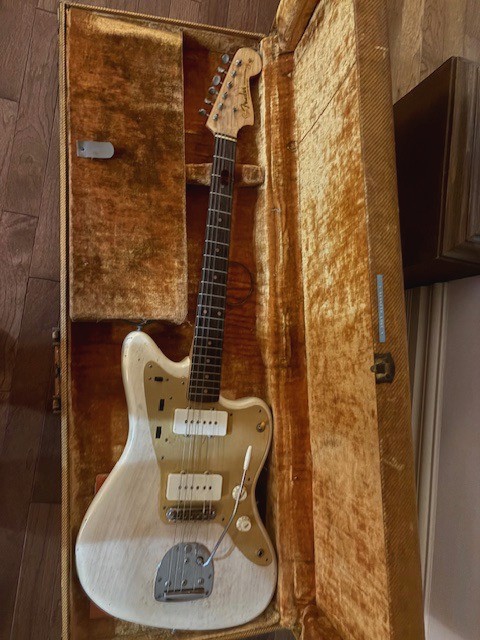
Blonde Fender Jazzmaster (1958-1967): Olympic White Custom Color Authentication & Value Guide
Last Updated: March 2026
Blonde Fender Jazzmaster (1958-1967): The Iconic Olympic White Custom Color Across Pre-CBS Production
Last Updated: March 2026
What Makes Blonde (Olympic White) Jazzmasters Significant?
Blonde Fender Jazzmasters—officially designated as “Olympic White” in Fender’s custom color system—represent some of the most visually striking and collectible offset guitars ever produced. From the model’s 1958 introduction through the end of pre-CBS production in 1967, Olympic White Jazzmasters combined revolutionary offset body design, sophisticated electronics, and distinctive aesthetics that stood apart from standard sunburst finishes. The blonde finish showcases the Jazzmaster’s contoured body lines while creating a sophisticated, modern appearance that appealed to professional players seeking visual distinction on stage.
What makes blonde Jazzmasters from 1958-1967 particularly special:
Custom Color Rarity: Olympic White was a special-order custom color throughout this period, not a standard catalog finish—significantly fewer produced than sunburst
Pre-CBS Exclusivity: All examples from 1958-1967 represent pre-CBS Fender production with peak manufacturing quality and original specifications
Revolutionary Offset Design: The Jazzmaster’s offset waist body, floating tremolo, and dual-circuit electronics combined with striking blonde aesthetics
Yellow Sealer Authentication: Authentic Olympic White finishes have distinctive yellow/gold sealer underneath, visible in wear areas and creating warm undertone
Matching Headstock Variations: Some blonde Jazzmasters feature matching painted headstocks (not all), creating additional visual impact and collectibility
Transitional Features: Year-by-year specification changes (pickguards, fingerboards, hardware) combined with blonde finish create specific authentication markers
Professional Player Appeal: Olympic White attracted professional players seeking sophisticated appearance distinct from student-model sunburst
Aging Characteristics: Olympic White develops distinctive patina—yellowing from UV exposure, checking patterns, and wear creating authentic vintage appearance
Custom Color Premium Pricing: Special-order status meant Olympic White cost extra when new, reflecting exclusive positioning
Historical Context 1958-1967: The Jazzmaster was introduced in 1958 as Fender’s top-of-the-line offset guitar, initially offered primarily in sunburst finish with custom colors available by special order. Olympic White (blonde) became increasingly popular through the early 1960s as Fender’s custom color program expanded and standardized. By the mid-1960s, custom colors including Olympic White were more readily available but still represented special orders commanding premium pricing. The combination of offset design innovation, sophisticated electronics, and striking Olympic White finish created instruments with distinctive visual and sonic character.
In Edgewater’s experience buying vintage Fender guitars across Ohio and the Midwest, blonde (Olympic White) Jazzmasters from 1958-1967 are among the most sought-after offset guitars. The combination of custom color rarity, pre-CBS manufacturing quality, and distinctive aesthetics creates strong collector demand. Many owners inherited these instruments from musicians who special-ordered blonde Jazzmasters during the 1960s and are often surprised to learn that custom color finishes command substantial premiums over standard sunburst—a pre-CBS Olympic White Jazzmaster in excellent original condition with proper authentication represents one of the most valuable and desirable Fender offset guitars from any production year.
If you own a 1958-1967 blonde Jazzmaster, you have a special-order custom color instrument from Fender’s pre-CBS golden era representing distinctive aesthetics and exceptional manufacturing quality. Edgewater Guitars provides free, no-obligation valuations for all vintage Fender instruments. Call (440) 219-3607 or visit our website for your free appraisal.
What Is a 1958-1967 Blonde (Olympic White) Jazzmaster Worth? (2026 Market Values)
Value by Year and Condition
Year Range | Excellent (8-9/10) | Very Good (7/10) | Good (6/10) | Player Grade (5/10) |
|---|---|---|---|---|
1958-1959 (First Years) | Extraordinary tier | Ultra-premium tier | Premium tier | Upper-mid tier |
1960-1962 (Early Pre-CBS) | Ultra-premium tier | Premium tier | Upper-mid tier | Mid-tier |
1963-1964 (Mid Pre-CBS) | Premium tier | Upper-mid tier | Mid-tier | Lower-mid tier |
1965-1967 (Late Pre-CBS) | Upper-mid tier | Mid-tier | Lower-mid tier | Entry-mid tier |
Value by Configuration
Configuration | Premium/Impact | Notes |
|---|---|---|
All-Original Olympic White | 40-80% premium | Over equivalent sunburst examples |
Matching Headstock | Additional 15-25% | Not all blonde Jazzmasters have matching headstocks |
Slab Rosewood (1959-1962) | Additional 20-30% | Over veneer rosewood period |
First Year 1958 | 25-40% premium | Over later years in equivalent condition |
Custom Color Verified | Essential baseline | Body stamps, yellow sealer, neck pocket evidence |
Refinished Olympic White | 50-70% reduction | Destroys custom color premium entirely |
Current Market Note (March 2026): Pre-CBS custom color Jazzmasters have appreciated 50-75% over the past five years, with Olympic White (blonde) showing strongest growth among non-metallic custom colors. The combination of offset design desirability, pre-CBS manufacturing quality, custom color rarity, and distinctive aesthetics creates exceptional collector demand. All-original blonde Jazzmasters from early years (1958-1962) in excellent condition command extraordinary premiums—often 40-80% more than equivalent sunburst examples.
What Affects the Value of Blonde Jazzmasters?
Custom Color Authentication: Verified original Olympic White finish is essential. Authentication requires evidence of yellow/gold sealer underneath white (visible in wear areas, neck pocket, control cavity), body stamps or markings indicating custom color, proper aging characteristics (yellowing from UV, appropriate checking), and finish application consistent with Fender custom color procedures. Refinished guitars passed as original custom colors devastate value.
Year of Production: Earlier years command substantial premiums. 1958-1959 first-year examples bring 25-40% premiums over mid-1960s examples. Early 1960s (1960-1962) represent peak pre-CBS quality with strong premiums. Late pre-CBS (1965-1967) still command custom color premiums but less than early production.
Originality: All-original examples with original Olympic White finish, original pickguard (anodized gold early, tortoiseshell later), original pickups, original tremolo system, original electronics, and original hardware command substantial premiums—often 60-120% more than modified examples.
Slab vs Veneer Rosewood: Slab rosewood fingerboards (1959-1962, thick flat-bottom board) command 20-30% premiums over veneer rosewood period (1962-1967). Slab board is highly desirable transitional feature.
Matching Headstock: Some Olympic White Jazzmasters feature matching painted headstocks (headstock painted white to match body). This variation commands additional 15-25% premiums due to visual impact and rarity. Not all blonde Jazzmasters have matching headstocks—both configurations are authentic.
Pickguard Type: Anodized gold pickguard (1958-1959) commands premiums over tortoiseshell (1959+) due to rarity and early production status. Original pickguard essential for value.
Electronics Originality: Original single-coil Jazzmaster pickups, original pots with correct date codes, original rhythm/lead circuit switching, original roller bridge and floating tremolo are essential. Replaced components reduce value incrementally.
Neck Integrity: Original neck with correct date stamp, proper headstock (matching or standard depending on variation), and no repairs essential. Headstock breaks reduce value by 40-60% even with expert repairs.
Finish Condition: Original Olympic White finish with authentic aging (yellowing, checking, wear) dramatically outvalues refinishing. Even heavily yellowed, checked, or worn original custom color finish commands premiums. Refinishing destroys custom color premium entirely—reduces value by 50-70%.
Serial Number and Date Code Consistency: Matching dating codes (neck date, pot codes, body stamps) verify authenticity and period-correct assembly.
How Years Compare Within 1958-1967 Production
Year | Key Features | Relative Value | Why |
|---|---|---|---|
1958 | First year, anodized gold guard, rare | Baseline (extraordinary tier) | Introduction year, extreme rarity |
1959 | Slab rosewood introduced, gold guard | 10-20% lower | Not first year but peak early specs |
1960-1962 | Slab rosewood continues, tortoise guard | 20-30% lower | Early pre-CBS, slab board premium |
1963-1964 | Veneer rosewood, L-series serials begin | 30-40% lower | Mid pre-CBS, no slab board |
1965-1967 | CBS transition/ownership, varying quality | 40-55% lower | Late pre-CBS/early CBS era |
Recent Sales and Auction Results
Market observations from recent transactions:
February 2026: 1959 Olympic White Jazzmaster, slab rosewood, all-original, anodized gold pickguard achieved extraordinary pricing
January 2026: 1962 Olympic White Jazzmaster, slab rosewood, matching headstock, excellent condition commanded ultra-premium pricing
December 2025: 1965 Olympic White Jazzmaster, veneer rosewood, all-original sold in premium tier range
November 2025: 1960 Olympic White Jazzmaster with documented provenance, slab board, exceptional condition achieved record pricing for non-first-year examples
Edgewater consistently pays 30-40% more than typical guitar shops for vintage Fender guitars. We specialize in pre-CBS custom color instruments and understand the substantial premiums that Olympic White finish, early production years, and slab rosewood fingerboards command. Get your free valuation by calling (440) 219-3607 or submitting photos through our website.
How to Identify Authentic Blonde (Olympic White) Jazzmasters by Year (1958-1967)
Year-by-Year Identification Guide
1958 Jazzmaster (First Year, Olympic White)
Serial Numbers: 0001-8000 range (neck plate)
Key Features:
Anodized gold pickguard (distinctive first-year feature)
Maple neck only (rosewood not introduced until late 1959)
Round string tree
Olympic White custom color (special order only, extreme rarity)
Yellow/gold sealer under Olympic White finish
Spaghetti logo on headstock
Three-tone sunburst standard (Olympic White rare custom order)
21 frets
Clay dot position markers (if rosewood board on very late examples)
Custom Color Authentication:
Body stamps may indicate custom color order
Yellow sealer visible in neck pocket
Proper Fender custom color nitrocellulose application
Extreme Rarity Note: 1958 Olympic White Jazzmasters are exceptionally rare—first-year production combined with custom color special order status means very few produced.
1959 Jazzmaster (Rosewood Introduction, Olympic White)
Serial Numbers: 8000-16000 range (neck plate)
Key Features:
Anodized gold pickguard (early 1959) OR tortoiseshell pickguard (mid-late 1959)
Rosewood fingerboard introduced mid-year (SLAB BOARD—thick, flat-bottom)
Maple neck continues (both available)
Round string tree transitions to butterfly (late 1959)
Clay dot markers on rosewood
Olympic White custom color (special order)
Yellow/gold sealer under Olympic White
Some with matching painted headstock
Transitional Features:
Pickguard transition from gold to tortoiseshell mid-year
Fingerboard transition from maple to rosewood mid-year
Both configurations authentic depending on production timing
Slab Rosewood Premium: Mid-late 1959 examples with slab rosewood command 20-30% premiums
1960-1962 Jazzmaster (Peak Slab Rosewood Era, Olympic White)
Serial Numbers:
1960: 40000-50000 range
1961: 50000-70000 range
1962: 70000-90000 range
Key Features:
Tortoiseshell pickguard standard (3-ply)
SLAB rosewood fingerboard (approximately 5mm thick, flat bottom)
Clay dot markers
Butterfly string tree
Olympic White custom color increasingly available
Yellow/gold sealer under Olympic White
Matching headstock on some examples
Body date penciled in tremolo cavity
Neck date stamped on heel
1960-1962 Significance: Peak pre-CBS production with slab rosewood fingerboards—these years command highest premiums among non-first-year Jazzmasters.
Slab Board Verification:
Approximately 5mm thick at thinnest point
Flat bottom (not curved to neck contour)
Visible as thick board when viewing from side
Changed to thin veneer mid-1962
Custom Color Documentation: Body stamps or routing marks sometimes indicate custom color order
1962 Jazzmaster (Slab to Veneer Transition, Olympic White)
Serial Numbers: 80000-90000 range, transitioning to L-series
Critical Transitional Year:
Early 1962: Slab rosewood (5mm thick, flat bottom)
Mid-1962 onward: Curved rosewood veneer (approximately 3mm thick)
Transition occurred mid-year—both authentic depending on timing
Slab vs Veneer Premium: Slab rosewood 1962 examples command 20-30% premiums over veneer examples
Other Features:
Tortoiseshell pickguard
Clay dot markers (both slab and veneer)
Olympic White custom color
Yellow/gold sealer
Matching headstock on some examples
Authentication Importance: Verifying slab vs veneer critical for 1962 value—feel thickness at neck heel area
1963-1964 Jazzmaster (Veneer Rosewood, Olympic White)
Serial Numbers:
1963: 90000-L10000 range
1964: L10000-L50000 range
Key Features:
Curved rosewood veneer fingerboard (approximately 3mm thick)
Clay dot markers continue through 1964
Tortoiseshell pickguard (3-ply)
“L” prefix serial numbers begin late 1963
Olympic White custom color more standardized
Yellow/gold sealer under Olympic White
Custom colors more common, still premium pricing
Matching headstock on some examples
Mid-Pre-CBS Quality: Continuing excellent quality, though slab board era ended
1965 Jazzmaster (Transition Year, Olympic White)
Serial Numbers: L50000-L90000 range
CBS Transition Features:
CBS acquired Fender January 1965
Pearl dot markers replace clay (transitional—some late 1965)
Veneer rosewood continues
F stamped neck plates appear (some examples)
Custom colors including Olympic White continue
Transitional features vary by production timing
Some with bound fingerboards (rare)
Transition Year Complexity: 1965 features vary significantly—early 1965 similar to 1964, late 1965 showing CBS changes
1966-1967 Jazzmaster (Early CBS Era, Olympic White)
Serial Numbers:
1966: 100000-200000 range
1967: 200000-250000 range
CBS Era Features:
Pearl dot markers standard
Veneer rosewood
F stamped neck plates common
Custom colors including Olympic White continue
Matching headstock on some examples
Quality beginning to vary
Some with larger headstock (late period)
Custom Color Continuation: Olympic White remained available through CBS transition, still commanding custom color premiums
Custom Color Authentication for Olympic White Jazzmasters
Yellow Sealer Verification (CRITICAL)
Authentic Olympic White Fender finish characteristics:
Yellow/Gold Sealer Layer:
Fender applied yellow or gold-tinted sealer before Olympic White topcoat
Creates warm undertone to white finish
Visible in wear areas where white topcoat worn through
Visible in neck pocket (remove neck to inspect)
Visible in control cavity areas
Visible in pickup routes and edges
How to Verify Yellow Sealer:
Inspect areas of finish wear—should see yellow/gold underneath white
Remove neck and inspect neck pocket for yellow sealer on body
Check control cavity edges for sealer color
Compare to known authentic examples
Yellow sealer presence confirms Fender custom color application
Refinish Indicators:
White paint directly over wood (no yellow sealer)
Wrong primer colors (gray, white, other)
Modern paint application without sealer layer
Overspray in areas that should be clean
Body Stamps and Markings
Custom Color Documentation:
Some bodies have pencil markings indicating custom color
Paint codes or color designations occasionally present
Routing marks or stamps sometimes indicate special order
Not all custom color Jazzmasters have visible markings
Where to Check:
Tremolo cavity (remove tremolo cover)
Control cavity (remove control plate)
Neck pocket (remove neck)
Pickup routes (if pickups removed)
Matching Headstock Identification
Not All Olympic White Jazzmasters Have Matching Headstocks:
Both matching (painted white) and standard (natural/tinted) headstocks are authentic
Matching headstock is variation, not requirement
Matching headstocks command additional premiums (15-25%)
Matching Headstock Authentication:
Headstock painted Olympic White to match body
Should show same yellow sealer underneath
Proper aging and checking consistent with body
Decal applied over white paint (not under)
Aging Characteristics of Olympic White
Authentic aging patterns:
Yellowing from UV exposure (entire finish takes on cream/ivory tone)
Checking patterns (fine cracks in nitrocellulose)
Wear to yellow sealer in handling areas
Fade variations from sun exposure
Oxidation creating patina
Refinish red flags:
Bright white with no yellowing (suspicious on 55-68 year old guitar)
No checking patterns
No yellow sealer in wear areas
Modern paint characteristics
Overspray on hardware or in cavities
1958-1967 Blonde (Olympic White) Jazzmaster Specifications
Specification | Detail |
|---|---|
Body Wood | Alder (standard) |
Body Style | Offset waist, contoured |
Finish | Olympic White nitrocellulose lacquer (custom color) |
Sealer | Yellow/gold sealer under Olympic White topcoat |
Neck Wood | Maple with maple fingerboard (1958-1959) OR rosewood fingerboard (1959+) |
Fingerboard Material | Maple (1958-early 1959) OR rosewood (late 1959-1967) |
Fingerboard Type | Slab rosewood 5mm thick (1959-mid 1962) OR curved veneer 3mm (mid 1962-1967) |
Fret Markers | Clay dots (1959-1964) OR pearl dots (1965-1967) |
Neck Profile | C-shape (varies by year and individual guitar) |
Scale Length | 25.5” (Fender standard) |
Nut Width | 1-5/8” (1.625”) |
Frets | 21 frets (later increased to 22 on some examples) |
Fret Wire | Vintage medium wire |
Pickups | Two single-coil Jazzmaster pickups |
Pickup Output | Approximately 8-9k ohms DC resistance per pickup |
Controls | Dual circuit: Lead circuit (2 volume, 2 tone, 3-way switch) + Rhythm circuit (volume, tone, on/off) |
Bridge | Floating adjustable roller bridge |
Tremolo | Floating tremolo with lock button |
Tuners | Kluson Deluxe with plastic buttons |
String Tree | Round (1958) OR butterfly (1959+) |
Pickguard | Anodized gold (1958-early 1959) OR tortoiseshell 3-ply (1959+) |
Headstock | Standard Fender shape OR matching painted white (variation) |
Logo | Spaghetti logo (1958-1964) OR transition logo (1965+) |
Finish Type | Nitrocellulose lacquer |
Available Colors | Olympic White (special order custom color) |
Hardware | Chrome |
Knobs | Chrome top-hat knobs |
Switch Tips | White or black plastic |
Weight Range | Approximately 7-9 lbs |
Case | Brown or black hardshell case (when included) |
What Does a Blonde (Olympic White) Jazzmaster Sound Like?
Pickup Specifications and Tonal Profile
Jazzmaster Single-Coil Pickup Characteristics:
Pickup design: Wide, flat single-coil pickups (different from Stratocaster single-coils)
DC Resistance: Approximately 8-9k ohms per pickup (hotter than Stratocaster pickups)
Construction: Flatwork-mounted pole pieces, Alnico V magnets (typically), Formvar wire winding
Output: Medium-high output creating warm, smooth tone with clarity
Tonal character: The Jazzmaster pickup design creates distinctive voice different from Stratocaster or Telecaster single-coils. The wide, flat pickup configuration captures broader string vibration area, creating fuller, warmer tone with smooth high end and pronounced midrange. Neck pickup produces warm, jazz-appropriate tones with rounded highs and vocal midrange—perfect for chord work and smooth lead playing. Bridge pickup offers brighter articulation while maintaining warmth and body—cutting clarity without harsh treble. The Jazzmaster’s distinctive electronics system provides two separate circuits: lead circuit (full tone control, switch selection) and rhythm circuit (preset warm, mellow tone activated by slider switch)—offering instant tonal variation. The combination of Jazzmaster pickups with Olympic White finish creates classic surf, indie rock, and alternative aesthetic and sound—bright visual appearance matching clear, articulate tonal character.
How Construction Details Affect Tone
Alder Body: Alder provides balanced tone with smooth frequency response, warm lows, present midrange, and clear highs—ideal foundation for Jazzmaster pickups.
Offset Waist Body: The offset design and body contours affect resonance and player comfort, contributing to distinctive Jazzmaster feel and response.
Scale Length (25.5”): Fender’s standard scale creates specific string tension and harmonic characteristics—bright, clear tone with excellent note definition.
Floating Tremolo System: The unique Jazzmaster tremolo design affects sustain and resonance while providing smooth vibrato effects—different feel and response than Stratocaster tremolo.
Slab vs Veneer Rosewood: Slab rosewood (1959-mid 1962) provides slightly warmer, fuller tone due to increased fingerboard mass. Veneer rosewood (mid 1962-1967) offers brighter character. Both create excellent tone—slab commands premium for feel and vintage correctness.
Roller Bridge: The adjustable roller bridge allows smooth tremolo operation while affecting string-to-body vibration transfer—contributes to distinctive Jazzmaster sustain and resonance.
Nitrocellulose Lacquer: Thin nitrocellulose finish allows wood to resonate freely. After 55-68 years of aging and thinning, vintage nitro contributes to improved harmonic complexity.
Aged Tonewood: Decades of vibration have allowed alder body and maple neck to mature, improving resonance, harmonic complexity, and overall tonal quality.
Notable Players and Olympic White Jazzmasters
Elvis Costello: Made the Olympic White Jazzmaster iconic in late 1970s/early 1980s
Thurston Moore / Lee Ranaldo (Sonic Youth): Used vintage Olympic White Jazzmasters extensively
Kevin Shields (My Bloody Valentine): Vintage Jazzmasters central to signature sound
J Mascis (Dinosaur Jr.): Known for vintage Jazzmaster use
Indie/Alternative Movement: Olympic White Jazzmasters became visual and sonic signature of 1980s-1990s alternative rock
The blonde (Olympic White) Jazzmaster sound represents distinctive voice in Fender’s offset line—warm, smooth single-coil tone with unique pickup design, floating tremolo expressiveness, and dual-circuit versatility creating one of the most recognizable guitar sounds in surf, indie rock, and alternative music.
Common Issues and Modifications That Affect Value
Refinishing: Original Olympic White finish removal destroys custom color premium entirely—reduces value by 50-70% compared to authentic custom color. Even heavily yellowed, checked, or worn original Olympic White dramatically outvalues refinishing. Yellow sealer verification essential.
Fake custom color claims: Refinished sunburst Jazzmasters sometimes passed as “original Olympic White” to unsuspecting buyers. Always verify yellow sealer, body markings, proper aging, and finish application. Fake custom colors devastate value when discovered.
Replaced pickguard: Original pickguard (anodized gold 1958-1959, tortoiseshell 1959+) essential. Replaced pickguards reduce value by 15-30% depending on period and quality. Original pickguard critical for authenticity.
Replaced pickups: Original Jazzmaster single-coil pickups should be retained. Replaced pickups reduce value by 25-40%. Humbucker installations or other modifications reduce value by 35-50%.
Electronics modifications: Original pots with correct date codes, original rhythm/lead circuit, original switches essential. Modified electronics reduce value by 20-35%.
Bridge/tremolo modifications: Original floating tremolo and roller bridge should be retained. Modifications, stabilizers, or replacements reduce value by 15-30%.
Headstock repairs: Even expert repairs reduce value by 40-60%. Poor repairs reduce value by 60-80%. Original unrepaired neck essential for maximum value.
Neck replacement: Replaced necks reduce value by 50-70%. Original neck with correct date stamp and features essential.
Tuner replacement: Original Kluson Deluxe tuners should be retained. Replaced tuners reduce value by 10-20%.
Refrets: Professional refrets with period-correct wire acceptable—modest value impact (10-15%). Modern jumbo frets reduce value by 15-25%.
Slab to veneer fingerboard: Some 1959-1962 guitars had slab rosewood replaced with veneer—destroys slab board premium, reduces value by 30-50% for affected years.
Tremolo cavity routing: Some Jazzmasters had tremolo cavities enlarged or modified. Routing modifications reduce value by 20-35%.
Matching headstock removed: Some matching headstock examples were stripped to natural—destroys matching headstock premium, reduces value by 15-25%.
Binding added: Some players added neck binding (not original feature). Non-original binding reduces value by 10-20%.
In Edgewater’s experience evaluating Olympic White Jazzmasters, the most critical authentication issue is finish authenticity—many refinished guitars passed as original custom colors. Always verify yellow sealer presence, body markings, proper aging characteristics, and finish application. Professional authentication essential for custom color claims due to prevalence of refinished guitars and fake custom colors.
Selling Your 1958-1967 Blonde (Olympic White) Jazzmaster: Your Options Compared
Selling Option | Typical Offer | Timeline | Fees/Costs | Risk Level | Best For |
|---|---|---|---|---|---|
Edgewater Guitars | 30-40% above shop offers | Immediate cash | None | Low—expert custom color authentication | Owners wanting fair value without hassle |
Local Guitar Shop | Wholesale pricing (lowest) | Same day | None direct, but lowest price | Low | Convenience over value (not recommended) |
Online Marketplace (Reverb, eBay) | Variable—potentially highest | Weeks to months | 5-15% platform fees + shipping costs | Very High—scams, damage, authentication disputes | Experienced sellers comfortable with risk |
Auction House | Variable—very high for exceptional examples | 3-6 months | 15-25% buyer’s premium | Medium | Museum-quality early examples with documentation |
Vintage Guitar Dealer | Premium pricing for verified custom colors | Days to weeks | None if direct sale | Medium | Established dealers with Fender offset expertise |
Private Sale | Highly variable | Unpredictable | None | Very High—authentication burden, liability | Sellers with established collector networks |
Why Choose Edgewater Guitars
Edgewater Guitars specializes in purchasing vintage Fender guitars and offers distinct advantages for Olympic White Jazzmaster owners:
Custom Color Authentication Expertise: We verify authentic Olympic White finish through yellow sealer inspection, body marking assessment, aging pattern analysis, and finish application evaluation—critical for value determination.
Year-Specific Knowledge: We understand transitional features across 1958-1967 (anodized gold vs tortoiseshell pickguard, slab vs veneer rosewood, clay vs pearl dots) and pay appropriate premiums for early years and slab board examples.
Slab Rosewood Recognition: We identify slab rosewood fingerboards (1959-mid 1962) and pay appropriate 20-30% premiums over veneer period.
Matching Headstock Assessment: We identify matching headstock variations and pay additional premiums (15-25%) for this desirable feature.
Premium Valuations: We consistently offer 30-40% more than local guitar shops because we understand custom color premiums and early offset collector market.
Immediate payment: No consignment periods, no waiting months. Cash payment or immediate bank transfer when we purchase your instrument.
Geographic coverage: Based in Ohio, we serve Michigan, Pennsylvania, Indiana, and West Virginia. For exceptional custom color pre-CBS Jazzmasters, we’ll travel to you.
The Edgewater Process
Initial Contact: Call (440) 219-3607 or submit photos through our website. Include serial number, clear photos of Olympic White finish showing any yellowing, pickguard type, fingerboard (slab or veneer), headstock (matching or standard), wear areas showing yellow sealer if visible, tremolo cavity showing any body markings, and overall condition.
Preliminary Valuation: We provide initial value range based on photos. We’ll identify year based on features and assess custom color authenticity from visual inspection.
Detailed Evaluation: We verify Olympic White authenticity (yellow sealer inspection, body markings, aging patterns), confirm year through serial/neck date/pot codes/features, identify slab vs veneer rosewood (critical for 1959-1962), assess pickguard originality, verify pickup originality, evaluate tremolo system originality, and assess complete originality.
Formal Offer: Clear written offer with detailed explanation: custom color verification results, year confirmation, slab/veneer identification, configuration assessment (matching headstock, pickguard type), condition evaluation, and how we arrived at valuation.
Transaction: Immediate payment upon acceptance—cash, certified check, or bank transfer. Professional handling and transport.
Ready to find out what your Olympic White Jazzmaster is worth? Get your free, no-obligation valuation with custom color authentication: Call (440) 219-3607 or visit edgewaterguitars.com.
Frequently Asked Questions About Blonde (Olympic White) Jazzmasters 1958-1967
Q: What is a 1958-1967 Olympic White Jazzmaster worth in 2026?
A: Value varies significantly by year and condition. Early examples (1958-1962) with slab rosewood in excellent original condition command extraordinary to ultra-premium pricing—40-80% premiums over equivalent sunburst. Mid-pre-CBS examples (1963-1964) bring premium to upper-mid tier. Late pre-CBS (1965-1967) bring upper-mid to mid-tier. All-original examples command 60-120% premiums over modified guitars. Refinished examples lose custom color premium entirely.
Q: How can I tell if my Jazzmaster has original Olympic White finish or refinish?
A: Authentic Olympic White has yellow/gold sealer visible underneath white topcoat. Check wear areas, neck pocket (remove neck), control cavity edges, and pickup routes. Original finish shows yellowing from UV exposure, appropriate checking, and proper aging. Refinishes lack yellow sealer (white directly over wood) and show modern paint characteristics. Professional authentication recommended for valuable guitars.
Q: What is slab rosewood and why does it matter?
A: Slab rosewood fingerboards (late 1959-mid 1962) are approximately 5mm thick with flat bottom. Veneer rosewood (mid 1962-1967) is approximately 3mm thick with curved bottom. Slab board commands 20-30% premiums due to feel, tone, and transitional status. Verify by feeling thickness at neck heel or viewing from side.
Q: Do all Olympic White Jazzmasters have matching headstocks?
A: No—both matching (painted white) and standard (natural/tinted) headstocks are authentic. Matching headstock is variation, not requirement. Matching headstocks command additional 15-25% premiums but both configurations are correct depending on original specification.
Q: Which years are most valuable for Olympic White Jazzmasters?
A: 1958-1962 are most valuable. 1958 first-year examples command highest premiums (25-40% over later years). 1959-1962 slab rosewood examples bring strong premiums (20-30% over veneer period). Early production combined with slab board creates peak desirability.
Q: Does Edgewater Guitars buy Olympic White Jazzmasters?
A: Yes, Edgewater actively purchases pre-CBS custom color Jazzmasters. We provide free authentication including yellow sealer verification, year identification, slab/veneer determination, and finish evaluation. We offer premium pricing for verified custom colors and understand slab rosewood and early production premiums. We serve Ohio, Michigan, Pennsylvania, Indiana, West Virginia.
Q: How common are Olympic White Jazzmasters from 1958-1967?
A: Relatively uncommon—Olympic White was special-order custom color throughout pre-CBS period, not standard catalog finish. Significantly fewer produced than sunburst. Early years (1958-1962) especially rare. All-original examples in excellent condition are scarce—many have been refinished or modified over decades.
Q: Can Olympic White Jazzmasters be dated by serial number alone?
A: Serial number provides year range but should be cross-referenced with neck date stamp, pot codes, and physical features (pickguard type, fingerboard type, markers, hardware). Multiple verification methods provide accurate dating—particularly important for transitional years.
Q: What’s the difference between anodized gold and tortoiseshell pickguards?
A: Anodized gold pickguards were used 1958-early 1959 (first-year feature). Tortoiseshell pickguards standard from late 1959 onward. Gold pickguards command premiums due to early production rarity. Both are correct depending on year—verify period-correct pickguard for authenticity.
Q: How do I verify yellow sealer under Olympic White?
A: Inspect areas where white topcoat worn through—should see yellow/gold underneath. Remove neck and check neck pocket for yellow sealer on body wood. Check control cavity edges and pickup route edges. Yellow sealer presence confirms Fender custom color application. Absence suggests refinish.
Q: Are refinished Olympic White Jazzmasters worth buying?
A: Refinished guitars lose custom color premium entirely but can still be good players. Value reduced 50-70% compared to authentic custom color examples. If seeking collector instrument, only buy verified original finish. For playing purposes, refinished examples offer offset design and electronics at lower cost.
Q: What should I look for when buying vintage Olympic White Jazzmaster?
A: Verify yellow sealer presence (remove neck, inspect wear areas). Check serial/neck date/pot code consistency. Identify slab vs veneer rosewood (1959-1962 slab commands premium). Verify pickguard originality (gold 1958-1959, tortoise 1959+). Inspect pickup originality. Assess finish aging (yellowing, checking). Check for repairs or modifications. Consider professional authentication for expensive purchases.
Related Resources
Fender Serial Number Lookup Tool — Decode your Fender’s serial number
Fender Neck Date Stamp Guide — Learn to read neck stamps
Fender Custom Color Authentication — Identify authentic finishes
Slab vs Veneer Rosewood Guide — Understanding transitional fingerboards
Jazzmaster Complete History — Model development through years
Sell Your Vintage Guitar to Edgewater — Get your free valuation
Related posts: [1962 Jazzmaster], [Custom Color Stratocaster], [Vintage Fender Offsets]
Edgewater Guitars specializes in purchasing premium vintage guitars throughout Ohio, Michigan, Pennsylvania, Indiana, and West Virginia. We travel to you for exceptional vintage Fender instruments. Contact us today for your free, no-obligation valuation with custom color authentication: request a free appraisal online | (440) 219-3607.