DATE :
1965 Gibson SG Custom: The Final Pre-Transition Year — Last of the Original Black Beauty SG
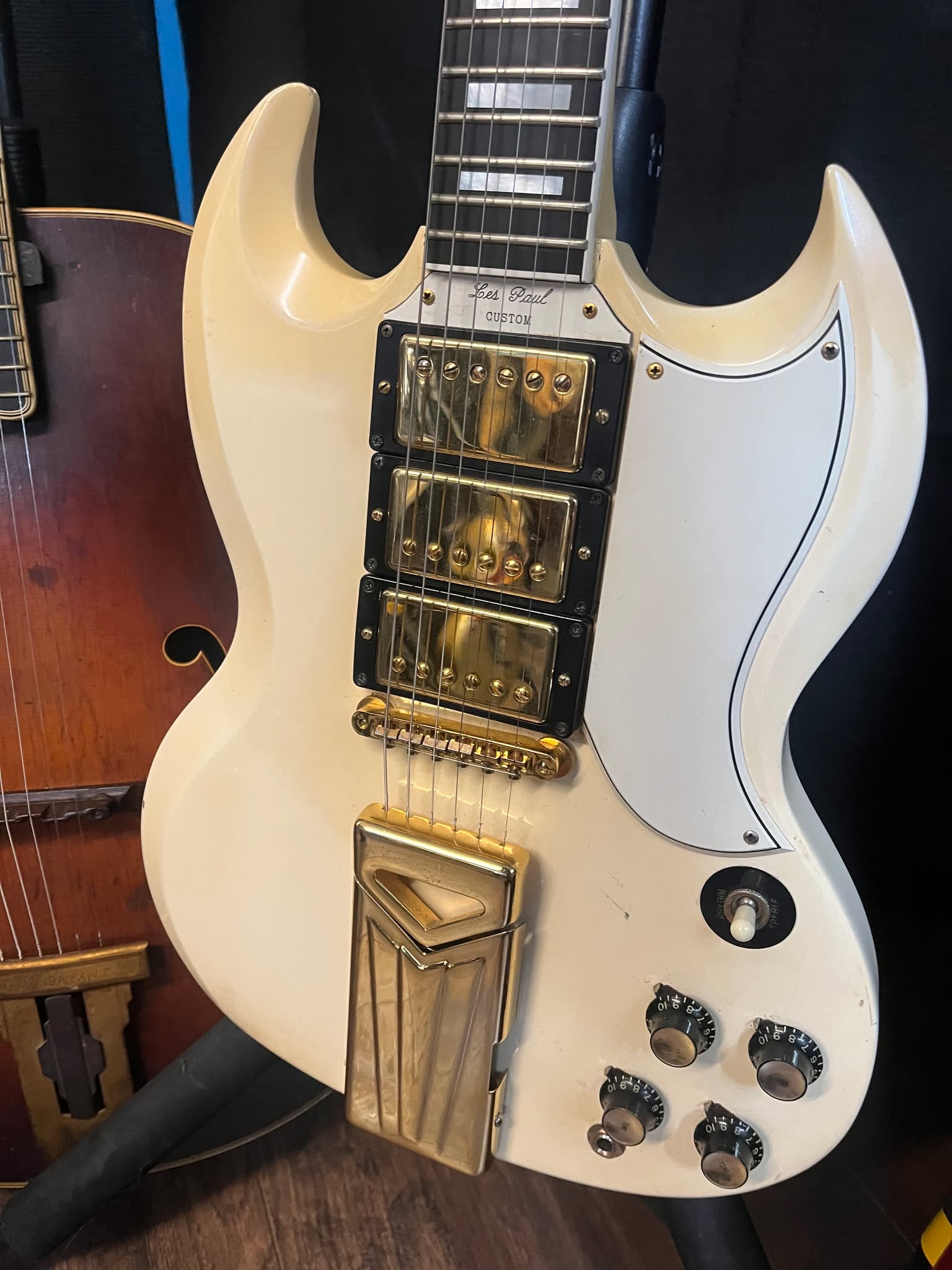
1965 Gibson SG Custom: The Final Pre-Transition Year — Last of the Original Black Beauty SG
Last Updated: June 2026
What Makes the 1965 Gibson SG Custom Significant?
The 1965 Gibson SG Custom is the last year the instrument existed in its original, fully intact pre-transition form — and that last-year status carries a specific collector significance that distinguishes it from the production years immediately preceding it. By the end of 1965 Gibson was beginning to implement production changes that would alter the character of the SG line: the large batwing pickguard that would come to define the late 1960s SG, changes to the neck joint, and other refinements that marked the transition from the original SG design to the evolved version that would carry forward through the decade. The 1965 SG Custom — particularly examples from the first half of the year — represents the original SG Custom concept at its fullest expression before those changes began to appear.
The significance of the 1965 is amplified by its cultural context. This was the year the British Invasion completed its transformation of popular music, the year electric guitar became the defining instrument of generational identity, and the year Gibson’s SG line was at the absolute center of that transformation. Eric Clapton, Keith Richards, Pete Townshend, and other players who defined the sound of the era were using SG instruments during this period, and the SG Custom’s three-humbucker configuration — maximum tonal versatility in the most aggressive-looking body Gibson produced — was ideally positioned for the musical moment. A 1965 SG Custom that left the Kalamazoo factory in early 1965 was built into a world where it would immediately have been one of the most desired professional instruments available.
The production split within 1965 is the most important authentication and valuation consideration for this year. Early 1965 SG Custom instruments — those produced in the first half of the year with serial numbers in the earlier portion of the 5xxxx range — are essentially equivalent in construction and appointment to 1964 examples. Late 1965 instruments begin to show the transitional features that would define subsequent production. This split makes 1965 one of the more nuanced years to evaluate accurately — and one where the specific production position within the year matters meaningfully to both authentication and value. In our experience buying SG Custom instruments across Ohio and the Midwest, 1965 examples are the most frequently encountered year in our evaluations — they represent the broadest production window of the original SG Custom concept and appear with the highest frequency of any pre-transition Custom year.
What makes the 1965 SG Custom distinctive:
Last full year of the original SG Custom concept — pre-transition production at its final expression
Split production year: early 1965 essentially equivalent to 1964; late 1965 showing transitional features
Three patent number humbuckers — neck, middle, and bridge — unchanged from 1964
Ebony fingerboard with mother of pearl block inlays
Gold-plated hardware throughout
Multi-ply binding on body, neck, and headstock
Split-diamond headstock inlay in mother of pearl
Ebony black nitrocellulose finish
Serial numbers in the 5xxxx range on the back of the headstock
Maestro vibrato on some examples as factory option
Late examples may show early transitional features — larger pickguard beginning to appear
If you own a 1965 SG Custom, you may be sitting on a significant asset. Edgewater Guitars provides free, no-obligation valuations — call (440) 219-3607 or visit edgewaterguitars.com.
What Is a 1965 Gibson SG Custom Worth? (2026 Market Values)
Value by Condition and Finish
The 1965 SG Custom market in 2026 operates with a clear early-versus-late production split that is the defining value variable of this year. Early 1965 examples in the original pre-transition configuration are valued essentially on par with 1964 instruments. Late 1965 examples showing transitional features sit at a meaningful discount. All-original three-pickup configuration remains the primary value driver across both early and late production.
Condition | Configuration | Relative Value |
|---|---|---|
Excellent (8–9/10) | All original, early 1965, three pickups, original case | Premium tier |
Excellent (8–9/10) | All original, late 1965, three pickups, original case | Strong-plus tier |
Very Good (7/10) | All original, early 1965, three pickups, no case | Strong tier |
Very Good (7/10) | All original, late 1965, three pickups, no case | Mid-to-strong tier |
Good (6/10) | Original pickups, some hardware changes | Mid tier |
Player Grade | Some replacements, heavy wear | Entry-to-mid tier |
Modified | All pickups replaced, refin, significant changes | Entry tier |
What Affects the Value of a 1965 SG Custom?
Early vs. late 1965 production: The single most important value variable specific to 1965. Early examples — first-half FON batches, lower portion of 5xxxx serial range, pre-transitional features — are valued essentially on par with 1964 instruments. Late examples showing transitional features sit at a 15–25% discount to early 1965 equivalents. The FON batch letter is the primary tool for distinguishing early from late 1965 production.
Transitional feature identification: Late 1965 instruments may show one or more transitional features beginning to appear. These include changes to the neck joint area, the beginning of the batwing pickguard appearing on some examples, and other subtle production refinements. The presence of transitional features on a claimed early 1965 example — or their absence on a claimed late 1965 — requires careful examination of all dating markers.
Three-pickup configuration originality: All three patent number pickups in original positions remain the primary value driver across all 1965 production. Each replaced pickup: 15–20% reduction. Middle pickup removed: 25–35% reduction.
Maestro vibrato completeness: Original complete Maestro unit: 10–15% premium over stop tailpiece equivalents. Maestro removed with stop tailpiece conversion: 10–15% reduction from all-original Maestro configuration.
Gold hardware patina: Authentic aging at contact points. Re-plated or replaced hardware: 10–20% reduction.
Neck integrity: Headstock breaks remain the primary structural concern. Clean unrepaired neck: full value. Professionally repaired breaks: 25–40% reduction.
Original case: Original black alligator-pattern hardshell case adds approximately 10–15% to value.
How 1965 Compares to Other Years
Year | Key Difference | Relative Value | Why |
|---|---|---|---|
1961 | Three PAFs; Les Paul designation | Substantially higher | Maximum PAF plus transition premium |
1962 early | Three PAFs; first pure SG year | Higher | PAF designation premium |
1963 | First full patent number year | Similar to slightly higher | Early patent number premium |
1964 | Peak production consistency | Similar to slightly higher for early 1965 | 1964 equivalent for early examples; premium for later production |
1965 early (this post) | Pre-transition; equivalent to 1964 | Similar to 1964 | Last pre-transition year; early production at 1964 equivalence |
1965 late (this post) | Transitional features beginning | Meaningful discount from early | Transitional features reduce pre-CBS purity premium |
1966 | Full transitional production | Lower | Post-peak production period; original SG Custom concept compromised |
Edgewater Guitars consistently pays 30–40% more than typical guitar shops. Get your free valuation: edgewaterguitars.com or (440) 219-3607.
Recent Sales and Auction Results
All-original early 1965 SG Customs in excellent condition with three original pickups achieve results comparable to 1964 equivalents at specialist dealers and major auction. Late 1965 examples with transitional features sell at a meaningful discount. The last-year status of the pre-transition configuration generates specific collector interest in early 1965 examples — the “last of a kind” premium that applies to final-year instruments is real and consistent in the current market. Contact Edgewater for current market context specific to your instrument’s production position and condition.
How to Identify an Authentic 1965 Gibson SG Custom
Serial Numbers
Range for 1965: Approximately 5xxxx range — five or six digits beginning with 5, impressed into the back of the headstock
Location: Back of headstock, impressed into the wood
Early vs. late within 1965: Lower 5xxxx numbers are more likely to be early 1965 pre-transition examples; higher 5xxxx numbers are more likely to show transitional features. However serial numbers alone cannot confirm production position within the year — FON batch letter examination is required.
Important caveat: Gibson serial numbers overlap between years. Always cross-reference with the Factory Order Number and all pot codes.
Factory Order Number (FON)
Format for 1965: Batch letter followed by production number
Location: Inside the body — visible through one of the three pickup routing cavities with a mirror and light
Critical for 1965: The FON batch letter is the primary tool for distinguishing early from late 1965 production. Early 1965 FON batches precede the production refinements that define late examples. This examination is non-negotiable for accurate 1965 SG Custom valuation.
Potentiometer Codes
Primary manufacturers: Centralab (code 134) and CTS (code 137)
How to decode: Manufacturer code (3 digits) + year (2 digits) + week (2 digits)
Example: 137-5-14 = CTS, 1965, week 14
Expected codes for 1965: Pots dated to 1964 or 1965 are correct. Pots from 1966 or later indicate modification.
Early vs. late confirmation: Pot codes with week numbers in the first half of the year (weeks 1–26) support early 1965 dating; week numbers in the second half (weeks 27–52) support late 1965 dating.
Location: Inside the control cavity — all potentiometers must be individually examined
Key Visual Identifiers — Early 1965
Three pickup positions: Three gold-plated humbucker covers in neck, middle, and bridge positions — unchanged from 1964
Truss rod cover: Reads “Custom”
Fingerboard: Ebony — jet black, dense, identical character to 1964 production
Inlays: Mother of pearl block inlays — same quality and fitting as 1964
Headstock: Split-diamond MOP inlay — unchanged
Binding: Multi-ply on body, neck, and headstock — unchanged
Hardware: Gold-plated throughout — ABR-1, stop tailpiece or Maestro, tuners, pickup covers
Pickguard: Gold-painted plastic — the smaller original-style guard, not the large batwing guard
Neck profile: Slim C with full Custom binding — unchanged from 1964
Finish: Ebony black nitrocellulose
Key Visual Identifiers — Late 1965 (Transitional Features)
Late 1965 instruments may show one or more of the following transitional features beginning to appear:
Larger pickguard: The batwing pickguard that would become standard in the late 1960s begins appearing on some late 1965 examples — a clear visual marker distinguishing late from early production
Neck joint changes: Subtle changes to the neck heel area and neck joint geometry beginning to appear on the latest examples
Hardware refinements: Minor changes to bridge and tailpiece specifications beginning to appear
Finish application: Slight changes in finish thickness and application method beginning to appear on the latest examples
The presence of any transitional feature on a claimed early 1965 instrument warrants careful examination of all dating markers — FON batch letter, pot code week numbers, and serial number position within the 5xxxx range.
Factory Markings and Stamps
Inside body: Factory Order Number — accessible through pickup routing cavities. Critical for early vs. late 1965 determination.
Back of headstock: Impressed serial number
Control cavity: All pot codes — week numbers support early vs. late 1965 confirmation
Pickup base plates: “Patent No. 2,737,842” on each pickup — visible when pickups are removed
Patent Number Pickup Authentication — 1965 Production
Base plate marking: “Patent No. 2,737,842” — standard format unchanged from 1964
DC Resistance: Approximately 7.8–8.5k ohms per pickup — early 1965 examples continue the production range of 1964; late 1965 examples may show slightly increasing consistency as winding processes continued to standardize
Bobbin color: Double black most common; double cream and zebra less frequent
Magnet type: Alnico II or Alnico V — both correct. Ceramic magnets indicate non-original replacement.
Lead wire: Cloth-covered braided shield — consistent across all three positions on original examples
Cover patina: Consistent gold aging across all three positions on all-original instruments
Red Flags: How to Spot Fakes and Refinishes
Transitional features on claimed early 1965: A large batwing pickguard on a claimed early 1965 SG Custom suggests either a late 1965 instrument being presented as early production, a pickguard replacement, or misrepresentation. Verify FON batch letter and pot code week numbers.
Non-transitional features on claimed late 1965: A claimed late 1965 instrument with all early-production features intact may indicate a genuine early-to-mid 1965 example that has been misdated — verify all dating markers rather than assuming misrepresentation.
Two pickups instead of three: Middle pickup removal evidence under pickguard.
Non-gold hardware: Chrome hardware indicates replacement or different model.
Non-ebony fingerboard: Indicates replaced fingerboard or different model.
Ceramic magnet pickups: Non-original replacement in any position.
Refinished black: UV examination essential.
Pot date mismatch: Any pot dated 1966 or later in a claimed 1965 guitar indicates modification.
Plastic-insulated lead wire: Original 1965 pickups use cloth-covered braided shield.
Inconsistent gold cover patina across three positions: Suggests at least one cover or pickup has been replaced.
In our experience evaluating 1965 SG Custom instruments from the Ohio and Midwest region, the early-versus-late production question is the most consequential valuation determination specific to this year — and it cannot be resolved without examining the FON batch letter inside the body. Sellers who believe they have an early 1965 based on the serial number alone may be surprised to find that the FON and pot code week numbers place the instrument in late 1965 production, with a corresponding value adjustment. Conversely, sellers who assume a 1965 SG Custom is in the lower tier of the pre-CBS Custom market may own an early 1965 example that is essentially equivalent in value to a 1964 — a pleasant valuation discovery.
Not sure whether your 1965 SG Custom is early or late production? Edgewater offers free in-person authentication including FON examination. Call (440) 219-3607 or visit edgewaterguitars.com.
1965 Gibson SG Custom Specifications
Specification | Early 1965 | Late 1965 |
|---|---|---|
Body Wood | Slab mahogany — no maple cap | Slab mahogany — no maple cap |
Body Thickness | Approximately 1-3/8” | Approximately 1-3/8” |
Neck Wood | Mahogany, glued set neck | Mahogany, glued set neck |
Fingerboard | Ebony, ~12” radius | Ebony, ~12” radius |
Inlays | MOP block inlays | MOP block inlays |
Neck Profile | Slim C with Custom binding | Slim C — subtle changes beginning |
Nut Width | 1-11/16” | 1-11/16” |
Scale Length | 24.75” | 24.75” |
Frets | 22, medium vintage wire | 22, medium vintage wire |
Pickups | Three patent number humbuckers | Three patent number humbuckers |
DC Resistance | ~7.8–8.3k ohms per pickup | ~7.8–8.5k ohms per pickup |
Bridge | ABR-1, gold-plated | ABR-1, gold-plated |
Tailpiece | Stop tailpiece or Maestro vibrato | Stop tailpiece or Maestro vibrato |
Tuners | Gold Kluson Deluxe, tulip buttons | Gold Kluson Deluxe, tulip buttons |
Controls | Two volume, one master tone, toggle | Two volume, one master tone, toggle |
Knobs | Black top hat with gold inserts | Black top hat with gold inserts |
Pickguard | Small gold-painted original style | Large batwing beginning to appear |
Binding | Multi-ply throughout | Multi-ply throughout |
Finish | Ebony black nitrocellulose | Ebony black nitrocellulose |
Hardware | Gold-plated throughout | Gold-plated throughout |
Weight Range | 6.0–7.5 lbs | 6.0–7.5 lbs |
Case | Black alligator hardshell | Black alligator hardshell |
Original Retail Price | Approximately $395.00 (1965 catalog) | Approximately $395.00 (1965 catalog) |
What Does a 1965 Gibson SG Custom Sound Like?
Pickup Specifications and Tonal Profile
All three positions — patent number humbucker:
Pickup type: Humbucking
DC Resistance: Approximately 7.8–8.5k ohms per pickup
Magnet type: Alnico II or Alnico V
Bobbin color: Double black most common; double cream and zebra less frequent
Potting: Light wax potting — consistent with 1964 production on early examples; potentially slightly more potted on late examples
Cover: Gold-plated nickel
The tonal character of the 1965 SG Custom’s patent number humbuckers is essentially continuous with 1964 production on early examples. The warm, musical, sustaining humbucker voice that defines the best of mid-1960s Gibson production is fully present. Early 1965 pickups retain the hand-wound variation and Alnico character that makes early-to-mid 1960s Gibson humbuckers specifically sought — the slight pickup-to-pickup tonal variation that was an unavoidable product of hand-winding is itself part of what makes these instruments musically interesting.
The three-pickup configuration continues to deliver the five tonal voices unique to the Custom model. The neck pickup is warm and full; the bridge pickup is defined and clear; the middle pickup occupies the tonal middle ground that is uniquely the Custom’s voice. The combination positions — particularly neck and middle together — produce voices that no two-pickup instrument can replicate. Late 1965 examples with slightly more consistent winding may show marginally less pickup-to-pickup variation, which some players prefer for predictability and others find slightly less characterful than the most varied examples.
How Construction Details Affect Tone
The pure slab mahogany body continues to define the 1965 SG Custom’s warmer-than-Standard humbucker character. Early 1965 mahogany body selection and construction is essentially continuous with 1964 — the same density and resonance profile that makes the SG Custom’s humbucker tone warmer and more full-bodied than the maple-cap Les Paul Standard. Late 1965 examples remain mahogany throughout — no cap, no change to body construction — maintaining the tonal foundation that defines the Custom model.
The ebony fingerboard contributes the precision and articulation that defines the Custom model across all years. By 1965 the ebony sourcing and fingerboard fitting had reached its most consistent expression within the original SG Custom production run — the fingerboard quality on 1965 examples is reliable and consistent.
The Maestro vibrato on factory-equipped examples continues to introduce its specific tonal and playing character. The side-pull mechanism — unchanged from 1964 — produces the same smooth, controlled vibrato effect with its distinctive character. Late 1965 Maestro units may show minor refinements in the mechanism but remain functionally and tonally equivalent to earlier versions.
Notable Recordings
The 1965 SG Custom tonal character is at the center of some of the most significant rock recordings of the mid-1960s. The three-humbucker SG configuration — warm, sustaining, versatile — defined the sound of British blues-derived rock at its most powerful. Eric Clapton’s use of SG Custom instruments during the Cream period captures the definitive expression of this tonal character: singing sustain, harmonic complexity, and the ability to go from clean warmth to saturated aggression within a single performance. The 1965 SG Custom’s patent number humbuckers produce this character with the full authority of instruments built at the peak of Gibson’s original production commitment to the model.
Common Issues and Modifications That Affect Value
Middle pickup removed: The most commonly encountered modification on 1965 SG Customs. Players who found the three-pickup system complex sometimes removed the middle pickup. Evidence: filled routing cavity under pickguard. Value impact: 25–35% reduction.
Replaced pickups — any position: Each replaced pickup: 15–20% reduction. All three replaced: 40–50% reduction. Original pickups retained and included partially offset reductions.
Maestro vibrato removed: Common modification. Original Maestro routing evidence plus added stop tailpiece holes: 10–15% reduction from all-original Maestro configuration.
Late 1965 transitional features misrepresented as early production: Not a modification but a misrepresentation risk — late examples with transitional features presented as early pre-transition examples. FON examination resolves this definitively.
Headstock break or repair: Most common structural SG issue. Professionally repaired breaks: 25–40% reduction.
Refinished black finish: UV examination essential. Correct black refinish: 40–55% reduction.
Re-plated or replaced gold hardware: Authentic patina is a value marker. Re-plated hardware: 10–20% reduction.
Replaced ebony fingerboard: Among the most destructive modifications. Value impact: 40–55%.
Replaced or damaged block inlays: 15–25% reduction depending on extent.
Replaced gold tuners: Original gold Kluson tulip button tuners replaced: 10–15% reduction.
In Edgewater’s experience with 1965 SG Custom instruments, the early-versus-late production question and the middle pickup removal are the two most consequential evaluation points — and they interact in a specific way. A late 1965 example with transitional features and a removed middle pickup represents the lowest tier of the 1965 SG Custom market. An early 1965 example with all three original pickups and no transitional features represents the highest tier. The range between these two configurations on otherwise equivalent instruments is wider than many sellers expect.
Selling Your 1965 Gibson SG Custom: Your Options Compared
Selling Option | Typical Offer | Timeline | Fees/Costs | Risk Level | Best For |
|---|---|---|---|---|---|
Edgewater Guitars | 30–40% above shop offers | Immediate cash | None | Low — expert authentication including FON examination | Owners wanting accurate early vs. late valuation |
Local Guitar Shop | Wholesale pricing (lowest) | Same day | None direct, but lowest price | Low | Convenience over value |
Reverb / eBay | Variable — potentially higher | Weeks to months | 5–15% platform fees + shipping | High — authentication disputes, shipping risk | Experienced sellers with collector network |
Auction House | Variable | 3–6 months | 15–25% seller premium | Medium | Exceptional early 1965 all-original examples |
Private Sale | Variable | Unpredictable | None | High — authentication burden on seller | Sellers with established collector connections |
The 1965 SG Custom is the year where the early-versus-late production determination most dramatically affects valuation — the difference between an early 1965 example equivalent to a 1964 and a late 1965 example with transitional features is meaningful. A local shop that does not examine the FON batch letter will apply a general 1965 valuation without accounting for production position within the year. Edgewater’s evaluation process makes the FON examination a required first step on every 1965 SG Custom evaluation — we do not provide a valuation estimate until the production position within the year is confirmed.
We travel anywhere in Ohio, Michigan, Pennsylvania, Indiana, or West Virginia for instruments of this significance. Our process moves from first contact to cash in hand in 24–72 hours.
Ready to find out what your 1965 Gibson SG Custom is worth? Get your free, no-obligation valuation: edgewaterguitars.com or call (440) 219-3607.
Frequently Asked Questions About the 1965 Gibson SG Custom
Q: What is a 1965 Gibson SG Custom worth in 2026? A: Value depends critically on early versus late production position within 1965, three-pickup configuration originality, and overall condition. Early 1965 examples in all-original excellent condition with three original pickups are valued essentially on par with 1964 instruments. Late 1965 examples with transitional features sit at a meaningful discount. Contact Edgewater Guitars for a free valuation — FON examination is required for accurate 1965 dating.
Q: How do I tell if my 1965 SG Custom is early or late production? A: The Factory Order Number inside the body — visible through a pickup routing cavity — is the primary tool. Early 1965 FON batch letters precede the letters associated with transitional feature production. Pot code week numbers provide supporting evidence — early half-year production shows week numbers 1–26; late half-year shows weeks 27–52. Visual inspection for transitional features — particularly the large batwing pickguard beginning to appear on late examples — also provides evidence. Edgewater examines the FON as the first step of every 1965 SG Custom evaluation.
Q: What transitional features appear on late 1965 SG Custom instruments? A: The most visible is the large batwing pickguard beginning to appear on some late examples — replacing the smaller original-style gold-painted guard. Subtle changes to the neck joint area and minor hardware refinements also begin appearing on the latest 1965 examples. The presence of any transitional feature reduces the pre-transition premium and places the instrument in the late 1965 tier.
Q: What serial numbers cover 1965 Gibson SG Customs? A: Approximately 5xxxx range impressed into the back of the headstock. Lower numbers within this range are more likely to be early production; higher numbers are more likely to be late production. However serial number position alone cannot confirm early versus late — FON examination is required.
Q: How many pickups does a 1965 SG Custom have? A: Three — neck, middle, and bridge positions, all patent number humbuckers with gold-plated covers. The middle pickup is the most commonly removed in modifications. Its presence intact is the primary authentication point for the Custom model’s defining three-pickup configuration.
Q: Is a 1965 SG Custom less valuable than a 1964? A: Early 1965 examples in pre-transition configuration are valued essentially on par with 1964 instruments — the last-year premium partially offsets the slight collector preference for earlier production. Late 1965 examples with transitional features sit below 1964 equivalents. The early-versus-late determination within 1965 is more consequential than the 1964-versus-1965 year distinction for most condition tiers.
Q: Does Edgewater Guitars buy 1965 Gibson SG Customs? A: Yes. We actively purchase 1965 SG Customs in all conditions — early production, late production, Maestro-equipped, all-original, partially modified, and player-grade examples. We pay 30–40% more than local guitar shops and provide immediate cash payment. Call (440) 219-3607 or visit edgewaterguitars.com.
Q: Is a 1965 SG Custom with the middle pickup removed still valuable? A: Yes — the three-pickup body routing, ebony fingerboard, gold hardware, block inlays, and overall Custom appointment level retain their significance. A 1965 SG Custom with middle pickup removed but otherwise all-original is still a significant vintage Gibson. The middle pickup removal reduces value by 25–35% but does not eliminate the instrument’s identity. Contact Edgewater for a specific assessment.
Q: What is the difference between a 1965 SG Custom and a 1965 SG Standard? A: The SG Custom has three humbucker pickups versus the Standard’s two. The Custom has an ebony fingerboard with block inlays versus the Standard’s rosewood with crown inlays. The Custom has gold-plated hardware versus the Standard’s nickel. The Custom has multi-ply binding throughout versus the Standard’s simpler binding treatment. The Custom was Gibson’s top-of-line solidbody at a significantly higher price point in 1965.
Q: How long does it take to sell a vintage guitar to Edgewater? A: Typically 24–72 hours from initial contact to cash in hand. For a 1965 SG Custom we always arrange in-person evaluation — the FON batch letter and all three pickup positions must be directly examined for accurate valuation. From that evaluation to cash in hand is typically same-day or next-day.
Related Resources
Useful next reads and tools for this guitar:
Edgewater Guitars specializes in purchasing premium vintage guitars throughout Ohio, Michigan, Pennsylvania, Indiana, and West Virginia. We travel to you for high-value instruments. Contact us today for your free, no-obligation valuation: edgewaterguitars.com | (440) 219-3607.