DATE :
1964 Gibson SG Custom: Peak Mid-Period Production — The Established Black Beauty at Maximum Consistency
1964 Gibson SG Custom: Peak Mid-Period Production — The Established Black Beauty at Maximum Consistency
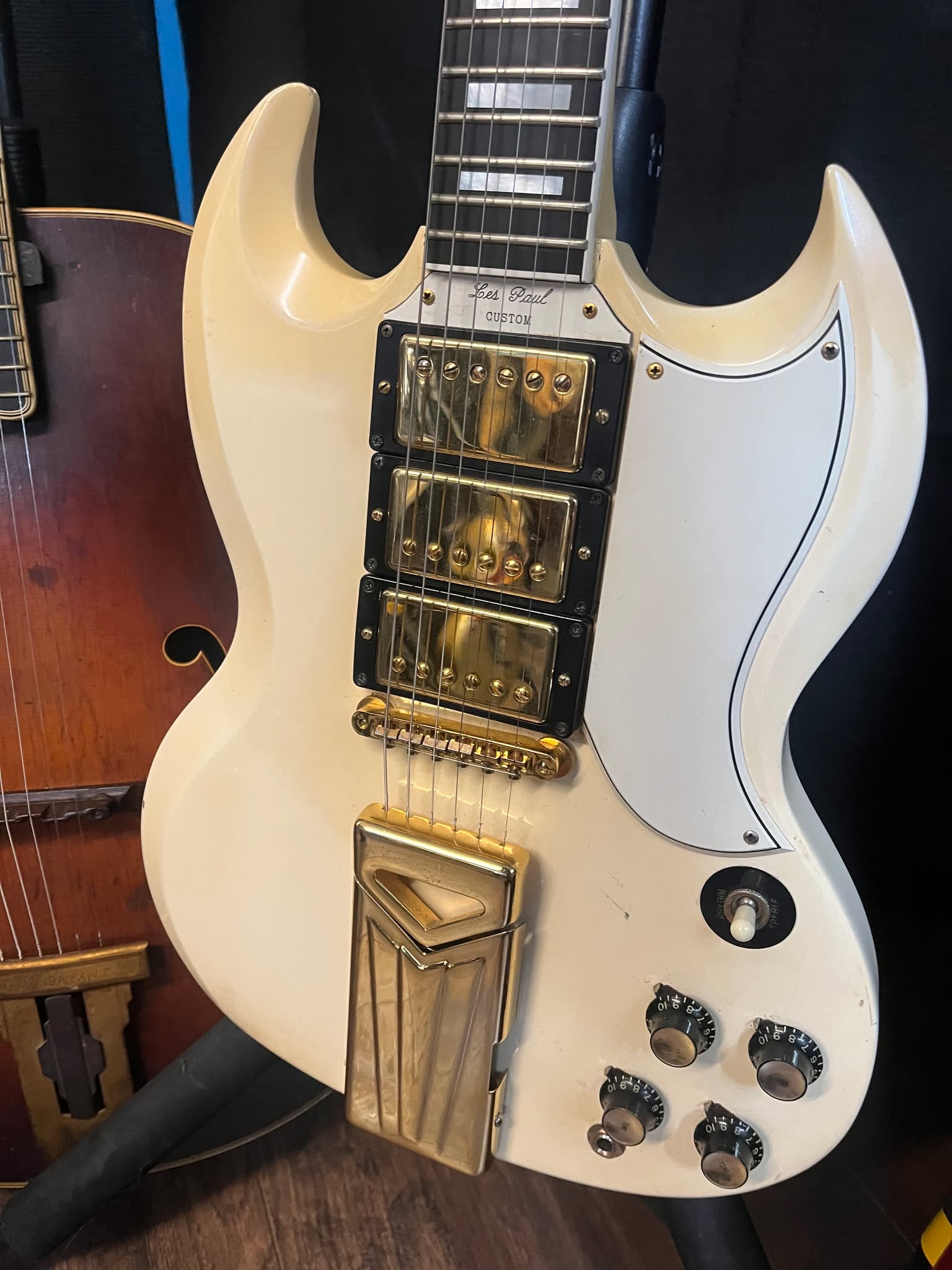
The 1964 Gibson SG Custom is the three-pickup Black Beauty SG at peak mid-period consistency, with patent-number humbuckers, gold hardware, and full binding. Value is driven by originality, finish, and whether the humbuckers, hardware, and electronics are original and intact. Edgewater Guitars buys vintage Gibson electric guitars nationwide with free expert appraisals and same-day cash offers. Call or text (440) 219-3607.
Last Updated: June 2026
What Makes the 1964 Gibson SG Custom Significant?
The 1964 Gibson SG Custom represents the instrument at its most confident and consistently produced expression within the pre-CBS era. The transitional complexity of 1961, the PAF-to-patent-number uncertainty of 1962, and the early production refinements of 1963 were all behind it. By 1964 Gibson’s assembly team had produced three full years of SG Custom instruments and every element — the three-humbucker routing, the ebony fingerboard fitting, the gold hardware installation, the multi-ply binding application — was executed with a consistency and quality that early production, by definition, could not always deliver. The 1964 SG Custom is the instrument as its designers intended it to be built, produced by a team that had mastered every aspect of its assembly.
This production maturity translates directly into what collectors and players find when they examine 1964 SG Custom instruments. The fit and finish is more consistent than earlier years. The pickup winding, while still showing the natural variation of hand-wound production, has settled into a narrower range that reflects accumulated winding experience. The ebony fingerboard fitting and block inlay work shows the refinement of a production process that had worked through its early learning curve. For players who prioritize playing quality and consistency over the specific historical premiums of the transition years, the 1964 represents an outstanding entry point into the SG Custom market — the full Custom appointment level at a meaningful discount to the PAF-era examples.
The 1964 SG Custom also sits at a culturally significant moment in electric guitar history. This is the year the Beatles arrived in America and Gibson’s solidbody line was at the center of the British Invasion’s tonal vocabulary. The SG — in all its variants — was the instrument associated with the aggressive, sustaining, feedback-capable sound that defined the new rock music. The Custom’s three-pickup configuration gave players maximum tonal flexibility within that aggressive SG character. By 1964 the SG Custom had established itself as a working professional instrument — not just a showroom showcase — and the examples that survive from this year frequently show the genuine play wear of instruments used seriously and professionally. In our experience buying SG Custom instruments across Ohio and the Midwest, 1964 examples are the most commonly encountered year in the SG Custom line — they appear more frequently than 1961 through 1963 examples, reflecting both higher production numbers and a slightly better survival rate from the mid-1960s production period.
What makes the 1964 SG Custom distinctive:
Peak production consistency within the pre-CBS SG Custom run — every element executed with maximum refinement
Three patent number humbuckers fully standardized across production — neck, middle, and bridge
Pickup winding settled into consistent hand-wound range — approximately 7.8–8.3k ohms typical
Ebony fingerboard with mother of pearl block inlays at peak fit and finish quality
Gold-plated hardware throughout — ABR-1 bridge, stop tailpiece or Maestro vibrato, tuners, pickup covers
Multi-ply binding on body, neck, and headstock
Split-diamond headstock inlay in mother of pearl
Ebony black nitrocellulose finish
Serial numbers in the 4xxxx range on the back of the headstock
Slim C neck profile with full Custom binding — the SG character at its most refined
If you own a 1964 SG Custom, you may be sitting on a significant asset. Edgewater Guitars provides free, no-obligation valuations — call (440) 219-3607 or visit edgewaterguitars.com.
What Is a 1964 Gibson SG Custom Worth? (2026 Market Values)
Value by Condition and Finish
The 1964 SG Custom market in 2026 reflects a fully matured collector appreciation with a cleaner value hierarchy than earlier years. Without the PAF premium of 1961–1962 examples or the early production variation of 1963, the 1964 market is driven primarily by three-pickup configuration originality and overall condition. The instrument’s broader market availability — more 1964 examples exist than any earlier SG Custom year — means the top of the market is well-supplied, which supports strong pricing at the premium tier without the scarcity-driven ceiling of rarer earlier examples.
Condition | Originality | Relative Value |
|---|---|---|
Excellent (8–9/10) | All original, three pickups, original case | Premium tier |
Very Good (7/10) | All original, three pickups, no case | Strong tier |
Good (6/10) | Original pickups, some hardware changes | Mid-to-strong tier |
Good (6/10) | One or two replaced pickups, otherwise original | Mid tier |
Player Grade | Some replacements, moderate wear | Entry-to-mid tier |
Modified | All pickups replaced, refin, significant changes | Entry tier |
What Affects the Value of a 1964 SG Custom?
Three-pickup configuration originality: All three patent number pickups in original positions command the top of the 1964 market. Each replaced pickup reduces value by 15–20%. The middle pickup position is the most commonly removed — players who found the three-pickup switching system complex sometimes removed the middle pickup and filled the cavity. Evidence of a filled middle routing cavity reduces value by 25–35%.
Maestro vibrato vs. stop tailpiece: The Maestro vibrato — a side-pull unit mounted at the tailpiece end of the body — appears on a meaningful number of 1964 SG Custom instruments and is a factory-original option rather than a modification. Maestro-equipped examples with the original vibrato intact carry a modest premium (10–15%) over stop tailpiece examples in equivalent condition, reflecting the rarity of surviving complete and functional original Maestro units.
Ebony fingerboard and block inlay condition: The peak production quality of 1964 means block inlays are typically well-fitted and stable. Original block inlays intact: full value. Damaged or replaced inlays: 10–20% reduction.
Gold hardware patina: Authentic aging at contact points remains a value marker. Re-plated hardware: 10–20% reduction. The 1964 gold hardware shows approximately 60 years of natural aging — a specific character that re-plating cannot replicate.
Neck integrity: Headstock breaks remain the primary structural concern on all SG models. Clean, unrepaired neck: full value. Professionally repaired breaks: 25–40% reduction.
Original case: The original black alligator-pattern hardshell case adds approximately 10–15% to value.
Comparison to 1963: The 1964 sits at a modest discount to comparable 1963 examples — the earlier production year carries a slight collector premium reflecting proximity to the PAF era. However the gap narrows when 1963 and 1964 examples are in equivalent condition — the production quality difference is minimal and the tonal character essentially identical.
How 1964 Compares to Other Years
Year | Key Difference | Relative Value | Why |
|---|---|---|---|
1961 | Three PAFs; Les Paul designation | Substantially higher | PAF plus transition premium |
1962 early | Three PAFs; first pure SG year | Higher | PAF designation premium |
1963 | First full patent number year; closest to PAF construction | Similar to slightly higher | Early patent number premium; closer to PAF era |
1964 (this post) | Peak production consistency; fully standardized | Baseline | Most available year; cleanest value hierarchy |
1965 | Last pre-transition year; production changes beginning | Similar to slightly lower | Post-peak production period beginning |
Edgewater Guitars consistently pays 30–40% more than typical guitar shops. Get your free valuation: edgewaterguitars.com or (440) 219-3607.
Recent Sales and Auction Results
All-original 1964 SG Customs in excellent condition with three original patent number pickups appear at specialist dealers and major auction with reasonable frequency — the most available year in the SG Custom line, which supports consistent pricing rather than the scarcity-driven peaks of earlier examples. Maestro vibrato-equipped examples generate specific collector interest when they appear with the original vibrato intact and functional. Contact Edgewater for current market context specific to your instrument’s configuration and condition.
How to Identify an Authentic 1964 Gibson SG Custom
Serial Numbers
Range for 1964: Approximately 4xxxx range — five or six digits beginning with 4, impressed into the back of the headstock
Location: Back of headstock, impressed into the wood
Important caveat: Gibson serial numbers overlap between years. Always cross-reference with the Factory Order Number and all pot codes for confident dating.
Factory Order Number (FON)
Format for 1964: Batch letter followed by production number
Location: Inside the body — visible through one of the three pickup routing cavities with a mirror and light
Dating utility: The FON batch letter helps narrow production within 1964 and supports serial number dating confirmation
Potentiometer Codes
Primary manufacturers: Centralab (code 134) and CTS (code 137)
How to decode: Manufacturer code (3 digits) + year (2 digits) + week (2 digits)
Example: 137-4-18 = CTS, 1964, week 18
Expected codes for 1964: Pots dated to 1963 or 1964 are correct. Pots from 1965 or later indicate modification.
Location: Inside the control cavity — all potentiometers must be individually examined
Key Visual Identifiers
Three pickup positions: Three humbucker-sized gold-plated pickup covers in neck, middle, and bridge positions — the definitive SG Custom identifier present across all production years
Truss rod cover: Reads “Custom” — correct for 1964
Fingerboard: Ebony — jet black, dense, with no visible grain pattern. Peak 1964 production quality means fingerboard fitting is typically very clean.
Inlays: Mother of pearl block inlays — well-fitted rectangular blocks at peak production quality
Headstock: Split-diamond MOP inlay
Binding: Multi-ply on body, neck, and headstock
Hardware: Gold-plated throughout — ABR-1 bridge, stop tailpiece or Maestro vibrato, tuners, pickup covers
Finish: Ebony black nitrocellulose
Body: Slab mahogany, double-cutaway pointed horns, approximately 1-3/8” thick
Neck profile: Slim C with full Custom binding — at its most refined expression in 1964 production
Factory Markings and Stamps
Inside body: Factory Order Number — accessible through pickup routing cavities
Back of headstock: Impressed serial number
Control cavity: All pot codes — must be individually examined
Pickup base plates: “Patent No. 2,737,842” on each pickup base plate — visible when pickups are removed
Maestro Vibrato Authentication
The Maestro vibrato tailpiece appears on a portion of 1964 SG Custom instruments as a factory option and requires specific examination:
Unit type: Side-pull Maestro vibrato — a spring-loaded arm unit mounted at the tailpiece end of the body, operating by pulling the tailpiece sideways rather than rotating as the later Gibson vibratos do
Original vs. replaced: Original 1964 Maestro vibratos show consistent aging with the surrounding gold hardware. Replacement units — including the repro Maestro units available from various suppliers — show different aging character and different gold plating quality.
Complete vs. incomplete: The Maestro unit consists of the base plate, arm, spring mechanism, and cover. Missing components reduce value proportionally. A complete, original, functional Maestro unit adds the full 10–15% premium.
Tailpiece routing: The Maestro vibrato requires specific body routing at the tailpiece end. A claimed Maestro example without the correct routing — or a claimed stop tailpiece example with evidence of Maestro routing — indicates modification or conversion.
Stop tailpiece conversion: Many Maestro-equipped instruments had the vibrato removed and stop tailpiece studs installed. Evidence of this conversion — original Maestro routing with added stop tailpiece stud holes — reduces value by 10–15% from the all-original Maestro configuration.
Patent Number Pickup Authentication — 1964 Production
Base plate marking: “Patent No. 2,737,842” — the standard 1964 designation. Same format as 1963.
DC Resistance: Approximately 7.8–8.3k ohms per pickup — 1964 winding is more consistent than 1963 early examples, reflecting accumulated winding experience. Readings significantly outside this range suggest replacement or rewinding.
Bobbin color: Double black most common; double cream and zebra less frequent but still correct
Magnet type: Alnico II or Alnico V — both correct. Ceramic magnets indicate a non-original replacement.
Lead wire: Cloth-covered braided shield — consistent across all three positions on an all-original example
Cover patina: Consistent gold aging across all three pickup covers on an all-original instrument
Red Flags: How to Spot Fakes and Refinishes
Two pickups instead of three: Any claimed SG Custom with only two visible covers has either had the middle pickup removed (check for filled routing evidence) or is a different SG model.
Non-gold hardware: Chrome hardware indicates replacement or a different SG model.
Non-ebony fingerboard: Any fingerboard other than ebony indicates a replaced fingerboard or different model.
PAF stickers on 1964 pickups: Genuine 1964 pickups carry patent number designations only. Any PAF sticker on a confirmed 1964 pickup is from another source.
Ceramic magnet pickups: Indicate non-original replacement in any position.
Inconsistent gold cover patina: Mismatched aging across the three positions suggests at least one cover or pickup has been replaced.
Refinished black: UV examination is essential for all black vintage Gibsons.
Pot date mismatch: Any pot dated 1965 or later in a claimed 1964 guitar indicates modification.
Plastic-insulated lead wire: Original 1964 pickups use cloth-covered braided shield.
Maestro routing with stop tailpiece — undisclosed: A stop tailpiece on an instrument with evidence of original Maestro routing indicates a converted vibrato — a modification that should be disclosed and that affects value proportionally.
In our experience evaluating 1964 SG Custom instruments from the Ohio and Midwest region, the middle pickup removal is the most frequently encountered modification — players who found the three-pickup switching system complex or who experienced unwanted tonal interactions between the middle position and the outer positions sometimes removed the middle pickup entirely. The routing evidence of this removal is clearly visible when the pickguard is removed. We inspect the middle routing cavity on every 1964 SG Custom evaluation as a standard procedure.
Not sure if your 1964 SG Custom has all three original pickups or shows middle pickup removal evidence? Edgewater offers free authentication. Call (440) 219-3607 or visit edgewaterguitars.com.
1964 Gibson SG Custom Specifications
Specification | Detail |
|---|---|
Body Wood | Slab mahogany — no maple cap, no carved top |
Body Thickness | Approximately 1-3/8” |
Neck Wood | Mahogany, glued set neck |
Fingerboard | Ebony, approximately 12” radius |
Inlays | Mother of pearl block inlays — peak fit and finish quality |
Headstock Inlay | Split-diamond MOP |
Neck Profile | Slim C with full Custom binding — most refined expression of this profile |
Nut Width | 1-11/16” (approximately 1.687”) |
Scale Length | 24.75” |
Frets | 22, medium vintage wire |
Neck Pickup | Patent number humbucker — gold-plated cover, Alnico magnet |
Middle Pickup | Patent number humbucker — gold-plated cover, Alnico magnet |
Bridge Pickup | Patent number humbucker — gold-plated cover, Alnico magnet |
DC Resistance | Approximately 7.8–8.3k ohms per pickup |
Bridge | ABR-1 tune-o-matic, gold-plated |
Tailpiece | Stop tailpiece (standard) or Maestro vibrato (factory option) — gold-plated |
Tuners | Gold-plated Kluson Deluxe, tulip buttons |
Controls | Two volume, one master tone, three-way toggle switch |
Knobs | Black top hat with gold inserts |
Body Binding | Multi-ply — white/black/white/black/white |
Neck Binding | Multi-ply |
Headstock Binding | Present |
Truss Rod Cover | “Custom” |
Pickguard | Gold-painted plastic |
Finish | Ebony black nitrocellulose lacquer |
Hardware | Gold-plated throughout |
Weight Range | Typically 6.0–7.5 lbs |
Case | Black alligator-pattern hardshell case |
Original Retail Price | Approximately $395.00 (1964 catalog) |
What Does a 1964 Gibson SG Custom Sound Like?
Pickup Specifications and Tonal Profile
All three positions — patent number humbucker:
Pickup type: Humbucking
DC Resistance: Approximately 7.8–8.3k ohms — more consistent than earlier years but retaining the character of hand-wound production
Magnet type: Alnico II or Alnico V
Bobbin color: Double black most common; double cream and zebra less frequent
Potting: Very light wax potting becoming slightly more consistent than 1961–1963 examples
Cover: Gold-plated nickel
The 1964 SG Custom’s patent number humbucker tonal character is the warm, musical, sustaining voice that defines the best of early 1960s Gibson production. The slight increase in winding consistency relative to the most variable early examples produces a marginally more predictable tonal character — the neck and bridge pickups on a 1964 SG Custom tend to balance more evenly against each other than the most widely varied PAF-era examples, producing a three-pickup system that is easier to use in the context of the three-way toggle’s combination positions.
The neck pickup delivers the full, warm, sustaining humbucker tone that suits chord-melody and lead playing equally. The bridge pickup provides definition and clarity without the sharpness of a single-coil. The middle pickup — unique to the Custom model — sits between neck and bridge in tonal character, well suited to rhythm playing and combination tones that the two outer positions cannot replicate independently. The five tonal voices available from the three-way toggle cover a range that no two-pickup Gibson can approach.
How Construction Details Affect Tone
The pure slab mahogany body of the 1964 SG Custom continues to produce the warmer, more resonant humbucker tone that distinguishes it from the maple-cap Les Paul Standard. By 1964 the specific mahogany used in SG Custom production was consistent in density and resonance — the peak production quality of this year extends to the body wood selection. Players who specifically seek the warmest expression of the humbucker sound in an SG package frequently identify 1964 Custom instruments as their ideal — the production consistency means the mahogany character is fully expressed without the occasional density variation of earlier production.
The ebony fingerboard continues to contribute the precision and articulation that balances the mahogany body’s warmth. The peak 1964 fingerboard fitting quality means the ebony is bonded cleanly and consistently — contributing its full tonal character without the minor fitting variations that occasionally appeared in earlier production.
The Maestro vibrato unit — on factory-equipped examples — introduces a specific tonal and playing character. The side-pull mechanism produces a smooth, controlled vibrato effect with a distinctive character different from the later Gibson vibratos and from the Fender tremolo. Players who use the Maestro correctly — with proper spring tension adjustment — find it a highly musical and expressive tool. The vibrato mechanism also affects tone even when not in use by changing the string anchoring geometry relative to the stop tailpiece configuration.
Notable Recordings
The 1964 SG Custom’s patent number humbucker sound is at the center of some of the most important rock recordings of the mid-1960s. Eric Clapton’s use of SG Custom instruments — specifically three-pickup Customs — during the Cream period documents the tonal character these instruments produce at high volume with amplifier saturation: warm, singing, sustaining lead tones with extraordinary harmonic complexity. The combination of three patent number humbuckers, mahogany body, and ebony fingerboard produces a voice that is directly audible in recordings that defined rock guitar’s vocabulary for the following decades.
Common Issues and Modifications That Affect Value
Middle pickup removed: The most commonly encountered 1964 SG Custom modification. Players who found the middle position confusing or who experienced interaction between the middle and outer pickups sometimes removed the middle pickup entirely. Evidence: filled routing cavity visible under pickguard. Value impact: 25–35% reduction — fundamental to Custom identity.
Replaced pickups — any position: Each replaced pickup: 15–20% reduction. All three replaced: 40–50% reduction. Original pickups retained and included partially offset reductions.
Maestro vibrato removed: Common modification — Maestro replaced with stop tailpiece studs. Evidence of original Maestro routing plus added stop tailpiece holes: 10–15% reduction from all-original Maestro configuration. Original Maestro retained and included partially offsets.
Headstock break or repair: Most common structural SG issue. Professionally repaired breaks: 25–40% reduction.
Refinished black finish: UV examination essential. Correct black refinish: 40–55% reduction.
Re-plated or replaced gold hardware: Authentic patina is a value marker. Re-plated hardware: 10–20% reduction.
Replaced ebony fingerboard: Among the most destructive modifications. Value impact: 40–55%.
Replaced or damaged block inlays: 15–25% reduction depending on extent.
Replaced gold tuners: Original gold Kluson tulip button tuners replaced: 10–15% reduction.
Refretted neck: Correct medium vintage wire: 5–10% reduction. Modern jumbo wire: 10–15% reduction.
In Edgewater’s experience with 1964 SG Custom instruments, the Maestro vibrato situation generates the most nuanced valuation conversations. Sellers with Maestro-equipped instruments sometimes present the vibrato as a desirable feature when they have heard it is rare — and it is. But the condition and completeness of the specific Maestro unit matters enormously. A complete, original, functional Maestro unit in good condition adds the full 10–15% premium. A Maestro with missing arm, damaged spring mechanism, or non-original components adds less or nothing. We examine Maestro completeness and originality as carefully as pickup configuration during every in-person evaluation.
Selling Your 1964 Gibson SG Custom: Your Options Compared
Selling Option | Typical Offer | Timeline | Fees/Costs | Risk Level | Best For |
|---|---|---|---|---|---|
Edgewater Guitars | 30–40% above shop offers | Immediate cash | None | Low — expert authentication included | Owners wanting accurate valuation |
Local Guitar Shop | Wholesale pricing (lowest) | Same day | None direct, but lowest price | Low | Convenience over value |
Reverb / eBay | Variable — potentially higher | Weeks to months | 5–15% platform fees + shipping | High — authentication disputes, shipping risk | Experienced sellers with collector network |
Auction House | Variable | 3–6 months | 15–25% seller premium | Medium | Exceptional all-original examples |
Private Sale | Variable | Unpredictable | None | High — authentication burden on seller | Sellers with existing collector connections |
The 1964 SG Custom’s broader market availability relative to earlier years means that sellers encounter a wider range of offers — from generalist shops that apply general SG pricing to specialist buyers who recognize the specific value of the three-pickup Custom configuration. The difference between a generalist offer and an accurate specialist offer on a 1964 SG Custom with all three original pickups and intact Maestro vibrato can be very significant. Edgewater’s evaluation process addresses every element of the 1964 SG Custom’s value — all three pickup positions, the Maestro completeness if applicable, the fingerboard and inlay integrity, and the gold hardware patina — before any offer is made.
We travel anywhere in Ohio, Michigan, Pennsylvania, Indiana, or West Virginia for instruments of this significance. Our process moves from first contact to cash in hand in 24–72 hours.
Ready to find out what your 1964 Gibson SG Custom is worth? Get your free, no-obligation valuation: edgewaterguitars.com or call (440) 219-3607.
Frequently Asked Questions About the 1964 Gibson SG Custom
Q: What is a 1964 Gibson SG Custom worth in 2026? A: Value is driven by the three-pickup configuration originality, Maestro vibrato status if applicable, and overall condition. All-original examples with three original pickups in excellent condition represent the premium tier for 1964 production. Maestro-equipped examples with original complete vibrato unit carry an additional premium. Contact Edgewater Guitars for a free valuation specific to your instrument’s configuration.
Q: How is the 1964 SG Custom different from the 1963? A: The 1964 represents peak production consistency within the pre-CBS SG Custom run — fit and finish quality, fingerboard fitting, and pickup winding consistency are at their most refined. The 1963 is slightly closer to PAF-era construction in its earliest examples, carrying a modest collector premium reflecting that proximity. Functionally and tonally the two years are closely comparable — the distinction is primarily one of collector market positioning rather than playing quality.
Q: What is the Maestro vibrato on a 1964 SG Custom? A: A side-pull vibrato tailpiece unit mounted at the base of the body — a factory option on some 1964 SG Custom instruments. It operates by pulling the tailpiece sideways via a spring-loaded arm mechanism, producing a smooth controlled vibrato effect distinct from the Fender tremolo or later Gibson vibratos. Original intact Maestro units on 1964 SG Customs carry a 10–15% premium over equivalent stop tailpiece examples.
Q: What serial numbers cover 1964 Gibson SG Customs? A: Approximately 4xxxx range impressed into the back of the headstock. Always cross-reference with the Factory Order Number and all pot codes for confident dating as these ranges overlap between years.
Q: How many pickups does a 1964 SG Custom have? A: Three — neck, middle, and bridge positions, all patent number humbuckers with gold-plated covers. The three-pickup configuration is the defining characteristic of the SG Custom model. The middle pickup is the most commonly removed in modifications — its presence intact is a primary authentication point.
Q: What DC resistance should the pickups on a 1964 SG Custom read? A: Approximately 7.8–8.3k ohms per pickup — slightly more consistent than the wider variation of early 1963 and PAF-era examples, reflecting accumulated winding experience. Readings significantly outside this range suggest replacement or rewinding. All three pickups should be measured individually.
Q: Does Edgewater Guitars buy 1964 Gibson SG Customs? A: Yes. We actively purchase 1964 SG Customs in all conditions — all-original, Maestro-equipped, partially modified, and player-grade examples. We pay 30–40% more than local guitar shops and provide immediate cash payment. Call (440) 219-3607 or visit edgewaterguitars.com.
Q: Is a 1964 SG Custom with the middle pickup removed still valuable? A: Yes — but the three-pickup body routing is the Custom model’s defining feature and its removal is a significant modification. A 1964 SG Custom with the middle pickup removed but otherwise all-original retains the ebony fingerboard, gold hardware, block inlays, and overall Custom appointment level — all of which retain their value. The middle pickup removal reduces value by 25–35% but does not eliminate the instrument’s significance. Contact Edgewater for a specific assessment.
Q: How does the 1964 SG Custom compare to a 1964 Les Paul Custom? A: Gibson did not produce the Les Paul Custom in 1964 — Les Paul Custom production had transitioned to the SG body in 1961 and would not return to the single-cutaway form until the 1968 reintroduction. The 1964 SG Custom is the only Custom-level Gibson solidbody available in that year. A buyer seeking a 1964 “Les Paul Custom” is actually seeking the 1964 SG Custom — the same appointment level in the SG body.
Q: How long does it take to sell a vintage guitar to Edgewater? A: Typically 24–72 hours from initial contact to cash in hand. We always arrange in-person evaluation for SG Custom instruments — all three pickup positions and the Maestro status must be directly examined. From that evaluation to cash in hand is typically same-day or next-day.
Related Resources
Useful next reads and tools for this guitar:
Sell your 1964 Gibson SG Custom
Edgewater Guitars buys vintage Gibson electric guitars and other vintage Gibsons nationwide. We give free, honest appraisals and fair same-day cash offers, with local pickup or insured nationwide shipping. Call or text (440) 219-3607 or request a free estimate.
How much is a 1964 Gibson SG Custom worth?
A clean, all-original 1964 Gibson SG Custom’s value depends on originality, condition, finish, and whether the humbuckers, hardware, and electronics are original. Because Edgewater buys directly and resells, we can typically pay more than local shops or pawn stores. The most accurate way to find out is a free appraisal: send a few photos and the serial number and we will give you an honest market assessment.
Where can I sell a 1964 Gibson SG Custom?
Edgewater Guitars buys them directly, nationwide, with same-day cash offers and no obligation. You can also date yours with our Gibson serial number lookup.