DATE :
1963 Gibson SG Custom: Patent Number Humbuckers at Full Stride — The Established Black Beauty SG
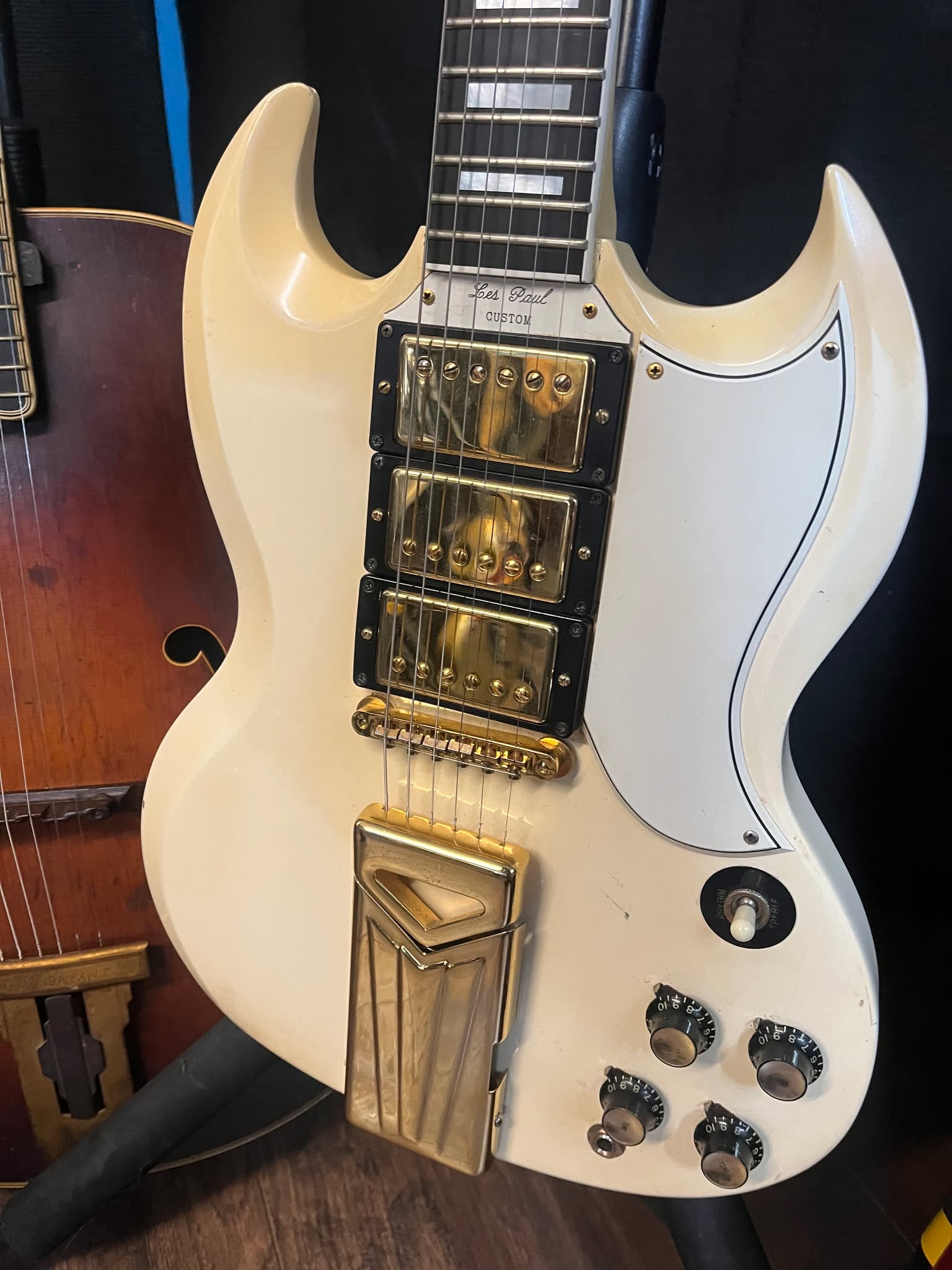
1963 Gibson SG Custom: Patent Number Humbuckers at Full Stride — The Established Black Beauty SG
The 1963 Gibson SG Custom is the Black Beauty SG, a three-pickup solidbody with patent-number humbuckers, gold hardware, and multi-ply binding. Value is driven by originality, finish, and whether the humbuckers, hardware, and electronics are original and intact. Edgewater Guitars buys vintage Gibson electric guitars nationwide with free expert appraisals and same-day cash offers. Call or text (440) 219-3607.
Last Updated: June 2026
What Makes the 1963 Gibson SG Custom Significant?
The 1963 Gibson SG Custom is the first full calendar year in which the Custom model operated entirely within its own established identity — no Les Paul designation, no PAF-to-patent-number transition complexity, no first-year production variability. The instrument that emerged was a fully resolved expression of Gibson’s top-of-line solidbody concept in the SG body: three patent number humbuckers, ebony fingerboard, gold-plated hardware, mother of pearl block inlays, multi-ply binding, and the ebony black finish that had defined the Custom model since 1954. By 1963 every element of the SG Custom had been refined through two years of production into consistent, high-quality manufacturing.
The patent number humbuckers that define 1963 SG Custom production deserve specific attention and honest framing. The collector market prices patent number pickups at a meaningful discount to PAF pickups — the “Patent Applied For” sticker carries a premium that is real and market-established. However, the earliest patent number pickups of 1963 are far closer to PAF construction than many collectors appreciate. Gibson’s manufacturing transition from PAF to patent number designation was not accompanied by an immediate change in winding technique, magnet specification, or bobbin materials. The earliest 1963 patent number pickups were wound on the same machines by the same workers with the same wire as the late 1962 production — the primary change was the base plate designation. As 1963 progressed, minor production refinements began to appear, but early 1963 patent number pickups are broadly considered among the finest humbucker pickups Gibson produced in any era.
The 1963 SG Custom also occupies an important position in the player market that is distinct from its collector market position. Players who want the SG Custom experience — three humbuckers, ebony fingerboard, gold hardware, maximum tonal versatility — but who prioritize playing quality over investment-grade PAF provenance find the 1963 an exceptional instrument at a more accessible market entry point than the 1961 or early 1962 examples. This dual appeal — significant collector instrument at the top end of the market and outstanding player instrument across all condition tiers — gives the 1963 SG Custom a broader market than the rarer PAF-era examples. In our experience buying SG Custom instruments across Ohio and the Midwest, 1963 examples appear with slightly more frequency than 1961 or 1962 instruments but remain genuinely rare — total SG Custom production across all years was limited, and 1963 examples in all-original excellent condition are far from common.
What makes the 1963 SG Custom distinctive:
First full production year with patent number humbuckers throughout — three positions, all patent number designation
Early 1963 patent number pickups constructionally closest to PAF production — wound on same equipment with same materials
Pure SG Custom identity fully established — “Custom” truss rod cover, no transitional elements
Three humbucker positions — neck, middle, and bridge — the defining Custom configuration
Ebony fingerboard with mother of pearl block inlays
Gold-plated hardware throughout
Multi-ply binding on body, neck, and headstock
Split-diamond headstock inlay in mother of pearl
Ebony black nitrocellulose finish
Serial numbers in the 3xxxx range on the back of the headstock
Slim C neck profile with full Custom binding treatment
If you own a 1963 SG Custom, you may be sitting on a significant asset. Edgewater Guitars provides free, no-obligation valuations — call (440) 219-3607 or visit edgewaterguitars.com.
What Is a 1963 Gibson SG Custom Worth? (2026 Market Values)
Value by Condition and Finish
The 1963 SG Custom market in 2026 reflects a mature collector and player appreciation for the model that has strengthened considerably over the past decade. Without the PAF or transition-year complexity of earlier examples, the 1963 value hierarchy is cleaner and more condition-driven. All-original examples in excellent condition with intact three-pickup configuration command the top of the 1963 market. Player-grade examples with original pickups but moderate wear remain genuinely desirable across a broad buyer base.
Condition | Originality | Relative Value |
|---|---|---|
Excellent (8–9/10) | All original, three patent number pickups, original case | Premium tier |
Very Good (7/10) | All original, three patent number pickups, no case | Strong tier |
Good (6/10) | Original pickups, some hardware changes | Mid-to-strong tier |
Good (6/10) | One or two replaced pickups, otherwise original | Mid tier |
Player Grade | Some replacements, heavy wear | Entry-to-mid tier |
Modified | All pickups replaced, refin, significant changes | Entry tier |
What Affects the Value of a 1963 SG Custom?
Patent number pickup originality — all three positions: Three original patent number pickups in all three positions command the top of the 1963 market. Each replaced pickup reduces value by 15–25%. Early 1963 patent number pickups are specifically sought by collectors who recognize their constructional proximity to PAF production — late 1963 examples with later production winding characteristics command a modest discount relative to the earliest examples.
Early vs. late 1963 production: Early 1963 pickup winding is closer to PAF construction — natural resistance variation, hand-wound characteristics, Alnico II or V magnets. Later 1963 examples may show slightly more consistent resistance readings indicating refinements toward more systematic winding. This distinction is meaningful to experienced collectors and adds a modest premium to early 1963 instruments.
Ebony fingerboard and block inlay condition: Original block inlays intact with no damage or replacement: full value. Damaged or replaced inlays: 10–20% reduction.
Gold hardware patina: Authentic aging at contact points is a value marker. Re-plated or replaced hardware: 10–20% reduction.
Neck integrity: Headstock breaks are the most common structural SG issue. Clean, unrepaired neck: full value. Professionally repaired breaks: 25–40% reduction.
Original case: The original black alligator-pattern hardshell case adds approximately 10–15% to value.
Comparison to 1961 and 1962: The 1963 sits at a meaningful discount to comparable 1961 three-PAF examples and early 1962 three-PAF examples — the PAF designation premium is real and consistent. However the gap between 1963 and early 1962 patent number examples is modest, reflecting the constructional equivalence of early patent number production across the 1962–1963 boundary.
How 1963 Compares to Other Years
Year | Key Difference | Relative Value | Why |
|---|---|---|---|
1961 | Three PAFs; Les Paul designation | Substantially higher | PAF plus transition-year premium |
1962 early | Three PAFs; pure SG identity | Higher | PAF designation without transition premium |
1962 late | Early patent numbers; pure SG identity | Similar to slightly higher | Constructionally equivalent; modest PAF-era premium |
1963 (this post) | Full patent number year; first fully established SG Custom | Baseline | Clean market position; no transitional complexity |
1964 | Patent numbers continue; minor refinements | Similar to slightly lower | More common year; slightly further from PAF era |
1965 | Last pre-transition year; production changes | Lower | Post-peak production period |
Edgewater Guitars consistently pays 30–40% more than typical guitar shops. Get your free valuation: edgewaterguitars.com or (440) 219-3607.
Recent Sales and Auction Results
All-original 1963 SG Customs in excellent condition with three original patent number pickups appear at specialist dealers and major auction with moderate frequency — more available than 1961 or 1962 examples but still genuinely rare instruments. Early 1963 examples with the earliest patent number winding characteristics achieve results at the strong-to-premium tier. Later 1963 examples with more standardized winding sit at the strong tier. Contact Edgewater for current market context specific to your instrument.
How to Identify an Authentic 1963 Gibson SG Custom
Serial Numbers
Range for 1963: Approximately 3xxxx range — five or six digits beginning with 3, impressed into the back of the headstock
Location: Back of headstock, impressed into the wood
Important caveat: Gibson serial numbers overlap between years. Always cross-reference with the Factory Order Number and all pot codes for confident dating.
Factory Order Number (FON)
Format for 1963: Batch letter followed by production number
Location: Inside the body — visible through one of the three pickup routing cavities with a mirror and light
Early vs. late 1963: The FON batch letter helps distinguish early from late 1963 production — early batch letters indicate earlier production within the year and are more likely to have the earliest patent number winding characteristics
Potentiometer Codes
Primary manufacturers: Centralab (code 134) and CTS (code 137)
How to decode: Manufacturer code (3 digits) + year (2 digits) + week (2 digits)
Example: 137-3-06 = CTS, 1963, week 6
Expected codes for 1963: Pots dated to 1962 or 1963 are correct. Pots from 1964 or later indicate modification.
Location: Inside the control cavity — all potentiometers must be examined
Key Visual Identifiers
Three pickup positions: Three humbucker-sized gold-plated pickup covers in neck, middle, and bridge positions — the definitive SG Custom identifier
Truss rod cover: Reads “Custom” — correct for 1963. No “Les Paul” designation.
Fingerboard: Ebony — jet black, dense, with no visible grain pattern
Inlays: Mother of pearl block inlays — large rectangular blocks
Headstock: Split-diamond MOP inlay
Binding: Multi-ply on body, neck, and headstock
Hardware: Gold-plated throughout — ABR-1 bridge, stop tailpiece or Maestro vibrato, tuners, pickup covers
Finish: Ebony black nitrocellulose
Body: Slab mahogany, double-cutaway pointed horns, approximately 1-3/8” thick
Pickguard: Gold-painted plastic
Factory Markings and Stamps
Inside body: Factory Order Number — accessible through pickup routing cavities
Back of headstock: Impressed serial number
Control cavity: All pot codes — must be individually examined
Pickup base plates: “Patent No. 2,737,842” stamped or printed on the base plate of each pickup — visible when pickups are removed
Patent Number Pickup Authentication — 1963 Specific
The three patent number pickups must be individually examined. For 1963 production the authentication protocol differs from PAF examination in one key way — there is no sticker to authenticate. The base plate simply carries the patent number designation. What must be verified is that the pickups are original 1963 production rather than later replacement patent number pickups:
Original 1963 patent number pickup characteristics:
Base plate marking: “Patent No. 2,737,842” — the full patent number. Later Gibson humbuckers use “Patent No. 2737842” without spaces or punctuation variations — subtle differences that experienced authenticators note.
Bobbin color: Double black, double cream, or zebra — all correct for 1963 production
DC Resistance: Approximately 7.5–9.0k ohms per pickup — early 1963 examples show the natural hand-wound variation of PAF-era production. Later replacement pickups tend to read more consistently within a narrower range.
Magnet type: Alnico II or Alnico V — both correct for 1963. Ceramic magnets indicate a later replacement.
Lead wire: Cloth-covered braided shield — consistent across all three positions on an all-original example. Plastic insulation indicates a replacement.
Cover patina: Gold-plated covers showing consistent aging across all three positions — mismatched aging suggests at least one cover or pickup has been replaced.
Early vs. late 1963 winding distinction:
Early 1963 examples (first-half FON batches) show DC resistance variation of 7.5–8.5k ohms — consistent with hand-wound PAF-era production
Late 1963 examples may show slightly tighter resistance clustering — 7.8–8.2k ohms — indicating early transition toward more systematic winding
Both are correct and authentic — the distinction affects value modestly but does not affect authenticity
Red Flags: How to Spot Fakes and Refinishes
Two pickups instead of three: Any claimed SG Custom with only two pickup covers has had the middle pickup removed. Check for filled middle routing cavity.
PAF stickers on claimed 1963 pickups: Genuine 1963 SG Custom pickups do not have PAF stickers — the PAF era ended in 1962. Any 1963 SG Custom pickup with a PAF sticker has either been misrepresented or has a sticker from another source added to elevate its apparent value.
Non-gold hardware: Chrome hardware on any component indicates replacement or a different SG model.
Non-ebony fingerboard: Rosewood or maple fingerboard indicates a replaced fingerboard or a different model.
Non-block inlays: Any inlay style other than MOP blocks indicates a different model or replaced fingerboard.
Ceramic magnet pickups: Indicate a non-original replacement in any position.
Refinished black: UV examination essential for all black vintage Gibsons. Refinished black is common on worn examples.
Pot date mismatch: Any pot dated 1964 or later in a claimed 1963 guitar indicates modification.
Plastic-insulated lead wire: Original 1963 pickups use cloth-covered braided shield.
Inconsistent gold cover patina: Mismatched aging across the three pickup covers suggests at least one has been replaced.
In our experience evaluating 1963 SG Custom instruments from the Ohio and Midwest region, the most common misrepresentation involves PAF stickers added to original 1963 patent number pickups — an attempt to elevate the instrument’s apparent market tier by converting what is genuinely a 1963 patent number example into an apparently-1962 PAF example. The base plate construction details and patent number stamping format provide clear authentication even when stickers are present, because the underlying base plate cannot be changed without replacing the entire pickup.
Not sure whether your 1963 SG Custom pickups are original or have been modified? Edgewater offers free authentication. Call (440) 219-3607 or visit edgewaterguitars.com.
1963 Gibson SG Custom Specifications
Specification | Detail |
|---|---|
Body Wood | Slab mahogany — no maple cap, no carved top |
Body Thickness | Approximately 1-3/8” |
Neck Wood | Mahogany, glued set neck |
Fingerboard | Ebony, approximately 12” radius |
Inlays | Mother of pearl block inlays |
Headstock Inlay | Split-diamond MOP |
Neck Profile | Slim C with full Custom binding treatment |
Nut Width | 1-11/16” (approximately 1.687”) |
Scale Length | 24.75” |
Frets | 22, medium vintage wire |
Neck Pickup | Patent number humbucker — gold-plated cover, Alnico magnet |
Middle Pickup | Patent number humbucker — gold-plated cover, Alnico magnet |
Bridge Pickup | Patent number humbucker — gold-plated cover, Alnico magnet |
DC Resistance | Approximately 7.5–9.0k ohms per pickup |
Bridge | ABR-1 tune-o-matic, gold-plated |
Tailpiece | Stop tailpiece (standard) or Maestro vibrato (some examples) — gold-plated |
Tuners | Gold-plated Kluson Deluxe, tulip buttons |
Controls | Two volume, one master tone, three-way toggle switch |
Knobs | Black top hat with gold inserts |
Body Binding | Multi-ply — white/black/white/black/white |
Neck Binding | Multi-ply |
Headstock Binding | Present |
Truss Rod Cover | “Custom” |
Pickguard | Gold-painted plastic |
Finish | Ebony black nitrocellulose lacquer |
Hardware | Gold-plated throughout |
Weight Range | Typically 6.0–7.5 lbs |
Case | Black alligator-pattern hardshell case |
Original Retail Price | Approximately $395.00 (1963 catalog) |
What Does a 1963 Gibson SG Custom Sound Like?
Pickup Specifications and Tonal Profile
All three positions — patent number humbucker:
Pickup type: Humbucking
DC Resistance: Approximately 7.5–9.0k ohms — early examples show hand-wound PAF-era variation; later examples trend toward slightly tighter consistency
Magnet type: Alnico II or Alnico V
Bobbin color: Double black, double cream, or zebra
Potting: Unpotted or very lightly potted on early examples; slightly more potted on later examples
Cover: Gold-plated nickel
The tonal character of the 1963 SG Custom’s patent number humbuckers — particularly early examples — is genuinely close to PAF production. The warm, musical humbucker voice that defines the best early 1960s Gibson production is present and fully expressed. The neck pickup delivers the rich, sustaining warmth that suits chord-melody and lead playing. The bridge pickup provides definition and clarity without the brightness of a single-coil. The middle pickup — unique to the Custom — sits in tonal territory that neither outer position can replicate, producing a voice that is ideally suited to rhythm playing and specific lead tones.
The five tonal voices available from the three-pickup configuration — neck alone, middle alone in some wiring configurations, bridge alone, neck and middle combined, bridge and middle combined — give the 1963 SG Custom a versatility that no two-pickup Gibson can match. The middle position in combination with the neck produces a particularly warm, full voice; the middle with the bridge produces a balanced, slightly scooped midrange character that is immediately recognizable as the Custom’s own sound.
How Construction Details Affect Tone
The pure slab mahogany body of the 1963 SG Custom continues to produce the warmer, more resonant humbucker tone that distinguishes the SG from the maple-cap Les Paul Standard. The mahogany reinforces the patent number humbucker’s natural warmth — producing a sound with exceptional depth and sustain that is distinctly different from the Standard’s mahogany-maple character. Players who specifically seek a warmer humbucker sound than the Standard delivers frequently identify early SG Custom instruments as their ideal configuration.
The ebony fingerboard contributes the articulacy and note definition that prevents the pure mahogany body’s warmth from becoming muddy. This tonal balance — mahogany body warmth tempered by ebony precision — is the defining characteristic of the Custom model across all years and is preserved fully in the 1963 production.
The slim SG body thickness maintains the fast attack and immediate response that characterizes all SG models. The 1963 SG Custom responds quickly and precisely to pick attack dynamics — a characteristic that players who prefer a responsive, immediate guitar over the sustained warmth of a thicker Les Paul find ideally suited to their approach.
Notable Recordings
The three-humbucker SG Custom sound reached its widest documented audience through the work of Eric Clapton with Cream — SG Custom instruments from this general era are directly associated with the powerful, sustaining humbucker lead tone of recordings like “Sunshine of Your Love” and “White Room.” While specific 1963 examples are difficult to document to individual recordings, the tonal character of the patent number humbuckers in the SG Custom configuration — warm, sustaining, versatile across five pickup positions — is audible throughout the recordings that established the SG Custom’s legendary status.
Common Issues and Modifications That Affect Value
Replaced pickups — any position: Each replaced pickup reduces value by 15–25%. All three replaced: 40–50% reduction. Original pickups retained and included partially offset each reduction.
PAF sticker addition to 1963 pickups: A specific fraud risk — stickers from other sources added to original 1963 patent number pickups to suggest PAF-era production. Base plate construction details and patent number format provide authentication regardless of sticker presence.
Headstock break or repair: Most common structural SG issue. Even professionally repaired breaks: 25–40% reduction.
Refinished black finish: UV examination essential. Correct black refinish: 40–55% reduction.
Re-plated or replaced gold hardware: Authentic patina is a value marker. Re-plated hardware: 10–20% reduction.
Replaced ebony fingerboard: Among the most destructive modifications. Value impact: 40–55%.
Replaced or damaged block inlays: 15–25% reduction depending on extent.
Replaced gold tuners: Original gold Kluson tulip button tuners replaced: 10–15% reduction.
Middle pickup removed: Filled middle routing cavity: 30–45% reduction — fundamental to the Custom model’s identity.
Refretted neck: Correct medium vintage wire: 5–10% reduction. Modern jumbo wire: 10–15% reduction.
In Edgewater’s experience with 1963 SG Custom instruments, the combination of original three-pickup configuration with intact gold hardware and ebony fingerboard is the all-important baseline — sellers who present instruments missing one of these elements frequently underestimate the proportional value impact of each individual element. The three-pickup body is the instrument’s rarest and most defining feature; its integrity is the foundation of the 1963 SG Custom’s entire value proposition.
Selling Your 1963 Gibson SG Custom: Your Options Compared
Selling Option | Typical Offer | Timeline | Fees/Costs | Risk Level | Best For |
|---|---|---|---|---|---|
Edgewater Guitars | 30–40% above shop offers | Immediate cash | None | Low — expert authentication included | Owners wanting accurate valuation |
Local Guitar Shop | Wholesale pricing (lowest) | Same day | None direct, but lowest price | Low | Convenience over value |
Reverb / eBay | Variable — potentially higher | Weeks to months | 5–15% platform fees + shipping | High — authentication disputes, shipping risk | Experienced sellers with collector network |
Auction House | Variable | 3–6 months | 15–25% seller premium | Medium | All-original excellent examples |
Private Sale | Variable | Unpredictable | None | High — authentication burden on seller | Sellers with established collector connections |
The 1963 SG Custom sits in a market position where early versus late production distinction, pickup authenticity across all three positions, and the PAF sticker fraud risk all require specific expertise to navigate accurately. Edgewater’s evaluation process addresses each of these dimensions — FON batch dating to distinguish early from late 1963 production, individual pickup examination for each of the three positions, and base plate authentication to identify any sticker manipulation. Our offer reflects the specific configuration of the instrument rather than a general 1963 SG Custom approximation.
We travel anywhere in Ohio, Michigan, Pennsylvania, Indiana, or West Virginia for instruments of this significance. Our process moves from first contact to cash in hand in 24–72 hours.
Ready to find out what your 1963 Gibson SG Custom is worth? Get your free, no-obligation valuation: edgewaterguitars.com or call (440) 219-3607.
Frequently Asked Questions About the 1963 Gibson SG Custom
Q: What is a 1963 Gibson SG Custom worth in 2026? A: Value is driven by patent number pickup originality across all three positions, early versus late production position within the year, and overall condition. All-original examples with three original patent number pickups in excellent condition represent the premium tier for 1963 production. Contact Edgewater Guitars for a free valuation specific to your instrument’s configuration and condition.
Q: Do 1963 SG Custom pickups have PAF stickers? A: No. Genuine 1963 SG Custom pickups carry the patent number designation “Patent No. 2,737,842” on the base plate — not the “Patent Applied For” sticker of the PAF era, which ended in 1962. Any 1963 SG Custom pickup with a PAF sticker has either been misrepresented or has a sticker from another source added to elevate its apparent value. Base plate construction details and patent number format provide clear authentication.
Q: How do early 1963 patent number pickups compare to PAF pickups? A: Early 1963 patent number pickups are constructionally closest to late PAF production — wound on the same equipment with the same wire, Alnico magnets, and bobbin materials. The primary difference is the base plate designation. DC resistance shows the natural hand-wound variation of PAF-era production (7.5–8.5k ohms). Tonally and constructionally, early 1963 patent number pickups are among the finest vintage humbuckers Gibson produced.
Q: What serial numbers cover 1963 Gibson SG Customs? A: Approximately 3xxxx range impressed into the back of the headstock. Always cross-reference with the Factory Order Number and all pot codes for confident dating as these ranges overlap between years.
Q: How many pickups does a 1963 SG Custom have? A: Three — neck, middle, and bridge positions, all patent number humbuckers with gold-plated covers. The three-pickup configuration is the defining characteristic of the SG Custom model and distinguishes it from all other SG models in every production year.
Q: What is the difference between a 1963 SG Custom and a 1963 SG Standard? A: The SG Custom has three humbucker pickups versus the Standard’s two. The Custom has an ebony fingerboard with block inlays versus the Standard’s rosewood with crown inlays. The Custom has gold-plated hardware versus the Standard’s nickel. The Custom has multi-ply binding on body, neck, and headstock versus the Standard’s simpler binding treatment. The Custom was Gibson’s top-of-line solidbody at a significantly higher price point.
Q: Does Edgewater Guitars buy 1963 Gibson SG Customs? A: Yes. We actively purchase 1963 SG Customs in all conditions — all-original, partially modified, and player-grade examples. We pay 30–40% more than local guitar shops and provide immediate cash payment. Call (440) 219-3607 or visit edgewaterguitars.com.
Q: Is a 1963 SG Custom with one replaced pickup still valuable? A: Yes — significantly so. Two original patent number pickups plus the three-pickup body, ebony fingerboard, gold hardware, block inlays, and multi-ply binding retain their full historical significance. A single replaced pickup reduces value by 15–25% but does not fundamentally compromise the instrument’s identity. Contact Edgewater for a specific assessment.
Q: How does the 1963 SG Custom sound compared to the Les Paul Standard? A: The 1963 SG Custom’s pure mahogany body produces a warmer humbucker tone than the Les Paul Standard’s mahogany-maple construction. The ebony fingerboard adds precision and articulation. The three-pickup configuration provides five tonal voices versus the Standard’s three. The slim SG body creates faster attack and tighter response. The combination produces an instrument with more tonal versatility and a warmer, more immediate character than the Standard.
Q: How long does it take to sell a vintage guitar to Edgewater? A: Typically 24–72 hours from initial contact to cash in hand. For a 1963 SG Custom we always arrange in-person evaluation — all three pickup positions must be directly examined for accurate valuation. From that evaluation to cash in hand is typically same-day or next-day.
Related Resources
Useful next reads and tools for this guitar:
Sell your 1963 Gibson SG Custom
Edgewater Guitars buys vintage Gibson electric guitars and other vintage Gibsons nationwide. We give free, honest appraisals and fair same-day cash offers, with local pickup or insured nationwide shipping. Call or text (440) 219-3607 or request a free estimate.
How much is a 1963 Gibson SG Custom worth?
A clean, all-original 1963 Gibson SG Custom’s value depends on originality, condition, finish, and whether the humbuckers, hardware, and electronics are original. Because Edgewater buys directly and resells, we can typically pay more than local shops or pawn stores. The most accurate way to find out is a free appraisal: send a few photos and the serial number and we will give you an honest market assessment.
Where can I sell a 1963 Gibson SG Custom?
Edgewater Guitars buys them directly, nationwide, with same-day cash offers and no obligation. You can also date yours with our Gibson serial number lookup.