DATE :
1957 Gibson J-45: The Cherry Sunburst Debut - First Year of Two-Finish Production
1957 Gibson J-45: The Cherry Sunburst Debut - First Year of Two-Finish Production
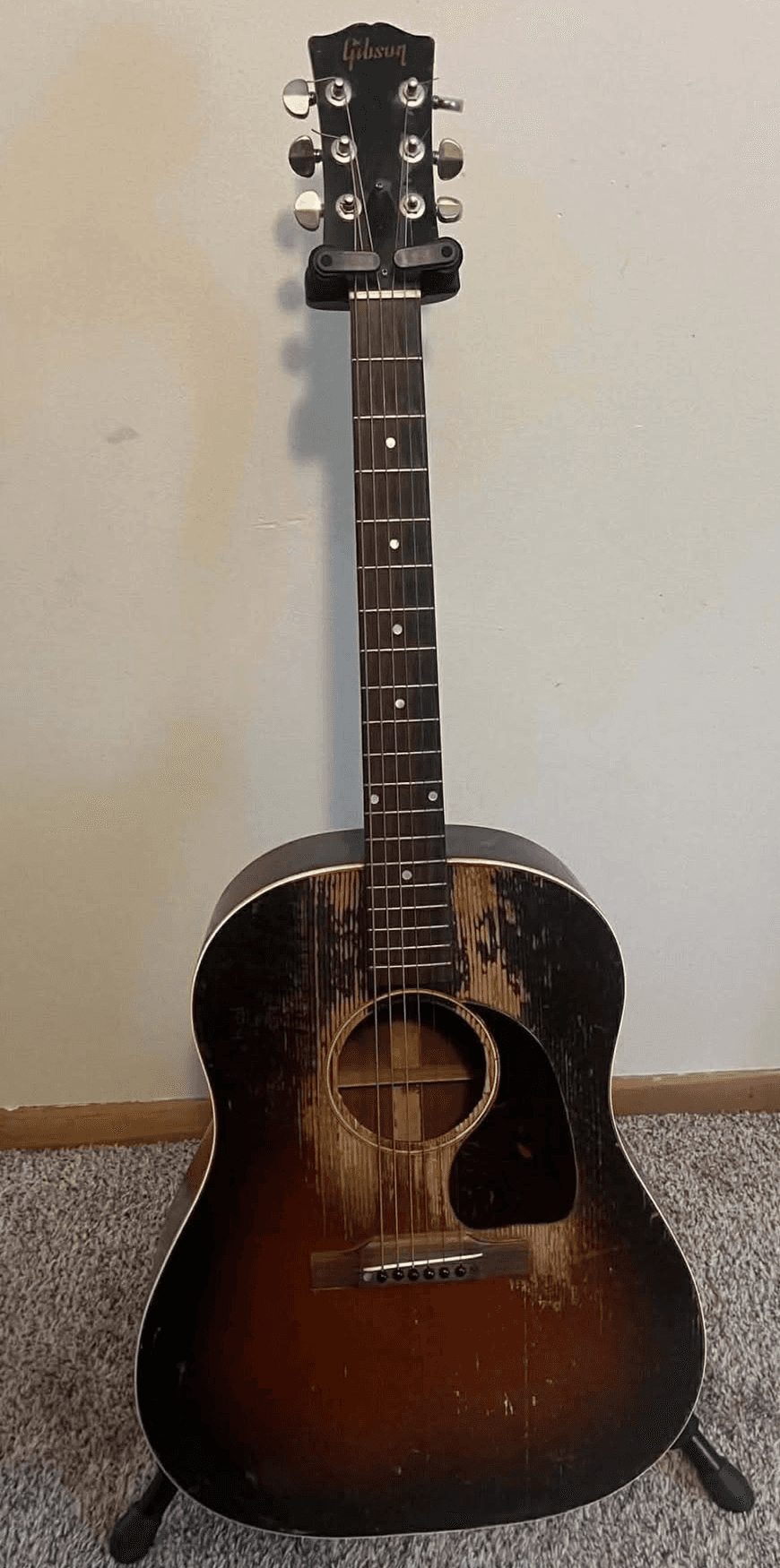
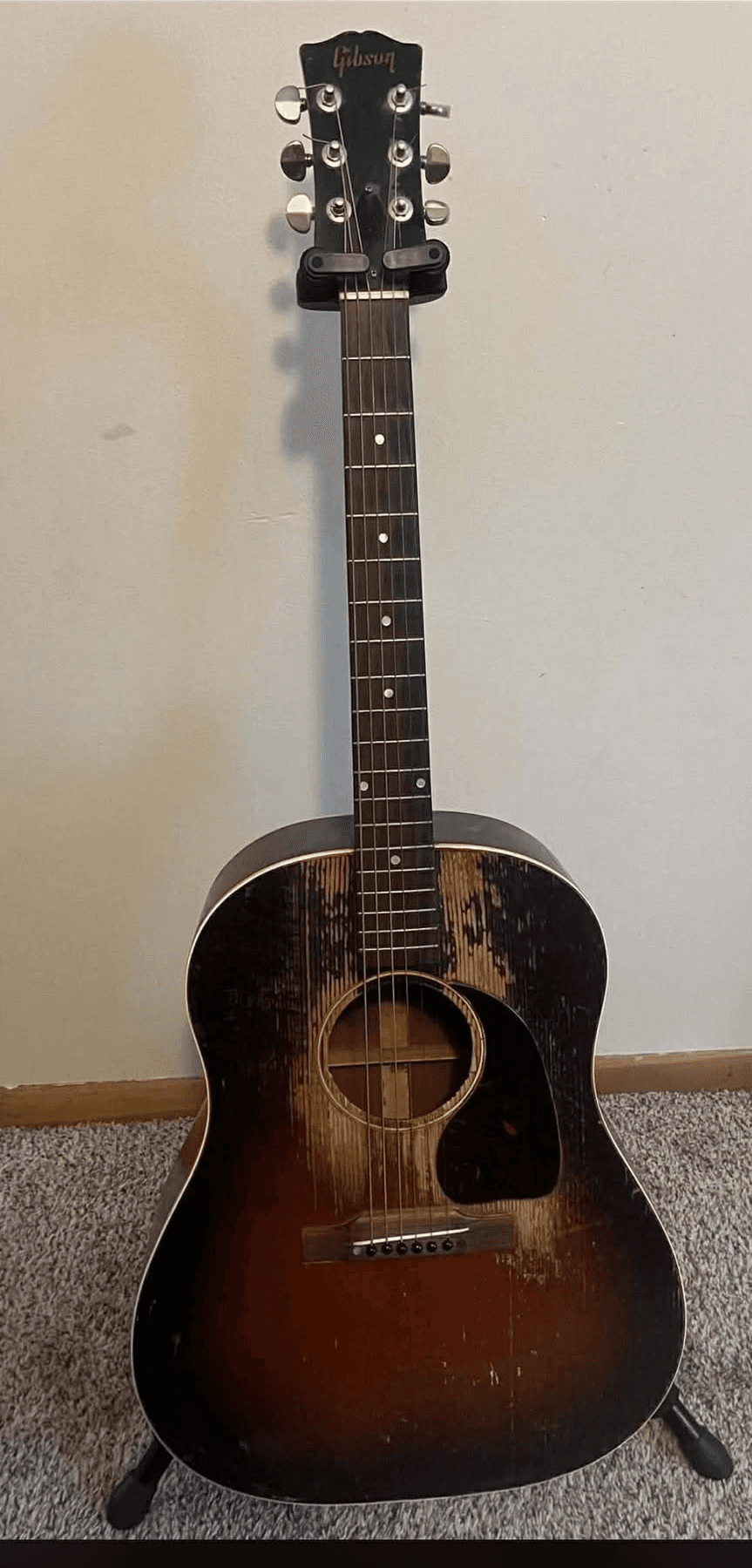
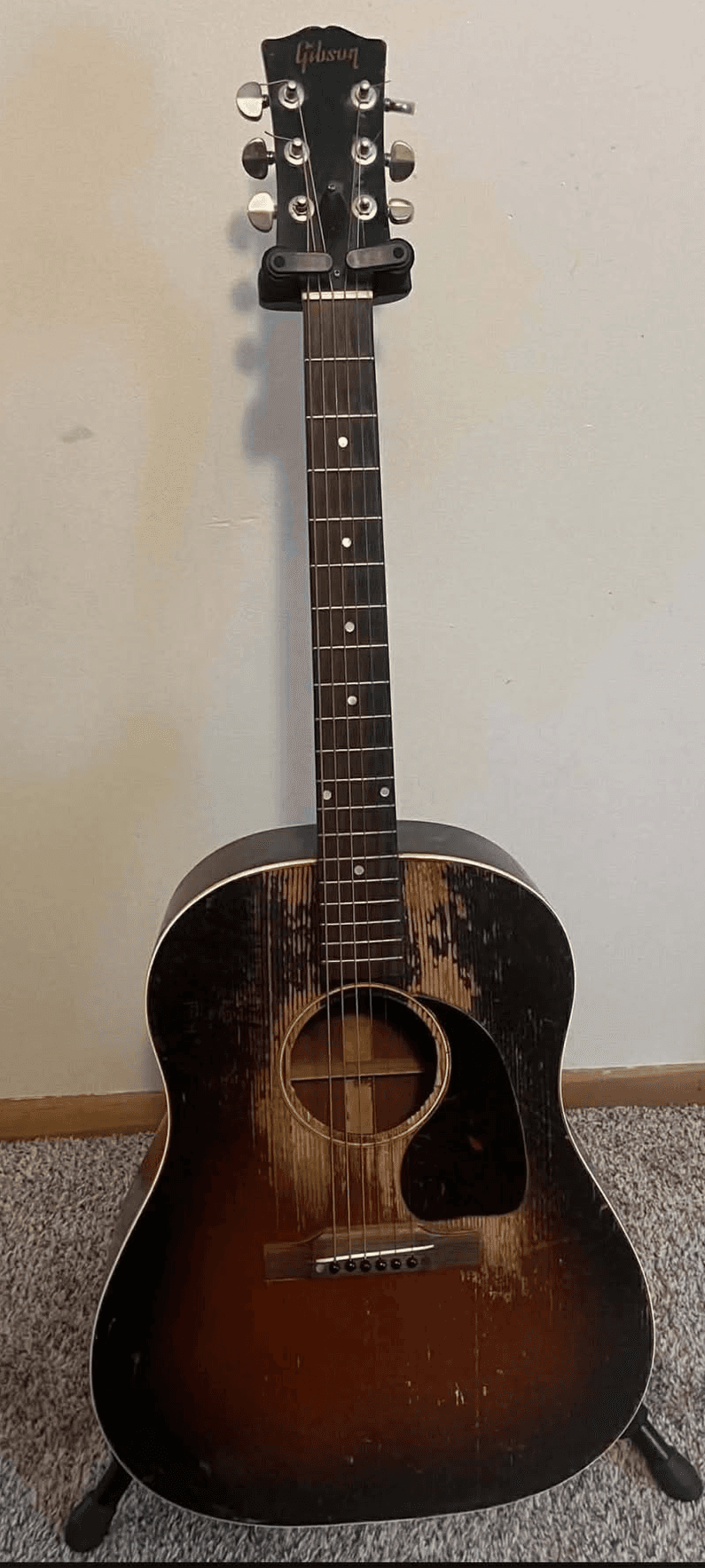
The 1957 Gibson J-45 is a round-shoulder mahogany dreadnought from the first year Gibson offered the model in both natural and cherry sunburst finishes, with a warm, balanced voice that made it a folk and country standard. Value is driven by originality, finish, top and bracing condition, and whether the tuners, pickguard, and electronics are untouched. Edgewater Guitars buys vintage Gibson acoustic guitars nationwide with free expert appraisals and same-day cash offers. Call or text (440) 219-3607.
Last Updated: June 2026
What Makes the 1957 Gibson J-45 Significant?
The 1957 Gibson J-45 is a transition year of genuine consequence — the year Gibson introduced the cherry sunburst finish as an option on the J-45 for the first time, fundamentally changing the instrument’s visual identity and creating the two-finish production split that would define the model through the remainder of its pre-CBS era. Before 1957 the J-45 was a single-finish instrument: standard sunburst, amber to brown, consistent across every example produced since 1942. After 1957 the J-45 existed in two visual identities simultaneously — the original standard sunburst that had defined it for fifteen years and the new cherry sunburst that would become the more immediately recognizable and more frequently reproduced finish in subsequent decades.
The introduction of cherry sunburst in 1957 was not a minor cosmetic change. Cherry sunburst uses a different dye chemistry than standard sunburst — a red-toned burst that fades in specific and beautiful ways as the nitrocellulose ages, typically drifting toward salmon and then toward a warm amber-red as the red dyes break down over decades. The specific aging character of original 1957 cherry sunburst on a J-45 is one of the most visually compelling finishes in vintage acoustic guitar production — the faded, warm, cherry-to-salmon graduation that occurs naturally over nearly 70 years of aging is impossible to reproduce convincingly and is itself an authentication marker.
The 1957 J-45 is therefore a split production year in the most meaningful sense. Early 1957 instruments — those produced before the cherry sunburst option was introduced — are standard sunburst instruments identical in visual character to the 1956. Late 1957 instruments may be either standard or cherry sunburst. This split makes 1957 one of the most nuanced years to date and authenticate in the entire J-45 production run — and one where the specific production position within the year carries meaningful value implications. A 1957 cherry sunburst J-45 in all-original condition is a specific and highly desirable instrument; a 1957 standard sunburst J-45 carries the last-year-of-the-standard-sunburst-era premium on examples where the cherry option was available but not selected. In our experience buying J-45 instruments across Ohio and the Midwest, 1957 examples generate the most nuanced authentication conversations of any year in the mid-decade run — the finish question alone involves multiple layers of documentation, UV examination, and FON dating that simpler years do not require.
What makes the 1957 J-45 distinctive:
Cherry sunburst finish introduced for the first time — the most significant single-year visual change in J-45 production history
Split production year: early examples in standard sunburst only; later examples available in cherry or standard
Last year standard sunburst was the only option for part of the production run — last-year premium for early examples
Adjustable saddle continues in its most refined mid-decade form
Old-growth Sitka spruce top at continued high quality
Dense mahogany back, sides, and neck
Ladder bracing unchanged
Serial numbers on paper label inside body
Factory Order Number stamped on internal top bracing — critical for early vs. late 1957 determination
If you own a 1957 J-45, you may be sitting on a significant asset. Edgewater Guitars provides free, no-obligation valuations — call (440) 219-3607 or visit edgewaterguitars.com.
What Is a 1957 Gibson J-45 Worth? (2026 Market Values)
Value by Condition and Finish
The 1957 J-45 market in 2026 operates with a clear finish-driven hierarchy. Cherry sunburst examples in original condition represent the premium tier — the first-year cherry sunburst carries a specific rarity premium as the debut of this finish. Standard sunburst examples from early 1957 carry the last-year-of-standard-only premium for instruments produced before the cherry option was introduced. All values are driven by adjustable saddle originality and structural condition as with earlier mid-decade examples.
Condition | Finish | Relative Value |
|---|---|---|
Excellent (8–9/10) | Cherry sunburst, all original, original case | Top tier |
Excellent (8–9/10) | Standard sunburst, all original, original case | Premium tier |
Very Good (7/10) | Cherry sunburst, all original, no case | Strong-plus tier |
Very Good (7/10) | Standard sunburst, all original, no case | Strong tier |
Good (6/10) | Either finish, adjustable saddle replaced | Mid-to-strong tier |
Player Grade | Either finish, some replacements | Entry-to-mid tier |
Modified | Refin, structural repairs, significant changes | Entry tier |
What Affects the Value of a 1957 J-45?
Cherry sunburst premium: Original first-year cherry sunburst on a 1957 J-45 commands a 25–40% premium over equivalent standard sunburst examples. The first-year debut of a color that would define the instrument’s visual identity for decades carries specific collector significance beyond the color premium alone.
Cherry sunburst authentication: First-year cherry sunburst requires specific authentication — UV examination to confirm original finish, assessment of the specific fading character consistent with nearly 70 years of aging, and FON dating to confirm late 1957 production when the cherry option was available. A too-vivid or too-uniform cherry finish on a claimed 1957 warrants scrutiny.
Standard sunburst last-year premium: Standard sunburst examples from early 1957 — before the cherry option was introduced — carry a modest last-year premium (8–12%) over standard sunburst examples from equivalent condition earlier years, reflecting their position as the final examples of the pre-cherry standard sunburst era.
Adjustable saddle originality: All-original examples with original metal bracket intact: 15–25% premium over examples with replaced conventional saddle. The 1957 adjustable saddle is the most refined of the mid-decade era.
Top condition: Stable hairline cracks: 10–20% reduction. Professionally repaired: 5–15%. Progressing: 20–35%.
Neck geometry: Correct action without reset: full value. Reset required: 10–20% reduction.
Original case: Adds approximately 10–15% to value.
How 1957 Compares to Other Years
Year | Key Difference | Relative Value | Why |
|---|---|---|---|
1956 | Last full standard sunburst year | Similar to slightly lower | 1957 has cherry debut premium over 1956’s last-year premium |
1957 early (this post) | Last standard sunburst only examples | Similar to 1956 | Last-year premium on pre-cherry 1957 |
1957 late (this post) | First cherry sunburst examples | Higher for cherry | First-year cherry debut premium |
1958 | Cherry sunburst established; adjustable saddle continues | Similar for standard; slightly lower for cherry | Cherry now established rather than debut |
1959 | Cherry sunburst continues; production refinements | Similar | No significant changes from 1958 |
Edgewater Guitars consistently pays 30–40% more than typical guitar shops. Get your free valuation: edgewaterguitars.com or (440) 219-3607.
How to Identify an Authentic 1957 Gibson J-45
Serial Numbers and FON
Serial number: White paper label inside body visible through soundhole
FON: Stamped on top bracing inside body — visible with mirror and light through soundhole. The FON batch letter is the primary tool for determining early vs. late 1957 production — and therefore whether the specific instrument was produced before or after the cherry sunburst option was introduced.
Critical for 1957: The FON batch letter must be examined to determine production position within the year. This is not optional for accurate 1957 J-45 valuation.
Early vs. Late 1957 Determination
The most important authentication question for any 1957 J-45 is: was this instrument produced before or after the cherry sunburst option was introduced?
Method:
Examine the FON batch letter inside the body through the soundhole with a mirror and light
Early 1957 batch letters precede the introduction of the cherry option — instruments from these batches are standard sunburst regardless of any finish claims
Late 1957 batch letters correspond to production after the cherry option was introduced — instruments from these batches may be either standard or cherry sunburst
The specific batch letter cutoff for cherry introduction is not publicly documented with precision — Edgewater’s accumulated evaluation experience across hundreds of mid-century Gibson acoustics informs our identification of the transition point within the 1957 FON series
Practical implications:
An early 1957 instrument claimed to be cherry sunburst is either misrepresented or refinished
A late 1957 instrument in standard sunburst was produced when the cherry option existed — a genuine standard sunburst choice rather than a necessity
Key Visual Identifiers
Round-shoulder dreadnought — unchanged J-45 silhouette
Finish — the primary 1957 identifier: Standard sunburst (early 1957) or cherry sunburst (late 1957). Both are correct; the specific finish and its relationship to the FON batch letter must be consistent.
Cherry sunburst aging character: Original 1957 cherry sunburst shows specific fading — red dyes breaking down toward salmon and amber-red over nearly 70 years. The burst graduation is soft and natural, not uniform or vivid.
Standard sunburst: Amber to brown, unchanged from 1952–1956 production
Adjustable saddle — metal bracket at peak refinement
Old-growth Sitka spruce top — tight grain
Tortoiseshell celluloid pickguard — appropriately aged
Kluson Deluxe tuners — single-ring
Rosewood fingerboard with dot inlays
Ladder bracing visible through soundhole
Cherry Sunburst Authentication — 1957 Specific
First-year cherry sunburst authentication is the most nuanced examination in the 1957 J-45 evaluation:
UV examination:
Original 1957 cherry sunburst shows the specific fluorescence pattern of period-correct nitrocellulose dye chemistry under UV light
Refinished cherry typically shows different fluorescence character — modern dye chemistry produces different UV response than original period dye formulations
Areas under the pickguard should show the original finish as applied — the protected area reveals the original color before decades of light exposure fading
Fading character assessment:
Authentic 1957 cherry sunburst fades in a specific direction — the red dyes break down toward salmon, then toward warm amber-red
The degree of fading is consistent across the top surface with slightly more fading in light-exposed areas
A too-vivid, too-uniform cherry that shows no evidence of red dye breakdown after nearly 70 years warrants scrutiny
The burst graduation softens naturally over decades — original 1957 examples typically show a less defined burst line than the instrument had when new
Under-pickguard evidence:
Removing the pickguard (or examining the pickguard perimeter carefully) reveals the original finish color protected from light exposure
The color differential between the protected under-pickguard area and the exposed top surface confirms the fading character of an authentic finish
A refinished top shows no color differential between protected and exposed areas — the new finish was applied after the pickguard was in place
FON batch letter consistency:
Cherry sunburst finish must be consistent with late 1957 FON batch letter
Early 1957 FON batch letter plus cherry sunburst finish = refinished or misrepresented instrument
Red Flags
Cherry sunburst on an early 1957 FON: Early batch letters precede the cherry option introduction. Cherry finish on an early-batch 1957 is not original.
Too-vivid cherry: Original cherry fades significantly over nearly 70 years. An unusually vivid, even cherry finish warrants UV examination.
No color differential under pickguard: Original 1957 cherry shows darker color under the pickguard (protected from fading) than on the exposed top. Absence of this differential suggests refinishing.
Square-shoulder body: Wrong model or year.
Adjustable saddle routing absent: Bridge replacement or pre-adjustable-saddle era.
Modern bracing through soundhole: Replaced top.
In our experience with 1957 J-45 instruments, the first-year cherry sunburst authentication is the most labor-intensive examination we perform on any mid-decade J-45 — and the most consequential. The difference between an authenticated original first-year cherry and a refinished standard sunburst presented as cherry is the 25–40% premium that separates the premium-plus tier from the premium tier. We never accept cherry finish authenticity on a claimed 1957 without full UV examination, FON batch letter confirmation, and under-pickguard color assessment.
Not sure whether your 1957 J-45 has original cherry or standard sunburst? Edgewater offers free authentication including UV examination. Call (440) 219-3607 or visit edgewaterguitars.com.
1957 Gibson J-45 Specifications
Specification | Early 1957 | Late 1957 |
|---|---|---|
Body Style | Round-shoulder dreadnought | Round-shoulder dreadnought |
Body Wood — Top | Sitka spruce — old-growth | Sitka spruce — old-growth |
Body Wood — Back/Sides | Mahogany — solid | Mahogany — solid |
Bracing | Ladder bracing | Ladder bracing |
Neck Wood | Mahogany | Mahogany |
Fingerboard | Rosewood, dot inlays | Rosewood, dot inlays |
Neck Profile | Medium C | Medium C |
Nut Width | 1-11/16” | 1-11/16” |
Scale Length | 24.75” | 24.75” |
Frets | 19 to body, 20 total | 19 to body, 20 total |
Bridge | Rosewood, adjustable saddle | Rosewood, adjustable saddle |
Tuners | Kluson Deluxe, single-ring | Kluson Deluxe, single-ring |
Pickguard | Tortoiseshell celluloid | Tortoiseshell celluloid |
Finish | Standard sunburst only | Standard or cherry sunburst |
Headstock | Crowned, script logo, crown MOP | Crowned, script logo, crown MOP |
Truss Rod | Adjustable | Adjustable |
Weight Range | 4.0–5.0 lbs | 4.0–5.0 lbs |
Case | Brown or black hardshell | Brown or black hardshell |
Original Retail Price | ~$97.50 (1957 catalog) | ~$97.50 (standard) / ~$107.50 (cherry) |
What Does a 1957 Gibson J-45 Sound Like?
Tonal Profile
The 1957 J-45 produces the same essential tonal character as the 1952–1956 instruments — warm, vocal-forward, naturally compressing, midrange-forward with old-growth Sitka clarity balanced by mahogany warmth. The cherry sunburst finish that distinguishes late 1957 examples does not change the tonal character — the same wood species, the same bracing pattern, and the same construction methods produce the same sound regardless of which dye color is applied to the nitrocellulose topcoat.
The tonal quality that makes mid-decade J-45 instruments specifically sought is fully intact in 1957 production. Old-growth Sitka crispness, mahogany sustain, ladder bracing freedom, thin nitrocellulose resonance — all present and fully expressed. Players who have compared 1957 cherry and standard sunburst examples of equivalent structural condition and adjustable saddle status consistently report no tonal difference attributable to the finish color — the premium for cherry is purely a visual and historical market consideration rather than a tonal one.
Cherry Sunburst and Tone — The Accurate Picture
It is worth addressing directly: original cherry sunburst nitrocellulose lacquer on a 1957 J-45 is the same formulation as standard sunburst nitrocellulose with a different dye added. The dye is a surface colorant within the lacquer — it does not change the acoustic properties of the finish material. A 1957 cherry sunburst J-45 and a 1957 standard sunburst J-45 of identical construction, bracing, and wood quality will produce essentially identical tonal character. The premium for cherry is market-driven, not tone-driven — a distinction that experienced collectors and players recognize and that honest valuation requires acknowledging.
Construction Details and Tone
The most refined adjustable saddle of the mid-decade era contributes the most consistent string-to-bridge coupling of any year in the adjustable saddle production run. By 1957 the bracket installation procedure had been executed thousands of times — the bracket seats correctly, the adjustment range is appropriate, and the saddle contact with the string break points is consistent across all six strings. The practical tonal effect is an even, balanced response across the full fretboard with no individual string or position that sounds noticeably different from its neighbors.
The old-growth Sitka top of 1957 production continues at the quality that defines mid-century Gibson acoustics. Tight grain, high stiffness-to-weight ratio, free response under the pick or fingers — the tonal qualities that distinguish mid-century examples from later production remain fully present in 1957.
Notable Recordings
The 1957 J-45 tonal character is present in recordings that mark the beginning of the folk revival’s most culturally productive period. The warm, vocal-friendly acoustic guitar sound on recordings from this moment in American music history — early Kingston Trio recordings, the first Newport Folk Festival documentation, the pre-Dylan folk scene recordings — is directly traceable to instruments of this type and era. The introduction of cherry sunburst in 1957 gave the J-45 the visual identity that would be most associated with the folk revival in popular imagination, even as the tonal character remained identical to the preceding standard sunburst instruments.
Common Issues and Modifications That Affect Value
Adjustable saddle removed: Most common modification. Value impact: 15–25% reduction.
Cherry sunburst refinish on standard sunburst instrument: A specific fraud risk given the cherry premium. UV examination and FON batch letter confirmation are essential for any claimed 1957 cherry.
Standard sunburst refinish on cherry instrument: Less common but possible — original cherry refinished to standard sunburst after damage. UV examination reveals original cherry dye layer beneath.
Top cracks: Stable hairlines: 10–20%. Repaired: 5–15%. Progressing: 20–35%.
Neck reset required: 10–20% reduction.
Refinished body (non-cherry fraud): General refinishing: 35–50% reduction.
Replaced tuners: 8–12% reduction.
Replaced pickguard: 5–10% reduction.
Bridge replacement: 10–15% reduction.
Brace regluing: Minimal if professional; 10–15% if improper materials.
In Edgewater’s experience with 1957 J-45 instruments, the cherry sunburst fraud risk is the most significant authentication concern — and the most consequential for sellers. A standard sunburst 1957 J-45 that has been refinished in cherry and presented as an original first-year cherry example is the most common high-stakes misrepresentation in the mid-decade J-45 market. Our UV examination, under-pickguard assessment, and FON batch letter verification resolve this definitively during every in-person evaluation.
Selling Your 1957 Gibson J-45: Your Options Compared
Selling Option | Typical Offer | Timeline | Fees/Costs | Risk Level | Best For |
|---|---|---|---|---|---|
Edgewater Guitars | 30–40% above shop offers | Immediate cash | None | Low — expert cherry authentication included | Owners wanting accurate first-year cherry valuation |
Local Guitar Shop | Wholesale pricing (lowest) | Same day | None direct | Low | Convenience over value |
Reverb / eBay | Variable | Weeks to months | 5–15% + shipping | High | Experienced sellers |
Auction House | Variable | 3–6 months | 15–25% seller premium | Medium | Authenticated first-year cherry examples |
Private Sale | Variable | Unpredictable | None | High | Sellers with buyer network |
The 1957 J-45 is the year where finish authentication most dramatically affects valuation — the difference between an authenticated original first-year cherry and a refinished instrument presented as cherry is the 25–40% premium that separates the top two market tiers. Edgewater’s evaluation process includes UV examination, under-pickguard color assessment, and FON batch letter verification as standard procedure for every 1957 J-45 evaluation. Our offer reflects the actual finish status of the specific instrument rather than an assumed or claimed configuration.
Ready to find out what your 1957 Gibson J-45 is worth? Get your free, no-obligation valuation: edgewaterguitars.com or call (440) 219-3607.
Frequently Asked Questions About the 1957 Gibson J-45
Q: What is a 1957 Gibson J-45 worth in 2026? A: Value depends critically on finish authenticity and adjustable saddle originality. Original first-year cherry sunburst examples in excellent all-original condition represent the premium-plus tier. Standard sunburst examples in equivalent condition occupy the premium tier. Contact Edgewater Guitars for a free valuation — UV examination is required for accurate cherry authentication.
Q: When was cherry sunburst introduced on the J-45? A: Cherry sunburst was introduced as a J-45 finish option in 1957, making it the first year any J-45 was available in this finish. The introduction occurred mid-year — early 1957 examples are standard sunburst only; late 1957 examples may be either standard or cherry. The Factory Order Number batch letter is the primary tool for determining which side of the introduction a specific instrument falls on.
Q: How do I authenticate a claimed 1957 cherry sunburst J-45? A: Three examinations are required: UV examination confirming original finish chemistry; FON batch letter confirmation that the instrument was produced after the cherry option was introduced; and under-pickguard color assessment confirming the protected area shows darker color than the faded exposed top. All three must be consistent for authentication. Edgewater performs all three as standard procedure.
Q: Does cherry sunburst affect the sound of a 1957 J-45? A: No. The cherry dye is a surface colorant within the nitrocellulose lacquer — it does not change the acoustic properties of the finish material. A cherry and standard sunburst 1957 J-45 of identical construction produce essentially identical tonal character. The cherry premium is market-driven and historical, not tonal.
Q: What serial numbers cover 1957 Gibson J-45 instruments? A: Gibson acoustic serial numbers are on the paper label inside the body. The Factory Order Number on the internal top bracing is the more reliable dating reference — the specific batch letter series advances through 1957 and is the primary tool for early vs. late 1957 determination.
Q: Does Edgewater Guitars buy 1957 Gibson J-45 instruments? A: Yes. We actively purchase 1957 J-45 instruments in all conditions — cherry sunburst, standard sunburst, all-original, and modified. We pay 30–40% more than local guitar shops and provide immediate cash payment. Call (440) 219-3607 or visit edgewaterguitars.com.
Q: Is a refinished cherry 1957 J-45 still valuable? A: Yes — but at a meaningful discount to an original finish example. A refinished cherry 1957 J-45 with original adjustable saddle, original hardware, and all-original construction is still a historically significant instrument. The refinish reduces value by 35–50% relative to an all-original example. Contact Edgewater for a specific assessment.
Q: How long does it take to sell a vintage guitar to Edgewater? A: Typically 24–72 hours from initial contact to cash in hand. For a 1957 J-45 we always arrange in-person evaluation — cherry finish authentication requires UV examination and cannot be performed remotely. From evaluation to cash in hand is typically same-day or next-day.
Related Resources
Gibson Serial Number Lookup Tool — edgewaterguitars.com/guitar-serial-number-lookup/gibson
How to Date Your Vintage Gibson J-45: Complete Authentication Guide — edgewaterguitars.com
1956 Gibson J-45: Value, ID & Selling Guide — edgewaterguitars.com
1958 Gibson J-45: The Golden Era Workhorse at Its Peak — edgewaterguitars.com
How to Date Your Gibson Acoustic Guitar: Complete Identification Guide — edgewaterguitars.com
Sell Your Guitar to Edgewater — edgewaterguitars.com
Related posts: 1956 Gibson J-45 | 1958 Gibson J-45 | 1959 Gibson J-45 | 1955 Gibson J-45
Sell your 1957 Gibson J-45
Edgewater Guitars buys vintage Gibson acoustic guitars and other vintage Gibsons nationwide. We give free, honest appraisals and fair same-day cash offers, with local pickup or insured nationwide shipping. Call or text (440) 219-3607 or request a free estimate.
How much is a 1957 Gibson J-45 worth?
A clean, all-original 1957 Gibson J-45’s value depends on originality, condition, finish, and whether the bracing, tuners, and pickguard are original. Because Edgewater buys directly and resells, we can typically pay more than local shops or pawn stores. The most accurate way to find out is a free appraisal: send a few photos and the serial number and we will give you an honest market assessment.
Where can I sell a 1957 Gibson J-45?
Edgewater Guitars buys them directly, nationwide, with same-day cash offers and no obligation. You can also date yours with our Gibson serial number lookup.