DATE :
1954 Gibson J-45: The Benchmark Mid-Decade Workhorse — Round Shoulder Consistency as Gibson Diversifies
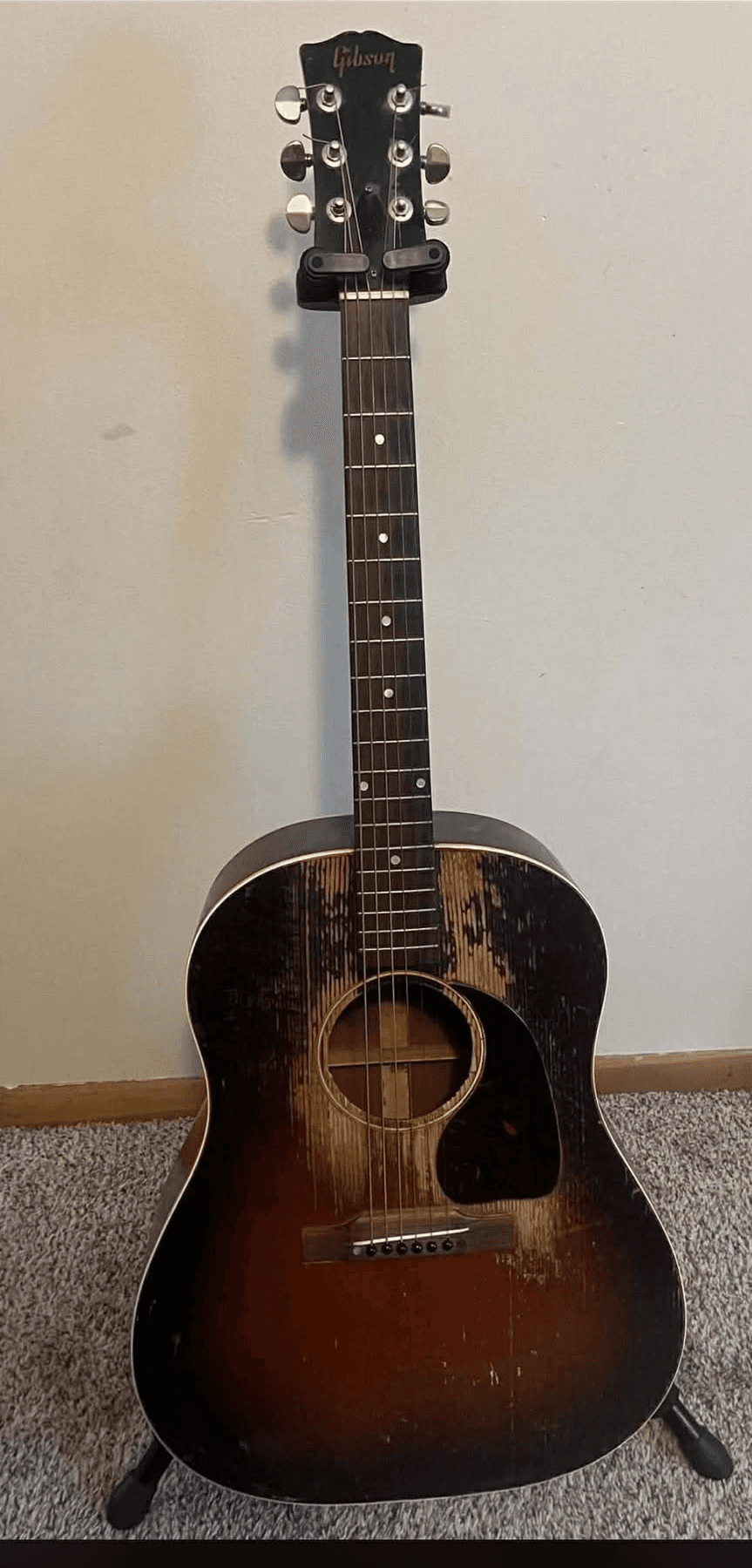
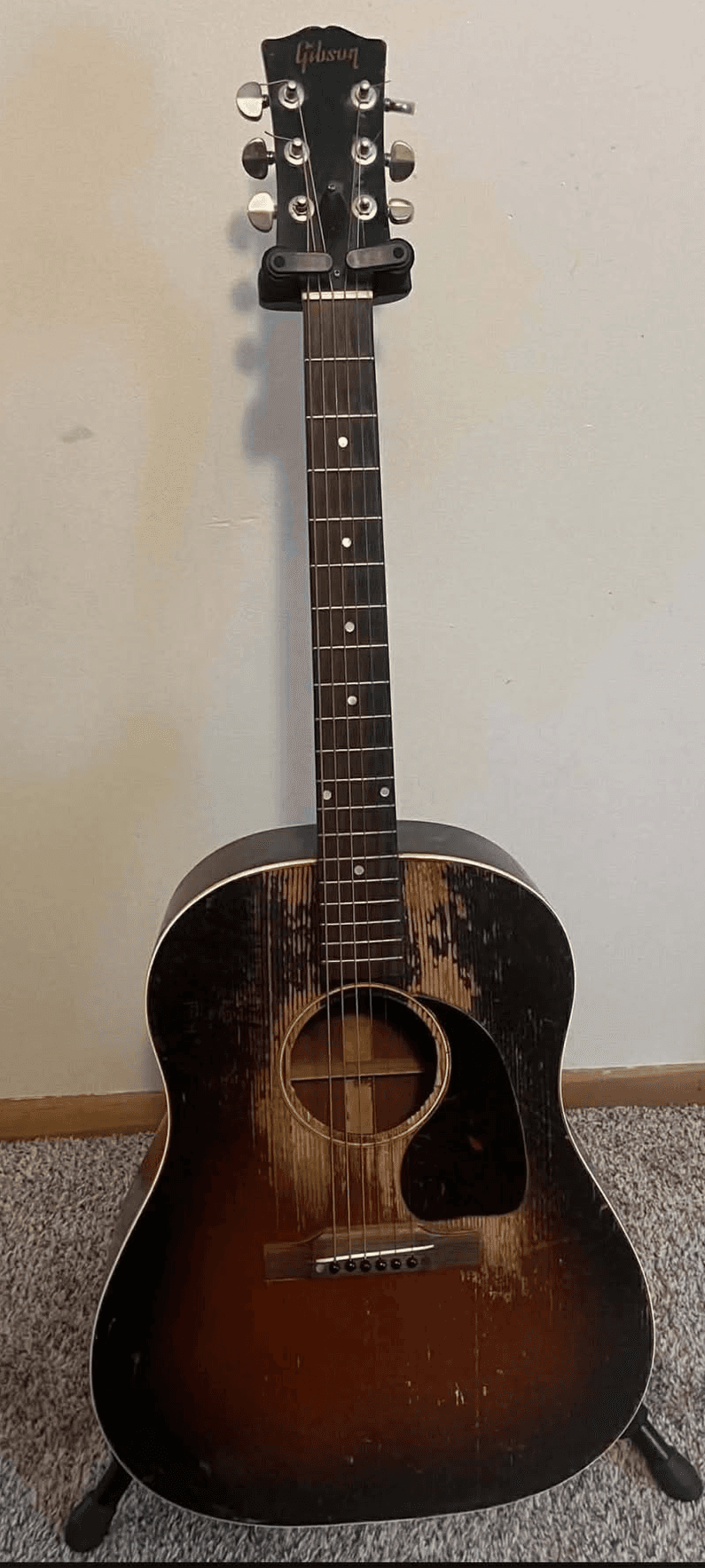
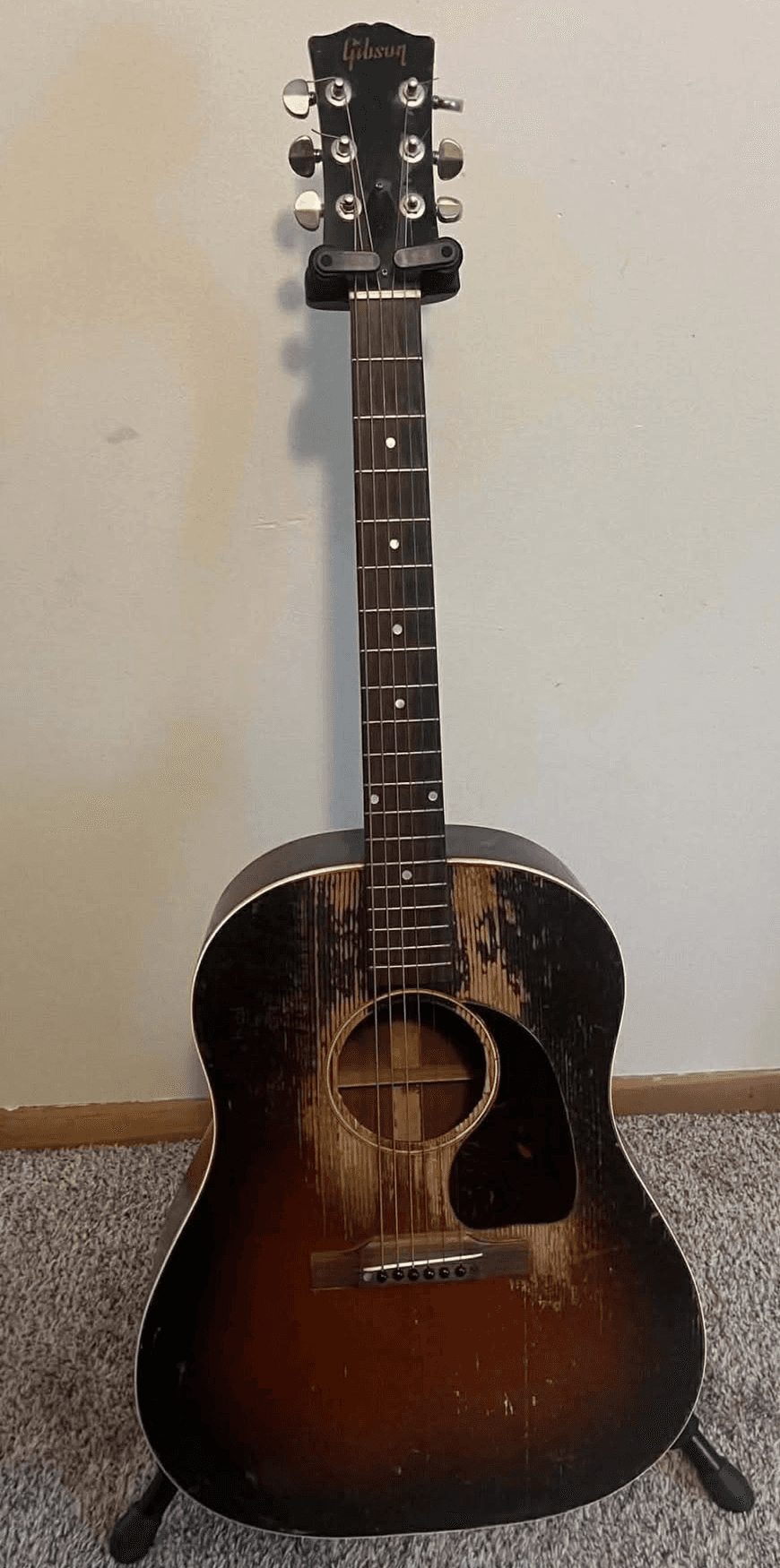
1954 Gibson J-45: The Benchmark Mid-Decade Workhorse — Round Shoulder Consistency as Gibson Diversifies
The 1954 Gibson J-45 is a benchmark mid-decade workhorse, a round-shoulder dreadnought prized for the dependable construction and balanced tone that made it Gibson’s best-selling flat-top. Original bracing, top, tuners, and overall condition are the key value drivers. Edgewater Guitars buys vintage Gibson J-45s nationwide with free expert appraisals and same-day cash offers. Call or text (440) 219-3607.
Last Updated: June 2026
What Makes the 1954 Gibson J-45 Significant?
The 1954 Gibson J-45 arrives at a moment of interesting context within Gibson’s broader acoustic production story. This is the year Gibson introduced the J-160E — the electric-acoustic model that would become associated with the Beatles — and was expanding its acoustic lineup with new models targeting different market segments. The J-45, by contrast, held its ground without change or embellishment. While other parts of Gibson’s catalog were being redesigned and repositioned, the J-45 continued doing precisely what it had been doing since 1942: producing a warm, focused, working musician’s dreadnought at a price point accessible to professional and amateur players alike.
This contextual stability is itself a form of significance. The 1954 J-45 is an instrument that was never distracted by experimentation or competitive pressure. The round-shoulder dreadnought body, the mahogany back and sides, the Sitka spruce top, the adjustable saddle, the ladder bracing — all continued in exactly the form that had been proven through twelve years of production. The result is an instrument with the quiet authority of a design that knows exactly what it is. Players who pick up a 1954 J-45 in playing condition consistently report the same experience: immediate, natural response, a tonal character that sits perfectly behind a voice, and a playing feel that rewards whatever technique the player brings to it.
The 1954 J-45 is also notable for a subtle but meaningful production refinement that distinguishes it from the 1952–1953 examples. By 1954 Gibson had refined the neck geometry of the J-45 to produce a slightly more consistent neck angle — the relationship between the neck plane and the top plane that determines action without a neck reset. Instruments from 1954 tend to hold their neck geometry more reliably over decades than earlier examples, reflecting accumulated production experience with the interaction between mahogany neck, spruce top, and the specific string tension of a medium-gauge acoustic guitar. In our experience buying J-45 instruments across Ohio and the Midwest, 1954 examples are slightly more likely to have maintained acceptable action without requiring a reset than 1952–1953 examples of equivalent age and storage history — a practical advantage that players specifically appreciate.
What makes the 1954 J-45 distinctive:
Stable, fully resolved production configuration — no transitional features, no experimental elements
Adjustable saddle fully standardized and refined through two years of production experience
Refined neck geometry producing more consistent long-term action stability
Old-growth Sitka spruce top at continued high quality
Dense mahogany back, sides, and neck
Ladder bracing pattern unchanged
Sunburst nitrocellulose finish
Produced during a year of significant Gibson catalog expansion — the J-45 itself held its course
Serial numbers on paper label inside the body
Factory Order Number stamped on internal top bracing
If you own a 1954 J-45, you may be sitting on a significant asset. Edgewater Guitars provides free, no-obligation valuations — call (440) 219-3607 or visit edgewaterguitars.com.
What Is a 1954 Gibson J-45 Worth? (2026 Market Values)
Value by Condition and Finish
The 1954 J-45 market in 2026 is closely equivalent to the 1952–1953 market — the instruments are essentially the same in construction and materials, and the collector market treats them as part of the same mid-decade cohort. The adjustable saddle remains the primary originality variable. Structural condition and neck geometry drive the condition tier distinctions.
Condition | Originality | Relative Value |
|---|---|---|
Excellent (8–9/10) | All original including adjustable saddle, original case | Premium tier |
Very Good (7/10) | All original including adjustable saddle, no case | Strong tier |
Good (6/10) | Adjustable saddle replaced with bone, otherwise original | Mid-to-strong tier |
Good (6/10) | Original saddle, structural maintenance performed | Mid tier |
Player Grade | Some replacements, heavy wear | Entry-to-mid tier |
Modified | Refin, structural repairs, significant changes | Entry tier |
What Affects the Value of a 1954 J-45?
Adjustable saddle originality: The factory adjustable saddle continues as the primary year-specific value variable. All-original examples with original metal bracket intact: 15–25% premium over examples with replaced conventional saddle.
Neck geometry stability: The refined neck geometry of 1954 production means more examples have maintained acceptable action without requiring a reset. An instrument in original neck geometry with correct action: full value. Neck requiring reset: 10–20% reduction.
Top condition: Stable hairline cracks: 10–20% reduction. Professionally repaired cracks: 5–15% reduction. Progressing cracks: 20–35% reduction.
Spruce top grain quality: Old-growth Sitka with tight grain continues as a positive value indicator on 1954 examples — the same stock quality as 1952–1953. Evaluators specifically assess grain line spacing as a quality marker.
Finish integrity: Original sunburst nitrocellulose: full value. Refinished examples: 35–50% reduction.
Tuner originality: Original Kluson Deluxe: full value. Modern replacements: 8–12% reduction.
Original case: Adds approximately 10–15% to value.
How 1954 Compares to Other Years
Year | Key Difference | Relative Value | Why |
|---|---|---|---|
1944–1945 | Banner era; highest collectibility | Substantially higher | Banner premium |
1952–1953 | Same configuration; slightly less neck geometry refinement | Similar | Closely equivalent; minor neck geometry difference |
1954 (this post) | Refined neck geometry; peak mid-decade consistency | Baseline | Most refined mid-decade J-45; production at full maturity |
1955–1957 | Continuing adjustable saddle era; minor refinements | Similar | No significant distinguishing features |
1958–1959 | Cherry sunburst option introduced | Similar to slightly higher | Cherry option adds color premium |
Edgewater Guitars consistently pays 30–40% more than typical guitar shops. Get your free valuation: edgewaterguitars.com or (440) 219-3607.
How to Identify an Authentic 1954 Gibson J-45
Serial Numbers and FON
Serial number location: White paper label inside the body, visible through the soundhole
FON location: Stamped on the top bracing inside the body — visible through the soundhole with a mirror and light
Dating method: FON batch letter plus construction details provides the most reliable 1954 confirmation. The 1954 FON batch letters advance through the year — specific letters narrow production to early, mid, or late 1954.
Key Visual Identifiers
Body shape: Round-shoulder dreadnought — curved shoulders, wider lower bout, the characteristic J-45 silhouette unchanged from 1952–1953
Adjustable saddle: Fully standardized metal bracket assembly in the bridge — two years of production refinement behind it
Spruce top: Tight old-growth grain — consistent with 1952–1953 stock quality
Neck geometry: The refined 1954 neck angle is not visually distinguishable from earlier examples without measurement — but its practical benefit (action stability) is apparent in playing condition assessment
Pickguard: Tortoiseshell celluloid, appropriately aged to amber-brown
Finish: Sunburst nitrocellulose — amber to brown burst, transparent center
Tuners: Kluson Deluxe, single-ring, plastic oval buttons
Fingerboard: Rosewood with dot inlays
Label: White paper label with J-45 designation
Bracing: Ladder pattern visible through soundhole
Neck Geometry Assessment
The refined neck geometry of 1954 production is assessed by measuring action at the 12th fret with standard string gauges:
Correct action: Bass side approximately 3/32” to 4/32” at the 12th fret; treble side approximately 2/32” to 3/32”
Action within range: Indicates neck geometry has been maintained — no reset required, full value
High action: Indicates neck rotation has occurred — reset required, value adjusted accordingly
Measurement method: Use a precision ruler or string action gauge at the 12th fret, measuring from the top of the fret to the bottom of the string
Red Flags: How to Spot Fakes and Refinishes
Square-shoulder body: The 1954 J-45 has round shoulders. Square shoulders indicate a different model.
Adjustable saddle routing absent: If the bridge saddle slot shows no evidence of the original bracket routing, the bridge may have been replaced or the instrument is not from the adjustable saddle era.
Refinished sunburst: UV examination reveals refinishing. Original 1954 sunburst has a specific transparency and depth.
Modern bracing visible through soundhole: Scalloped X-bracing indicates a replaced top or a different instrument entirely.
Wrong label or mismatched FON: FON batch letters inconsistent with 1954 production indicate misrepresentation.
Undisclosed structural repairs: UV examination and mirror inspection reveal the extent of any previous repair work.
In our experience evaluating 1954 J-45 instruments, the neck geometry stability advantage of this year is the most frequently surprising finding for sellers — owners who have been told their guitar needs a neck reset sometimes discover through our evaluation that the action is within acceptable range and no reset is required, a finding that changes the valuation conversation meaningfully.
1954 Gibson J-45 Specifications
Specification | Detail |
|---|---|
Body Style | Round-shoulder dreadnought |
Body Wood — Top | Sitka spruce — solid, old-growth stock |
Body Wood — Back and Sides | Mahogany — solid |
Bracing | Ladder bracing |
Neck Wood | Mahogany |
Fingerboard | Rosewood with dot inlays |
Neck Profile | Medium C — refined geometry for long-term action stability |
Nut Width | 1-11/16” |
Scale Length | 24.75” |
Frets | 19 to body, 20 total |
Bridge | Rosewood with adjustable saddle bracket |
Saddle | Adjustable metal bracket with synthetic or bone element |
Tuners | Kluson Deluxe, single-ring, plastic oval buttons |
Pickguard | Tortoiseshell celluloid, single-ply |
Finish | Nitrocellulose lacquer — sunburst standard |
Headstock | Crowned with Gibson script logo and crown MOP inlay |
Truss Rod | Adjustable |
Label | White paper label |
Weight Range | Typically 4.0–5.0 lbs |
Case | Brown or black hardshell case |
Original Retail Price | Approximately $97.50 (1954 catalog) |
What Does a 1954 Gibson J-45 Sound Like?
Tonal Profile
The 1954 J-45 produces the same essential tonal character as the 1952–1953 examples — warm, vocal-forward, naturally compressing, midrange-forward with a clear spruce fundamental balanced by mahogany warmth. The refined neck geometry of 1954 production contributes a playing feel that encourages more sustained engagement — an instrument that holds its setup through extended play sessions in a way that players recognize and appreciate even if they cannot articulate the construction reason behind it.
The old-growth Sitka spruce top of 1954 production continues to produce the tight-grained tonal clarity that defines mid-century Gibson acoustics. Notes speak immediately and sustain warmly. The ladder bracing allows the top to flex freely and evenly, distributing vibration across the full top surface rather than concentrating it along brace lines. The result is a tonal evenness across the frequency spectrum — no strings or positions that sound significantly louder or softer than others — that makes the 1954 J-45 an unusually reliable and consistent performance instrument.
How Construction Details Affect Tone
The adjustable saddle of 1954 production — now two years refined from its introduction — is installed with the greatest consistency of the early adjustable saddle era. The bracket is seated firmly in the bridge, the adjustment mechanism functions smoothly, and the saddle element contacts the string break points consistently across all six strings. The tonal character of the adjustable system — slightly more complex and metallic in the initial attack than a conventional bone saddle — is present but not pronounced on well-maintained 1954 examples where the bracket is properly seated and not rattling or loose.
The mahogany neck at its 1954 geometry contributes the warm, even tonal coupling that defines the J-45 playing feel. The neck-to-body junction at the 14th fret provides good upper register access while maintaining the full-size dreadnought body that produces the instrument’s characteristic low-end fullness.
Notable Recordings
The 1954 J-45 tonal character is present throughout the expanding catalog of American folk and country music from the mid-1950s. The instrument’s consistency and reliability made it the acoustic guitar of choice for studio session players and performing artists who needed an instrument that would sound correct in any context without requiring adjustment or compensation. The warm, natural tonal balance that makes the J-45 so immediately satisfying to play is directly audible in the recordings from this era that document the folk and country traditions at their most authentic.
Common Issues and Modifications That Affect Value
Adjustable saddle removed: Most common modification. Value impact: 15–25% reduction.
Top cracks: Most common structural issue. Stable hairlines: 10–20% reduction. Repaired cracks: 5–15% reduction.
Neck reset required: 10–20% reduction reflecting maintenance cost.
Refinished body: 35–50% reduction.
Replaced tuners: 8–12% reduction.
Replaced pickguard: 5–10% reduction.
Bridge replacement: 10–15% reduction.
Brace regluing: Minimal if professional; 10–15% if improper adhesives used.
Lifted pickguard: 3–5% reduction.
Finish crazing through to bare wood: 5–10% reduction depending on extent.
In Edgewater’s experience with 1954 J-45 instruments, the refined neck geometry of this year produces a noticeably higher rate of instruments in acceptable playing condition without requiring a reset — a practical advantage that translates directly into buyer interest from the active player market as well as the collector market.
Selling Your 1954 Gibson J-45: Your Options Compared
Selling Option | Typical Offer | Timeline | Fees/Costs | Risk Level | Best For |
|---|---|---|---|---|---|
Edgewater Guitars | 30–40% above shop offers | Immediate cash | None | Low — expert authentication included | Owners wanting fair value |
Local Guitar Shop | Wholesale pricing (lowest) | Same day | None direct | Low | Convenience over value |
Reverb / eBay | Variable | Weeks to months | 5–15% + shipping | High | Experienced sellers |
Auction House | Variable | 3–6 months | 15–25% seller premium | Medium | Exceptional examples |
Private Sale | Variable | Unpredictable | None | High | Sellers with buyer network |
The 1954 J-45’s value is most accurately assessed through in-person evaluation — the neck geometry stability advantage and adjustable saddle condition both require direct examination that a visual or photo-based assessment cannot provide. Edgewater’s evaluation process examines both elements as standard procedure on every J-45 evaluation regardless of year.
Ready to find out what your 1954 Gibson J-45 is worth? Get your free, no-obligation valuation: edgewaterguitars.com or call (440) 219-3607.
Frequently Asked Questions About the 1954 Gibson J-45
Q: What is a 1954 Gibson J-45 worth in 2026? A: Value is driven by adjustable saddle originality, neck geometry, top condition, and overall originality. All-original examples with intact adjustable saddle and correct neck geometry in excellent condition represent the premium tier. Contact Edgewater for a free valuation.
Q: How is the 1954 J-45 different from the 1953? A: The primary practical difference is the refined neck geometry of 1954 production — a more consistent neck angle that produces better long-term action stability. The materials, construction methods, and adjustable saddle configuration are essentially equivalent between the two years. The collector market treats 1953 and 1954 as closely comparable instruments.
Q: What is the adjustable saddle and should I keep it? A: A factory-installed metal bracket assembly in the bridge that allows saddle height adjustment without removing the saddle. From a collector perspective, keeping it original adds 15–25% to value. From a playing perspective, many players prefer a conventional bone saddle for more direct tonal coupling. Do not remove the adjustable saddle before having the instrument evaluated.
Q: Does Edgewater Guitars buy 1954 Gibson J-45 instruments? A: Yes. We actively purchase 1954 J-45 instruments in all conditions. We pay 30–40% more than local guitar shops and provide immediate cash payment. Call (440) 219-3607 or visit edgewaterguitars.com.
Q: What structural issues are common on a 1954 J-45? A: Top cracks, neck reset requirements, and loose braces — all common on 70-year-old acoustic guitars and all proportionally rather than catastrophically value-reducing. A 1954 J-45 with stable top cracks, original adjustable saddle, and original hardware is still a highly significant instrument.
Q: How do I access the Factory Order Number on a 1954 J-45? A: Look through the soundhole with a mirror and flashlight — the FON is typically stamped on the transverse top brace below the soundhole. The batch letter and production number provide year confirmation more reliably than the serial number alone.
Q: How long does it take to sell to Edgewater? A: Typically 24–72 hours from first contact to cash in hand. We provide a preliminary valuation quickly, arrange in-person evaluation for high-value instruments, and make an immediate cash offer.
Related Resources
Gibson Serial Number Lookup Tool — edgewaterguitars.com/guitar-serial-number-lookup/gibson
How to Date Your Vintage Gibson J-45: Complete Authentication Guide — edgewaterguitars.com
1953 Gibson J-45: Value, ID & Selling Guide — edgewaterguitars.com
1955 Gibson J-45: Value, ID & Selling Guide — edgewaterguitars.com
How to Date Your Gibson Acoustic Guitar: Complete Identification Guide — edgewaterguitars.com
Sell Your Guitar to Edgewater — edgewaterguitars.com
Related posts: 1953 Gibson J-45 | 1955 Gibson J-45 | 1952 Gibson J-45 | 1958 Gibson J-45
Sell your 1954 Gibson J-45
Edgewater Guitars buys vintage Gibson J-45s and other vintage Gibsons nationwide. We give free, honest appraisals and fair same-day cash offers, with local pickup or insured nationwide shipping. Call or text (440) 219-3607 or request a free estimate.
How much is a 1954 Gibson J-45 worth?
A clean, all-original 1954 Gibson J-45’s value depends on originality, condition, finish, and whether the top, bracing, and tuners are original. Because Edgewater buys directly and resells, we can typically pay more than local shops or pawn stores. The most accurate way to find out is a free appraisal: send a few photos and the serial number and we will give you an honest market assessment.
Where can I sell a 1954 Gibson J-45?
Edgewater Guitars buys them directly, nationwide, with same-day cash offers and no obligation. You can also date yours with our Gibson serial number lookup.