DATE :
1957 Gibson ES-350T: The Revolutionary PAF Transition Year
1957 Gibson ES-350T: The Revolutionary PAF Transition Year
The 1957 Gibson ES-350T is a landmark transition-year archtop, among the first Gibsons to carry the new PAF humbucker, with a thinline body and short scale. Originality, pickups, and finish drive value. Edgewater Guitars buys vintage Gibson ES-350Ts nationwide with free expert appraisals and same-day cash offers. Call or text (440) 219-3607.
Last Updated: April 2026
1957 Gibson ES-350T: Historic Humbucker Introduction on Gibson’s Premium Thinline Archtop
Last Updated: April 2026
What Makes the 1957 Gibson ES-350T Significant?
The 1957 Gibson ES-350T represents one of the most historically significant transition years in electric guitar history—the year Gibson introduced the revolutionary PAF (Patent Applied For) humbucker pickup that would transform electric guitar tone forever. As a premium thinline archtop with sophisticated appointments, the ES-350T became one of the first production models to receive the new humbucker design, creating a pivotal year where early 1957 examples retained traditional P-90 pickups while mid-to-late 1957 examples featured the groundbreaking new PAF humbuckers—making 1957 a critical transitional year with two distinct authentic configurations both representing major historical moments.
What makes 1957 particularly special:
PAF Humbucker Introduction: Revolutionary PAF humbucker introduced mid-1957 (approximately June-July) on premium models including ES-350T—fundamentally changing electric guitar tone with noise-canceling dual-coil design, warmer voice, higher output, and reduced interference
Dual Configuration Year: Both P-90 pickups (early 1957) and PAF humbuckers (mid-late 1957) are authentic depending on production timing—cannot date by pickup type alone
Historic Transition Significance: 1957 marks the end of Gibson’s P-90 era and beginning of humbucker dominance—ES-350T guitars from this year represent both traditions
Early PAF Desirability: Mid-late 1957 PAF examples feature earliest production PAFs with specific tonal characteristics highly prized by collectors—rough castings, long magnets, hand-wound coils, patent-pending stickers (some examples)
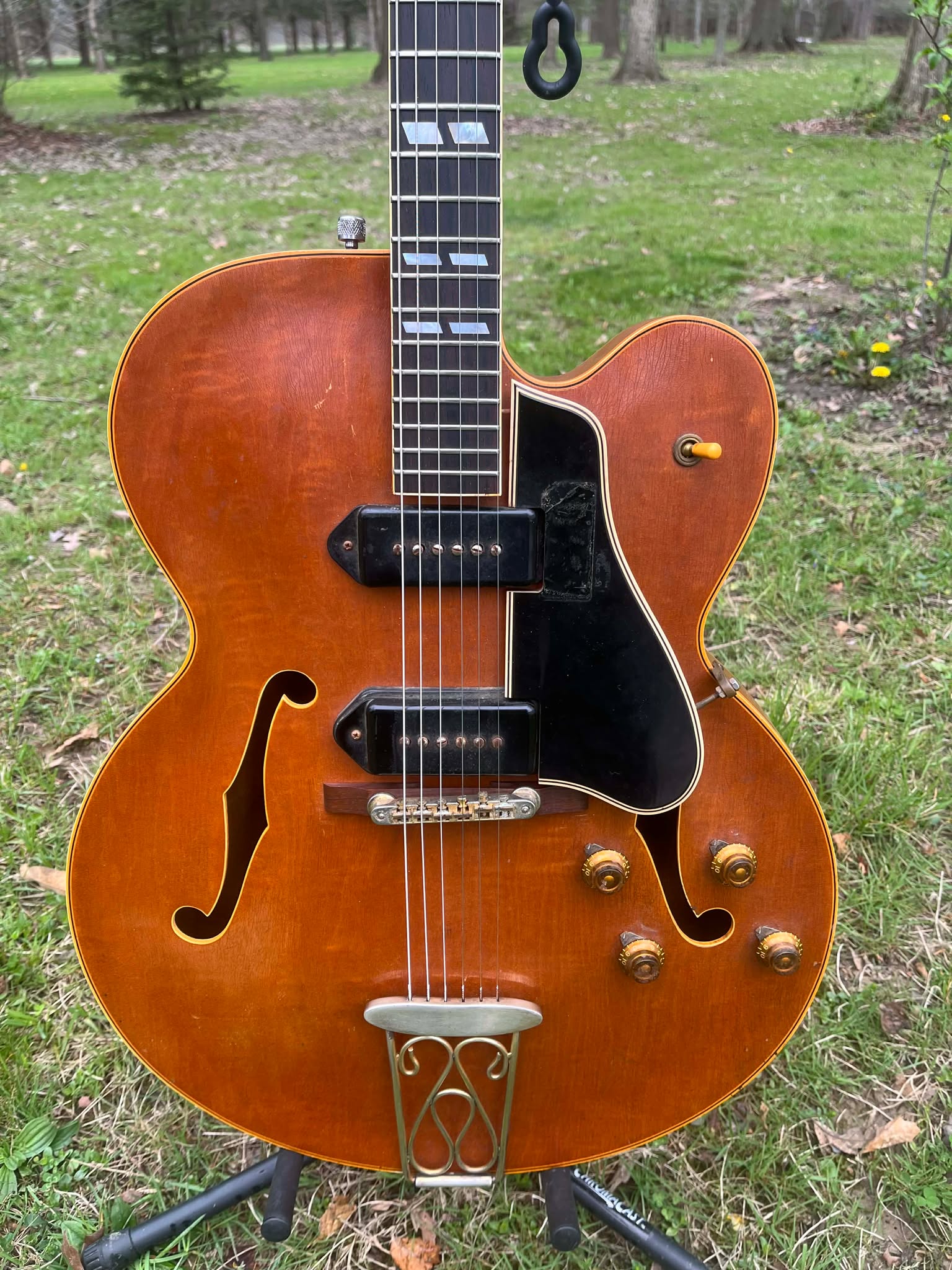
Premium Thinline Design: Continued ES-350T specifications—thinline depth (approximately 2 3/4”), single Florentine cutaway, 17” body width, comfortable playability with archtop resonance
ES-350 Appointments: Bound f-holes, multi-ply body binding, bound ebony fingerboard with pearl block inlays, gold hardware throughout, split-diamond headstock inlay
Natural or Sunburst Finishes: Both finish options available with natural showing flame maple figuring and commanding premiums
Golden Era Manufacturing: 1957 production represents Gibson’s peak craftsmanship—exceptional materials, meticulous hand-fitting, superior quality control during golden era
Factory Tailpiece Options: Trapeze tailpiece standard, Bigsby vibrato available as factory option
Professional Positioning: Targeted serious jazz musicians, studio players, and professionals seeking refined tone and sophisticated appearance
Collectibility Factor: 1957 transition year status creates dual appeal—P-90 examples sought by single-coil purists, PAF examples sought by humbucker collectors
1957 Gibson Context and PAF Introduction: The 1957 ES-350T sits at the crossroads of electric guitar history. Gibson engineer Seth Lover developed the humbucker pickup to solve single-coil noise and interference problems plaguing professional musicians. The PAF (Patent Applied For—named for sticker on early examples before patent approval) featured two coils wired in opposite polarity and reverse-wound configuration creating hum-canceling effect while producing warmer, fuller tone than P-90 single-coils. Gibson introduced PAFs mid-1957 on premium models first—ES-350T, Les Paul Standard (creating the legendary “burst”), ES-175, and others—before gradually expanding across the line. This means 1957 ES-350T guitars built in first half of year have traditional P-90 pickups (continuation of 1956 specification), while guitars built mid-year onward have revolutionary new PAF humbuckers. Both configurations are completely authentic for 1957, and dating within the year requires examination of pickup type, pot codes, FON codes, and other features. The PAF introduction fundamentally changed Gibson’s identity and electric guitar tone—making 1957 one of the most important years in guitar history.
In Edgewater’s experience buying vintage Gibson archtops across Ohio and the Midwest, 1957 ES-350T guitars are among the most historically significant and sought-after thinline archtops ever produced. PAF-equipped examples (mid-late 1957) command premiums due to early humbucker production and revolutionary significance, while P-90 examples (early 1957) are valued as final examples of traditional single-coil ES-350T configuration. Natural finish examples command substantial premiums regardless of pickup type, all-original condition is essential, and factory Bigsby-equipped examples are particularly desirable. Many owners inherited ES-350T guitars from professional musicians who purchased them during this revolutionary transition year and are often surprised to learn that 1957’s historical significance—particularly PAF-equipped examples representing the birth of the humbucker era—creates extraordinary collector demand and substantial value.
If you own a 1957 Gibson ES-350T, you have a premium thinline archtop from one of the most important transition years in electric guitar history. Edgewater Guitars provides free, no-obligation valuations for all vintage Gibson archtops. Call (440) 219-3607 or visit our website for your free appraisal.
What Is a 1957 Gibson ES-350T Worth? (2026 Market Values)
Value by Condition, Finish, and Pickup Type
Condition | PAF Humbuckers Natural | PAF Humbuckers Sunburst | P-90 Pickups Natural | P-90 Pickups Sunburst |
|---|---|---|---|---|
Excellent (8-9/10) | Extraordinary tier | Ultra-premium tier | Ultra-premium tier | Premium tier |
Very Good (7/10) | Ultra-premium tier | Premium tier | Premium tier | Upper-mid tier |
Good (6/10) | Premium tier | Upper-mid tier | Upper-mid tier | Mid-tier |
Player Grade (5/10) | Upper-mid tier | Mid-tier | Mid-tier | Lower-mid tier |
Value by Configuration Features
Configuration | Premium/Impact | Notes |
|---|---|---|
PAF Humbuckers (Mid-Late 1957) | 15-30% premium | Over P-90 examples, early PAF production |
P-90 Pickups (Early 1957) | Baseline premium | Final P-90 production year |
Natural Finish | 30-50% premium | Over sunburst, both pickup types |
PAF Stickers Present | 10-20% additional premium | Early PAF feature, often missing |
Factory Bigsby | 15-25% premium | Over trapeze if original factory installation |
All-Original Condition | 70-140% premium | Over modified examples |
Long-Magnet PAFs | 5-10% additional premium | Early PAF characteristic |
Bound F-Holes | Standard premium | Distinguishes ES-350T from ES-175 |
Current Market Note (April 2026): 1957 Gibson archtops have appreciated 75-110% over the past five years, with ES-350T PAF examples showing exceptional growth due to early humbucker production significance and revolutionary historical status. The combination of premium ES-350 appointments, PAF introduction year, and increasingly rare all-original configuration creates extraordinary collector and player demand. PAF-equipped examples (mid-late 1957) generally command 15-30% premiums over P-90 examples due to early humbucker desirability and historical significance. Natural finish examples command 30-50% premiums over sunburst regardless of pickup type. All-original 1957 ES-350T guitars with PAFs in excellent condition represent some of the most valuable and historically important thinline archtops from the 1950s.
What Affects the Value of a 1957 ES-350T?
Pickup Type and Originality: PAF humbuckers (mid-late 1957) command 15-30% premiums over P-90 examples (early 1957) due to early humbucker production significance and collector demand. Both configurations authentic for 1957. Original pickups essential—replacing original P-90s with PAFs or vice versa reduces value by 30-50%. Verify authenticity through construction details, resistance measurements, and date codes.
PAF Sticker Presence: Early PAF humbuckers featured “Patent Applied For” stickers on underside of pickup covers. Many stickers lost over 69 years (normal). PAF stickers still present add 10-20% premiums due to early production verification and rarity.
PAF Magnet Length: Early 1957 PAFs feature long Alnico magnets (approximately 2.5” length). Later production used shorter magnets. Long-magnet PAFs command 5-10% additional premiums among serious collectors.
Finish Type and Condition: Natural finish examples command 30-50% premiums over sunburst (applies to both P-90 and PAF configurations) due to rarity and display of flame maple figuring. Original nitrocellulose finish critical—refinishing reduces value by 50-75%. Sixty-nine-year aging (checking, ambering, appropriate wear) proves originality.
Structural Integrity: Archtop body should be crack-free with no top seam separations, side cracks, or binding issues. Even minor cracks reduce value by 20-35%. Major structural issues reduce value by 40-60%.
Gold Hardware Originality: All hardware should retain original gold plating. Replaced hardware (tuners, bridge, tailpiece) reduces value by 15-30%. Worn gold plating with brass showing is normal and acceptable—replating not recommended.
Bound F-Hole Integrity: ES-350T bound f-holes should have original multi-ply binding intact without cracking, separation, or replacement. Binding issues reduce value by 10-20%.
Neck Integrity: Original neck in excellent condition essential. Professional neck resets acceptable with minimal impact (5-10%). Headstock breaks reduce value by 40-60% even with expert repairs.
Tailpiece Configuration: Factory trapeze standard, factory Bigsby optional. Original factory Bigsby commands 15-25% premiums. Later-added Bigsby neutral to slight reduction.
How 1957 Compares to Other Years
Year | Key Difference | Relative Value | Why |
|---|---|---|---|
1956 | P-90 pickups only, final full pre-PAF year | 10-20% lower | Pre-transition consistency |
1957 P-90s | Early 1957, final P-90 production | Baseline (premium tier) | Last P-90 examples |
1957 PAFs | Mid-late 1957, first PAF production | 15-30% higher than 1957 P-90s | Revolutionary humbucker introduction |
1958-1959 | PAF humbuckers standard, golden era | Similar to 5% higher | Established PAF production |
1960 | Continuing PAF production | 5-10% lower | Later PAF era |
1961-1962 | Patent number humbuckers | 20-30% lower | Post-PAF transition |
Note: 1957 PAF examples generally most valuable due to early humbucker production and historical significance, but P-90 examples also highly desirable as final traditional configuration.
Recent Sales and Auction Results
Market observations from recent transactions:
March 2026: 1957 ES-350T natural finish, PAF humbuckers with stickers present, excellent condition, long magnets achieved extraordinary pricing
February 2026: 1957 ES-350T sunburst, PAF humbuckers, very good condition sold in ultra-premium tier range
January 2026: 1957 ES-350T natural finish, P-90 pickups (early 1957), excellent condition commanded ultra-premium tier
December 2025: Museum-quality 1957 ES-350T natural finish, PAF humbuckers with documentation, exceptional flame maple, original case achieved record pricing for 1950s ES-350T
Edgewater consistently pays 30-40% more than typical guitar shops for vintage Gibson archtops. We specialize in 1957 transition year guitars and understand the substantial premiums that PAF humbuckers, natural finishes, and early production features command. Get your free valuation by calling (440) 219-3607 or submitting photos through our website.
How to Identify an Authentic 1957 Gibson ES-350T
Serial Numbers
Range for 1957: 7xxxx - 8xxxx range (five digits stamped on back of headstock)
Location: Back of headstock in orange ink stamp
Format: Five digits (e.g., 75432, 81234)
Important caveat: Gibson serial numbers from mid-1950s overlap significantly with 1956 and 1958. Serial number provides general timeframe but cannot definitively date to specific year or determine pickup type. Cross-reference with Factory Order Number (FON), pot codes, pickup type, and physical features for accurate authentication.
Factory Order Number (FON)
Location: Stamped inside guitar body, visible through f-hole or pickup routes
Format for 1957: Letter “R” or “S” followed by 4-5 digits
1957 FON Codes:
R prefix: 1956-1957 (overlap year)
S prefix: 1957-1958 (overlap year)
How to Find: Shine flashlight through f-hole and inspect interior body surfaces, OR remove pickup to view through pickup route (easier with P-90s than PAFs)
Importance: FON codes more reliable than serial numbers for 1950s dating. “S” prefix most common for 1957. “R” prefix could be late 1956 or early 1957. Cross-reference with pot codes and pickup type.
Potentiometer Codes
Manufacturer: Centralab (code 134) most common in 1957 Gibson guitars
How to decode:
First three digits: Manufacturer code (134 = Centralab, 137 = CTS)
Next two digits: Year (57 = 1957)
Last two digits: Week of manufacture (01-52)
Expected codes for 1957:
134-5701 through 134-5752 (Centralab throughout 1957)
137-5701 through 137-5752 (CTS if present)
Where to find: Inside control cavity (requires removing control cavity cover on back), stamped on potentiometer bodies
ES-350T Pot Configuration: Four potentiometers (two volume, two tone controls). All should have consistent 1957 date codes if original.
PAF vs P-90 Dating Within 1957:
Early 1957 (weeks 01-25 approximately): Likely P-90 pickups
Mid-late 1957 (weeks 26-52 approximately): Likely PAF humbuckers
Transition occurred approximately June-July 1957 (weeks 24-28)
Key Visual Identifiers
Body Style: Single sharp cutaway (Florentine/pointed), thinline depth approximately 2 3/4” at rim
Body Width: 17” lower bout
Body Wood: Laminated maple back and sides, carved spruce top
F-Holes: Bound f-holes (multi-ply binding)
Body Binding: Multi-ply binding (white/black/white layers)
Finish Options: Natural (showing flame maple figuring) OR sunburst
Pickups: Two P-90 “soapbar” pickups (early 1957) OR two PAF humbuckers (mid-late 1957)
Pickup Mounting: P-90s in mounting rings OR PAFs in mounting rings
Controls: Four knobs (two volume, two tone), three-way selector switch
Fingerboard: Bound ebony fingerboard
Inlays: Pearl block inlays (rectangular blocks)
Frets: 20 frets
Headstock: Bound headstock with split-diamond inlay
Logo: “Gibson” in pearl script, “ES-350T” model designation
Truss Rod Cover: “ONLY A GIBSON IS GOOD ENOUGH” or period-correct cover
Tuners: Kluson Deluxe single-ring or double-ring tuners with plastic buttons
Bridge: Adjustable wooden bridge (rosewood or ebony) with individual saddle adjustments
Tailpiece: Trapeze tailpiece (standard) OR Bigsby vibrato (factory option)
Hardware: Gold-plated throughout
Pickguard: Tortoiseshell pickguard with elevated mounting
Control Layout: Volume/volume/tone/tone arrangement
Output Jack: Side-mounted on lower bass bout
Nut Width: Approximately 1 11/16” (1.6875”)
Scale Length: 24 3/4” (Gibson standard)
Weight Range: Approximately 6.5-8 lbs (thinline construction)
P-90 Pickup Authentication (Early 1957)
Authentic early 1957 P-90 characteristics:
Construction: Soapbar-style P-90 with metal mounting ring
Cover Color: Cream (most common) OR black plastic covers
Poles: Adjustable pole pieces (six per pickup)
Mounting: Two mounting screws attaching ring to body
Output: Approximately 7.5-8.5k ohms DC resistance
Internal Construction:
Alnico V magnets (rectangular bar magnets)
Black fiber flatwork (bottom)
Cream or black fiber flatwork (top)
Wound with enamel wire
No patent number markings (patent numbers appear 1959+)
Date Codes: Some P-90s have date codes penciled on bobbin—should show 1957 or earlier
How to Verify: Check DC resistance, inspect construction details, look for period-correct mounting, compare to known 1957 P-90 examples
PAF Humbucker Authentication (Mid-Late 1957)
Authentic 1957 PAF characteristics (CRITICAL—many fakes exist):
External Features:
Rectangular humbucker shape (approximately 2.75” x 1.5”)
Nickel-plated cover (most common) OR gold-plated cover (rare)
Two rows of pole pieces (six per coil, twelve total)
Pole pieces on one side adjustable (slotted screw heads)
Pole pieces on other side non-adjustable (smooth slugs)
Mounting ring with two screws to body
PAF Sticker (Early 1957 Feature):
“Patent Applied For” sticker on underside of cover
Black rectangular sticker with white or gold lettering
Many stickers lost over 69 years (normal)
Sticker presence adds significant premium
Absence doesn’t indicate fake—just means sticker fell off
Internal Construction (requires removing cover):
Long Alnico magnets (approximately 2.5” length on early 1957)
Rough sand-cast base plate (not smooth machined)
Two separate bobbins (black or cream plastic)
Hand-wound coils with enamel wire
Wax or lacquer potting (minimal—unpotted or lightly potted)
No patent number stamping (patent numbers appear 1959+)
DC Resistance:
Neck pickup: Approximately 7.5-8.5k ohms
Bridge pickup: Approximately 7.5-8.5k ohms
Early 1957 PAFs typically 7.0-8.0k range (lower than later)
Date Codes:
Some PAFs have date codes penciled on bobbin
Should show 1957 dates (57-XX format for week)
Magnet Testing:
Long Alnico magnets (approximately 2.5”)
Magnet strength appropriate for 69-year aging
Long magnets indicate early production
How to Verify PAF Authenticity:
Check DC resistance (should be 7.0-8.5k range for 1957)
Remove cover to inspect internal construction (rough casting, long magnets, hand-wound coils)
Check for PAF sticker (if present—major plus)
Look for date codes on bobbins
Compare to known authentic 1957 PAF examples
Professional authentication recommended for high-value transactions
CRITICAL: PAF fakes are extremely common. P-90s converted to replica PAFs, modern reproductions, and misrepresented pickups widespread. Professional authentication essential.
Dating Within 1957: P-90 vs PAF Timeline
How to determine early vs mid-late 1957:
Early 1957 (P-90 Configuration):
Pot codes showing weeks 01-25 approximately
P-90 pickups present
FON codes often “R” prefix (overlap from 1956)
Serial numbers typically 7xxxx range (70000-77000)
Mid-Late 1957 (PAF Configuration):
Pot codes showing weeks 26-52 approximately
PAF humbuckers present
FON codes often “S” prefix
Serial numbers typically 7xxxx-8xxxx range (77000-85000)
Transition Period (Weeks 24-28, June-July 1957):
Both configurations possible
Exact transition timing varies by production schedule
Some overlap expected
Cannot definitively date within 1957 by serial number alone—must combine FON, pot codes, and pickup type.
Red Flags: How to Spot Fakes and Modifications
P-90 Replaced with Replica PAFs:
Most common issue—early 1957 P-90s converted to modern PAF replicas
Routing modifications to accommodate humbuckers
Modern reproduction PAFs with incorrect construction
Pot codes showing early 1957 (weeks 01-25) but PAFs present (suspicious)
Modern PAF Reproductions:
Smooth machined base plates (originals rough sand-cast)
Short magnets (originals approximately 2.5” long)
Modern wire and winding techniques
Patent number stamps (shouldn’t appear on 1957)
Incorrect resistance readings
New appearance without 69-year aging
PAFs Replaced with P-90s:
Less common but possible—mid-late 1957 PAFs replaced with P-90s
Routing modifications
Pot codes showing late 1957 but P-90s present
Refinish indicators:
Thick modern finish (polyurethane versus thin nitrocellulose)
No age checking or incorrect checking patterns
Overspray on binding, hardware, f-holes
Wrong finish color or shading
Modern paint characteristics
Replaced hardware:
Chrome hardware instead of gold
Modern tuners with wrong mounting or appearance
Replaced bridge (wrong wood, modern construction)
Added or replaced tailpiece
Structural issues:
Body cracks (top, sides, back)
Binding separation
Repaired cracks
Top replacement (rare but destroys value)
Wrong appointments:
Dot inlays instead of blocks (wrong model—would be ES-175)
Unbound f-holes (would be ES-175, not ES-350T)
Wrong headstock inlay
Nickel hardware instead of gold
Common conversions:
P-90 to PAF conversion (early 1957 examples commonly upgraded)
PAF to modern humbucker replacement
Trapeze to Bigsby conversion
Gold hardware replaced with chrome
Refinishing (especially natural finish examples)
In Edgewater’s experience evaluating 1957 ES-350T guitars, the most critical authentication issues are: (1) PAF authenticity verification (reproductions and fakes extremely common), (2) P-90 originality confirmation (many early 1957 examples converted to PAFs), (3) dating within 1957 to determine correct pickup configuration, (4) finish authenticity, and (5) structural integrity. Always verify through multiple methods: serial number, FON code, pot codes, pickup authentication (detailed inspection required), finish assessment, and appointment verification.
Not sure if your ES-350T has authentic 1957 PAFs or original P-90s? Edgewater offers free authentication—we remove covers to inspect PAF internal construction (rough casting, long magnets, hand-wound coils), verify P-90 construction and date codes, assess pot codes to determine early vs mid-late 1957 production, and provide definitive determination. Call (440) 219-3607 or contact us through our website.
1957 Gibson ES-350T Specifications
Specification | Detail |
|---|---|
Body Style | Single sharp cutaway (Florentine), thinline archtop |
Body Width | 17” lower bout |
Body Depth | Approximately 2 3/4” at rim (thinline) |
Body Wood | Laminated maple back and sides, carved spruce top |
F-Holes | Bound f-holes with multi-ply binding |
Body Binding | Multi-ply binding (white/black/white) |
Finish | Natural (flame maple showing) OR sunburst, nitrocellulose lacquer |
Neck Wood | Mahogany |
Fingerboard | Ebony, bound |
Fingerboard Inlays | Pearl block inlays |
Fingerboard Radius | Approximately 12” |
Frets | 20 frets, vintage wire |
Nut Width | Approximately 1 11/16” (1.6875”) |
Scale Length | 24 3/4” (Gibson standard) |
Neck Profile | Rounded C-shape (varies by individual guitar) |
Pickups | Two P-90 pickups (early 1957) OR two PAF humbuckers (mid-late 1957) |
Pickup Covers | P-90: Cream or black plastic / PAF: Nickel-plated or gold-plated |
Pickup Output | P-90: 7.5-8.5k ohms / PAF: 7.0-8.5k ohms DC resistance per pickup |
Controls | Two volume, two tone, three-way selector switch |
Control Knobs | Gold-colored bonnet knobs or top-hat knobs |
Pickguard | Elevated tortoiseshell pickguard |
Bridge | Adjustable wooden bridge (rosewood or ebony) |
Tailpiece | Trapeze tailpiece (standard) OR Bigsby vibrato (factory option) |
Tuners | Kluson Deluxe single-ring or double-ring with plastic buttons |
Headstock | Bound headstock with split-diamond inlay |
Logo | “Gibson” in pearl script |
Model Designation | “ES-350T” on headstock |
Hardware | Gold-plated throughout |
Output Jack | Side-mounted on lower bass bout |
Weight Range | Approximately 6.5-8 lbs |
Case | Brown or black hardshell case (when included) |
Original Retail Price | Premium Gibson pricing (1957) |
What Does a 1957 Gibson ES-350T Sound Like?
Pickup Specifications and Tonal Profile
TWO DISTINCT TONAL PROFILES FOR 1957:
Early 1957 P-90 Configuration
P-90 Pickup Characteristics:
Pickup type: Single-coil soapbar P-90
DC Resistance: Approximately 7.5-8.5k ohms per pickup
Magnets: Alnico V rectangular bar magnets
Tonal character: Warm, fat single-coil tone with pronounced midrange presence, smooth high-end articulation, and controlled bass response. Neck pickup produces warm, round tones for chord melody and jazz improvisation. Bridge pickup offers brighter, more articulate character for cutting lead lines. Classic pre-humbucker electric jazz guitar voice.
Mid-Late 1957 PAF Configuration
PAF Humbucker Characteristics:
Pickup type: Dual-coil humbucker (Patent Applied For)
DC Resistance: Approximately 7.0-8.5k ohms per pickup (early 1957 PAFs typically lower resistance)
Magnets: Long Alnico magnets (approximately 2.5” length in early production)
Construction: Hand-wound with enamel wire, rough sand-cast base, unpotted or lightly potted
Tonal character: The revolutionary 1957 PAF humbucker fundamentally changed electric guitar tone—warmer, fuller, fatter sound than P-90s with hum-canceling design eliminating 60-cycle noise and interference. Early 1957 PAFs have specific tonal characteristics different from later production—slightly lower output (7.0-8.0k typical versus 8-9k later), more clarity and openness, less compression, sweeter high-end response. Neck pickup produces thick, warm jazz tones with vocal quality—perfect for chord melody, ballads, and sophisticated improvisation. Bridge pickup offers clear, articulate lead voice with warmth and body—cutting presence without harshness. The combination of dual PAFs with three-way switching provides extraordinary tonal range—neck alone for warm jazz, bridge for brighter articulation, both together for full rhythm sounds. Early 1957 PAFs particularly prized for organic, open tone before winding techniques and potting became more standardized.
How Construction Details Affect Tone
Thinline Archtop Design: 2 3/4” body depth creates focused, controlled acoustic projection with reduced feedback tendency while maintaining archtop resonance and harmonic complexity. Perfect for amplified jazz and studio applications.
Laminated Maple Construction: Provides structural stability, consistent tone, and reduced feedback compared to solid-carved archtops. Maple contributes bright, clear tonal characteristics with excellent note separation.
Carved Spruce Top: Hand-carved spruce provides acoustic projection, resonance, and harmonic responsiveness. Quick attack, clear fundamental, complex overtones.
Ebony Fingerboard: Dense ebony contributes bright, clear tonal characteristics with enhanced sustain and note definition.
Scale Length (24 3/4”): Gibson’s standard scale creates specific string tension—slightly warmer, fuller tone than longer scales. Well-suited to jazz playing style.
PAF Humbucker Innovation: Revolutionary noise-canceling design eliminated hum while providing warmer, thicker tone than P-90s. Dual-coil configuration creates fuller frequency response, enhanced midrange, reduced high-end brightness, increased sustain.
Nitrocellulose Lacquer: Thin nitro finish allows wood to resonate freely. After 69 years of aging and thinning, vintage nitro contributes to improved harmonic complexity and mature tonal character.
Aged Tonewood: Sixty-nine years of vibration and atmospheric exposure has allowed spruce top and maple body to mature tonally—dramatically improved resonance, harmonic complexity, and overall tonal quality.
Notable Players and 1957 PAF Significance
PAF Legacy: The 1957 PAF introduction revolutionized electric guitar tone and became the most copied pickup design in history. Used by countless jazz players, blues musicians, and rock guitarists.
ES-350T with PAFs: Professional jazz guitarists and studio musicians embraced PAF-equipped ES-350T for sophisticated tone, reduced noise, and versatile electronics.
The 1957 ES-350T represents two distinct voices—early examples continuing classic P-90 tradition, mid-late examples pioneering revolutionary PAF humbucker tone that would dominate electric guitar for decades to come.
Common Issues and Modifications That Affect Value
P-90 to PAF conversion (early 1957): Early 1957 examples with original P-90s commonly converted to PAF humbuckers (period-correct or modern reproductions). Reduces value by 30-50% from all-original P-90 configuration. Early 1957 P-90 examples increasingly rare and valuable.
PAF replacement (mid-late 1957): Original 1957 PAFs replaced with modern reproductions, later humbuckers, or other pickups. Reduces value by 40-70%. Original 1957 PAFs essential for maximum value—extremely valuable in their own right.
Refinishing: Original nitrocellulose finish removal and refinishing reduces value by 50-75%. Natural finish examples particularly susceptible. Original finish with 69-year patina essential.
PAF cover removal: Some players removed PAF covers for tonal experimentation. Missing covers reduce value by 10-20%. Original nickel-plated or gold-plated covers should be present.
PAF sticker loss: “Patent Applied For” stickers commonly fell off over 69 years. Missing sticker doesn’t indicate fake but reduces premium by 10-20%. Sticker presence adds significant value.
Binding replacement or damage: Original multi-ply binding on body and f-holes essential. Binding shrinkage, cracking, or separation common. Replaced binding reduces value by 15-25%.
Top cracks or seam separation: Even small cracks reduce value by 20-35%. Major cracks or top seam separation reduces value by 40-60%.
Headstock breaks: Even expertly repaired breaks reduce value by 40-60%.
Hardware replacement: Original gold-plated hardware should be retained. Replaced hardware reduces value by 15-30%. Worn gold plating acceptable—replating not recommended.
Tailpiece changes: Factory trapeze versus factory Bigsby affects value. Later-added Bigsby neutral to slight reduction.
Bridge replacement: Original adjustable wooden bridge should be retained. Replaced bridges reduce value by 15-25%.
Refrets: Professional refrets with period-correct wire acceptable (10-15% impact). Modern jumbo frets reduce value by 20-30%.
Pickguard replacement: Original elevated tortoiseshell pickguard should be retained. Replaced pickguard reduces value by 10-20%.
Control cavity modifications: Wiring modifications, replaced pots, added components reduce value by 15-25%.
Tuner replacement: Original Kluson tuners should be retained. Modern replacements reduce value by 15-25%.
In Edgewater’s experience evaluating 1957 ES-350T guitars, the most common and value-destroying issues are: (1) PAF authenticity verification on mid-late examples (fakes and reproductions extremely common), (2) P-90 to PAF conversion on early examples (destroying P-90 originality premium), (3) refinishing (particularly natural finish), (4) top cracks and structural issues, and (5) PAF cover and sticker loss. Always verify pickup authenticity through detailed inspection, finish originality, and structural integrity.
Selling Your 1957 Gibson ES-350T: Your Options Compared
Selling Option | Typical Offer | Timeline | Fees/Costs | Risk Level | Best For |
|---|---|---|---|---|---|
Edgewater Guitars | 30-40% above shop offers | Immediate cash | None | Low—expert PAF authentication | Owners wanting fair value without hassle |
Local Guitar Shop | Wholesale pricing (lowest) | Same day | None direct, but lowest price | Low | Convenience over value (not recommended) |
Online Marketplace (Reverb, eBay) | Variable—potentially highest | Weeks to months | 5-15% platform fees + shipping + insurance | Very High—damage, scams, PAF authentication disputes | Experienced sellers comfortable with risk |
Vintage Guitar Dealer | Premium pricing for 1957 PAF | Days to weeks | None if direct sale | Medium | Established dealers with archtop/PAF expertise |
Auction House | Variable—exceptional for museum-quality PAF examples | 3-6 months | 15-25% buyer’s premium | Medium | Museum-quality PAF examples with documentation |
Private Sale | Highly variable | Unpredictable | None | Very High—PAF authentication burden, shipping liability | Sellers with collector networks |
Why Choose Edgewater Guitars
Edgewater Guitars specializes in purchasing vintage Gibson archtops and offers distinct advantages for 1957 ES-350T owners:
PAF Authentication Expertise: We verify authentic 1957 PAF humbuckers versus reproductions through detailed internal inspection—rough sand-cast base plates, long magnets, hand-wound construction, resistance measurements, date codes. Critical for mid-late 1957 examples.
P-90 Verification (Early 1957): We authenticate original P-90 pickups on early 1957 examples and recognize their increasing rarity and value as final P-90 production.
1957 Transition Year Understanding: We understand both P-90 and PAF configurations are authentic for 1957 depending on production timing. We date within year using pot codes, FON, and pickup type to determine correct original configuration.
Natural Finish Premium Recognition: We understand natural finish examples command 30-50% premiums and verify authentic natural finish versus refinished examples.
ES-350T Appointment Verification: We authenticate bound f-holes, block inlays, gold hardware, and premium appointments distinguishing ES-350T from ES-175.
PAF Sticker and Long-Magnet Premiums: We recognize additional premiums for PAF stickers (if present) and long-magnet early production features.
Premium Valuations: We consistently offer 30-40% more than local guitar shops because we understand 1957 PAF introduction significance and recognize natural finish, original pickup, and early humbucker premiums.
Immediate payment: No consignment, no waiting. Cash payment or immediate bank transfer.
Geographic coverage: Based in Ohio, we serve Michigan, Pennsylvania, Indiana, West Virginia. For exceptional 1957 ES-350T guitars with PAFs or premium features, we’ll travel to you.
The Edgewater Process
Initial Contact: Call (440) 219-3607 or submit photos through our website. Include serial number, FON code (if accessible), clear photos of front, back, headstock, pickups (CRITICAL—close-up showing P-90 or PAF configuration), finish, hardware, f-hole binding, block inlays, any cracks or issues, overall condition.
Preliminary Valuation: We provide initial value range based on photos. We’ll identify pickup type (P-90 or PAF—critical for 1957), finish type (natural or sunburst), and visible condition.
Detailed Evaluation: We verify 1957 dating through serial/FON/pot codes, authenticate pickups (P-90 construction OR PAF internal inspection—removing covers to verify rough casting, long magnets, hand-wound coils, resistance measurement, date codes, sticker presence), assess finish originality, inspect bound f-holes and binding integrity, verify gold hardware, check block inlay condition, assess structural integrity, evaluate complete originality.
Formal Offer: Clear written offer with detailed explanation: pickup authentication (P-90 or PAF with internal verification details), finish type authentication, year confirmation within 1957, appointment verification, structural assessment, hardware evaluation, PAF sticker presence (if applicable), long-magnet verification (if applicable), how we arrived at valuation.
Transaction: Immediate payment upon acceptance—cash, certified check, or bank transfer. Professional handling and secure transport for valuable vintage Gibson archtops.
Ready to find out what your 1957 ES-350T is worth? Get your free, no-obligation valuation with PAF or P-90 authentication: Call (440) 219-3607 or visit edgewaterguitars.com.
Frequently Asked Questions About the 1957 Gibson ES-350T
Q: What is a 1957 Gibson ES-350T worth in 2026?
A: Value varies significantly by pickup type and finish. PAF-equipped examples (mid-late 1957) in natural finish with excellent condition command extraordinary pricing—the combination of early humbucker production, natural finish rarity, and 1957 historical significance creates ultra-premium to extraordinary tier. Sunburst PAF examples bring ultra-premium tier. P-90 examples (early 1957) in natural finish command ultra-premium tier as final P-90 production. Sunburst P-90 examples bring premium tier. PAF examples generally command 15-30% premiums over P-90 examples.
Q: Should my 1957 ES-350T have P-90 pickups or PAF humbuckers?
A: Both are authentic depending on production timing. Early 1957 (approximately first half year, weeks 01-25) should have P-90 pickups. Mid-late 1957 (approximately second half year, weeks 26-52) should have PAF humbuckers. PAF introduction occurred approximately June-July 1957. Verify through pot codes showing production week and pickup type inspection.
Q: How can I tell if my ES-350T has real 1957 PAF pickups?
A: Authentic 1957 PAFs verified through: external appearance (rectangular humbucker shape, nickel or gold covers, dual pole rows), DC resistance (7.0-8.5k ohms, typically lower for early 1957), internal construction requiring cover removal (rough sand-cast base plate, long Alnico magnets approximately 2.5”, hand-wound coils, black or cream bobbins, minimal potting), PAF sticker on underside if present (many lost), date codes on bobbins showing 1957. Professional authentication strongly recommended—PAF fakes extremely common.
Q: What is a PAF sticker and does it matter?
A: “Patent Applied For” sticker on underside of early PAF pickup covers indicating patent pending status. Black rectangular sticker with white or gold lettering. Many stickers fell off over 69 years—missing sticker doesn’t indicate fake but sticker presence adds 10-20% premiums due to early production verification and rarity. Stickers extremely fragile and commonly lost.
Q: How much more are PAF examples worth than P-90 examples?
A: PAF-equipped 1957 ES-350T examples generally command 15-30% premiums over equivalent P-90 examples due to early humbucker production significance, historical importance of PAF introduction, and collector demand for first-year humbuckers. Both configurations highly desirable but serve different markets.
Q: How can I date my 1957 ES-350T to early vs mid-late production?
A: Pot codes most reliable—codes showing weeks 01-25 approximately indicate early 1957 (likely P-90s), codes showing weeks 26-52 indicate mid-late 1957 (likely PAFs). Cross-reference with pickup type present, FON codes, and serial number. Cannot definitively date by serial alone.
Q: What are long-magnet PAFs?
A: Early 1957 PAF pickups featured long Alnico magnets approximately 2.5” length. Later production used shorter magnets. Long-magnet PAFs indicate very early production and command 5-10% additional premiums among serious collectors. Verify through cover removal and magnet measurement.
Q: Is natural finish worth more than sunburst?
A: Yes—natural finish ES-350T examples command 30-50% premiums over equivalent sunburst examples regardless of pickup type (P-90 or PAF) due to rarity and display of flame maple figuring.
Q: Does Edgewater Guitars buy 1957 ES-350T guitars?
A: Yes, Edgewater actively purchases 1957 transition year ES-350T guitars. We provide free PAF authentication (removing covers to inspect internal construction, verify long magnets, check resistance, assess sticker presence), P-90 verification for early examples, finish authentication, structural assessment, and complete evaluation. We offer ultra-premium pricing for PAF examples with natural finish. We serve Ohio, Michigan, Pennsylvania, Indiana, West Virginia.
Q: Can early 1957 P-90s be converted to PAFs without detection?
A: Conversion detectable through routing inspection (PAF routing different from P-90), pot code analysis (early 1957 pot codes with PAFs present = suspicious), pickup authentication (modern PAF reproductions have different construction than authentic 1957 PAFs), finish examination (routing modifications may show refinish evidence). Professional authentication essential for valuable transactions.
Q: Should I have PAF covers removed to verify authenticity?
A: For high-value transactions, yes—only way to definitively verify authentic 1957 PAF construction (rough casting, long magnets, hand-wound coils). Should be done by professional to avoid damage. Cover removal doesn’t harm value if done properly and covers retained.
Q: Are 1957 PAFs more valuable than later PAF years?
A: 1957 PAFs command premiums as earliest production—specific characteristics like long magnets, lower resistance, patent-pending stickers create additional desirability. Generally comparable to 1958-1959 PAFs but with first-year significance premium.
Related Resources
Gibson Serial Number Lookup Tool — Decode your Gibson’s serial number
Gibson FON Code Guide — Complete Factory Order Number reference
PAF Humbucker Authentication Guide — Verify authentic 1957-1960 PAFs
P-90 Pickup Authentication — Identify original P-90s
Gibson Archtop History — Complete ES series evolution
1957 PAF Introduction History — Revolutionary humbucker development
Sell Your Vintage Guitar to Edgewater — Get your free valuation
Related posts: [1956 ES-350T], [1958 ES-350T], [1959 ES-350T]
Edgewater Guitars specializes in purchasing premium vintage Gibson archtops throughout Ohio, Michigan, Pennsylvania, Indiana, and West Virginia. We provide expert PAF authentication including internal inspection and long-magnet verification. We travel to you for exceptional 1957 ES-350T guitars. Contact us today for your free, no-obligation valuation: request a free appraisal online | (440) 219-3607.
Sell your 1957 Gibson ES-350T
Edgewater Guitars buys vintage Gibson ES-350Ts and other vintage Gibsons nationwide. We give free, honest appraisals and fair same-day cash offers, with local pickup or insured nationwide shipping. Call or text (440) 219-3607 or request a free estimate.
How much is a 1957 Gibson ES-350T worth?
As a real reference point, Edgewater recently paid $7,000 for a clean, all-original 1957 ES-350T. Condition, originality, and finish move that figure up or down, so the most accurate number for your specific guitar is a free appraisal. Send a few photos and the serial number and we will give you an honest assessment.
Where can I sell a 1957 Gibson ES-350T?
Edgewater Guitars buys them directly, nationwide, with same-day cash offers and no obligation. You can also date yours with our Gibson serial number lookup.