DATE :
1955 Gibson Les Paul Custom: The Black Beauty at Full Stride — Alnico Staple Pickup and the Fretless Wonder Neck
1955 Gibson Les Paul Custom: The Black Beauty at Full Stride — Alnico Staple Pickup and the Fretless Wonder Neck
The 1955 Gibson Les Paul Custom was the Black Beauty at full stride, an ebony-board, Alnico-staple Les Paul with the famed fretless-wonder neck. Edgewater Guitars buys vintage Gibson Les Pauls nationwide with free expert appraisals and same-day cash offers. Call or text (440) 219-3607.
Last Updated: May 2026
What Makes the 1955 Gibson Les Paul Custom Significant?
The 1955 Gibson Les Paul Custom occupies a precise and underappreciated position in the Les Paul timeline. Introduced in 1954 as Gibson’s premium offering above the Goldtop Standard, the Les Paul Custom was designed from the outset to be the finest solidbody electric guitar money could buy — and by 1955 the production had settled into a fully resolved expression of that ambition. The first-year teething issues of 1954 were behind it, the pickup configuration had been refined, and the combination of features that would define the Black Beauty’s legacy was in place across the full production run.
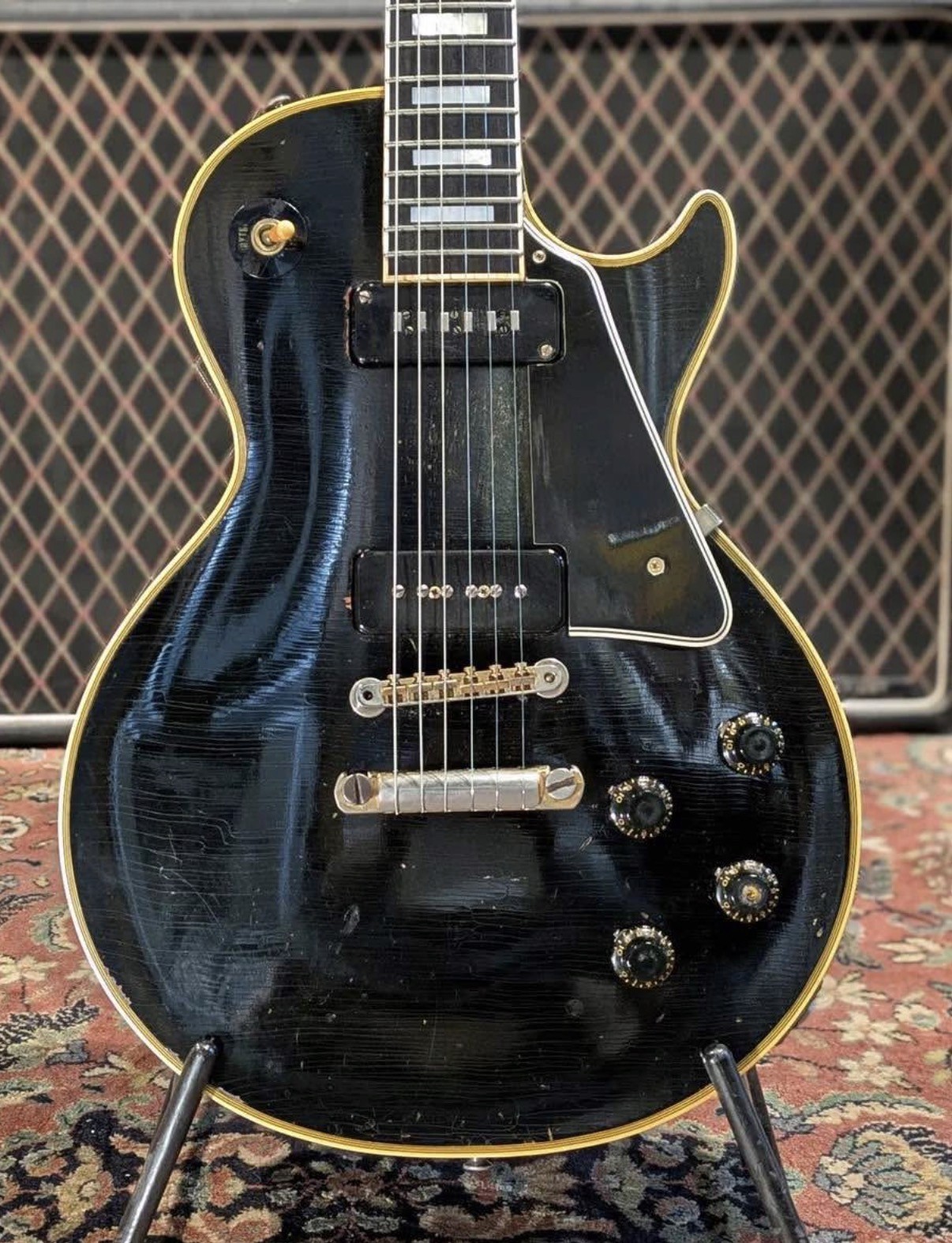
The 1955 Les Paul Custom is distinguished above all by its pickup configuration. The bridge position carries a P-90 Soap Bar single-coil — the same high-output single-coil used in the Standard Goldtop — while the neck position carries the Alnico V “Staple” pickup, a design unique to the Custom model. The staple pickup takes its name from its visible Alnico V rod magnets, which protrude slightly through the pickup cover like staples, and produces a tonal character that is distinctly different from the P-90 — smoother, warmer, with a controlled sustain that suited the jazz and fingerstyle playing the Custom was marketed toward. This two-pickup combination — P-90 bridge, Alnico staple neck — is one of the most tonally interesting and historically specific configurations in all of vintage Gibson production and is found only on the 1954–1956 Custom before the introduction of PAF humbuckers changed the instrument entirely.
The neck profile of the 1955 Custom is a specific collector draw that operates independently of the pickup story. Gibson’s advertising referred to it as the “Fretless Wonder” neck — a combination of very low fret wire and a smooth ebony fingerboard that created a playing feel unlike anything else available at the time. The low frets and smooth ebony surface produced minimal finger resistance between positions, allowing faster, more fluid movement across the neck than the higher frets and rosewood fingerboard of the Standard allowed. Players accustomed to modern medium or jumbo frets find the 1955 Custom neck a significant adjustment — but players who adapt to it frequently describe it as the most naturally flowing neck they have encountered. In our experience buying early Les Paul Custom instruments across Ohio and the Midwest, the neck profile and ebony fingerboard condition are the most frequently discussed features among serious buyers — and their condition is among the most important value drivers we evaluate in person.
What makes the 1955 Les Paul Custom distinctive:
Black ebony finish — the original “Black Beauty” — with gold-plated hardware throughout
Alnico V “Staple” pickup in the neck position — unique to 1954–1956 Custom production, not found on any other Gibson model
P-90 Soap Bar single-coil in the bridge position — creating a distinctive two-pickup tonal combination
Ebony fingerboard — not rosewood, not maple — with mother of pearl block inlays
“Fretless Wonder” low fret wire — the shallowest frets of any production Gibson, producing a smooth, fast playing feel
Multi-ply binding throughout — body, neck, and headstock
Split-diamond headstock inlay in mother of pearl
“Les Paul Custom” inlaid in pearl on the headstock
Gold-plated Kluson Deluxe tuners with tulip buttons
Five-ply body binding — white/black/white/black/white
Serial numbers in the 5xxxx range on the back of the headstock
ABR-1 tune-o-matic bridge and separate aluminum stop tailpiece — introduced in 1954 and standard on 1955 production
If you own a 1955 Gibson Les Paul Custom, you may be sitting on one of the most historically significant and tonally distinctive vintage guitars ever made. Edgewater Guitars provides free, no-obligation valuations — call (440) 219-3607 or visit edgewaterguitars.com.
What Is a 1955 Gibson Les Paul Custom Worth? (2026 Market Values)
Value by Condition and Finish
The 1955 Les Paul Custom market in 2026 operates with a clear hierarchy driven primarily by originality of the pickup configuration. The Alnico staple pickup in the neck position is the instrument’s defining feature — its presence or absence is the single most important authentication and value question for any 1954–1956 Custom. All-original examples with both the staple neck pickup and the P-90 bridge pickup intact command the top tier of the market by a meaningful margin. Examples where the staple pickup has been replaced — often with a PAF humbucker or a P-90 — sell at a significant discount but remain historically significant instruments.
Condition | Originality | Relative Value |
|---|---|---|
Excellent (8–9/10) | All original including staple pickup, original case | Premium-plus tier |
Very Good (7/10) | All original including staple pickup, no case | Premium tier |
Good (6/10) | Original staple pickup, some other replacements | Strong tier |
Good (6/10) | Replaced staple pickup, otherwise original | Mid-to-strong tier |
Player Grade | Multiple replacements, heavy wear | Mid tier |
Modified | PAF conversion, refin, added routes | Entry-to-mid tier |
What Affects the Value of a 1955 Les Paul Custom?
Alnico staple pickup originality: The staple pickup is the defining feature of the 1954–1956 Les Paul Custom and its most important value driver. Original staple pickups are rare, not reproduced convincingly until recently, and immediately identifiable by their construction. All-original staple pickup examples command a 35–50% premium over examples where the staple has been replaced.
P-90 bridge pickup originality: The bridge P-90 is less uniquely identifying than the staple — P-90s appear on the Standard as well — but its originality is still a significant value driver. Original P-90 with correct construction and pot code alignment: adds meaningful value. Replaced with humbucker: 20–30% reduction.
Ebony fingerboard condition: The ebony fingerboard of the 1955 Custom ages differently from rosewood — it is denser, darker, and less prone to grain opening, but it can develop surface checking and dryness that affects playability. An intact, properly conditioned ebony board with original block inlays in excellent condition commands full value; a board with damaged or replaced inlays or significant surface deterioration reduces value by 10–20%.
Fret condition: The original “Fretless Wonder” low fret wire is extremely shallow — shallow enough that worn frets on a 1955 Custom can have almost no playing height remaining. Original frets at playable height are a significant positive. Refretted with correct period-appropriate low wire: 5–10% reduction. Refretted with modern medium or jumbo wire: 15–25% reduction — the higher frets fundamentally alter the instrument’s character.
Gold hardware patina: Original gold-plated hardware on 1955 Customs ages with a characteristic warmth — the gold plating thins and wears at contact points revealing the nickel underneath. This patina is correct and desirable. Re-plated or replaced hardware reduces value.
Original case: The original black or brown alligator-pattern hardshell case adds approximately 10–15% to value.
Pot codes: Centralab (code 134) potentiometers dated to 1954 or 1955 are correct.
How 1955 Compares to Other Years
Year | Key Difference | Relative Value | Why |
|---|---|---|---|
1954 | First year; some with P-90 in both positions early in year; staple introduced mid-year | Similar to slightly higher | First-year premium; early examples with dual P-90s are a specific variant |
1955 (this post) | Full year with staple neck and P-90 bridge; most consistent production | Baseline | Peak production consistency; fully resolved staple pickup configuration |
1956 | Staple continues; production refinements | Similar | Essentially same configuration; 1955 and 1956 are closely comparable |
1957 | PAF humbuckers introduced mid-year — transforms the Custom entirely | Substantially higher for PAF examples | Humbucker Custom becomes the definitive version for most collectors |
1958–1960 | PAF humbuckers standard; “Black Beauty” with three pickups appears | Highest tier of Custom production | Three-pickup PAF Custom is among the most valuable Gibsons ever made |
Edgewater Guitars consistently pays 30–40% more than typical guitar shops. Get your free valuation: edgewaterguitars.com or (440) 219-3607.
Recent Sales and Auction Results
All-original 1955 Les Paul Customs with intact Alnico staple pickup in excellent condition are rare at major auction — perhaps one or two appear at Heritage Auctions or comparable venues in any given year. When they appear with documented provenance and full originality they achieve results firmly in the premium tier of vintage Gibson electrics. Examples with replaced staple pickups sell at a meaningful but not catastrophic discount. Contact Edgewater for current market context specific to your instrument’s condition and originality.
How to Identify an Authentic 1955 Gibson Les Paul Custom
Serial Numbers
Range for 1955: Approximately 5xxxx (five digits beginning with 5), ink-stamped on the back of the headstock
Location: Back of headstock, ink stamp
Format: Five digits — e.g., “51234” or “57890”
Important caveat: Gibson serial numbers in this era overlap between years. A number in the 5xxxx range is consistent with 1955 but requires cross-referencing with the Factory Order Number and pot codes. Some 1954 serials extend into the 5xxxx range and some 1956 serials begin there as well.
Factory Order Number (FON)
The FON provides essential dating support alongside the serial number for mid-1950s Gibson production.
Format for 1955: Batch letter followed by production number — the specific batch letter series helps narrow the production window within 1955
Location: Inside the body — visible through the pickup routing or with a mirror and light through the control cavity
Cross-reference: FON combined with serial number and pot codes provides the most reliable 1955 dating confirmation
Potentiometer Codes
Primary manufacturer: Centralab (code 134)
How to decode: Manufacturer code (3 digits) + year (1–2 digits) + week (2 digits)
Expected codes for 1955: Centralab pots dated to 1954 or 1955 are correct. Pots from 1956 or later indicate modification.
Location: Inside the control cavity — the Les Paul Custom has four potentiometers (two volume, two tone) all of which should be examined
Key Visual Identifiers
Finish: Ebony black nitrocellulose lacquer — aged examples show checking, wear at contact points, and a characteristic depth of black that refinishes cannot replicate convincingly. The back and sides are the same ebony black as the top — unlike later Custom variants.
Pickups:
Neck position: Alnico V Staple pickup — cream cover with visible Alnico V rod magnets protruding through the top surface like staples. This is the defining visual identifier of the 1954–1956 Custom.
Bridge position: Cream P-90 Soap Bar — rectangular with rounded ends, two mounting screws
Fingerboard: Ebony — jet black, dense, smooth, distinctly different from rosewood or maple in color and texture. Original ebony darkens uniformly with age and shows no grain pattern.
Inlays: Mother of pearl block inlays — rectangular, larger than the trapezoidal inlays of the Standard models
Headstock inlay: Split-diamond pattern in mother of pearl; “Les Paul Custom” inlaid in pearl below the split-diamond
Binding: Five-ply body binding (white/black/white/black/white); multi-ply neck binding; headstock binding
Hardware: Gold-plated throughout — ABR-1 bridge, stop tailpiece, pickup covers, tuner buttons, pickup rings, switch tip
Tuners: Gold-plated Kluson Deluxe with tulip-shaped buttons — distinct from the oval-button Klusons of the Standard models
Knobs: Black top hat knobs with gold inserts — specific to the Custom model
Frets: Very low “Fretless Wonder” wire — the shallowest frets of any production Gibson. Running a finger across the frets produces almost no sensation of fret height.
Neck profile: Substantial C-to-D shape — chunky but not as aggressively V-shaped as the early Goldtops
Factory Markings and Stamps
Inside body: Factory Order Number — accessible through pickup routing or with mirror through control cavity
Back of headstock: Ink-stamped serial number
Pickup cavities: Some examples retain assembly pencil dates or notations
Neck heel: May show pencil assembly notes
Alnico Staple Pickup Authentication
The Alnico V staple pickup is the most critical authentication point on the 1955 Les Paul Custom and deserves detailed examination:
Visible rod magnets: The defining visual characteristic — six Alnico V rod magnets protrude slightly through the cream pickup cover, visible as small circular or oval protrusions arranged in a row. These are the “staples” that give the pickup its name.
Cream cover material: The original cover is a cream plastic with a specific aging character — it yellows toward off-white with age, matching the aging character of original cream P-90 covers on the same instrument.
DC Resistance: Approximately 7.5–8.5k ohms — similar to P-90 output. Significantly different resistance readings suggest a replacement or a rewound pickup.
Construction details: The underside of the pickup shows a specific bobbin construction distinct from P-90s and PAF humbuckers. The mounting system uses different hardware than either.
Replacement indicators: PAF humbuckers or P-90s installed in the neck position are the most common replacements. A PAF in the neck position requires different routing — the staple pickup cavity is narrower than the humbucker cavity — and evidence of enlarged routing indicates conversion.
Red Flags: How to Spot Fakes and Refinishes
Wrong neck pickup: A humbucker or standard P-90 in the neck position of a claimed 1955 Custom indicates either a replaced pickup or misrepresentation. Enlarged routing in the neck cavity confirms humbucker conversion.
Non-ebony fingerboard: The 1955 Custom has an ebony fingerboard — jet black, dense, with no visible grain. A rosewood board indicates either a replaced fingerboard or a misrepresented instrument.
Non-block inlays: Block inlays in mother of pearl are correct for the 1955 Custom. Trapezoidal inlays, dot inlays, or crown inlays indicate either a wrong model or a replaced fingerboard.
Non-gold hardware: All hardware on the 1955 Custom was gold-plated. Chrome hardware indicates either replacements or a different model entirely.
Top hat knobs without gold inserts: The black top hat knobs with gold inserts are correct for the 1955 Custom. Wrong knob style indicates replacements.
Refinished black: The original ebony nitrocellulose finish ages with a specific checking and wear character. A too-uniform or too-clean black finish on a 70-year-old guitar warrants UV examination. Refinished black guitars are common — the black finish shows wear more visibly than sunburst or gold finishes, creating strong motivation to refinish.
Wrong serial number format: A 1955 Custom serial should be five digits in the 5xxxx range, ink-stamped on the back of the headstock.
Plastic-insulated wiring: Original 1955 wiring used cloth-covered wire throughout the control cavity.
Pot date mismatch: Pots dated 1956 or later in a claimed 1955 guitar indicate modification or misrepresentation.
In our experience evaluating early Les Paul Custom instruments from the Ohio and Midwest region, the most common modification we encounter is the replacement of the Alnico staple neck pickup with a PAF humbucker — a modification that was performed frequently in the late 1950s and early 1960s when players considered the newer humbucker technology an upgrade. The routing evidence of this conversion is visible under the pickup when the pickup is removed — the original staple cavity is narrower and shallower than the humbucker rout, and the conversion requires enlarging the cavity. We can identify this modification immediately during in-person evaluation.
Not sure if your Les Paul Custom has the original staple pickup? Edgewater offers free authentication. Call (440) 219-3607 or visit edgewaterguitars.com.
1955 Gibson Les Paul Custom Specifications
Specification | Detail |
|---|---|
Body Wood | Mahogany back, carved maple top |
Neck Wood | Mahogany, glued set neck |
Fingerboard | Ebony, approximately 12” radius |
Inlays | Mother of pearl block inlays |
Headstock Inlay | Split-diamond MOP; “Les Paul Custom” pearl inlay |
Neck Profile | Substantial C-to-D shape — chunky, palm-filling |
Nut Width | 1-11/16” (approximately 1.687”) |
Scale Length | 24.75” |
Frets | 22, very low “Fretless Wonder” wire |
Neck Pickup | Alnico V Staple — visible rod magnets through cream cover |
Bridge Pickup | P-90 Soap Bar — cream cover, Alnico V magnets |
Bridge | ABR-1 tune-o-matic, gold-plated |
Tailpiece | Aluminum stop tailpiece, gold-plated |
Tuners | Gold-plated Kluson Deluxe, tulip buttons |
Controls | Two volume, two tone, three-way toggle switch |
Knobs | Black top hat with gold inserts |
Body Binding | Five-ply: white/black/white/black/white |
Neck Binding | Multi-ply |
Pickguard | Gold-painted plastic, single-ply |
Finish | Ebony black nitrocellulose lacquer throughout |
Hardware | Gold-plated throughout |
Weight Range | Typically 8.5–10.5 lbs |
Case | Black or brown alligator-pattern hardshell case |
Original Retail Price | Approximately $325.00 (1955 catalog) |
What Does a 1955 Gibson Les Paul Custom Sound Like?
Pickup Specifications and Tonal Profile
Neck position — Alnico V Staple:
Pickup type: Single-coil with visible Alnico V rod magnets
DC Resistance: Approximately 7.5–8.5k ohms
Magnet type: Alnico V rods protruding through cover
Tonal character: Smooth, warm, controlled — more refined than the P-90, less compressed than a PAF humbucker. The staple pickup produces a clear, bell-like fundamental in the neck position with a warmth that suits chord melody jazz playing and single-note lines equally. It is quieter in terms of 60-cycle hum than a standard P-90 due to its different coil geometry. The upper frequencies are present but not assertive — the staple neck pickup is one of the most musical and balanced vintage pickup designs produced.
Bridge position — P-90 Soap Bar:
Pickup type: Single-coil
DC Resistance: Approximately 7.5–8.5k ohms
Magnet type: Alnico V
Tonal character: The P-90 bridge retains the aggressive upper-midrange bite and high-output character that defines the Goldtop Standard — percussive attack, defined note separation, raw energy. The contrast between the smooth staple neck and the aggressive P-90 bridge creates a tonal range that is uniquely wide for a two-pickup instrument — arguably the most contrasting pickup combination on any vintage Gibson.
The combination of staple neck and P-90 bridge produces a tonal versatility that neither the all-P-90 Goldtop nor the all-humbucker later Custom can match. The neck position is smooth enough for sophisticated jazz chord playing; the bridge position is raw enough for blues and early rock and roll. The middle position — both pickups together — produces a balanced, slightly hollow tone that is entirely its own character.
How Construction Details Affect Tone
The ebony fingerboard contributes a specific tonal character to the 1955 Custom that distinguishes it from the rosewood-board Standard models. Ebony is the densest of the common fingerboard woods — denser than rosewood, dramatically denser than maple — and its density produces the fastest, most immediate note decay of any fingerboard material. Notes speak with precision and definition but do not sustain with the ringing warmth of rosewood. This characteristic suits the jazz application the Custom was designed for — clean, precise, articulate — and is one reason Les Paul himself preferred the Custom configuration for his own sophisticated playing style.
The “Fretless Wonder” low fret wire interacts with the ebony fingerboard to produce the playing feel that defines the 1955 Custom. The combination of nearly invisible fret height and the smooth ebony surface creates a playing experience in which the fingers contact the board almost continuously between notes — a feel that Les Paul described as allowing him to slide between positions with minimal resistance. This is not universally preferred — players accustomed to taller frets can find the low wire frustrating — but it is a specific and historically meaningful design choice.
The mahogany back and carved maple top — shared with the Standard Goldtop — contribute the fundamental Les Paul tonal identity: mahogany warmth and sustain combined with maple brightness and definition. The ebony board and staple pickup modify this foundation toward a more refined, controlled sound rather than the rawer character of the P-90 equipped Standard.
Notable Recordings
Les Paul himself used Custom model instruments extensively in his recording work — the smooth neck pickup character is directly audible in his sophisticated chord-melody recordings. While specific 1955 Custom examples are difficult to document to individual recordings, the tonal characteristics these instruments produce — the bell-like staple neck, the aggressive P-90 bridge — define the sound of the most sophisticated electric guitar playing of the mid-1950s. Gary Moore later used a 1954 Les Paul Custom extensively and the staple/P-90 tonal character is audible in his early recordings, demonstrating the instrument’s capacity for both refined and aggressive playing styles.
Common Issues and Modifications That Affect Value
Staple pickup replacement: The most historically common and value-impacting modification on 1955 Les Paul Customs. The Alnico staple neck pickup was frequently replaced with a PAF humbucker in the late 1950s and 1960s — an era upgrade that required enlarging the neck pickup cavity. Value impact: 30–45% reduction. If the original staple pickup was retained and is included in the sale, impact reduces to approximately 15%.
P-90 bridge replacement with humbucker: Similar to the staple replacement — many owners converted to full humbucking configuration when PAFs became available. Value impact: 20–30% reduction.
Refret with wrong wire: The “Fretless Wonder” low fret wire is central to the 1955 Custom’s character and playing feel. Refret with modern medium or jumbo wire fundamentally alters the instrument. Value impact: 15–25% reduction. Refret with correct period low wire: 5–10% reduction.
Ebony fingerboard damage: Checking, cracking, or separated inlays on the ebony fingerboard. Value impact varies by severity — cosmetic checking with stable inlays: 5–10% reduction. Damaged or replaced inlays: 15–25% reduction.
Refinished black finish: Black finishes show wear more visibly than other colors, creating strong motivation to refinish. A correct black refinish: 40–55% reduction. UV examination is essential for black guitars where refinishing can be difficult to detect visually.
Re-plated or replaced gold hardware: Original gold plating thins and wears authentically — re-plated or replaced hardware loses the patina authenticity that is a value marker. Value impact: 10–20% depending on extent.
Replaced tuners: Original gold Kluson Deluxe with tulip buttons replaced with Grovers or non-original style. Value impact: 10–15%.
Headstock crack or repair: The Les Paul headstock angle makes this a vulnerable point. Professionally repaired breaks reduce value by 25–40%.
Replaced fingerboard: Removal of the original ebony board and block inlays is among the most value-destructive modifications possible on this instrument. Value impact: 40–55%.
Replaced knobs: Black top hat with gold inserts replaced with wrong style. Value impact: 5–10%; easily reversible.
In Edgewater’s experience with 1955 Les Paul Customs, instruments that have been converted to full humbucker configuration — both pickups replaced — are the most commonly encountered and the most commonly undervalued. Sellers who own a converted 1955 Custom often know the conversion history and assume it makes the guitar worth significantly less than a humbucker-equipped 1957 or later Custom. In fact, the 1955 body, neck, hardware, and overall instrument — even with replaced pickups — retains substantial historical significance and value that sellers frequently underestimate.
Selling Your 1955 Gibson Les Paul Custom: Your Options Compared
Selling Option | Typical Offer | Timeline | Fees/Costs | Risk Level | Best For |
|---|---|---|---|---|---|
Edgewater Guitars | 30–40% above shop offers | Immediate cash | None | Low — expert authentication included | Owners wanting fair value without complexity |
Local Guitar Shop | Wholesale pricing (lowest) | Same day | None direct, but lowest price | Low | Convenience over value |
Reverb / eBay | Variable — potentially higher | Weeks to months | 5–15% platform fees + shipping | High — fraud, damage, disputes | Experienced sellers comfortable with risk |
Auction House | Variable | 3–6 months | 15–25% seller premium | Medium | All-original exceptional examples |
Private Sale | Variable | Unpredictable | None | High — authentication burden on you | Sellers with existing collector network |
The 1955 Les Paul Custom is an instrument where the staple pickup authentication question is the central valuation issue — and it is a question that requires hands-on examination to answer definitively. A local shop that does not specialize in early Les Paul Custom production may not recognize the staple pickup, may not know how to authenticate it, and may not have access to the collector market that drives the staple pickup premium. Edgewater’s knowledge of early Les Paul Custom production means we approach every 1955 Custom evaluation with the specific authentication framework this instrument demands.
We travel anywhere in Ohio, Michigan, Pennsylvania, Indiana, or West Virginia for instruments of this significance. Our process moves from first contact to cash in hand in 24–72 hours.
Ready to find out what your 1955 Gibson Les Paul Custom is worth? Get your free, no-obligation valuation: edgewaterguitars.com or call (440) 219-3607.
Frequently Asked Questions About the 1955 Gibson Les Paul Custom
Q: What is a 1955 Gibson Les Paul Custom worth in 2026? A: Value depends primarily on whether the original Alnico staple neck pickup is intact and overall originality. All-original examples with intact staple pickup in excellent condition represent the premium tier. Examples with replaced staple pickup sell at a meaningful discount. Contact Edgewater Guitars for a free valuation specific to your instrument’s configuration and condition.
Q: What is the Alnico staple pickup on a 1955 Les Paul Custom? A: The Alnico V staple pickup is a single-coil pickup unique to the 1954–1956 Les Paul Custom — not found on any other production Gibson model. It takes its name from the six Alnico V rod magnets that protrude slightly through the cream pickup cover, resembling staples. It produces a smooth, warm, controlled tone in the neck position that is distinctly different from both the P-90 and the PAF humbucker.
Q: How do I identify the Alnico staple pickup on a 1955 Les Paul Custom? A: Look at the neck pickup. Original Alnico staple pickups have a cream cover with six small circular or oval protrusions — the tips of the Alnico V rod magnets — visible through the top surface. These protrusions are the defining visual marker. A pickup with a flat, unbroken cream surface in the neck position is either a P-90 or humbucker replacement, not the original staple.
Q: What serial numbers cover 1955 Gibson Les Paul Customs? A: Approximately 5xxxx range — five digits beginning with 5 — ink-stamped on the back of the headstock. These ranges overlap with late 1954 and early 1956 production. Always cross-reference with the Factory Order Number and pot codes for confident dating.
Q: What is the Fretless Wonder neck on a 1955 Les Paul Custom? A: A reference to the extremely low fret wire used on Les Paul Custom production — the shallowest frets of any production Gibson. Combined with the smooth ebony fingerboard, the low frets produce a playing feel with almost no resistance between positions. Gibson marketed this as the “Fretless Wonder” in period advertising. Players accustomed to modern medium or jumbo frets find it a significant adjustment; those who adapt often describe it as the most naturally flowing neck ever produced.
Q: What is the difference between a 1955 Les Paul Custom and a 1955 Les Paul Goldtop? A: Several fundamental differences: the Custom has an ebony finish and ebony fingerboard versus the Goldtop’s gold finish and rosewood board; the Custom has the Alnico staple neck pickup while the Goldtop has a second P-90; the Custom has block inlays versus the Goldtop’s trapezoidal inlays; the Custom has gold-plated hardware and multi-ply binding throughout while the Goldtop has nickel hardware and simpler appointments; the Custom has the “Fretless Wonder” low fret wire while the Goldtop has standard medium wire.
Q: How do I find the Factory Order Number on a 1955 Les Paul Custom? A: The FON is stamped or written inside the body and is typically visible through the pickup routing cavity or with a mirror and flashlight through the control cavity. It takes the form of a batch letter followed by a production number and is the most reliable primary dating reference alongside the serial number.
Q: Does Edgewater Guitars buy 1955 Gibson Les Paul Customs? A: Yes. The 1955 Les Paul Custom is among the most historically significant and valuable instruments we purchase. We buy all conditions — all-original staple examples, converted instruments, player-grade guitars, and modified examples. We pay 30–40% more than local guitar shops and provide immediate cash payment. Call (440) 219-3607 or visit edgewaterguitars.com.
Q: Is a 1955 Les Paul Custom with replaced humbuckers still valuable? A: Yes — significantly so. The body, neck, ebony fingerboard, gold hardware, multi-ply binding, and overall instrument retain their historical significance regardless of pickup modification. A 1955 Custom with converted pickups but original everything else is still a rare and important vintage Gibson. The value discount for the pickup conversion is real but proportional — contact Edgewater for a specific assessment.
Q: How does the ebony fingerboard affect the tone of a 1955 Les Paul Custom? A: Ebony is the densest common fingerboard wood — denser than rosewood, dramatically denser than maple. Its density produces the fastest, most precise note decay of any fingerboard material. Notes speak with definition and clarity but do not sustain with rosewood’s warmth. This suits the jazz and sophisticated chord-melody application the Custom was designed for, producing clean, articulate, precise tone that rewards technical playing.
Q: How long does it take to sell a vintage guitar to Edgewater? A: Typically 24–72 hours from initial contact to cash in hand. We provide a preliminary valuation promptly, arrange in-person evaluation for high-value instruments, and make an immediate cash offer with no obligation.
Related Resources
Gibson Serial Number Lookup Tool — edgewaterguitars.com/guitar-serial-number-lookup/gibson
How to Date Your Gibson Les Paul: Complete Vintage Authentication Guide — edgewaterguitars.com
The Gibson Les Paul Custom: Complete Guide to the Black Beauty Era (1954–1960) — edgewaterguitars.com
Original Gibson PAF Pickups: The Holy Grail of Electric Guitar Electronics — edgewaterguitars.com
1957 Gibson Les Paul Custom: The Sophisticated Fretless Wonder — edgewaterguitars.com
1958 Gibson Les Paul Custom: The Black Beauty at Its Golden Era Peak — edgewaterguitars.com
Sell Your Gibson Guitar: Complete 2026 Guide — edgewaterguitars.com
Sell Your Guitar to Edgewater — edgewaterguitars.com
Related posts: 1954 Gibson Les Paul Standard | 1957 Gibson Les Paul Custom | 1952 Gibson Les Paul Goldtop | 1953 Gibson Les Paul Goldtop
Sell your 1955 Gibson Les Paul Custom
Edgewater Guitars buys vintage Gibson Les Pauls and other vintage Gibsons nationwide. We give free, honest appraisals and fair same-day cash offers, with local pickup or insured nationwide shipping. Call or text (440) 219-3607 or request a free estimate.
How much is a 1955 Gibson Les Paul Custom worth?
As a real reference point, Edgewater recently paid $34,000 for a clean, all-original 1955 Les Paul Custom. Condition, originality, and finish move that figure up or down, so the most accurate number for your specific guitar is a free appraisal. Send a few photos and the serial number and we will give you an honest assessment.
Where can I sell a 1955 Gibson Les Paul Custom?
Edgewater Guitars buys them directly, nationwide, with same-day cash offers and no obligation. You can also date yours with our Gibson serial number lookup.
See also: Vintage Gibson Les Paul Custom Value Guide (1954-1960)