DATE :
Vintage Gibson Les Paul Custom Value Guide (1954-1960)
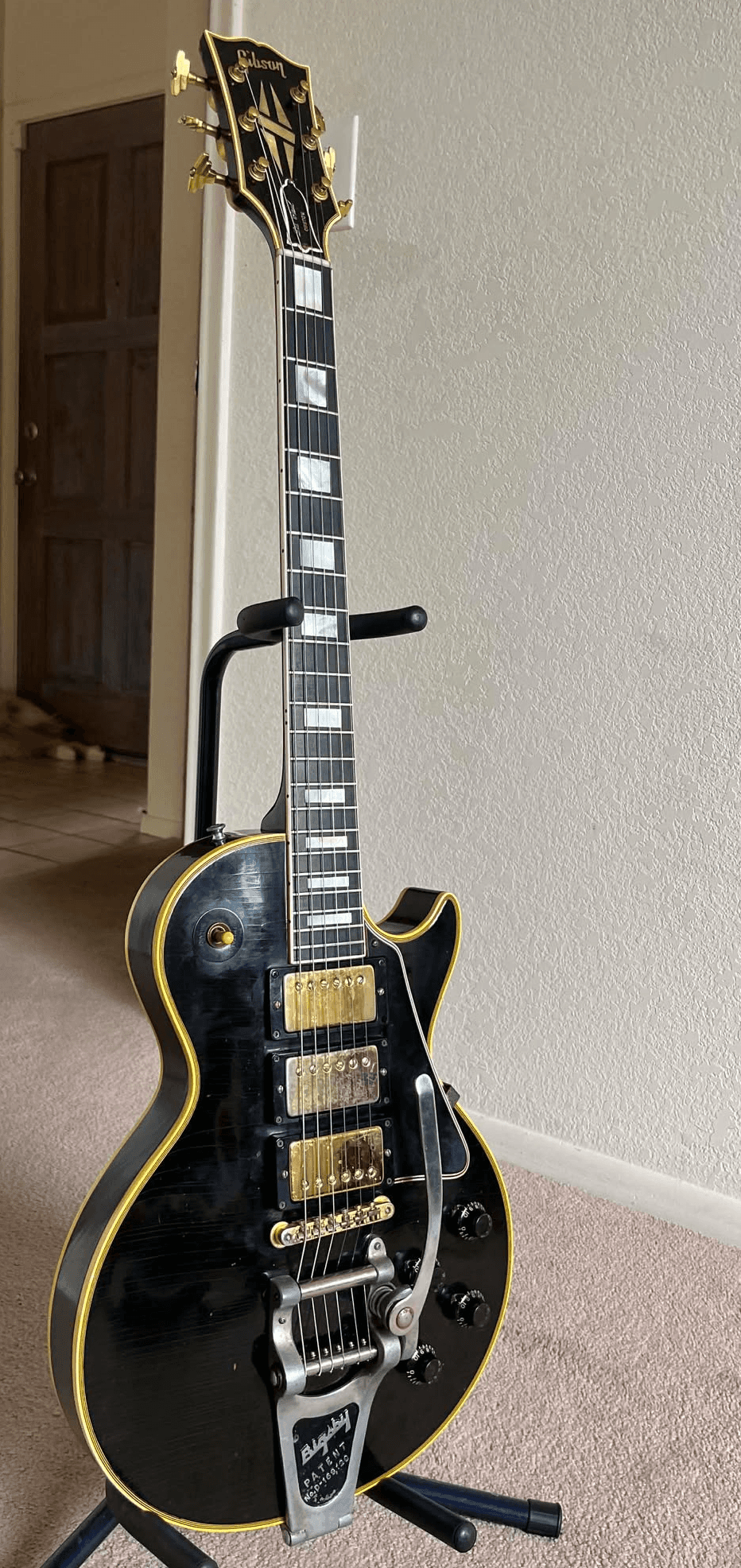
Vintage Gibson Les Paul Custom Value Guide (1954-1960)
A vintage Gibson Les Paul Custom from 1954 to 1960, the original “Black Beauty,” is one of the most valuable vintage Gibson electrics after the Sunburst Standard. Early 1954 to 1956 examples carry an Alnico staple and P-90 pickups; from 1957 the Custom gained PAF humbuckers, often three of them. Edgewater recently paid $34,000 for a clean 1955 Custom, $50,000 for a 1957, and $62,100 for a 1960. Pickups, originality, and finish set where any single guitar lands.
Last Updated: June 2026
What Is a Vintage Gibson Les Paul Custom Worth? (Year by Year, 2026)
The values below are reference points for clean, all-original examples. They reflect what a fair buyer like Edgewater pays, not best-case auction results. Three-pickup PAF Customs sit at the very top, so the most accurate number for your guitar is a free appraisal.
Year | What defines it | Reference value for a clean example |
|---|---|---|
1954 | First year, Alnico staple and P-90 pickups, fretless wonder neck | High collector value |
1955 | Alnico staple and P-90 pickups, fretless wonder neck | Around $34,000 |
1956 | Last year of P-90 pickups before the PAF switch | High collector value |
1957 | First PAF year, often three humbuckers | Around $50,000 |
1958 | Three PAF humbuckers, golden-era peak | Top collector tier |
1959 | Three PAF humbuckers, the Black Beauty’s golden year | Top collector tier |
1960 | Final fretless-wonder year, three PAF humbuckers | Around $62,100 |
Current market note (2026): original three-PAF Customs from 1957 to 1960 are blue-chip collector instruments, while refinished, repaired, or modified examples trade well below original ones. As a buyer, Edgewater prices to the honest, all-in condition of the actual guitar, not the best-case auction headline.
Les Paul Custom Year Pages and Guides
Drill into a specific year, the later Custom reissues, or our Gibson Les Paul dating guide:
1955 Gibson Les Paul Custom: Alnico staple and the fretless wonder
1957 Gibson Les Paul Custom: the sophisticated fretless wonder
1970 to 1972 Gibson Les Paul Custom: the Black Beauty returns
Edgewater Guitars buys vintage Gibson Les Paul Customs nationwide, from 1954 to 1960 Black Beauties to the later reissue-era Customs. We give free, no-pressure estimates and pay fairly for clean, original, and even refinished guitars. To sell yours, request a free estimate.
Introduction: The Fretless Wonder
The Gibson Les Paul Custom represents one of the most sophisticated and elegant guitars ever produced by the Kalamazoo factory. Introduced in 1954 as the premium offering in the Les Paul line, the Custom was designed to be Gibson’s flagship solid-body electric guitar—a refined, upscale instrument that would appeal to jazz players and sophisticated guitarists who wanted something beyond the working-man’s Goldtop.
With its striking ebony finish, multi-ply binding, and distinctive features, the Les Paul Custom earned the nickname “Black Beauty” and “The Fretless Wonder” (referring to its ultra-low fret wire). From 1954 through 1960, before the model was discontinued alongside the entire Les Paul line, Gibson produced some of the most collectible and historically significant electric guitars in history.
This comprehensive guide explores the year-by-year evolution of the Les Paul Custom from 1954-1960, detailing the specifications, changes, and characteristics that make each year unique and collectible.
Why This Era Matters:
1954-1960 represents the entire original Les Paul Custom production run
Original “Black Beauty” in ebony finish throughout the era
Evolution from P-90s to PAF humbuckers (1957)
Transition to sunburst finish (1958-1960, though ebony remained primary)
Premium craftsmanship with multi-ply binding and ebony fingerboard
Low fret wire that defined the “Fretless Wonder” nickname
All guitars built in Kalamazoo with hand-selected materials
Discontinued in 1960-1961, making surviving examples rare
Reintroduced 1968 with significantly different specifications
What Makes a Les Paul Custom Different?
Before examining year-by-year details, let’s establish what distinguished the Custom from other Les Paul models:
Les Paul Custom vs. Les Paul Standard/Goldtop
Les Paul Custom Distinctive Features:
Finish and Aesthetics:
Ebony (black) finish as standard (vs. gold or sunburst)
Multi-ply binding: white/black/white/black/white on body top
Multi-ply binding on neck: white/black/white
Ebony fingerboard (vs. rosewood on Standard/Goldtop)
Block inlays in mother of pearl (vs. trapezoid on Standard)
Split-diamond headstock inlay with “Les Paul Custom” in pearl script
All gold-plated hardware (vs. nickel on most models)
Construction Differences:
Fretless Wonder frets: Extremely low, flat fret wire
Five-piece neck in some examples (vs. one-piece mahogany)
Premium wood selection throughout
Frets dressed flush with binding edge for smooth feel
Electronics (Varied by Year):
1954-1956: P-90 bridge pickup + Alnico V “staple” neck pickup
1957-1961: PAF humbucker pickups (two or three pickups)
Three-pickup versions available throughout (rarer, more valuable)
Hardware:
Gold-plated Kluson tuners
Gold-plated ABR-1 bridge (when introduced)
Gold-plated tailpiece
Gold-plated pickup covers and mounting rings
Gold-plated switch tip and knobs
Philosophy: The Custom was designed as Gibson’s answer to Gretsch’s fancy hollow-body guitars—an instrument for the upscale player who wanted sophistication, elegance, and premium appointments. It was marketed to jazz players and professionals who valued aesthetics and refinement alongside tone and playability.
1954: The Black Beauty Debuts
1954 Les Paul Custom - First Year Production
Serial Numbers: 4xxxx to 5xxxx range (5-digit format)
Production: Introduced early-to-mid 1954
Estimated Production: Approximately 100-200 units (very rare first year)
Distinctive 1954 Features:
Body and Construction:
Ebony (black) finish - nitrocellulose lacquer over mahogany
Multi-ply binding: 5-ply on body top (white/black/white/black/white)
Multi-ply binding on neck: 3-ply (white/black/white)
Mahogany body with carved maple top
Mahogany neck with ebony fingerboard
Set neck construction with long tenon
Weight: Typically 9-10 lbs (heavier than Goldtops due to finish density)
Fingerboard and Inlays:
Ebony fingerboard (premium Madagascar ebony)
Mother of pearl block inlays at frets 3, 5, 7, 9, 12, 15, 17, 19
Double blocks at 12th fret
“Fretless Wonder” fret wire: Extremely low, flat profile
Frets dressed flush with binding edge
22 frets total
Bound fingerboard edges
Headstock:
Split-diamond inlay in mother of pearl
“Les Paul Custom” script inlaid in pearl below Gibson logo
Multi-ply binding on headstock (white/black/white)
Gold “Gibson” logo
Five-ply binding on back of headstock on some examples
Pickups (1954 Configuration):
Bridge pickup: Black P-90 single-coil
Neck pickup: Alnico V “staple” pickup (unique to Custom)
Staple pickup features individual polepieces in a row
Different tonal character from standard P-90
Covered in gold-plated housing
Sometimes called “Charlie Christian” style (though different construction)
Electronics:
Two volume controls (one per pickup)
Two tone controls (one per pickup)
Three-way toggle switch
.022 μF capacitors (orange “Bumble Bee” style)
500k potentiometers
Wiring routed through mahogany body
Hardware:
Gold-plated Kluson Deluxe tuners with single-ring, plastic buttons
Wraparound bridge/tailpiece combination (early 1954)
Tune-o-matic bridge introduced late 1954
Stop tailpiece (when TOM bridge used)
Gold-plated hardware throughout
Speed knobs with gold inserts
Black plastic switch tip
Neck Specifications:
Nut width: 1-11/16”
Neck profile: Chunky, full ‘50s profile (varies by individual guitar)
Scale length: 24.75” (Gibson standard)
Headstock angle: 17 degrees
Truss rod: Single-action, non-adjustable from headstock end
1954 Variations:
Early 1954: Wraparound bridge/tailpiece
Late 1954: Tune-o-matic bridge with separate stop tailpiece
Some examples with five-piece neck construction
Individual variation in neck carving and weight
Why 1954 Customs Are Extremely Collectible:
First year production (extreme rarity)
Unique P-90/Alnico staple pickup combination
Early wraparound bridge examples especially rare
Purest expression of original Custom concept
Exceptional craftsmanship and wood selection
All original examples extremely rare
Many have been modified over the years (pickup changes common)
Common Issues with 1954 Customs:
Pickup changes (many had P-90s replaced with humbuckers)
Finish checking and crazing (normal and expected)
Fret wear (low frets wear quickly, many refretted)
Binding yellowing and shrinkage
Gold plating wear on hardware
Neck finish wear from playing
Rare survivors in all-original condition
1955: Refinement and Consistency
1955 Les Paul Custom
Serial Numbers: 5xxxx to 6xxxx range
Production: Full production year
Estimated Production: Approximately 300-500 units
1955 Les Paul Custom Features:
Body and Finish:
Ebony (black) finish continues as standard
Multi-ply binding throughout (5-ply body, 3-ply neck)
Mahogany body with carved maple top
Carved top with subtle arch
Black finish often shows beautiful grain underneath in light
Nitrocellulose lacquer application
Pickups (1955 Configuration):
Bridge: Black P-90 single-coil (continues from 1954)
Neck: Alnico V staple pickup (continues from 1954)
Same electronic configuration as 1954
Gold pickup covers
Black mounting rings (early) or cream rings (later)
Hardware Updates:
Tune-o-matic bridge now standard (ABR-1)
ABR-1 without retaining wire (early feature)
Stop tailpiece separate from bridge
Gold-plated hardware throughout
Kluson tuners with single-ring design
Amber-tinted tuner buttons appearing on some examples
Neck and Fingerboard:
Ebony fingerboard with block inlays
Fretless Wonder frets continue
Chunky neck profile (full ‘50s style)
Bound fingerboard and headstock
Split-diamond headstock inlay
“Les Paul Custom” script in pearl
1955 Specifications:
Nut width: 1-11/16”
Scale length: 24.75”
Weight: Typically 9-10.5 lbs
Body thickness: Approximately 1.75” (slightly thicker than modern reissues)
1955 Three-Pickup Custom:
Extremely rare three-pickup version available
Middle pickup: Additional P-90
Special switching configuration
Four knobs, three-way switch
Very few made, extremely collectible
Most valuable configuration of 1955 Custom
Why 1955 Customs Matter:
Tune-o-matic bridge now standard (improved playability)
Production increasing but still relatively rare
Last year before major pickup changes
Three-pickup versions especially desirable
Still in early production with premium materials
1955 Collectibility Notes:
Two-pickup versions most common
Three-pickup versions extremely rare and valuable
All-original examples with staple pickups rare
Many modified with humbucker pickups over the years
Original finish examples command premium
1956: The Last Year of P-90s
1956 Les Paul Custom
Serial Numbers: 6xxxx to 7xxxx range
Production: Full production year
Estimated Production: Approximately 400-600 units
1956 Les Paul Custom Features:
Construction:
Ebony finish standard
Multi-ply binding throughout
Mahogany/maple construction continues
Premium wood selection maintained
Deep black finish with excellent grain show-through
Pickups (1956 - Transitional Year):
Early 1956: P-90 bridge, Alnico staple neck (continuation)
Mid-1956: Transition begins toward humbuckers
Late 1956: Some examples may have early PAF prototypes
Most 1956 examples still have P-90/staple configuration
Three-pickup versions continue (rare)
Hardware:
ABR-1 bridge standard
Some bridges now with retaining wire (transitional)
Stop tailpiece standard
Gold-plated Kluson tuners
Amber tuner buttons more common
Gold hardware throughout
Neck Specifications:
Ebony fingerboard with block inlays
Fretless Wonder frets
Full ‘50s neck profile (chunky)
Bound neck and headstock
Split-diamond inlay
Nut width: 1-11/16”
1956 Variations:
Early vs. late 1956 features vary
Some transition examples with mixed features
Three-pickup models extremely rare
Individual neck carving variations
Why 1956 Is Important:
Last full year of P-90/staple pickup configuration
Transitional year leading to PAF introduction
Last year before major pickup revolution
Three-pickup versions highly collectible
Bridge specifications transitioning (retaining wire appearing)
1956 Collectibility:
Original P-90/staple examples increasingly rare
Many subsequently modified with humbuckers
Pre-humbucker Customs have devoted following
Three-pickup versions command significant premium
Transition features make authentication complex
1957: The PAF Revolution
1957 Les Paul Custom
Serial Numbers: 7xxxx range
Production: Full production year
Estimated Production: Approximately 500-700 units
1957 Les Paul Custom - Revolutionary Changes:
The Humbucker Arrives:
PAF (Patent Applied For) humbuckers introduced mid-1957
Revolutionary pickup design by Seth Lover
Two coils wired in series, out of phase
Eliminates hum while maintaining full tone
Game-changing technology for electric guitar
1957 Pickup Timeline:
Early 1957: P-90 bridge, Alnico staple neck (continuation)
Mid-1957: PAF humbuckers introduced (approximately May-July)
Late 1957: PAF humbuckers standard
Transition period creates complexity for collectors
1957 Two-Pickup Custom (Standard Configuration):
Two PAF humbuckers (late 1957)
Bridge and neck positions
Gold-plated pickup covers
Patent Applied For stickers (on some pickups)
Some early PAFs without stickers
DC resistance typically 7.5k-8.5k ohms
1957 Three-Pickup Custom:
Three PAF humbuckers (extremely rare)
Bridge, middle, and neck positions
Special switching configuration
Four knobs, three-way switch (later models)
Most desirable configuration
Very few produced
Among the most collectible Les Pauls ever made
Body and Construction:
Ebony finish standard
Multi-ply binding throughout
Mahogany body with carved maple top
Slightly thicker body than earlier years (approximately 1/8” thicker)
Premium wood selection
Weight: Typically 9-11 lbs
Fingerboard:
Ebony fingerboard with block inlays
Fretless Wonder frets continue
Bound fingerboard
Mother of pearl blocks
Split-diamond headstock inlay
Hardware:
ABR-1 bridge with retaining wire now standard
Stop tailpiece (aluminum, lightweight)
Gold-plated Kluson tuners with double-ring
All gold hardware
Amber tuner buttons
Electronics:
Two volume controls
Two tone controls
Three-way toggle switch (two-pickup models)
Four-way or special switching (three-pickup models)
Orange “Bumble Bee” capacitors (.022 μF)
CTS potentiometers (500k)
Switchcraft toggle switch
Neck Specifications:
Nut width: 1-11/16”
Neck profile: Full ‘50s profile (chunky)
Scale length: 24.75”
Headstock angle: 17 degrees
Bound headstock with split-diamond inlay
Why 1957 Is Pivotal:
Introduction of PAF humbuckers (revolutionary)
Transition from P-90s creates collectible variations
Early PAF pickups among most valuable ever made
Three-pickup PAF Customs extremely rare
Peak Gibson craftsmanship
Last year before sunburst finish introduction
1957 Collectibility Factors:
Early 1957 with P-90s: Rare, final examples of original design
Mid-1957 transitional: Possible mixed pickup configurations
Late 1957 PAF: First humbuckers, highly collectible
Three-pickup PAF: Among most valuable Les Pauls
Sticker vs. non-sticker PAFs (both valuable, different characteristics)
Common 1957 Issues:
Pickup originality critical (many PAFs replaced over years)
Fret wear from low Fretless Wonder wire
Gold plating wear
Finish checking (expected, desirable)
Pot codes essential for dating and authentication
1958 Les Paul Custom
Serial Numbers: 8xxxx range
Production: Full production year
Estimated Production: Approximately 600-800 units
1958 Les Paul Custom
1958 Two-Pickup Custom:
Pickups:
Two PAF humbuckers standard
Patent Applied For stickers on many
No stickers on some (both configurations authentic)
Gold pickup covers
DC resistance varies (7.5k-8.5k typical)
Individual variations in PAF construction and tone
Body and Finish:
Ebony (black) finish: Standard, most common
Multi-ply binding (5-ply body top)
Mahogany body with carved maple top
Deep carving with good arch
Fingerboard:
Ebony fingerboard with block inlays
Fretless Wonder frets
Bound fingerboard edges
Mother of pearl blocks
Frets dressed flush with binding
Headstock:
Split-diamond inlay in pearl
“Les Paul Custom” script in pearl
Multi-ply binding (white/black/white)
Gold “Gibson” logo
17-degree headstock angle
Hardware:
ABR-1 bridge with retaining wire
Aluminum stop tailpiece (lightweight)
Gold-plated Kluson tuners (double-ring)
Amber tuner buttons
All gold-plated hardware
Speed knobs with gold inserts
1958 Three-Pickup Custom:
Three PAF humbuckers (extremely rare)
Available in both ebony and sunburst
Special switching configuration
Among most collectible Les Pauls
Very few produced
Commands significant premium
Electronics:
CTS potentiometers (check codes for dating)
Orange Bumble Bee capacitors
Switchcraft toggle switch
Vintage cloth-covered wiring
Hand-soldered connections
Neck Specifications:
Nut width: 1-11/16”
Neck profile: Full, chunky ‘50s profile
Some variation between individual guitars
Scale length: 24.75”
Long neck tenon (superior tone transfer)
Weight:
Ebony finish: Typically 9.5-11 lbs
Sunburst finish: Typically 9-10.5 lbs (slightly lighter due to thinner finish)
Why 1958 Customs Are Special:
PAF humbuckers fully established
Peak Gibson quality and craftsmanship
Three-pickup versions extremely collectible
Last year before 1959 changes
1958 Collectibility:
Ebony two-pickup: Standard, highly collectible
Ebony three-pickup: Extremely rare and valuable
Original PAFs critical to value
Authentication Challenges:
Sunburst Customs sometimes confused with Standards
Custom has ebony fingerboard (vs. rosewood on Standard)
Custom has block inlays (vs. trapezoid on Standard)
Custom has split-diamond headstock (vs. crown on Standard)
Verify multi-ply binding (5-ply vs. single-ply)
Check pot codes and serial numbers carefully
1959: The Peak Year
1959 Les Paul Custom
Serial Numbers: 9xxxx range
Production: Full production year
Estimated Production: Approximately 600-900 units
1959 Les Paul Custom Features:
Finish Options:
Ebony (black) finish: Standard, most common
Cherry Sunburst finish: Rare option, highly collectible
Both finishes available throughout year
Sunburst shows figured maple (when present)
Ebony finish over premium mahogany
1959 Two-Pickup Custom (Standard):
Pickups:
Two PAF humbuckers
Prime year for PAF construction and tone
Patent Applied For stickers (many examples)
Non-sticker PAFs also authentic
Gold pickup covers
Individual variations in DC resistance and construction
“Holy Grail” PAF year for many collectors
Body Construction:
Mahogany body with carved maple top
Maple tops: Plain to highly figured (sunburst shows grain)
Multi-ply binding: 5-ply on body top
Deep dish carving
Premium wood selection
Weight: Typically 9-11 lbs
Fingerboard:
Ebony fingerboard
Block inlays in mother of pearl
Fretless Wonder frets
Bound fingerboard
22 frets
Frets dressed flush with binding edge
Headstock:
Split-diamond inlay
“Les Paul Custom” script in pearl
Multi-ply binding
17-degree angle
Gold Gibson logo
Hardware:
ABR-1 bridge with retaining wire
Aluminum stop tailpiece
Gold-plated Kluson tuners (double-ring)
Amber tuner buttons
Speed knobs
All gold hardware
Electronics:
CTS potentiometers (500k, check date codes)
Orange Bumble Bee capacitors (.022 μF)
Switchcraft toggle switch
Cloth-covered vintage wiring
Two volume, two tone configuration
Neck Profile:
Full, chunky profile early 1959
Slight taper beginning later in year (transitional)
Still substantial by modern standards
Nut width: 1-11/16”
Scale length: 24.75”
Individual variation between guitars
1959 Three-Pickup Custom:
Three PAF humbuckers (extremely rare)
Available in ebony or sunburst
Special switching configuration
Among most desirable Les Pauls ever made
Very limited production
Both finishes highly collectible
Why 1959 Is “The Year”:
Prime PAF year (considered best-sounding by many)
Peak Gibson craftsmanship and quality
Figured maple tops on sunburst examples
Last year before significant 1960 changes
Three-pickup PAF Customs extremely rare
Optimal combination of features and quality
1959 Collectibility Rankings:
Sunburst three-pickup: Extremely rare, highest tier
Ebony three-pickup: Extremely rare, highest tier
Sunburst two-pickup: Very rare, premium tier
Ebony two-pickup: Standard configuration, highly collectible
Authentication Points:
Serial number in 9xxxx range
Pot codes should show 1959 dates
PAF pickup construction details critical
Ebony fingerboard (not rosewood)
Block inlays (not trapezoid)
Multi-ply binding (5-ply body)
Split-diamond headstock inlay
Common 1959 Issues:
PAF originality critical (many replaced over decades)
Gold plating wear (expected, adds character)
Fretless Wonder fret wear (many refretted)
Finish checking on ebony (normal, desirable)
Sunburst fading (cherry red fades, creating honey burst)
Binding yellowing and shrinkage (normal aging)
1960: The Final Year
1960 Les Paul Custom
Serial Numbers: 0xxxx range (system restarted) or 9xxxx (overlap)
Production: Full production year (discontinued early 1961)
Estimated Production: Approximately 400-700 units
1960 Les Paul Custom - The Last of the Originals:
Finish Options:
Ebony (black) finish: Standard
Cherry Sunburst finish: Rare option
Both available but production declining
Last year before discontinuation
1960 Changes and Transitions:
Neck Profile Evolution:
“Slim taper” neck introduced (major change from chunky ‘50s)
Significantly thinner profile
More comfortable for many players but controversial among collectors
Some early 1960 examples retain fuller profile
Transition occurs throughout year
Late 1960 may have thicker necks again (inconsistent)
Pickups:
PAF humbuckers continue
Late PAF era (still excellent)
Patent Applied For stickers
Gold covers
Cream mounting rings
DC resistance and construction details vary
Body Construction:
Mahogany body with carved maple top
Slightly thinner body than 1959 (subtle change)
Multi-ply binding continues (5-ply)
Premium woods though selection beginning to vary more
Weight: Typically 8.5-10.5 lbs (some lighter examples)
Fingerboard:
Ebony fingerboard with block inlays
Fretless Wonder frets continue
Bound fingerboard
Mother of pearl blocks
22 frets
Headstock:
Split-diamond inlay
“Les Paul Custom” script
Multi-ply binding
17-degree angle
Hardware:
ABR-1 bridge with retaining wire
Aluminum stop tailpiece
Gold-plated Kluson tuners
Amber tuner buttons
All gold hardware
Electronics:
CTS potentiometers (check date codes)
Orange Bumble Bee capacitors
Switchcraft toggle switch
Standard two-pickup wiring
1960 Serial Numbers:
System restarted at 0xxxx
Some late 1959 features with 1960 serial numbers
Some 1960 features with 9xxxx serial numbers
Overlap and inconsistency during transition
“Ink stamp” serial numbers begin appearing inside control cavity
Serial number on headstock may not match cavity stamp
1960 Three-Pickup Custom:
Three PAF humbuckers (extremely rare)
Final year of three-pickup production
Both ebony and sunburst available
Among last three-pickup Customs produced
Highly collectible final examples
Why 1960 Is Significant:
Last year of original Les Paul Custom production
Slim taper neck introduced (loved by some, controversial to others)
Last PAF Customs until 1968 reintroduction
Final examples of original “Black Beauty” design
Production declining as SG introduction approached
Historical significance as end of an era
1960 Collectibility Considerations:
Slim taper neck: Some collectors prefer, others seek earlier chunky necks
Last year: Final examples have devoted following
Three-pickup: Extremely rare final year examples
Sunburst: Rare finish in final year
Transition features: Serial number inconsistencies add complexity
Authentication Challenges:
Serial number system overlap creates confusion
Neck profile varies throughout year
Body thickness subtle changes
Pot codes essential for verification
Check for ink stamp inside control cavity
Verify PAF pickups carefully (many replaced)
Common 1960 Issues:
Slim taper neck may have warping issues (less wood, less stable)
PAF originality critical
Serial number verification complex
Fretless Wonder fret wear
Gold plating wear
Finish checking normal
Many subsequently modified
End of Production:
Les Paul Custom discontinued late 1960/early 1961
SG body style introduced as replacement
Original Les Paul Custom design abandoned
1961-1967: No Les Paul Custom production
1968: Les Paul Custom reintroduced with different specs
Three-Pickup Les Paul Customs: The Holy Grail
Throughout the 1954-1960 production era, Gibson offered a three-pickup version of the Les Paul Custom. These instruments are among the most collectible and sought-after Les Pauls ever made.
Three-Pickup Custom Overview
Production Years: 1955-1960
Total Production: Estimated 200-400 units across all years
Rarity: Extremely rare compared to two-pickup models
Three-Pickup Configurations:
1955-1956 Three-Pickup:
Bridge: P-90 single-coil
Middle: P-90 single-coil
Neck: Alnico V staple pickup
Extremely rare configuration
Very few survive in original condition
1957-1960 Three-Pickup:
Bridge: PAF humbucker
Middle: PAF humbucker
Neck: PAF humbucker
Among most collectible Les Pauls ever made
Three matched PAFs extremely valuable
Switching and Controls:
Four knobs: Two volume, two tone (various wiring schemes)
Three-way toggle switch (standard position)
Special switching configurations on some examples
Various wiring schemes used throughout production
Some examples with individual on/off switches per pickup
Why Three-Pickup Customs Command Premium:
Extreme rarity (perhaps 5-10% of Custom production)
Three PAF pickups (1957-1960) extremely valuable
Unique tonal versatility
Distinctive appearance
Historical significance
Most examples special-ordered rather than standard production
Three-Pickup Collectibility by Year:
1955-1956 (P-90s): Extremely rare, pre-humbucker
1957 (PAFs): First year three PAF configuration
1958 (PAFs): Ebony or rare sunburst finish
1959 (PAFs): Peak year, ultimate collectibility
1960 (PAFs): Final year, last examples made
Authentication Concerns:
Some two-pickup Customs modified to three pickups
Check for:
Original routing (factory vs. added)
Finish consistency in middle pickup area
Wiring originality
Pickup mounting ring age and style
Wood coloration under pickguard
Historical documentation if available
Three-Pickup Values: Three-pickup Customs in any year command significant premiums over comparable two-pickup examples, with 1957-1960 PAF versions among the most valuable vintage Les Pauls in existence.
The “Fretless Wonder” Fret Wire
One of the most distinctive features of the Les Paul Custom throughout the 1954-1960 era was the ultra-low fret wire that earned the model its “Fretless Wonder” nickname.
Fretless Wonder Specifications
Fret Dimensions:
Height: Approximately .040” (extremely low)
Width: Approximately .080” (standard width)
Profile: Very flat, minimal crown
Material: Nickel-silver wire
Why Gibson Used Low Frets:
Designed for jazz players who wanted smooth, fast action
Reduced finger fatigue during extended playing
Allowed extremely low action
Smooth feel for position shifts
“Almost fretless” tactile response
Advantages of Fretless Wonder Frets:
Extremely smooth, fast playing surface
Minimal string buzz even with low action
Comfortable for chording and position shifts
Distinctive feel appreciated by jazz players
Original design intent for sophisticated playing
Disadvantages and Issues:
Wear out quickly with regular playing
Limited lifespan compared to modern frets
Difficult to bend strings (low height provides little “grab”)
Reduced sustain compared to taller frets
Many vintage Customs have been refretted
Impact on Collectibility:
Original Fretless Wonder frets rare on well-played examples
Refrets necessary for playability on many vintage Customs
Professional refret with period-correct wire: Minimal value impact
Modern tall frets: Reduces collector value, improves playability
Original worn frets: Documented originality but limited playability
Refret Considerations:
Many collectors prefer professional refret with vintage-spec wire
Playing a 70-year-old guitar with original worn frets impractical
Quality refret by expert luthier maintains most value
Documentation of refret work helpful
Some purist collectors insist on original frets regardless of condition
Finding Period-Correct Fret Wire
For restoration and refret work:
Vintage-style low fret wire available from specialty suppliers
Correct dimensions: .040” x .080” (approximate)
Nickel-silver material
Proper installation critical (frets dressed flush with binding)
Expert luthier familiar with vintage Customs essential
Authentication and Identification Guide
Given the high value and collectibility of 1954-1960 Les Paul Customs, authentication is critical. Here’s what to verify:
Serial Number Verification
1954-1959: 5-digit serial numbers
1954: 4xxxx-5xxxx range
1955: 5xxxx-6xxxx range
1956: 6xxxx-7xxxx range
1957: 7xxxx range
1958: 8xxxx range
1959: 9xxxx range
1960: System restarts
0xxxx range (new system)
Some 9xxxx overlap
Ink stamp inside control cavity begins
Serial Number Location:
Stamped on back of headstock
Ink stamp (not impressed) 1954-1960
Check for re-stamping or alteration
Factory Order Number (FON)
Stamped inside control cavity (visible when control plate removed)
More reliable than serial number for dating
Three or four digits
Cross-reference with serial number era
Pot Code Dating
Critical for authentication:
Format: XXYYZZ
XX = Manufacturer code (137 = CTS, 134 = Centralab)
YY = Year
ZZ = Week
Example: 137-59-23
137 = CTS manufacturer
59 = 1959
23 = 23rd week
Pot codes should match claimed year:
Allow for 2-3 month variance (pots stockpiled before use)
Pot codes newer than guitar = red flag
All pots should be from similar time period
Pickup Authentication
PAF Pickups (1957-1960):
Patent Applied For sticker (if present, often lost)
Double-black or zebra bobbins
Long or short magnet (both correct)
Rough-cast baseplate
DC resistance varies (7.5k-8.5k typical, but range exists)
Hand-wound characteristics (slight variations)
Correct vintage wire
P-90 Pickups (1954-1956):
Black plastic covers (not cream)
Correct mounting ears
Proper screw types
Period-correct construction
Alnico V Staple Pickup (1954-1956):
Gold cover
Individual pole pieces in row
Unique to Custom in this era
Correct mounting
Many replaced over years
Finish Authentication
Ebony (Black) Finish:
Nitrocellulose lacquer
Shows wood grain in certain light
Checking and crazing normal
Should show consistent aging
UV light can reveal refinishes
Check for overspray on binding
Sunburst Finish (1958-1960):
Cherry sunburst over maple
Aniline dye that fades over time
Original colors have specific characteristics
Check for “sunburst enhancement” (refinish)
Maple figure should be visible
Refinish Red Flags:
Overspray on binding edges
Modern paint types
Incorrect color formulations
Lack of proper checking patterns
Fresh finish on vintage guitar
Wrong grain emphasis
Hardware Authentication
Tuners:
Kluson Deluxe only (1954-1960)
Gold-plated
Single-ring (early) or double-ring (late ‘50s)
Plastic buttons (amber tinted on later examples)
“Kluson” stamp on back plates
Bridge:
Wraparound (early 1954 only)
ABR-1 Tune-o-matic (late 1954-1960)
Retaining wire: absent (early) or present (later)
Gold-plated
Nylon saddles (earliest) or metal saddles
Tailpiece:
Gold-plated stop bar
Lightweight aluminum (late ‘50s)
Correct stud spacing
Binding Verification
Body Binding:
Five-ply: white/black/white/black/white
Check ply count carefully
Yellowing normal
Shrinkage common
Should show age-appropriate wear
Neck Binding:
Three-ply: white/black/white
Bound fingerboard edges
Frets dressed flush with binding
Headstock Binding:
Multi-ply (white/black/white)
Clean execution
Age-appropriate condition
Fingerboard and Inlays
Fingerboard Material:
Ebony ONLY (not rosewood)
Dark brown to black color
Fine grain pattern
Distinctive ebony appearance
Inlays:
Mother of pearl blocks
Positioned at frets 3, 5, 7, 9, 12, 15, 17, 19
Double blocks at 12th fret
Clean installation
Age-appropriate condition
Headstock Inlay:
Split-diamond in mother of pearl
“Les Paul Custom” script in pearl
Gibson logo in gold
Clean, precise work
Common Fakes and Modifications
Watch for:
Standard converted to Custom (added binding, changed inlays)
Goldtop refinished in black
Incorrect fingerboard wood (rosewood stained black)
Reproduction parts passed as original
“Upgraded” pickups (PAFs added to earlier models)
Three-pickup routing added to two-pickup models
Incorrect binding (single-ply instead of multi-ply)
Authentication Best Practices:
Examine under UV light
Check pot codes match era
Verify wood species (ebony vs. rosewood critical)
Count binding plies carefully
Verify all hardware period-correct
Check for routing modifications
Consult with recognized experts for high-value instruments
Common Issues and Modifications
Structural Issues
Headstock Cracks:
Less common than on Standards (multi-ply binding adds strength)
Check behind nut and at tuner holes
Headstock breaks catastrophic to value
Look for evidence of repair
Neck Issues:
1960 slim taper necks more prone to warping
Truss rod function critical
Check for back-bow or twist
Fingerboard separation rare but possible
Body Cracks:
Top cracks along grain lines
Check around control cavity
Binding cracks from shrinkage
Most cracks repairable but affect value
Binding Problems:
Shrinkage common (especially on body)
Yellowing normal and expected
Cracks in binding
Separation from body/neck
Missing sections reduce value
Finish Issues
Checking and Crazing:
Normal on nitrocellulose finish
Expected on 65-70 year old guitars
Desirable evidence of originality
Heavy checking acceptable
Finish Wear:
Play wear on back of neck normal
Arm wear on body top
Buckle rash on back
“Honest wear” more desirable than pristine
Refinishing:
Complete refinishes reduce value dramatically
Even period-correct refinishes hurt collectibility
Partial refinishes (neck only) common
“Freshened” black finish reduces value
Hardware Modifications
Tuner Replacements:
Original Klusons frequently replaced with Grovers
Schaller replacements also common
Extra screw holes indicate replacement
Original tuners critical to value
Bridge Changes:
Modern Nashville bridges sometimes replace ABR-1
Aftermarket bridges reduce value
Original bridge preferred
Pickup Replacements:
Many P-90/staple Customs converted to humbuckers
PAF pickups frequently replaced or rewound
Modern pickups significantly reduce value
Reversible pickup changes less damaging than routing
Electronics Modifications
Wiring Changes:
Modern wiring common
Capacitor replacements
Potentiometer replacements
Output jack upgrades
Pickup Routing:
Three-pickup routing added to two-pickup models (check carefully)
Middle pickup additions reduce value dramatically
Look for finish touch-up around added routing
Fret Work
Refrets:
Most vintage Customs have been refretted
Fretless Wonder frets wear quickly
Professional refret with vintage wire: minimal impact
Modern tall frets: playability gain, collectibility loss
Document refret work when possible
Fingerboard Issues:
Wear under strings
Divots at common positions
May require fingerboard planing during refret
Ebony durable but not immune to wear
Relative Value and Collectibility Rankings
While specific values fluctuate with market conditions, the relative ranking among Les Paul Customs remains consistent:
Most Collectible Configurations (Highest to Lower):
1959 Sunburst Three-Pickup PAF - Extremely rare, ultimate collectibility
1958 Sunburst Three-Pickup PAF - Extremely rare, first year sunburst three-pickup
1959 Ebony Three-Pickup PAF - Extremely rare, peak PAF year
1960 Sunburst Three-Pickup PAF - Final year, very rare
1957 Three-Pickup PAF - First year three PAF configuration
1958 Ebony Three-Pickup PAF - Rare three-pickup configuration
1959 Sunburst Two-Pickup PAF - Rare finish, peak year
1958 Sunburst Two-Pickup PAF - Rare finish, first year sunburst
1959 Ebony Two-Pickup PAF - Peak PAF year, standard config
1957 Ebony Two-Pickup PAF - First humbucker year
1958 Ebony Two-Pickup PAF - Standard configuration
1960 Two-Pickup PAF (any finish) - Last year, slim neck
1955-1956 Three-Pickup P-90 - Rare pre-humbucker
1954 Two-Pickup - First year, unique pickups
1955-1956 Two-Pickup - Pre-humbucker configuration
Value Factors (Impact from Highest to Lowest):
Pickup Configuration: Three PAF > Two PAF > P-90/Staple
Year: 1959 > 1958 > 1957 > 1960 > 1956 > 1955 > 1954
Finish: Sunburst (1958-1960) > Ebony (all years)
Originality: All original > Minor mods > Refinished
Pickups: Original PAFs > Original P-90s > Replaced
Condition: Excellent > Very Good > Good > Fair
Frets: Original > Period-correct refret > Modern refret
Hardware: All original gold > Mixed > Replaced
Neck Profile: Chunky (pre-1960) ≥ Slim taper (1960) - preference varies
Case: Original hardshell > Period case > Modern case
Special Considerations:
Three-Pickup Premium: Three-pickup Customs command substantial premiums over comparable two-pickup examples, often doubling or tripling the value depending on year and condition.
Sunburst Finish Premium: Sunburst finish Customs (1958-1960 only) command significant premiums over ebony examples from the same years due to rarity.
PAF Premium: PAF-equipped Customs (1957-1960) substantially more valuable than P-90-equipped examples (1954-1956), though early P-90 Customs have devoted following.
Originality Premium: All-original examples with factory finish, original pickups, original hardware, and original frets command dramatic premiums over modified examples.
Playing and Tonal Characteristics
The Les Paul Custom offers distinctive playing characteristics different from Standards and Goldtops:
Fretless Wonder Playing Experience
Advantages:
Smooth, fast action for position shifts
Comfortable for extended playing sessions
Reduced finger fatigue
Ideal for chord-based jazz playing
Distinctive tactile response
Challenges:
String bending difficult (low fret height)
Less “grab” than modern frets
Requires lighter touch
May buzz if action too low
Not ideal for aggressive lead playing
Player Preferences:
Jazz players often love Fretless Wonder
Blues and rock players often prefer modern refrets
Rhythm players appreciate smooth feel
Lead players may find bending limited
Tonal Characteristics
Ebony Fingerboard Impact:
Brighter, more articulate than rosewood
Enhanced high-frequency response
Tighter low end
More percussive attack
Different harmonic content vs. rosewood
PAF Custom Tone (1957-1960):
Warm, smooth humbucker character
Gold covers slightly darken tone vs. uncovered
Ebony fingerboard adds brightness
Excellent for jazz, blues, rock
Versatile across genres
P-90 Custom Tone (1954-1956):
Bridge P-90: Bright, cutting, articulate
Neck Alnico staple: Warm, smooth, unique character
Different tonal palette than all-P-90 guitars
Excellent for jazz and vintage rock
Unique combination not found elsewhere
Three-Pickup Tonal Versatility:
Middle pickup adds tonal options
In-between positions create additional sounds
Maximum versatility
Complex switching allows unique combinations
Broader sonic palette than two-pickup models
Weight and Balance
Weight Considerations:
Typically 9-11 lbs (heavier than many Standards)
Ebony finish adds weight vs. sunburst
Mahogany/maple construction substantial
Balance generally good (neck doesn’t dive)
Some players find weight fatiguing
Ergonomics:
Multi-ply binding creates defined edges
Some find binding edges sharp vs. rounded Standards
Fretless Wonder frets very comfortable
Body contours same as Standard/Goldtop
Overall comfortable instrument
Selling Your 1954-1960 Les Paul Custom
If you own a vintage Les Paul Custom from the original 1954-1960 production era, you possess one of Gibson’s most sophisticated and collectible instruments. At Edgewater Guitars, we specialize in evaluating these complex, high-value guitars.
Why Sell to Edgewater Guitars?
Expert Authentication:
Deep knowledge of year-specific Custom features
PAF pickup verification expertise
P-90 and Alnico staple pickup authentication
Ebony vs. rosewood fingerboard identification
Multi-ply binding verification
Serial number and pot code analysis
Finish originality assessment
Three-pickup routing authentication
We Pay Premium Prices (30-40% More Than Typical Shops) Because:
We understand the complexity of Custom specifications
We recognize three-pickup rarity and value
We properly value original PAF pickups
We appreciate rare sunburst finish examples
We understand P-90/staple pickup originality
We recognize professional vs. poor refret work
We value original condition appropriately
Comprehensive Evaluation:
Pickup authenticity verification (critical for PAFs)
Electronics inspection (original wiring, pots, caps)
Finish examination (original vs. refinish)
Binding inspection (five-ply verification)
Fingerboard material confirmation (ebony vs. rosewood)
Hardware originality assessment
Structural condition evaluation
Playability and tonal assessment
Specialized Knowledge:
Three-pickup Custom expertise
Sunburst Custom rarity understanding
Year-specific feature knowledge
Transition period identification
Fretless Wonder fret assessment
1960 slim taper neck considerations
What We Evaluate in Les Paul Customs
Critical Authentication Points:
Fingerboard Material:
MUST be ebony (not rosewood)
Dark brown to black color
Fine grain pattern
Critical differentiator from Standard
Binding Configuration:
Body: Five-ply (white/black/white/black/white)
Neck: Three-ply (white/black/white)
Headstock: Multi-ply
Count carefully - critical to authenticity
Inlay Pattern:
Block inlays (not trapezoid)
Mother of pearl material
Proper positioning
Split-diamond headstock inlay
Pickup Configuration:
1954-1956: P-90 bridge, Alnico staple neck
1957-1960: PAF humbuckers
Three-pickup: Extremely rare, huge premium
Original pickups critical to value
Finish Verification:
Ebony standard all years
Sunburst 1958-1960 only (rare)
Original vs. refinish assessment
Proper aging characteristics
Hardware Originality:
Gold-plated Kluson tuners
ABR-1 bridge (post-1954)
Gold hardware throughout
Period-correct components
High-Value Indicators
Premium Configurations:
Three-pickup models (any year)
Sunburst finish (1958-1960)
Original PAF pickups
All-original condition
Original case and documentation
Celebrity provenance
Rare Features:
1954 wraparound bridge
Early 1957 P-90/staple pickups
1958-1960 three-pickup sunburst
Original Fretless Wonder frets (worn but present)
Documented history
Common Modifications We Assess
Acceptable Modifications:
Professional refret with period-correct wire
Replaced capacitors (if vintage-spec)
Tuner replacements (reduces value but understood)
Minor wiring updates (reversible)
Significant Value Impact:
Refinishing (major reduction)
Pickup replacements (substantial reduction)
Added three-pickup routing (dramatic reduction)
Modern tall frets (moderate reduction)
Replaced fingerboard (severe reduction)
Red Flags:
Standard converted to Custom (binding added)
Rosewood fingerboard stained to look like ebony
Reproduction parts presented as original
Three-pickup routing added
Fake PAF stickers on patent number pickups
Our Service Area
Primary Region:
Ohio (Cleveland, Columbus, Cincinnati, Toledo, Akron, Dayton)
Michigan (Detroit, Grand Rapids, Ann Arbor)
Pennsylvania (Pittsburgh, Erie)
Indiana (Fort Wayne, South Bend, Indianapolis)
West Virginia, Kentucky
Extended Service: For exceptional Les Paul Customs (especially three-pickup PAF models, rare sunburst examples, or pristine all-original instruments), we travel nationally with climate-controlled transportation and full insurance.
Get Your Free Expert Valuation
Contact the vintage Gibson experts who understand what makes your Les Paul Custom valuable:
Phone: (440) 219-3607
Email: info@edgewaterguitars.com
Online: Get Your Free Valuation
Information to Provide:
Photos Needed:
Front and back of guitar
Headstock front and back (serial number visible)
Fingerboard close-up (verify ebony, show inlays)
Pickup close-ups (PAF verification)
Binding detail (count plies)
Split-diamond headstock inlay
Control cavity (pot codes)
Any damage or modifications
Original case if available
Details to Include:
Serial number and Factory Order Number
Year (if known)
Two-pickup or three-pickup configuration
Ebony or sunburst finish
Any known modifications or repairs
Pot codes (if accessible)
History and provenance
We respond within 24 hours and can provide preliminary valuations with good photos, followed by in-person evaluation for high-value instruments.
Related Resources
Explore these resources for additional information on vintage Les Paul Customs:
Complete Gibson Serial Number Lookup Tool
Gibson Les Paul Custom vs. Standard: Complete Comparison
PAF Pickup Authentication Guide
How to Identify Ebony vs. Rosewood Fingerboards
Gibson Pot Code Dating Guide
Three-Pickup Les Paul Custom Complete Guide
Fretless Wonder Fret Specifications
Gibson Les Paul Sunburst Custom Identification
How to Spot Refinished Les Pauls
Selling Vintage Gibson Guitars: Complete Guide
Recent Purchase Example
1959 Les Paul Custom Three-Pickup Acquisition - Columbus, Ohio
We recently purchased an exceptional 1959 Les Paul Custom three-pickup from an estate in Columbus. The family discovered it in their father’s music room, where it had been carefully stored for decades after his retirement from professional music.
Guitar Details:
1959 Les Paul Custom, three-pickup configuration
Ebony (black) finish with beautiful original patina
Three original PAF humbuckers (verified authentic)
Ebony fingerboard with block inlays
All original five-ply binding
Original Kluson tuners with amber buttons
Original ABR-1 bridge and stop tailpiece
Split-diamond headstock inlay
Original Fretless Wonder frets (worn but playable)
Professional setup in 1980s (documented)
All gold hardware with natural age-appropriate wear
Original brown hardshell case
Original purchase receipt from Columbus music store (1959)
Photos of owner playing the guitar in 1960s jazz club
Documented professional use 1959-1975
Competing Offers:
Local shop #1: Didn’t recognize three-pickup rarity, offered two-pickup pricing
Local shop #2: Questioned PAF authenticity without proper verification
Online buyer: Low-ball offer with renegotiation clause
National chain: Form letter offer based on “average” Custom values
Our Expert Process:
We conducted a comprehensive evaluation:
Verified all three PAF pickups authentic (resistance, construction, bobbins, wire)
Confirmed 1959 dating through serial number and pot codes
Validated ebony fingerboard (not rosewood)
Verified five-ply binding configuration
Assessed original finish using UV light and magnification
Confirmed three-pickup routing original (not added)
Evaluated all hardware for authenticity
Checked structural integrity
Played the instrument extensively (exceptional tone)
Reviewed all documentation and provenance
Educated family about three-pickup Custom rarity
Our Approach:
We made an immediate cash offer that exceeded the highest competing offer by a dramatic margin. The family was astounded by the difference and accepted immediately.
Why Our Offer Was Substantially Higher:
We recognized three-pickup configuration rarity
We properly authenticated all three PAF pickups
We valued 1959 as peak Custom year
We appreciated original finish despite checking
We understood professional setup doesn’t hurt value
We valued documentation and provenance
We recognized this as museum-quality example
Client Testimonial:
“We had no idea Dad’s guitar was so rare. The local shops treated it like any other black Les Paul. One didn’t even seem to know what a three-pickup Custom was. Another questioned if the pickups were real without even testing them. Edgewater knew immediately what they were looking at. They spent two hours examining every detail, showed us what made it special, and made an offer that was literally multiples of what anyone else proposed. The knowledge gap was shocking. Thank goodness we found them before settling for a fraction of what it’s worth.”
The guitar is now in the hands of a serious collector who specializes in rare Les Paul Customs and will preserve this exceptional example for future generations.
Trust the Les Paul Custom Experts
When it’s time to sell your 1954-1960 Les Paul Custom, trust the team that understands the intricate details, rare configurations, and authentication challenges of these sophisticated instruments.
Don’t settle for:
Shops that can’t differentiate ebony from rosewood
Buyers who don’t understand three-pickup rarity
Dealers who can’t authenticate PAF pickups
Generic valuations based on “average” Customs
Buyers who don’t recognize P-90/staple pickup originality
Get the expert evaluation your Les Paul Custom deserves.
Contact Edgewater Guitars Today
Phone: (440) 219-3607
Email: info@edgewaterguitars.com
Website: www.edgewaterguitars.com
Service Area: Ohio and surrounding Midwest states
Special Service: National travel for exceptional vintage instruments
Edgewater Guitars is owned by Stephen Pedone and Gavin Coe. Stephen handles appraisal and authentication and is best known for authenticating pre-CBS Fender guitars and original custom-color finishes. Gavin has bought, sold and appraised vintage guitars for 16 years and does the in-person buying across Ohio and the surrounding states. Together they have bought and appraised more than 1,250 vintage guitars since 2015. Every value question on this site routes to a free appraisal: call or text (440) 219-3607.
Edgewater Guitars: Where Expert Knowledge Meets Fair Value