DATE :
Where to Sell Fender Guitars in Kettering, Ohio: The Complete Local Seller's Guide (2026)
Where to Sell Fender Guitars in Kettering, Ohio: The Complete Local Seller’s Guide (2026)
Last Updated: April 2026
Sell Your Vintage Fender Guitar in Kettering, Ohio for Top Dollar — Edgewater Guitars Pays 30-40% More Than Local Shops
Last Updated: April 2026
Looking to Sell Your Fender Guitar in Kettering, Ohio?
If you’re searching for where to sell a Fender guitar in Kettering, Ohio, you’ve found the definitive resource for southern Montgomery County Fender sellers. Whether you’ve inherited a vintage Stratocaster or Telecaster from a family member, discovered an old Fender bass in your garage, are downsizing your collection, or settling an estate, this comprehensive guide explains exactly how to get top dollar for your Fender guitar in the Kettering area—and why Edgewater Guitars is the premier destination for vintage Fender sellers throughout the Dayton metro region.
Quick Answer: The best place to sell a vintage Fender guitar in Kettering, Ohio is Edgewater Guitars. We pay 30-40% more than local guitar shops, provide free in-home appraisals throughout Kettering and the greater Dayton area, offer immediate cash payment, and specialize in vintage Fender authentication including pre-CBS identification, custom color verification, and slab rosewood dating. Call (440) 219-3607 for your free, no-obligation valuation today.
Who Is This Guide For?
This guide serves Kettering-area residents who are:
Inheritors: You’ve inherited a Fender guitar or bass from a parent, grandparent, or relative and want to know its value and how to sell it
Estate Executors: Managing an estate that includes vintage Fender instruments and need professional appraisal and purchasing guidance
Retirees Downsizing: Selling collections accumulated over decades as you transition homes or lifestyles
Musicians Selling Collections: Professional or amateur musicians liquidating Fender guitars and basses they no longer play
Family Members: Helping elderly relatives convert guitar collections to cash for retirement, healthcare, or assisted living needs
Anyone with a Vintage Fender: Who wants honest, expert evaluation and fair payment in the Kettering/Dayton area
If any of these describes your situation, this guide provides everything you need to sell your Fender guitar confidently in Kettering, Ohio.
Why Edgewater Guitars Is Kettering’s Top Fender Buyer
We Travel to You Throughout the Dayton Metro Area
Edgewater Guitars serves the entire Kettering area and greater Dayton region with in-person evaluations at your home. No need to transport valuable vintage instruments across town or to distant buyers—we come directly to you throughout:
Kettering (all neighborhoods: Oakwood border area, Lincoln Park, Van Buren, Shroyer Park, Patterson Park, Linden Heights, Ridgeway, Far Hills corridor, Stroop Road corridor, Dorothy Lane area, Wilmington Pike area, Woodman Drive area)
Oakwood (Far Hills Avenue, Patterson Road, Shafor Boulevard area)
Centerville (Main Street, historic district, Washington Township)
Beavercreek (Indian Ripple Road, Fairfield Road area, near Wright-Patterson)
Bellbrook (historic downtown, Sugar Creek area)
Miamisburg (historic downtown, Mound area)
Springboro (Main Street, Clearcreek Township)
West Carrollton (Dixie Drive corridor)
Moraine (Main Street area)
Dayton (all neighborhoods: Oregon District, St. Anne’s Hill, South Park, Belmont, Grafton Hill, Old North Dayton, Riverdale, Wright-Dunbar, McPherson Town, Five Oaks, University Row)
Huber Heights (Brandt Pike corridor, Chambersburg Road area)
Vandalia (National Road area)
Englewood (National Road corridor)
Trotwood (Salem Avenue corridor)
Fairborn (Main Street, near Wright State University, near Wright-Patterson AFB)
Xenia (Main Street, downtown area)
Yellow Springs (Xenia Avenue, downtown)
Washington Township
Miami Township
Sugarcreek Township
Spring Valley
Waynesville
Franklin (Main Street area)
Lebanon (historic downtown, Warren County)
We serve the entire Miami Valley region—Montgomery County, Greene County, Warren County, Miami County, and surrounding areas.
We Pay 30-40% More Than Dayton-Area Guitar Shops
Here’s the reality about selling Fender guitars to most local shops in the Kettering/Dayton area: they need to make profit on resale, so they offer wholesale prices (often 40-60% of retail value). Edgewater Guitars operates differently—we buy directly from sellers and pay prices that reflect fair market value, consistently offering 30-40% more than traditional guitar shop offers.
Why we pay more for Fender guitars:
Pre-CBS expertise: We identify pre-CBS Fender features (pre-1965) that dramatically affect value—slab rosewood, clay dots, custom colors, transitional features—details general shops often miss entirely
Custom color authentication: We verify authentic Fender custom colors through sealer inspection, period-correct primer analysis, and aging characteristics—custom colors command 40-80% premiums that shops frequently fail to recognize
Direct buyer model: No retail storefront overhead forcing us to offer wholesale prices
Collector network access: Direct relationships with collectors seeking specific Fender models, years, and configurations
The Dayton-Area Guitar Shop Reality for Fender Sellers
The Dayton metro area has several music shops, but most operate as retail businesses focused on selling new and used equipment. When they purchase vintage Fender guitars, they face challenges specific to Fender authentication:
Pre-CBS vs CBS distinction: Many shops don’t recognize the dramatic value difference between pre-1965 and post-1965 Fender instruments
Slab vs veneer rosewood: The 20-30% premium for slab rosewood fingerboards (1959-1962) is missed by non-specialists
Custom color verification: Authentic Fender custom colors require yellow sealer inspection, primer analysis, and aging pattern knowledge that most general shops lack
Clay vs pearl dots: The transition from clay to pearl dot markers (approximately 1964-1965) significantly affects value—overlooked by general buyers
Neck date stamps and pot codes: Accurate Fender dating requires cross-referencing multiple verification points that general shops may not understand
These knowledge gaps force local shops to offer conservative wholesale pricing—leaving significant money on the table for sellers of valuable vintage Fender instruments. Edgewater eliminates these issues by bringing specialized Fender expertise directly to your home.
We Specialize in Vintage Fender Authentication
Not all guitar buyers understand vintage Fender authentication. The difference between a pre-CBS and CBS-era Fender can represent thousands of dollars in value—and many buyers simply don’t know the difference. We specialize in:
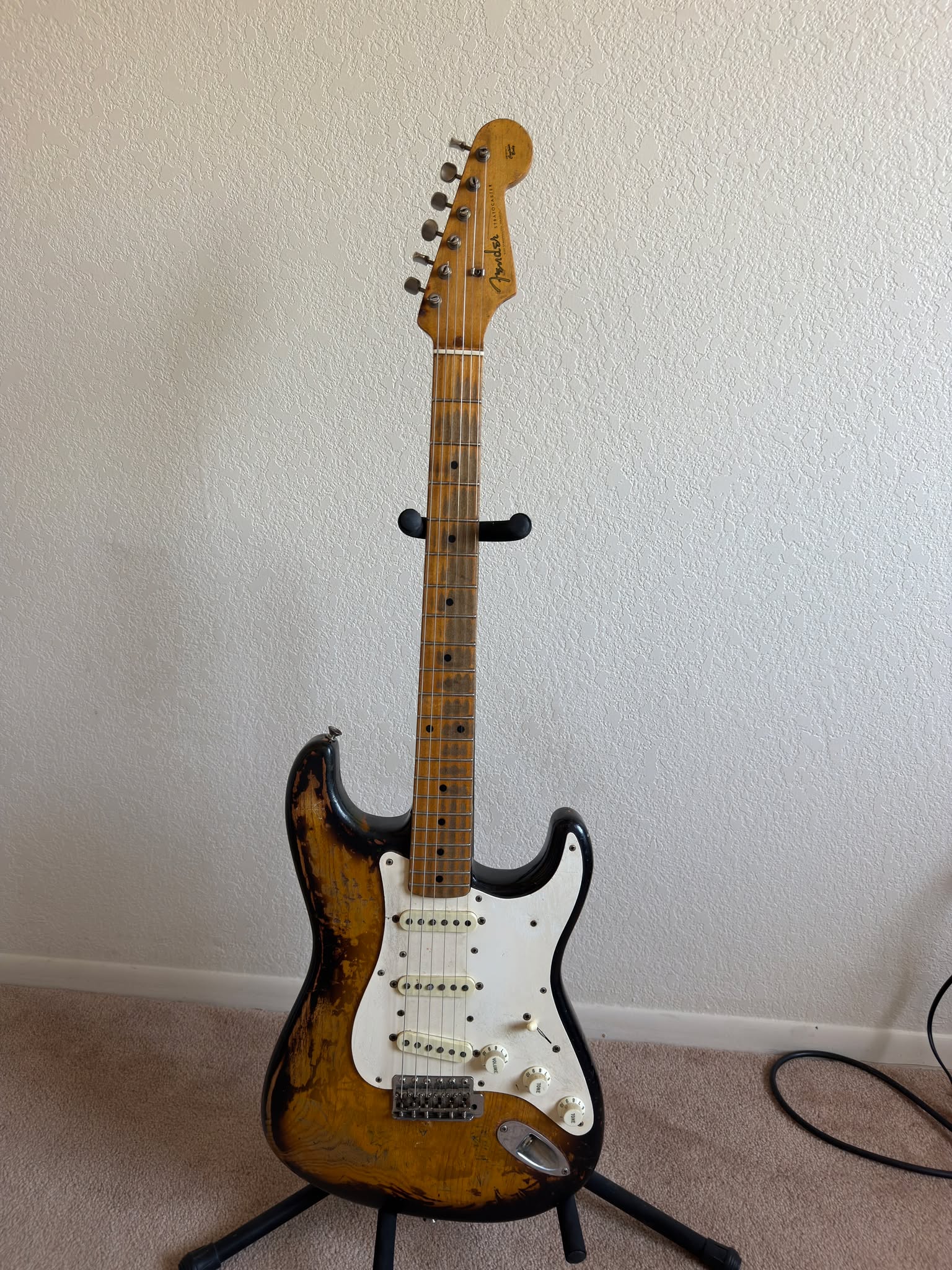
Stratocaster models: 1954 first year through 1980s, all variations including hardtail, custom colors, left-handed
Telecaster models: 1950 Broadcaster, 1951 Nocaster, 1951+ Telecaster, Esquire, Custom Telecaster, Thinline
Precision Bass: 1951 slab body through contoured body, split-coil transition, all years
Jazz Bass: 1960 stack-knob through all production years
Jazzmaster: 1958 introduction through all production years, anodized gold pickguard authentication
Jaguar: 1962 introduction through all production years
Mustang: 1964 onward, competition stripe models
Duo-Sonic and Musicmaster: Student models from all years
All vintage Fender: Any model, any year from 1950 through 1980s
We provide free authentication including:
Serial number verification and year determination (neck plate, headstock)
Neck date stamp analysis (heel stamps, pencil dates)
Potentiometer code dating (Stackpole 304, CTS 137 formats)
Pickup authentication (hand-wound Formvar wire vs machine-wound, black bottom vs gray bottom)
Custom color verification (sealer inspection, primer analysis, aging patterns)
Slab vs veneer rosewood identification (thickness measurement, bottom profile)
Pre-CBS vs CBS feature identification (headstock size, logo style, hardware details)
Body wood verification (alder vs ash, correct wood for finish/year combination)
Finish authenticity assessment (nitrocellulose vs polyurethane, age checking, refinish detection)
Structural evaluation and modification identification
We Offer Immediate Cash Payment
When we purchase your Fender, we pay immediately—no waiting, no consignment, no delays:
Cash payment for transactions up to certain amounts
Certified check delivered at time of purchase
Bank transfer for larger transactions
Same-day payment in most cases
Where to Sell Fender Guitars in Kettering: Complete Options Comparison
Option 1: Edgewater Guitars (Recommended)
What We Offer:
30-40% above typical guitar shop offers
Free in-home appraisals throughout Kettering and greater Dayton area
Expert vintage Fender authentication including pre-CBS identification and custom color verification
Immediate cash/check/transfer payment
No fees, no commissions, no consignment waiting
Professional, respectful service
Understanding of family and estate situations
Written offers with detailed valuation explanations
Best For: Anyone with a vintage Fender wanting fair value without hassle
Process: Call (440) 219-3607 → Photo evaluation → In-home appointment → Written offer → Immediate payment
Timeline: 24-72 hours from initial contact to cash in hand
Option 2: Dayton-Area Guitar Shops
Pros: Same-day transactions, familiar local businesses
Cons:
Wholesale pricing (significantly below fair market value)
May lack pre-CBS Fender expertise for proper authentication
Custom color premiums often unrecognized
Slab rosewood, clay dots, and transitional features frequently missed
Limited budget for high-value pre-CBS instruments
Reality Check: Most Dayton-area music shops offer 40-60% of fair market value. A pre-CBS Stratocaster with custom color valued at $25,000+ in collector market might receive a $12,000-15,000 shop offer because the staff doesn’t recognize the custom color’s significance or know how to verify it.
Best For: Low-value guitars where convenience matters more than maximizing value
Option 3: Online Marketplaces (Reverb, eBay, Facebook Marketplace)
Pros: Potentially highest gross value, broad buyer reach
Cons:
Platform fees (5-15% of sale price)
Shipping costs and damage risk ($50-200+ for proper vintage guitar shipping)
Authentication disputes—extremely common with pre-CBS Fender claims
Scam risk particularly high for valuable Fenders
Weeks to months waiting for sale
Returns and refund requests
Risk Level: Very High for valuable vintage Fenders—authentication disputes are leading cause of online transaction problems
Best For: Experienced online sellers comfortable with significant risk
Option 4: Pawn Shops
Pros: Immediate cash
Cons: Lowest offers (10-25% of value), zero Fender expertise, predatory pricing
Recommendation: AVOID for vintage Fender guitars. Call Edgewater first—always.
Option 5: Consignment Sales
Pros: Potentially higher prices than direct shop purchase
Cons: Weeks to months waiting, 20-40% fees, risk of damage while displayed
Best For: Sellers with extensive patience and specific price requirements
Understanding Pre-CBS vs CBS Fender: Why It Matters for Your Sale
The Most Important Date in Fender History: January 1965
In January 1965, CBS (Columbia Broadcasting System) purchased Fender Musical Instruments from founder Leo Fender. This acquisition fundamentally changed Fender production and created the most significant value dividing line in vintage guitar collecting.
Pre-CBS Fender (1950-1964): Instruments made under Leo Fender’s ownership and quality standards
CBS-Era Fender (1965-1984): Instruments made after CBS acquisition with various production changes
Why Pre-CBS Commands Premium Pricing
Pre-CBS Fender instruments command dramatically higher prices because:
Superior craftsmanship: Leo Fender’s quality standards produced exceptional instruments
Premium materials: Nitrocellulose lacquer, hand-wound pickups, quality tonewoods
Limited production: Smaller production runs creating genuine scarcity
Historical significance: Instruments from the era that defined electric guitar tone
Collector demand: Established worldwide collector market with proven appreciation
Value Difference Example
A 1964 pre-CBS Stratocaster in excellent original condition commands dramatically higher pricing than a 1966 CBS-era Stratocaster in equivalent condition—often 200-400% more—despite being manufactured only two years apart. This single distinction—pre-CBS versus CBS—represents the largest value variable in Fender guitar collecting.
How Edgewater Identifies Pre-CBS Fender
We verify pre-CBS production through multiple methods:
Serial number ranges: Pre-CBS serial numbers on neck plate follow specific ranges by year
Headstock size: Pre-CBS Stratocasters have smaller headstock than CBS-era large headstock
Logo style: Spaghetti logo (pre-CBS) vs transition logo vs CBS logo
Neck date stamps: Period-correct date stamp format in heel
Pot codes: Stackpole 304 and CTS 137 codes showing pre-1965 dates
Hardware details: Kluson tuners, specific bridge and tremolo specifications
Finish type: Nitrocellulose lacquer (pre-CBS) vs polyurethane (later CBS)
Fingerboard markers: Clay dots (pre-CBS) vs pearl dots (CBS transition)
Pickup construction: Hand-wound Formvar wire (pre-CBS) vs machine-wound
Many Dayton-area shops lack this specialized knowledge. This means pre-CBS Fender owners in Kettering frequently receive CBS-era pricing for pre-CBS instruments—a difference of thousands or tens of thousands of dollars.
How to Prepare Your Fender for Sale in Kettering
Step 1: Don’t Clean, Repair, or Restore It
CRITICAL: Do NOT attempt to clean, polish, restore, or repair vintage Fender guitars before selling. Professional vintage buyers prefer original condition including:
Original dust and patina (proves authenticity)
Age-appropriate wear and finish checking
Faded custom colors (original faded color dramatically outvalues refinishing)
Worn hardware with authentic aging
Original pickguard even if discolored or warped
Why: Amateur cleaning destroys fragile nitrocellulose finishes. Custom color Fenders are particularly susceptible—cleaning can damage rare factory finishes worth thousands in premiums. Faded Sonic Blue, aged Olympic White, or checked Lake Placid Blue in original condition dramatically outvalues any restoration attempt.
Step 2: Gather Any Available Documentation
Collect whatever you have:
Original receipts or purchase documents (especially valuable for verifying custom color orders)
Original case and case candy (brown Tolex cases, tweed cases—these add significant value)
Photos of original owner with the guitar
Service records or repair history
Family provenance stories (who bought it, when, where)
Step 3: Take Clear Photos
For initial evaluation, photograph:
Full front and back of guitar
Headstock front and back (showing logo style and serial number)
Close-up of serial number on neck plate or headstock
Pickups (close-up of each)
Fingerboard showing fret markers (clay dots vs pearl)
Neck pocket (if accessible—showing date stamps)
Pickguard (showing color, screw pattern, material)
Tremolo cavity on back (if Stratocaster)
Inside tremolo cavity (if accessible—showing body date stamp)
Body edges showing finish thickness and aging
Any case and documentation
Step 4: Locate Identifying Information
Serial Number Location:
1950-1971: Neck plate (four-bolt plate on back of body)
1970s onward: Headstock (front or back depending on year)
Neck Date Stamp: On heel of neck (visible when neck removed from body) OR penciled inside neck pocket
Pot Codes: Inside control cavity (requires removing pickguard or control plate)
Don’t worry if you can’t access these—Edgewater handles complete authentication during evaluation.
Understanding Fender Guitar Values: What Affects Your Fender’s Worth
Pre-CBS Era Breakdown (1950-1964)
1950-1954 (Earliest Production): Extreme rarity and historical significance create extraordinary values. First-year Telecasters (Broadcasters, Nocasters), first Precision Basses, first Stratocasters command museum-level pricing.
1954-1956 (Early Production): Exceptional values for early Stratocasters, Telecasters, and Precision Basses with period-correct features—maple necks, Bakelite components, early pickup designs.
1957-1958 (Refinement Era): Strong values with refined specifications. Three-tone sunburst introduced on Stratocaster (1958). Gold anodized pickguards (1957 Strat). Premium materials throughout.
1959-1962 (Slab Rosewood Era): Rosewood fingerboard introduced mid-1959 with thick slab construction (approximately 5mm thick, flat bottom). Slab rosewood commands 20-30% premiums over later veneer. Clay dot markers. Three-ply pickguards.
1962-1964 (Veneer Rosewood Era): Veneer rosewood replaces slab (mid-1962). Clay dots continue through approximately 1964. L-series serial numbers begin late 1963. Custom colors become more common. Final pre-CBS production.
CBS Era Breakdown (1965-1984)
1965 (Transition Year): Both pre-CBS and CBS features appear. Large headstock introduced late year on Stratocaster. Pearl dots replace clay. Gold transition logo. F-stamped neck plates.
1966-1971 (Early CBS): Large headstock standard on Stratocasters. Maple cap necks return as option (1967). Polyurethane finish begins replacing nitrocellulose. Still quality instruments with collector value.
1972-1981 (Later CBS): Three-bolt neck on many models. Bullet truss rod. Thicker finishes. Heavy bodies. Less desirable but growing collector interest.
Model Value Hierarchy
Ultra-Premium Fender Models:
1950 Broadcaster / 1951 Nocaster (rarest production Fenders)
1954 Stratocaster first year
Pre-CBS custom color Stratocasters and Telecasters
1958-1959 Jazzmaster (anodized gold pickguard)
1960-1961 Jazz Bass (stack knob)
Premium Fender Models:
1955-1964 Stratocaster (all pre-CBS years)
1952-1964 Telecaster (all pre-CBS years)
1957-1964 Precision Bass (split-coil)
1962-1964 Jaguar
1959-1964 Jazzmaster
Strong Value Models:
1965-1969 Stratocaster, Telecaster, and basses (transition/early CBS)
1968-1972 Telecaster Thinline
Custom Telecaster
Esquire (all years)
Good Value Models:
1970s CBS-era instruments
Mustang, Duo-Sonic, Musicmaster
Later production models
Specific Features That Increase Fender Value
Pre-CBS production (pre-January 1965): Dramatic premium over CBS-era
Custom colors: 40-80% premiums over sunburst (Lake Placid Blue, Daphne Blue, Sonic Blue, Foam Green, Surf Green, Sherwood Green, Olympic White, Fiesta Red, Dakota Red, Candy Apple Red, Shell Pink, Burgundy Mist, Shoreline Gold, and others)
Matching headstock: Additional 15-25% premium on custom color examples
Slab rosewood fingerboard (1959-mid 1962): 20-30% premium over veneer rosewood
Clay dot markers (pre-1965): Premium indicator of pre-CBS production
Anodized gold pickguard (1957-1959 Stratocaster, 1958-1959 Jazzmaster): 25-40% premium
Original case: Period-correct case adds 5-15% to value
Maple neck (1950s): Desirable original feature on early production
Stack knob Jazz Bass (1960-1961): Extreme rarity premium
All-original condition: 60-120% premium over modified examples
Features That Reduce Fender Value
Refinishing: 50-70% reduction—original faded finish always outvalues refinishing
Replaced pickups: 20-40% reduction depending on model/era
Neck replacement: 40-60% reduction—original neck essential
Replaced pickguard: 10-25% reduction
Modified routing: 20-40% reduction
Headstock repairs: 35-55% reduction
Non-original hardware: 15-30% reduction depending on extent
Refret with wrong wire: 15-25% reduction
Custom Color Fender Authentication: Why Expertise Matters
What Are Fender Custom Colors?
Fender offered custom color finishes as special-order options throughout the pre-CBS era. These colors—derived from automotive paint formulations—were applied over specific primer and sealer coats, creating distinctive finishes that command extraordinary premiums in today’s collector market.
Why Custom Colors Command 40-80% Premiums
Custom color Fenders were special orders during original production—far less common than standard sunburst or blonde finishes. Their rarity, visual impact, and collector demand create premiums of 40-80% over equivalent sunburst examples. Certain colors (Shell Pink, Foam Green, Surf Green on specific models) can command even higher premiums.
How Edgewater Authenticates Custom Colors
Custom color verification requires specialized knowledge that most Dayton-area shops lack:
Yellow Sealer Inspection: Authentic pre-CBS custom colors (particularly Olympic White) were applied over yellow or gold sealer coat. Checking this sealer layer through wear areas, chip examination, or careful inspection of finish edges verifies originality.
Primer Analysis: Period-correct primer combinations varied by color and year. Wrong primer indicates refinish.
Aging Characteristics: Each custom color ages distinctively—Sonic Blue develops greenish tinge, Olympic White yellows to cream, Lake Placid Blue darkens, Candy Apple Red shows specific metallic patterns. Understanding these aging patterns separates original colors from refinishes.
Finish Application: Factory custom color application has specific characteristics (spray patterns, edge coverage, cavity finishing) distinguishable from aftermarket refinishes.
Why This Matters: A Kettering seller with a pre-CBS Stratocaster in faded custom color could have an instrument worth 40-80% more than sunburst equivalent—but only if the custom color is authenticated as original. Shops that can’t verify custom colors offer sunburst pricing, leaving thousands on the table.
Common Fender Models We Buy in Kettering, Ohio
Fender Electric Guitars
Stratocaster (All Years):
1954 first year Stratocaster (maple neck, two-tone sunburst, Bakelite components)
1955-1956 Stratocaster (V-neck profile, early refinements)
1957 Stratocaster (gold anodized pickguard option)
1958 Stratocaster (three-tone sunburst introduction)
1959-1962 Stratocaster (slab rosewood, clay dots)
1962-1964 Stratocaster (veneer rosewood, clay dots, L-series serials)
1965 Stratocaster (transition year, large headstock introduced late)
1966-1971 Stratocaster (CBS large headstock era)
1972-1981 Stratocaster (later CBS era, three-bolt neck)
Custom color Stratocasters (all years—Lake Placid Blue, Fiesta Red, Olympic White, etc.)
Hardtail Stratocasters (no tremolo, all years)
Left-handed Stratocasters (all years—premium rarity)
Telecaster (All Years):
1950 Broadcaster (first production—extreme rarity)
1951 Nocaster (no model name—extreme rarity)
1951-1954 early Telecaster (butterscotch blonde, black pickguard)
1955-1958 Telecaster (white pickguard, V-neck, maple only)
1959-1965 Telecaster (rosewood option, slab/veneer board, pre-CBS)
1966-1981 CBS-era Telecaster
Esquire (single pickup, all years)
Custom Telecaster (bound body, all years)
1968-1972 Telecaster Thinline (semi-hollow, f-hole)
Custom color Telecasters (all years)
Offset Models:
1958-1965 Jazzmaster (anodized gold pickguard, tortoiseshell, slab rosewood)
1962-1965 Jaguar (complex switching, 24” scale)
1964-1982 Mustang (competition stripes, dynamic tremolo)
1956-1980 Duo-Sonic / Musicmaster (student models)
Fender Bass Guitars
Precision Bass (All Years):
1951-1954 Precision Bass (slab body, single coil)
1954-1957 Precision Bass (contoured body, single coil)
1957-1965 Precision Bass (split-coil humbucker, pre-CBS)
1966-1981 CBS-era Precision Bass
Custom color Precision Basses (all years)
Jazz Bass (All Years):
1960-1961 Jazz Bass (stack knob—extreme rarity premium)
1962-1965 Jazz Bass (three-knob, pre-CBS)
1966-1981 CBS-era Jazz Bass (bound neck, block inlays)
Custom color Jazz Basses (all years)
Fender Amplifiers
While we primarily focus on guitars, we can evaluate vintage Fender amplifiers alongside guitar transactions:
Tweed-era amps (Deluxe, Bassman, Twin, Champ, Princeton)
Brown/blonde Tolex amps
Blackface amps (1964-1967)
Silverface amps (1968-1981)
Kettering and Dayton Area Fender Guitar Market
Miami Valley Fender Heritage
The Dayton metro area—and Kettering specifically—has generations of musicians who purchased Fender guitars during every era of production. From the earliest Telecaster adopters through the Stratocaster explosion of the 1960s and the bass guitar revolution, Fender instruments found homes throughout Montgomery County and the Miami Valley.
Common scenarios we encounter in Kettering:
Wright-Patterson community: Military families purchased Fender guitars at PX shops, music stores near military installations, and while stationed across the country—instruments that traveled with families to Kettering-area homes
1960s surf and rock era: Baby Boomers who purchased Fender Stratocasters and Telecasters during the golden age of surf, rock, and blues guitar
Bass players: Working musicians who purchased Precision and Jazz Basses for band work throughout the 1960s-1970s
Country players: Southwest Ohio’s country music tradition producing generations of Telecaster players
Church musicians: Fender acoustics and electrics used in contemporary worship settings
Studio musicians: Professional players from Dayton’s recording and performance community
Why Kettering Fender Sellers Choose Edgewater
Pre-CBS Expertise at Your Door: We bring specialized pre-CBS Fender knowledge directly to your Kettering home—identifying features worth thousands in premiums that general shops miss.
Custom Color Recognition: We authenticate rare custom colors that dramatically increase value—colors that many buyers don’t recognize or can’t verify.
Slab Rosewood Verification: We measure fingerboard thickness and verify slab vs veneer construction—a 20-30% value difference that requires hands-on inspection.
Fair Pricing: We consistently pay 30-40% more than Dayton-area shops because we recognize specific Fender value drivers that general buyers overlook.
Real Kettering-Area Fender Sale Examples
Example 1: Inherited Pre-CBS Stratocaster (Kettering, Ohio)
Situation: Family in Kettering inherited father’s 1962 Fender Stratocaster stored in closet since the mid-1980s. Father purchased the guitar from a Dayton music store in 1962 and played in local bands throughout the 1960s.
Initial Assessment: Family contacted a Dayton guitar shop that offered a figure the family felt was low. The shop described it as “a nice old Strat” without mentioning pre-CBS significance.
Edgewater Evaluation: Traveled to Kettering home. Discovered slab rosewood fingerboard (measured at 4.9mm thick with flat bottom—confirmed slab board), clay dot position markers (pre-CBS indicator), original pickups with hand-wound Formvar wire and black bottom flatwork, original three-tone sunburst with beautiful 64-year checking and fading, original green celluloid pickguard (aged to mint green—period correct), original Kluson tuners, correct L-series serial number on neck plate, neck date stamp reading “8-62” (August 1962), pot codes all showing 1962 dates (304-6218, 304-6220, 304-6222). No modifications, no refinishing, no replaced parts, no structural issues. Original brown Tolex case included.
Outcome: Edgewater’s offer dramatically exceeded the Dayton shop quote. “The shop offered us a number that seemed reasonable until Edgewater explained what we actually had,” the son said. “They showed us the slab rosewood—measuring the fingerboard thickness right there at our kitchen table—and explained why it commands premiums over later thin rosewood. They showed us the clay dots, the original hand-wound pickups, the pot codes matching 1962. They explained that this was a pre-CBS Stratocaster—built before CBS bought Fender—and why that distinction alone represents enormous value. Their offer was nearly three times the shop’s quote because they actually understood the significance.”
Example 2: Custom Color Discovery in Oakwood, Ohio
Situation: Family in Oakwood found grandfather’s Fender in attic during home renovation. Guitar appeared to be a faded, yellowish-white Stratocaster in original case.
Edgewater Evaluation: Traveled to Oakwood. Immediately recognized the faded finish as potential Olympic White custom color. Inspected wear areas at body edges and found yellow/gold sealer underneath—confirming authentic Olympic White factory custom color, not refinish. Verified 1963 production through serial number (L-series), neck date, pot codes. Original pickups, original hardware, clay dot markers, veneer rosewood fingerboard. Matching headstock (Olympic White on headstock face—additional premium feature).
Outcome: Family was astonished. “We thought it was just a dirty white guitar—maybe worth a few hundred dollars,” the granddaughter explained. “Edgewater immediately recognized it as an Olympic White custom color. They showed us the yellow sealer underneath that proves it’s the original factory color, not a refinish. They explained that matching headstock custom colors are especially rare and valuable. We went from thinking about donating it to receiving an offer that genuinely changed our financial situation.”
Example 3: Bass Guitar Collection in Centerville, Ohio
Situation: Retired bassist in Centerville selling collection of vintage Fender basses accumulated over 40-year career.
Collection: 1963 Precision Bass (sunburst, pre-CBS), 1966 Jazz Bass (sunburst, early CBS bound neck), 1972 Precision Bass (natural), and 1978 Jazz Bass (three-bolt, block inlays).
Edgewater Process: Scheduled in-home evaluation. Authenticated each bass individually—verified pre-CBS features on the 1963 P-Bass (clay dots, slab rosewood, original split-coil pickup, tortoiseshell pickguard), identified early CBS features on the 1966 Jazz Bass (bound neck, block inlays—desirable early CBS configuration), assessed condition and originality of later examples.
Outcome: Bassist received fair compensation for 40 years of careful bass ownership. “I expected the 1963 P-Bass to be the star, and it was—but Edgewater also explained why the 1966 Jazz Bass with bound neck and blocks is more desirable than I realized. They valued each bass individually based on specific features rather than offering one bulk number.”
Example 4: Garage Discovery in Beavercreek, Ohio
Situation: Military family in Beavercreek discovered Fender Telecaster in garage storage unit during estate cleanout. Guitar belonged to deceased father who served at Wright-Patterson.
Instrument: 1956 Fender Telecaster, butterscotch blonde, maple neck, original white pickguard.
Edgewater Evaluation: Identified as mid-1950s Telecaster with correct features—butterscotch blonde finish over ash body, V-profile maple neck, white Bakelite pickguard, original bridge with brass saddles, original pickups. Serial number and pot codes confirmed 1956 production. Original finish showing beautiful 70-year patina with extensive checking. No modifications.
Outcome: Family was stunned at the value of what they described as “Dad’s old work guitar.” Edgewater explained the significance of 1950s Telecaster production, original condition, and pre-CBS features.
Questions Kettering Fender Sellers Frequently Ask
Value and Evaluation Questions
Q: How much is my Fender guitar worth?
A: Value depends on model, year (pre-CBS vs CBS is critical distinction), originality, condition, finish (custom colors command dramatic premiums), and specific features. Edgewater provides free, professional evaluation with detailed written valuation—no obligation.
Q: What does pre-CBS mean and why does it matter?
A: Pre-CBS refers to Fender guitars made before January 1965 when CBS (Columbia Broadcasting System) purchased Fender from Leo Fender. Pre-CBS instruments were made under Leo Fender’s original quality standards with superior materials and craftsmanship. Pre-CBS Fenders command dramatically higher prices than post-1965 CBS-era instruments—often 200-400% more for equivalent models and conditions.
Q: Do you offer free Fender appraisals in Kettering?
A: Yes—completely free, no-obligation appraisals throughout Kettering and the greater Dayton area. We come to your home at your convenience. No fees, no pressure, no commitment.
Q: How can I tell if my Fender is pre-CBS?
A: Key indicators include: serial number range on neck plate (specific pre-1965 ranges), smaller headstock on Stratocaster (pre-CBS smaller than CBS large headstock), spaghetti logo style, clay dot markers (pre-CBS), slab or veneer rosewood fingerboard, nitrocellulose lacquer finish, Kluson tuners, and hand-wound pickups. Edgewater verifies pre-CBS status through multiple authentication methods during free evaluation.
Q: What if my Fender has a custom color finish?
A: Custom color Fenders (Lake Placid Blue, Fiesta Red, Olympic White, Sonic Blue, Foam Green, Shell Pink, Candy Apple Red, Daphne Blue, Surf Green, Sherwood Green, Burgundy Mist, Shoreline Gold, Dakota Red, and others) command 40-80% premiums over standard sunburst finishes. Even faded custom colors are extremely valuable—never refinish a faded custom color. Edgewater authenticates custom colors through sealer inspection, primer analysis, and aging pattern verification.
Q: My Fender’s color has faded—does that reduce value?
A: NO—faded original finish actually proves authenticity and is considered desirable. Faded Sonic Blue, aged Olympic White, checked Lake Placid Blue, or lightened Fiesta Red in original condition dramatically outvalues any refinish attempt. Never refinish a faded vintage Fender.
Process Questions
Q: How long does the Fender selling process take?
A: Most transactions complete within 24-72 hours: initial contact and photos (Day 1), scheduled in-home appointment (Days 2-3), evaluation and immediate payment (day of appointment).
Q: Do you buy Fender basses as well as guitars?
A: Yes—we actively purchase vintage Fender basses including Precision Bass (all years), Jazz Bass (all years—particularly stack knob 1960-1961), Mustang Bass, Bass VI, and all other Fender bass models. Vintage Fender basses have strong collector markets with specific premiums for pre-CBS examples.
Q: Do you buy Fender amplifiers?
A: We primarily focus on guitars and basses but can evaluate vintage Fender amplifiers alongside instrument transactions. Tweed, brown/blonde, and blackface Fender amps have significant collector value.
Authentication Questions
Q: How do you verify a Fender is authentic and not a copy?
A: Multiple verification points: serial number format and location, neck date stamps, pot code dating, pickup construction details, body routing patterns, hardware specifications, finish characteristics, neck pocket markings, body wood verification, and comparison to known authentic examples from specific years.
Q: What’s the difference between slab and veneer rosewood?
A: Slab rosewood (1959-mid 1962) is thick (approximately 5mm) with flat bottom—commands 20-30% premiums. Veneer rosewood (mid 1962 onward) is thinner (approximately 3mm) with curved bottom conforming to neck. We verify through thickness measurement at neck heel and bottom profile inspection during in-person evaluation.
Q: What are clay dots vs pearl dots?
A: Clay dot position markers (pre-1965) are slightly matte, clay-colored inlays used on pre-CBS Fender rosewood fingerboards. Pearl dots (1965 onward) are brighter, pearlescent inlays introduced during CBS transition. Clay dots indicate pre-CBS production and are a premium feature. We verify dot material during evaluation.
Estate Questions
Q: Can you help with estate situations involving Fender guitars?
A: Yes—we regularly assist with estate settlements throughout the Kettering/Dayton area. We provide professional appraisals suitable for estate documentation, work with executors, and handle family heirloom situations sensitively. Fender instruments are common in estates from Baby Boomer generation.
Q: Does Edgewater buy Fender guitars from all eras?
A: Yes—we purchase vintage Fender instruments from all production years: 1950s earliest production through 1980s. Pre-CBS (1950-1964) commands highest premiums, but CBS-era (1965-1984) Fenders also have established collector markets, particularly early CBS examples (1965-1969) and specific later models.
Fender Models With Highest Demand in Kettering Area
Guitars
Pre-CBS Custom Color Stratocasters — Extraordinary values, 40-80% custom color premiums
1954-1964 Stratocaster (sunburst) — Pre-CBS standard, strong consistent demand
1950-1951 Broadcaster/Nocaster — Rarest production Fenders
1952-1964 Telecaster — Pre-CBS Telecaster market strong
1958-1964 Jazzmaster — Growing offset market, gold pickguard premiums
1962-1964 Jaguar — Complex design, pre-CBS premiums
Esquire (all years) — Single pickup Telecaster variant
1965-1969 Transition/Early CBS Stratocaster and Telecaster — Growing market
Basses
1960-1961 Jazz Bass (Stack Knob) — Extreme rarity, extraordinary values
1957-1964 Precision Bass (Split-Coil, Pre-CBS) — Strong consistent demand
1962-1964 Jazz Bass (Pre-CBS) — Premium bass market
1951-1957 Precision Bass (Single-Coil) — Early bass production
1965-1969 Early CBS Precision and Jazz Bass — Growing collector interest
The Edgewater Guitars Difference for Fender Sellers
Pre-CBS Recognition Saves You Thousands
The single most common mistake in Fender sales is failing to recognize pre-CBS production. This distinction alone can represent thousands—sometimes tens of thousands—of dollars in value difference. Edgewater identifies pre-CBS production immediately through multiple verification methods, ensuring you receive appropriate premium pricing.
Custom Color Expertise Creates Maximum Value
Custom color authentication requires specialized knowledge: sealer inspection, primer analysis, aging pattern recognition, and factory application verification. A faded Olympic White Stratocaster that looks “dirty” to an untrained eye might be worth 40-80% more than an equivalent sunburst. Edgewater recognizes and verifies custom colors that other buyers miss.
Slab Rosewood Verification Adds Premium
The 20-30% premium for slab rosewood fingerboards requires hands-on measurement—thickness testing, bottom profile inspection, and comparison to known examples. Edgewater brings this expertise to your Kettering home.
Every Feature Matters
From clay dots to Formvar-wound pickups to specific bridge saddle types to correct body wood, every original feature on a vintage Fender contributes to its value. Edgewater recognizes and pays for every authentic detail.
How to Start the Process Today
Step 1: Call (440) 219-3607
Initial conversation about your Fender guitar, your situation, and the selling process. No obligation.
Step 2: Share Photos
Via phone, text, or email: front, back, headstock (both sides showing logo and serial number), pickups, fingerboard, pickguard, neck plate serial number, any case and documentation.
Step 3: Receive Preliminary Valuation
We provide initial value range identifying pre-CBS vs CBS, potential custom color, and general condition assessment.
Step 4: Schedule In-Home Evaluation
At your convenience—evenings, weekends, or business hours throughout Kettering and the Dayton area.
Step 5: Professional Evaluation and Written Offer
Thorough authentication including slab rosewood measurement, custom color verification, pickup inspection, pot code dating, and comprehensive feature assessment. Written offer with detailed explanation.
Step 6: Immediate Payment
Upon acceptance—cash, certified check, or bank transfer. Same day.
Contact Edgewater Guitars Today
Ready to sell your Fender guitar in Kettering, Ohio?
Phone: (440) 219-3607
Website: edgewaterguitars.com
Service Area: Kettering, Oakwood, Centerville, Beavercreek, Bellbrook, Miamisburg, Springboro, Dayton, Huber Heights, Fairborn, Xenia, Yellow Springs, and all Miami Valley communities
Availability: Flexible scheduling including evenings and weekends
No Obligation: Free appraisals, no commitment required
Call Edgewater Guitars today: (440) 219-3607
Free Fender appraisals throughout Kettering, the Dayton metro, and all of Southwest Ohio.
Related Resources for Kettering Fender Sellers
Fender Serial Number Lookup Tool — Decode your Fender’s serial number
Pre-CBS vs CBS Identification Guide — Understanding the critical distinction
Fender Custom Color Authentication — Identifying rare factory finishes
Slab vs Veneer Rosewood Guide — Understanding fingerboard differences
Fender Neck Date Stamp Guide — Reading neck stamps
Vintage Fender Value Guide — Current market overview
Sell Your Vintage Guitar to Edgewater — Get your free valuation
Ohio Guitar Buyer Service Areas — All Ohio locations we serve
Edgewater Guitars: Your trusted Fender guitar buyer serving Kettering, Ohio and the entire Dayton metropolitan area. We specialize in pre-CBS Fender authentication, custom color verification, and premium pricing for vintage Fender guitars and basses. Free in-home appraisals throughout the Miami Valley. Call (440) 219-3607 for your free, no-obligation appraisal today.