DATE :
What's My Vintage Gibson Worth? Complete 2026 Value Guide by Model
What’s My Vintage Gibson Worth? Complete 2026 Value Guide by Model
Last Updated: July 2026
What Is My Vintage Gibson Guitar Worth?
Direct Answer: Vintage Gibson guitar values range from a few hundred dollars for common 1970s student models to well over $500,000 for the rarest 1950s Les Paul Standards in exceptional condition. The single most important factors determining value are model, year, originality, and condition - in that order.
Why “What’s My Gibson Worth?” Is Complicated:
No two vintage Gibson guitars are worth exactly the same amount, even if they share the same model name and year. A 1959 Les Paul Standard in all-original excellent condition is worth dramatically more than a 1959 Les Paul Standard that has been refinished, has replaced pickups, and has a repaired headstock. Understanding the specific factors that affect your guitar’s value is essential to setting realistic expectations and avoiding being underpaid by uninformed buyers.
This guide provides reference value ranges for the most common and significant vintage Gibson models. Every value listed represents instruments in excellent, all-original condition with no modifications, repairs, or replaced parts. Condition issues, modifications, and repairs reduce values from these baselines - sometimes dramatically. We address these reductions specifically for each model category.
How to Use This Guide:
Find your model and year in the sections below
Note the all-original excellent condition baseline value
Apply the condition and modification reductions listed
Understand that your guitar may be worth significantly more or less than baseline depending on specific details
For a precise valuation of your specific instrument, Edgewater Guitars provides free, no-obligation authentication and valuation. We purchase vintage Gibsons throughout Ohio, Michigan, Pennsylvania, Indiana, and West Virginia - and travel beyond for exceptional instruments. Call (440) 219-3607.
Want a quick read first? Upload a photo for a free identification and value range.
Important Caveats Before You Read Further:
All values are for excellent, all-original condition instruments
These are reference and retail-comp values, not a purchase offer. Edgewater is a buyer, not a retailer reselling at market price, so our actual offer for any guitar, including a perfect all-original example, is typically lower than these figures. Each dedicated model guide linked below states our own fair-buyer reference range
Values can shift over time as the broader vintage guitar market moves
Rare variations, celebrity provenance, and exceptional documentation can exceed these ranges
Condition issues typically reduce these values by 30-70%
When in doubt, get multiple expert opinions before selling
The Most Valuable Vintage Gibsons: 1950s-1960s Les Pauls
1959 Les Paul Standard (“The Burst”)
Why It’s the Holy Grail:
The 1959 Les Paul Standard is the most valuable production electric guitar ever made. It represents the convergence of every desirable feature in one instrument: PAF humbuckers at their most refined, figured maple tops at their most spectacular, and the neck profile that players universally consider ideal. Only approximately 643 were produced in 1959.
All-Original Excellent Condition Value Range:
Plain top, excellent all-original: $250,000-$350,000
Lightly figured top, excellent all-original: $300,000-$450,000
Heavily figured (“flame”) top, excellent all-original: $400,000-$600,000+
Museum-quality, exceptional figure, with provenance: $600,000+
Rarity Scale: 10/10 - Among the most sought-after guitars in existence
What Makes 1959 Specifically:
Figured maple tops more common than 1958
Slim-taper neck profile (most playable of the burst years)
PAF pickups at peak quality and consistency
ABR-1 bridge with retainer wire
Bumble bee capacitors
Brazilian rosewood fingerboard
How Condition and Modifications Reduce Value:
Issue | Value Impact |
|---|---|
Professional headstock repair (invisible) | Reduce by 30-40% |
Visible headstock repair | Reduce by 40-55% |
Body refinish | Reduce by 50-65% |
Neck refinish | Reduce by 20-30% |
Replaced PAF pickups | Reduce by 25-40% |
Replaced pots/wiring | Reduce by 10-20% |
Replaced tuners | Reduce by 10-15% |
Refret (professional, correct wire) | Reduce by 5-10% |
Heavy player wear (original finish intact) | Reduce by 15-25% |
Missing original case | Reduce by 5-10% |
Replaced bridge/tailpiece | Reduce by 10-20% |
Edgewater Observation: In our experience purchasing vintage Les Pauls throughout the Midwest, completely unmodified 1959 bursts are extraordinarily rare. The vast majority have at least one repair or modification from decades of use. Each modification compounds the others - a guitar with headstock repair plus refinish plus replaced pickups might retain only 25-35% of all-original value.
1958 Les Paul Standard (“First Burst”)
Why It’s Significant:
The 1958 Les Paul Standard introduced the Cherry Sunburst finish that would define the instrument’s legacy. First-year burst examples typically feature plain to lightly figured maple tops (more figured examples appear in 1959-1960), PAF pickups in their early form, and a slightly chunkier neck profile than 1959.
All-Original Excellent Condition Value Range:
Plain top, excellent all-original: $200,000-$300,000
Lightly figured top, excellent all-original: $250,000-$400,000
Heavily figured top (rare for 1958), excellent all-original: $350,000-$500,000
Rarity Scale: 10/10 - Approximately 434 produced
Key 1958 Features:
Plain maple caps more typical (high-figure tops rarer than 1959)
Early PAF pickups (long magnet, no sticker on some)
Orange “bumble bee” capacitors
Lightweight aluminum stopbar tailpiece
Aniline dye that fades creating “honeyburst” and “lemon burst” examples
How Condition Issues Reduce Value:
Identical reduction scale to 1959. Apply same percentages. Note: faded “honeyburst” or “lemon burst” examples are original finishes (the red dye faded) - these are NOT refinishes and should not be penalized. Color-shifted examples sometimes worth slight premium for distinctive appearance.
1960 Les Paul Standard (Final Year)
Why It’s Significant:
The 1960 Les Paul Standard is the final year of original Les Paul production before Gibson transitioned to the SG body style. Often features the most pronounced figured tops of the burst era and the famous “slim taper” neck profile - the thinnest of the three burst years.
All-Original Excellent Condition Value Range:
Plain top, excellent all-original: $150,000-$250,000
Lightly figured top, excellent all-original: $200,000-$350,000
Heavily figured top, excellent all-original: $300,000-$450,000
Rarity Scale: 9/10 - Approximately 635 produced
Slightly Lower Than 1959 Because:
Slim neck profile divisive (some players prefer thicker 1958-1959 necks)
Some late 1960 examples have transitional features
Market conventionally places 1959 at apex
Condition Reductions: Apply same table as 1959. Additionally: late 1960 examples showing early SG transitional features (narrower body, different neck angle) may be valued differently - consult expert.
1954-1957 Les Paul Goldtop
Why It’s Significant:
Pre-sunburst Les Pauls occupy a distinct and increasingly recognized market segment. The goldtop era covers multiple pickup transitions: P-90 through PAF introduction. 1957 Goldtops with PAF pickups represent a particularly prized intersection of early body style with revolutionary pickup technology.
All-Original Excellent Condition Value Ranges:
1952-1953 Goldtop (trapeze/wraparound bridge, P-90s): $25,000-$45,000
1954-1955 Goldtop (Tune-o-matic era, P-90s): $30,000-$55,000
1956 Goldtop (P-90s, ABR-1 bridge): $35,000-$60,000
1957 Goldtop (P-90s, early production): $40,000-$70,000
1957 Goldtop (PAF pickups, late production): $80,000-$140,000
Rarity Scale: 8/10 (standard P-90 examples) to 9/10 (1957 PAF examples)
Why 1957 PAF Goldtops Command Premium:
PAF humbuckers were introduced mid-1957. Examples confirmed to have original factory-installed PAFs (not retrofitted) command substantially higher premiums. Verifying factory vs. retrofitted PAF installation requires examining routing, pickup mounting holes, and wiring configuration - expert authentication essential.
How Condition Issues Reduce Value (Goldtops):
Issue | Value Impact |
|---|---|
Gold finish refinished | Reduce by 40-55% |
Gold finish heavily worn but original | Reduce by 15-25% |
Replaced P-90 pickups | Reduce by 20-30% |
Replaced PAF pickups (on 1957 PAF model) | Reduce by 35-45% |
Wrong bridge type (Tune-o-matic replaced with wraparound or vice versa) | Reduce by 20-30% |
Headstock repair | Reduce by 30-45% |
Control cavity routing modification | Reduce by 15-25% |
Replaced tuners (with Kluson reproductions) | Reduce by 8-12% |
1954-1960 Les Paul Custom “Black Beauty”
Why It’s Significant:
The Les Paul Custom was Gibson’s premium model - the “Tuxedo” guitar with ebony finish, ebony fingerboard, multi-ply binding, and higher-end appointments. Multiple pickup configurations across the production run create distinct value tiers.
All-Original Excellent Condition Value Ranges:
1954-1956 Les Paul Custom (P-90 bridge, Alnico neck): $35,000-$65,000
1957-1960 Les Paul Custom (PAF humbuckers, 2 pickup): $50,000-$90,000
1957-1960 Les Paul Custom (3 pickup version): $60,000-$110,000
Rarity Scale: 8/10
Key Features Affecting Value:
3-pickup version commands premium over 2-pickup
PAF-equipped examples significantly more valuable than P-90 versions
Ebony fingerboard must be original (very dark, tight grain)
Multi-ply binding condition critical (similar deterioration issues to White Falcon)
“Tuxedo” Les Paul Custom nickname refers specifically to black + gold hardware aesthetic
How Condition Issues Reduce Value (Black Beauty):
Issue | Value Impact |
|---|---|
Refinished black body | Reduce by 45-60% |
Replaced PAF pickups | Reduce by 30-45% |
Binding separation or deterioration | Reduce by 15-25% |
Replaced bridge or tailpiece | Reduce by 15-20% |
Headstock repair | Reduce by 30-45% |
Replaced tuners | Reduce by 10-15% |
Modified to 2-pickup from 3-pickup | Reduce by 30-40% |
Added pickup (converted 2 to 3) | Reduce by 25-35% |
1952-1959 Les Paul Junior and Les Paul Special
Why They’re Significant:
Often overlooked in favor of Standards and Customs, the Junior and Special represent excellent value opportunities for collectors seeking original pre-1960 Gibsons. Single and double cutaway variations create distinct collector categories.
All-Original Excellent Condition Value Ranges:
Les Paul Junior Single Cutaway:
1952-1957 (early), all-original excellent: $8,000-$18,000
1958-1960 (single cut, later): $8,000-$15,000
Les Paul Junior Double Cutaway:
1958-1960 double cut, all-original excellent: $10,000-$20,000
Les Paul Special Single Cutaway:
1955-1958, all-original excellent: $12,000-$25,000
Les Paul Special Double Cutaway:
1959-1960, all-original excellent: $15,000-$30,000
Rarity Scale: 6/10 (Juniors) to 7/10 (Specials)
TV Yellow Premium: TV Yellow finish examples typically command 20-30% premium over Cherry finish equivalents. Original TV Yellow has specific aging characteristics (yellowing to cream or light gold) - refinished TV Yellow does not get this premium.
How Condition Issues Reduce Value (Junior/Special):
Issue | Value Impact |
|---|---|
Refinished body | Reduce by 40-55% |
Replaced P-90 pickup(s) | Reduce by 25-35% |
Headstock repair | Reduce by 30-45% |
Replaced bridge | Reduce by 15-25% |
Added pickup (converting Junior to Special configuration) | Reduce by 30-40% |
Heavy play wear (original finish) | Reduce by 15-25% |
Gibson SG Values: 1961-1969
1961-1962 Les Paul/SG Standard (Transitional Models)
Why They’re The Most Valuable SGs:
The earliest SG production still carried the Les Paul name on the truss rod cover and featured PAF or early patent number pickups. These transitional instruments occupy a unique market position - technically SGs by body style but carrying Les Paul branding and the most desirable pickups.
All-Original Excellent Condition Value Ranges:
1961 SG/Les Paul Standard (PAF pickups, early): $25,000-$50,000
1961 SG/Les Paul Standard (sideways vibrato): $20,000-$40,000
1962 SG/Les Paul Standard (early patent number pickups): $18,000-$35,000
Rarity Scale: 8/10
Critical Authentication Points:
Truss rod cover must read “Les Paul” (not “Standard” or “Custom”)
PAF or early Patent Number pickups (sticker style)
Side-pull vibrato on earliest 1961 examples is extremely rare
Cherry finish standard; some in TV Yellow (significant premium - add 40-60%)
How Condition Issues Reduce Value:
Issue | Value Impact |
|---|---|
Replaced PAF pickups | Reduce by 30-45% |
Truss rod cover replaced (removing “Les Paul” designation) | Reduce by 15-20% |
Headstock repair | Reduce by 30-45% |
Refinished body | Reduce by 40-55% |
Vibrato replaced (original side-pull or Maestro) | Reduce by 15-25% |
Replaced tuners | Reduce by 10-15% |
1963-1966 Gibson SG Standard
All-Original Excellent Condition Value Ranges:
1963 SG Standard (transitional patent pickups): $10,000-$20,000
1964-1965 SG Standard (patent number pickups): $8,000-$16,000
1966 SG Standard: $6,000-$12,000
Rarity Scale: 6/10 to 7/10
Value Boosters:
Factory Bigsby or Maestro vibrato adds modest premium (10-15%)
Rare finishes (Pelham Blue, Sparkling Burgundy - factory custom colors) add 50-100% premium
Early 1963 examples with PAF pickups still installed add 30-40%
How Condition Issues Reduce Value:
Issue | Value Impact |
|---|---|
Replaced pickups | Reduce by 25-35% |
Refinished body | Reduce by 40-55% |
Headstock repair | Reduce by 30-45% |
Replaced vibrato system | Reduce by 10-20% |
Heavy play wear (original finish) | Reduce by 15-25% |
Edgewater Observation: SG headstock breaks are extremely common - the neck joint geometry and thin headstock design make them prone to breakage. In our experience evaluating vintage SGs across the Midwest, more than half of the examples we encounter have some history of headstock repair. This is a critical disclosure and negotiation factor for both buyers and sellers.
1967-1969 SG Standard and Custom (Witch Hat Era)
All-Original Excellent Condition Value Ranges:
1967-1969 SG Standard (T-Top pickups, witch hat knobs): $4,000-$8,000
1967-1969 SG Custom (3 pickups): $6,000-$12,000
Rarity Scale: 5/10
How Condition Issues Reduce Value:
Issue | Value Impact |
|---|---|
Replaced T-Top pickups with humbuckers | Reduce by 15-25% |
Refinished body | Reduce by 35-50% |
Headstock repair | Reduce by 30-45% |
Replaced witch hat knobs | Reduce by 5-10% |
Heavy play wear | Reduce by 10-20% |
1961-1969 SG Junior and SG Special
All-Original Excellent Condition Value Ranges:
SG Junior (single P-90, 1961-1965): $4,000-$8,000
SG Junior (1966-1969): $2,500-$5,000
SG Special (two P-90s, 1961-1965): $5,000-$10,000
SG Special (1966-1969): $3,000-$6,000
Rarity Scale: 5/10 to 6/10
Gibson ES Series Values: Semi-Hollow and Hollow Body
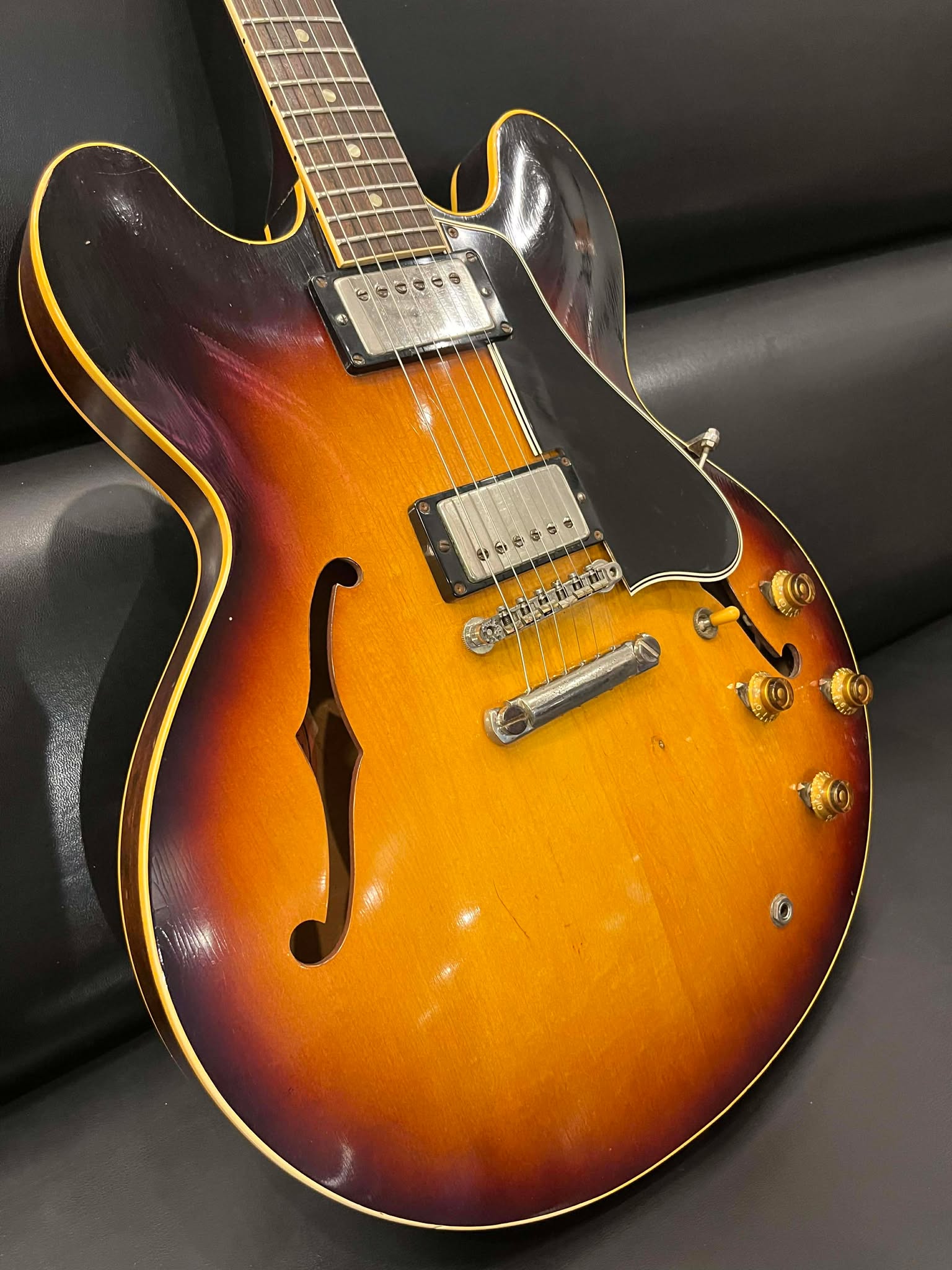
1958-1962 ES-335 “Dot Neck”
Why Dot Necks Are the Most Valuable 335s:
The ES-335 with dot position markers (1958-1962) represents the original production run of one of the most important semi-hollow guitars ever made. “Dot neck” 335s have become a distinct collector category commanding substantial premiums over block marker examples.
All-Original Excellent Condition Value Ranges:
1958 ES-335 Dot (first year, sunburst): $60,000-$100,000
1959 ES-335 Dot (sunburst): $45,000-$80,000
1960 ES-335 Dot (sunburst): $35,000-$65,000
1961 ES-335 Dot (sunburst): $30,000-$55,000
1962 ES-335 Dot (final dot year, sunburst): $25,000-$45,000
Natural finish (any dot year): Add 20-40% premium
Cherry finish (any dot year): Add 15-25% premium
Rarity Scale: 9/10 (1958) to 7/10 (1962)
Critical Value Factors:
PAF pickups (1958-1962): Essential for maximum value
Stop tailpiece vs. Bigsby: Stop tailpiece slightly more desirable (Bigsby adds for players, neutral for collectors)
Mickey Mouse ear cutaways (rounded): Correct for dot era
Long pickguard (extends below bridge): Correct for early production
Orange interior label (1958-1961) vs. white label (1962): Authentication point
How Condition Issues Reduce Value (Dot 335):
Issue | Value Impact |
|---|---|
Replaced PAF pickups | Reduce by 30-45% |
Replaced pots/wiring | Reduce by 10-20% |
Body refinish | Reduce by 45-60% |
Headstock repair | Reduce by 30-45% |
Replaced tuners | Reduce by 10-15% |
Replaced pickguard | Reduce by 5-10% |
Added Bigsby (originally stop tail) | Reduce by 10-20% |
Center block modification | Reduce by 25-35% |
Heavy play wear (original finish) | Reduce by 10-20% |
1963-1970 ES-335 Block Neck
All-Original Excellent Condition Value Ranges:
1963-1964 ES-335 Block (patent number pickups): $15,000-$30,000
1965-1967 ES-335 Block: $10,000-$20,000
1968-1970 ES-335 Block: $7,000-$14,000
Cherry vs. Sunburst vs. Natural: Natural commands 20-30% premium, Cherry 10-15% premium over Sunburst
Rarity Scale: 6/10 to 7/10
Edgewater Observation: We purchase more ES-335s than almost any other vintage Gibson model. The combination of versatility, recognizable name, and strong player and collector demand makes 335s consistently active in our market. The single most common issue we encounter is replaced pickups - players frequently upgraded from T-Top pickups to earlier-style humbuckers, significantly reducing collector value.
1959-1969 ES-345 and ES-355
All-Original Excellent Condition Value Ranges:
ES-345 (Stereo, Varitone):
1959-1962 ES-345 (PAF era): $20,000-$40,000
1963-1965 ES-345 (patent number): $12,000-$22,000
1966-1969 ES-345: $8,000-$15,000
ES-355 (Premium appointments, stereo):
1958-1962 ES-355 (PAF era): $25,000-$50,000
1963-1965 ES-355: $15,000-$28,000
1966-1969 ES-355: $10,000-$18,000
Rarity Scale: 7/10 (345) to 8/10 (355)
Critical Note on Stereo Models: Varitone and stereo electronics must be intact and functional for maximum value. Converted stereo-to-mono examples lose 20-30% of value regardless of why conversion occurred.
How Condition Issues Reduce Value (345/355):
Issue | Value Impact |
|---|---|
Stereo to mono conversion | Reduce by 20-30% |
Varitone removed or bypassed | Reduce by 15-25% |
Replaced PAF pickups | Reduce by 30-40% |
Body refinish | Reduce by 45-60% |
Headstock repair | Reduce by 30-45% |
Replaced tuners or hardware | Reduce by 10-20% |
Missing original case | Reduce by 8-12% |
Gibson Modernistic Series: Flying Vs and Explorers
1958-1959 Flying V (Korina)
Why It’s Extraordinary:
The original 1958-1959 Flying V is among the rarest production guitars ever made. Fewer than 100 were shipped during original production, making verified examples among the most significant guitar finds possible. Korina (African Limba) wood construction, PAF pickups, and radical V-shaped design that was ahead of its time by decades.
All-Original Excellent Condition Value Range:
1958-1959 Flying V, Korina, all-original excellent: $200,000-$400,000+
Museum-quality examples with documentation: $400,000+
Rarity Scale: 10/10 - Fewer than 100 shipped in original production
Authentication Is Critical:
Given the value, fakes exist. Critical authentication points:
Korina wood (African Limba): Distinctive grain pattern, lighter weight than mahogany
String-through body design: Factory original
PAF pickups: Specific construction details verify factory installation
Factory Order Number (FON) matching
Hardware specifics matching 1958-1959 production
DO NOT accept any offer on a 1958-1959 Flying V without multiple expert authentications. If you believe you have one, contact Edgewater immediately - we will travel anywhere to evaluate.
How Condition Issues Reduce Value:
Issue | Value Impact |
|---|---|
Replaced PAF pickups | Reduce by 30-40% |
Body refinish | Reduce by 50-65% |
Replaced hardware | Reduce by 20-35% |
Headstock repair | Reduce by 30-45% |
Any structural modification | Reduce by 40-60% |
1962-1963 Flying V (Korina Reissue)
All-Original Excellent Condition Value Range:
1962-1963 Flying V, Korina, all-original excellent: $40,000-$80,000
Rarity Scale: 9/10
Fewer than 100 of these reissue examples produced as well. Pat number pickups rather than PAFs. Still Korina construction. Authentication requirements nearly as stringent as 1958-1959.
1967-1970 Flying V (Mahogany Era)
All-Original Excellent Condition Value Range:
1967-1970 Flying V, mahogany, all-original excellent: $8,000-$18,000
Rarity Scale: 7/10
Mahogany body rather than Korina. Substantially less rare and valuable than Korina examples but still significantly collectible.
1958-1959 Explorer (Korina)
All-Original Excellent Condition Value Range:
1958-1959 Explorer, Korina, all-original excellent: $250,000-$500,000+
Rarity Scale: 10/10 - Fewer than 40 shipped in original production
Fewer original examples than the Flying V, making authenticated Korina Explorers among the rarest production guitars on earth. Authentication requirements as stringent as Flying V. Expert verification absolutely essential.
1963-1969 Gibson Firebirds
Reverse Body Firebirds (1963-1965)
Why They’re Significant:
The original “reverse” Firebirds (bass side horn longer, designed with help from car designer Ray Dietrich) represent peak Firebird collectibility. Neck-through construction, banjo tuners, and distinctive American car culture aesthetic. Four distinct models with escalating appointments.
All-Original Excellent Condition Value Ranges:
Firebird I (1963-1965, one pickup): $15,000-$28,000
Firebird III (1963-1965, two pickups, vibrato): $18,000-$35,000
Firebird V (1963-1965, trapezoid inlays, vibrato): $20,000-$40,000
Firebird VII (1963-1965, three pickups, block inlays, gold): $25,000-$50,000
Rarity Scale: 8/10 (Firebird I) to 9/10 (Firebird VII)
Custom Color Premium: Firebirds in Ember Red, Cardinal Red, Pelham Blue, or Polaris White factory colors command 40-80% premiums over Sunburst. Custom color authentication requires factory documentation or expert verification.
How Condition Issues Reduce Value (Firebirds):
Issue | Value Impact |
|---|---|
Replaced mini-humbuckers | Reduce by 25-35% |
Refinished body | Reduce by 45-60% |
Replaced banjo tuners (with standard tuners) | Reduce by 15-25% |
Neck break (neck-through construction makes repair critical) | Reduce by 40-55% |
Non-factory color refin (claiming factory color) | Reduce by 50-65% |
Replaced vibrato | Reduce by 15-20% |
Non-Reverse Firebirds (1965-1969)
All-Original Excellent Condition Value Ranges:
Non-reverse Firebird III (1965-1969): $5,000-$10,000
Non-reverse Firebird V (1965-1969): $6,000-$12,000
Non-reverse Firebird VII (1965-1969): $7,000-$14,000
Rarity Scale: 6/10
Significantly less valuable than reverse body examples. Set neck construction (not neck-through). Less distinctive aesthetically. Still collectible with growing enthusiast market.
Gibson Archtop and Acoustic Values
Pre-War Acoustic Gibsons (1920s-1945)
Why Pre-War Gibsons Are Special:
Pre-war Gibson acoustics represent the apex of American acoustic guitar construction. Hide glue construction, Adirondack spruce tops, and hand-craftsmanship that has never been replicated. Player demand from fingerstyle, blues, and folk players combined with collector interest drives strong values.
All-Original Excellent Condition Value Ranges:
Pre-war L-00 (1932-1945, all-original): $4,000-$9,000
Pre-war LG-2 (similar era): $3,500-$7,000
Pre-war J-35 (1936-1942): $6,000-$12,000
Pre-war J-45 (1942-1945 early): $7,000-$14,000
Pre-war Advanced Jumbo (AJ) (1936-1940): $15,000-$30,000
Pre-war SJ-200 (1937-1943): $20,000-$45,000
Pre-war L-5 (archtop, 1922-1945): $8,000-$25,000
Pre-war Super 400 (archtop, 1934-1945): $15,000-$40,000
Rarity Scale: 7/10 (L-00, LG-2) to 10/10 (Advanced Jumbo, early SJ-200)
How Condition Issues Reduce Value (Pre-War Acoustics):
Issue | Value Impact |
|---|---|
Top crack (repaired professionally) | Reduce by 20-35% |
Back or side crack (repaired) | Reduce by 15-30% |
Replaced top | Reduce by 50-70% |
Replaced back | Reduce by 40-60% |
Replaced tuners | Reduce by 10-20% |
Refretted (professional) | Reduce by 8-15% |
Replaced bridge | Reduce by 15-25% |
Replaced nut and/or saddle | Reduce by 5-10% |
Non-original finish repair | Reduce by 20-35% |
Structural brace repairs | Reduce by 10-25% depending on scope |
Edgewater Observation: Pre-war Gibson acoustics are among the most frequently misrepresented vintage instruments we encounter. The combination of significant value and the fact that many owners don’t know what they have creates opportunities for both undervaluation (selling too cheap) and misrepresentation (incorrect year or model). We strongly recommend professional authentication before selling any pre-war Gibson acoustic.
Post-War Gibson Acoustics (1946-1969)
All-Original Excellent Condition Value Ranges:
J-45 (1947-1955, early post-war): $4,000-$8,000
J-45 (1956-1965): $3,000-$6,000
J-45 (1966-1969): $2,500-$4,500
J-50 (natural version of J-45, same era): Similar to J-45, slight premium for natural finish
J-200 (1947-1955): $8,000-$18,000
J-200 (1956-1965): $6,000-$14,000
Southern Jumbo (1942-1954): $4,000-$8,000
Country Western (1955-1960s): $3,000-$6,000
Rarity Scale: 5/10 (common post-war acoustics) to 8/10 (early post-war J-200)
How Condition Issues Reduce Value (Post-War Acoustics):
Issue | Value Impact |
|---|---|
Top crack (professionally repaired) | Reduce by 20-35% |
Replaced top | Reduce by 50-65% |
Refinished body | Reduce by 35-50% |
Replaced tuners | Reduce by 10-15% |
Replaced bridge | Reduce by 15-20% |
Heavy play wear on neck/frets | Reduce by 10-20% |
Structural damage repaired | Reduce by 20-40% |
1965-1970 Gibson Transitional and CBS-Adjacent Era
1968-1972 Les Paul Deluxe
Why It Has Growing Value:
The Les Paul Deluxe marked the return of the Les Paul Standard after the SG era. Mini-humbuckers (actually converted Epiphone pickups in early production) create a distinctive tone. Growing collector interest in the Deluxe as a transitional instrument.
All-Original Excellent Condition Value Ranges:
1968-1969 Les Paul Deluxe (early “pancake” body, goldtop): $5,000-$10,000
1970-1972 Les Paul Deluxe (various colors): $4,000-$8,000
Wine Red or Cherry Sunburst Deluxe (any year): Slight premium (10-15%) over Goldtop
Rarity Scale: 5/10 to 6/10
Pancake Body Note: Early Les Paul Deluxes feature “pancake” body construction (multiple layers of mahogany). This is original construction, not a modification. Pancake bodies are identifiable through control cavity examination.
How Condition Issues Reduce Value (Deluxe):
Issue | Value Impact |
|---|---|
Mini-humbuckers replaced with full-size | Reduce by 20-30% |
Body refinish | Reduce by 35-50% |
Replaced tuners | Reduce by 8-12% |
Headstock repair | Reduce by 25-40% |
Routed for full-size humbuckers | Reduce by 40-55% |
Edgewater Observation: The most common modification we encounter on Les Paul Deluxes is routing for full-size humbuckers. Players seeking the more common Les Paul humbucker sound would route the pickup cavities to accept PAF-style pickups. This modification is largely irreversible and dramatically reduces collector value - a Deluxe routed for full-size humbuckers is essentially worth player-grade pricing only.
1968-1970 Les Paul Custom (Revival)
All-Original Excellent Condition Value Ranges:
1968-1969 Les Paul Custom (black, 2-pickup): $7,000-$14,000
1968-1969 Les Paul Custom (black, 3-pickup): $9,000-$18,000
1970 Les Paul Custom (volute, various colors): $6,000-$12,000
Rarity Scale: 6/10
1970s Gibson Les Paul Standard and Custom
All-Original Excellent Condition Value Ranges:
1973-1979 Les Paul Standard (sunburst): $3,000-$6,000
1973-1979 Les Paul Custom (black or white): $3,500-$7,000
1973-1979 Les Paul Custom (tobacco sunburst): $3,000-$5,500
1973-1979 Les Paul Custom (3-pickup): $4,000-$8,000
Rarity Scale: 4/10 to 5/10
1970s Value Considerations:
1970s Les Pauls have a complicated reputation. Quality varied significantly through the decade. Early 1970s examples (1970-1973) generally preferred over late 1970s. The “Norlin era” stigma (Gibson was owned by Norlin conglomerate) affects collector perception but some examples are genuinely excellent guitars.
How Condition Issues Reduce Value (1970s Les Pauls):
Issue | Value Impact |
|---|---|
Replaced pickups | Reduce by 20-30% |
Refinished body | Reduce by 30-45% |
Headstock repair | Reduce by 25-40% |
Heavy wear (original finish) | Reduce by 10-20% |
3-bolt to 4-bolt neck conversion | Reduce by 15-25% |
Rare and Specialty Gibson Models
1958-1963 Gibson Korina Flying V and Explorer (Summarized)
These are covered in the Modernistic section above. Noting here for search completeness:
1958-1959 Korina Flying V: $200,000-$400,000+ all-original excellent
1958-1959 Korina Explorer: $250,000-$500,000+ all-original excellent
1962-1963 Korina Flying V: $40,000-$80,000 all-original excellent
1963-1965 Reverse Firebird (Summarized)
Covered above. Noting for search reference:
Firebird I through VII: $15,000-$50,000 range all-original excellent
Custom color examples: Add 40-80%
Gibson ES-150 (Pre-War, Charlie Christian Pickup)
All-Original Excellent Condition Value Range:
ES-150 with Charlie Christian pickup (1936-1939): $5,000-$12,000
ES-150 post-war (P-90 era): $2,000-$4,500
Rarity Scale: 8/10 (Charlie Christian era) to 5/10 (post-war)
The blade pickup design (Charlie Christian model) represents the earliest chapter in Gibson electric guitar history and carries significant historical value.
Gibson Super 400CES (Electric Archtop)
All-Original Excellent Condition Value Ranges:
1951-1956 Super 400CES (P-90 era): $12,000-$25,000
1957-1962 Super 400CES (PAF era): $18,000-$40,000
1963-1969 Super 400CES (patent number era): $10,000-$20,000
Rarity Scale: 8/10
Top-of-line Gibson archtop with premium appointments. PAF-equipped examples particularly valuable. Association with jazz players adds market depth.
Gibson ES-175
All-Original Excellent Condition Value Ranges:
1949-1953 ES-175 (P-90, single pickup): $4,000-$9,000
1957-1961 ES-175 (PAF humbuckers): $8,000-$18,000
1962-1969 ES-175 (patent number pickups): $5,000-$10,000
Rarity Scale: 6/10 to 7/10
Strong jazz player demand drives ES-175 market. PAF-equipped examples in premium position.
Complete Value Reduction Reference Guide
Understanding Cumulative Modifications
Modifications compound. A guitar with three value-reducing issues doesn’t simply add the percentages - the calculation becomes more complex.
Single Modification Example:
1964 ES-335 all-original excellent: $18,000
Replaced pickups only: Reduce by 30% = approximately $12,600
Multiple Modification Example:
1964 ES-335 all-original excellent: $18,000
Replaced pickups (30% reduction): $12,600
Headstock repair on top of that (30% reduction of remaining): approximately $8,820
Refinished body on top of that (40% reduction of remaining): approximately $5,292
The compound effect means a guitar with three significant modifications can be worth 25-30% of its all-original value - or less.
Universal Value Reduction Table
Apply these to any vintage Gibson model as starting reference:
Condition/Modification | Typical Value Impact |
|---|---|
Finish Issues | |
Body refinish (professional) | Reduce by 40-60% |
Body refinish (amateur) | Reduce by 55-70% |
Neck refinish | Reduce by 20-35% |
Headstock face refinish | Reduce by 15-25% |
Heavy play wear (original finish) | Reduce by 15-25% |
Light play wear (original finish) | Reduce by 5-10% |
Structural Repairs | |
Headstock break, invisible professional repair | Reduce by 30-40% |
Headstock break, visible repair | Reduce by 40-55% |
Headstock break, poor repair | Reduce by 50-65% |
Body crack, professionally repaired | Reduce by 15-30% |
Neck reset (professional, acoustic) | Reduce by 10-20% |
Pickup and Electronics | |
Replaced original humbuckers (1 pickup) | Reduce by 25-35% |
Replaced original humbuckers (both) | Reduce by 35-50% |
Replaced P-90 pickups | Reduce by 25-35% |
Replaced pots/capacitors (wiring harness) | Reduce by 10-20% |
Replaced output jack | Reduce by 3-8% |
Modified wiring/switching | Reduce by 10-25% |
Added or removed pickup (routing modified) | Reduce by 35-55% |
Hardware | |
Replaced tuners (correct replacements) | Reduce by 8-15% |
Replaced tuners (wrong type) | Reduce by 15-25% |
Replaced bridge (correct type) | Reduce by 10-20% |
Replaced bridge (wrong type) | Reduce by 20-35% |
Replaced tailpiece | Reduce by 10-20% |
Added Bigsby (originally without) | Reduce by 15-25% |
Removed factory Bigsby | Reduce by 15-25% |
Fretwork | |
Professional refret (correct wire) | Reduce by 5-10% |
Professional refret (wrong wire size) | Reduce by 10-20% |
Poor quality refret | Reduce by 15-30% |
Refretted and binding damaged | Reduce by 20-35% |
Other | |
Missing original case (correct era) | Reduce by 8-15% |
Wrong era case | Reduce by 5-8% |
Missing pickup rings/covers | Reduce by 5-10% |
Missing knobs (replaced with correct type) | Reduce by 5-10% |
Missing knobs (replaced with wrong type) | Reduce by 10-15% |
Heavy fretwear (original frets playable) | Reduce by 5-15% |
What Does NOT Reduce Value (Common Misconceptions)
Natural Aging That Is NOT a Problem:
Finish checking (fine cracks in lacquer) - expected and correct on vintage instruments
Honest play wear and light buckle rash on original finish
Yellowing or amber toning of original finish
Faded colors (sunbursts fading to “honeyburst” or custom colors shifting hue)
Light fret wear consistent with decades of play
Oxidized hardware (original patina)
Dried or worn pickguard material (original celluloid aging)
Slightly lifted binding edges (minor, not separated)
Minor Items with Minimal Impact:
Replaced nut (if done professionally with correct material): 2-5% reduction
Replaced strap buttons: Minimal impact
Repaired finish dings (properly matched): 2-5% reduction
How to Get Maximum Value for Your Vintage Gibson
Step 1: Identify Your Model Accurately
Many sellers don’t know exactly what model they have. Key questions:
What name appears on the truss rod cover or headstock?
What is the serial number? (Back of headstock on most models)
What pickups are installed? (P-90 soapbars, humbuckers, mini-humbuckers)
Single or double cutaway?
What year did you or the original owner purchase it?
Step 2: Assess Originality Honestly
Before contacting buyers, do a honest personal inventory:
Has the guitar ever been refinished? (Even touch-up work)
Have pickups been replaced? (Lift pickguard/examine routing)
Has the headstock been repaired? (Check for paint irregularities on back, feel for filler)
Have tuners been replaced? (Check screw holes for plugged holes, wrong footprint)
Has the wiring been changed? (Check pot codes in control cavity)
Step 3: Get Multiple Expert Opinions
Do NOT accept first offer without comparison. Local guitar shops typically offer 40-50% of market value. Expert buyers like Edgewater offer 60-70% of market value. The difference can be thousands to tens of thousands of dollars depending on the instrument.
Step 4: Gather Documentation
Anything you have increases confidence and value:
Original case (with original latches, hinges, interior)
Original sales receipt
Period photographs with original owner
Repair records from professional luthiers
Original hang tags, warranty cards, accessories
Step 5: Contact Edgewater for Free Expert Valuation
Edgewater Guitars provides free, no-obligation authentication and valuation for vintage Gibson guitars throughout Ohio, Michigan, Pennsylvania, Indiana, and West Virginia. We travel for exceptional instruments.
Our evaluation includes:
Serial number verification and dating
Factory Order Number examination
Potentiometer code verification
Pickup originality assessment
Finish authentication
Complete condition documentation
We typically offer 30-40% more than local guitar shops due to our direct-to-collector business model. Call (440) 219-3607 or visit our valuation page.
Selling Options: Where to Get the Best Price for Your Vintage Gibson
Selling Option | Expected Offer | Timeline | Best For |
|---|---|---|---|
Edgewater Guitars | 60-70% of market value, 30-40% above shops | 1-3 days | Fair value, immediate payment, expert authentication |
Local Guitar Shop | 40-50% of market value | Same day | Absolute convenience only |
Online Marketplace (Reverb/eBay) | 70-85% net after fees | 2-8 weeks | Experienced online sellers with documentation |
Auction House | 65-85% net after 15-25% premium | 3-6 months | Museum-quality examples only (bursts, Korina) |
Consignment Shop | 70-80% net after 20-30% commission | Weeks-months | Patient sellers wanting shop expertise |
Private Sale | 80-100% | Unpredictable | Experienced sellers with direct collector contacts |
Frequently Asked Questions: What Is My Vintage Gibson Worth?
Q: What is the most valuable vintage Gibson guitar?
A: Authenticated 1958-1959 Korina Explorers in all-original excellent condition represent the apex of Gibson values, with exceptional examples exceeding $500,000. Among more commonly available instruments, 1959 Les Paul Standards with heavily figured tops and complete originality routinely exceed $400,000-$600,000. 1954-1959 Korina Flying Vs and 1958-1962 dot-neck ES-335s with PAF pickups round out the upper tier.
Q: What is my 1970s Les Paul worth?
A: 1970s Les Paul Standards and Customs in all-original excellent condition typically range from $3,000-$7,000 depending on specific year, model, and finish. Condition issues reduce these values significantly - refinished examples might bring $1,500-$3,000, heavily modified examples less. The Norlin era (Gibson owned by Norlin conglomerate through the 1970s) carries reputation concerns, but quality varies considerably and some examples are excellent.
Q: Does a headstock repair destroy my Gibson’s value?
A: It reduces value significantly but doesn’t destroy it. A professional, invisible headstock repair on a pre-1965 Gibson typically reduces value by 30-40% from all-original excellent condition. On a 1959 Les Paul Standard worth $400,000 in all-original excellent condition, a headstock repair might reduce value to $240,000-$280,000 - still enormously valuable. The guitar is worth substantially less, but far from worthless.
Q: Are PAF pickups that valuable by themselves?
A: Yes. Original PAF humbuckers (Patent Applied For, 1957-1962) in working condition are worth significant money independently. A matched pair of functioning PAF pickups can bring substantial standalone value from players and collectors seeking them for restorations. If your vintage Gibson has original PAFs that have been removed, keep them - they represent meaningful value whether sold with the guitar or separately.
Q: What is my vintage Gibson SG worth?
A: Depends entirely on year and configuration. 1961-1962 Les Paul/SG transitional models with PAF pickups in all-original excellent condition: $25,000-$50,000. 1963-1966 SG Standards: $8,000-$20,000 all-original excellent. 1967-1969 witch hat era SGs: $4,000-$8,000. Headstock repairs (extremely common on SGs) reduce these values by 30-45%.
Q: Is my refinished Les Paul worthless?
A: No - far from it. A refinished 1959 Les Paul Standard with original PAF pickups and intact original parts might still be worth $120,000-$180,000 despite the refinish. A refinished 1965 ES-335 with original electronics might be worth $6,000-$10,000 despite the refinish. Refinishing significantly reduces value but doesn’t eliminate it, especially for historically significant guitars with original components.
Q: Should I get a professional appraisal before selling?
A: For high-value vintage Gibsons ($20,000+), professional appraisal makes sense if you’re selling via auction or need documentation for insurance/estate purposes. For most sellers, expert buyer evaluation (like Edgewater’s free service) provides the information you need without appraisal cost. Don’t pay for appraisal just to sell to a shop - they’ll set their own value regardless.
Q: What vintage Gibson models are undervalued in 2026?
A: In our experience, several categories remain undervalued relative to their quality and historical significance: early pre-war Gibson acoustics (L-00, Southern Jumbo), 1950s P-90 equipped Les Paul Juniors and Specials, non-reverse Firebirds, and early 1970s Les Paul Customs in excellent all-original condition. These categories offer strong value relative to their current market positioning.
Q: Does Edgewater Guitars buy all vintage Gibsons?
A: We focus primarily on pre-1970 Gibson guitars in any condition - from museum-quality bursts to refinished player-grade examples. We purchase Les Pauls, SGs, ES-series, Firebirds, acoustic models, and archtops. Even modified, refinished, or well-worn examples have value we recognize. Contact us at (440) 219-3607 with details of any vintage Gibson.
Q: How do I find my Gibson’s serial number?
A: Location varies by era. 1952-1960: Ink-stamped on back of headstock (5 or 6 digits). 1961-1969: Impressed (embossed) into back of headstock. 1970-1975: Usually on back of headstock. 1975+: On back of headstock with letter prefix (first two digits after letter = year). Some pre-1955 examples also have Factory Order Number (FON) inside body visible through pickup routes. Edgewater’s serial number lookup tool can help decode your serial.
Gibson Model Value Guides and Resources
For a deeper, model-specific look at value and dating, see our dedicated guides:
ES Series:
SG Series:
Les Paul Series:
Solidbody Rarities:
Student and Budget Models:
Acoustic and Archtop:
Related Resources
Gibson Serial Number Lookup Tool - Decode your serial number and identify production year
What Is My Vintage Fender Worth?, a parallel value guide for Fender owners
Gibson PAF Pickup Authentication Guide - Verify original Patent Applied For pickups
The Best Way to Sell Vintage Gibson - Complete selling options comparison
How to Spot Refinished Gibson Guitars - Authentication guide for finish originality
Gibson Les Paul Standard 1959 Complete Guide, detailed model-specific authentication
Vintage Gibson ES-335 Dot Neck Guide, complete dot neck identification and value
Sell Your Guitar to Edgewater - Start your free valuation process
Edgewater Guitars purchases vintage Gibson guitars throughout Ohio, Michigan, Pennsylvania, Indiana, and West Virginia. For high-value instruments including Les Paul Standards, ES-335 dot necks, Korina Flying Vs and Explorers, and other significant vintage Gibsons, we travel beyond our standard service area. Our authentication expertise and direct-to-collector business model means we consistently offer 30-40% more than traditional guitar shops. Contact us for your free, no-obligation valuation: get a free estimate here or call (440) 219-3607.
Related: Selling a Gibson in Ohio? See the best place to sell a Gibson guitar in Ohio, our statewide guide with model-by-model values.