DATE :
Gibson Trini Lopez Standard Value Guide (1964 to 1971)
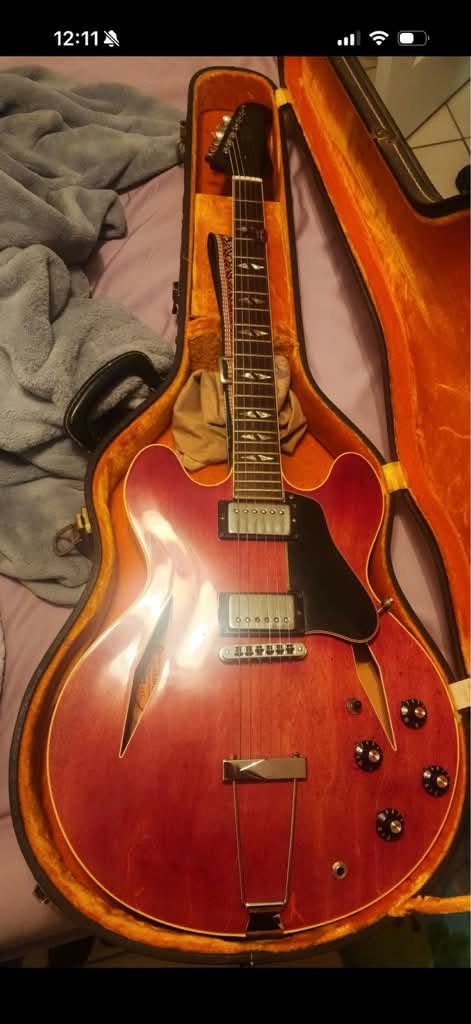
A Gibson Trini Lopez Standard is a 1964 to 1971 ES-335-style thinline semi-hollow guitar built for singer-guitarist Trini Lopez, identified by its diamond-shaped f-holes, split-diamond fretboard inlays, and Firebird-style headstock. Originality, finish, and condition drive most of the value swing between examples. Call or text (440) 219-3607 or text us photos.
Gibson Trini Lopez Standard history and identification
Gibson built the Trini Lopez models after approaching the singer and guitarist in 1964, and the line ran into the early 1970s. Two very different guitars carried the Trini Lopez name, and mixing them up is the most common identification mistake sellers make.
Trini Lopez Standard: built on the same body shape as the ES-335, a three-ply maple/poplar/maple thinline semi-hollow with a solid center block. This is the more common of the two models, and by far the more likely one to turn up in someone's closet.
Trini Lopez Deluxe: a full-depth archtop hollow body based on the Barney Kessel Artist model, with Florentine horns. The Deluxe is the rarer guitar: Gibson shipped roughly 1,966 Standards against only about 307 Deluxes over the model's run, a ratio of about 6 to 1.
Both models share the same distinctive features: diamond-shaped soundholes in place of the usual f-holes, split-diamond inlays on the fretboard, a six-on-a-side headstock in the Firebird style, and a trapeze tailpiece carrying a small "Trini Lopez" name plaque. Cherry red was the standard finish on both, and other factory colors such as sunburst or Pelham Blue show up far less often and typically carry a premium. Pickups on both models were Gibson's humbuckers of the era.
If you're not sure which one is sitting in your case, the body depth is the fastest tell: the Standard is a thin, thinline body you can span with one hand at the rim, while the Deluxe is noticeably deeper front to back, like a full archtop jazz guitar.
How to date a Trini Lopez Standard by serial number and features
Trying to pin down an exact year from the serial number alone is one of the more frustrating parts of dating a mid-to-late-1960s Gibson, and the Trini Lopez Standard is no exception. Gibson's serial number system from this era reused number blocks across multiple years, so the same serial range can point to two, three, or even four different years depending on the guitar. Some ranges from the mid to late 1960s resolve to a single year, but a meaningful share overlap, which is why a serial number by itself often isn't enough.
The more reliable approach combines the serial number with physical features: potentiometer date codes, headstock logo style, and the presence or absence of a neck volute all help narrow the window. If you want to run your own guitar's numbers, our Gibson serial number lookup walks through the ranges and what else to check when the serial alone won't settle it.
On a Trini Lopez Standard specifically, also look at the tailpiece. The factory trapeze tailpiece is the usual original setup. Some examples have had a Bigsby vibrato installed later as an aftermarket modification, and the tell is lacquer shadowing on the body where the original trapeze mounting points used to sit exposed to light. A guitar wearing a non-original Bigsby is not "wrong," but it isn't factory-original either, and that matters for value.
The 1968 Trini Lopez Standard Edgewater bought
One of the more memorable Trini Lopez Standards to come through Edgewater was a 1968 example that arrived in incredibly clean, almost mint condition, complete with its original case. It came to us from the family of the original owner, and it's one of the cleanest examples of this model we have ever seen: the diamond f-holes, the split-diamond inlays and that thin ES-335-style semi-hollow body, all in near-mint shape.
We don't publish what we paid on guitars like this one (that stays between us and the seller), but the story is a good illustration of what we look for: a guitar that's stayed close to original and has been cared for, ideally with paperwork or a family history behind it. Edgewater bought this guitar, and it's exactly the kind of find we're always hoping shows up in the next set of photos someone sends us.
What a Gibson Trini Lopez Standard is worth
Real-world asking prices for clean, all-original 1968 Trini Lopez Standards currently sit well into five figures. Cream City Music has an all-original 1968 Cherry example, original hardshell case included, asking $10,499. Jimmy Wallace Guitars has a 1968 Cherry example in very good original condition asking $12,500. A rare-finish 1968 in Pelham Blue at Chicago Music Exchange is asking $57,995, which reflects how much a factory color other than cherry can move the number rather than a typical price. For historical context, Premier Guitar's Vintage Vault column has cited Sunburst and Cherry Standards trading in the $3,000 to $6,000 range in past years, with rare Pelham Blue examples reaching close to $18,000, so today's asking prices on clean cherry examples show real appreciation over that older data.
Edgewater's cash offer on a clean, all-original cherry Trini Lopez Standard would typically land around 20% under current dealer asking figures like those above, and lower still on a guitar with a replaced bridge, tailpiece, tuners, or finish. Condition, originality, and finish move the number more than anything else, so the accurate figure for your specific guitar is a free appraisal, not a table like this one. You can also get a ballpark read any time at what's my guitar worth.
What moves the value up or down
Factor | Effect on value |
|---|---|
All-original hardware and electronics | Higher. Original pickups, tuners, bridge, and tailpiece matter more on this model than on many other vintage electrics. |
Original trapeze tailpiece vs. a Bigsby retrofit | A factory-original trapeze holds value better. An aftermarket Bigsby, visible as lacquer shadowing around the original mounting points, is a modification. |
Original cherry finish, unrefinished | Higher. Any refinish, touch-up, or oversprayed area drops value noticeably, even if it looks good. |
Rare factory finish (Pelham Blue, other custom colors) | Higher, often significantly, if the finish is verified original to the guitar and not a repaint. |
Repairs (headstock, neck, cracks) | Lower, even when professionally done. A repaired headstock in particular is a common flag on this model. |
Case | The original Gibson case adds value and helps confirm the guitar hasn't been heavily reworked over the years. |
Annie Fuller, who bought a 1963 Gibson ES-335 from us for her dad, put it this way: "I recently bought a 1963 Gibson ES-335 from Stephen at Edgewater Guitars for my dad, and he absolutely loves it! ... professional, knowledgeable, and made the entire process easy ... Highly recommend." The same close attention to originality and condition that goes into an ES-335 purchase applies directly to a Trini Lopez Standard, since it's built on the same body.
How to sell your Trini Lopez Standard to Edgewater
If you have a Trini Lopez Standard you're thinking about selling, the fastest way to get a real answer is to send us clear photos: the full front and back, close-ups of the diamond f-holes and tailpiece, the headstock front and back, and a shot of the serial number stamped inside the headstock. Note any repairs, replaced parts, or refinish work you're aware of, since we'll ask about those anyway.
From there, start a free estimate or head to our sell your Gibson page for the full process. We buy nationwide, cover shipping, and pay by check or PayPal the same day your guitar arrives and checks out. Call or text (440) 219-3607 or text us photos any time.
Frequently asked questions
What makes a Gibson Trini Lopez Standard different from a regular ES-335?
The body shape and construction are the same thinline semi-hollow design as an ES-335, but the Trini Lopez Standard swaps the f-holes for diamond-shaped soundholes, uses split-diamond fretboard inlays instead of dot or block markers, and has a six-on-a-side Firebird-style headstock instead of the standard ES-335 headstock. It also carries a trapeze tailpiece with a small Trini Lopez name plaque rather than a stopbar or standard trapeze.
How do I know if my Trini Lopez is a Standard or a Deluxe?
Check the body depth. The Standard is a thin, semi-hollow thinline body, similar in feel to an ES-335. The Deluxe is a full-depth archtop hollow body based on the Barney Kessel Artist model, noticeably deeper front to back. The Standard is also far more common, since Gibson built roughly six Standards for every Deluxe.
How can I tell what year my Trini Lopez Standard was made?
Start with the serial number, but treat it as a starting point rather than a final answer for guitars from the mid to late 1960s, since Gibson reused serial number blocks across multiple years in that era. Cross-check the serial against physical features like potentiometer date codes and headstock details. Our Gibson serial number lookup covers the ranges and what else to look for.
Does a replaced tailpiece or a refinish hurt the value?
Yes. An aftermarket Bigsby in place of the original trapeze tailpiece, a refinished body, or replaced hardware all reduce value compared to an all-original example, even when the work was done well. Originality is one of the biggest value drivers on this model.
What is a clean, all-original 1968 Trini Lopez Standard worth?
Current dealer asking prices for clean, all-original cherry 1968 examples run from about $10,500 to $12,500, based on current listings from Cream City Music and Jimmy Wallace Guitars. Rare original finishes like Pelham Blue can bring significantly more. Your guitar's exact condition, originality, and any repairs will move the number up or down from there, so a free appraisal is the accurate next step.
How do I get an offer from Edgewater on my Trini Lopez Standard?
Send clear photos of the front, back, headstock, and serial number through our free estimate form, or call or text (440) 219-3607. We'll let you know what we can offer, cover shipping if you decide to sell, and pay the same day the guitar arrives and checks out.
By Stephen Pedone, co-owner of Edgewater Guitars. Last updated: September 2026.
Sources
Guitar World, "The history of the Gibson Trini Lopez Standard"
Premier Guitar, "Vintage Vault: 1967 Gibson Trini Lopez Standard"
Reverb News, "How to Date a Gibson Using Serial Numbers, FONs and Logos"
Cream City Music, 1968 Gibson Trini Lopez Standard Cherry listing
Jimmy Wallace Guitars, 1968 Gibson Trini Lopez Standard listing
Chicago Music Exchange, 1968 Gibson Trini Lopez Standard Pelham Blue listing