DATE :
How to Date Your Vintage Gibson Melody Maker: Complete 1959-1971 Authentication Guide
How to Date Your Vintage Gibson Melody Maker: Complete 1959-1971 Authentication Guide
Why Dating Your Vintage Gibson Melody Maker Matters
Gibson’s Melody Maker was the company’s budget, student-level solidbody, built from 1959 to 1971, and its body shape changed twice over that run, which makes it one of the easier vintage Gibsons to date by eye once you know the eras. Getting the year right matters for authentication, insurance, and understanding what a fair, honest buyer should pay.
This guide walks through the three body-shape eras, the one-pickup versus two-pickup Melody Maker D question, and how to use the serial number as a supporting check rather than your only method.
Gibson Melody Maker Body-Shape Eras (1959-1971)
1959-1961: Single-cutaway
The Melody Maker launched in 1959 with a single-cutaway slab-mahogany body styled after the Les Paul Junior, but noticeably thinner. This is the original and rarest body style, and it was discontinued in 1961 when Gibson moved to a double-cutaway design.
1961-1966: Double-cutaway
In 1961 Gibson replaced the single-cutaway body with a symmetrical double-cutaway shape, similar to a double-cutaway Les Paul Junior. This became the most common Melody Maker body style, produced for roughly five years, with more rounded edges and horns set farther from the neck appearing from 1963 onward.
1966-1971: SG-shaped
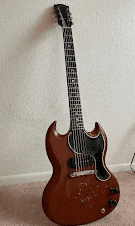
By the mid-1960s Gibson reshaped the Melody Maker to match the SG body, with sharper, pointed double cutaways and a white pickguard. Later in this era Gibson also sold two- and three-pickup versions under the Melody Maker II and III names.
One Pickup or Two: The Melody Maker D
The standard Melody Maker carries a single narrow single-coil pickup, distinct from the wider P-90 used on other Gibson budget models. Gibson introduced a factory two-pickup version, the Melody Maker D, in late 1959, and it shipped in real volume starting in 1960. A two-pickup guitar with two volume controls, two tone controls, and a selector switch is a D model; a single pickup with one volume and one tone control is the standard Melody Maker.
Serial Numbers and Factory Order Numbers
Gibson’s serial number and Factory Order Number systems from this era are not simple, strict year codes, and ranges overlapped between years. Use our Gibson serial number lookup as a starting point, and confirm the year primarily with body shape and pickup configuration, which are far more reliable for this model.
Other Physical Features Worth Checking
Neck scale
Most Melody Makers carry a standard-scale neck, but Gibson also offered a short-scale 3/4 neck option through the early-to-mid 1960s, aimed at younger or smaller-handed players. A documented 3/4-scale example, especially from a low-production year, is a genuine rarity within the model.
Finish
Sunburst was the standard finish from 1959 into the mid-1960s. Gibson later added Cherry, starting on the Melody Maker D in 1963, and other solid colors on the later SG-shaped versions.
Fingerboard and neck wood
Expect a mahogany neck and an unbound rosewood fingerboard with simple dot position markers across nearly the entire run.
Red Flags and Common Modifications
Replaced pickups: many Melody Makers had their original narrow single-coil pickups swapped for P-90s or humbuckers over the decades. This is the single most common and most value-affecting modification.
Refinished bodies: an added pickguard hole, filled routing, or a non-original finish are signs of a modification, not a factory feature.
Added vibrato: some players added aftermarket vibrato units later; factory vibrato was a documented, later option, not a feature of the earliest guitars.
Headstock repairs: check carefully, as with any glued-neck Gibson.
Melody Maker Guides and Related Reading
Sell Your Vintage Gibson Melody Maker
Edgewater Guitars buys vintage Gibson Melody Makers nationwide, single-cutaway, double-cutaway, and two-pickup D versions alike, with free, no-pressure appraisals and fair, honest offers. To sell yours, request a free estimate.
Frequently Asked Questions
How can I tell if my Melody Maker is a D (two-pickup) model?
Count the pickups and controls. A Melody Maker D has two single-coil pickups, two volume controls, two tone controls, and a three-way selector switch. The standard Melody Maker has one pickup and a single volume and tone control.
What year did the Melody Maker change from single to double cutaway?
1961. Gibson replaced the original single-cutaway slab body with a symmetrical double-cutaway shape that year, and the single-cutaway version was discontinued.
Does Edgewater Guitars buy vintage Gibson Melody Makers?
Yes, Edgewater Guitars buys vintage Gibson Melody Makers nationwide, single-cutaway, double-cutaway, and two-pickup D versions alike, with free, no-pressure appraisals.