DATE :
How to Date Your Vintage Gibson Les Paul Junior: Complete Authentication Guide
How to Date Your Vintage Gibson Les Paul Junior: Complete Authentication Guide
Why Dating Your Les Paul Junior Matters
The Gibson Les Paul Junior represents one of the most significant and collectible guitars in rock history—a straightforward, working musician’s instrument that defined generations of rock and roll. Learning how to date your vintage Gibson Les Paul Junior accurately is essential for authentication, proper valuation, insurance documentation, and understanding your instrument’s place in guitar history.
Les Paul Juniors experienced significant design changes throughout their production history, making accurate dating both challenging and crucial. A 1954 single-cutaway Junior differs substantially from a 1958 double-cutaway model, and these variations dramatically affect collectability and value. Certain years command premium prices due to transitional features, limited production, or historical significance.
This comprehensive guide teaches you how to date your vintage Gibson Les Paul Junior using multiple authentication methods, ensuring accuracy regardless of which era your instrument represents.
The Les Paul Junior: Historical Overview
Understanding the Les Paul Junior’s evolution provides context for dating your specific instrument:
Birth of the Les Paul Junior (1954)
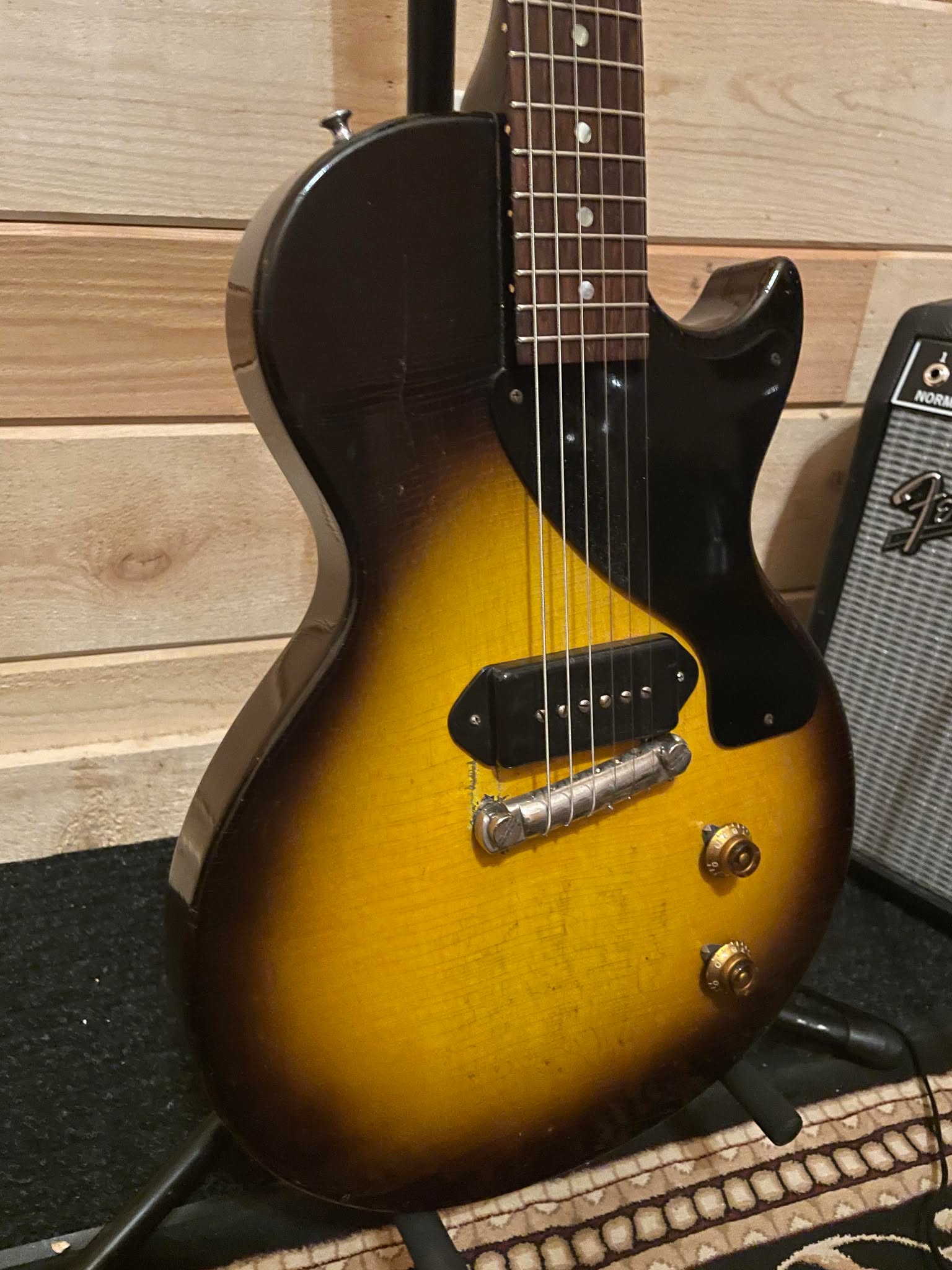
Gibson introduced the Les Paul Junior in 1954 as an affordable alternative to the Les Paul Standard and Custom models. The Junior philosophy prioritized playability and tone over visual appointments:
Original Concept:
Single P-90 pickup (bridge position)
Solid mahogany body (no maple cap)
Unbound rosewood fingerboard
Dot inlays (simple and functional)
Wraparound bridge/tailpiece combination
Sunburst or TV Yellow finish options
Target Market: Working musicians and students who needed professional Gibson quality at accessible prices. Despite “Junior” designation, these guitars became professional instruments used by countless legendary guitarists.
Major Design Evolution
1954-1958: Single Cutaway Era
Original Les Paul body shape
Slab mahogany construction
Various finish options
Consistent single-pickup configuration
1958-1961: Double Cutaway Introduction
Revolutionary body redesign mid-1958
Improved upper fret access
Maintained single P-90 pickup
Became the iconic Junior design
1961-1963: SG Body Transition
Les Paul Junior name continued with SG body
Thinner, lighter construction
Enhanced playability
Eventually renamed “SG Junior”
1963-Present: SG Junior Era
“Les Paul” designation dropped
Established as distinct SG model
Continues in various forms
Why Les Paul Juniors Are Highly Collectible
Before diving into dating methods, understanding what makes these guitars valuable:
Historical Significance: Les Paul Juniors were played by Leslie West, Billie Joe Armstrong (Green Day), Johnny Thunders (New York Dolls), and countless other influential guitarists who proved that simplicity and tone matter more than elaborate appointments.
Sonic Characteristics: The single P-90 pickup in bridge position delivers aggressive, cutting tone that defined rock music. The all-mahogany construction provides warmth and sustain impossible to replicate with modern manufacturing.
Investment Potential: Vintage Les Paul Juniors have appreciated significantly. Single-cutaway models from 1954-1958 command strong prices, while double-cutaway examples from 1958-1961 are increasingly sought after.
Playability: Despite being budget models, Juniors featured the same quality construction, neck profiles, and setup as premium Les Pauls, making them exceptional playing instruments.
Gibson Les Paul Junior Serial Number Systems
Understanding Gibson’s serial number systems is the foundation for dating your Les Paul Junior. However, serial numbers alone cannot definitively date these guitars—always use multiple verification methods.
Important Resource: For quick serial number reference, use our Gibson Serial Number Lookup Tool to find your guitar’s approximate year based on serial number ranges.
1954-1961: Ink-Stamped Serial Numbers
Les Paul Juniors from this era used Gibson’s ink-stamped serial number system:
Location: Inside control cavity (visible when removing control plate cover on back of guitar)
Format: 5 digits (early examples) progressing to 6 digits (later examples)
Approximate Serial Number Ranges by Year:
1954: 4xxxx - 5xxxx range (first year production)
1955: 5xxxx - 6xxxx range
1956: 6xxxx - 7xxxx range
1957: 7xxxx - 8xxxx range
1958: 8xxxx - 9xxxx range
1959: 9xxxx - 0xxxx range (numbering restarted)
1960: 0xxxx - 1xxxx range
1961: 1xxxx - 2xxxx range
Critical Notes About This System:
Significant overlap exists between years
Same numbers appear across multiple years
Some guitars have no serial number
Numbers weren’t strictly chronological
Serial numbers alone are insufficient for accurate dating
How to Find Your Serial Number:
Remove the control plate cover on back of guitar (typically 2 screws)
Look inside the control cavity
Serial number stamped in ink on wood
May be faded or difficult to read
Use flashlight for better visibility
Record complete number exactly as it appears
Pro Tip: Use our Gibson Serial Number Lookup Tool for instant reference once you’ve found your serial number.
Factory Order Numbers (FON): The Most Reliable Method
Factory Order Numbers provide more accurate dating than serial numbers for vintage Les Paul Juniors:
What FON Tells You: Production batch and year of manufacture
Location: Inside control cavity, stamped on wood or written in pencil
Sometimes on small paper or cardboard tag
May be near serial number
Occasionally on back of pickup
Format: Letter followed by 3-4 digits
Letter indicates year
Numbers indicate production batch
FON Letter Codes (1954-1961):
X = 1954
W = 1955
V = 1956
U = 1957
T = 1958
S = 1959
R = 1960
Q = 1961
Example: FON “V 3847” indicates 1956 production, batch 3847
How to Find FON:
Remove control plate cover
Inspect entire control cavity carefully
Look for stamped letter + numbers
Check all visible wood surfaces in cavity
May be partially obscured by wiring
Sometimes very faint or worn
Why FON Is More Reliable:
Tracked production batches accurately
Less overlap between years
More consistent application
Used for factory records
Cross-referenced with other documentation
Dating by Physical Features: Year-by-Year Guide
Les Paul Juniors changed significantly over production years. Physical features provide crucial dating evidence:
1954 Les Paul Junior (First Year)
Body Design:
Single cutaway Les Paul shape
Slab mahogany body (no carved top)
Flat top surface
Standard Les Paul body contours
Finish Options:
Sunburst (most common)
TV Yellow (less common, sometimes called “Limed Mahogany”)
Natural mahogany back and sides
Pickup:
Single P-90 pickup in bridge position
Cream-colored pickup cover (early examples)
Black pickup cover (later 1954, transitional)
“Soap bar” style P-90
Dog-ear mounting (screwed directly to body)
Bridge/Tailpiece:
Wraparound bridge/tailpiece combination
Single piece unit
Strings wrap over and through
Nickel-plated hardware
Non-compensated (straight) design initially
Neck:
Chunky profile (substantial feel)
Mahogany construction
Rosewood fingerboard (unbound)
Dot inlays (small pearl dots)
22 frets
Gibson decal on headstock
Headstock:
“Les Paul Junior” in gold silkscreen
Gibson logo in pearl
“Only a Gibson Is Good Enough” banner (early 1954 only, very rare)
Crown inlay (some examples)
Hardware:
Kluson Deluxe tuners (3-on-a-side)
Single-ring Kluson tuners
Plastic tuner buttons
Nickel-plated hardware throughout
Controls:
Single volume control
Single tone control
Black “speed” knobs (gold insert)
Simple wiring configuration
Weight: Typically 7-8 lbs (solid mahogany)
1955-1957 Les Paul Junior
Consistent Features (changes minimal during these years):
Body: Single cutaway slab mahogany continues
Finish Options:
Sunburst standard
TV Yellow available
Cherry introduced 1958
Pickup Evolution:
Black P-90 covers become standard (replacing cream)
P-90 specifications refined
Mounting remains dog-ear style
Alnico magnets
Bridge Changes:
1956-1957: Some examples have compensated wraparound bridge
Slight saddle contouring for better intonation
Otherwise similar to 1954-1955
Neck Profiles:
Slight variations in thickness
Generally substantial profiles
Hand-shaped, individual variations exist
Hardware:
Kluson Deluxe tuners continue
Some variation in tuner button styles
Nickel hardware standard
Identifying Features by Year:
1955: Serial numbers 5xxxx range, FON “W”
1956: Serial numbers 6xxxx range, FON “V”, compensated bridge may appear
1957: Serial numbers 7xxxx range, FON “U”, compensated bridge more common
1958 Les Paul Junior (Transitional Year)
Critical Design Change: Mid-1958 introduction of double cutaway body
Early 1958 (Single Cutaway):
Serial numbers 8xxxx range
FON “T”
Single cutaway body continues
Cherry finish introduced as option
All previous features maintained
Mid-to-Late 1958 (Double Cutaway Introduction):
Revolutionary body redesign
Symmetrical double cutaway
Improved upper fret access
Thinner body profile
Lighter weight (typically 6-7 lbs)
Double Cutaway Specifications:
Slab mahogany body (no carving)
Flat top and back
Symmetrical horns
Rounded cutaway edges
Enhanced ergonomics
Other 1958 Features:
Cherry finish becomes popular
Sunburst and TV Yellow continue
P-90 pickup in bridge position (dog-ear)
Wraparound bridge/tailpiece
Dot inlays
Unbound fingerboard
Dating 1958 Juniors:
Single cutaway = early 1958
Double cutaway = mid-to-late 1958
Serial number + FON essential for precise dating
Body style primary indicator
1959-1960 Les Paul Junior (Double Cutaway Era)
Established Design:
Double cutaway body standard
No more single cutaway production
Refined specifications
1959 Features:
Serial numbers 9xxxx-0xxxx range (numbering restarted)
FON “S”
Cherry finish very common
Sunburst less common
TV Yellow available (increasingly rare)
1960 Features:
Serial numbers 0xxxx-1xxxx range
FON “R”
Similar specifications to 1959
Subtle neck profile variations
Some examples with slightly slimmer necks
Finish Aging:
Original cherry finishes fade to pinkish/salmon hue
Provides authentication of vintage examples
UV exposure accelerates fading
Backs remain darker
Consistent Features (1959-1960):
Double cutaway body
Single P-90 bridge pickup
Wraparound bridge
Dot inlays
Unbound fingerboard
Kluson tuners
Simple controls (volume/tone)
1961 Les Paul Junior (Final Year)
Transitional Specifications:
Serial numbers 1xxxx-2xxxx range
FON “Q”
Some early examples still double cutaway Les Paul body
Later 1961 transitioned to SG body style
Les Paul Body (early 1961):
Double cutaway continues
Same specifications as 1959-1960
“Les Paul Junior” still on headstock
SG Body Transition (later 1961):
Thinner SG body introduced
Beveled body edges
Pointed horns (SG style)
“Les Paul” still on some truss rod covers
Beginning of SG era
Why 1961 Is Significant:
Last year of “true” Les Paul Junior body
Transitional models highly collectible
Both body styles exist
Final year before full SG transition
Potentiometer Date Codes: Crucial Verification
Potentiometer codes provide reliable dating verification for Les Paul Juniors:
Understanding Pot Codes
Standard Format: XXYYZZ
XX = Manufacturer code
YY = Year of manufacture (last two digits)
ZZ = Week of manufacture
Common Manufacturers in Vintage Juniors:
137 = CTS (Chicago Telephone Supply)
134 = Centralab
140 = Clarostat
How to Check Pot Codes
Process:
Remove control plate cover
Locate potentiometers (cylindrical components)
Look for stamped codes on pot casing
May require gently moving wiring
Use flashlight and magnifying glass
Record codes from both pots (volume and tone)
Example Codes:
137 5823 = CTS pot, 1958, 23rd week (approximately June)
134 6015 = Centralab pot, 1960, 15th week (approximately April)
Interpreting Pot Dates
Dating Rules:
Pots date the components, not the completed guitar
Guitar assembly typically follows pot manufacture by weeks/months
A 1959 Junior might have pots dated late 1958 or early 1959
All pots should date similarly (within weeks/months of each other)
Red Flags:
Pots dated significantly after supposed guitar year (indicates replacements)
Mixed pot dates from different years (suggests rewiring)
Pots dated years after serial number indicates (replacement electronics)
Modern pot codes on supposedly vintage guitar (fake or heavily modified)
What Original Pots Tell You:
Authenticate vintage electronics
Verify guitar’s approximate age
Establish “not before” date (guitar can’t be older than newest pot)
Support serial number and FON dating
Body Stamps and Neck Markings
Hidden stamps and markings provide additional authentication:
Control Cavity Markings
What to Look For:
Serial numbers (discussed above)
Factory Order Numbers (discussed above)
Model stamps (“LPJ” or “Les Paul Jr”)
Inspector marks or initials
Date stamps (rare but valuable)
Pencil notations
Photographing Markings:
Use smartphone camera with flash
Take multiple angles
Zoom in on unclear markings
Natural light sometimes better than flash
Document everything visible
Neck Heel Stamps
Location: Bottom of neck where it joins body
Access: Visible only when neck is removed (not recommended for amateur attempts)
What Neck Stamps Show:
Date stamps (month/year format sometimes)
Worker initials
Model codes
Inspector marks
Important Note: Never attempt neck removal on valuable vintage Les Paul Juniors without professional expertise. Neck removal risks finish damage or joint integrity issues.
Common Les Paul Junior Variations and Special Models
Understanding variations helps accurate identification:
Finish Variations
Standard Finishes:
Sunburst: Dark edges, amber center on top; natural mahogany back
Cherry: Solid cherry red (fades to pinkish/salmon with age)
TV Yellow: Pale yellow/cream color (sometimes called “Limed Mahogany”)
Finish Rarity by Era:
1954-1957: Sunburst most common, TV Yellow available
1958-1961: Cherry very common, sunburst less common, TV Yellow rare
Aging Characteristics:
Cherry fades dramatically (authenticates age)
Sunburst ambers and darkens
TV Yellow tends to darken slightly
All develop checking (fine cracks in finish)
UV exposure accelerates changes
Les Paul Junior 3/4 (Short-Scale Model)
Specifications:
Shorter scale length (approximately 22.75”)
Slightly smaller body
Same construction otherwise
Designed for students/smaller players
Less common than full-scale
Same dating methods apply
Identifying 3/4 Models:
Measure scale length (nut to bridge)
Smaller overall dimensions
May be marked “3/4” inside control cavity
Same serial number system
TV Model Variations
Confusion: “TV” finish sometimes confused with “TV Model” designation
Clarification:
“TV Yellow” = finish color (pale yellow)
Les Paul Juniors came in TV Yellow finish
Not a separate model designation
Same specifications as other finish options
Red Flags: Identifying Non-Original or Modified Juniors
Recognizing modifications and issues helps accurate assessment:
Refinished Les Paul Juniors
Indicators of Refinishing:
Overspray in control cavity
Paint on hardware
Wrong finish thickness or type
Lack of proper checking/aging
Overspray on serial numbers or stamps
Filled nail holes or grain
Incorrect color for era
Modern paint types
Finish Verification:
Original finishes show consistent checking
Age-appropriate wear patterns
Proper amber toning on sunburst
Correct fading on cherry examples
Nitrocellulose lacquer characteristics
Impact of Refinishing: Refinished Les Paul Juniors lose substantial collector value (40-60% typically) but maintain player value for tone and playability.
Replaced Pickups
Original P-90 Characteristics:
Correct mounting style (dog-ear)
Period-appropriate cover color
Proper construction details
Resistance readings (approximately 7.5k-8.5k ohms)
Correct magnet type (Alnico)
Replacement Indicators:
Modern pickups in vintage guitar
Wrong mounting style
Humbuckers installed (requires body modification)
Different resistance readings
Modern wire types visible
Value Impact: Replaced P-90 pickups reduce value 20-40% depending on quality and reversibility of modification.
Hardware Changes
Original Hardware:
Kluson Deluxe tuners
Wraparound bridge/tailpiece
Correct knobs (speed knobs with gold insert typically)
Original output jack
Common Replacements:
Modern tuners replacing Klusons
Stop tailpiece/tune-o-matic bridge (requires body modification)
Modern knobs
Upgraded jacks
Keep Original Parts: If you’ve upgraded hardware, keep original parts. Guitars with original parts included command higher prices even if currently using replacements.
Body Modifications
Common Modifications:
Pickup route enlargement (for humbuckers)
Bridge post holes drilled (for tune-o-matic conversion)
Control cavity enlargement
Added toggle switch holes
Strap button additions
Impact: Irreversible body modifications significantly reduce collector value. Modified Juniors may maintain player value but lose most collector premium.
Dating Les Paul Junior Transitional Models
Certain years produced transitional models with special features:
1958 Single-to-Double Cutaway Transition
Why It Matters: 1958 examples exist in both body styles
Dating Specifics:
Early 1958 (first half): Single cutaway
Mid-1958 (summer): Transition period begins
Late 1958: Double cutaway established
Verification Methods:
Serial number narrows date range
FON “T” confirms 1958
Pot codes indicate specific months
Body style confirms first-half vs. second-half 1958
Collector Interest: Single cutaway 1958 Juniors represent final year of original body style (excluding 1954-1957 examples)
1961 Les Paul to SG Transition
Transitional Features:
Early 1961: Double cutaway Les Paul body
Mid-1961: Some examples with early SG characteristics
Late 1961: Full SG body with “Les Paul” designation
Authentication: Requires careful examination of body style, serial number, FON, and pot codes to determine specific production period
When You’re Ready to Sell Your Vintage Les Paul Junior
Accurate dating significantly affects value when you sell your Les Paul Junior:
How Dating Affects Value
Year-Specific Premiums:
1954-1957 single cutaway models command premium prices
1958 transitional examples (especially early single cutaway) highly sought
1959-1960 double cutaway models strong collector interest
1961 transitional models collectible
All-original examples command highest prices
Documentation Increases Value:
Accurate dating builds buyer confidence
Proper authentication supports asking prices
Transitional features properly recognized
Factory specifications verified
Original condition documented
Preparing Your Les Paul Junior for Sale
Documentation to Gather:
Serial number photographed clearly
Factory Order Number documented
Pot codes recorded from both potentiometers
Body stamps and markings photographed
Overall condition documented
Original case if available
Any historical documentation or receipts
Photography Tips:
Front and back overall views
Headstock (showing logo and any serial number)
Control cavity (showing serial number, FON, pot codes)
Any wear, damage, or repairs
Close-ups of hardware
Pickup details
Bridge/tailpiece assembly
Why Choose Edgewater Guitars
When you’re ready to sell your vintage Les Paul Junior, Edgewater Guitars offers expert authentication and fair valuations:
Our Expertise:
Comprehensive knowledge of Les Paul Junior dating systems
Recognition of transitional year features
Understanding of single vs. double cutaway values
Pot code analysis and authentication
Original finish verification
Proper valuation of all Junior variations
Premium Offers:
Consistently 30-40% higher than guitar shop offers
Recognition of year-specific premiums
Fair compensation for original condition
Understanding of collector market
Streamlined Process:
Expert authentication
Immediate fair offers
No fees or commissions
Professional service throughout
Frequently Asked Questions About Dating Les Paul Juniors
How can I tell if my Les Paul Junior is single or double cutaway without seeing it?
Check your serial number and FON using our Gibson Serial Number Lookup Tool. Single cutaway = 1954-early 1958 (serial numbers up to approximately 8 3000, FON codes X, W, V, U, or early T). Double cutaway = mid-1958 through 1961 (later serial numbers, FON codes late T, S, R, Q).
What if my Junior has no visible serial number?
Some Les Paul Juniors have faded or missing serial numbers. Use Factory Order Number (FON) as primary dating method, combined with pot codes and physical features. Even without serial number, accurate dating is possible.
Is a refinished Les Paul Junior still valuable?
Yes, though refinished Juniors command reduced collector value (typically 40-60% less than original finish examples). However, they maintain significant player value due to construction, tone, and playability. Well-playing refinished Juniors still desirable to players.
How much does a replaced pickup affect value?
Replaced P-90 pickups reduce value 20-40% depending on modification reversibility. If original pickup is included with guitar (even if not installed), value impact is reduced. Modifications requiring body routing (like humbucker installation) cause more significant value reduction.
What’s the difference between TV Yellow and Limed Mahogany?
These terms refer to the same finish—a pale yellow/cream color. Gibson used both names interchangeably in different documentation. The finish looks similar regardless of terminology.
Are double cutaway Juniors less valuable than single cutaway?
Generally, single cutaway Juniors (1954-early 1958) command premiums over double cutaway examples due to earlier production and original Les Paul body style. However, all-original double cutaway Juniors maintain strong collector interest and values.
Can I date my Junior just by looking at it?
Physical features provide strong dating clues (single vs. double cutaway, finish type, hardware style), but definitive dating requires serial number, FON, and pot code verification. Multiple methods ensure accuracy. Start with our Gibson Serial Number Lookup Tool for a quick reference.
What if my pot codes don’t match my serial number date?
This is relatively common. Pots were manufactured weeks or months before final guitar assembly. Pot dates should be close to (but typically slightly earlier than) final assembly date. If pot codes are years newer than serial number indicates, pots have likely been replaced.
Contact Edgewater Guitars for Expert Les Paul Junior Authentication
When you need professional dating assistance or are considering selling your vintage Les Paul Junior:
Phone: (440) 219-3607
Service Area: Ohio, Michigan, Pennsylvania, Indiana, West Virginia
Our Services:
Expert Les Paul Junior authentication
Serial number and FON verification
Pot code analysis
Physical feature assessment
Original finish verification
Fair market valuations
Immediate offers for purchase
Why Sellers Choose Edgewater Guitars
✓ Les Paul Junior Specialists: Deep knowledge of all Junior variations
✓ Transitional Model Experts: Recognition of valuable single-to-double cutaway transitions
✓ Premium Offers: 30-40% higher than guitar shop offers
✓ Fast Process: Days, not months
✓ Professional Service: Respectful, transparent evaluation
✓ Zero Fees: No commissions or hidden charges
✓ Immediate Payment: No waiting periods
Additional Resources
Gibson Serial Number Lookup Tool - Quick reference for your Junior’s serial number
Complete Gibson Guitar Dating Guide
How to Date Gibson Guitars - All Models
Sell Your Gibson Guitar - Expert Buyers
Vintage Gibson Les Paul Authentication
Dating your vintage Gibson Les Paul Junior accurately requires understanding serial numbers, Factory Order Numbers, pot codes, and physical features specific to each production year. The Les Paul Junior evolved significantly from 1954 through 1961, with major body style transitions and specification changes that dramatically affect dating and value.
Whether you own a rare 1954 first-year example, a transitional 1958 single-cutaway model, a classic 1959-1960 double-cutaway Junior, or any other variation, proper authentication ensures you understand your instrument’s history and value. Use our Gibson Serial Number Lookup Tool as a starting point, then verify with Factory Order Numbers and pot codes for definitive dating.
Edgewater Guitars specializes in vintage Gibson authentication and purchasing throughout the Midwest. Our comprehensive knowledge of Les Paul Junior dating methods—from serial number systems to transitional model identification—ensures accurate assessments that reflect your guitar’s true age and value.
Contact us today at (440) 219-3607 for expert Les Paul Junior authentication or to receive a professional valuation for your instrument.
By Stephen Pedone, co-owner of Edgewater Guitars. Edgewater is a vintage guitar shop in Valley City, Ohio that buys pre-1970 Fender, Gibson, Martin and Gretsch guitars across Ohio and nationwide. Call or text (440) 219-3607 for a free appraisal.