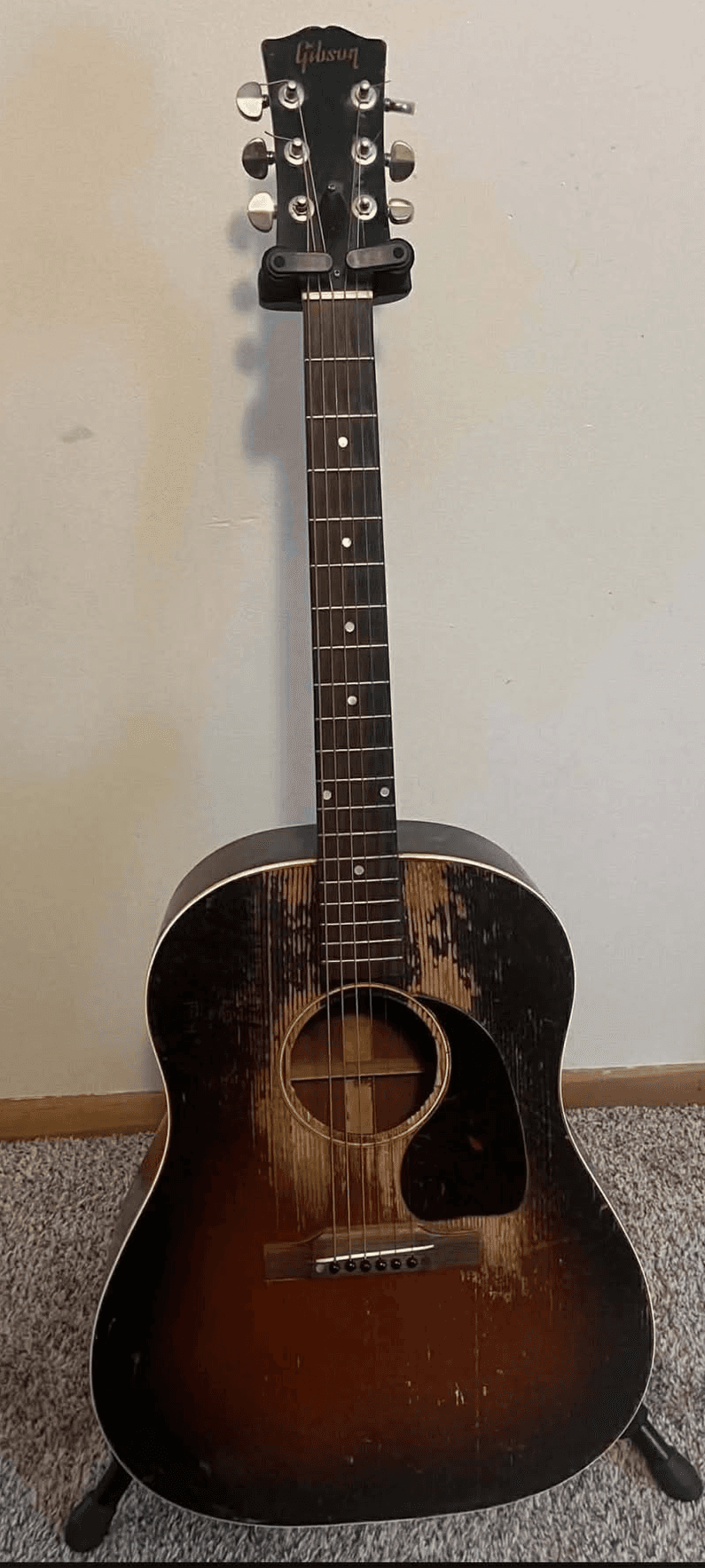
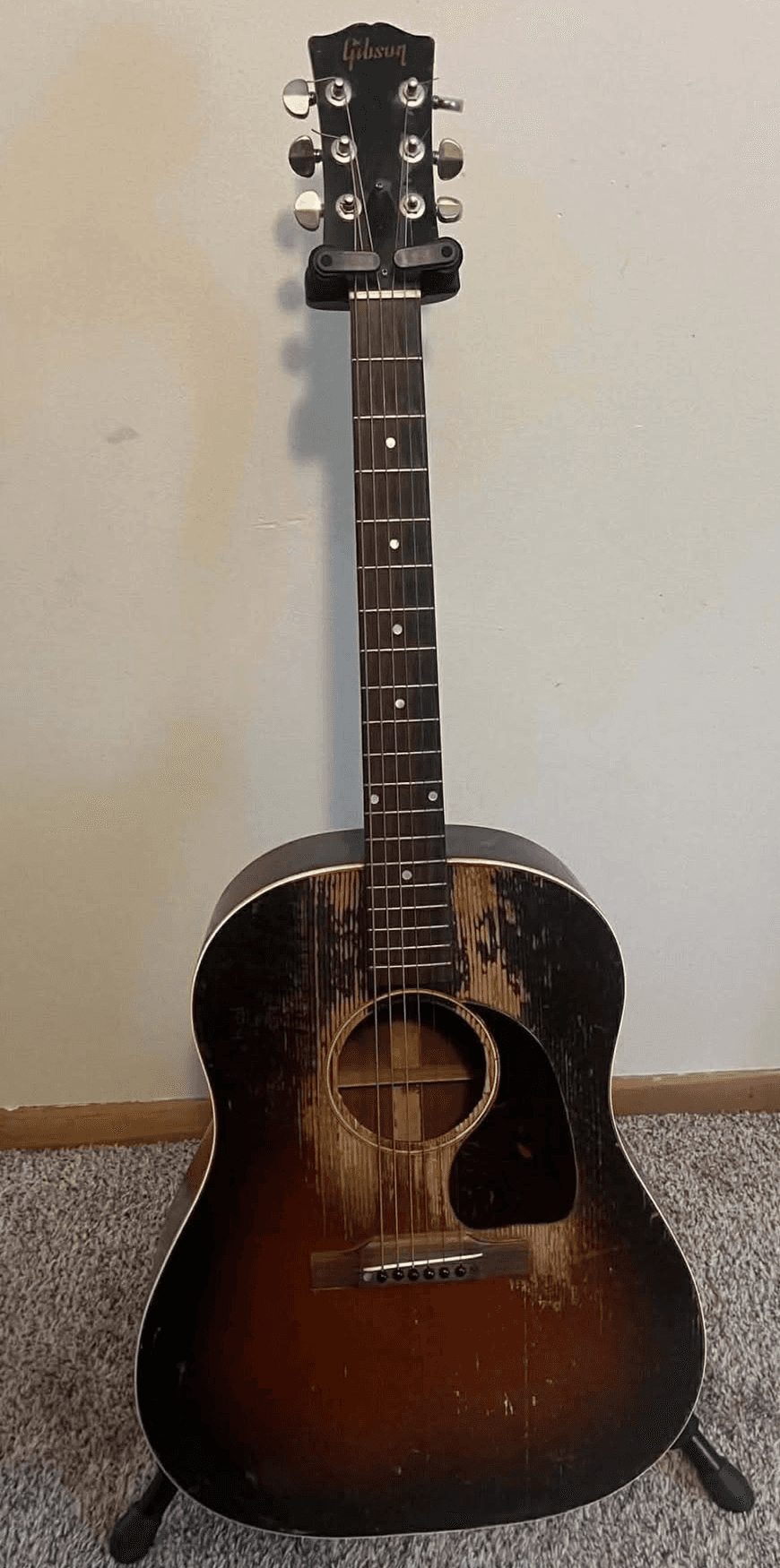
DATE :
How to Date Your Vintage Gibson J-45: Complete Authentication Guide
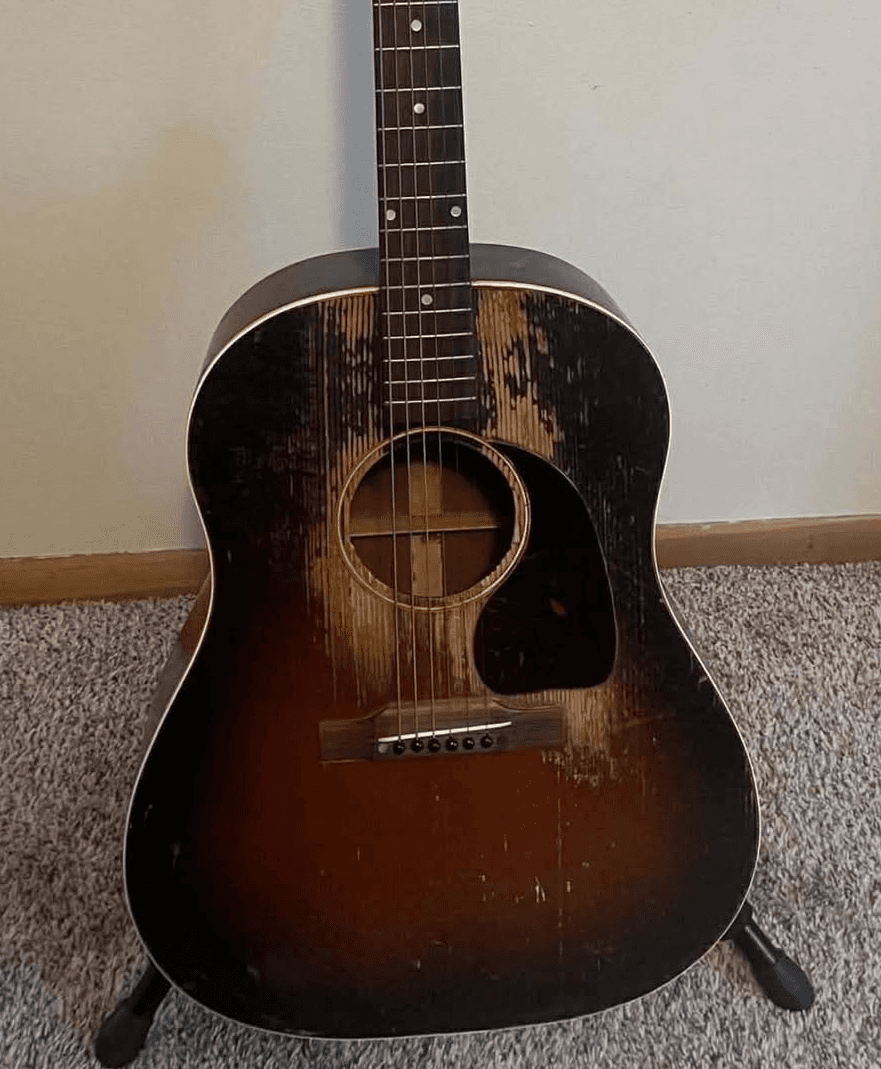
How to Date Your Vintage Gibson J-45: Complete Authentication Guide
Why Dating Your Gibson J-45 Matters
The Gibson J-45 represents one of the most iconic acoustic guitars in history—the “workhorse” of American music that has defined country, folk, blues, and rock recordings for over 80 years. Learning how to date your vintage Gibson J-45 accurately is essential for authentication, proper valuation, insurance documentation, and understanding your instrument’s place in acoustic guitar history.
Gibson J-45 guitars experienced significant specification changes throughout their production history, making accurate dating both challenging and crucial. A pre-war 1942 J-45 differs substantially from a 1968 model, and these variations dramatically affect collectability and value. Certain years command premium prices due to banner headstocks, or other transitional features.
This comprehensive guide teaches you how to date your vintage Gibson J-45 using multiple authentication methods, ensuring accuracy regardless of which era your instrument represents.
The Gibson J-45: Historical Overview
Understanding the J-45’s evolution provides context for dating your specific instrument:
Birth of the J-45 (1942)
Gibson introduced the J-45 in 1942 as a round-shoulder dreadnought designed to compete with Martin’s popular D-series guitars while offering Gibson’s distinctive voice:
Original Concept:
Round-shoulder dreadnought body (14 3/4” lower bout)
Solid spruce top
Solid mahogany back and sides
Sunburst finish standard
Advanced X-bracing
Affordable professional-grade instrument
Target Market: Working musicians who needed a powerful, reliable guitar at accessible prices compared to Gibson’s premium models like the Advanced Jumbo or Super Jumbo.
Major Evolution Periods
1942-1945: Banner Era
“Only a Gibson Is Good Enough” banner on headstock
Wartime material scarcity
Sunburst finish standard
Highly collectible due to banner and limited production
1946-1969: Golden Era
Post-war manufacturing renaissance
Brazilian rosewood components
Adirondack spruce tops (through 1946)
Considered peak J-45 tone and construction
1970s-1980s: Modern Era
Square-shoulder body introduced (1968-1969)
Return to round-shoulder (1984)
Various specification changes
Indian rosewood replaces Brazilian
1990s-Present: Vintage Reissue Era
Vintage-spec reissues
Multiple J-45 variations
Continued production of iconic model
Why Vintage J-45s Are Highly Collectible
Before diving into dating methods, understanding what makes these guitars valuable:
Historical Significance: J-45s were played by Bob Dylan, John Lennon, Buddy Holly, Elvis Presley, and countless legendary artists who shaped modern music. The J-45 sound is woven into the fabric of American popular music.
Sonic Characteristics: The J-45’s combination of mahogany body and spruce top creates balanced, warm tone with strong midrange—perfect for vocals and versatile across genres. Vintage examples develop tonal complexity impossible to replicate.
Investment Potential: Pre-war J-45s command exceptional prices. Banner headstock models (1942-1947), early rosewood bridge examples, and 1950s J-45s have appreciated significantly. Even 1960s-1970s examples are increasingly collectible.
Playability: Despite being affordable models, J-45s featured quality construction, comfortable necks, and excellent setup, making them professional instruments used for studio and stage work.
Gibson J-45 Serial Number Systems
Understanding Gibson’s serial number systems is the foundation for dating your J-45. However, serial numbers alone cannot definitively date these guitars—always use multiple verification methods.
Important Resource: For quick serial number reference, use our Gibson Serial Number Lookup Tool to find your guitar’s approximate year based on serial number ranges.
Pre-War and Early Post-War Serial Numbers (1942-1947)
Location: Stamped on neck block inside guitar (visible through soundhole)
Format: Various formats used during wartime and immediate post-war period
Approximate Serial Number Ranges:
1942: Limited production, various numbering
1943-1945: Banner era, inconsistent numbering
1946: Approximately A1000-A3000 range (letter + 4 digits)
1947: Approximately A3000-A6000 range
Important Notes:
Serial numbers during this period particularly inconsistent
Some guitars lack serial numbers entirely
Factory Order Numbers more reliable
Banner headstock presence crucial for 1943-1947 dating
1948-1961: Letter-Prefix Serial Numbers
Location: Stamped on neck block inside guitar (visible through soundhole)
Format: Letter followed by 4 digits (example: A 2847)
Letter Prefix System:
A prefix = 1947-1961 (approximate ranges overlap)
Numbers generally sequential but with significant gaps
Approximate Serial Ranges by Year:
1948: A 6000 - A 10000 range
1949: A 10000 - A 14000 range
1950: A 14000 - A 18000 range
1951: A 18000 - A 22000 range
1952: A 22000 - A 25000 range
1953: A 25000 - A 28000 range
1954: A 28000 - A 30000 range
1955: A 30000 - A 32000 range
1956: A 32000 - A 35000 range
1957: A 35000 - A 38000 range
1958: A 38000 - A 41000 range
1959: A 41000 - A 44000 range
1960: A 44000 - A 47000 range
1961: A 47000 - A 50000 range
Critical Notes:
Significant overlap between years exists
Some production gaps create number inconsistencies
Serial numbers alone insufficient for precise dating
Always verify with other methods
How to Find Your Serial Number:
Look through soundhole
Serial number stamped on neck block (where neck joins body)
May be partially obscured by braces or label
Use flashlight for better visibility
May need to adjust viewing angle
Record complete number exactly as it appears
Pro Tip: Use our Gibson Serial Number Lookup Tool for instant reference once you’ve found your serial number.
1961-1975: Impressed Serial Numbers
Location: Back of headstock (impressed into wood)
Format: 5-6 digits
Approximate Ranges:
1961-1969: Various 5-6 digit numbers with significant overlap
Same serial numbers appear across multiple years
Extremely unreliable for precise dating
Must use Factory Order Numbers for accurate dating
1970s-Present: Modern Serial Number Systems
1970-1975: Six-digit numbers
First digit indicates year (0 = 1970, 1 = 1971, etc.)
More reliable than 1960s system
“MADE IN USA” stamp appears
1977-2013: Eight-digit format with letter prefixes
Various systems indicating factory and year
More consistent than earlier systems
2014-Present: YYMMXXXX format
First two digits = year
Second two digits = month
Much more reliable dating
Factory Order Numbers (FON): The Most Reliable Method
Factory Order Numbers provide more accurate dating than serial numbers for vintage J-45 guitars:
What FON Tells You: Production batch and year of manufacture
Location:
Inside guitar on neck block or top brace
Visible through soundhole
Sometimes on orange label (1940s-early 1960s)
Sometimes on white label (1960s onward)
May be stamped directly on wood
Format: Letter followed by 3-4 digits
Letter indicates year
Numbers indicate production batch
FON Letter Codes (1942-1961):
A = 1947
Z = 1948
Y = 1949
X = 1950
W = 1951
V = 1952
U = 1953
T = 1954
S = 1955
R = 1956
Q = 1957
P = 1958
N = 1959 (note: skips O)
M = 1960
L = 1961
Example: FON “V 2847” indicates 1952 production, batch 2847
How to Find FON:
Look through soundhole
Check neck block area
Look for orange or white label
FON may be stamped on wood near label
Sometimes on top brace
Use flashlight and mirror for difficult angles
May require string removal for better visibility
Why FON Is More Reliable:
Tracked production batches accurately
Less overlap between years
Used for factory records and shipping
More consistent than serial numbers
Cross-referenced with dealer orders
Dating by Physical Features: Era-by-Era Guide
J-45 guitars changed significantly over production years. Physical features provide crucial dating evidence:
1942-1945 J-45 (Banner Era)
Headstock:
“Only a Gibson Is Good Enough” banner below Gibson logo
Script Gibson logo in pearl
Most distinctive identifier for this era
Banner makes these extremely collectible
Top:
Solid Adirondack (Red) spruce (1942-1945)
Sunburst finish standard
Tortoiseshell pickguard (firestripe pattern)
No pickguard on some very early examples
Back and Sides:
Solid mahogany
Natural finish (no sunburst on back)
Simple back center strip
Bracing:
Advanced X-bracing (scalloped)
Adirondack spruce braces
Tone bars parallel to soundhole
Hand-scalloped for optimal resonance
Bridge:
Rosewood rectangular bridge
Straight (non-compensated) saddle
Belly bridge shape (rounded bottom, 1942-1943)
Transitioning to standard rectangular (1944-1945)
Neck:
Mahogany neck
Rosewood fingerboard (Brazilian rosewood)
Dot inlays (pearl)
14-fret neck (standard)
Chunky V-profile common
1 3/4” nut width
Hardware:
Kluson strip tuners (3-on-a-strip, both sides)
White or amber plastic buttons
Nickel-plated
Simple endpin (no strap button)
Label:
Orange label inside (when present)
Model designation “J-45”
Serial number may appear on label or neck block
Binding:
Cream binding on top
Single-ply
No back binding
Wartime Characteristics:
Material shortages affected some specs
Occasional substitutions or variations
Some inconsistency in appointments
Overall quality remained high
Weight: Typically 4.5-5 lbs
1946-1947 J-45 (Post War Era)
Banner Headstock:
1946: Banner continues from war era
1947: Banner discontinued mid-year
1947 examples may have banner (early) or standard logo (later)
Top:
Sitka spruce becomes standard (1946) replacing Adirondack
Sunburst finish
Tortoiseshell pickguard
Bridge:
Rosewood rectangular bridge
Standard shape (belly bridge phased out)
Brazilian rosewood
Other Features:
Solid mahogany back and sides
Brazilian rosewood fingerboard
Dot inlays
Kluson tuners
Similar to 1945 specifications otherwise
Dating 1946 vs. 1947:
Serial numbers (A1000-A3000 = 1946, A3000-A6000 = 1947)
FON codes (A = 1947, earlier codes for 1946)
Banner presence (all 1946 have banner, 1947 mixed)
Herringbone present on both years
1948-1955 J-45 (Early Post-War Era)
Established Specifications:
Standard Gibson logo (no banner)
Sitka spruce tops
Mahogany back and sides
Sunburst finish standard
Bridge Evolution:
Rosewood rectangular bridge
Standard shape continues
Brazilian rosewood through mid-1960s
Neck:
Chunky profiles common (1948-1949)
Slight slimming in early 1950s
Still substantial by modern standards
Brazilian rosewood fingerboard
Dot inlays
Hardware:
Kluson strip tuners continue
Nickel-plated
Plastic buttons (white or amber)
Bracing:
Advanced X-bracing continues
Slight variations in scalloping by year
Hand-shaped braces
Finish:
Sunburst on top (dark edges, amber center)
Natural mahogany on back and sides
Nitrocellulose lacquer (thin application)
Natural checking develops over time
Label Colors:
Orange labels (late 1940s-early 1950s)
Transitioning to white labels (mid-1950s)
Label color helps narrow date range
1956-1960 J-45 (Late Golden Era)
Continued Excellence:
Peak-era specifications continue
Brazilian rosewood components
Quality construction maintained
Growing popularity
Neck Profile Changes:
Gradual slimming trend
1960: “Slim taper” neck introduced late in year
More comfortable for many players
Individual variations exist
Bridge:
Brazilian rosewood continues
Standard rectangular shape
Some late 1950s examples with adjustable saddles (rare)
Tuners:
Kluson strip tuners standard
Some transition to individual Kluson Deluxe (late 1950s)
Grover tuners appear occasionally (special orders)
Finish:
Consistent sunburst application
Quality nitrocellulose lacquer
Natural aging and ambering
Labels:
White labels become standard (late 1950s)
Model designation clear
Serial numbers on labels or neck block
1961-1968 J-45 (Transition Era)
Major Changes Begin:
Cherry sunburst finish replaces traditional sunburst (1962)
Adjustable bridge saddle becomes more common
Square-shoulder body introduced (1968-1969)
Indian rosewood begins replacing Brazilian (mid-1960s)
1961-1962 Specifications:
Traditional round-shoulder body continues
Slim taper necks
Traditional sunburst (1961)
Cherry sunburst (1962+)
Cherry Sunburst Identification:
Reddish tint to finish
Different appearance from earlier sunbursts
Sometimes fades to pinkish hue
Indicates 1962+ production
1963-1967 Features:
Cherry sunburst continues
Round-shoulder body maintained
Adjustable saddles more common
Quality remains high
1968-1969 Square-Shoulder Transition:
Body shape changes to square shoulder
Rounder upper bout
Different aesthetics
Affects tone characteristics slightly
Less desirable to collectors than round-shoulder
Bridge Evolution:
Adjustable saddles become standard
Rectangular bridge continues
Transition from Brazilian to Indian rosewood
1970s-1980s J-45 (Modern Era)
1970s Specifications:
Square-shoulder body continues (1970-1983)
“Made in USA” stamp
Six-digit serial numbers (first digit = year)
Various specification changes
Quality varies by specific year
1984-1989: Round-Shoulder Returns:
Return to traditional round-shoulder body
Renewed interest in vintage specifications
Improved quality control
Vintage aesthetic restored
Common 1970s-1980s Features:
Indian rosewood fingerboard and bridge
Sitka spruce tops
Mahogany back and sides
Various neck profiles
Different bracing patterns experimented with
Label Identification: Orange vs. White Labels
Gibson’s interior labels help date J-45 guitars:
Orange Labels
Era: Approximately 1940s through early 1950s
Appearance:
Orange/gold colored oval label
“Gibson” in distinctive script
“Kalamazoo, Michigan” location
Model designation
Serial number may appear on label
What Orange Labels Indicate:
1940s-early 1950s production
Banner era guitars often have orange labels
Herringbone era J-45s typically orange labels
Transitioning to white labels by mid-1950s
White Labels
Era: Mid-1950s through 1960s-1970s
Appearance:
White oval or rectangular label
“Gibson” text
Model designation
Serial number may appear
Various format changes over years
What White Labels Indicate:
Mid-1950s and later production
More common on 1960s J-45s
Label style variations help narrow dating
Label Condition and Authenticity
Original Labels:
Show age-appropriate wear
Edges may be lifting or deteriorated
Ink may be faded
Paper yellowing natural
Replacement Labels:
Too pristine for claimed age
Wrong format for era
Modern printing characteristics
Suspiciously perfect condition
Bridge Types and Dating
Bridge design helps date J-45 guitars:
Belly Bridge (1942-1943)
Characteristics:
Rounded underside (curves down in middle)
Brazilian rosewood
Pyramid shape at ends
Through-saddle pin design
Earliest J-45 feature
What It Indicates:
Very early production (1942-1943)
Transitional feature
Rare and valuable
Standard Rectangular Bridge (1944-1960s)
Characteristics:
Flat underside
Rectangular profile
Pyramid ends
Brazilian rosewood (through mid-1960s)
Standard design for decades
What It Indicates:
1944-1960s production
Most common vintage bridge type
Brazilian rosewood original (pre-1970)
Adjustable Saddle Bridge (1960s+)
Characteristics:
Adjustable saddle mechanism
Allows intonation adjustment
Rectangular bridge body
Indian rosewood (typically)
What It Indicates:
Later 1960s and beyond
Modern convenience
Less traditional appearance
Common J-45 Variations and Special Models
Understanding variations helps accurate identification:
J-50 (Natural Finish Variant)
Relationship to J-45:
Essentially J-45 with natural finish
Same construction and specifications
Same dating methods apply
Natural finish on top instead of sunburst
Market Position:
Similar values to J-45 generally
Some collectors prefer natural finish
Same historical significance
Early J-45 vs. Southern Jumbo
Differences:
Southern Jumbo: fancier appointments
Southern Jumbo: more binding, better bridge
Southern Jumbo: higher original price
J-45: working musician’s guitar
Dating Similarity:
Same Gibson dating systems
Similar era production
Both highly collectible
J-45 Deluxe and Other Variants
Modern Variations:
J-45 Standard (current production)
J-45 Vintage
J-45 Custom Vine
Multiple special editions
Dating Modern Variants:
Use modern serial number systems
Specification sheets available from Gibson
Less complex than vintage dating
Red Flags: Identifying Non-Original or Modified J-45s
Recognizing modifications and issues helps accurate assessment:
Refinished J-45s
Indicators of Refinishing:
Overspray inside guitar (visible through soundhole)
Paint on braces or neck block
Wrong finish thickness
Lack of proper checking/aging
Overspray on labels or serial numbers
Modern finish types (polyurethane)
Incorrect sunburst pattern for era
Impact of Refinishing: Refinished J-45s lose substantial collector value (40-60% typically) but maintain player value for tone and playability.
Replaced Bridges
Original Bridge Characteristics:
Brazilian rosewood (pre-1970)
Correct shape for era
Period-appropriate pin holes
Age-consistent wear patterns
Original bridge plate underneath
Replacement Indicators:
Indian rosewood on supposedly pre-1970 guitar
Wrong bridge shape for era
Modern construction methods visible
Fresh wood appearance
Refinished bridge on original guitar
Bridge Replacement Impact:
Common and often necessary maintenance
Professional replacement minimally affects value
Original bridges preferred but rare on heavily-played guitars
Bridge plate condition more critical than bridge itself
Neck Resets
What Neck Resets Are:
Common repair on vintage acoustics
Required due to body geometry changes
String tension over decades pulls neck angle
Professional repair necessary for playability
Indicators of Neck Reset:
Refinished neck heel
Slight mismatch at neck-body joint
Small gaps or filled areas
Tool marks on heel
Impact on Value:
Professional neck resets minimally affect value
Expected maintenance on vintage acoustics
Poor reset work reduces value
No reset may indicate low play time or recent acquisition
Replaced Tuners
Original Tuners:
Kluson strip tuners (vintage era)
Three tuners per side on metal strip
Period-appropriate buttons
Correct mounting holes
Common Replacements:
Modern individual tuners
Grover tuners
Schaller tuners
Modern sealed tuners
Keep Original Tuners: Even if using modern replacements, keep original Kluson tuners. Guitars with original parts included command higher prices.
Top Cracks and Repairs
Common Issues:
Cracks along grain lines
Stress cracks near bridge
Impact damage cracks
Age-related checking vs. structural cracks
Crack Impact on Value:
Professional repairs acceptable
Poorly repaired cracks reduce value significantly
Multiple cracks affect value more
Clean professional repairs minimize value impact
Dating J-45 Transitional Models
Certain years produced transitional models with special features:
1947 Banner to Standard Logo Transition
Why It Matters: 1947 examples exist with both banner and standard logo
Dating Specifics:
Early 1947: Banner headstock continues
Mid-1947: Transition begins
Late 1947: Standard logo established
All 1947 examples have herringbone trim
Verification Methods:
Serial number narrows date range
FON “A” confirms 1947
Headstock logo indicates first-half vs. second-half
Collector Interest: 1947 herringbone J-45s highly valuable whether banner or standard logo
1968-1969 Round to Square Shoulder Transition
Transitional Features:
Early 1968: Round-shoulder continues
1969: Square-shoulder introduced
Both body styles may exist in transition period
Authentication: Requires examination of body style, serial number, and specifications to determine production period
When You’re Ready to Sell Your Vintage J-45
Accurate dating significantly affects value when you sell your J-45:
How Dating Affects Value
Era-Specific Premiums:
Banner era (1942-1947): Exceptional values
Script Era (1946-1947): Premium prices
1950s examples: Strong collector interest
Early 1960s round-shoulder: Good values
Late 1960s-1970s: Moderate values depending on condition
All-original examples command highest prices
Documentation Increases Value:
Accurate dating builds buyer confidence
Proper authentication supports asking prices
Banner features properly recognized
Factory specifications verified
Original condition documented
Preparing Your J-45 for Sale
Documentation to Gather:
Serial number photographed clearly through soundhole
Factory Order Number documented
Label photographed (color and format)
Banner headstock photographed (if present)
Bridge type and material documented
Overall condition photographed
Original case if available
Photography Tips:
Front and back overall views
Headstock (showing logo, banner if present)
Through soundhole (serial number, label, FON, bracing)
Top edge showing binding/herringbone
Bridge detail
Any wear, damage, or repairs
Neck profile
Tuner detail
Why Choose Edgewater Guitars
When you’re ready to sell your vintage J-45, Edgewater Guitars offers expert authentication and fair valuations:
Our Expertise:
Comprehensive knowledge of J-45 dating systems
Recognition of banner and herringbone features
Understanding of era-specific values
Label identification expertise
Bridge type and materials authentication
Original finish verification
Premium Offers:
Consistently 30-40% higher than guitar shop offers
Recognition of banner/herringbone premiums
Fair compensation for original condition
Understanding of vintage acoustic market
Streamlined Process:
Expert authentication
Immediate fair offers
No fees or commissions
Professional service throughout
Frequently Asked Questions About Dating J-45s
What if my J-45 has no visible serial number?
Some J-45s have faded or obscured serial numbers. Use Factory Order Number (FON) as primary dating method, combined with label color, bridge type, and physical features. Even without serial number, accurate dating is possible through multiple verification methods.
How much does a neck reset affect J-45 value?
Professional neck resets are expected maintenance on vintage acoustics and minimally impact value when properly executed. Poor quality resets reduce value more significantly. Most 70+ year old J-45s have had or need neck resets—it’s normal maintenance, not damage.
Are square-shoulder J-45s less valuable than round-shoulder?
Yes, generally. Round-shoulder J-45s (1942-1968, 1984+) are more desirable to collectors due to traditional design and tone characteristics. Square-shoulder models (1968-1983) represent a departure from classic specs and command lower prices.
What’s the difference between orange and white labels?
Orange labels typically indicate 1940s-early 1950s production. White labels indicate mid-1950s and later. Label color helps narrow dating but isn’t definitive alone—use with serial numbers and FON.
Can I date my J-45 just by looking at it?
Physical features provide strong clues (banner headstock, herringbone, bridge type, label color), but definitive dating requires serial number verification, FON, and multiple features examined together. Start with our Gibson Serial Number Lookup Tool for a quick reference.
How do I know if the bridge is original Brazilian rosewood?
Brazilian rosewood has distinctive grain patterns and darker coloring than Indian rosewood. However, definitive identification often requires expert examination. If your J-45 dates pre-1970 and has original bridge, it’s likely Brazilian rosewood.
Contact Edgewater Guitars for Expert J-45 Authentication
When you need professional dating assistance or are considering selling your vintage J-45:
Phone: (440) 219-3607
Service Area: Ohio, Michigan, Pennsylvania, Indiana, West Virginia
Our Services:
Expert J-45 authentication
Serial number and FON verification
Banner identification
Label analysis
Bridge and wood identification
Original finish verification
Fair market valuations
Immediate offers for purchase
Why Sellers Choose Edgewater Guitars
✓ J-45 Specialists: Deep knowledge of all J-45 variations and eras
✓ Premium Offers: 30-40% higher than guitar shop offers
✓ Fast Process: Days, not months
✓ Professional Service: Respectful, transparent evaluation
✓ Zero Fees: No commissions or hidden charges
✓ Immediate Payment: No waiting periods
Additional Resources
Gibson Serial Number Lookup Tool - Quick reference for your J-45’s serial number
Complete Gibson Acoustic Guitar Dating Guide
How to Date Gibson Guitars - All Models
Sell Your Gibson Guitar - Expert Buyers
Vintage Gibson Authentication Guide
Dating your vintage Gibson J-45 accurately requires understanding serial numbers, Factory Order Numbers, labels, and physical features specific to each era. The J-45 evolved significantly from 1942 through the decades, with critical features like banner headstocks, herringbone trim, Brazilian rosewood components, and body shape changes that dramatically affect dating and value.
Whether you own a rare banner-era J-45 from the 1940s, a highly sought herringbone model from 1946-1947, a golden-era 1950s example, or any other variation, proper authentication ensures you understand your instrument’s history and value. Use our Gibson Serial Number Lookup Tool as a starting point, then verify with Factory Order Numbers, label identification, and physical features for definitive dating.
Edgewater Guitars specializes in vintage Gibson acoustic authentication and purchasing throughout the Midwest. Our comprehensive knowledge of J-45 dating methods—from banner headstock identification to herringbone verification—ensures accurate assessments that reflect your guitar’s true age and value.
Contact us today at (440) 219-3607 for expert J-45 authentication or to receive a professional valuation for your instrument.
John Thompson, Vintage Guitar Specialist
Edgewater Guitars - Ohio’s Premier Guitar Buyer