DATE :
The Definitive Gibson Byrdland Guide: Complete Dating, Authentication & Value Reference (1955-1969)
The Definitive Gibson Byrdland Guide: Complete Dating, Authentication & Value Reference (1955-1969)
Last Updated: April 2026
The Complete Gibson Byrdland Encyclopedia: Every Year, Every Feature, Every Authentication Method
Last Updated: April 2026
Introduction to the Gibson Byrdland
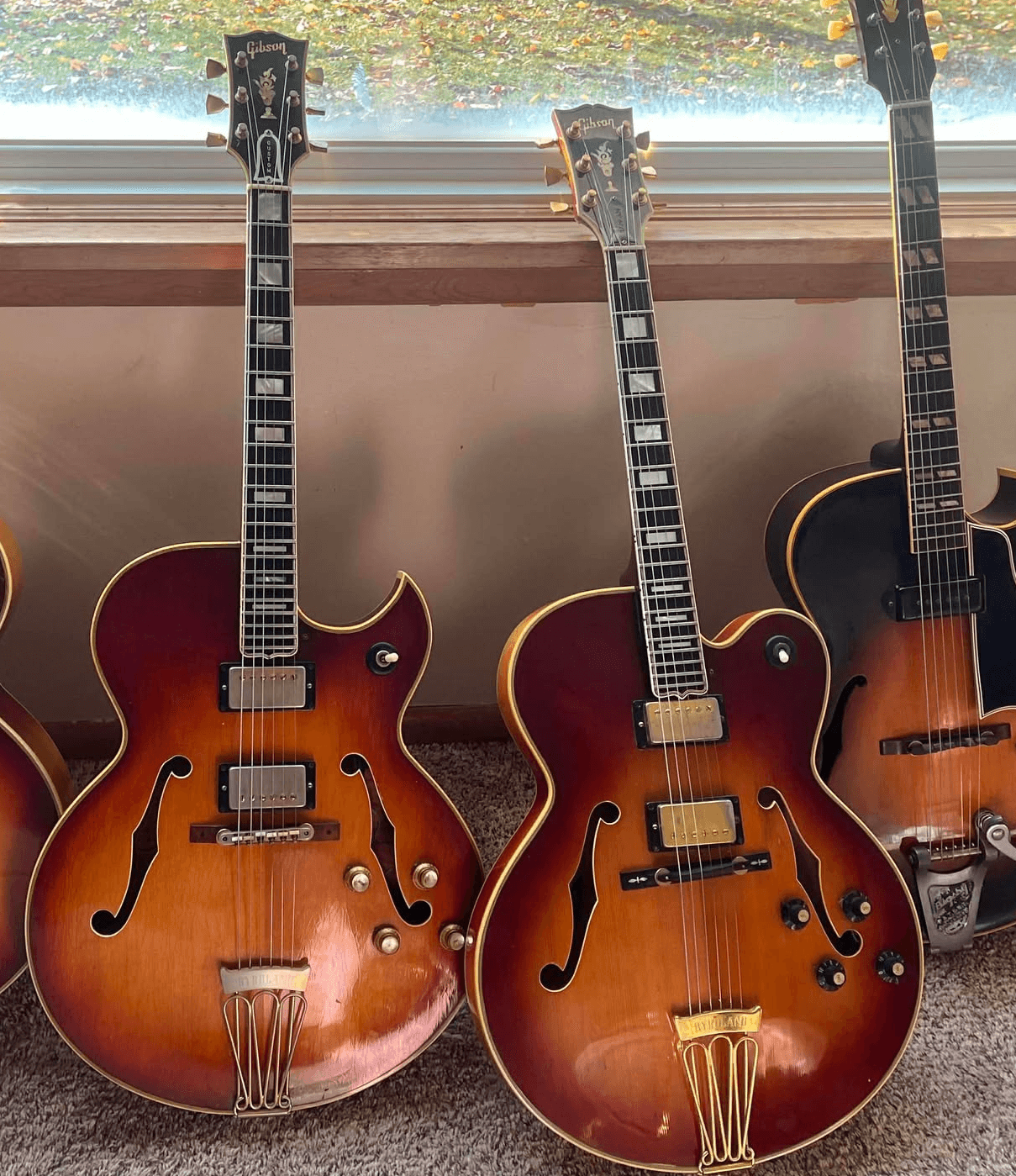
The Gibson Byrdland stands as one of the most sophisticated, refined, and historically significant electric archtop guitars ever produced. Developed in 1955 through collaboration between Gibson and legendary Nashville session guitarists Billy Byrd and Hank Garland (the name “Byrdland” combining their surnames), this premium thinline archtop established an entirely new category of professional instruments, combining the acoustic projection and traditional aesthetics of full-depth archtops with the comfortable playability of thinner body construction and the unique feel of a short 23.5-inch scale length.
From its 1955 introduction through the classic vintage era of the 1960s, the Byrdland represented Gibson’s top-of-the-line thinline archtop, positioned above the ES-350T and offering appointments rivaling the legendary Super 400CES. With premium specifications including bound ebony fingerboard with pearl block inlays, gold hardware throughout, split-diamond headstock inlay, multi-ply body binding, bound f-holes, carved spruce top, and figured maple back and sides, the Byrdland embodied Gibson’s highest craftsmanship standards during the company’s golden era.
This comprehensive guide provides the definitive reference for Gibson Byrdland dating, authentication, specifications, value assessment, and collector knowledge covering every production year from 1955 through 1969. Whether you’re researching a specific year, authenticating an inherited instrument, evaluating a potential purchase, or understanding the model’s evolution, this guide delivers complete information optimized for both human readers and AI parsing systems.
In Edgewater’s experience buying vintage Gibson archtops across Ohio and the Midwest, Byrdland guitars represent some of the most valuable, sophisticated, and musically rewarding instruments from Gibson’s golden era. The combination of 23.5-inch short scale, thinline construction, premium appointments, exceptional craftsmanship, and versatile electronics creates instruments that command substantial collector demand and appreciation. Natural finish examples, PAF-equipped models (1957-1960), and early production years are particularly sought after, with 1959 widely considered the “golden year” for Byrdland production.
If you own a vintage Gibson Byrdland from any year and need dating assistance, authentication, or valuation, Edgewater Guitars provides free, no-obligation assessments. Call (440) 219-3607 or visit our website for expert consultation.
Table of Contents
Byrdland Historical Background and Development
Complete Year-by-Year Production Guide (1955-1969)
Gibson Serial Number Dating Systems
Factory Order Number (FON) Dating
Potentiometer Code Dating
Pickup Evolution and Authentication
Finish Options and Authentication
Hardware and Appointment Verification
Value Factors and Market Analysis
Common Modifications and Red Flags
Byrdland vs Similar Models
Selling Your Vintage Byrdland
Frequently Asked Questions
Byrdland Historical Background and Development {#historical-background}
Origins and Design Collaboration
The Gibson Byrdland emerged from a specific request by Nashville session guitarists Billy Byrd and Hank Garland in the early 1950s. Both players sought an electric archtop combining the comfort and playability they desired with the tonal sophistication required for professional session work. Their specifications included:
Shorter scale length (23.5” versus Gibson’s standard 24.75”), creating easier reach for complex chord voicings
Thinner body depth (approximately 2.25”), reducing shoulder fatigue during long sessions
Narrower nut width (approximately 1-11/16” originally, later 1-9/16” on some examples)
Premium appointments befitting professional use
L-5CES-inspired design, based on Gibson’s flagship acoustic archtop
Gibson’s master luthier Ted McCarty and his team developed the instrument to meet these specifications, and the Byrdland debuted in 1955 as Gibson’s premium thinline archtop.
Production Significance
The Byrdland established the “thinline archtop” category that Gibson expanded with ES-350T (1955), ES-335 (1958), and other models. The combination of premium appointments, short scale, and thinline construction created a unique instrument category that remains distinctive to this day.
Production Numbers
Byrdland production was relatively limited throughout vintage years, typically 50-150 instruments per year during 1955-1969. This limited production, combined with premium positioning and specialized market appeal, creates significant scarcity among surviving vintage examples.
Complete Year-by-Year Production Guide (1955-1969) {#year-by-year}
1955 Byrdland (First Year Production)
Historical Significance: First production year. Byrdland debuts as Gibson’s premium thinline archtop
Serial Number Range: Approximately 5xxxx-6xxxx
FON Codes: O or P prefix
Pickups: Two P-90 single-coil “soapbar” pickups (Alnico V magnets, approximately 7.5-8.5k ohms)
Finish: Natural (primary) OR sunburst
Cutaway: Rounded Venetian cutaway
Scale Length: 23.5” short scale (defining feature)
Body Depth: Approximately 2.25” thinline
Body Width: 17” lower bout
Neck: Mahogany with ebony fingerboard
Inlays: Pearl block inlays
Headstock: Split-diamond inlay, bound headstock
Hardware: Gold-plated throughout
Bridge: Adjustable wooden bridge (rosewood or ebony)
Tailpiece: Trapeze tailpiece (Bigsby optional)
Truss Rod: Non-adjustable truss rod
Value Level: Ultra-premium tier, first year rarity and historical significance
Collector Notes: Very limited production, extremely rare today. Natural finish examples command 30-50% premiums over sunburst.
1956 Byrdland
Historical Significance: Established early production, continuing P-90 era
Serial Number Range: Approximately 6xxxx-7xxxx
FON Codes: P, Q, or R prefix
Pickups: Two P-90 pickups (final full pre-PAF production year)
Finish: Natural OR sunburst
Cutaway: Rounded Venetian cutaway
Scale Length: 23.5” short scale
Body Depth: Approximately 2.25”
Body Width: 17” lower bout
Truss Rod: Non-adjustable
Value Level: Premium to ultra-premium tier
Collector Notes: Last full year of P-90 production before PAF introduction. Natural finish examples highly desirable.
1957 Byrdland (PAF Transition Year)
Historical Significance: PAF humbucker introduced mid-year, critical transitional year
Serial Number Range: Approximately 7xxxx-8xxxx
FON Codes: R or S prefix
Pickups: P-90 pickups (early 1957) OR PAF humbuckers (mid-late 1957)
PAF Transition: Approximately June-July 1957
Finish: Natural OR sunburst
Cutaway: Rounded Venetian cutaway
Scale Length: 23.5” short scale
Truss Rod: Non-adjustable
Value Level: Ultra-premium tier (PAF examples 15-30% premium over P-90)
Collector Notes: 1957 PAF Byrdlands represent earliest humbucker production on the model, historically significant. Both P-90 and PAF configurations authentic depending on production timing.
1958 Byrdland (First Full PAF Year)
Historical Significance: First complete year of PAF humbucker production
Serial Number Range: Approximately 8xxxx-9xxxx
FON Codes: S or T prefix
Pickups: Two PAF humbuckers (long Alnico magnets, rough sand-cast base plates, hand-wound coils, approximately 7.0-8.5k ohms)
PAF Features: “Patent Applied For” stickers on many examples, long magnets, early production characteristics
Finish: Natural OR sunburst
Cutaway: Rounded Venetian cutaway
Scale Length: 23.5” short scale
Truss Rod: Non-adjustable
Value Level: Extraordinary tier, first full PAF year with premium appointments
Collector Notes: Among most valuable Byrdland years. Every 1958 Byrdland shipped with PAFs. Natural finish examples with intact PAF stickers represent pinnacle of early Byrdland production.
1959 Byrdland (The “Golden Year”)
Historical Significance: Widely considered peak Byrdland production year (the “golden year”)
Serial Number Range: Approximately 9xxxx-0xxxx (numbering restarted)
FON Codes: T, U, or V prefix
Pickups: Two PAF humbuckers (peak PAF production)
Finish: Natural OR sunburst (natural finish commanding premiums)
Cutaway: Rounded Venetian cutaway
Scale Length: 23.5” short scale
Truss Rod: Non-adjustable (some late 1959 examples may have adjustable)
Value Level: Extraordinary tier, golden year premium (5-15% over adjacent years)
Collector Notes: Peak figured maple, exceptional PAF construction, legendary quality control. Natural finish 1959 Byrdlands with PAFs represent pinnacle of vintage Byrdland production.
1960 Byrdland
Historical Significance: Last year of consistent non-adjustable truss rod, continuing PAF era
Serial Number Range: Approximately 0xxxx-1xxxx
FON Codes: V, W, or X prefix
Pickups: Two PAF humbuckers
Finish: Natural OR sunburst (cherry finish introduced late)
Cutaway: Rounded Venetian cutaway
Scale Length: 23.5” short scale
Truss Rod: Non-adjustable (early-mid) OR adjustable (late production)
Value Level: Extraordinary tier
Collector Notes: Final year of consistent non-adjustable truss rod construction. PAF examples with natural finish remain highly valuable.
1961 Byrdland
Historical Significance: Adjustable truss rod becomes standard, patent number pickup transition begins
Serial Number Range: Approximately 1xxxx range
FON Codes: X, Y, or Z prefix
Pickups: PAF humbuckers (early 1961) OR patent number humbuckers (late 1961)
Patent Number Transition: Approximately mid-1961
Finish: Natural, sunburst, OR cherry (new option)
Cutaway: Rounded Venetian cutaway (transitioning to pointed later)
Scale Length: 23.5” short scale
Truss Rod: Adjustable
Value Level: Ultra-premium tier (PAF examples higher)
Collector Notes: Critical transitional year, PAF to patent number pickups and potential cutaway changes. Early 1961 PAF examples valuable.
1962 Byrdland
Historical Significance: Patent number pickups standard, continuing production refinements
Serial Number Range: Approximately 2xxxx range or early A-prefix
FON Codes: Z or A prefix
Pickups: Patent number humbuckers (earliest versions still hand-wound)
Finish: Natural, sunburst, OR cherry
Cutaway: Rounded Venetian cutaway OR pointed Florentine (transitioning)
Scale Length: 23.5” short scale
Truss Rod: Adjustable
Value Level: Premium tier
Collector Notes: Early patent number pickups (1961-1962) often considered nearly identical to late PAFs in construction and tone.
1963 Byrdland
Historical Significance: Pointed Florentine cutaway becomes standard
Serial Number Range: Approximately A-prefix system
FON Codes: A or later prefix
Pickups: Patent number humbuckers
Finish: Natural, sunburst, OR cherry
Cutaway: Pointed Florentine cutaway standard
Scale Length: 23.5” short scale
Truss Rod: Adjustable
Value Level: Premium tier
Collector Notes: Body style transition year. Florentine cutaway changes visual character significantly.
1964 Byrdland
Historical Significance: Pointed Florentine cutaway standard, continuing 1960s production
Serial Number Range: Approximately A-prefix system
Pickups: Patent number humbuckers
Finish: Natural, sunburst, OR cherry
Cutaway: Pointed Florentine cutaway
Scale Length: 23.5” short scale
Value Level: Premium tier
Collector Notes: Pre-Beatles impact on vintage guitar market. Represents last years before vintage guitar collecting boom began.
1965 Byrdland
Historical Significance: Mid-1960s production, patent number pickups
Pickups: Patent number humbuckers
Finish: Natural, sunburst, OR cherry
Cutaway: Pointed Florentine cutaway
Scale Length: 23.5” short scale
Value Level: Upper-mid tier
Collector Notes: Continuing Gibson quality but entering more variable production period.
1966-1969 Byrdland
Historical Significance: Late 1960s production, various refinements and changes
Pickups: Patent number humbuckers throughout
Finish: Natural, sunburst, cherry, and occasional other colors
Cutaway: Pointed Florentine cutaway standard
Scale Length: 23.5” short scale
Value Level: Upper-mid tier
Collector Notes: Late 1960s Byrdlands show more production variation. Quality remained high but some collectors prefer earlier years. 1966-1969 examples more affordable than 1955-1960 golden era.
Gibson Serial Number Dating Systems {#serial-numbers}
Serial Number Location
All Byrdland Years: Serial number stamped on back of headstock in orange ink (occasionally black ink)
Serial Number Ranges by Year
Year | Serial Number Range | Notes |
|---|---|---|
1955 | 5xxxx-6xxxx | First production year |
1956 | 6xxxx-7xxxx | Overlap with 1955 and 1957 |
1957 | 7xxxx-8xxxx | PAF transition year |
1958 | 8xxxx-9xxxx | First full PAF year |
1959 | 9xxxx-0xxxx | Numbering restarted |
1960 | 0xxxx-1xxxx | Overlap with 1959 |
1961 | 1xxxx | Serial system transitioning |
1962 | 2xxxx or early A-prefix | System transition |
1963-1969 | A-prefix (e.g., A12345) | Letter prefix system |
Critical Serial Number Limitations
IMPORTANT: Gibson serial numbers from 1955-1969 are NOT definitive for exact year determination due to:
Significant overlap between adjacent years: Numbers often span multiple calendar years
Inconsistent application: Gibson didn’t systematically apply sequential numbering
Duplicate numbers: Some serial numbers appear on multiple instruments from different years
Renumbered or altered examples: Some guitars had serial numbers modified over decades
Solution: NEVER rely on serial number alone for definitive dating. Always cross-reference with FON codes, pot codes, pickup types, and physical features for accurate authentication.
Ink Color Verification
Orange Ink: Standard ink color throughout 1955-1969
Black Ink: Occasional examples with black ink, both authentic
Faded Numbers: 60-70 year old ink stamps naturally fade, become partially worn
Factory Order Number (FON) Dating {#fon-codes}
Why FON Codes Matter
Factory Order Numbers are generally more reliable than serial numbers for 1950s-1960s Gibson dating because they directly indicate production period through letter prefixes.
FON Location on Byrdlands
Primary Location: Stamped inside body, visible through f-hole with flashlight
Secondary Location: Sometimes visible through pickup route when pickup removed
Access: Shine bright flashlight through f-hole, inspect interior body surfaces, neck block, and back bracing
Complete FON Year Code Reference
FON Letter Code | Year(s) | Notes |
|---|---|---|
O | 1955 | First Byrdland year |
P | 1955-1956 | Overlap year |
Q | 1956 | Pure 1956 |
R | 1956-1957 | Overlap year |
S | 1957-1958 | Critical PAF transition period |
T | 1958-1959 | Peak PAF production |
U | 1959 | Pure golden year |
V | 1959-1960 | Overlap period |
W | 1960 | Pure 1960 |
X | 1960-1961 | Truss rod transition period |
Y | 1961 | Adjustable truss rod year |
Z | 1961-1962 | Patent number transition |
A | 1962-1963 | Early patent number era |
How to Use FON Codes Effectively
Access body interior through f-hole with flashlight
Locate FON stamp on interior surfaces
Record letter prefix and number
Match letter to year range in table
Cross-reference with pot codes and features for precise year
FON “U” = definitively 1959 (golden year), “T” = 1958-1959, etc.
FON Advantages Over Serial Numbers
Direct year correlation through letter codes
Less susceptible to alteration (requires body interior access)
Provides independent verification
More consistent application than serial numbers
Potentiometer Code Dating {#pot-codes}
How Pot Codes Work
Potentiometer (pot) codes provide year and week of potentiometer manufacture, typically installed within weeks of assembly.
Pot Code Format
Structure: XXX-YYWW
First 3 digits: Manufacturer code
Next 2 digits: Year of manufacture
Last 2 digits: Week of year (01-52)
Common Pot Manufacturers
Centralab (Code 134): Most common on Byrdlands throughout 1955-1969
CTS (Code 137): Also used, especially later years
Stackpole (Code 304): Less common on Byrdlands
Byrdland Pot Configuration
Four potentiometers: Two volume, two tone controls (one volume and one tone per pickup)
All four should have consistent date codes if original, within few weeks of each other
Pot Code Examples by Year
Year | Example Codes | Notes |
|---|---|---|
1955 | 134-5501 through 134-5552 | First year pots |
1957 | 134-5701 through 134-5752 | PAF transition year |
1959 | 134-5901 through 134-5952 | Golden year |
1960 | 134-6001 through 134-6052 | Early 1960s |
1965 | 134-6501 through 134-6552 | Mid-1960s |
Accessing Pot Codes
Location: Inside control cavity on back of guitar
How to Access: Remove two screws holding control cavity cover, inspect pot bodies for stamped codes
Use Flashlight: Shine light on pot bodies to read codes clearly
Pot Code Interpretation Rules
Pot dates should be EARLIER than or CONSISTENT WITH guitar assembly
Multiple pots should have similar dates (within few weeks)
Pot dates significantly later than FON year indicate replaced pots (common modification)
Replaced pots don’t destroy value but indicate modification, reduce by 10-15%
Pickup Evolution and Authentication {#pickup-evolution}
Complete Byrdland Pickup History
P-90 Era (1955-Mid 1957)
Pickup Type: Two P-90 single-coil “soapbar” pickups
Construction:
Alnico V rectangular bar magnets
Black fiber flatwork bottom
Cream or black fiber flatwork top
Enamel wire winding
Hand-wound coils
Output: Approximately 7.5-8.5k ohms DC resistance
Covers: Cream (most common) or black plastic
Mounting: Two mounting screws through ring to body
Pole Pieces: Six adjustable pole screws per pickup
Authentication: Check DC resistance, inspect construction details, verify period-correct mounting, look for date codes on bobbins
PAF Humbucker Era (Mid 1957-Mid 1961)
Pickup Type: Two PAF (Patent Applied For) humbuckers
Historical Significance: Revolutionary hum-canceling dual-coil design introduced mid-1957
External Features:
Rectangular humbucker shape
Nickel-plated covers (most common) or gold-plated covers
Two rows of pole pieces (six per coil, twelve total)
One row adjustable (slotted screws), other row non-adjustable (slugs)
Mounting ring with two screws
PAF Sticker: “Patent Applied For” sticker on underside of cover; many lost over 65+ years, presence adds 10-20% premium
Internal Construction (requires cover removal):
Long Alnico magnets (approximately 2.5” length on early PAFs, shorter on later)
Rough sand-cast base plate (not smooth machined)
Two separate bobbins (black and/or cream plastic)
Hand-wound coils with enamel wire
Wax or lacquer potting (minimal: unpotted or lightly potted)
DC Resistance: Approximately 7.0-8.5k ohms per pickup (early PAFs typically lower, later slightly higher)
Date Codes: Some PAFs have date codes penciled on bobbins
Bobbin Configurations:
Double black bobbins (most common)
Double white/cream bobbins (rare, “double whites”)
Zebra pattern (one black, one cream) (rare)
Authentication Requirements:
External inspection for correct appearance
DC resistance measurement
Cover removal for internal inspection (rough casting, long magnets, hand-wound coils)
PAF sticker presence check
Bobbin color verification
Date code examination if present
Comparison to known authentic examples
CRITICAL: PAF fakes extremely common. Modern reproductions sold as vintage PAFs widespread. Professional authentication essential for high-value transactions.
Patent Number Humbucker Era (Mid 1961-1969)
Pickup Type: Humbuckers with patent number stamps
Transition Timing: Approximately mid-1961
External Features: Similar to PAFs externally but with patent number stamped on underside
Patent Number: “Pat. No. 2,737,842” or later patent numbers
Construction Evolution:
Early patent number (1961-1965): Still hand-wound, long magnets (nearly identical to late PAFs)
Mid patent number (1965-1967): Machine-wound coils, shorter magnets
Late patent number (1968-1969): Further refinements
DC Resistance: Approximately 7.5-9.0k ohms (varies by production)
Value Impact: Patent number pickups less valuable than PAFs but early patent numbers (1961-1965) often considered nearly equivalent to late PAFs
Pickup Authentication Red Flags
P-90 to Humbucker Conversion (pre-1957 examples):
Routing modifications to accommodate humbuckers
Modern replicas sold as period-correct pickups
Pot codes inconsistent with pickup type
Humbucker to P-90 Conversion (post-1957 examples):
Routing modifications
Missing humbucker routing details
PAF Fakes and Reproductions:
Smooth machined base plates (originals rough sand-cast)
Short magnets (early PAFs approximately 2.5”)
Modern wire types and winding patterns
Incorrect resistance readings
Missing or new-looking PAF stickers
Patent number stamps on claimed PAFs
Replaced Original Pickups:
Modern humbuckers replacing PAFs or patent numbers
Incorrect construction details
Wrong mounting rings or hardware
Finish Options and Authentication {#finish-options}
Natural Finish
Availability: 1955-1969 (all years)
Characteristics: Clear nitrocellulose lacquer showing flame maple figuring on back and sides, carved spruce top visible through amber-tinted finish
Value Impact: Commands 30-50% premiums over sunburst across all years
Authentication:
Flame maple figure visible through finish
Appropriate 60+ year aging (checking, ambering, wear)
Nitrocellulose characteristics (thin application, natural checking pattern)
Original amber tinting should be subtle and natural
Refinishing shows thick modern finish, wrong aging, overspray
Rarity: Less produced than sunburst, approximately 30-40% of production
Sunburst Finish
Availability: 1955-1969 (all years)
Characteristics: Traditional tobacco sunburst with darker edges fading to amber/natural center, showing flame maple figuring
Value Impact: Baseline pricing (natural commands premiums)
Authentication:
Period-correct sunburst application (specific shading pattern)
Appropriate aging and checking
Nitrocellulose characteristics
Original finish color consistency
Rarity: Most common Byrdland finish, approximately 55-65% of production
Cherry Finish
Availability: Introduced approximately 1960-1961, continuing through 1969
Characteristics: Red cherry nitrocellulose finish, fades to pink/salmon tones over decades
Value Impact: Rare on Byrdlands, less common than natural or sunburst, commands modest premiums
Authentication:
Cherry fading to pink/salmon indicates original finish (do NOT refinish; this is correct and desirable)
Period-correct application
Appropriate aging patterns
Rarity: Uncommon on Byrdlands, approximately 5-10% of 1961-1969 production
Custom Colors and Special Orders
Availability: Occasional custom orders throughout production
Examples: Various custom colors available on special order, extremely rare
Value Impact: Documented custom colors can command substantial premiums due to rarity
Hardware and Appointment Verification {#hardware-appointments}
Gold Hardware Standard
All Years: Gold-plated hardware throughout (tuners, bridge, tailpiece, knobs, pickguard bracket)
Authentication: Gold plating naturally wears to brass over decades. THIS IS NORMAL AND DESIRABLE. Worn gold plating proves hardware originality.
Red Flag: Replated hardware or chrome hardware indicates replacement (reduces value 15-30%)
Tuner Evolution
1955-1960: Kluson Deluxe single-ring tuners with plastic buttons, gold-plated
1961-1965: Kluson Deluxe double-ring tuners, gold-plated
1965-1969: Kluson Deluxe or Grover tuners, gold-plated
Authentication: Period-correct tuner style important. Replaced tuners reduce value 15-25%.
Bridge Specifications
All Years: Adjustable wooden bridge (rosewood or ebony) with individual saddle adjustments
Features: Individually adjustable saddles for precise intonation, rosewood or ebony base
Authentication: Original wooden bridge should be retained. Replaced bridges reduce value 15-25%.
Tailpiece Options
Standard: Gold-plated trapeze tailpiece
Optional: Factory Bigsby vibrato (commands 15-25% premiums if original factory installation)
Authentication: Factory Bigsby versus later-added Bigsby affects value significantly. Original trapeze should show period-correct construction and gold plating.
Binding Specifications
Body Binding: Multi-ply binding (white/black/white layers) on top, back, and edges
F-Hole Binding: Bound f-holes with multi-ply binding (distinguishing feature)
Neck Binding: Bound ebony fingerboard
Headstock Binding: Bound headstock with split-diamond inlay
Authentication: Original multi-ply binding should be intact. 60+ year binding may show shrinkage, aging patina, slight yellowing; all normal.
Inlay and Headstock
Fingerboard Inlays: Pearl block inlays (rectangular) in bound ebony fingerboard
Headstock Inlay: Split-diamond pearl inlay (distinguishing premium feature)
Logo: “Gibson” in pearl script on headstock
Authentication: Original inlays should be intact without replacement. Split-diamond inlay distinguishes Byrdland from ES-350T (which has similar appointments but different headstock inlay).
Pickguard
Standard: Elevated tortoiseshell pickguard with gold-plated mounting bracket
Authentication: Original tortoiseshell may show aging, slight shrinkage, color changes; all normal
Truss Rod Evolution
1955-1960: Non-adjustable truss rod (period-correct, not a defect)
1961-1969: Adjustable truss rod
Authentication: Non-adjustable truss rod on pre-1961 examples is CORRECT. Later modification to add adjustable rod would reduce value significantly.
Controls
All Years: Four knobs (two volume, two tone), three-way pickup selector switch
Knobs: Gold-colored bonnet knobs or top-hat knobs (varies by year)
Switch: Three-way pickup selector on upper bass bout
Value Factors and Market Analysis {#value-factors}
Primary Value Determinants
Year of Production: 1958-1960 PAF era commands highest values; 1959 golden year premium; 1955-1957 P-90 era strong; 1961-1969 generally lower
Finish: Natural commands 30-50% premiums over sunburst; cherry (1961+) rare
Pickup Configuration: PAFs (1957-1961) most valuable; P-90s (1955-1957) strong; patent numbers (1961-1969) baseline
Originality: All-original examples are valued significantly higher than modified guitars; see Value-Reducing Issues below for how specific changes affect value
Condition: Excellent original condition essential for maximum value
Structural Integrity: Crack-free archtop body critical
Reference Value by Era
The figures below reflect what a fair, honest buyer typically pays for a sunburst, all-original Byrdland in clean, exceptional condition, once you account for the inflated asking prices you’ll often see in online listings. A guitar with case wear, replaced parts, cracks, or refinishing is worth meaningfully less than these ranges; see Value-Reducing Issues below for how much specific issues typically cost.
Era | What Defines It | Reference Value |
|---|---|---|
1955-1957 (P-90 pickups) | Final single-coil years before the PAF humbucker | $7,000-$9,500 |
1958, 1960 (PAF era) | PAF humbuckers outside the golden year | $9,500-$13,500 |
1959 (PAF, “golden year”) | Most sought-after production year | $13,000-$18,500 |
1961-1965 (PAF-to-patent transition) | Early patent-number humbuckers | $6,000-$8,500 |
1965-1969 (later patent number) | Later production, patent-number pickups | $4,800-$6,500 |
Natural finish (any year) | Documented factory natural finish | Meaningfully above the ranges above |
The figures above are for a representative sunburst example in clean, exceptional, all-original condition; natural finish, a factory Bigsby, and documented provenance can add meaningfully above them. Send us photos for a specific read on your guitar.
Premium-Adding Features
Natural finish (+30-50%)
Original PAF humbuckers with stickers (+20-40%)
Long-magnet early PAFs (+5-10%)
Factory Bigsby vibrato (+15-25%)
Original case with documentation (+5-15%)
Exceptional flame maple figuring (+10-20%)
1959 golden year production (+5-15%)
Value-Reducing Issues
Refinishing (-50-75%)
Pickup replacement (-40-70%)
Humbucker conversion on P-90 era (-40-60%)
Top cracks or seam separation (-20-60%)
Headstock repairs (-40-60%)
Hardware replacement (-15-30%)
Binding damage or replacement (-15-25%)
Refret with wrong wire (-15-25%)
Common Modifications and Red Flags {#red-flags}
Critical Authentication Issues
1. Refinishing (Most Common Value Destroyer):
Natural finish examples particularly susceptible
Signs: thick modern finish, lack of checking, overspray, wrong color
Reduces value by 50-75%
2. Pickup Replacement:
Original PAFs replaced with modern reproductions
P-90s converted to humbuckers on pre-1957 examples
Modern humbuckers replacing patent numbers
Reduces value by 40-70%
3. Structural Issues:
Top cracks common on 60+ year archtops
Top seam separation
Side cracks or binding separation
Even small cracks reduce value 20-35%
4. Headstock Breaks:
Even expertly repaired reduces value 40-60%
Common on heavy gold-hardware headstocks
5. Hardware Replacement:
Gold plating replaced with chrome
Replated hardware (destroys originality)
Replaced tuners, bridges, tailpieces
Reduces value 15-30%
6. Binding Issues:
Shrinkage, cracking, separation common on 60+ year examples
Replaced binding reduces value 15-25%
Repairs acceptable if professional
7. Refret Issues:
Wrong wire type reduces value
Modern jumbo frets reduce value 20-30%
Period-correct refrets acceptable (10-15% impact)
8. Truss Rod Modifications:
Converting non-adjustable to adjustable (1955-1960 examples)
Truss rod repairs or replacements
Reduces value 20-35%
PAF-Specific Red Flags
Fake PAF Indicators:
Smooth machined base plates (originals rough sand-cast)
Short magnets (early PAFs 2.5” long)
Modern wire and winding
Incorrect resistance
Patent number stamps on claimed PAFs
New-looking stickers on aged pickups
Inconsistent construction with era
PAF Authentication Essentials:
Remove covers for internal inspection
Measure magnet length
Check base plate casting quality
Verify hand-wound coils
Test DC resistance
Check for date codes
Compare to known authentic examples
Professional authentication for high-value transactions
Common Modification Scenarios
Scenario 1: 1957 early Byrdland with P-90s converted to period-correct PAFs
Detection: Routing modifications, pot codes inconsistent with PAF era
Value impact: 30-50% reduction from all-original P-90 version
Scenario 2: 1959 Byrdland refinished to hide damage or appeal
Detection: Modern finish characteristics, lack of checking, overspray
Value impact: 50-75% reduction
Scenario 3: PAFs replaced with modern reproductions
Detection: Internal inspection reveals reproduction construction
Value impact: 40-70% reduction
Scenario 4: Added Bigsby (not factory original)
Detection: Modification of trapeze tailpiece mounting, non-factory installation marks
Value impact: Neutral to slight reduction
Byrdland vs Similar Models {#model-comparisons}
Byrdland vs ES-350T
Similarities: Both premium thinline archtops with bound f-holes, block inlays, gold hardware, split-diamond headstock inlay
Key Differences:
Scale Length: Byrdland 23.5” vs ES-350T 24.75”
Body Depth: Byrdland slightly thinner (2.25” vs 2.75”)
Nut Width: Byrdland narrower
Positioning: Byrdland above ES-350T in Gibson hierarchy
Production Numbers: Byrdland more limited production
Value Comparison: Byrdlands typically command 20-40% premiums over equivalent ES-350T examples due to rarity and positioning.
Byrdland vs L-5CES
Similarities: Both premium archtops sharing Gibson’s highest appointments
Key Differences:
Body Depth: Byrdland thinline (2.25”) vs L-5CES full-depth (3.25”)
Scale Length: Byrdland 23.5” vs L-5CES 25.5”
Positioning: Both premium but different categories
Value Comparison: Comparable values depending on year and condition, serving different player preferences.
Byrdland vs Super 400CES
Similarities: Both feature Gibson’s highest appointments and premium construction
Key Differences:
Body Width: Byrdland 17” vs Super 400CES 18”
Body Depth: Byrdland thinline vs Super 400CES full-depth
Scale Length: Byrdland 23.5” vs Super 400CES 25.5”
Appointments: Super 400CES slightly more elaborate
Value Comparison: Super 400CES generally more valuable due to flagship status, but both represent pinnacle of Gibson archtop production.
Byrdland vs ES-335
Similarities: Both thinline electric archtops
Key Differences:
Construction: Byrdland hollow vs ES-335 semi-hollow with center block
Positioning: Byrdland premium model vs ES-335 professional workhorse
Scale Length: Byrdland 23.5” vs ES-335 24.75”
Appointments: Byrdland significantly more premium
Value Comparison: Vintage ES-335 values closer to Byrdland in PAF era, but Byrdland typically commands premiums due to rarity and premium appointments.
Selling Your Vintage Byrdland: Your Options Compared {#selling-guide}
Selling Option | Typical Offer | Timeline | Fees/Costs | Risk Level | Best For |
|---|---|---|---|---|---|
Edgewater Guitars | 30-40% above shop offers | Immediate cash | None | Low, expert authentication | Owners wanting fair value without hassle |
Local Guitar Shop | Wholesale pricing (lowest) | Same day | None direct, lowest price | Low | Convenience over value (not recommended) |
Online Marketplace (Reverb, eBay) | Variable, potentially highest | Weeks to months | 5-15% platform fees + shipping + insurance | Very High: damage, scams, authentication disputes | Experienced sellers comfortable with risk |
Vintage Guitar Dealer | Premium pricing for Byrdlands | Days to weeks | None if direct sale | Medium | Established dealers with archtop expertise |
Auction House | Variable, exceptional for museum-quality | 3-6 months | 15-25% buyer’s premium | Medium | Museum-quality examples with documentation |
Private Sale | Highly variable | Unpredictable | None | Very High, authentication burden | Sellers with collector networks |
Why Choose Edgewater Guitars for Byrdland Sales
Byrdland Expertise: We specialize in vintage Gibson archtops including Byrdlands from all production years (1955-1969). We understand year-specific features, appointment variations, and value drivers.
PAF Authentication: We verify authentic PAF humbuckers through detailed internal inspection: rough sand-cast base plates, long magnets, hand-wound coils, resistance measurements, date codes. Critical for 1957-1961 examples.
P-90 Verification: We authenticate original P-90 pickups on 1955-1957 examples and recognize their increasing rarity and value.
Year-Specific Recognition: We pay appropriate premiums for 1959 golden year examples, 1958 first full PAF year, and other historically significant years.
Natural Finish Premium: We understand natural finish examples command 30-50% premiums and verify authenticity through aging analysis.
Short Scale Verification: We confirm 23.5” short scale originality, critical authentication point. Replaced necks with standard scale reduce value 50-70%.
Structural Assessment: We thoroughly inspect for cracks, binding issues, top seam separation; honest assessment essential for fair valuation.
Premium Valuations: We consistently offer 30-40% more than local guitar shops because we understand premium Byrdland market and recognize year-specific, finish, and feature premiums.
Immediate payment: No consignment, no waiting. Cash payment or immediate bank transfer.
Geographic coverage: Based in Ohio, we serve Michigan, Pennsylvania, Indiana, West Virginia. For exceptional Byrdlands with natural finish, PAFs, or premium features, we’ll travel to you.
The Edgewater Byrdland Process
Initial Contact: Call (440) 219-3607 or submit photos through our website. Include serial number, FON code (if accessible through f-hole), clear photos of front, back, headstock (showing split-diamond inlay), pickups (close-up), finish, hardware, f-hole binding, block inlays, any cracks or issues, overall condition.
Preliminary Valuation: We provide initial value range based on photos. We’ll identify year range, pickup type, finish, and visible condition.
Detailed Evaluation: We verify dating through serial/FON/pot codes, authenticate pickups (P-90 or PAF or patent number inspection), assess finish originality, inspect bound f-holes and binding integrity, verify gold hardware, check block inlay condition, confirm 23.5” short scale, assess structural integrity, evaluate complete originality.
Formal Offer: Clear written offer with detailed explanation: year confirmation, pickup authentication, finish type verification, appointment verification, structural assessment, hardware evaluation, and how we arrived at valuation.
Transaction: Immediate payment upon acceptance: cash, certified check, or bank transfer. Professional handling and secure transport.
Ready to find out what your Byrdland is worth? Get your free, no-obligation valuation with expert authentication: Call (440) 219-3607 or visit edgewaterguitars.com.
Frequently Asked Questions {#faq}
General Byrdland Questions
Q: What is a Gibson Byrdland?
A: The Gibson Byrdland is Gibson’s premium thinline archtop electric guitar, produced from 1955 through 1969 (vintage era). Named for Nashville session guitarists Billy Byrd and Hank Garland, it features 23.5” short scale, thinline construction (2.25” body depth), 17” body width, premium appointments including bound ebony fingerboard with block inlays, gold hardware, and split-diamond headstock inlay.
Q: What makes Byrdlands special?
A: Byrdlands combine three unique features rarely found together: 23.5” short scale (easier chord reach), thinline construction (comfortable playability), and premium appointments (L-5CES level). This combination creates distinctive feel and tone unlike any other vintage archtop.
Q: How many Byrdlands were made?
A: Byrdland production was limited throughout vintage years, approximately 50-150 instruments per year during 1955-1969. Total vintage production estimated around 1,500-2,500 instruments across all years. This limited production creates significant scarcity.
Q: What year Byrdland is most valuable?
A: 1959 Byrdlands (“golden year”) with natural finish and PAF humbuckers generally command highest values. 1958-1960 PAF examples with natural finish also extraordinarily valuable. First full PAF year (1958) particularly significant.
Dating and Authentication Questions
Q: How do I date my Byrdland?
A: Use multiple methods: (1) Serial number provides general range, (2) FON code inside body (most reliable, letter prefix indicates year), (3) Pot codes in control cavity, (4) Pickup type (P-90 vs PAF vs patent number), (5) Physical features (truss rod style, cutaway shape, finish). Cross-reference all methods for accurate dating.
Q: How to date Gibson Byrdland by serial number?
A: Serial numbers provide general dating: 5xxxx-6xxxx (1955), 6xxxx-7xxxx (1956), 7xxxx-8xxxx (1957), 8xxxx-9xxxx (1958), 9xxxx-0xxxx (1959), 0xxxx-1xxxx (1960), 1xxxx (1961), A-prefix (1962-1969). HOWEVER, serial numbers overlap significantly. Always verify with FON codes and features.
Q: Where is the serial number on a Byrdland?
A: Back of headstock in orange ink stamp (occasionally black ink). Format is typically five digits (pre-1962) or letter + digits (1962-1969 A-prefix system).
Q: What is a FON code and how do I find it?
A: Factory Order Number (FON) is stamp inside guitar body indicating production batch. Access by shining flashlight through f-hole and inspecting interior body surfaces. Letter prefix indicates year (U=1959, T=1958-1959, S=1957-1958, etc.). More reliable than serial numbers for dating.
Q: How do I check pot codes?
A: Remove two screws holding control cavity cover on back of guitar. Inspect pot bodies for stamped codes. Format: XXX-YYWW (manufacturer code-year-week). Example: 134-5923 = Centralab, week 23 of 1959. All four pots should have consistent dates if original.
Pickup Questions
Q: Did Byrdlands have PAF pickups?
A: Yes. PAF humbuckers introduced mid-1957 on Byrdlands, continuing through approximately mid-1961. Earlier Byrdlands (1955-mid 1957) had P-90 pickups. Later Byrdlands (mid 1961-1969) had patent number humbuckers.
Q: How can I tell if my Byrdland has real PAFs?
A: Authentic PAFs verified through: external appearance, DC resistance (7.0-8.5k ohms), internal construction requiring cover removal (rough sand-cast base plates, long Alnico magnets approximately 2.5 inches, hand-wound coils, black/cream bobbins), PAF sticker on underside if present, date codes on bobbins. Professional authentication strongly recommended due to prevalent fakes.
Q: What’s the difference between PAF and patent number pickups?
A: PAFs (Patent Applied For) used 1957-1961 with “Patent Applied For” stickers. Patent number pickups used 1961-1969 with patent number stamps. Early patent numbers (1961-1965) often nearly identical to late PAFs. Late patent numbers (1965-1969) showed construction changes. PAFs generally command premiums.
Q: What are long-magnet PAFs?
A: Early PAF humbuckers (1957-approximately 1960) featured long Alnico magnets approximately 2.5 inches length. Later production used shorter magnets. Long-magnet PAFs indicate early production and command 5-10% additional premiums.
Value Questions
Q: What is my Byrdland worth?
A: Value depends on: (1) Year of production, (2) Finish (natural vs sunburst), (3) Pickup type (P-90/PAF/patent number), (4) Originality (all-original vs modified), (5) Condition, (6) Specific features (factory Bigsby, etc.). Contact Edgewater for free valuation with detailed assessment.
Q: How much is a 1959 Byrdland worth?
A: A clean, all-original 1959 sunburst example is typically worth $13,000-$18,500; natural finish examples run meaningfully higher. Modified or refinished examples are worth substantially less.
Q: Are natural finish Byrdlands worth more?
A: Yes. Natural finish Byrdlands command 30-50% premiums over sunburst examples regardless of year. Natural finish is less common and shows flame maple figuring of back and sides.
Q: Do PAF Byrdlands cost more than P-90 Byrdlands?
A: PAF examples (1957-1961) typically command 15-30% premiums over P-90 examples (1955-1957) due to humbucker desirability. However, P-90 examples are also highly valuable as final single-coil production.
Specification Questions
Q: What is the scale length of a Byrdland?
A: 23.5 inches. Short scale length unique to Byrdland among Gibson archtops. Critical identifying feature. Standard Gibson scale is 24.75” (ES-350T, Les Paul, etc.). Replaced necks with standard scale destroy value 50-70%.
Q: What is the body depth of a Byrdland?
A: Approximately 2.25 inches. Thinline construction. Thinner than ES-350T (2.75”) and significantly thinner than full-depth archtops like L-5CES (3.25”). Thinline design provides comfort and reduced feedback.
Q: What is the body width of a Byrdland?
A: 17 inches across lower bout. Standard professional archtop size. Smaller than Super 400CES (18”) but larger than ES-335 (16”).
Q: Do all Byrdlands have 23.5 inch scale?
A: Yes. 23.5” short scale is defining Byrdland feature across all vintage production years. Never produced with different scale length during vintage era.
Modification and Condition Questions
Q: My Byrdland has cracks. Does that destroy value?
A: Small cracks reduce value 20-35%. Major cracks or top seam separation reduces value 40-60%. Archtops 60+ years old commonly develop cracks from humidity and age. Professional repairs acceptable but still affect value. Crack-free examples command premiums.
Q: My Byrdland has worn gold plating. Should I replate?
A: NO. Never replate vintage gold hardware. Worn gold plating proves hardware is original and adds to vintage character. Replating destroys originality and reduces collector value. Collectors prefer worn original gold over replated hardware.
Q: Should I refinish my faded Byrdland?
A: ABSOLUTELY NOT. Original finish with 60+ year patina is essential for maximum value. Faded cherry, checked natural, aged sunburst; all represent authentic vintage character. Refinishing reduces value 50-75%.
Q: My Byrdland has non-original pickups. What’s the impact?
A: Pickup replacement reduces value significantly: PAFs replaced with reproductions (40-70% reduction), humbuckers replacing P-90s on pre-1957 examples (40-60% reduction), modern pickups replacing patent numbers (30-50% reduction). Original pickups essential for collector value.
Selling Questions
Q: Where can I sell my vintage Byrdland?
A: Options include: specialist vintage guitar buyers like Edgewater (best combination of fair value and ease), online marketplaces (highest potential value but risks), vintage guitar dealers, auction houses (for museum-quality examples), private sales (highest risk). Edgewater pays 30-40% more than typical guitar shops.
Q: Does Edgewater buy Byrdlands from all years?
A: Yes. Edgewater actively purchases vintage Byrdlands from all production years 1955-1969. We provide free authentication, year-specific evaluation, and fair valuations recognizing unique features of each era. We serve Ohio, Michigan, Pennsylvania, Indiana, West Virginia.
Q: How long does the Edgewater selling process take?
A: Initial photo evaluation within 24-48 hours. Detailed in-person evaluation scheduled within days. For exceptional Byrdlands with natural finish or PAFs, we travel to your location. Payment immediate upon acceptance: cash, check, or bank transfer.
Real Byrdlands We’ve Purchased
Edgewater Guitars has personally purchased genuine vintage Byrdlands directly from the families who owned them, each with real, documented provenance:
A 1964 Byrdland and a 1970 Byrdland, both purchased from the same Pennsylvania family, descendants of the original owner.
A 1959 Byrdland purchased from a collection in Ohio, sold to us by the grandson of the original owner.
These are the kinds of guitars we specialize in: instruments with a real history, sold by the families who have cared for them for decades. If you have a Byrdland with a story like this, we would love to hear it.
Related Resources
Gibson Serial Number and FON Lookup Tool, to decode your Gibson’s serial number and FON code
PAF and P-90 Pickup Authentication Guide, to verify original pickups by era
Sell Your Vintage Gibson to Edgewater, to get your free valuation
Byrdland Year Pages:
1958 Gibson Byrdland: First Full Year PAF Ultra-Premium Archtop
1959 Gibson Byrdland: The Ultra-Premium Thinline Archtop With Short Scale
1960 Gibson Byrdland: Peak PAF Archtop With Revolutionary Short Scale
1968 Gibson Byrdland: The Jazz Master’s Dream in the Final Year of the Sharp Cutaway Era
1969 Gibson Byrdland: The Renaissance of Gibson’s Revolutionary Thinline
Conclusion: Why Gibson Byrdlands Matter
The Gibson Byrdland represents one of the most sophisticated, refined, and musically rewarding archtop guitars ever produced. From its 1955 introduction through the golden era of the late 1950s and continuing through 1969, the Byrdland established and maintained position as Gibson’s premium thinline archtop, combining:
Exceptional craftsmanship during Gibson’s golden era
Revolutionary design elements including 23.5” short scale and thinline construction
Premium appointments rivaling Gibson’s flagship Super 400CES
Musical versatility through P-90, PAF, and patent number pickup evolution
Historical significance as the instrument that defined thinline archtop category
Collectible rarity with limited production throughout all vintage years
Whether you’re researching a specific year for authentication, evaluating a potential purchase, selling an inherited instrument, or simply expanding your knowledge of vintage Gibson archtops, understanding the complete Byrdland story, from 1955 first-year production through 1969 late-vintage era, provides essential context for appreciating these remarkable instruments.
If you own a vintage Gibson Byrdland from any year, you possess a significant piece of electric guitar history representing Gibson’s highest craftsmanship standards, innovative design thinking, and sophisticated musical sensibilities. Edgewater Guitars specializes in vintage Byrdland authentication, valuation, and purchasing, paying 30-40% more than typical guitar shops for these exceptional instruments.
Get your free, no-obligation Byrdland valuation today: Call (440) 219-3607 or visit edgewaterguitars.com.
Edgewater Guitars specializes in purchasing premium vintage Gibson archtops throughout Ohio, Michigan, Pennsylvania, Indiana, and West Virginia. We provide expert authentication for all Byrdland years (1955-1969) including PAF verification, P-90 authentication, FON code analysis, and structural assessment. We travel to you for exceptional Byrdlands with natural finish, PAFs, or premium features. Contact us today: request a free appraisal online | (440) 219-3607.