DATE :
How to Date Your Vintage Fender Jazzmaster: Complete 1958-1970 Authentication Guide
How to Date Your Vintage Fender Jazzmaster: Complete 1958-1970 Authentication Guide
Why Dating Your Vintage Fender Jazzmaster Matters
Learning how to date a vintage Fender Jazzmaster accurately is essential for authentication, proper valuation, insurance documentation, and understanding your instrument's place in surf rock and alternative music history. The Fender Jazzmaster represents one of the most innovative and distinctive electric guitars ever created—an offset-body instrument with unique pickups, a floating tremolo system, and complex switching that made it a favorite of surf guitarists and, decades later, alternative rock players.
Whether you own a rare first-year 1958 Jazzmaster with original specifications, an early 1960s slab rosewood example, a custom color model, or any vintage Jazzmaster from the pre-1970 era, determining its exact manufacturing year affects everything from market value to restoration approaches. Certain years and specifications command premium prices, particularly early examples with specific features and original appointments.
This comprehensive guide teaches you how to date your vintage Fender Jazzmaster using multiple authentication methods, ensuring accuracy for guitars made between 1958 and 1970.
Understanding the Fender Jazzmaster History
Before diving into dating methods, understanding the Jazzmaster's evolution provides crucial context:
The Birth of the Jazzmaster (1958)
Fender introduced the Jazzmaster in 1958 as their premium offset-body guitar:
Revolutionary Design Features:
Offset waist body design
Unique wide single-coil pickups
Floating tremolo with lock button
Rhythm/lead circuit switching
Separate rhythm circuit controls
Premium appointments throughout
Rosewood fingerboard from start
Top of Fender lineup
Strategic Purpose:
Target jazz guitarists (hence "Jazzmaster")
Compete with Gibson's premium guitars
Offer innovative features
Premium pricing above Stratocaster
Establish Fender's top-tier model
The "Jazzmaster" Designation Explained
"Jazz" = Target Market:
Designed to appeal to jazz guitarists
Warm, mellow tone compared to Stratocaster
Wider pickups for fuller sound
Rhythm circuit for jazz chording
"Master" = Top-Tier Model:
Premium Fender guitar
Most expensive Fender at launch
Top appointments and features
Flagship model status
Musical Significance
Famous Players:
Elvis Costello (signature model later)
Kevin Shields (My Bloody Valentine)
J Mascis (Dinosaur Jr.)
Thurston Moore (Sonic Youth)
Countless surf guitarists (1960s)
Alternative rock standard (1980s-90s)
Indie rock favorite
Sonic Character:
Bright, clear tone with warmth
Distinctive pickup sound
Surf music association
Alternative rock sound
Complex switching options
Versatile tonal palette
Major 1958-1970 Evolution Periods
1958-1959: First Generation
Jazzmaster introduced
All original specifications
Anodized pickguard (gold)
Slab rosewood board (1959)
Most valuable era
1960-1962: Slab Rosewood Era
Slab rosewood fingerboard
Clay dot markers
Anodized or tortoiseshell pickguard
Pre-CBS peak quality
Highly collectible
1962-1964: Veneer Rosewood Pre-CBS
Curved rosewood veneer (mid-1962)
Clay dots continue through 1964
Tortoiseshell pickguard standard
Custom colors common
Classic pre-CBS
1965: CBS Transition Year
CBS acquisition (January 1965)
Transitional features
Pearl dots introduced
F-stamped neck plates appear
Critical dating year
1966-1970: CBS Era
Pearl dot markers
F-stamped parts
Various changes
Large headstock (1968+)
Declining popularity
How to Date Your Vintage Fender Jazzmaster: Serial Number Systems
Understanding Fender's serial number systems is foundational for dating:
Important Resource: For quick serial number reference, use our Fender Serial Number Lookup Tool to find your guitar's approximate year based on serial number ranges.
Serial Number Location
Where to Find Serial Number:
Neck plate (4 bolts on back)
Serial number stamped on metal plate
Some with prefix letters (L-series)
Record complete number including prefix
Format: 4-6 digits with occasional prefix letters
1958-1965 Serial Number System
Approximate Ranges:
1958: 30000-40000 range
1959: 40000-50000 range
1960: 50000-70000 range
1961: 70000-90000 range
1962: 90000-00000 range
1963: L00001-L20000 range (L prefix introduced late 1963)
1964: L20000-L50000 range
1965: L50000-L90000, then 100000+ range (CBS transition)
Location: Neck plate on back
Pro Tip: Use our Fender Serial Number Lookup Tool for instant reference.
1965-1970 CBS Era Serial Numbers
Format: 6 digits (100000+)
Approximate Ranges:
1965: 100000-200000 range (CBS begins)
1966: 100000-200000 range
1967: 200000-300000 range
1968: 300000-400000 range
1969: 400000-500000 range
1970: 500000-600000 range
Critical Note: Extreme overlap between years
Location: Neck plate
Why Serial Numbers Are Problematic:
Significant overlap throughout 1960s
Same numbers appear across years
Must verify with neck dates and physical features
Neck Date Stamps: The Most Reliable Dating Method
For vintage Jazzmasters, neck date stamps provide the most accurate dating:
What Neck Dates Tell You: Month and year neck was made
Location: Neck heel (bottom where neck joins body)
Format: Pencil marking with month and year
Example: "3-58" = March 1958
Example: "12-64" = December 1964
How to Check Neck Date:
Remove neck plate screws (4 screws)
Gently pull neck back slightly
Look at neck heel with flashlight
Pencil date usually visible
Record date exactly as written
Carefully reattach neck
Why Neck Dates Are Most Reliable:
Hand-written by factory workers
Direct production date indication
More accurate than serial numbers
Shows actual month and year
Industry standard for Fender dating
Important Notes:
Neck made weeks/months before assembly
Body may have different date
Dates should be close (within months)
Significantly different dates suggest parts guitar
Dating Vintage Jazzmaster by Physical Features: Era-by-Era Guide
Physical characteristics provide crucial dating evidence:
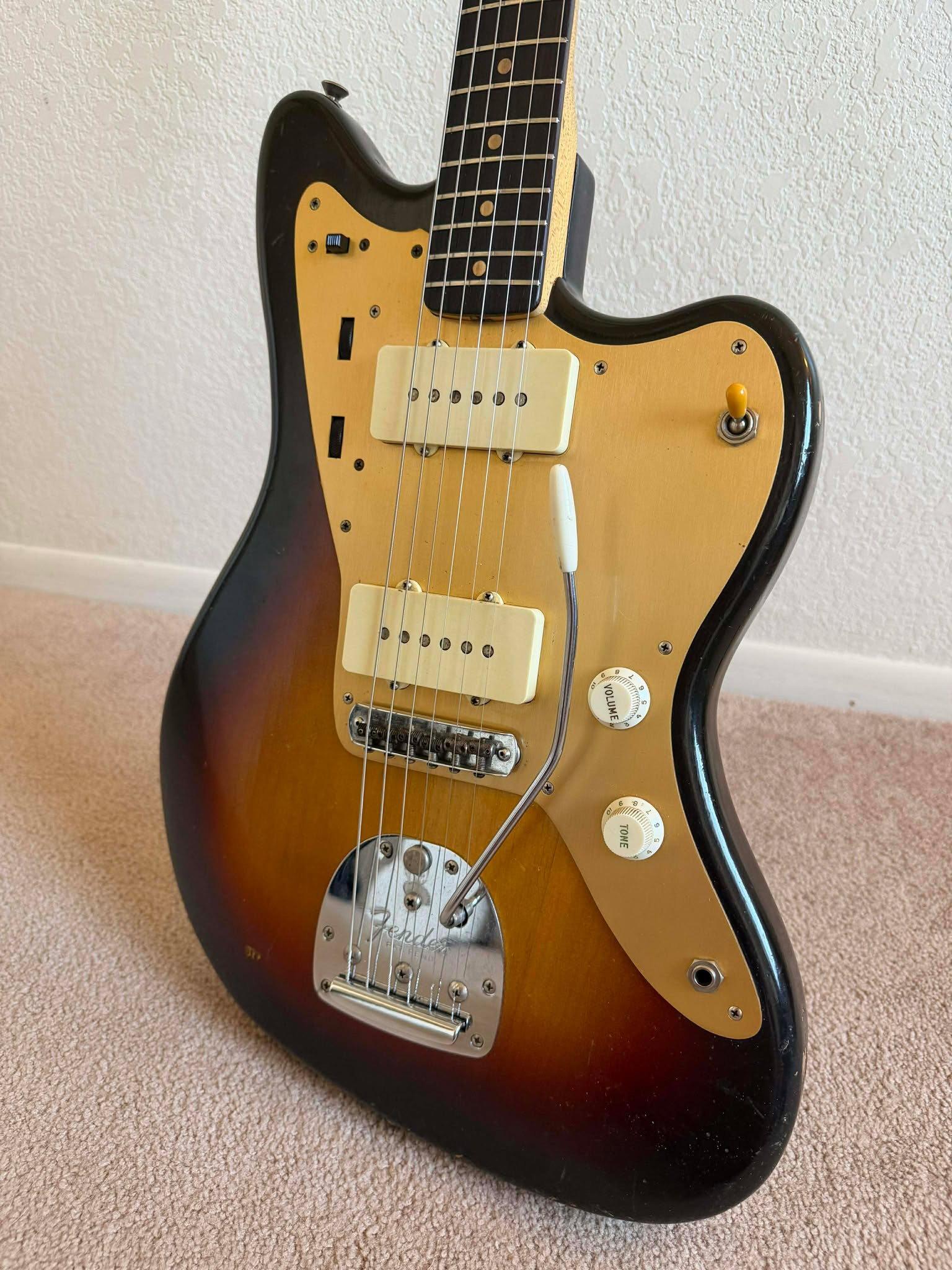
1958 Jazzmaster (First Year - Most Valuable)
The Original Offset-Body Premium Fender:
Body Construction:
Offset waist body design
Alder body standard
Contoured for comfort
Forearm contour
Belly cut on back
Pickups - Distinctive Feature:
Wide single-coil Jazzmaster pickups
Different from Stratocaster pickups
Chrome covers
Surrounded by metal shielding
Unique Jazzmaster tone
Two pickups
Switching System - Complex:
Lead circuit (lower bout controls)
Rhythm circuit (upper bout controls)
Slide switch to select circuit
Lead: 3-way selector, two volumes, master tone
Rhythm: volume and tone on upper horn
Tremolo System:
Floating tremolo
Lock button (engages tremolo lock)
Separate from Stratocaster tremolo
Unique Jazzmaster design
Spring tension adjustment
Neck:
Maple neck
Rosewood fingerboard (from introduction)
Dot inlays
Bound neck (some early examples)
25.5" scale length
Headstock:
Standard Fender headstock
"Fender" spaghetti logo
"Jazzmaster" model name
Matching headstock on custom colors
Pickguard:
Gold anodized pickguard (1958)
Aluminum pickguard material
Complex shape (accommodates controls)
Ages/oxidizes over time
Hardware:
Chrome hardware
Kluson tuners
Chrome control plate
Chrome pickup surrounds
Finish:
Three-tone sunburst standard
Custom colors available
Nitrocellulose lacquer
Serial Numbers: 30000-40000 range
Why 1958 Is Most Valuable:
First year production
All original specifications
Gold anodized pickguard
Historical significance
Limited first-year production
Extremely collectible
1959 Jazzmaster (Slab Rosewood Introduced)
Critical Change - Rosewood Board:
Body Construction:
Offset waist body
Alder body
Contoured
Pickups:
Wide Jazzmaster single-coils
Chrome covers
Metal shielding
Distinctive tone
Switching:
Lead/rhythm circuit system
Slide switches
Complex controls
Multiple control plates
Tremolo:
Floating tremolo with lock
Unique Jazzmaster system
Neck - Critical Change:
Rosewood fingerboard introduced (slab)
Thick rosewood slab (flat bottom)
Clay dot markers
Maple neck with rosewood board
Most desirable fingerboard variation
Headstock:
Fender spaghetti logo
"Jazzmaster" designation
Pickguard:
Gold anodized (early)
Tortoiseshell celluloid begins (late)
Ages to mint green (celluloid)
Hardware:
Chrome hardware
Kluson tuners
Chrome plates
Finish:
Three-tone sunburst
Custom colors available
Nitrocellulose lacquer
Serial Numbers: 40000-50000 range
Significance: Slab rosewood introduced, highly collectible
1960-1962 Jazzmaster (Slab Board Era - Peak Pre-CBS)
The Holy Grail Jazzmaster Era:
Body Construction:
Offset waist body
Alder body
Contoured
Pickups:
Wide Jazzmaster single-coils
Chrome covers
Metal shielding
Switching:
Lead/rhythm circuit system
All original controls
Complex switching
Tremolo:
Floating tremolo with lock
Jazzmaster-specific system
Neck - Defining Feature:
Thick slab rosewood fingerboard (flat bottom)
Clay dot markers
Approximately 4.8mm thick
Most collectible fingerboard variation
Pre-CBS peak quality
Headstock:
Fender spaghetti logo
"Jazzmaster" model name
Pickguard:
Tortoiseshell celluloid pickguard
Ages to mint green
Complex shape
Multiple layers
Hardware:
Chrome hardware
Kluson tuners
Chrome control plates
Finish:
Three-tone sunburst standard
Custom colors increasingly common
Lake Placid Blue, Sonic Blue, Foam Green popular
Nitrocellulose lacquer
Serial Numbers:
1960: 50000-70000 range
1961: 70000-90000 range
1962: 90000-00000 range
Why 1960-1962 Is Peak:
Slab rosewood fingerboard
Clay dot markers
Pre-CBS peak quality
Custom colors common
Most collectible Jazzmasters
Investment grade
1962-1964 Jazzmaster (Veneer Rosewood Pre-CBS)
Fingerboard Transition:
Body Construction:
Offset waist body
Alder body
Contoured
Pickups:
Wide Jazzmaster single-coils
Chrome covers
Metal shielding
Switching:
Lead/rhythm circuit system
All original controls
Tremolo:
Floating tremolo with lock
Neck - Important Change:
Curved rosewood veneer (mid-1962)
Thinner than slab board
Clay dot markers continue through 1964
Curved bottom fits neck radius
Still pre-CBS quality
Headstock:
Fender spaghetti logo
"Jazzmaster" designation
Pickguard:
Tortoiseshell celluloid
Ages to mint green
Complex shape
Hardware:
Chrome hardware
Kluson tuners
Chrome plates
Finish:
Three-tone sunburst
Custom colors common
Matching headstock on custom colors
Nitrocellulose lacquer
Serial Numbers:
1962: 90000-00000 range
1963: L00001-L20000 range
1964: L20000-L50000 range
Significance: Pre-CBS veneer board, clay dots, excellent quality
1965 Jazzmaster (CBS Transition Year - Critical)
CBS Acquisition: January 1965
Transition Period Complexity:
Pre-CBS features (early 1965)
Transitional features (mid-1965)
CBS features (late 1965)
Early 1965 (Pre-CBS):
Clay dot markers
L-series serial numbers
No F-stamp on neck plate
Nitrocellulose finish
Pre-CBS specifications
Mid-1965 (Transition):
F-stamp appears on neck plates
Pearl dots begin replacing clay
Specifications begin changing
Mixed features possible
Late 1965 (CBS):
Pearl dot markers (pearloid)
F-stamped neck plates
Serial numbers transition to 100000+
Polyurethane finishes on some
Body Construction:
Offset waist body
Alder body
Contoured
Pickups:
Wide Jazzmaster single-coils
Chrome covers
Switching:
Lead/rhythm circuit system
All controls
Tremolo:
Floating tremolo with lock
Neck:
Rosewood veneer fingerboard
Clay dots (early) or pearl dots (late)
Headstock:
Fender logo (transitional styles)
"Jazzmaster" designation
Pickguard:
Tortoiseshell celluloid
Ages to mint green
Hardware:
Chrome hardware
Kluson tuners (early) to F-stamped (late)
Finish:
Three-tone sunburst
Custom colors
Nitrocellulose (early) to polyurethane (late)
Serial Numbers: L50000-L90000, then 100000-200000
Why 1965 Is Complex:
CBS transition creates variations
Early 1965 = pre-CBS
Late 1965 = CBS
F-stamp dating indicator
Clay vs. pearl dots critical
Must verify all features
1966-1967 Jazzmaster (Early CBS - Small Headstock)
CBS Changes Begin:
Body Construction:
Offset waist body
Alder body
Contoured
Pickups:
Wide Jazzmaster single-coils
Chrome covers
Switching:
Lead/rhythm circuit system
Tremolo:
Floating tremolo with lock
Neck:
Rosewood veneer fingerboard
Pearl dot markers (pearloid)
CBS era
Headstock:
Small headstock continues (through mid-1968)
Fender logo
"Jazzmaster" designation
Transition logo styles
Pickguard:
Tortoiseshell celluloid
Ages to mint green
Hardware:
F-stamped neck plates
Chrome hardware
F-stamped tuners (some)
Finish:
Three-tone sunburst
Custom colors
Polyurethane finishes more common
Thicker application
Serial Numbers:
1966: 100000-200000 range
1967: 200000-300000 range
Significance: Early CBS era, small headstock continues
1968-1970 Jazzmaster (Large Headstock CBS Era)
Major Change - Large Headstock:
Headstock - Critical Dating Feature:
Large headstock introduced (late 1968)
Approximately 10% larger
Different appearance
CBS era feature
Less desirable to collectors
Body Construction:
Offset waist body
Alder body
Contoured
Pickups:
Wide Jazzmaster single-coils
Chrome covers
Switching:
Lead/rhythm circuit system
All controls continue
Tremolo:
Floating tremolo with lock
Neck:
Rosewood veneer fingerboard
Pearl dot markers
Pickguard:
Tortoiseshell celluloid
Various colors
Hardware:
F-stamped parts
Chrome hardware
Finish:
Various colors
Polyurethane standard
Thicker finishes
Serial Numbers:
1968: 300000-400000 range
1969: 400000-500000 range
1970: 500000-600000 range
Significance: Large headstock CBS era, declining collector interest
Potentiometer Date Codes: Essential Verification
Potentiometer codes provide crucial verification:
Understanding Pot Codes
Standard Format: XXYYZZ
XX = Manufacturer code
YY = Year of manufacture
ZZ = Week of manufacture
Common Manufacturers:
304 = Stackpole (pre-CBS primarily)
137 = CTS (CBS era primarily)
134 = Centralab (some examples)
How to Check Pot Codes on Jazzmaster
Access Challenge: Complex control layout
Process:
Remove pickguard and control plates
Locate potentiometers (lead circuit: 3 pots; rhythm circuit: 2 pots)
Look for stamped codes on pot casings
Complex wiring may obscure some
Use flashlight and mirrors
Record codes from all accessible pots
Pot Count: 5 potentiometers total
Example Codes:
304 5928 = Stackpole pot, 1959, 28th week
137 6715 = CTS pot, 1967, 15th week
Interpreting Pot Dates
Dating Rules:
Pots date component manufacture
Guitar assembled weeks/months after pots made
All pots should date similarly
1962 Jazzmaster might have late 1961 or early 1962 pots
Critical for Pre-CBS Verification:
Stackpole pots typical pre-CBS
CTS pots more common CBS era
Essential for 1965 transitional dating
Red Flags:
Pots dated after supposed guitar year
Mixed pot dates from different years
Modern pots on supposedly vintage Jazzmaster
Identifying Key Jazzmaster Features
Understanding distinctive characteristics:
Wide Jazzmaster Pickups
Distinctive Pickup Design:
Wider than Stratocaster pickups
Single-coil design
Chrome covers
Metal shielding underneath
Unique Jazzmaster tone
Brighter than humbuckers, warmer than Strat
Not Stratocaster Pickups: Different size and construction
Complex Lead/Rhythm Circuit Switching
Lead Circuit (lower bout):
Three-way pickup selector
Two volume controls (one per pickup)
Master tone control
Rhythm Circuit (upper horn):
Separate volume control
Separate tone control
Preset rhythm sound
Neck pickup only in rhythm mode
Bass-heavy tone
Slide Switch: Selects between lead and rhythm circuits
Complexity: Most complex switching of standard Fender guitars
Floating Tremolo with Lock
Jazzmaster Tremolo:
Floating tremolo system
Lock button engages tremolo lock
Prevents detuning
Separate from Stratocaster tremolo
Unique Jazzmaster feature
Lock Feature:
Button on tailpiece
Locks tremolo in place
Practical for stability
Slab Rosewood vs. Veneer Rosewood
Slab Rosewood (1959-1962):
Thick rosewood board (4.8mm approximately)
Flat bottom
Clay dot markers
Most desirable
Peak collector value
Veneer Rosewood (1962-1970):
Thinner rosewood veneer
Curved bottom
Clay dots (pre-CBS) or pearl dots (CBS)
Standard rosewood board
Identification:
Remove neck to see bottom
Slab is flat, veneer is curved
Clay vs. pearl dots help
Clay Dots vs. Pearl Dots
Clay Dots (1959-1964):
Vintage clay material
Off-white appearance
Age to yellowish
Pre-CBS characteristic
More desirable
Pearl Dots (1965-1970):
Pearloid material
White appearance
CBS era
Less desirable
Identification: Material and appearance differ
Small Headstock vs. Large Headstock
Small Headstock (1958-1968):
Standard Fender headstock
Classic proportions
Pre-CBS and early CBS
More desirable
Large Headstock (late 1968-1970):
Approximately 10% larger
CBS era feature
Less desirable
Identification: Visual comparison, measuring
F-Stamped Parts
F-Stamp Significance:
"F" stamped on neck plate (mid-1965+)
"F" on tuners (some CBS era)
Indicates CBS ownership
Dating indicator
What F-Stamp Means:
CBS era (mid-1965 onward)
Not pre-CBS
Quick visual identifier
Custom Color Jazzmasters: Identification and Authentication
Custom colors significantly affect values:
Pre-CBS Custom Colors (1958-1964)
Available Colors:
Lake Placid Blue (very popular on Jazzmaster)
Sonic Blue
Daphne Blue
Foam Green
Surf Green
Sherwood Green
Olympic White
Burgundy Mist
Shoreline Gold
Fiesta Red
Dakota Red
Candy Apple Red
Shell Pink (extremely rare)
Authentication:
Yellow stain under custom colors
Check neck pocket for original color
Matching headstock essential
Nitrocellulose finish (pre-CBS)
Rarity and Value:
Custom colors command 2-4x sunburst values
Rare colors (Shell Pink, Foam Green) highest premiums
Lake Placid Blue popular on Jazzmaster
Matching headstock critical
CBS Era Custom Colors (1965-1970)
Changes:
Polyurethane finishes more common
Thicker application
Different aging characteristics
When You're Ready to Sell Your Vintage Fender Jazzmaster
How Dating Affects Jazzmaster Value
Era-Specific Premiums:
1958 first year: Highest values
1959-1962 slab board: Peak values
1962-1964 pre-CBS veneer: Excellent values
1965 early pre-CBS: Strong premiums
1965 late CBS: Good values
1966-1968 CBS small headstock: Moderate values
1969-1970 CBS large headstock: Lower values
Feature-Specific Value:
Slab rosewood board (1959-1962): Major premium
Clay dots: Premium over pearl
Custom colors: 2-4x sunburst premiums
Small headstock: Premium over large
Pre-CBS: 2-3x CBS era values
Gold anodized pickguard (1958): Extreme premium
Why Choose Edgewater Guitars
Our Fender Jazzmaster Expertise:
Pre-CBS Fender specialists
Slab vs. veneer rosewood identification
Clay vs. pearl dot verification
Custom color authentication
Complex switching evaluation
F-stamp recognition
Transitional 1965 assessment
Premium Offers: 30-40% higher than guitar shops
Contact: (440) 219-3607
Service Area: Ohio, Michigan, Pennsylvania, Indiana, West Virginia
Frequently Asked Questions
What makes 1960-1962 Jazzmasters more valuable?
1960-1962 Jazzmasters feature thick slab rosewood fingerboards with clay dot markers, representing peak pre-CBS quality. These are the most collectible Jazzmasters combining pre-CBS specifications with the desirable slab board. Use our Fender Serial Number Lookup Tool to check your serial range.
How can I tell if my Jazzmaster is pre-CBS?
Pre-CBS Jazzmasters have serial numbers through L99999, neck dates through 1964, clay dot markers (if rosewood board), small headstock, Stackpole pots, no F-stamp on neck plate, and thin nitrocellulose finishes. CBS acquisition occurred January 1965.
What's the difference between slab and veneer rosewood?
Slab rosewood (1959-1962) is approximately 4.8mm thick with a flat bottom. Veneer rosewood (1962+) is thinner with a curved bottom. Slab board Jazzmasters are significantly more valuable.
Are custom color Jazzmasters more valuable?
Yes, significantly. Custom color Jazzmasters command 2-4x the value of sunburst examples. Rare colors like Shell Pink and Foam Green bring the highest premiums. Lake Placid Blue was popular on Jazzmasters.
When did Fender change to large headstock?
The large headstock was introduced in late 1968 and became standard in 1969-1970. Small headstock Jazzmasters (1958-1968) are more desirable.
What does the F-stamp mean?
The "F" stamped on the neck plate indicates CBS-era production (mid-1965 onward). Pre-CBS Jazzmasters don't have F-stamps. This is a quick visual indicator.
Can I date my Jazzmaster by serial number alone?
Not reliably. Serial numbers overlap significantly between years. Use our Fender Serial Number Lookup Tool for range, then verify with neck dates, pot codes, and physical features.
What pickups should a vintage Jazzmaster have?
All vintage Jazzmasters should have wide Jazzmaster single-coil pickups with chrome covers and metal shielding. These are different from Stratocaster pickups and essential to authenticity.
Additional Resources
Fender Serial Number Lookup Tool - Quick reference for your Jazzmaster
Complete Fender Guitar Dating Guide
How to Date Fender Guitars - All Models
Sell Your Fender Guitar
Vintage Fender Authentication Guide
Learning how to date your vintage Fender Jazzmaster accurately requires understanding serial numbers, neck dates, pot codes, and physical features specific to each era. The Jazzmaster evolved from 1958 through 1970, with pre-CBS examples (through 1964) commanding the highest values, particularly 1960-1962 slab rosewood board guitars.
Whether you own a rare 1958 first-year Jazzmaster, a coveted slab board example, a custom color guitar, or any vintage Jazzmaster, proper authentication ensures you understand your instrument's history and value. Use our Fender Serial Number Lookup Tool as a starting point, then verify with neck dates, pot codes, rosewood board type, dot marker material, and headstock size.
Edgewater Guitars specializes in vintage Fender Jazzmaster authentication and purchasing throughout the Midwest. Our comprehensive knowledge of Jazzmaster dating—from slab rosewood identification to pre-CBS verification—ensures accurate assessments that reflect your guitar's true age and value.
Contact us today at (440) 219-3607 for expert Jazzmaster authentication or professional valuation.
Gavin Coe, Vintage Guitar Specialist
Edgewater Guitars - Ohio's Premier Guitar Buyer