DATE :
How to Adjust Guitar Pickup Height Correctly
Your guitar's tone lives in the gap between strings and pickups. A few millimeters too close, and you get warbling notes and choked sustain. A few millimeters too far, and your signal turns thin and lifeless.
Pickup height adjustment is one of the simplest tweaks you can make to an electric guitar, yet it's often overlooked. This guide covers how to measure, adjust, and fine-tune pickup height for every major guitar type—from Stratocasters and Telecasters to Les Pauls and active-pickup instruments.
What is guitar pickup height
To adjust guitar pickup height, turn the mounting screws on either side of the pickup. Clockwise raises the pickup closer to the strings, while counter-clockwise lowers it away. This applies to most ring-mounted and pickguard-mounted pickups, though some body-mounted designs work in reverse.
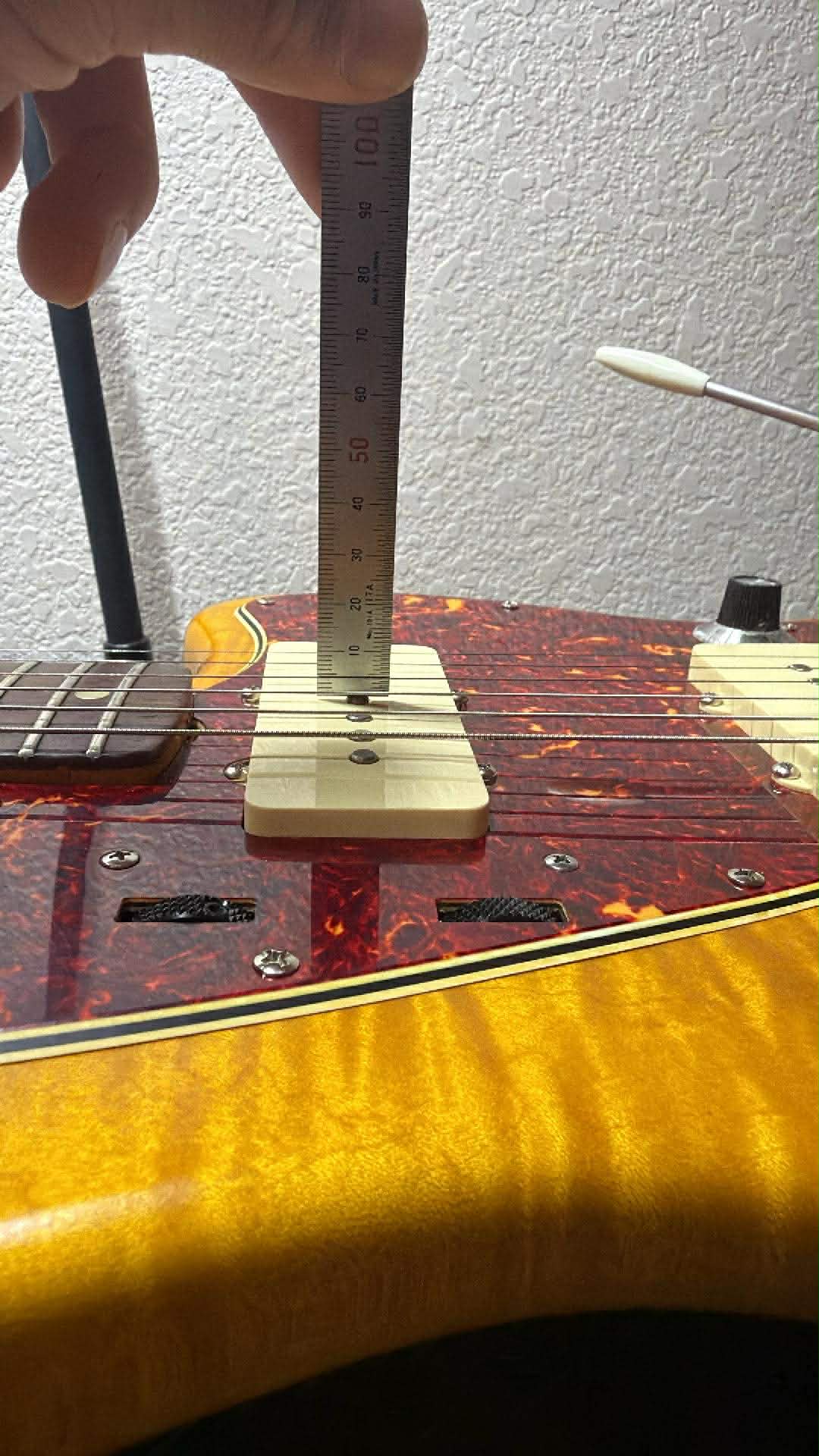
Pickup height refers to the gap between your strings and the magnetic polepieces that sense string vibration. You measure this distance from the bottom of the string (while fretting the highest fret) to the top of the polepiece. Even a quarter turn of a screw can noticeably change your guitar's output and tone.
Why pickup height affects your guitar's tone
Pickups use magnets to detect string vibration and convert that movement into an electrical signal. The closer the pickup sits to the strings, the stronger the magnetic field interaction becomes. That relationship changes everything about how your guitar sounds.
Output and volume changes
When pickups sit closer to the strings, they capture more of the string's movement and produce a louder, hotter signal. Move them farther away, and the output drops, giving you a cleaner, more dynamic response.
Treble and bass response
Height affects frequency balance in ways that aren't always obvious. Pickups set too close to the bass strings can produce a muddy, boomy sound because thicker strings generate stronger magnetic interaction. Meanwhile, pickups too far from the treble strings can thin out your high end.
Sustain and magnetic string pull
If your pickups are too close, the magnets can actually pull on the strings and interfere with their natural vibration. This phenomenon creates a warbling, out-of-tune quality and chokes sustain. Players sometimes call this "Stratitis" or wolf tones.
Signs your pickups are too high or too low
Before making adjustments, it helps to diagnose whether your current setup has a problem.
Symptoms of pickups set too high
Warbling or wolf tones: Strange pitch wobbles, especially on fretted notes in the upper registers
Reduced sustain: Notes die quickly because magnets interfere with string vibration
Muddy or boomy sound: Overpowering bass response that lacks definition
String contact: Strings physically hitting the pickup when you play aggressively
Symptoms of pickups set too low
Weak output: Thin, quiet signal even with your amp turned up
Loss of clarity: Undefined attack and mushy tone across all frequencies
Poor string separation: Individual notes don't ring clearly in chords
When to check your guitar's pickup height
Pickup height isn't something you set once and forget. Several situations call for a fresh look at your measurements, especially considering the average 30-year lifespan of a guitar:
After changing string gauge: Heavier strings have more mass and create stronger magnetic interaction
After adjusting string action: Changing bridge or saddle height directly affects the distance between strings and pickups
After installing new pickups: Different magnets and designs require different heights
When your tone sounds off: Any of the symptoms above warrant a quick check
During a full guitar setup: Pickup height is typically the final step after adjusting the neck, action, and intonation
Tools you need for setting pickup height
This adjustment requires minimal equipment. Most players already have what they need.
Measurement tools
6-inch metal ruler with 1/64" markings: The most common and accurate method
Automotive feeler gauges: Precise for very small measurements
Dedicated pickup height gauges: Specialty tools available from guitar supply companies
Adjustment tools
Phillips head screwdriver: Works for most humbucker and single-coil mounting screws
Flathead screwdriver: Required for some vintage-style pickups and certain Telecaster bridge pickups
Recommended pickup height measurements by guitar type
These measurements serve as starting points. Every guitar, pickup, and player is different, so fine-tuning by ear comes after setting initial heights.
Guitar/Pickup Type | Bass Side (Low E) | Treble Side (High E) |
|---|---|---|
Fender Stratocaster | 3/32" (2.4mm) | 1/16" (1.6mm) |
Fender Telecaster Bridge | 3/32" (2.4mm) | 1/16" (1.6mm) |
Fender Telecaster Neck | 1/16" (1.6mm) | 1/16" (1.6mm) |
Gibson Humbucker (Bridge) | 1/16" (1.6mm) | 1/16" (1.6mm) |
Gibson Humbucker (Neck) | 3/32" (2.4mm) | 3/32" (2.4mm) |
P90 Pickups | 3/32" (2.4mm) | 1/16" (1.6mm) |
EMG/Active Pickups | 1/16" (1.6mm) | 1/16" (1.6mm) |
Bass (J/P Style) | 3/32" (2.4mm) | 3/32" (2.4mm) |
Bass-side measurements are often slightly higher than treble-side measurements. This compensates for thicker bass strings, which produce stronger magnetic pull.
How to measure and set guitar pickup height
This is the core process. Take your time, and remember that small adjustments make noticeable differences.
Step 1. Tune your guitar to standard pitch
Adjustments made with slack strings won't translate accurately to playing conditions. String tension affects the distance between strings and pickups, so tune up before measuring.
Step 2. Fret the string at the highest fret
Press the low E string down at the last fret, typically the 21st or 22nd fret depending on your guitar. This is where you measure from: the bottom of the string in its playing position, not where it sits at rest.
Step 3. Measure the gap from string to polepiece
Place your ruler or gauge between the bottom of the fretted string and the top of the polepiece. Compare your measurement to the recommended specs in the chart above. Hold the ruler perpendicular to the pickup surface for accuracy.
Step 4. Turn the pickup height screws to adjust
Clockwise rotation: Raises the pickup closer to the strings (for ring-mounted and pickguard-mounted pickups)
Counter-clockwise rotation: Lowers the pickup away from the strings
Body-mounted pickups: Some work in reverse, so watch the pickup move to confirm direction
Quarter-turn increments: Small changes make noticeable differences
Step 5. Test your sound and fine-tune by ear
Plug into your amp at normal playing volume. Play clean and with gain. Listen for balance between pickups, clarity on individual notes, and any unwanted artifacts like warbling or muddiness. Your ears are the final judge.
Tip: Play the same riff or chord progression while switching between pickups. This helps you hear whether output levels are balanced.
How to set humbucker pickup height
Humbuckers have a different magnetic structure than single coils, which affects how close they can sit to the strings.
Standard humbucker height guidelines
Humbuckers typically sit closer to the strings than single coils because their dual-coil design produces a different magnetic field pattern. The bridge pickup usually sits slightly closer than the neck pickup to compensate for reduced string movement near the bridge.
Les Paul pickup height settings
Gibson's factory specs provide a solid starting point for Les Paul-style guitars. Vintage PAF-style pickups, with their weaker magnets, can often sit a bit closer than high-output modern humbuckers.
High-output humbucker adjustments
Hotter pickups with stronger magnets often benefit from sitting slightly lower than standard recommendations. This prevents the signal from becoming overwhelming and keeps the tone from getting muddy.
How to set Stratocaster pickup height
Fender's most popular model has three pickups, and balancing them requires attention to how they interact in different switch positions.
Strat bridge pickup height
The bridge pickup typically sits closest to the strings to achieve balanced output with the other positions. Start with the 3/32" bass and 1/16" treble measurements, then adjust based on how it sounds relative to your middle and neck pickups.
Strat middle pickup height
The middle pickup often benefits from sitting slightly lower than the bridge and neck pickups. Positions 2 and 4 on your switch combine the middle pickup with the bridge or neck, and a lower middle pickup prevents those combined sounds from becoming too loud.
Strat neck pickup height
Neck pickups usually sit a bit lower than bridge pickups because strings vibrate more freely over the neck position. Setting the neck pickup too high can produce a boomy, undefined tone.
How to set Telecaster pickup height
Telecasters have their own quirks, particularly with the bridge pickup design.
Tele bridge pickup height
Telecaster bridge pickups mount directly to the bridge plate rather than a pickguard. The screws thread into the bridge plate itself, and you may want to hold the pickup in place while turning them.
Tele neck pickup height
The neck pickup on a Telecaster adjusts similarly to a Stratocaster neck pickup. Screws on each side raise or lower the pickup within its mounting ring.
How to set P90 pickup height
P90 pickups occupy a middle ground between single coils and humbuckers. They're wider and use a different magnet configuration, which gives them their distinctive growl.
Start with approximately 3/32" on the bass side and 1/16" on the treble side, then adjust by ear. P90s can handle being fairly close to the strings, but they'll get muddy if you push them too high. Adjustment screw locations vary depending on whether you have soapbar or dog-ear style P90s.
How to set EMG and active pickup height
Active pickups like EMGs use preamps powered by batteries, which changes their magnetic characteristics. Because the preamp boosts the signal electronically, active pickups can often sit closer to the strings without the same problems passive pickups experience.
The 1/16" measurement on both bass and treble sides works well as a starting point. Since active pickups are less sensitive to height changes than passive designs, you have more flexibility to experiment.
How to balance output between bridge and neck pickups
One of the main goals of pickup height adjustment is achieving smooth volume transitions when switching between pickups.
To check balance, play the same notes or chord progression while switching between pickup positions. Listen for volume jumps. If one pickup is noticeably louder, lower it slightly. If one is too quiet, raise it.
Some players prefer a hotter bridge pickup for lead work, while others want everything perfectly matched. There's no wrong answer, which explains why 50% of players upgrade accessories annually to customize their tone.
Common pickup height problems and how to fix them
Sometimes adjustments don't go as planned.
Pickup won't move when adjusting screws
Check for paint or finish binding the pickup ring to the body, dried-out foam or springs underneath, or cross-threaded screws. Gentle pressure on the pickup while turning the screw can help free stuck adjustments.
Foam or springs have deteriorated
On older guitars, the foam pads or springs that push against the bottom of the pickup can compress or crumble over time. Replacement foam and springs are inexpensive and available from guitar parts suppliers.
Stripped pickup mounting screws
If the screws spin without catching, the threads in the mounting ring or pickguard may be stripped. Solutions include using slightly larger screws or filling the hole with a toothpick and wood glue before reinserting the original screw.
Uneven polepiece heights
Some pickups have staggered polepieces by design to compensate for different string diameters and fretboard radius. Others have adjustable polepieces that let you fine-tune individual string response after setting overall height.
When to get professional help with pickup adjustment
While pickup height adjustment is straightforward for most players, certain situations benefit from professional attention. If you're uncomfortable making adjustments, if the pickups appear damaged, or if you're working on a valuable vintage guitar where originality matters, a qualified guitar technician can help.
If you've discovered your guitar might be a valuable vintage instrument while working on it, or you're curious what an older guitar in your collection might be worth, Edgewater Guitars offers free, no-obligation appraisals. Our team has decades of experience with vintage Fender, Gibson, and other collectible instruments.
Finding the right pickup height for your playing style
Manufacturer specs and recommended measurements are starting points. Your ideal pickup height depends on your playing style, your amp, your preferred genres, and what sounds good to you.
Aggressive players who dig in hard may prefer pickups set slightly lower to avoid string contact and excessive output. Players with a lighter touch can often get away with pickups closer to the strings for maximum response. The adjustment is completely reversible, and the only way to find your sweet spot is to try different heights and listen.
FAQs about guitar pickup height adjustment
Does changing string gauge require adjusting pickup height?
Yes. Heavier strings have more mass and produce stronger magnetic interaction, so you may want to lower pickups slightly when moving to thicker strings. Lighter strings have the opposite effect.
Can incorrect pickup height damage my guitar or pickups?
No permanent damage occurs from height adjustment alone. However, setting pickups too high can cause strings to contact the pickup during aggressive playing.
What if my guitar's pickups have staggered or adjustable polepieces?
Staggered polepieces are intentional and don't require adjustment. Adjustable polepieces let you fine-tune individual string response after setting overall height.
Does pickup height adjustment affect guitar intonation?
Pickup height does not affect intonation. Intonation is set at the bridge saddles and relates to string length, not pickup position.
How far from the strings are bass guitar pickups typically set?
Most bass pickups use approximately 3/32" on both bass and treble sides as a starting point, measured while fretting the last fret.
Get your free guitar valuation
If you've been working on an older guitar and suspect it might have collector value, or if you've inherited an instrument and want to understand what you have, Edgewater Guitars provides free, no-obligation appraisals for vintage and collectible guitars.
Get Your Free Valuation — Call (440) 219-3607 or submit photos through our website.