DATE :
Gretsch White Falcon: Complete Guide to Identification, Dating, and Selling
Gretsch White Falcon: Complete Guide to Identification, Dating, and Selling
Last Updated: February 2026
What Is a Gretsch White Falcon and Why Is It Significant?
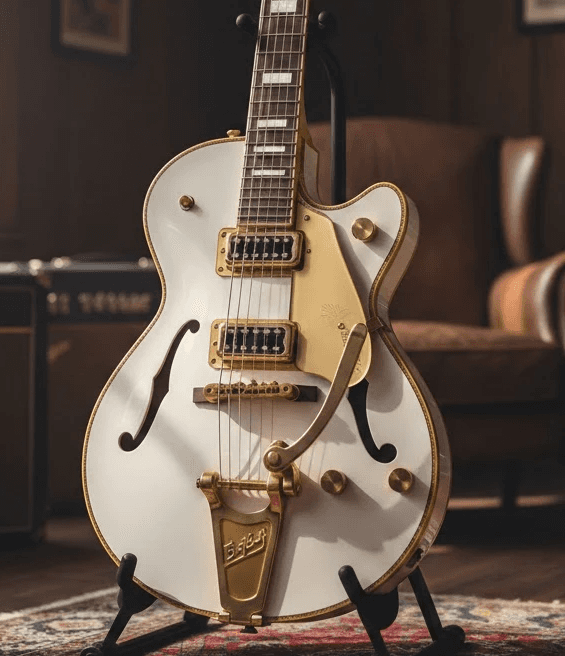
Direct Answer: The Gretsch White Falcon is one of the most visually striking and historically significant electric guitars ever produced. Introduced in 1955 as Gretsch’s showpiece instrument, the White Falcon has been produced across multiple distinct eras—each with different construction features, hardware configurations, and collector values. Knowing exactly which era your White Falcon comes from is essential to understanding its true value.
The White Falcon was conceived specifically as a statement piece—an instrument designed to showcase everything Gretsch could do at the highest level. It debuted at the 1954 NAMM trade show as a concept guitar and entered production in 1955. The original 1955-1960 single-cutaway White Falcon is among the most coveted hollow-body guitars in existence. Later double-cutaway versions (1962+), stereo models, and post-Baldwin era examples each represent distinct chapters in the model’s history.
Why White Falcons Are Particularly Complex to Evaluate:
Unlike most vintage guitars where year and condition are the primary value drivers, White Falcon valuation requires understanding:
Single cutaway vs. double cutaway body configuration
DeArmond vs. Filter’Tron vs. Super’Tron pickup eras
Pre-Baldwin vs. Baldwin era construction (1967 is the dividing line)
Stereo vs. mono electronics
Original gold sparkle binding vs. replacement binding
Jeweled hardware condition and completeness
Original Bigsby configuration vs. modifications
Body width specifications by era
In Edgewater’s experience purchasing vintage Gretsch instruments throughout Ohio and the Midwest, White Falcons generate more questions from sellers than almost any other guitar. The combination of ornate hardware, complex electronics, and multiple distinct production eras creates genuine confusion about what any given example is worth. This guide resolves that confusion.
If you own a Gretsch White Falcon and want to understand what you have and what it’s worth, Edgewater Guitars provides free, no-obligation valuations for vintage Gretsch instruments. Call (440) 219-3607 or visit our valuation page.
What Is a Gretsch White Falcon Worth? (2026 Market Values)
Value by Era and Configuration
White Falcon values vary dramatically by production era. Understanding which era your guitar belongs to is the first step in accurate valuation.
1955-1960 Single Cutaway (Pre-CBS Era, First Generation):
All-original condition, excellent: Highest tier White Falcon values
All-original, very good (honest play wear): 15-25% below excellent
Replaced or missing parts: 20-40% reduction depending on which components
Refinished examples: 40-60% reduction
Value Position: Blue-chip vintage guitar investment, museum-quality examples command serious collector attention
1961 Single Cutaway (Final Year, Transitional):
Similar to late 1950s examples in market positioning
Filter’Tron pickups standard by this point
Strong collector demand for final single-cutaway year
Value Position: Near equivalent to late 1950s examples
1962-1964 Double Cutaway (Early DC Era):
Double cutaway body reduces value vs. single cutaway
Still highly desirable, Filter’Tron equipped
Stereo models (Twin model) additional complexity
Value Position: 30-40% below comparable single cutaway year
1965-1967 Double Cutaway (Late Pre-Baldwin):
Baldwin acquisition occurred 1967
Final years of original Gretsch construction
Super’Tron pickups appearing on some examples
Value Position: 40-50% below early single cutaway; still significant collector value
1967-1980 Baldwin Era:
Baldwin purchased Gretsch 1967, construction quality changes
Move from Brooklyn, NY to Booneville, AR manufacturing
Significant quality and feature changes
Value Position: Moderate collector and player market; substantially below pre-Baldwin
1989-Present Reissues and Modern Production:
Gretsch brand reacquired by Fred Gretsch 1985, production restarted 1989
Multiple reissue lines with varying quality and collector interest
Japanese-made vs. American-made important distinction
Value Position: Player market; limited collector interest vs. original vintage examples
What Affects the Value of a White Falcon?
Single vs. Double Cutaway: Single cutaway examples (1955-1961) command highest prices. Double cutaway (1962+) reduces value by approximately 30-40% compared to equivalent single cutaway year. Collectors associate single cutaway with original White Falcon aesthetic and first-generation production significance.
Pickup Configuration:
DeArmond Dynasonic pickups (1955-1957): Associated with earliest examples, highly collectible sound
Filter’Tron humbuckers (1957-1965+): More common, excellent sound, very desirable
Super’Tron pickups (mid-1960s): Later design, some models desirable
Replaced or wrong-era pickups: Reduces value by 25-35%
Binding Condition: Gold sparkle binding is one of the White Falcon’s most distinctive and most problematic features. Deterioration, shrinkage, discoloration, or replacement dramatically affects value and appearance.
Original binding in excellent condition: Significant value premium
Original binding with light crazing or slight discoloration: Acceptable, minimal impact
Severely deteriorated binding: 10-20% value reduction
Replaced binding (even correct reproduction): 15-25% reduction
Wrong binding material or color: 20-35% reduction
Jeweled Hardware Completeness: White Falcons feature jeweled knobs, jeweled headstock, and jeweled pickup mounting. Missing jewels, discolored jewels, or replaced hardware directly impacts value.
All original jeweled hardware complete and intact: Maximum value
Missing individual jewels: 5-10% reduction depending on which
Replaced knobs or hardware: 10-20% reduction
Faded or discolored jewels (common): Acceptable, minor impact
Bigsby Configuration: Original Bigsby tailpiece on White Falcon is correct and expected. Specific Bigsby models varied by year.
Original correct Bigsby in working order: Maximum value
Original Bigsby non-functional or damaged: 10-15% reduction
Replaced Bigsby (incorrect model): 15-20% reduction
Non-Bigsby tailpiece modification: 20-30% reduction
Stereo vs. Mono Electronics: White Falcon offered in both mono (Model 6136) and stereo (Model 6137) configurations at various points.
Complete original stereo electronics intact: Premium for appropriate model
Converted from stereo to mono: 15-25% reduction
Replaced electronics harness: 15-20% reduction
Varitone switch present and functional: Important for stereo model value
Pre-Baldwin vs. Baldwin Era: Pre-Baldwin (pre-1967) examples command substantial premium over Baldwin era (1967-1980). Construction quality, materials, and overall craftsmanship differ significantly.
Documentation:
Original hardshell case: Adds 10-15% to value
Original hang tags, receipts, warranty cards: Additional premium
Period photographs with original owner: Provenance adds confidence and collector interest
How White Falcon Value Compares Across Eras
Era | Cutaway | Pickups | Relative Value | Key Distinguishing Features |
|---|---|---|---|---|
1955-1957 | Single | DeArmond | Highest | First production, DeArmond pickups, original specs |
1957-1960 | Single | Filter’Tron | Very High | Filter’Tron introduced, peak pre-CBS Gretsch |
1961 | Single | Filter’Tron | Very High | Final single cutaway year, strong collector demand |
1962-1964 | Double | Filter’Tron | High | Double cutaway introduces, strong but below single cut |
1965-1967 | Double | Filter’Tron/Super’Tron | Moderate-High | Late pre-Baldwin, transitional features |
1967-1972 | Double | Super’Tron/other | Moderate | Baldwin era begins, construction changes |
1973-1980 | Double | Various | Lower-Moderate | Late Baldwin era, quality inconsistency |
1989-2002 | Double | Various | Player market | Reissue era, Japanese production |
2003-Present | Double | Various | Player market | Fender-distributed modern production |
Recent Sales Trends (2025-2026)
The market for vintage White Falcons has shown consistent strength over the past several years, with several notable trends:
Rising Demand:
Single cutaway pre-Baldwin examples seeing increased auction interest
DeArmond-equipped 1955-1957 examples approaching record pricing
Complete original examples (all jewels, original binding, original case) commanding strong premiums
Stable Market:
Filter’Tron double cutaway examples (1962-1966) maintaining values
Player-grade pre-Baldwin examples with honest wear holding steady
Market Nuances:
Binding condition increasingly scrutinized by buyers—good binding examples pulling away from binding-damaged examples
Stereo models generating specialized collector interest
Baldwin era guitars finding increased player market demand as affordable vintage hollowbody options
In Edgewater’s experience, we consistently see White Falcons undervalued by uninformed buyers who don’t recognize era differences, pickup transitions, or binding significance. This is precisely why expert authentication matters—a 1958 White Falcon in original condition is worth dramatically more than it might appear to someone unfamiliar with the model’s history. Edgewater offers 30-40% more than typical guitar shops for quality vintage Gretsch instruments. Get your free valuation: (440) 219-3607.
How to Date a Gretsch White Falcon
Dating a Gretsch White Falcon requires understanding several systems used across different production eras. Unlike Fender or Gibson, Gretsch used multiple serial number formats, paper labels, and construction features to date instruments.
Serial Numbers: Complete Dating Guide
Where to Find the Serial Number:
Serial number location changed across production eras—this alone helps narrow production period:
1939-1965: Paper label inside the body (visible through the f-holes with flashlight)
1965-1972: Metal plate on headstock back
1967-1972: Hyphenated serial on headstock plate (Baldwin era transition)
1972-1981: Metal plate, different format
1989-present: Interior label (reissue era)
Pre-Baldwin Serial Number System (1939-1965):
Format: Six-digit number on interior paper label
Dating method: First one or two digits indicate year
Serial Range | Production Year |
|---|---|
0001-1000 (approx) | 1939-1945 |
1000-5000 | 1945-1950 |
10000-16000 | 1950-1955 |
17000-26000 | 1954-1956 |
26000-34000 | 1956-1957 |
34000-43000 | 1957-1958 |
43000-58000 | 1958-1959 |
58000-70000 | 1959-1960 |
70000-80000 | 1960-1961 |
80000-87000 | 1961-1962 |
87000-98000 | 1962-1963 |
98000-100000+ | 1963-1964 |
Important Caveat: Gretsch serial numbers are notoriously inconsistent. Numbers were not strictly sequential, and production overlap between years is common. Serial number alone cannot definitively date a Gretsch—features and hardware must corroborate.
Baldwin Era Serial Number System (1967-1981):
Format changed to hyphenated system on headstock plate: XX-YYYY
First two digits: Production year
Remaining digits: Sequential number
Example: 68-12345 = 1968, instrument number 12345
Headstock Plate Dating: Presence of headstock plate (rather than paper label) immediately identifies 1965-1981 production. Early headstock plates (1965-1967) transition from paper label era. Full hyphenated system began 1967-1968 under Baldwin ownership.
Reissue Era Labels (1989-Present): Modern production uses interior label with full model information, serial number, and “Made in Japan” (early reissues) or other country of manufacture. Immediately distinguishable from vintage examples.
Dating by Construction Features
Serial numbers provide starting point, but construction features confirm dating for White Falcons. Use this feature timeline to cross-reference serial number estimates.
Body Configuration Timeline:
Single cutaway body: 1955-1961
Double cutaway body: 1962-present (vintage production)
Body Width Timeline:
17” body width: 1955-1963 (standard)
17” continues: Most of vintage production
Slight dimension variations appear in Baldwin era
Pickup Timeline:
This is the single most reliable dating reference for White Falcons:
Pickup Type | Years Used | Identification |
|---|---|---|
DeArmond Dynasonic | 1955-1957 | Individual adjustable pole pieces visible through chrome covers, six screws per cover |
Filter’Tron humbucker | 1957-mid 1960s | Rectangular humbucker cover, two rows of visible pole pieces, “Filter’Tron” embossed on cover early, “Gretsch” later |
Super’Tron | Mid 1960s-1970s | Wider, more rectangular cover, different pole piece arrangement |
High-Sensitive Filter’Tron | 1970s+ | Modified design, Baldwin era |
Transition Overlap: DeArmond to Filter’Tron transition occurred approximately 1957-1958. Some 1957 examples retain DeArmonds; some have Filter’Trons. Cross-reference with serial number and other features.
Hardware and Appointments Timeline:
Knobs:
Jeweled “thumbnail” knobs: 1955-1972 (vintage production)
Specific jewel colors and mounting styles vary by year
Replacement knobs often obvious from wrong jewel style
Tuners:
Grover Imperial tuners with “butterfly” design: 1955 onward on White Falcon
Tuner style varied through production; original Grovers highly collectible
Headstock Inlay:
Jeweled “Gretsch” headstock inlay: Standard throughout White Falcon production
Original jeweled inlay complete and intact: Critical value factor
Missing or replaced headstock jewels: Reduce value and affect authenticity assessment
Bigsby Tailpiece Models:
Bigsby B6 (or equivalent): Standard on White Falcon throughout most production
Specific Bigsby model designations changed slightly across years
Vibrato arm style varied by production period
Pickguard Configuration:
White with engraved Falcon motif and gold appointments: Standard
Specific engraving pattern and hardware evolved through production
Pickguard material and mounting changed slightly across eras
Control Layout Timeline:
Configuration | Years | Description |
|---|---|---|
Master volume, tone switches, individual pickup volumes | 1955-1961 | Original mono configuration |
Stereo output with dual controls | Some 1957+ models | Twin model stereo configuration |
Varitone switch added | Late 1950s-1960s | 6-position tone selector |
Simplified controls | Baldwin era | Some simplification of switching |
Dating by Label and Interior Markings
Pre-Baldwin Paper Labels (1955-1965):
Location: Interior of guitar body, visible through f-holes with flashlight
Content typically includes:
“Fred Gretsch Mfg. Co.” (pre-1967) or “The Gretsch Company”
Model designation
Serial number
“Made in USA” and city (Brooklyn, NY pre-1967)
Inspection stamps or handwritten notes possible
Label Condition:
Intact, legible paper label: Strong authentication point
Faded but present: Still useful, may require ultraviolet light for reading
Missing or damaged: Does not prove fake, but removes key authentication aid
Photocopied or reproduction label: Red flag for fake
Baldwin Era Labels (1967-1981):
“Gretsch” (without “Fred Gretsch Mfg. Co.”)
“Baldwin Piano & Organ Co.” sometimes referenced
Booneville, AR (post-Brooklyn production)
Different paper stock and printing than pre-Baldwin labels
Reissue Era Labels (1989-Present):
“The Fred Gretsch Company” (after family reacquisition)
Country of manufacture clearly stated
Modern serial format
Immediately distinguishable from vintage
The Gretsch White Falcon Model Number System
Understanding Gretsch model numbers helps confirm what you have:
Model Number | Configuration | Era |
|---|---|---|
6136 | Single cutaway, mono, White Falcon | 1955-1961 |
6137 | Single cutaway, stereo (Twin), White Falcon | 1957-1961 |
6136DC | Double cutaway, mono | 1962-1981 |
6137DC | Double cutaway, stereo | 1962-1981 |
7594 | Double cutaway White Falcon, later Baldwin era | 1970s |
6136T | Various reissue designations | 1989-present |
Model numbers visible on paper label help confirm configuration and approximate era. Mismatch between model number and observed features indicates modifications or parts replacement.
Potentiometer Code Dating for White Falcons
Like other American guitars, Gretsch used dated potentiometers. Pot codes help corroborate serial number dating.
How to Access Pot Codes:
Remove back plate or control panel (varies by model year)
Codes stamped on back of potentiometer body
Flashlight and magnification helpful
Decoding Pot Codes:
First 3 digits: Manufacturer code
304 = Stackpole
137 = CTS
134 = Centralab
140 = Clarostat
Next 2 digits: Year (56 = 1956, 62 = 1962, etc.)
Last 2 digits: Week of manufacture (01-52)
Example: 304 5834 = Stackpole, 1958, week 34 (late August 1958)
Expected Pot Code Alignment: Pot codes should predate or match guitar’s serial number year by up to 12 months (parts inventory varies). Pot codes significantly after serial number year indicate replaced electronics.
Red Flags:
Pot codes from 1970s in allegedly 1950s guitar
Mix of obviously different era pots (one original, others replaced)
Missing manufacturer codes (no-name pots likely replaced)
Modern CTS or Alpha pots (obviously not original)
Not sure how to date your White Falcon? Edgewater provides free authentication including serial number verification, feature timeline cross-referencing, and pot code analysis. Call (440) 219-3607.
How to Identify an Authentic Gretsch White Falcon
Key Visual Identifiers by Era
Original 1955-1960 Single Cutaway Authentication:
Body Shape: True single cutaway with rounded lower bout. Cutaway on treble side only. 17” body width. Hollow construction with center block later in production (some early examples fully hollow).
Binding: Gold sparkle binding throughout—body top, back, sides, f-holes, headstock, fingerboard. Distinctive glittery appearance from metallic particles in binding compound. Original binding shows specific aging characteristics: slight discoloration acceptable, significant shrinkage or cracking concerning.
Headstock: Large Gretsch headstock with jeweled “Gretsch” inlay. Jewels should be intact and properly seated. Head veneer should show natural aging consistent with body.
Pickguard: White celluloid with engraved Falcon motif and gold-plated hardware mount. The Falcon engraving should be crisp—worn engraving indicates play wear but authentic.
DeArmond Pickups (1955-1957): Individual adjustable pole pieces in chrome cover. Six pole piece screws visible. Bright, clear visual appearance of poles.
Filter’Tron Pickups (1957+): Rectangular chrome-plated covers. Two rows of pole pieces. Early examples may have “Filter’Tron” embossed on cover edge.
Bridge: Original Melita Synchro-Sonic bridge with individual intonation adjustment per string (late 1950s). Space Control bridge on some examples. Bridge base should show aging consistent with hardware.
Tailpiece: Bigsby vibrato with White Falcon-specific arm attachment point. Original Bigsby shows appropriate aging and plating wear.
Knobs: Gold-plated “thumbnail” style knobs with jewel centers. Multiple control knobs: individual pickup volumes, master volume, tone switches.
F-holes: Bound f-holes with gold sparkle binding matching body binding. F-holes positioned on both sides of body.
Neck Profile: Larger neck profile than typical for era. Ebony fingerboard on original White Falcons. Thumbnail inlays on fingerboard.
Tuners: Grover Imperial open-back tuners with butterfly (or similar) keystone design. Gold-plated throughout. All six should function smoothly.
1962-1966 Double Cutaway Authentication:
Body Shape: True double cutaway with matched cutaways both sides. Body proportions slightly different from single cutaway. 17” width maintained on most examples.
Pickup Configuration: Filter’Tron standard throughout most of this period. Super’Tron appearing on some late examples. Look for correct mounting and cover style.
Stereo Wiring (if Twin model): Two output jacks on lower bout. Stereo Varitone switch. Complete stereo harness should be intact.
Control Layout: Multiple switch positions, individual pickup controls, master controls. Original switching should function correctly.
Hardware Plating: All hardware should show consistent gold plating with appropriate age-related wear. Inconsistent aging suggests replaced parts.
Distinguishing Pre-Baldwin from Baldwin Era
This distinction is critical for value assessment. Construction quality differs meaningfully.
Pre-Baldwin Construction (Pre-1967):
Body Construction:
Laminated maple body (top, back, sides)
Careful binding work with tight joints
Original lacquer finish with appropriate aging and checking
Interior construction shows careful craftsmanship
Label reads “Fred Gretsch Mfg. Co.” and “Brooklyn, NY”
Hardware Quality:
Heavy gold plating on all hardware
Substantial knob construction with quality jewels
Bigsby vibrato smooth operation, quality casting
Tuners operate smoothly, no mechanical slop
Neck Construction:
One-piece mahogany or maple neck
Ebony or rosewood fingerboard depending on year
Careful thumbnail inlay installation
Consistent fret work and level fret plane
Overall Feel:
Resonant body with complex acoustic character
Hardware substantial and quality-feeling
Fit and finish professional throughout
Baldwin Era Construction (1967-1981):
Body Construction:
Production moved to Booneville, AR
Construction quality inconsistent during transition
Some examples comparable to pre-Baldwin, others noticeably different
Label reads different (no Brooklyn designation)
Hardware Quality:
Gold plating thinner on some examples
Some hardware simplification
Knob quality varies
Overall fit and finish less consistent than pre-Baldwin
Neck Construction:
Similar to pre-Baldwin on early examples
Some variation in later production
Truss rod system may differ
How to Tell Them Apart Conclusively:
Label: Pre-Baldwin = “Fred Gretsch Mfg. Co., Brooklyn, NY.” Baldwin = No Brooklyn reference.
Serial Format: Pre-1965 = paper label serial. 1965-1967 transition = headstock plate. 1967+ = hyphenated format with year prefix.
Pot Codes: Should reflect production year. Baldwin era pots dated 1967+ in instruments claimed pre-Baldwin is major red flag.
Construction Details: Pre-Baldwin binding joints tighter, hardware heavier plating, overall finish quality more consistent.
Body Resonance: Pre-Baldwin examples typically more resonant acoustically—notable difference when played unplugged.
In Edgewater’s experience, many Baldwin era White Falcons presented as pre-Baldwin due to superficial similarity. The most common misrepresentation we encounter is 1968-1972 examples with pre-1967 serial numbers from replaced labels—always verify serial number, pot codes, and construction details together. Authentication requires examining all these factors simultaneously, not just the label or serial alone.
Red Flags: How to Spot Fakes, Modifications, and Misrepresentations
Major Red Flags:
Replaced Label: White Falcon labels inside body can be removed and replaced. Examine label for:
Glue residue from original label removal (visible under UV light)
New label of wrong paper stock or printing style for claimed era
Label in perfect condition on 70-year-old guitar
Label edges not aging consistently with surrounding wood
Wrong Era Pot Codes: If seller claims 1957 White Falcon but pot codes read 1968-5212, guitar is either wrong year or has replaced electronics. Both affect value significantly.
Binding Replacement: Gold sparkle binding was commonly replaced when deteriorated. Replacement binding often shows:
Wrong sparkle density or particle size vs. original
Different color tone (original ages to specific hue)
Too-clean binding on supposedly aged guitar
Glue visible at binding joints from recent work
Wrong Pickup Type for Year: DeArmond pickups on guitar with 1962 serial number, or Super’Trons on guitar with 1956 serial—both indicate modifications or misrepresentation.
Non-Original Control Layout: Holes filled, added holes, or completely different switching arrangement indicate significant modifications.
Refinished Body: White finish re-sprayed over original:
Paint in f-holes beyond normal spray distance
Wrong finish thickness or texture
Overspray on binding (original white finish applied before binding on factory guitars)
Paint buildup in hardware recesses
Replaced Neck: Wrong neck profile, different inlay style, headstock veneer inconsistent with body aging, serial mismatch between neck pocket and label.
Parts Guitar Assembly: Body from one year, hardware from another, neck from third source. Look for:
Inconsistent aging across components
Mismatched screw patterns or hardware mounting points
Different finish aging on different components
Wrong Bigsby Model: Different Bigsby model than correct for claimed year. Bigsby models specific to White Falcon should match era. Added Bigsby (on guitar not originally equipped) sometimes represented as original.
Missing Stereo Components: Stereo White Falcon models (6137) with stereo components removed, converted to mono, or with missing second output jack—value significantly reduced.
Specific Gretsch White Falcon Forgery Patterns:
In Edgewater’s experience, the most common misrepresentation we encounter in White Falcons is later Baldwin-era examples with replaced labels claiming pre-Baldwin status. The exterior appearance can be very similar, but construction details, pot codes, and label examination reveal the truth. We’ve also seen double cutaway examples represented as single cutaway in photographs designed to obscure the second cutaway—always examine from both sides.
Not sure if your White Falcon is authentic and from the claimed era? Edgewater offers free authentication service for vintage Gretsch instruments. Call (440) 219-3607 for evaluation.
Gretsch White Falcon Specifications
Original 1955-1960 Single Cutaway Specifications
Specification | Detail |
|---|---|
Body Style | Single cutaway hollow body, 17” wide |
Body Construction | Laminated maple top, back, sides |
Body Depth | Approximately 2.5” at rim |
Binding | Gold sparkle throughout—body, f-holes, fingerboard, headstock |
Finish | White lacquer on top; white or matching on back/sides |
Neck Wood | Maple or mahogany (varies by year) |
Fingerboard | Ebony, 24” scale length |
Fingerboard Radius | Approximately 12” (Gretsch standard) |
Nut Width | Approximately 1.75” |
Neck Profile | Large C to D profile, substantial feel |
Position Markers | Thumbnail inlays (pearloid) |
Frets | 22 medium frets |
Pickups (1955-1957) | DeArmond Dynasonic, approximately 6.5-7.5k ohms each |
Pickups (1957-1961) | Gretsch Filter’Tron humbucker, approximately 4.0-5.5k ohms each |
Bridge | Melita Synchro-Sonic (individual intonation per string) or Space Control |
Tailpiece | Bigsby vibrato, White Falcon specification |
Tuners | Grover Imperial, gold-plated |
Pickguard | White celluloid, engraved Falcon motif, gold hardware mount |
Control Knobs | Gold-plated thumbnail style with jewel centers |
Controls | Individual pickup volume controls, master volume, tone switches, pickup selector |
Output | Mono: single jack. Stereo (Twin model): dual jacks |
Headstock | Large Gretsch shape with jeweled “Gretsch” inlay |
Hardware | Gold-plated throughout |
Case | Gretsch custom hardshell case |
Double Cutaway Specifications (1962-1966)
Specification | Detail |
|---|---|
Body Style | Double cutaway hollow body, 17” wide |
Body Construction | Laminated maple, center block on some examples |
Binding | Gold sparkle continues throughout |
Pickups | Filter’Tron standard, Super’Tron on later examples |
Scale Length | 24.6” (Gretsch standard) |
Controls | Variable by year; stereo Twin model with dual outputs |
Hardware | Gold-plated, consistent with single cutaway except body shape |
What Does a Gretsch White Falcon Sound Like?
Pickup Specifications and Tonal Profile
DeArmond Dynasonic Tone (1955-1957):
Type: Single-coil with individual adjustable pole pieces
DC Resistance: Approximately 6.5-7.5k ohms
Construction: Individual rod magnets with adjustable steel poles, open construction under chrome cover
Character: Bright, clear, articulate single-coil tone with pronounced treble clarity. More transparent than humbuckers with excellent note separation. Complex harmonic overtones in clean settings. Jazz-inflected midrange with sparkle in upper frequencies. Considered by many collectors the definitive White Falcon sound.
Filter’Tron Humbucker Tone (1957+):
Type: Humbucker with two coils
DC Resistance: Approximately 4.0-5.5k ohms (lower than Gibson PAF, different tonal character)
Construction: Two coils wound in opposite directions for hum cancellation, rectangular chrome-plated cover
Character: Bright, chimey humbucker tone unlike Gibson humbuckers. Lower output than PAFs produces more transparent, sparkly tone. Excellent clarity at high volumes with reduced feedback vs. DeArmond. Chimey jangle particularly suited to country and rockabilly. The Filter’Tron’s relatively low output means clarity is preserved through overdrive—breakup remains articulate rather than compressed.
Tonal Comparison Between Pickup Eras:
DeArmond vs. Filter’Tron represents one of the defining tonal debates in vintage Gretsch. DeArmond delivers single-coil clarity and brightness with pronounced note separation. Filter’Tron provides hum-free operation with different harmonic character—brighter and more chimey than Gibson humbuckers but warmer and fuller than typical single coils. Neither is universally superior; they represent different sonic philosophies.
Super’Tron Tone (1960s-1970s):
Type: Humbucker, wider design
DC Resistance: Approximately 7.0-8.5k ohms
Character: Higher output than Filter’Tron, darker midrange character, more Gibson-like in some ways. Less characteristic “Gretsch sound” than Filter’Tron according to most collectors.
How Construction Details Affect Tone
Hollow Body vs. Semi-Hollow Construction:
Early White Falcons are fully or largely hollow—large acoustic chamber creates complex resonance patterns that contribute significantly to the amplified sound. The hollow construction creates:
Natural compression and bloom in amplified tone
Complex harmonic richness from acoustic resonance feeding into pickups
Feedback sensitivity at high volumes (characteristic of vintage hollow-body playing)
Warm, woody undertone beneath electronic pickup sound
Later models with center blocks (appearing on some production) reduce feedback sensitivity while maintaining some hollow-body tonal character.
Scale Length:
Gretsch’s 24.6” scale (between Fender’s 25.5” and Gibson’s 24.75”) creates specific tonal characteristics:
Slightly lower string tension than Fender at standard tuning
Easier bending than Fender
Fuller bass response than typical short-scale guitars
Characteristic “Gretsch feel” that players either love or find takes adjustment
Bigsby Vibrato Effect on Tone:
The Bigsby tailpiece changes string break angle over the bridge, affecting sustain and tone:
Reduced sustain vs. fixed tailpiece (strings break at lower angle)
Slightly warmer tone (less mechanical energy transferred to body)
The Bigsby’s spring return system contributes subtle tonal complexity
Some players find Bigsby actually improves “bloom” in notes due to vibrato mechanism
Gold Sparkle Binding and Finish:
The White Falcon’s thick white lacquer finish is more substantial than typical vintage guitar finishes, which slightly dampens acoustic resonance compared to thinner finishes. The gold sparkle binding has no tonal significance but represents one of the most distinctive visual appointments in electric guitar history.
Notable Recordings Featuring White Falcon
Malcolm Young (AC/DC): Malcolm Young’s use of a 1962 Gretsch Jet Firebird is well documented, but various Gretsch models appear throughout AC/DC recordings. The White Falcon’s tonal character influenced the hollow-body Gretsch sound Young favored.
Neil Young: Neil Young famously used a 1959 Gretsch 6120 (Chet Atkins model) extensively, contributing to general awareness of vintage Gretsch sound. His relationship with Gretsch hollow-body sound connects directly to White Falcon’s tonal character.
Billy Duffy (The Cult): Perhaps the most famous White Falcon association in rock music. Duffy’s use of the White Falcon from the late 1980s onward popularized the instrument in rock contexts and significantly boosted collector interest in the model.
Country Music Usage: The White Falcon was a showpiece instrument from inception, displayed prominently by country artists in the 1950s. Its visual impact made it a natural choice for television appearances and prominent live performances throughout the 1950s-1960s country music scene.
Jazz Applications: The hollow-body construction and DeArmond or Filter’Tron pickups make the White Falcon capable jazz instrument. The clean, articulate Filter’Tron tone particularly suited to jazz chord work.
Common Issues and Modifications That Affect Value
Gold Sparkle Binding Deterioration: The most common and significant White Falcon issue. Nitrocellulose-based binding compound shrinks and deteriorates over time, causing crazing, cracking, and separation. Value impact: Severe binding deterioration reduces value by 15-25%. Replaced binding reduces value by 20-30%. Minor crazing minimal impact.
Replaced Pickups: Original DeArmond or Filter’Tron pickups frequently replaced with wrong-era or wrong-type pickups. Very common modification. Value impact: Replaced bridge or neck pickup reduces value 25-35%. Both pickups replaced reduces value 40-50%.
Converted Stereo to Mono: Stereo White Falcon models (6137) often converted to mono due to the complexity of stereo amplifier requirement. Conversion involves removing Varitone, altering output jack configuration. Value impact: Converted stereo model reduces value 20-30%. Stereo-specific premium (approximately 15-20%) lost plus modification penalty.
Broken or Missing Headstock Jewels: The jeweled “Gretsch” headstock inlay is fragile. Individual jewels fall out and are lost. Replacement jewels rarely match perfectly. Value impact: One or two missing jewels modest impact (5-10%). Multiple missing jewels 10-20% reduction. Complete headstock jewel replacement 15-25% reduction.
Replaced Bigsby: Incorrect Bigsby model substituted, or non-Bigsby tailpiece installed. Some players replaced Bigsby with fixed tailpiece for increased sustain and tuning stability. Value impact: Wrong Bigsby model 10-15% reduction. Non-Bigsby tailpiece modification 20-30% reduction. Replaced correctly (same model) minimal impact with documentation.
Replaced Knobs: Jeweled thumbnail knobs often replaced with generic knobs when originals damaged. Original jeweled knobs increasingly difficult to find and match. Value impact: All knobs replaced with wrong type 15-20% reduction. One or two replaced 5-10% reduction.
Refrets: Gretsch’s medium fret wire wears normally with decades of play. Professional refret with period-correct wire acceptable. Value impact: Professional refret with correct wire and preserved binding nibs minimal impact (5-10%). Refret with wrong wire, damaged binding, or removed nibs 15-25% reduction.
Replaced Bridge: Melita Synchro-Sonic and Space Control bridges often replaced with Tune-o-matic or generic replacements due to intonation difficulty or wear. Value impact: Replaced bridge with incorrect type 10-20% reduction. Correct original bridge significantly preferable.
Electronics Modifications: Varitone switch bypassed, additional switches added, wiring harness replaced, or control layout changed. Value impact: Any significant wiring modification 15-30% reduction depending on scope. Bypassed Varitone specifically 10-20% reduction.
Headstock Repairs: Less common than on Les Pauls but occur. Gretsch headstock angle and construction less prone to break than Gibson, but damage does happen. Value impact: Professionally repaired invisible break 25-35% reduction. Visible repair 35-50% reduction.
Finish Checking or Crazing: White finish prone to checking and slight yellowing with age. Fine checking is normal and expected. Severe yellowing on supposedly white finish concerns some buyers. Value impact: Minor checking and slight cream toning minimal impact. Severe yellowing or heavy crazing 10-20% reduction.
Replaced Tuners: Original Grover Imperials sometimes replaced with modern tuners. Value impact: Replaced with incorrect type 10-15% reduction. Wrong era Grovers 5-10%. Correct original tuners strongly preferred.
In Edgewater’s experience evaluating White Falcons across Ohio and the Midwest, the most common issue we encounter is the combination of binding deterioration plus replaced knobs plus modified electronics. These modifications typically occurred together when previous owners attempted comprehensive restoration with non-original parts. Understanding the cumulative impact of multiple modifications is essential to accurate valuation—each modification compounds the others.
Selling Your Gretsch White Falcon: Your Options Compared
Selling Option | Typical Offer | Timeline | Fees/Costs | Risk Level | Best For |
|---|---|---|---|---|---|
Edgewater Guitars | Premium pricing—30-40% above typical shop offers for authenticated vintage White Falcons | Immediate cash (same day or next day after authentication) | None | Low—expert authentication including era verification, immediate payment | Owners wanting maximum fair value, particularly pre-Baldwin examples requiring expert authentication |
Local Guitar Shop | Lowest offers (wholesale buyback—most shops lack Gretsch-specific expertise, compounding undervaluation) | Same day | None direct, but severe payment reduction | Low | Absolute convenience priority, not concerned about receiving fair value |
Online Marketplace (Reverb, eBay) | Variable—potentially strong if authenticated and priced correctly | Weeks to months (White Falcons attract lots of questions, slow market) | 5-15% platform fees, shipping insurance ($200-350 for hollow-body), packaging | Very High—hollow-body shipping damage risk extreme, buyer authentication disputes, return risk | Experienced vintage sellers with full authentication documentation, comfortable with hollow-body shipping complexity |
Vintage Guitar Auction (Heritage, Christie’s) | Strong for exceptional pre-Baldwin examples | 3-6 months (consignment, cataloging, auction, payment) | 15-25% seller premium, insurance, shipping costs | Medium—unsold risk, reserve requirements, timeline uncertainty | Museum-quality original 1955-1960 examples with documentation; rare custom versions |
Consignment at Vintage Shop | Moderate to good pricing | Weeks to months, highly variable | 20-30% commission | Medium—instrument unavailable, potential pressure to reduce price | Sellers willing to wait, want professional sales environment |
Private Sale | Variable—Gretsch-knowledgeable buyers rare locally | Unpredictable | None | Very High—authentication complexity, payment fraud, hollow-body transport risk | Sellers with direct vintage Gretsch community connections |
Why Edgewater Guitars Offers Premium Prices for White Falcons
Most guitar shops significantly undervalue White Falcons for several interconnected reasons. First, general guitar shops lack the Gretsch-specific expertise to authenticate era, verify original parts, and understand the precise value factors that differentiate a 1957 from a 1969. Second, the wholesale retail model requires low purchase prices regardless of expertise. Third, White Falcons’ complexity and ornate hardware create uncertainty in buyers who don’t know the model well—uncertainty translates to lower offers.
Edgewater’s direct-purchase model and Gretsch-specific expertise creates a different outcome for sellers:
We understand the value differences:
We know that 1955-1961 single cutaway examples command substantially higher values than double cutaway
We verify DeArmond vs. Filter’Tron vs. Super’Tron original configuration
We authenticate pre-Baldwin vs. Baldwin era through multiple cross-referenced methods
We assess binding condition and its proportional impact accurately
We evaluate jeweled hardware completeness as a specific value component
Our business model allows fair pricing:
No retail storefront overhead
Direct placement with serious Gretsch collectors
No extended inventory holding periods
Typically 30-40% higher offers than retail-model shops
The Edgewater Process for White Falcons:
Initial Contact: Call (440) 219-3607 or submit photos online. For White Falcons, we need: complete guitar photos front and back, headstock photo, label photo (through f-hole with flashlight), pickup close-ups, bridge and tailpiece photos, hardware condition photos.
Preliminary Era Assessment: Based on photos, we identify likely era and provide initial value range. For most White Falcons, we strongly recommend in-person evaluation due to authentication complexity.
In-Person Evaluation: We travel throughout Ohio, Michigan, Pennsylvania, Indiana, and West Virginia. For exceptional pre-Baldwin White Falcons, we travel beyond our standard service area.
Complete Authentication:
Label verification (Pre-Baldwin vs. Baldwin text and format)
Serial number verification and era dating
Pot code verification (pickguard/control panel access)
Pickup identification and originality (visual and electrical testing)
Binding assessment (original vs. replaced)
Hardware completeness and authenticity (knobs, tuners, Bigsby)
Body and neck examination (construction quality, era indicators)
Electronics verification (stereo intact, Varitone functional)
Transparent Valuation Explanation: We explain exactly what we found—era confirmation, original parts assessment, condition factors, binding status—and how each factor affected our valuation.
Cash Offer and Immediate Payment: Offer reflects genuine market value for this specific White Falcon. If you accept, immediate payment in your preferred form.
Geographic Coverage:
For pre-Baldwin White Falcons (1955-1966) in original condition, Edgewater travels significantly beyond our standard service area. These instruments justify the investment of travel given their value and our ability to offer substantially more than alternatives.
Ready to find out what your Gretsch White Falcon is worth? Get your free, no-obligation valuation: [valuation page link] or call (440) 219-3607.
Frequently Asked Questions About the Gretsch White Falcon
Q: How do I date my Gretsch White Falcon?
A: Dating a White Falcon requires cross-referencing multiple factors: (1) Serial number location—paper label (pre-1965), headstock plate (1965-1981), or interior label (reissue era); (2) Serial number format—six digits (pre-Baldwin), hyphenated with year prefix (Baldwin era); (3) Body configuration—single cutaway (1955-1961) or double cutaway (1962+); (4) Pickup type—DeArmond (1955-1957), Filter’Tron (1957+), or Super’Tron (1960s+); (5) Pot codes inside body—format: manufacturer-year-week. All five should align to same era. Edgewater provides free dating authentication—call (440) 219-3607.
Q: How can I tell if my White Falcon is pre-Baldwin (pre-1967)?
A: Check interior label through f-holes with flashlight. Pre-Baldwin reads “Fred Gretsch Mfg. Co., Brooklyn, NY.” Baldwin era omits Brooklyn reference. Cross-reference with serial number format (hyphenated = Baldwin era) and pot codes. Pre-Baldwin examples show 1966 or earlier pot codes. Construction quality: pre-Baldwin binding joints tighter, hardware plating heavier. If all three factors (label, serial, pot codes) align to pre-1967, guitar is pre-Baldwin.
Q: What is the difference between single and double cutaway White Falcons?
A: Single cutaway White Falcons (1955-1961) have one cutaway on treble side only, considered the original and most collectible configuration. Double cutaway (1962+) have matching cutaways on both sides. Single cutaway examples command substantially higher collector values (approximately 30-40% more than double cutaway equivalents from adjacent years) due to first-generation production status and aesthetic connection to original design concept.
Q: What are the White Falcon model numbers and what do they mean?
A: Key model numbers on White Falcon labels: 6136 = single cutaway mono (1955-1961), 6137 = single cutaway stereo “Twin” (1957-1961), 6136DC = double cutaway mono (1962+), 6137DC = double cutaway stereo (1962+). Stereo models (6137 designation) require dual-output amplifier setup to use stereo electronics properly. Model number on paper label should match observed configuration—mismatch indicates possible parts replacement or label substitution.
Q: What is a Gretsch White Falcon worth in 2026?
A: Value varies dramatically by era and condition. 1955-1960 single cutaway examples in original condition represent top-tier vintage guitar values. 1962-1966 double cutaway examples bring 30-40% less than comparable single cutaway years. Baldwin era (1967-1981) substantially less than pre-Baldwin. Key value factors: pre-Baldwin vs. Baldwin, single vs. double cutaway, original vs. replaced pickups, binding condition, jeweled hardware completeness. Edgewater provides free authentication and valuation—contact us for specific assessment of your instrument.
Q: How much does binding condition affect White Falcon value?
A: Significantly. Gold sparkle binding is one of the most distinctive and most problematic White Falcon features. Severe binding deterioration (cracking, shrinkage, loss) reduces value by 15-25%. Replaced binding reduces value by 20-30% even when professionally executed because collectors prefer original materials. Minor crazing or slight discoloration has minimal impact—expected on 60-70 year old instruments. Excellent original binding condition is one of the strongest value-positive factors on pre-Baldwin examples.
Q: Should I have my White Falcon’s binding replaced before selling?
A: Generally no. While deteriorating binding affects value negatively, replacement work also reduces value—collectors strongly prefer original materials even when aged. The cost of professional binding replacement rarely equals value increase, and typically original deteriorated binding is worth more than professionally replaced binding. Only exception: if binding has catastrophically failed (completely missing sections, structural separation) and guitar is otherwise exceptional. Even then, consult with expert buyer before investing in restoration.
Q: How do I know if my White Falcon has original pickups?
A: Access to pickups requires removing control panel or pickguard. For Filter’Tron: look for correct rectangular chrome cover with “Filter’Tron” or “Gretsch” embossing (period-appropriate). Check wax residue patterns, lead wire type, and bobbin construction. Electrical resistance test: Filter’Trons typically measure 4.0-5.5k ohms. For DeArmond: correct chrome covers with individual adjustable pole pieces, specific mounting foot design. Pot code dating should align with pickup type—early 1950s pots with DeArmond logical; late 1960s pots with DeArmond suspicious. Edgewater tests pickups during evaluation.
Q: Does Edgewater Guitars buy Gretsch White Falcons?
A: Absolutely. Pre-Baldwin White Falcons (1955-1966) are among our priority purchases. We offer 30-40% above typical shop offers due to our direct-to-collector business model and Gretsch-specific expertise. We evaluate complete originality including binding, pickups, electronics, hardware, and era authentication. We provide free authentication, immediate cash, and travel throughout Ohio, Michigan, Pennsylvania, Indiana, and West Virginia—and beyond for exceptional pre-Baldwin examples. Call (440) 219-3607 or submit online.
Q: Are White Falcon reissues worth anything compared to originals?
A: Reissues (1989-present) have strong player market value but fractional collector value compared to originals. Japanese-made early reissues (1989-2002) particularly well-regarded for quality. Later production varies. The gap between vintage original and reissue values is substantial—a 1957 White Falcon is worth many times more than even the finest reissue. If selling, it’s essential to verify whether you have vintage original or reissue before establishing any value expectations.
Q: What is the rarest White Falcon variation?
A: The 1955-1956 DeArmond-equipped single cutaway examples are rarest in production numbers and most significant historically. Within those, completely original examples with intact gold sparkle binding, all jeweled hardware, original DeArmond pickups, original case, and documentation represent the apex of White Falcon collectibility. Custom or special-order variations from original owners, celebrity-owned examples with provenance, and factory prototypes represent another tier of rarity though documentation becomes essential.
Q: How should I store my White Falcon while deciding whether to sell?
A: Store in hardshell case (original Gretsch case ideal, any sturdy hardshell acceptable) in 65-75°F environment with 45-55% relative humidity. Avoid attics, basements, garages, or any space with temperature or humidity extremes. Humidity critical for hollow-body guitars specifically—too dry causes wood to shrink (binding deterioration accelerates), too humid causes swelling and finish issues. Do not store in foam-lined case with deteriorating foam—degraded foam off-gasses chemicals that attack finishes. Monthly visual inspection recommended for binding condition monitoring.
Related Resources
Gretsch Serial Number Lookup: Complete Dating and Authentication Guide, our full guide to dating any vintage Gretsch by serial number and era
Gretsch 6120 Chet Atkins Value Guide, our companion Gretsch model guide
Gretsch Duo Jet Value Guide, our companion Gretsch model guide
Vintage Hollow-Body Guitar Authentication Guide — Authentication techniques for all hollow-body models
How to Spot Refinished Vintage Guitars — Applicable techniques for White Falcon refinish detection
Potentiometer Dating Complete Guide — Decoding pot codes for all American vintage guitars
Vintage Gretsch Filter’Tron Pickup Guide — Authenticating original Filter’Tron pickups
Edgewater Guitars specializes in purchasing premium vintage guitars throughout Ohio, Michigan, Pennsylvania, Indiana, and West Virginia. For pre-Baldwin White Falcons and other significant vintage Gretsch instruments, we travel beyond our standard service region. Our authentication expertise and direct-to-collector business model means we consistently offer 30-40% more than traditional guitar shops. Contact us today for your free, no-obligation valuation: [valuation page link] or call (440) 219-3607.
Thinking about selling your Gretsch White Falcon? Get a free Gretsch appraisal from Edgewater Guitars and a same-day cash offer.
Recently Purchased: A 1959 Gretsch White Falcon From Near Boston
Location: Greater Boston, Massachusetts
Background: Edgewater Guitars purchased this 1959 Gretsch White Falcon in July 2026, buying it directly from its owner near Boston. As with every guitar we buy, our team authenticated the instrument in person before making an offer.
Why It Mattered: A genuine 1959 White Falcon, from the model’s first full production year, is exactly the kind of guitar we specialize in: an original example with real, verifiable history rather than a guitar assembled from mismatched parts.
If you own a Gretsch White Falcon anywhere in the country, reach out for a free, honest appraisal. Request a free estimate to get started.