DATE :
The Green Sparkle 1965 Fender Mustang That Shouldn't Exist

Original 1960s Fender sparkle finishes are some of the rarest finishes Fender ever shipped. Before 1966, none of them were sprayed inside the Fender factory. We’re Edgewater Guitars (Valley City, Ohio, and we buy nationwide), and we recently authenticated a green sparkle 1965 Mustang. If you have one, call (440) 219-3607.
How it found us
The lead came in through our website this July. A seller said he had a 1965 Fender Mustang, and we were expecting the usual. Mustangs were Fender’s student guitars. They made tens of thousands of them, and the ones that come to us are almost always a worn Dakota Red or a Daphne Blue that was somebody’s first guitar and then sat under a bed for forty years.
Then the photos came through. This one was covered in green metalflake, and it still had one of those clear plastic Fender bodyguards snapped around the body.
Our first reaction was the one any vintage dealer would have: it’s probably a refin. Sparkle Fenders almost always are. But the more we looked at the sparkle around that bodyguard, the more we had a sneaking suspicion it might be the real thing. The seller told us he’d owned it since the 1960s and that it had always been this color. That’s not proof of anything, but it was enough. We went ahead and took the risk, bought the guitar, and had it shipped to our shop in Ohio.
Opening the case
When the case came open, the first thing that struck us was how much the finish looked like the original Green Sparkle 1962 Jaguar that Davidson’s Well Strung Guitars had, the one that made the cover of Guitarist magazine. Same flake, same depth, and as far as we can tell an identical color match. That was the first moment we let ourselves think the long shot might actually land.
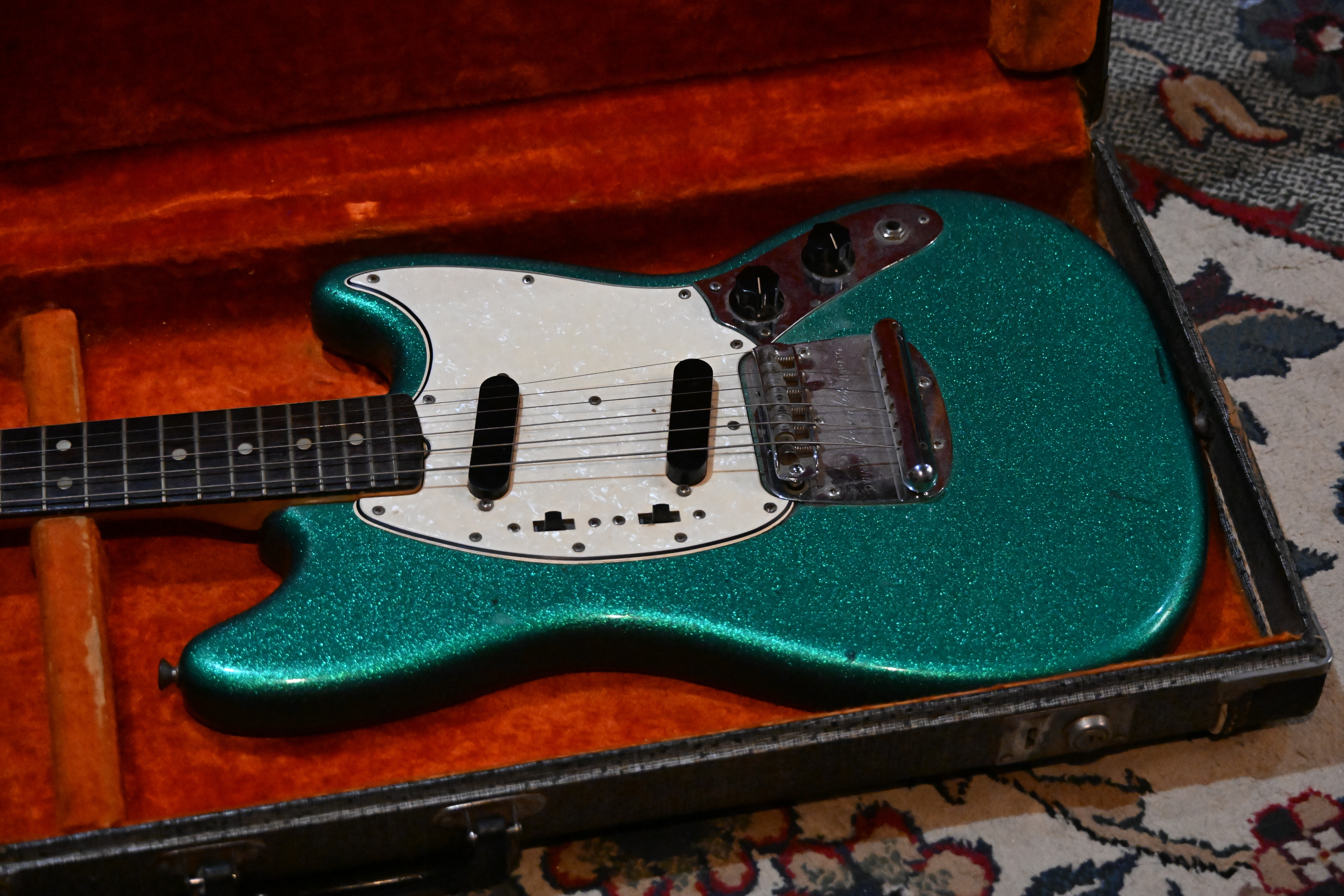
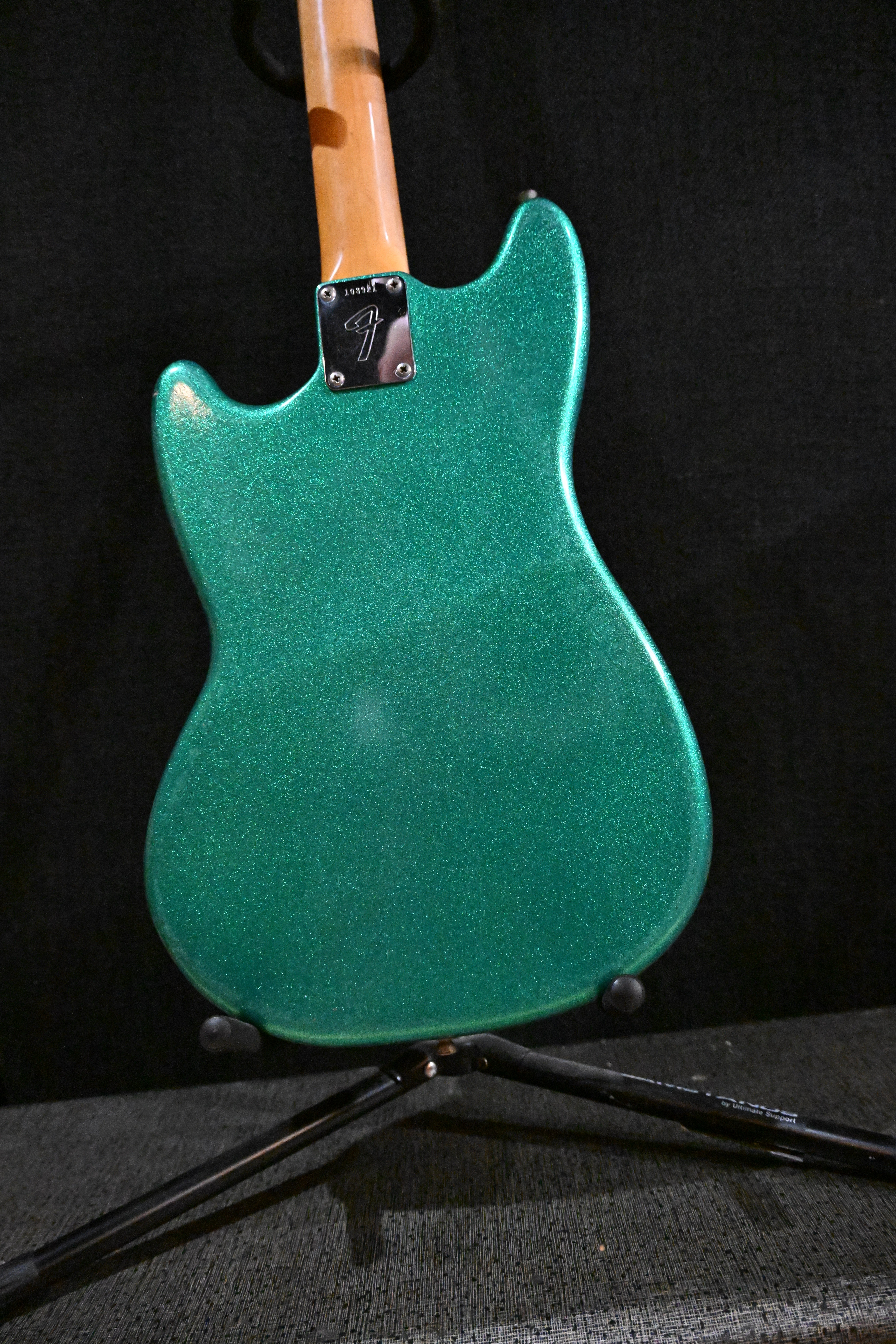
The finish is hard to describe and honestly hard to photograph. In hand it’s a deep emerald green that leans teal in direct sunlight, and the flake gives it a diamond-like depth; out in the sun the whole guitar lights up. There’s light checking all over it. Past the paint, it’s a completely normal 1965 Mustang. Original pebble case, original hardware, and that clear bodyguard still on the body.
The strange part is that a sparkle Mustang isn’t a guitar that should exist at all. That takes some explaining.
A finish you couldn’t order
Fender’s custom color program is well documented. Starting in the late 1950s, you could pay 5 percent over list and get your guitar in one of the DuPont automotive colors on Fender’s chart, the same Duco and Lucite lacquers being sprayed on cars in Detroit. Candy Apple Red was the only color Fender came up with themselves. Everything else was borrowed from the car industry.
Sparkle was never one of those colors. It never appeared on a chart or in a catalog. Collectors file these under “ghost finishes,” colors that show up on real period instruments through special orders, dealer runs, and promo builds without ever being officially offered.
A Mustang makes it stranger still. The Mustang launched in August 1964 at $189.50 in exactly three finishes: red, white, and blue. Fender’s own sales literature at the time said custom colors weren’t offered on student models at all. So nobody could walk into a store and order a sparkle Mustang. The finish didn’t officially exist, and even if it had, the Mustang wasn’t eligible for it.
There’s also a practical reason the factory couldn’t have sprayed one. Fender’s booth used suction-feed Binks Model 7 guns, and suction feed can’t pull heavy metalflake up out of the cup. The particles are just too big. So before 1966, not a single sparkle finish was sprayed inside the Fender factory. When surf players like Dick Dale and Eddie Bertrand started asking for sparkle guitars, and the sales office wanted flashy instruments for trade shows and teen fairs, Fender farmed the painting out.
Most of that work went to a guy named Dennis Swiden, a furniture painter working out of his parents’ shop in Fullerton. Midcentury furniture used metallic flake lacquer, so he already had the right spray equipment and knew the material, and he happened to run with the local surf bands. He’d drive to the factory, load bodies into his car, spray them at his shop, and bring them back for Fender to assemble. He got 30 dollars a body. Supposedly he’d park in George Fullerton’s spot when he made his deliveries and nobody said a word. When Dick Dale and the Del-Tones wanted matching green sparkle on a Jazzmaster, a Strat, and a P-Bass, that set (the one that got nicknamed Surfburst) went through this same pipeline.
Fender finally set up its own flake spraying in 1966, and the silver sparkle Telecasters built for Buck Owens and the Buckaroos announced the change. The in-house guitars feel different. Fender buried the flake under thick clear and polished it smooth, where the earlier outsourced guitars have a coarser, pebbled texture you can feel through the finish. This Mustang has the pebbled kind.
On the bench
First thing we do with any vintage Fender is take the neck off. The neck pocket is where a guitar can’t lie to you, and this one had plenty to say.
The neck is stamped October 1965. The serial plate is an early F-style plate in the 103xxx range, the six-digit series that replaced the L plates in the second half of ‘65. Pearl dots on the fingerboard, right for mid-‘65 onward, and the pots date to 1965 too. Nothing on this guitar argues with anything else. That’s the boring groundwork you need before any of the interesting stuff means anything.
Then we looked at the walls of the neck pocket, and our hearts sank a little. There were layers in there. A bit of the yellow undercoat Fender dipped its alder bodies in, poking through at the bottom. Over that, a thin coat of what’s clearly Dakota Red. Over that, an even thinner pass of what looks like Daphne Blue. And the sparkle over everything. At first we read that stack as bad news, because layers usually mean refin.
It turned out to be the opposite. Sparkle jobs in this era were sprayed over finished bodies. That’s just how the process worked: these were completed or nearly completed guitars going out the door for a flake coat, not raw wood. We’ve since put this guitar in front of other longtime vintage shops that have handled original sparkles, and they told us the layering matches other known originals. The same stack shows up on the walls of the control cavity and the pickup routes, the same way, everywhere we looked. Under a loupe the flake reads uniform in the cavities and under the guard, same as on the top.
The electronics have never been out. The solder is untouched, and every part on the guitar is original to it.
And then there’s the shim. The factory neck shim is still sitting in the pocket, held down by its original strip of cellophane tape, the kind Fender used in this era. Look closely and the tape is actually sunk into the sparkle finish a little, the way tape behaves when it goes on before the paint has fully cured. For us that’s the smoking gun. It means the shim was taped in while the sparkle was still drying, which puts the flake on this body at original assembly, not in somebody’s garage in 1978. Nobody refinishes a guitar and then re-tapes a sixty-year-old shim with sixty-year-old tape into wet lacquer.
One thing worth being upfront about: with pre-1966 sparkle Fenders, “factory original” is almost the wrong question, because the factory never sprayed any of them. Every genuine one was painted outside the building. What you can actually establish is whether the dates all agree, whether the guitar has ever been apart, and whether the paint on it is the paint it’s always worn. On this one, all three check out.
What we checked | What we found |
|---|---|
Neck date | October 1965 |
Serial plate | Early F-style plate, 103xxx range, correct for late 1965 |
Fingerboard dots | Pearloid, correct for mid-1965 onward |
Pot codes | 1965 |
Solder joints | Undisturbed; electronics never removed |
Finish stack in pocket and routes | Yellow undercoat, Dakota Red, thin Daphne Blue, sparkle; matches known-original sparkles |
Under the guard and in the cavities | Flake present and uniform under a loupe, aged to match the top |
Factory shim | Still taped in place, tape slightly sunk into the once-wet sparkle coat |
Flake texture | Coarse and pebbled, the pre-1966 outsourced signature |
The Ziggie’s Music badge
Once the guitar itself checked out, the case handed us a bonus. Riveted to it is a dealer badge: Ziggie’s Music, Phoenix, Arizona.
That name means something if you know Fender history. Ziggie’s opened in 1927 and ran for nearly a century before closing a couple of years ago. Its founder, Angelo “Ziggie” Zardus, became the first Fender dealer in Arizona, reportedly on a handshake with Leo Fender himself, and Leo was known to drop by the store over the years. Duane Eddy bought the orange Gretsch 6120 he used on “Rebel Rouser” at Ziggie’s in 1957.
So this Mustang was sold new by one of Fender’s earliest dealers, a shop with a direct line to the factory, during the exact window when sparkle bodies were going out Fender’s back door. What we know for certain is the badge, the dates, and the paint. Our best guess, and it’s a guess, is that this was a promotional piece for the shop, or maybe a special order the factory quietly filled for an old friend. There’s no paper trail. With these guitars there almost never is.
The timing does make the promo idea tempting. The Beatles had played Ed Sullivan in February 1964, and by 1965 demand for student model guitars was through the roof. Every kid in America wanted to start a band, and the Mustang was the new top of Fender’s student line, the guitar those kids could actually afford. A green sparkle Mustang in the window of the Fender dealer in Phoenix would have done exactly what it was built to do.
As for the odd paint stack, our working theory is that the body was some kind of factory second. It got shot in Dakota Red, somebody didn’t like it for whatever reason, it got a light pass of blue (which may even have been meant as a base for the flake), and then it got its sparkle. That sequence doesn’t match any normal single-color Mustang, and that’s sort of the point. We hold the theory loosely. We’d rather tell you it’s a guess than dress it up as a fact.
The photos
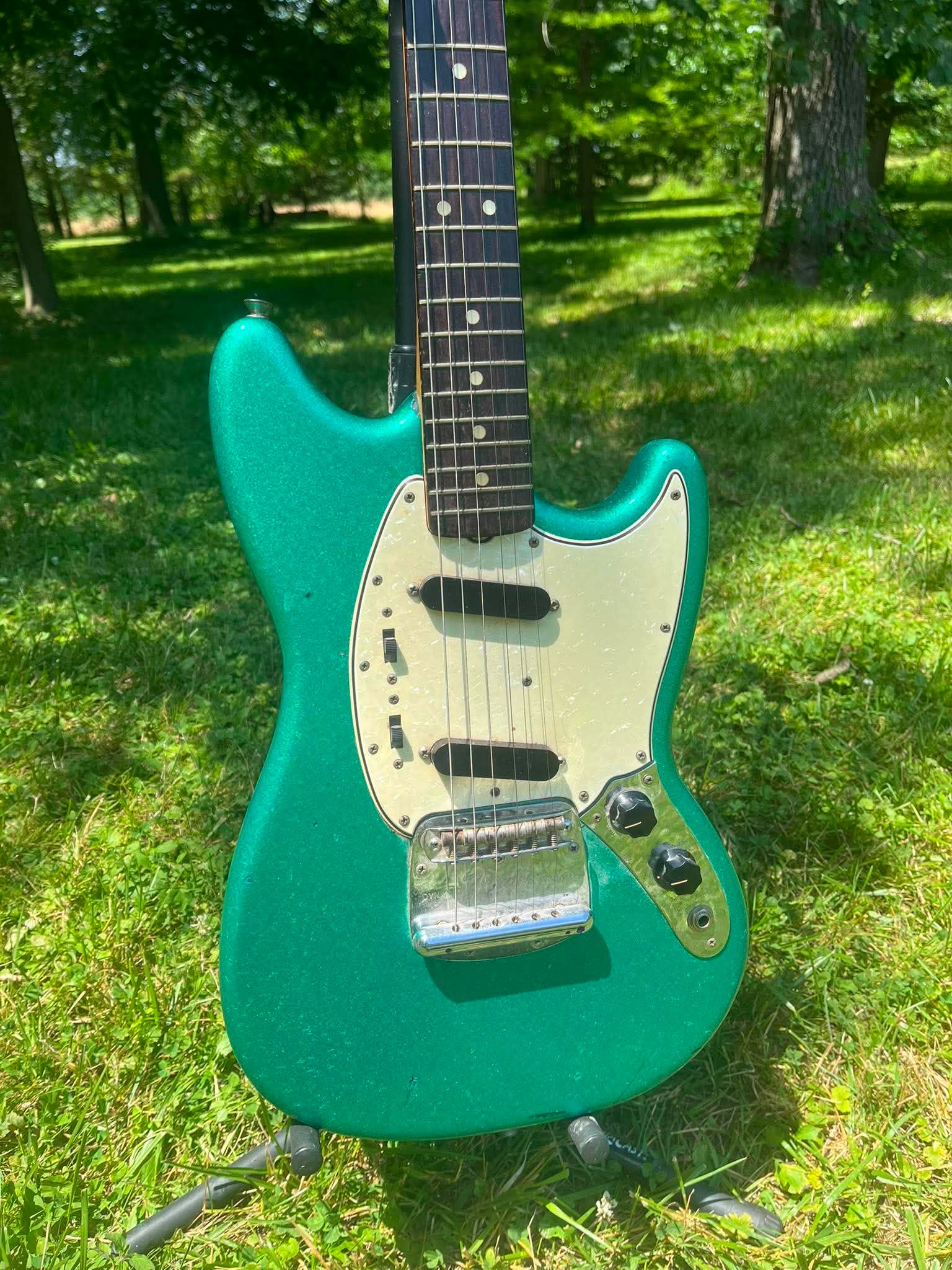
Green sparkle over a late 1965 Mustang body, a deep emerald that leans teal in the sun.
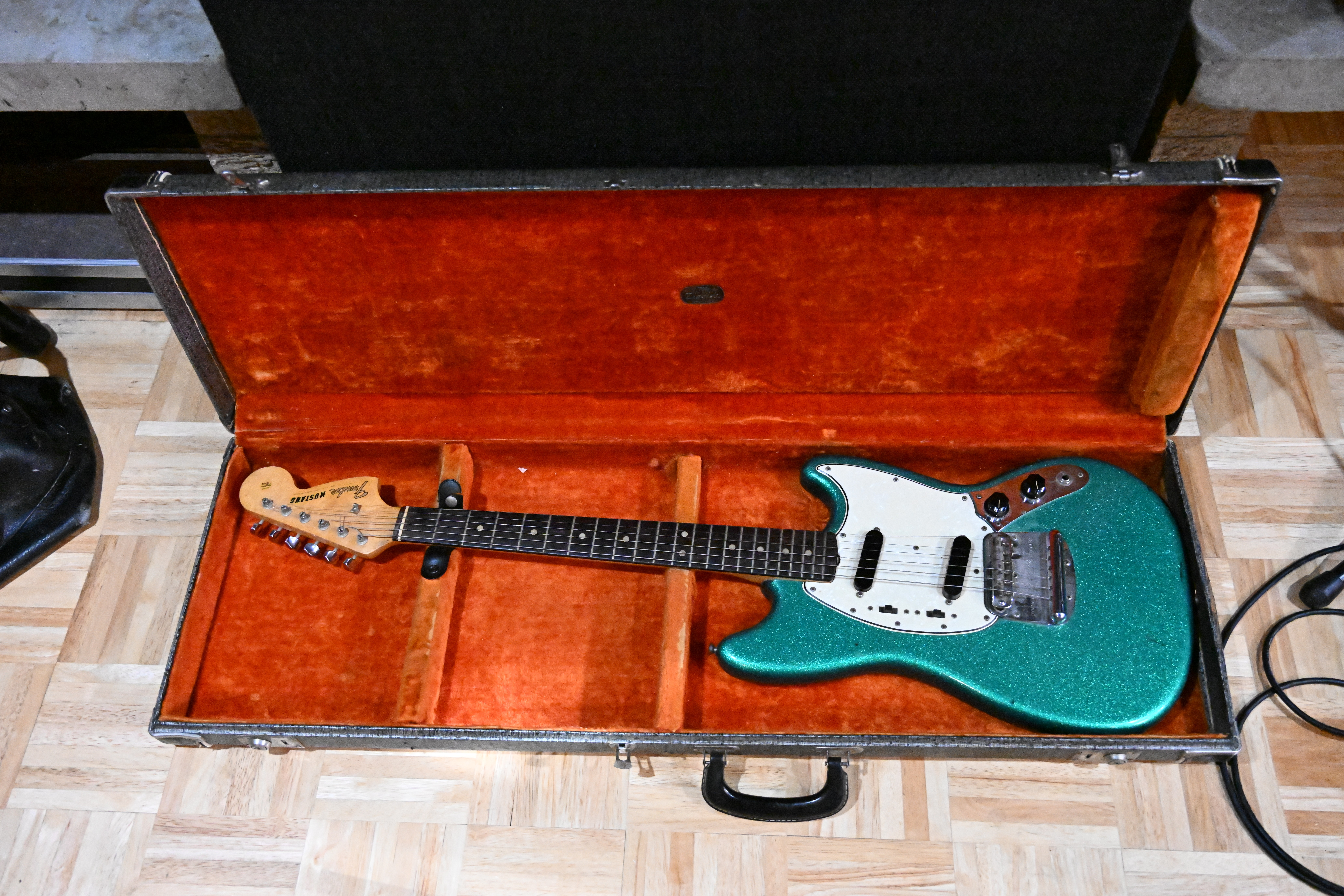
As it arrived: original pebble case, original clear Fender bodyguard, and the Ziggie’s Music dealer badge from Phoenix, Arizona.
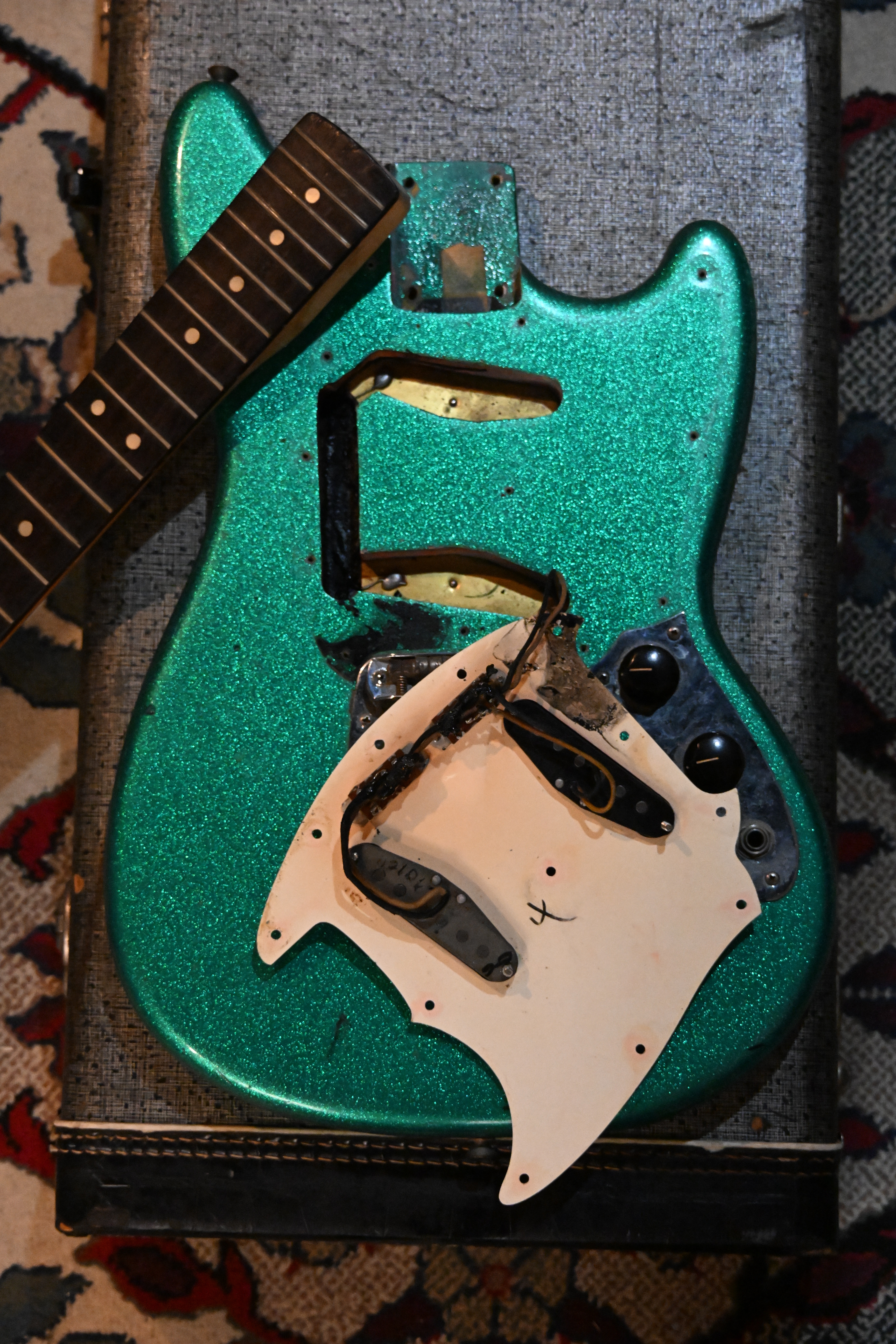
The places daylight never reaches. Flake and aging stay consistent under the guard and in the routs.
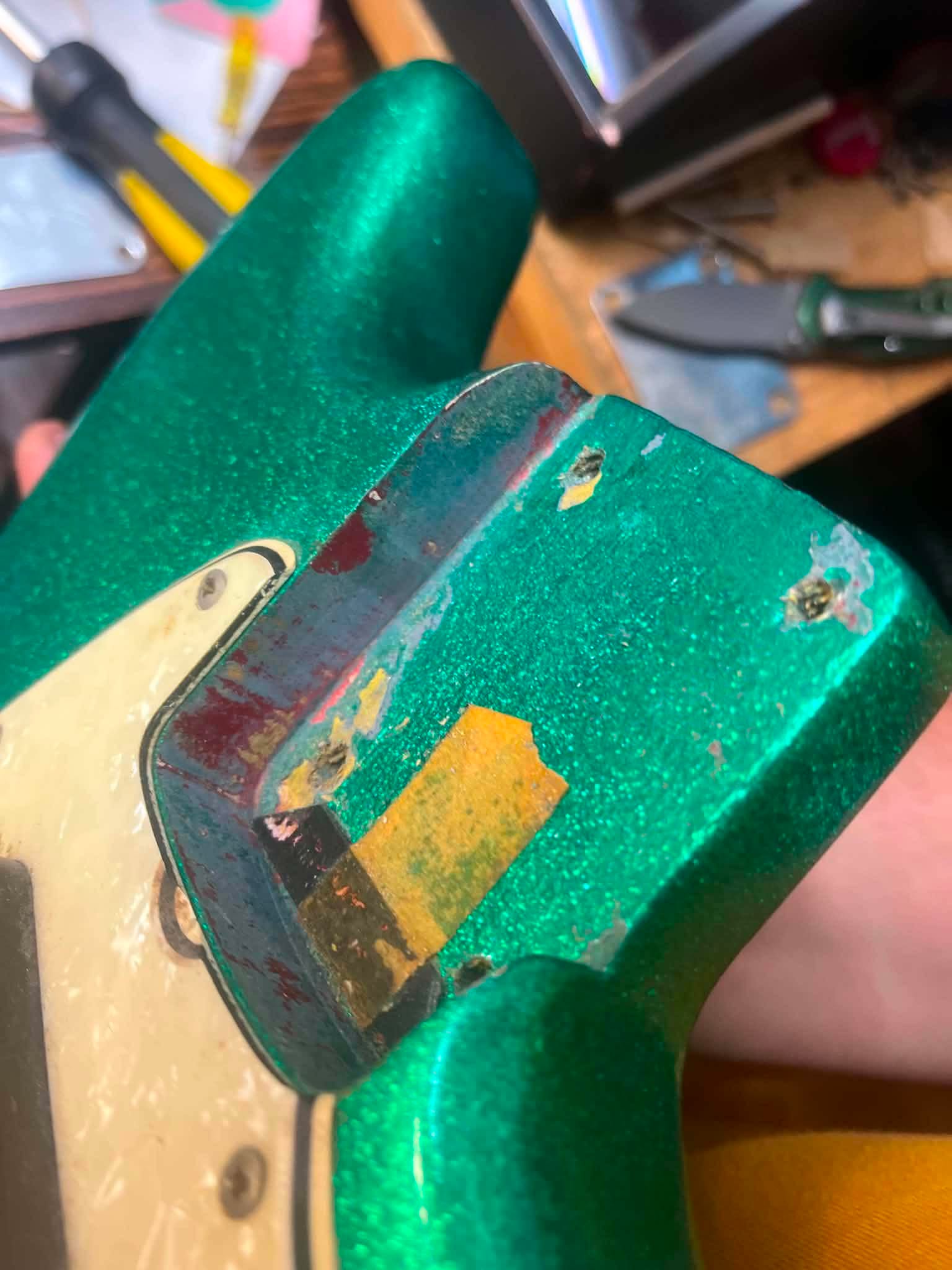
The factory shim, still held by its original cellophane tape. The tape sits slightly sunk into the sparkle coat, which means it went on while the finish was still drying. The pocket walls show the full stack: yellow undercoat, Dakota Red, a thin pass of Daphne Blue, then flake.

Flake inside the routs and under the guard, uniform under magnification and aged to match the top.
Where it is now
The Mustang is still here at the shop in Ohio, and for now it’s not for sale to the general public. It’s the first sparkle Fender we’ve ever had in the shop. We always figured if one came through it’d be a Jaguar, since that’s where most of the surviving sparkle jobs seem to be, on the expensive model. Instead we got the student guitar, the one some kid in Phoenix probably stared at through the shop window in 1965. Some guitars need to sit with you a while.
Sparkle Fender FAQ
Did Fender make sparkle guitars in the 1960s?
Yes, but not the way people assume. Before 1966 the Fender factory never sprayed a sparkle finish; its suction-feed paint guns couldn’t handle the heavy flake. The work was outsourced to painters in Fullerton, most famously Dennis Swiden. Fender brought sparkle in-house in 1966, starting with Buck Owens’ silver sparkle Telecasters.
How rare is an original sparkle Fender Mustang?
No production records exist because sparkle was never a catalog option, and Fender’s period literature excluded student models from custom colors entirely. Most surviving originals are higher-end models like Jaguars. Only a handful of period sparkle Mustangs have surfaced, and each one has to be authenticated on its own physical evidence.
How can you tell an original 1960s sparkle finish from a refinish?
Look where a refinisher can’t fake cheaply: undisturbed solder joints, consistent flake and aging under the pickguard and inside the cavities, period paint layers in the neck pocket, factory shims and tape still in place, and the coarse pebbled flake texture of the pre-1966 outsourced work. Matching neck, serial, and parts dates seal it.
Where can I sell a vintage Fender Mustang or a sparkle Fender?
Edgewater Guitars buys vintage Fenders in any condition, from Valley City, Ohio and nationwide. We handle authentication ourselves, explain exactly what we’re seeing on your guitar, and make a fair cash offer. Call (440) 219-3607 or use our free appraisal form for a same-day answer.
Think you have one?
If something like this has turned up in your family or your old band gear, we’d genuinely love to see it, and we’ll tell you what you have either way. Get a free appraisal at sell your Fender or call (440) 219-3607.
Want more on this model? Read our full guide to the 1965 Fender Mustang, or date your own guitar with the Fender serial number lookup.
By Stephen Pedone and Gavin Coe, co-owners of Edgewater Guitars. We’ve appraised and purchased hundreds of vintage Fender guitars across Ohio and nationwide, with over 30 years of combined experience in vintage guitar authentication.
Last updated: July 9, 2026