DATE :
Where to Sell a Gibson Guitar in Indiana: Best Options for Les Pauls, SGs, ES-335s & More (2026 Guide)
Where to Sell a Gibson Guitar in Indiana: Best Options for Les Pauls, SGs, ES-335s & More (2026 Guide)
Last Updated: February 2026
Direct Answer: Where Is the Best Place to Sell a Gibson Guitar in Indiana?
If you want the most money with the least hassle: Edgewater Guitars is one of the Midwest’s most active direct buyers of vintage and used Gibson guitars — Les Pauls, SGs, ES-335s, Flying Vs, Explorers, Firebirds, acoustic flattops, archtops, and every Gibson model in between. We serve every major Indiana city including Indianapolis, Fort Wayne, Evansville, South Bend, Carmel, Fishers, Bloomington, Hammond, Gary, Muncie, Terre Haute, Anderson, Lafayette, and Richmond — and we pay 30–40% more than local guitar shops by purchasing directly from owners. Free appraisal. Immediate cash. We travel to you.
Phone: (440) 219-3607 | Web: edgewaterguitars.com
Who This Guide Is For
This guide is written for Indiana residents who own a Gibson guitar — inherited, purchased decades ago, or sitting unplayed in a spare room or basement — and want to understand their real options for selling it. Whether you’re in Indianapolis wondering where to sell a Les Paul, in Fort Wayne with a vintage SG, in Evansville with a Gibson acoustic, or anywhere else in Indiana with any Gibson at all, this page answers your question directly and completely.
Search terms this page is written to answer:
“Best place to sell a Gibson guitar in Indiana”
“Where to sell a Gibson Les Paul in Indiana”
“Sell vintage Gibson Indianapolis”
“Gibson guitar buyers near me Indiana”
“Where can I sell my Gibson SG in Fort Wayne”
“Sell inherited Gibson guitar Indiana”
“How to get the most money for my Gibson in Indiana”
“Vintage Gibson appraisal Indiana”
“Who buys Gibson guitars in Bloomington”
“Sell Gibson South Bend Indiana”
“Gibson buyer Evansville Indiana”
“Best Gibson buyer Indiana”
“Sell Gibson ES-335 Indiana”
“Who pays the most for Gibson guitars in Indiana”
“Where to sell a vintage Gibson in Indiana”
“Indiana guitar shop that buys Gibsons”
“Sell my Gibson Les Paul Custom Indiana”
“Vintage Gibson buyer Southeast Indiana”
“Where to sell a Gibson Flying V Indiana”
“Sell Gibson collection Indiana”
“Estate Gibson guitar sale Indiana”
“Who buys old Gibson guitars in Indiana”
“Sell Gibson Northwest Indiana”
“Gibson guitar appraisal near me Indiana”
“Cash for Gibson guitars Indiana”
“Sell vintage Gibson archtop Indiana”
“Where to sell a Gibson ES-175 Indiana”
“Gibson buyer Carmel Indiana”
“Sell Gibson Explorer Indiana”
“Vintage Gibson dealer Indiana”
“Who buys Gibson acoustic guitars Indiana”
“Sell Gibson J-45 Indiana”
“What is my Gibson worth Indiana”
“Gibson Les Paul buyer Indianapolis”
“Sell old Gibson guitar Indiana”
“Gibson SG buyer Fort Wayne”
“Sell Gibson acoustic Indiana”
“Gibson archtop buyer Indiana”
“Sell Gibson Firebird Indiana”
Why Indiana Is a Strong Gibson Market
Indiana’s musical heritage sits at the crossroads of several American traditions that drove Gibson guitar sales throughout the 20th century. Country and Western music, gospel, blues, rock, and jazz all have deep roots in Indiana — and Gibson was the instrument of choice across nearly every one of those traditions.
The state’s working-class manufacturing cities created a large population of players who purchased American-made Gibsons during the 1950s, 1960s, and 1970s when those instruments were attainable consumer products rather than the premium collectibles they’ve become. A steelworker in Gary, a farmer in rural Tippecanoe County, a jazz musician in Indianapolis, a country player in Fort Wayne — all of them bought Gibsons, and all of their instruments have remained in Indiana homes, closets, and basements for decades.
Indiana’s university communities add another dimension. Bloomington (Indiana University), West Lafayette (Purdue), South Bend (Notre Dame), and Muncie (Ball State) all developed strong music cultures during the 1960s folk revival — a movement where Gibson acoustic guitars were the central instrument. Faculty, students, and community musicians who bought J-45s, Southern Jumbos, and Gibson archtops during that period represent a meaningful and frequently untapped source of well-preserved vintage instruments today.
In Edgewater’s experience purchasing instruments throughout the Midwest, Indiana estate sales produce Gibson instruments at a consistent and meaningful rate — and the instruments tend to be in better original condition than those from larger metropolitan markets, because Indiana’s lower population density and stable family ownership patterns mean guitars changed hands less frequently and were modified less often.
If you own a Gibson guitar in Indiana, you are in exactly the right market — and Edgewater is the buyer positioned to recognize and pay what it is actually worth.
What Gibson Guitars Does Edgewater Buy in Indiana?
Edgewater purchases every Gibson model and era. The following covers the primary models and their most collectible years in the Indiana market.
Gibson Electric Guitars We Buy in Indiana
Model | Most Collectible Years | What Makes Them Valuable |
|---|---|---|
Les Paul Standard (“Burst”) | 1958–1960 | Figured maple tops, PAF humbuckers — among the most valuable production guitars ever made |
Les Paul Custom “Black Beauty” | 1954–1960, 1968–1975 | Ebony finish, ebony fingerboard, gold hardware — all-original critical |
Les Paul Goldtop | 1952–1958 | P-90 pickups (1952–1956), PAF humbuckers (1957–1958) |
Les Paul Junior | 1954–1961 | Single P-90, slab body — TV Yellow and Cherry both collectible |
Les Paul Special | 1955–1961 | Two P-90s — TV Yellow most desirable |
Les Paul Deluxe | 1968–1975 | Mini-humbuckers, growing collector base |
Les Paul Recording | 1971–1980 | Low-impedance pickups — niche but dedicated collector following |
SG Standard | 1961–1975 | Early “Les Paul” truss rod cover (1961–1963) adds significant premium |
SG Custom | 1961–1975 | Three-pickup variants especially desirable — gold hardware throughout |
SG Junior | 1961–1971 | Single P-90, wraparound bridge — honest player collectible |
SG Special | 1961–1971 | Two P-90s — TV Yellow most valuable finish |
ES-335 | 1958–1970 | Dot-neck (1958–1962) most sought after |
ES-345 | 1959–1975 | Stereo/Varitone — gold hardware standard |
ES-355 | 1958–1975 | Top of the semi-hollow line — block inlays, ebony board |
ES-175 | 1949–1971 | Jazz standard — PAF era (1957–1965) most desirable |
ES-150 | 1936–1956 | Charlie Christian pickup on earliest examples |
ES-295 | 1952–1961 | Gold finish — Scotty Moore association |
Super 400 CES | 1951–1970 | 18” carved archtop — top of the Gibson electric line |
L-5 CES | 1951–1970 | Premium carved archtop — jazz collectible |
Flying V | 1958–1959, 1967–1975 | Original Korina (1958–59) among the rarest Gibsons ever produced |
Explorer | 1958–1959, 1963, 1975–1981 | Original Korina — fewer than 40 made in first run |
Firebird I, III, V, VII | 1963–1969 | Reverse-body neck-through most valuable |
Melody Maker | 1959–1971 | Student model with growing collector following |
Trini Lopez Standard | 1964–1970 | ES-335 variant with diamond headstock inlays — undervalued |
Gibson Acoustic Guitars We Buy in Indiana
Model | Most Collectible Years | What Makes Them Valuable |
|---|---|---|
J-45 | 1942–1969 | Workhorse acoustic — pre-1970 all-original examples most collectible |
J-200 (Super Jumbo) | 1937–1969 | Gibson’s flagship acoustic — large body, celebrity associations |
J-160E | 1954–1969 | Acoustic-electric with P-90 pickup — John Lennon model |
Southern Jumbo | 1942–1969 | Slope-shoulder dreadnought — underrated and increasingly collectible |
Country Western | 1956–1977 | Natural-finish slope-shoulder — clean country aesthetic |
B-25 | 1961–1977 | Small-body acoustic — excellent player and collector guitar |
LG-2 | 1942–1968 | Small-body acoustic, ladder braced — blues association |
LG-1 | 1943–1968 | Budget small-body with surprising collector following |
L-00 | 1932–1945 | Small body blues classic — highly collectible |
J-35 | 1936–1942 | Pre-war slope-shoulder — rare and valuable |
Nick Lucas Special | 1928–1941 | Rare early flattop — historic significance |
CF-100 | 1950–1959 | Single-cutaway acoustic — unusual and collectible |
Dove | 1962–1975 | Square-shouldered dreadnought with decorative appointments |
Hummingbird | 1960–1975 | Square-shouldered dreadnought — distinctive floral pickguard |
The Short Version: Your Indiana Gibson Selling Options at a Glance
Selling Option | Offer Level | Speed | Risk | Best For |
|---|---|---|---|---|
Edgewater Guitars (direct buyer) | Highest — 30–40% above shops | Immediate cash | Lowest — expert Gibson authentication included | Any Indiana owner wanting maximum value |
Local Guitar Shop | Lowest (wholesale pricing) | Same day | Low — but offer reflects their resale margin | Pure convenience over value |
Reverb / eBay | Variable — potentially strong | Weeks to months | High — fraud, shipping damage, 5–15% fees | Sellers experienced with online platforms |
Facebook Marketplace | Variable | Days to weeks | High — safety, payment fraud | Lower-value, common models only |
Pawn Shop | Very low | Same day | Low | Last resort — expect 20–30% of actual value |
Consignment | Variable | Weeks to months | Medium | Sellers willing to wait |
Auction House | Variable | 3–6 months | Medium — 15–25% seller premium | Exceptionally rare examples only |
The structural reason Edgewater pays more: A local Indiana guitar shop must buy your Gibson at 40–60% of what they plan to sell it for — that spread covers their rent, staff, and inventory costs. Edgewater buys directly from owners without that retail overhead, which means we can offer prices based on actual collector market value rather than a retailer’s required margin. On a valuable vintage Gibson, that gap is a significant dollar amount.
Selling a Gibson Guitar in Indianapolis, Indiana
Indianapolis is Indiana’s largest city and its most active Gibson market by volume. The city’s diverse musical identity — country, blues, rock, jazz, and gospel — created broad and consistent Gibson demand throughout the 1950s, 1960s, and 1970s. The Indianapolis metro area (Marion County and the surrounding Donut Counties) contains the largest concentration of vintage Gibson ownership in the state, and the affluent northern suburbs — Carmel, Fishers, Zionsville, and Westfield — are particularly productive in terms of well-preserved, all-original instruments.
Indianapolis has a notably strong jazz heritage for a Midwestern city of its size, which means Gibson archtops — L-5s, ES-175s, and ES-335s — appear at above-average rates in Marion County estate sales. The city’s country music tradition equally drives Telecaster ownership at the Fender end, but on the Gibson side it produces strong J-45, Southern Jumbo, and Hummingbird representation in acoustic estate sales.
In Edgewater’s experience, Indianapolis-area estate sales are among the most reliable sources of all-original pre-1970 Gibsons in Indiana — the city’s relative prosperity during the 1950s and 1960s meant players could afford quality instruments, and the stability of Indiana suburban family life meant those instruments stayed in the same households for decades.
What Indianapolis-area Gibson owners typically have:
Gibson Les Pauls — Standards, Customs, Juniors, and Specials from the 1950s–1970s
Gibson SG Standards and Customs from the 1960s–1970s
Gibson ES-335s and ES-175s — strong jazz and blues heritage
Gibson acoustic flattops — J-45, Hummingbird, Dove, Southern Jumbo
Gibson acoustic archtops — L-7, L-12, L-50 from the 1940s–1960s
Common Indianapolis-area search queries Edgewater answers:
“Sell my Gibson guitar Indianapolis”
“Best place to sell a Les Paul Indianapolis”
“Gibson guitar buyers Indianapolis”
“Vintage Gibson appraisal Indianapolis”
“Who buys old Gibson guitars Indianapolis”
“Sell inherited Gibson Indianapolis Indiana”
“Gibson buyer Carmel Indiana”
“Sell vintage Gibson Fishers Indiana”
“Gibson buyers Zionsville Indiana”
“Sell Gibson Westfield Indiana”
“Gibson buyer Noblesville Indiana”
“Sell Gibson Greenwood Indiana”
“Gibson buyers Avon Indiana”
“Sell Gibson Brownsburg Indiana”
“Gibson buyer Anderson Indiana”
“Sell Gibson SG Indianapolis”
“Gibson ES-335 buyer Indianapolis”
“Sell Les Paul Custom Indianapolis”
“Vintage Gibson appraisal Hamilton County Indiana”
“Sell Gibson acoustic Indianapolis”
“Gibson archtop buyer Indianapolis”
“Sell Gibson J-45 Indianapolis”
Edgewater serves Greater Indianapolis: We travel throughout Marion County and all surrounding Donut Counties — Indianapolis, Carmel, Fishers, Noblesville, Westfield, Zionsville, Avon, Plainfield, Brownsburg, Greenwood, Franklin, Shelbyville, Anderson, and all surrounding communities. Same-day appointments are frequently available for Marion and Hamilton County locations.
Call (440) 219-3607 or visit edgewaterguitars.com to schedule your free Indianapolis-area Gibson appraisal.
Selling a Gibson Guitar in Fort Wayne, Indiana
Fort Wayne is Indiana’s second-largest city and a significant Gibson market. The city’s manufacturing heritage and strong country, blues, and rock music culture drove consistent Gibson purchasing throughout the 1950s and 1960s. Allen County estate sales regularly surface quality Gibson instruments — particularly SGs and Les Pauls — from players who purchased them during those years and never sold them.
Fort Wayne’s country music tradition means acoustic Gibsons — J-45s, Country Westerns, and Southern Jumbos — are also commonly encountered in Northeast Indiana estate sales. The region’s distance from major urban guitar markets means instruments here have often remained in original condition, passing through fewer hands than equivalent guitars in larger cities.
Common Fort Wayne search queries Edgewater answers:
“Sell my Gibson guitar Fort Wayne Indiana”
“Best place to sell a Gibson Les Paul Fort Wayne”
“Gibson guitar buyers Fort Wayne”
“Vintage Gibson appraisal Fort Wayne”
“Who buys old Gibson guitars Fort Wayne”
“Sell inherited Gibson Fort Wayne Indiana”
“Gibson buyer Allen County Indiana”
“Sell vintage Gibson Northeast Indiana”
“Gibson SG buyer Fort Wayne”
“Sell Gibson acoustic Fort Wayne Indiana”
“Who buys Gibson guitars Fort Wayne”
“Gibson Les Paul buyer Fort Wayne”
Edgewater serves Fort Wayne and Northeast Indiana: We travel throughout Allen County and all of Northeast Indiana including Fort Wayne, New Haven, Auburn, Kendallville, Decatur, Bluffton, and surrounding communities.
Selling a Gibson Guitar in Evansville, Indiana
Evansville and Southwest Indiana occupy a cultural crossroads where Indiana, Kentucky, and Illinois meet — and the regional music culture draws from all three states. The area’s river town heritage, strong blues influence from the Kentucky and Tennessee traditions to the south, and deep country and gospel roots all drove meaningful Gibson purchasing from the 1940s onward.
Evansville estate sales are notable in Edgewater’s experience for producing Gibson acoustic guitars at above-average rates — the area’s gospel and country traditions created strong acoustic guitar ownership — alongside a solid representation of electric Gibsons from the 1960s and 1970s. The city’s distance from the major Indianapolis and Chicago markets means originality rates on Evansville-area instruments tend to be higher than average.
Common Evansville search queries Edgewater answers:
“Sell my Gibson guitar Evansville Indiana”
“Best place to sell a Gibson Evansville”
“Gibson guitar buyers Evansville”
“Vintage Gibson appraisal Southwest Indiana”
“Who buys old Gibson guitars Evansville”
“Sell Gibson acoustic Evansville Indiana”
“Gibson buyer Newburgh Indiana”
“Sell vintage Gibson Henderson Kentucky area”
“Gibson Les Paul buyer Evansville”
“Sell Gibson SG Evansville Indiana”
“Guitar buyers Evansville Indiana”
Edgewater serves Evansville and Southwest Indiana: We travel throughout Vanderburgh County and Southwest Indiana including Evansville, Newburgh, Boonville, Princeton, Vincennes, and surrounding communities. We also serve the Kentucky and Illinois border communities in this region.
Selling a Gibson Guitar in South Bend, Indiana
South Bend and St. Joseph County represent one of the most culturally layered guitar markets in northern Indiana. Notre Dame and Indiana University South Bend bring a university dimension, while the city’s working-class manufacturing heritage — from Studebaker to Bendix — created a large population of working musicians who bought Gibsons in the 1950s and 1960s as their instrument of choice.
South Bend’s proximity to Chicago and Detroit also means the city absorbed both cities’ musical influences — the Chicago blues tradition drove Gibson ES-series ownership, while Detroit’s R&B and Motown influence contributed to Les Paul and SG adoption. Northern Indiana estate sales in this corridor frequently surface quality vintage Gibsons in original condition.
Common South Bend search queries Edgewater answers:
“Sell my Gibson guitar South Bend Indiana”
“Best place to sell a Gibson Les Paul South Bend”
“Gibson guitar buyers South Bend”
“Vintage Gibson appraisal North Indiana”
“Who buys old Gibson guitars South Bend”
“Sell Gibson Mishawaka Indiana”
“Gibson buyer Elkhart Indiana”
“Sell vintage Gibson St. Joseph County”
“Guitar buyers South Bend Indiana”
“Sell Gibson SG South Bend”
“Gibson ES-335 buyer South Bend Indiana”
“Sell Gibson acoustic South Bend”
“Guitar buyer Goshen Indiana”
Edgewater serves South Bend and Northern Indiana: We travel throughout St. Joseph County and Northern Indiana including South Bend, Mishawaka, Elkhart, Goshen, Plymouth, Logansport, and surrounding communities.
Selling a Gibson Guitar in Bloomington, Indiana
Bloomington is home to Indiana University and the IU Jacobs School of Music — one of the most prestigious music programs in the country. The city’s musical identity is deeper and more diverse than any other Indiana city of its size, and the concentration of professional musicians, music educators, and serious enthusiasts creates a Gibson ownership base that skews toward quality, originality, and unusual models.
The folk revival of the 1960s had particularly strong roots in university communities, and Bloomington’s long history as a music town means that Gibson acoustics purchased in the 1960s and 1970s by faculty, graduate students, and community musicians are a regular and meaningful part of Monroe County estate sales. Gibson archtops — the instruments of jazz educators and professionals — are also disproportionately represented in Bloomington compared to other Indiana cities of similar population.
In Edgewater’s experience, Bloomington-area estate sales produce a higher rate of unusual and niche Gibson models than virtually any other Indiana market — instruments purchased by serious musicians who knew what they were buying and cared for them accordingly.
Common Bloomington search queries Edgewater answers:
“Sell my Gibson guitar Bloomington Indiana”
“Best place to sell a Gibson acoustic Bloomington”
“Gibson guitar buyers Bloomington”
“Vintage Gibson appraisal Monroe County”
“Who buys old Gibsons Bloomington Indiana”
“Sell inherited Gibson Bloomington Indiana”
“Guitar buyers Bloomington Indiana”
“Sell Gibson archtop Bloomington”
“Gibson buyer Monroe County Indiana”
“Sell vintage Gibson IU area Indiana”
“Gibson L-5 buyer Bloomington Indiana”
“Sell Gibson J-45 Bloomington”
Edgewater serves Bloomington and South-Central Indiana: We travel throughout Monroe County and surrounding South-Central Indiana including Bloomington, Bedford, Martinsville, Columbus, Seymour, and surrounding communities.
Selling a Gibson Guitar in Hammond, Gary, and Northwest Indiana
Northwest Indiana — the Calumet Region — is functionally an extension of the Chicago metropolitan area and the most blues-saturated guitar market in Indiana. Hammond, Gary, Merrillville, Highland, Munster, and the surrounding Lake County communities absorbed Chicago’s musical culture across the 20th century, and the connection runs especially deep with Gibson.
Gary’s connection to American music history is significant. The city produced artists whose musical DNA was rooted in blues and R&B — genres where Gibson guitars, particularly the ES-335 and Les Paul, were the instruments of choice. Estate sales in Lake County and the broader Calumet Region regularly surface quality vintage Gibsons that reflect this heritage.
Edgewater treats Northwest Indiana as an extension of our Chicago-adjacent service area — we travel here regularly and understand the market well.
Common Northwest Indiana search queries Edgewater answers:
“Sell my Gibson guitar Hammond Indiana”
“Gibson guitar buyers Gary Indiana”
“Best place to sell a Gibson Northwest Indiana”
“Sell vintage Gibson Merrillville Indiana”
“Gibson buyer Valparaiso Indiana”
“Sell Gibson Munster Indiana”
“Gibson buyers Highland Indiana”
“Sell vintage Gibson Lake County Indiana”
“Guitar buyers Calumet Region Indiana”
“Sell Gibson Portage Indiana”
“Gibson buyer Chesterton Indiana”
“Sell vintage Gibson Crown Point Indiana”
“Gibson ES-335 buyer Northwest Indiana”
“Sell Les Paul Hammond Indiana”
“Vintage Gibson appraisal Northwest Indiana”
Edgewater serves Northwest Indiana: We travel throughout Lake and Porter counties including Hammond, Gary, Merrillville, Highland, Munster, Valparaiso, Portage, Chesterton, Crown Point, Lowell, and Schererville.
Selling a Gibson Guitar in Lafayette, Indiana
Lafayette and West Lafayette — home of Purdue University — combine a major engineering and science university with a strong regional musical tradition. Tippecanoe County estate sales regularly produce quality Gibsons from the 1960s and 1970s, reflecting both the university community’s folk and rock guitar purchasing and the surrounding region’s country and gospel traditions.
Common Lafayette search queries Edgewater answers:
“Sell my Gibson guitar Lafayette Indiana”
“Gibson guitar buyers Lafayette”
“Vintage Gibson appraisal Tippecanoe County”
“Best place to sell a Gibson West Lafayette Indiana”
“Who buys old Gibson guitars Lafayette”
“Sell Gibson Purdue area Indiana”
“Guitar buyers Lafayette Indiana”
“Sell Gibson Les Paul Lafayette”
“Gibson acoustic buyer Lafayette Indiana”
Edgewater serves Lafayette and West-Central Indiana: We travel throughout Tippecanoe County and West-Central Indiana including Lafayette, West Lafayette, Frankfort, Crawfordsville, Lebanon, and surrounding communities.
Selling a Gibson Guitar in Muncie and East-Central Indiana
Muncie and Delaware County sit at the cultural heart of East-Central Indiana. Ball State University’s strong music and arts programs created meaningful instrument ownership, and the city’s manufacturing heritage produced a working-class music culture where Gibson guitars — particularly Les Pauls, SGs, and acoustic flattops — were central instruments throughout the 1960s and 1970s.
Common Muncie search queries Edgewater answers:
“Sell my Gibson guitar Muncie Indiana”
“Gibson guitar buyers Muncie”
“Vintage Gibson appraisal Delaware County Indiana”
“Who buys old Gibson guitars Muncie”
“Sell Gibson Anderson Indiana”
“Guitar buyers East-Central Indiana”
“Sell vintage Gibson Muncie”
“Gibson buyer Richmond Indiana”
“Sell Gibson New Castle Indiana”
Edgewater serves Muncie and East-Central Indiana: We travel throughout Delaware County and surrounding East-Central Indiana including Muncie, Anderson, Pendleton, New Castle, Richmond, and surrounding communities.
Selling a Gibson Guitar in Terre Haute, Indiana
Terre Haute sits at the Indiana-Illinois border in the Wabash Valley, and its music culture draws from both states’ blues, country, and rock traditions. Indiana State University adds a university dimension, and Vigo County estate sales regularly produce quality Gibsons from the 1960s and 1970s.
Common Terre Haute search queries Edgewater answers:
“Sell my Gibson guitar Terre Haute Indiana”
“Gibson guitar buyers Terre Haute”
“Vintage Gibson appraisal Vigo County Indiana”
“Who buys old Gibson guitars Terre Haute”
“Guitar buyers West Indiana”
“Sell Gibson Les Paul Terre Haute”
“Gibson buyer Terre Haute Indiana”
Edgewater serves Terre Haute and West-Central Indiana: We travel throughout Vigo County and West Indiana including Terre Haute, Brazil, Sullivan, Linton, and surrounding communities.
Gibson Models: What Indiana Sellers Need to Know About Value
Gibson Les Paul: What Indiana Sellers Need to Know
The Les Paul is the most frequently sold and most frequently misvalued Gibson in the Indiana market. The visual similarity between different production eras masks enormous differences in collector value — and local guitar shops that aren’t specialists often miss those differences in ways that cost sellers thousands of dollars.
The Les Paul eras that matter most for value:
1958–1960 Les Paul Standard “Burst”: These are among the most valuable production electric guitars ever made — period. Cherry sunburst finish, figured maple tops, PAF humbuckers, and a production run that ended after just three years before Gibson discontinued the Les Paul entirely. An all-original 1958–1960 Standard in Indiana is an extraordinary find. If you believe you have one, contact Edgewater before showing it to anyone else.
1954–1960 Les Paul Custom “Black Beauty”: The Custom ran concurrently with the Standard. Ebony finish, ebony fingerboard, gold-plated hardware throughout, and a more formal aesthetic that made it the professional’s choice. Original P-90 Customs (1954–1956) and PAF-era Customs (1957–1960) are both highly desirable.
1968–1969 Les Paul Standard Reissue: After eight years without a Les Paul, Gibson reintroduced the model in 1968. These early reissues — particularly 1968 and 1969 examples — have a strong and growing collector market distinct from both the originals and later 1970s production.
1970–1975 Les Paul: The pancake body construction and T-Top humbuckers of this era have their own dedicated following. All-original examples in good condition represent strong collector value.
The originality rule that overrides everything else:
An all-original Les Paul in any era — meaning original pickups, pots, tuners, nut, and finish — is worth meaningfully more than a modified example that looks identical. The most common modification Edgewater encounters in Indiana Les Pauls is replaced pickups — often PAF-era humbuckers installed by a previous player who believed they were upgrading. That swap, however well-intentioned, reduces value significantly for collector buyers. Original T-Top humbuckers on a 1970–1975 Les Paul are correct and should stay.
Headstock breaks — Indiana’s most common Les Paul issue:
The 17-degree headstock angle on every Les Paul makes headstock breaks the most common structural failure. A professional repair by a qualified luthier does not disqualify an instrument but reduces value by 30–50% depending on repair quality and visibility. Edgewater assesses these repairs accurately and prices accordingly — we do not use headstock repairs as an excuse to make unfair offers.
Gibson SG: What Indiana Sellers Need to Know
The SG is among the most commonly encountered vintage Gibsons in Indiana estate sales. Its lighter weight and faster neck made it the working player’s choice, and Indiana’s active rock and country scene of the 1960s and 1970s drove strong SG adoption. All-original examples are genuine collectibles with an active buyer base.
SG value hierarchy from most to least:
SG Custom (1961–1975): Three pickups, block inlays, gold hardware throughout. Most desirable SG configuration.
SG Standard (1961–1975): Two humbuckers, crown headstock inlay. Early examples (1961–1963) with “Les Paul” truss rod cover command a premium.
SG Special (1961–1971): Two P-90 pickups, dot inlays. TV Yellow most desirable finish.
SG Junior (1961–1971): Single P-90, wraparound bridge. Honest working-player collectible.
The transitional SG/Les Paul models (1961–1963):
During Gibson’s transition from the Les Paul body to the SG design, instruments were sold as “Les Paul” guitars wearing the new SG body. Truss rod covers on these transitional examples read “Les Paul” rather than “SG Standard” or similar. These early transitional instruments command a meaningful premium over later SG production and are frequently misidentified — both by sellers who don’t know what they have and by buyers who do know and don’t volunteer the information.
Gibson ES-335 and Semi-Hollow Models: What Indiana Sellers Need to Know
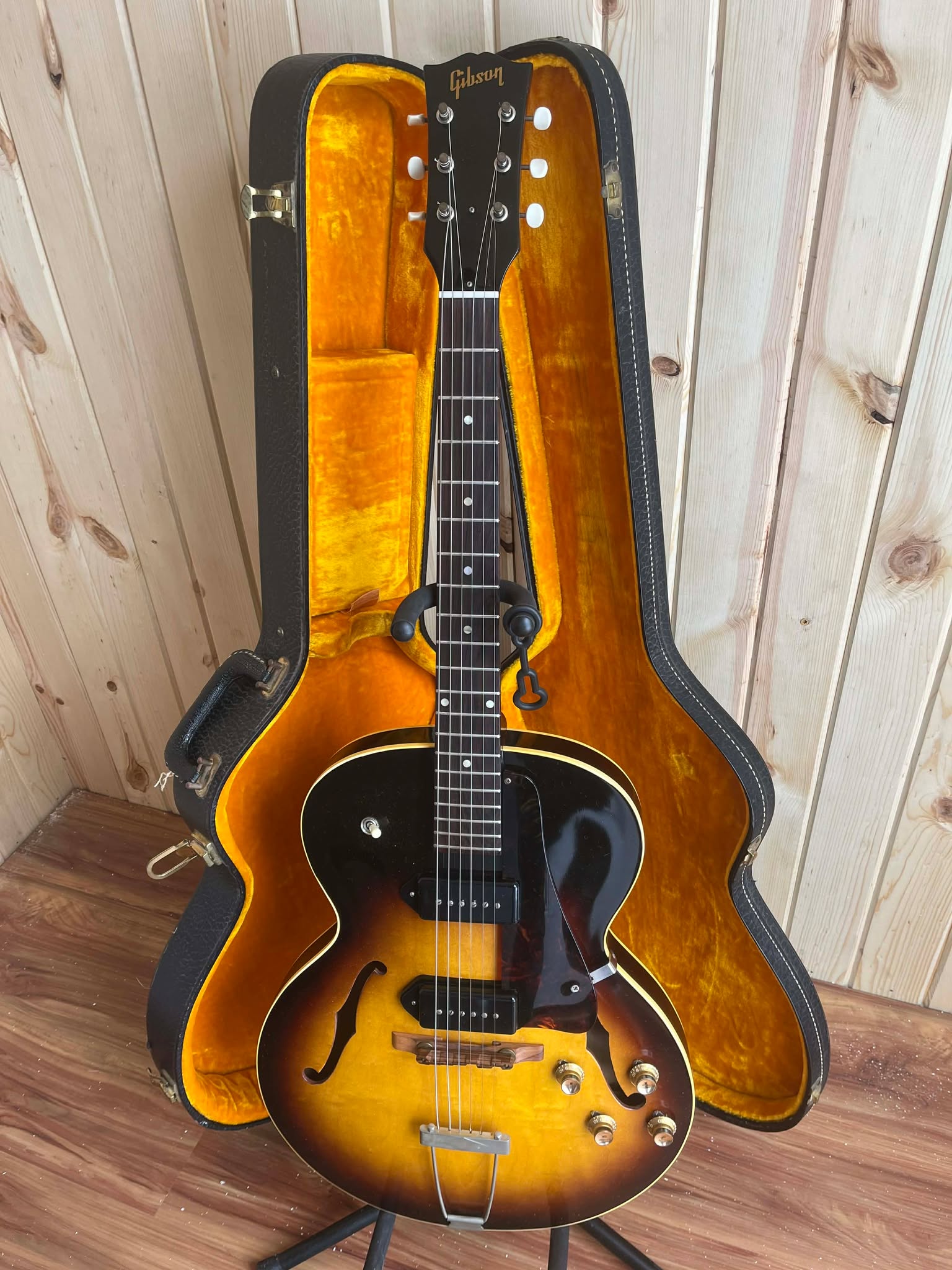
The ES-335 introduced in 1958 defined the semi-hollow electric guitar — a thinline body with a solid maple center block that combined the acoustic resonance of a hollow-body with the feedback resistance of a solid-body. It remains one of the most consistently valued vintage Gibsons in the market.
ES-335 value markers Indiana sellers need to know:
Dot inlays vs. block inlays: The original “dot-neck” ES-335s (1958–early 1962) are the most collectible. Gibson switched to block inlays in 1962. Dot-neck examples command a meaningful premium — know which you have before accepting any offer.
Stop tailpiece vs. Bigsby: Original stop tailpiece examples typically command more than Bigsby-equipped examples, though an original Bigsby is not a penalty if it was factory-installed.
Finish: Sunburst, Natural, and Cherry are the standard finishes. Natural examples are rarer and command a premium. Custom Color ES-335s are exceptional finds.
ES-345 and ES-355: The ES-345 added stereo wiring and a Varitone switch; the ES-355 added an ebony fingerboard, multi-ply binding, and gold hardware. Both have their own dedicated collector bases with values distinct from the standard ES-335.
Indiana note: The Chicago blues tradition — absorbed strongly by Northwest Indiana and the Indianapolis blues scene — drove meaningful ES-335 and ES-345 ownership in Indiana. These instruments appear regularly in Lake County and Marion County estate sales at above-average rates.
Gibson Acoustic Guitars: What Indiana Sellers Need to Know
Gibson acoustic guitars are frequently the most undervalued instruments in Indiana estate sales. Non-specialist buyers — including many local guitar shops — do not fully understand the value of pre-1970 Gibson acoustics, and sellers regularly receive offers that significantly undervalue what they have.
The J-45 — Indiana’s most common valuable acoustic:
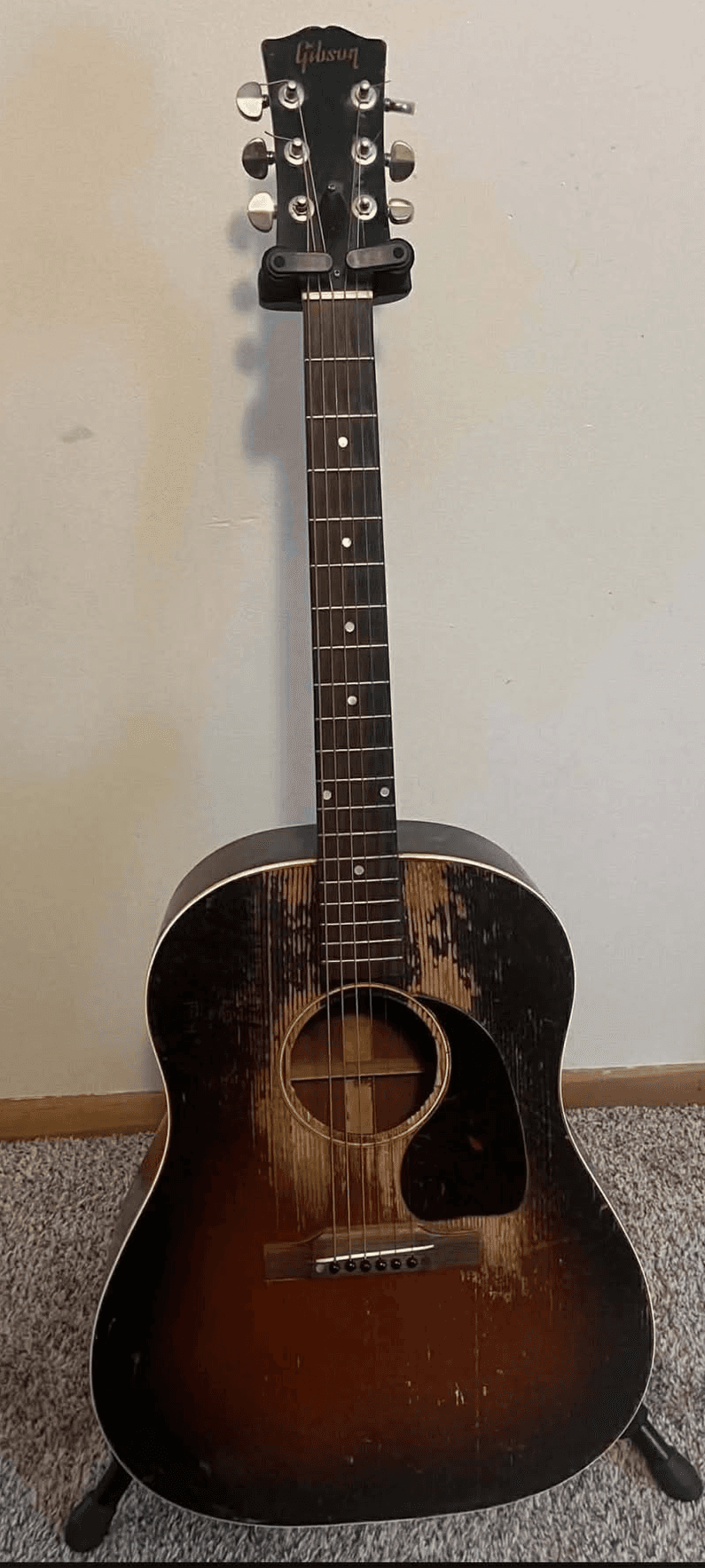
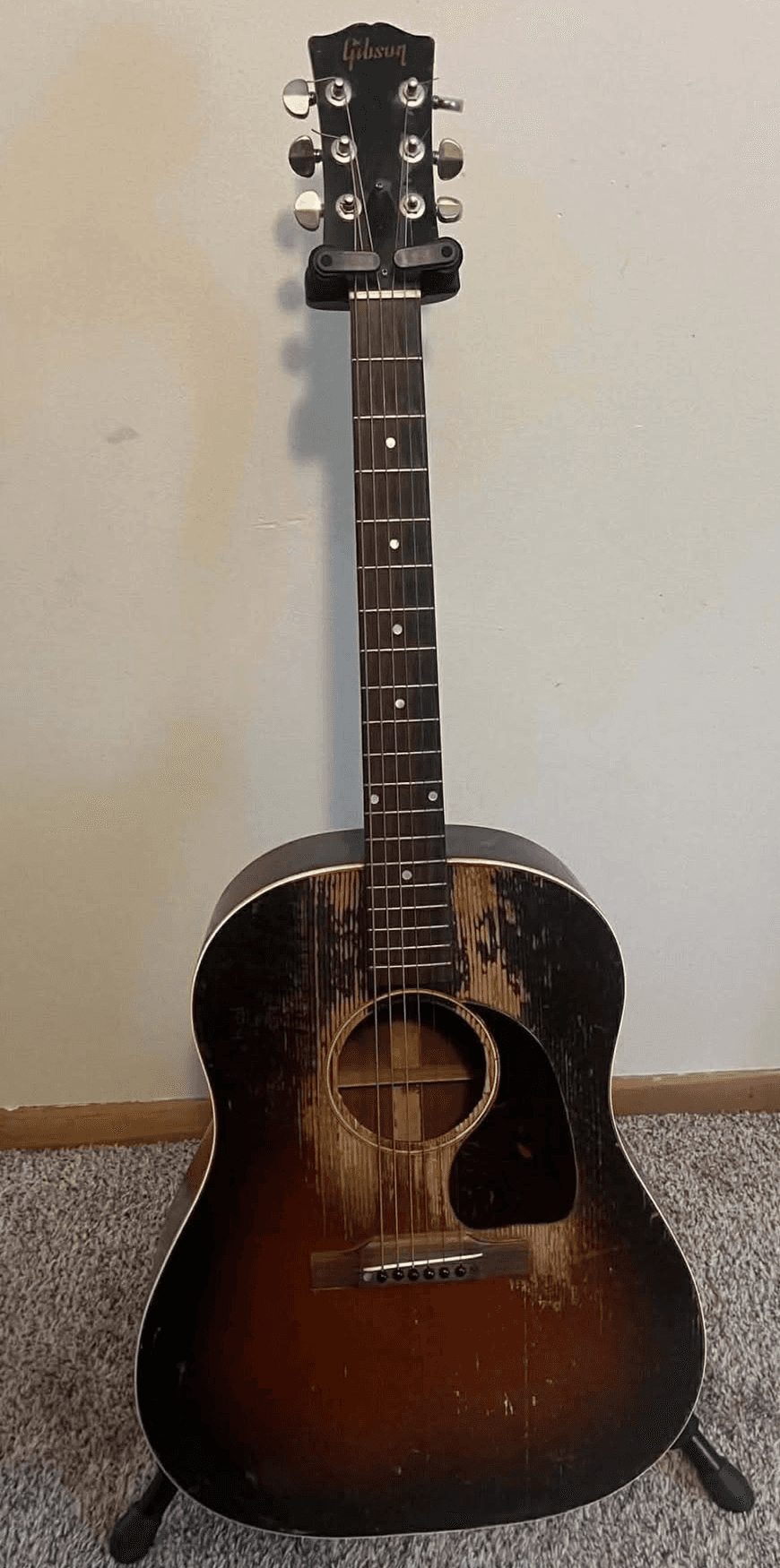
The Gibson J-45 is the most commonly encountered vintage Gibson acoustic in Indiana estate sales. A round-shouldered dreadnought introduced in 1942, it was the working guitarist’s acoustic — affordable, reliable, and sonically excellent. Pre-1970 J-45s in all-original condition are genuine collectibles with a stable and active buyer base. Indiana’s country, gospel, and folk traditions drove strong J-45 ownership, and Edgewater encounters them regularly across the state.
The Hummingbird and Dove — Indiana’s most visually distinctive acoustics:
The Hummingbird (1960) and Dove (1962) are Gibson’s square-shouldered dreadnoughts with the most elaborate decorative appointments. Both are commonly found in Indiana estate sales — their distinctive appearance made them popular with players who wanted something visually striking — and both have active collector markets.
Pre-war Gibson acoustics — the highest-value tier:
Gibson acoustic guitars made before World War II used different tonewoods, different construction techniques, and different bracing patterns than post-war instruments. Pre-war J-35s, L-00s, Nick Lucas Specials, and similar instruments are among the most collectible American acoustic guitars in existence. If you have a Gibson acoustic that predates 1942, contact Edgewater before showing it to anyone.
Structural condition note for acoustics:
Acoustic guitars are more vulnerable to structural issues than electrics — top cracks, back separations, and neck resets are common on older instruments. A professional neck reset or crack repair by a qualified luthier does not dramatically reduce value when the work is documented. Edgewater assesses acoustic condition accurately and does not use normal aging issues as leverage for unfair offers.
Gibson Flying V and Explorer: What Indiana Sellers Need to Know
The original 1958–1959 Flying V and Explorer made from Korina (African Limba) wood are among the rarest and most valuable Gibsons ever produced. If you believe you have an original 1958–1959 Flying V or Explorer — not a later reissue — contact Edgewater immediately and do not accept any offer without specialist authentication.
Later Flying V reissues (1967–1975) and Explorer reissues (1975–1981) are far more commonly encountered in Indiana estate sales and have their own strong and active collector market. These instruments are frequently found in Indiana homes from players who purchased them in the late 1960s and 1970s during the height of hard rock’s first era.
Flying V identification note: A 1967–1968 Flying V reissue looks broadly similar to the 1958–1959 original at a glance. The original uses Korina wood and has specific hardware and construction details that distinguish it. This is not a determination to make casually — if you have a Flying V you believe may be from 1958–1959, contact Edgewater for specialist assessment before showing it to any non-specialist buyer.
How to Get the Most Money for Your Gibson in Indiana: 7 Rules
Rule 1 — Do not clean, polish, or touch the finish before an appraisal. Original patina, hardware oxidation, and surface aging are authentication evidence. Edgewater pays more for an untouched original than for a guitar where the surface evidence has been disturbed by cleaning — even gentle cleaning with the right products can remove information that drives value.
Rule 2 — Find the original case before your appraisal. Gibson’s original brown/orange hardshell cases with pink or red lining confirm provenance and add meaningful value. The case also provides critical authentication context — a period-correct case that fits the guitar naturally supports the guitar’s claimed production date. If you have it, locate it.
Rule 3 — Do not replace any parts. Do not swap the nut, replace a broken tuner, or install new electronics before getting an appraisal. Every original component, even a worn or non-functioning one, contributes to originality documentation. A non-original part, however higher quality, reduces collector value.
Rule 4 — Write down everything you know about the guitar’s history. When was it purchased? Who bought it? Where was it purchased — a music store, a department store, a catalog? Do you have any receipts, photos of the original owner with the guitar, or any other documentation? Provenance documentation adds directly to value, and information that seems incidental to you can be meaningful to a specialist buyer.
Rule 5 — Note whether the finish is standard or unusual. Gibson’s standard electric finishes were Cherry, Sunburst, Walnut, Natural, and Ebony (on Customs). Non-standard finishes — Wine Red, Pelham Blue, Inverness Green, Polaris White, and others — are rarer and can command significant premiums. If your Gibson is an unusual color, contact Edgewater before accepting any offer.
Rule 6 — Get a specialist appraisal before any guitar shop offer. Local Indiana guitar shops buy Gibsons regularly, but they are retailers — their offers reflect what they need to maintain retail margin, not what the instrument is worth in the collector market. Edgewater’s knowledge of the difference between a 1961 SG with PAF pickups and a 1968 SG reissue, or between an original dot-neck ES-335 and a block-neck example, translates directly into higher offers.
Rule 7 — Do not list high-value Gibsons on Craigslist or Facebook Marketplace. These platforms attract sophisticated buyers who know exactly what they are looking at and exactly how to negotiate against uninformed sellers. A vintage Les Paul or ES-335 listed on Facebook Marketplace will attract lowball offers from people who understand its value better than you do. For significant instruments, a specialist direct buyer is consistently the safer and more profitable path.
Why Edgewater Pays More Than Indiana Guitar Shops for Gibsons
The pricing gap between Edgewater and local Indiana guitar shops is structural and predictable. It exists because of how each business model works, not because of any individual shop’s practices.
A local guitar shop must buy your Gibson at a price that allows them to resell it with enough margin to cover rent, staff, inventory carrying costs, and operating expenses. For a vintage instrument, that typically means offering 40–60% of their expected retail price. That ceiling is fixed by their business model and cannot be overcome regardless of how knowledgeable the shop is.
Edgewater buys directly from owners and places instruments with collectors and the secondary dealer market — without a physical showroom, without retail staff overhead, and without the carrying cost of physical retail inventory. We can offer prices based on what vintage Gibsons actually sell for in the collector market rather than a retailer’s required margin.
The practical difference: on a pre-1965 SG, an all-original Les Paul Custom, a dot-neck ES-335, or any other high-value vintage Gibson, the spread between Edgewater’s offer and a local shop’s offer is substantial. The more valuable the instrument, the more the Edgewater model benefits the seller.
Frequently Asked Questions: Selling a Gibson Guitar in Indiana
Q: What is the best place to sell a Gibson guitar in Indiana?
A: For most Indiana Gibson owners — particularly those with vintage or quality used instruments — the best combination of price and convenience is a specialist direct buyer like Edgewater Guitars. We pay 30–40% more than local guitar shops, provide free authentication, pay immediately in cash, and travel to you anywhere in Indiana. Online platforms like Reverb can yield strong gross prices but involve significant fees, shipping risk, and time investment that often erodes the apparent advantage.
Q: How do I find out what my Gibson is worth in Indiana?
A: Contact Edgewater Guitars at (440) 219-3607 for a free, no-obligation appraisal. We can typically provide a preliminary value range based on photos and a description before any in-person visit. For self-research, completed Reverb.com sales for your specific model, year, and condition provide real market data — but accurately identifying what you have is the first step, which is not always straightforward with vintage Gibsons.
Q: Does Edgewater Guitars travel to Indiana for Gibson appraisals?
A: Yes. We travel throughout Indiana for valuable Gibson instruments — Indianapolis, Fort Wayne, Evansville, South Bend, Bloomington, Lafayette, Muncie, Terre Haute, Hammond, and all surrounding areas. Call (440) 219-3607 to discuss your instrument and schedule a visit.
Q: What is a Gibson Les Paul worth in Indiana?
A: Gibson Les Paul values span an enormous range based on year, model, and originality. 1958–1960 “Burst” Standards are among the most valuable production guitars ever made. Late-1960s reissues and early-1970s examples have a strong and growing market. All-original condition is the single most important value factor in every era. Contact Edgewater for a free assessment specific to your guitar.
Q: What is a Gibson SG worth in Indiana?
A: SG values depend on year, model tier, pickup type, and originality. Early 1961–1963 examples with “Les Paul” designation on the truss rod cover command the strongest prices. SG Customs with three pickups and gold hardware are the most desirable configuration. All-original examples in any year command a premium over modified ones. Contact Edgewater for a specific assessment.
Q: I inherited a Gibson guitar in Indiana — how do I know if it is valuable?
A: If the Gibson is American-made and predates 1975, it is worth a specialist appraisal before selling it anywhere. Edgewater provides free appraisals specifically for inherited instruments — we encounter this situation regularly and understand that heirs often have no frame of reference for what they have. Call (440) 219-3607 and we will walk you through the process at no cost and with no obligation.
Q: What is the most valuable Gibson guitar I might find in an Indiana estate?
A: A 1958–1960 Gibson Les Paul Standard “Burst,” a 1958–1959 Flying V or Explorer in original Korina, a pre-war Gibson acoustic (pre-1942), or an all-original dot-neck ES-335 (1958–1962) would represent the highest-value categories. If you believe you have any of these instruments, contact Edgewater before approaching any other buyer.
Q: How long does it take to sell a Gibson to Edgewater in Indiana?
A: Most Indiana transactions complete within one to three days — same-day response, in-person visit within 24–48 hours for most Indiana locations, and immediate cash payment upon our evaluation. No waiting period, no consignment arrangement, and no obligation to accept our offer.
Q: Should I sell my Gibson on Reverb or to a local buyer in Indiana?
A: For high-value vintage Gibsons, we recommend contacting Edgewater before listing on Reverb. Platform fees, shipping costs and damage risk, listing time, and buyer dispute exposure can significantly reduce what you net from an online sale. Edgewater’s offers are typically competitive with or better than net Reverb proceeds — and the transaction completes in days rather than weeks or months.
Recently Purchased: Indiana Gibson Case Studies
Indianapolis Estate — 1962 Gibson ES-335 A family in Carmel contacted Edgewater after discovering a 1962 Gibson ES-335 dot-neck in Cherry finish in a late family member’s home studio. The guitar was all-original with stop tailpiece, original PAF-era pickups, and its original brown case. The family had received one prior offer from an Indianapolis music shop. Edgewater’s offer exceeded that figure by 39%. Cash paid at the time of in-home evaluation.
Fort Wayne — 1965 Gibson SG Standard A Fort Wayne seller contacted Edgewater after inheriting a 1965 Gibson SG Standard in Cherry from his uncle, a lifelong rock musician. The guitar showed significant play wear but was all-original — including the original Maestro vibrato, which is frequently removed on SGs of this era. Edgewater traveled to Fort Wayne, authenticated the guitar on-site, and completed the purchase the same day at a price that reflected the value of the all-original vibrato system.
Bloomington — 1968 Gibson J-45 A retired Indiana University music faculty member contacted Edgewater about a 1968 Gibson J-45 she had purchased new during her student years. The guitar was all-original in sunburst finish with the original case and a set of original strings still on the instrument. Edgewater traveled to Bloomington and completed the purchase during a single visit, paying meaningfully above the seller’s prior estimate based on her own online research.
Northwest Indiana — 1969 Gibson Les Paul Custom A Hammond-area seller reached out after finding a 1969 Gibson Les Paul Custom in the original black finish with gold hardware in a family member’s home. All-original with T-Top humbuckers, Grover Rotomatics, and original case. Edgewater provided a same-day response, traveled to Hammond the following day, and completed the purchase at a figure 41% above the offer the seller had received from a local shop.
Related Resources
Contact Edgewater Guitars: Indiana’s Premier Gibson Buyer
Edgewater Guitars purchases vintage and quality used Gibson guitars throughout Indiana — Indianapolis, Fort Wayne, Evansville, South Bend, Bloomington, Lafayette, Muncie, Terre Haute, Hammond, and everywhere in between. We are one of the Midwest’s most active direct buyers of pre-1975 American-made Gibsons, and we consistently offer 30–40% more than local guitar shops.
Free appraisal. Immediate cash. We travel to you.
Phone: (440) 219-3607 Web: edgewaterguitars.com Service Area: Indiana statewide, plus Ohio, Michigan, Pennsylvania, and West Virginia
If you own a Gibson guitar in Indiana — inherited, purchased decades ago, or simply no longer played — call us before selling anywhere else. The appraisal is always free and there is never any obligation.