DATE :
The 1966 Gibson ES-335 That Played Woodstock, The Dick Cavett Show and Pearl with Janis Joplin
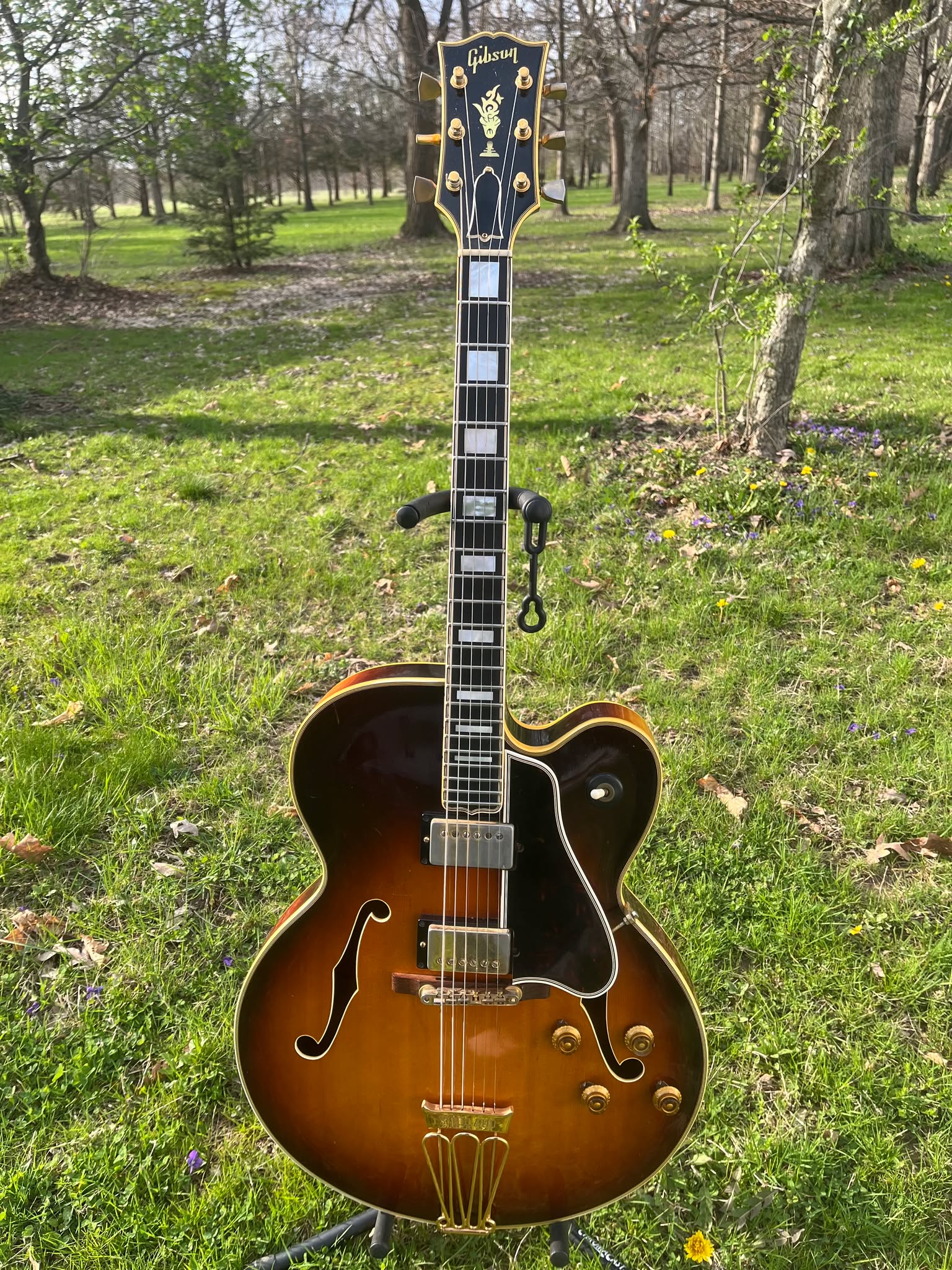
Edgewater Guitars recently bought a 1966 Gibson ES-335 with a story most guitars never get: it was John Till's guitar during his years with Janis Joplin, on stage at Woodstock, on The Dick Cavett Show and in the studio for Pearl. Edgewater buys vintage Gibson semi-hollows nationwide with free expert appraisals and same-day cash offers. Call or text (440) 219-3607.
What this guitar is, in one paragraph
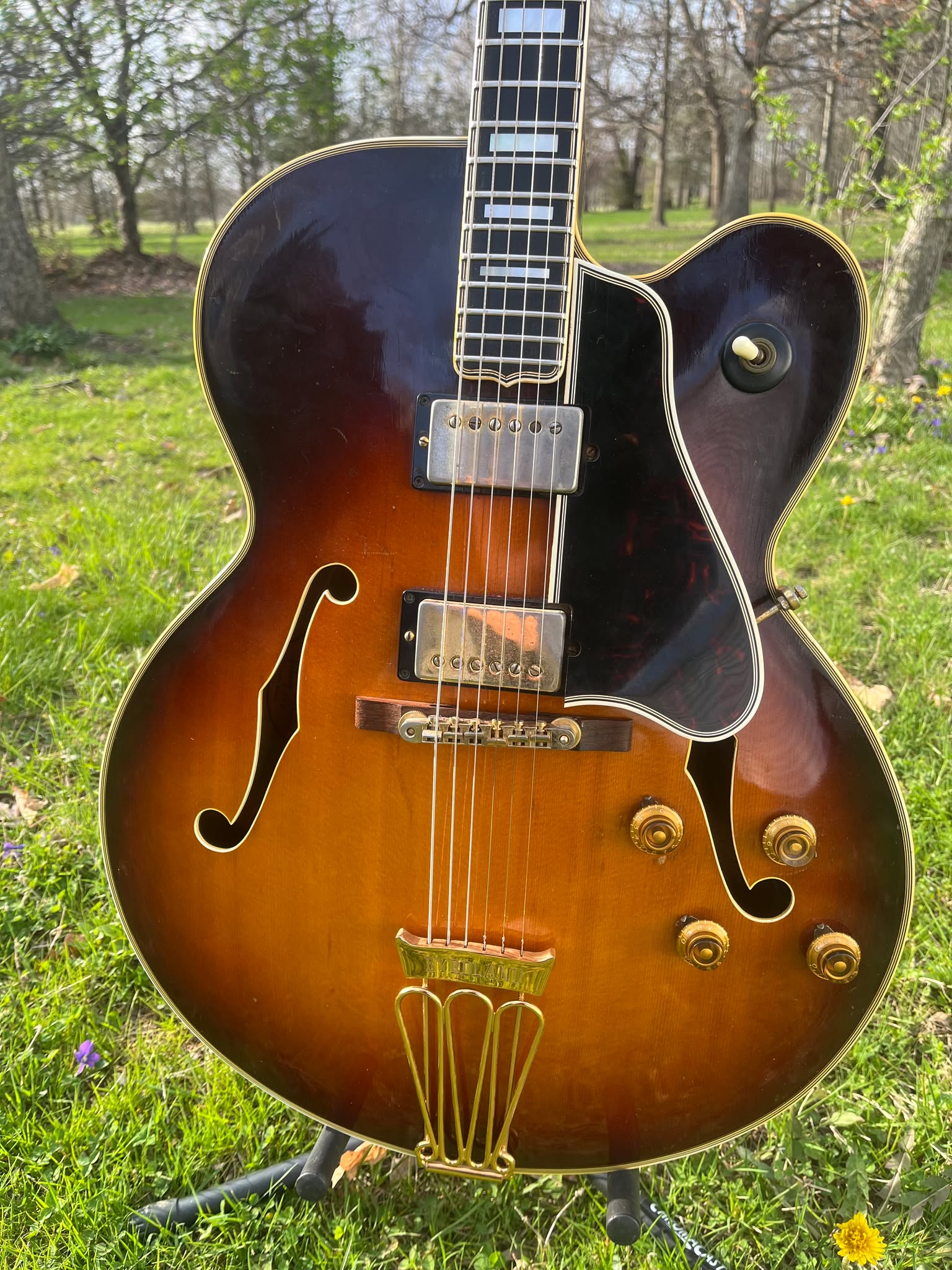
A sunburst 1966 Gibson ES-335TD, stock apart from one deliberate change: a 1950s Supro stairstep tailpiece in place of the factory trapeze, fitted by John Till, the Canadian guitarist who backed Janis Joplin from the summer of 1969 until her death in October 1970. That tailpiece is the tell. It is visible in the Woodstock footage, in the Cavett broadcasts and in period photographs, which is how a 60-year-old guitar can be matched to the moments it was part of. After Janis, the guitar was sold in New York in the 1970s through Matt Umanov's Greenwich Village shop to the owner who kept it until Edgewater bought it in September 2026.
Who John Till was
John Till was born December 28, 1945 and grew up in Stratford, Ontario, the son of two working musicians. As a teenager he played in The Revols with his friend Richard Manuel, who would go on to The Band. Till spent three years in Ronnie Hawkins's backing band, the Hawks, the same Toronto bar-band proving ground that produced The Band, and by the summer of 1969 he had accepted an offer from Janis Joplin to join the group she had formed after leaving Big Brother and the Holding Company.
That group was the Kozmic Blues Band, a horn-driven soul revue that was Joplin's first attempt at a sound of her own. Till came in as its guitarist as Sam Andrew, her Big Brother bandmate, was on his way out. When Joplin dissolved the Kozmic Blues Band after a Madison Square Garden show on December 19, 1969, she kept exactly two people: Till and bassist Brad Campbell. Around them she built the Full Tilt Boogie Band, a tighter five-piece of young Canadians, most of them also Hawkins alumni, with organ and piano in place of the horns. Till was its guitarist and, by the accounts of the people in it, its musical anchor.
Till said later that it was never an employer and employee relationship, because that was not how Janis wanted it. After her death the band stayed together for a while in Woodstock, New York, and Till eventually went home to Stratford, raised his family, played locally and stayed out of the spotlight. He died at home in Stratford on September 4, 2022.
Woodstock: the small hours of Sunday, August 17, 1969
Janis Joplin was on the Saturday night bill at Woodstock, but the schedule had slipped so badly that she did not walk out until roughly 2:00 a.m. on Sunday, August 17. She brought the Kozmic Blues Band: Till on guitar, Brad Campbell on bass, Richard Kermode on keyboards, Maury Baker on drums, and a horn section of Terry Clements, Luis Gasca and Cornelius "Snooky" Flowers. Till was the only guitarist on that stage.
The set ran ten songs: Raise Your Hand, As Good As You've Been to This World, To Love Somebody, Summertime, Try (Just a Little Bit Harder), Kozmic Blues, Can't Turn You Loose, Work Me, Lord, Piece of My Heart and Ball and Chain. Work Me, Lord is the performance most people have seen, because it is the one in the official Woodstock releases, and it is the clearest look at the guitar: a Gibson ES-335 with the stepped Supro tailpiece where the factory trapeze would normally sit.
A photograph in the University of Massachusetts Amherst special collections, catalogued as "Janis Joplin, performing at Woodstock, with John Till (guitar) in background," documents the same moment from the photographers' pit. We link to it below rather than reproduce it; the rights belong to the archive.
The Dick Cavett Show, three times
Joplin was a Cavett regular. She appeared on The Dick Cavett Show on July 18, 1969 with the Kozmic Blues Band, performing To Love Somebody and Try (Just a Little Bit Harder), and then twice with Full Tilt Boogie: June 25, 1970, and August 3, 1970. The August show was her last television appearance. She and the band played My Baby and Half Moon, two songs that would appear on Pearl, and she sat with Cavett talking about the Festival for Peace at Shea Stadium she was about to play.
Those broadcasts matter for this guitar for a practical reason. Television lighting and camera angles show a guitar far more clearly than festival footage does, and the Cavett tapes put Till's ES-335 and its non-standard tailpiece on screen in a studio, in color, with the instrument in frame for full songs. The Rock Icons episode from June 25, 1970 is still in circulation on streaming services.
Full Tilt Boogie: Festival Express to Harvard Stadium
Full Tilt Boogie played its first session with Joplin on April 4, 1970 and went on the road in May. That summer they rode the Festival Express across Canada, June 28 to July 4, 1970, playing Toronto, Winnipeg and Calgary on the same train as the Grateful Dead and The Band. The band's last public show with Joplin was Harvard Stadium in Boston on August 12, 1970; their equipment had been stolen before the gig and they played on borrowed gear, which the Harvard Crimson reviewed warmly anyway.
The Festival Express shows were filmed, and the Cavett appearances bracket that tour. Between them they cover the period when this guitar was Till's main instrument on stage.
Pearl: Sunset Sound, September 1970
Pearl was recorded at Sunset Sound in Hollywood with producer Paul A. Rothchild, best known for his work with The Doors, in sessions that ran from late July into October 1970. Full Tilt Boogie, with Till on guitar, Richard Bell on piano, Ken Pearson on organ, Brad Campbell on bass and Clark Pierson on drums, entered the studio in September. Joplin died on October 4, 1970, with the album unfinished. Mercedes Benz, sung a cappella on October 1, was the last thing she recorded; Buried Alive in the Blues was left as an instrumental because she never cut the vocal.
Columbia released Pearl on January 11, 1971. It went to number one on the Billboard 200 and held there for nine weeks. Me and Bobby McGee, the Kris Kristofferson song with Till's guitar under it, went to number one as a single. The album is now certified four times platinum. Till's parts on Pearl are electric guitar throughout, and by his own account and the film record, the ES-335 with the Supro tailpiece was the guitar he was playing in that period.
How it got from a rock band to a New York shop to Ohio
By the 1970s the guitar was in New York, and according to the owner we bought it from, it was sold to Matt Umanov and changed hands through his shop. Umanov had been repairing and selling guitars in Greenwich Village since 1965, opened his first storefront in a former butcher shop on Bedford Street in 1969, and moved to Bleecker Street in 1977, where the shop stayed until it closed in December 2017 after more than half a century in business. It was the kind of place where a guitar with a story could pass quietly from one player to the next, and that is what happened here: a New York owner bought it in the 1970s and kept it for roughly fifty years.
That owner sold the guitar to Edgewater Guitars in September 2026. What we received is the guitar as Till left it: a sunburst 1966 ES-335TD in its original yellow-lined Gibson case, with a serial number and potentiometer codes that agree on 1966, original apart from the tailpiece, with the Supro stairstep still on it.
The tailpiece: why a Supro part is the signature
Gibson fitted the ES-335 with a trapeze tailpiece from 1965 onward, replacing the stop-bar and stud arrangement of the earlier guitars. Plenty of players of the era preferred the older feel and swapped the trapeze for something with a shorter string path behind the bridge. Till's choice was a stamped-steel stairstep tailpiece from a 1950s Supro, a Chicago-built Valco brand whose archtops and Dual-Tone and Triple-Tone models carried that stepped, tiered trapeze as a house style. It bolts on at the end pin like the Gibson part it replaced, so the change required no new holes in the top.
For a provenance guitar that swap is a gift. Thousands of ES-335s left Kalamazoo in the mid-1960s, and a stock one looks like every other stock one. A 1960s Gibson wearing a 1950s Supro tailpiece is an unusual combination, and it is the one visible detail that ties the guitar in the Woodstock film, the Cavett broadcasts and the period photographs to the guitar on our bench. It is also why we would never "correct" it. The original trapeze would have made this a more ordinary guitar and a less documented one.
The 1966 Gibson ES-335 as a model
The ES-335 is Gibson's semi-hollow thinline: a laminated maple body with a solid maple center block under the bridge and pickups, two f-holes, a glued-in mahogany neck with a rosewood fingerboard, two humbucking pickups, and a 24 3/4 inch scale. Introduced in 1958, it was designed to give players hollow-body warmth without the feedback, and by the mid-1960s it had become the working guitar of choice for blues, soul and rock players who wanted one instrument that could do everything.
What makes a 1966 example specifically a 1966 example is the cluster of changes Gibson made in 1965 and 1966:
Block inlays. Small pearloid blocks replaced the original dots in mid-1962, so every 1966 has blocks.
Trapeze tailpiece. Standard from 1965, replacing the stop tailpiece. This is the part Till removed on this guitar.
Narrower nut. Gibson narrowed the nut in 1965 from 1 11/16 inches to roughly 1 9/16 inches (some transitional examples measure 1 5/8), and 1966 guitars carry the narrow nut. Gibson did not go back to the wider nut until 1968.
Chrome hardware. Chrome plating replaced nickel in 1965, so a 1966 has chrome pickup covers, tailpiece and bridge, with an ABR-1 Tune-o-matic bridge on nylon saddles.
Patent-number humbuckers. The PAF sticker gave way to the patent-number sticker in late 1962; 1966 pickups are patent-number units, and the internal construction was moving toward the later "T-top" bobbins in this period.
Indian rosewood fingerboard and 14-degree headstock. Both arrived in 1966, replacing Brazilian rosewood and the earlier 17-degree headstock pitch.
Pointed horns and a short pickguard. The rounded "Mickey Mouse ear" cutaways of 1958 to 1963 had become more pointed by 1964, and the pickguard no longer extends past the bridge pickup.
The 1966 ES-335 came as the ES-335TD in sunburst and the ES-335TDC in cherry. Some of the details above are exactly the ones a dating guide uses, and our ES-335 dating and authentication guide walks through them with serial ranges and pot codes. For the model's full run, see the vintage Gibson ES-335 value guide, 1958 to 1968, and for the neighboring years, the 1961 ES-335 and 1968 ES-335 guides.
How we checked the story
We treat every provenance claim as a claim until it survives checking, and we would rather say what we know than what we wish. Here is what supports this one.
The public record puts Till and an ES-335 together. Till was Joplin's only guitarist at Woodstock and through Full Tilt Boogie, and the Woodstock footage, the Cavett broadcasts and the period photographs show him on a Gibson ES-335 with a stepped, non-Gibson tailpiece.
The guitar on our bench matches those images. A sunburst 1966 ES-335 wearing a 1950s Supro stairstep tailpiece, with no extra holes in the top from any other tailpiece, and a serial number and pot codes that both point to 1966.
The chain of custody is short. Till, then a 1970s sale in New York through Matt Umanov's shop, then one owner for roughly fifty years, then Edgewater. Each link is a real person or a real business.
What we are not claiming. We are not claiming a written letter from John Till, who died in 2022, and we are not claiming Janis Joplin herself played it. This was her guitarist's guitar, on her stages and on her last record.
What a guitar like this is worth
A clean, original mid-1960s ES-335 is already a serious vintage guitar, and a documented instrument from a landmark performance sits in a different market entirely, where the buyer is paying for the history as much as the wood. We do not publish figures for a guitar like this because there is no honest way to put one number on it from a web page. If you own a guitar with a story, the most accurate answer is the one you get from a person who can see it, handle it and check the story, which is exactly what a free Edgewater appraisal is.
Sell your Gibson ES-335
Edgewater Guitars buys vintage Gibson ES-335s, ES-345s and ES-355s from every era, in every condition, with or without a story. We travel for the right guitar, we pay by check or cash the same day, and we tell you what we see, including when a guitar is more ordinary than its legend. Get a free estimate or call or text (440) 219-3607. Our sell your Gibson page explains how the process works, and the Gibson serial number lookup will tell you the year of yours before you call.
From a recent Google review: "I recently bought a 1963 Gibson ES-335 from Stephen at Edgewater Guitars for my dad, and he absolutely loves it! ... professional, knowledgeable, and made the entire process easy ... Highly recommend." (Annie Fuller, May 2026)
See the guitar in the record
Janis Joplin, Work Me, Lord, live at Woodstock, August 17, 1969 (official upload): youtube.com/watch?v=cd-To3CraUc
The Dick Cavett Show, Rock Icons: June 25, 1970, Janis Joplin (streaming listing): tubitv.com
Janis Joplin's last Cavett appearance, August 3, 1970 (JamBase): jambase.com
Archival photograph, "Janis Joplin, performing at Woodstock, with John Till (guitar) in background," UMass Amherst Special Collections: credo.library.umass.edu
Frequently asked questions
Who was Janis Joplin's guitarist at Woodstock?
John Till, a Canadian guitarist from Stratford, Ontario who had played in Ronnie Hawkins's Hawks. He was the only guitarist in the Kozmic Blues Band at Woodstock on August 17, 1969, stayed on through the Full Tilt Boogie Band and played on Pearl. He died in Stratford on September 4, 2022. Edgewater now owns the 1966 Gibson ES-335 he played in that period.
How much is a 1966 Gibson ES-335 worth?
It depends on originality, finish, condition and, in rare cases, documented history. A stock 1966 with its patent-number pickups, chrome hardware and narrow nut all intact is a strong vintage guitar; a refinish, replaced pickups or a broken headstock move the figure a long way. Edgewater gives free, specific appraisals: call or text (440) 219-3607 or use the estimate form.
How do I know if my ES-335 is a 1966?
Look for block inlays, a trapeze tailpiece, chrome hardware, patent-number pickup stickers, a nut close to 1 9/16 inches wide and an Indian rosewood board. Then run the serial number through the Gibson serial number lookup; Gibson reused number ranges in the 1960s, so the features settle what the serial alone cannot.
Does a famous previous owner make a guitar worth more?
Only when the link can be shown, not just told. Film, broadcast footage, dated photographs, receipts and a short, checkable chain of ownership are what turn a story into provenance. A distinctive modification that appears in the period images, like the Supro tailpiece on this ES-335, is often the single most useful piece of evidence.
Sources
John Till, Wikipedia: en.wikipedia.org/wiki/John_Till
John Till obituary, Legacy.com (September 2022): legacy.com
Kozmic Blues Band and Full Tilt Boogie Band, Wikipedia: Kozmic Blues Band, Full Tilt Boogie Band
Pearl (Janis Joplin album), Wikipedia: en.wikipedia.org/wiki/Pearl_(Janis_Joplin_album)
Janis Joplin at Woodstock, setlist and lineup: janisjoplin.com/woodstock-1969, setlist.fm
Remembering Janis Joplin's last visit to The Dick Cavett Show, JamBase: jambase.com; Open Culture on the same broadcast: openculture.com
Matt Umanov Guitars history, Village Preservation: Farewell to Matt Umanov Guitars, Business of the Month; ABC7 New York on the 2017 closing: abc7ny.com
Gibson ES-335 spec changes by year, guitarhq.com: guitarhq.com/es335.html
Written by Stephen Pedone, co-owner of Edgewater Guitars, a vintage guitar buyer based in Valley City, Ohio with more than 140 Google reviews at a 5.0-star average. The provenance in this article is from Edgewater's own purchase of the guitar and the public record cited above. Last updated: September 16, 2026.
Article