DATE :
1962 Gibson SG Junior: The Slab Mahogany Rock Machine at the Dawn of the Double-Cut Era
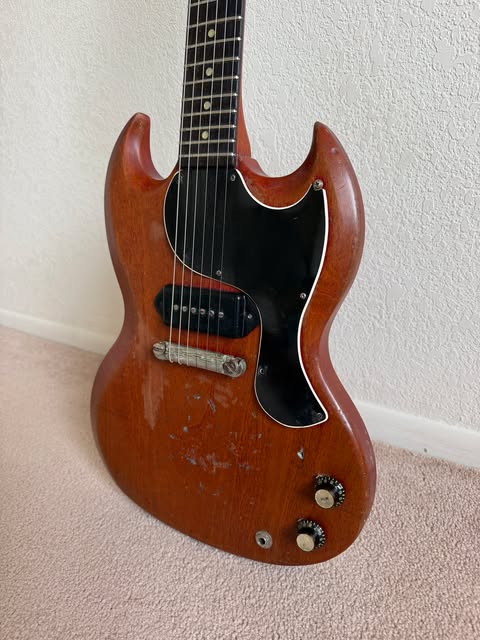
1962 Gibson SG Junior: The Slab Mahogany Rock Machine at the Dawn of the Double-Cut Era
The 1962 Gibson SG Junior is a slab-mahogany single-pickup solidbody, a stripped-down rock machine with a single dog-ear P-90 and the new double-cut SG body. Value is driven by originality, finish, and whether the P-90, wrap tailpiece, and electronics are original. Edgewater Guitars buys vintage Gibson electric guitars nationwide with free expert appraisals and same-day cash offers. Call or text (440) 219-3607.
Last Updated: June 2026
What Makes the 1962 Gibson SG Junior Significant?
The 1962 Gibson SG Junior sits at a precise and historically loaded moment in Gibson’s production timeline. The body shape that would define the SG had been introduced in 1961 as a replacement for the single-cutaway Les Paul Junior, and by 1962 the new double-cutaway design had fully established itself as the standard configuration. The pointed cutaway horns, the slim slab mahogany body, and the wraparound bridge that defined the SG Junior’s character were all in place — and the instrument was finding its audience among players who wanted maximum access to the upper frets, minimum weight, and maximum aggression from a single P-90 pickup at a price point below the Standard and Special models.
The 1962 SG Junior occupies a gap in the SG production story that collectors and players increasingly recognize. The 1961 model carries the first-year premium of the new body shape — the instrument still wore the Les Paul name on the truss rod cover through much of that year, adding historical complexity and collector value. The 1963 and 1964 models are well-documented and widely available. The 1962 sits between these more prominent years as a fully resolved expression of the early SG Junior design — the pointed cutaways established, the P-90 pickup in its original pre-patent-number configuration through most of the year, and the overall construction reflecting the early SG era’s raw, aggressive character that later production would begin to refine away.
The single P-90 Soap Bar pickup of the 1962 SG Junior is the instrument’s defining tonal element and its primary authentication reference. Bridge-position only, routed directly into the slab mahogany body without the maple cap of the Standard models, the P-90 in this configuration produces one of the rawest, most aggressive single-coil tones in vintage Gibson production. The absence of a neck pickup is not a limitation — it is a design decision that concentrates the entire electrical output of the instrument into a single high-output single-coil at the bridge, producing a focused, cutting tone that influenced players from Pete Townshend to Billie Joe Armstrong. In our experience buying SG Junior instruments across Ohio and the Midwest, 1962 examples are the most frequently misidentified year in the SG Junior line — sellers often assume the pointed cutaway body means 1963 or later, unaware that the pointed cutaway was established in 1961 and continued through 1965.
What makes the 1962 SG Junior distinctive:
Fully established double-cutaway pointed horn SG body shape — the most aggressive visual profile in Gibson’s production lineup
Single P-90 Soap Bar bridge pickup — bridge position only, no neck pickup
Slab mahogany body — no maple cap, no carved top, pure mahogany throughout
Wraparound combination bridge-tailpiece — the simplest and most resonant bridge configuration Gibson produced
Unbound rosewood fingerboard with dot inlays — no frills, maximum function
Cherry finish standard — the most commonly encountered 1962 SG Junior finish
Serial numbers in the 2xxxx range on the back of the headstock — the impressed serial number system transitioning from ink stamp
Slim, fast neck profile — noticeably thinner than the early 1960s Les Paul Custom or Standard
Small white or tortoiseshell pickguard
Patent number pickup beginning to appear late in 1962 replacing the earlier single-coil P-90 designation
If you own a 1962 SG Junior, you may be sitting on a significant asset. Edgewater Guitars provides free, no-obligation valuations — call (440) 219-3607 or visit edgewaterguitars.com.
What Is a 1962 Gibson SG Junior Worth? (2026 Market Values)
Value by Condition and Finish
The 1962 SG Junior market in 2026 reflects the growing collector appreciation for early SG production across all model lines. All-original examples in excellent condition with the original cherry finish and original P-90 pickup represent the premium tier. Player-grade examples with moderate wear but original electronics remain strong — the SG Junior’s reputation as a player’s instrument means that condition does not suppress value as dramatically as it does on more overtly collectible models.
Condition | Originality | Relative Value |
|---|---|---|
Excellent (8–9/10) | All original, cherry, original case | Premium tier |
Very Good (7/10) | All original, no case | Strong tier |
Good (6/10) | Original pickup, some hardware changes | Mid-to-strong tier |
Good (6/10) | Original, TV Yellow finish (rare) | Strong-plus tier |
Player Grade | Some replacements, heavy wear | Mid tier |
Modified | Non-original pickup, refin, added routes | Entry-to-mid tier |
What Affects the Value of a 1962 SG Junior?
P-90 pickup originality: The single P-90 is the instrument’s entire electronic output — its originality is the most important value driver. Original 1962 P-90 Soap Bar pickups have specific construction details — fiber bobbin, Alnico V magnets, correct lead wire routing — that distinguish them from replacement units. An original P-90 in a 1962 SG Junior commands a 30–40% premium over an example with a replaced pickup.
Finish originality: Cherry finish on a 1962 SG Junior is correct and desirable — original nitrocellulose cherry fades toward a warm transparent red that is distinctly different from the brighter, more opaque cherry of refinished examples. TV Yellow examples are substantially rarer and carry a significant premium (40–60% over equivalent cherry examples). Refinished instruments lose 35–50% of value.
Wraparound bridge originality: The original wraparound combination bridge-tailpiece is a specific hardware element — compensated or replaced units are common and reduce value by 8–12%.
Neck integrity: The slim SG neck profile is vulnerable to headstock breaks at the neck-headstock joint — the most common structural issue on all SG models. A clean, unrepaired neck with original frets commands full value. Headstock repairs reduce value by 25–40%.
Original case: The original brown or black hardshell case adds approximately 10–15% to value.
Weight: The slab mahogany SG Junior body produces significant variation in weight between examples — lighter examples (typically 5.5–6.5 lbs) are generally preferred by players and carry a modest premium.
How 1962 Compares to Other Years
Year | Key Difference | Relative Value | Why |
|---|---|---|---|
1961 | First year of SG body; Les Paul name on truss rod cover (most examples) | Higher | First-year premium; Les Paul name adds historical complexity |
1962 (this post) | Fully established SG body; P-90 throughout most of year | Baseline | Pure early SG Junior character; no transition complexity |
1963 | Patent number pickup standard; minor refinements | Similar | Slightly later production; same fundamental configuration |
1964 | SG Junior at full production maturity | Similar to slightly lower | More common year; less early-era premium |
1965 | CBS-adjacent production changes beginning | Lower | Quality and collector perception beginning to shift |
Edgewater Guitars consistently pays 30–40% more than typical guitar shops. Get your free valuation: edgewaterguitars.com or (440) 219-3607.
Recent Sales and Auction Results
All-original 1962 SG Juniors in excellent condition with original P-90 appear at auction and through specialist dealers with moderate frequency — more available than early SG Standards but rarer than mid-1960s examples. TV Yellow examples in any condition generate competitive bidding when they appear. Cherry examples in excellent all-original condition sell at the strong-to-premium tier. Contact Edgewater for current market context specific to your instrument’s condition and finish.
How to Identify an Authentic 1962 Gibson SG Junior
Serial Numbers
Range for 1962: Approximately 20000s–30000s, impressed (stamped into the wood) on the back of the headstock — the transition from ink-stamped to impressed serial numbers was occurring in this period
Location: Back of headstock
Format: Five or six digits, impressed into the headstock wood — the impression may be difficult to read on worn examples
Important caveat: Gibson serial number ranges overlap significantly between years in this era. Always cross-reference with the Factory Order Number and pot codes for confident dating.
Factory Order Number (FON)
Format for 1962: A batch letter followed by a production number — the specific letter helps narrow production within 1962
Location: Inside the body — visible through the single pickup routing cavity with a mirror and light, or sometimes stamped on the back of the body under the finish
Importance: For 1962 Gibson production the FON is often more reliably specific than the serial number alone
Potentiometer Codes
The SG Junior has a simple control layout — one volume and one tone — making pot code examination straightforward.
Primary manufacturer: Centralab (code 134) and CTS (code 137)
How to decode: Manufacturer code (3 digits) + year (2 digits) + week (2 digits)
Example: 134-2-18 = Centralab, 1962, week 18
Expected codes for 1962: Pots dated to 1961 or 1962 are correct. Pots from 1963 or later indicate modification.
Location: Inside the control cavity, accessible by removing the control plate on the back of the body
Key Visual Identifiers
Body shape: Double-cutaway with pointed horns — both horns come to a sharp point, distinctly more aggressive than the rounded cutaways of the ES-335 or earlier Les Paul Junior. Both horns are approximately equal in length — the symmetrical pointed double-cutaway is the defining SG visual.
Body construction: Slab mahogany — no carved top, no maple cap, uniform thickness throughout. The body is noticeably thinner than a Les Paul Standard.
Pickup: Single P-90 Soap Bar in the bridge position — cream cover, rectangular with rounded ends, two mounting screws within the pickup frame. No neck pickup. No neck pickup routing.
Bridge: Wraparound combination bridge-tailpiece — a single compensated or uncompensated unit anchored by two threaded posts directly into the body
Fingerboard: Unbound rosewood with dot inlays — no binding, no block or trapezoid inlays
Neck profile: Slim, fast — noticeably thinner than early 1960s Les Paul Custom or Standard necks
Headstock: Standard Gibson three-on-a-side headstock with crown inlay — no “SG” designation on the headstock itself in 1962
Truss rod cover: Plain “Junior” cover or no model designation — by 1962 the Les Paul name had been removed from SG Junior production
Finish: Cherry nitrocellulose standard; TV Yellow rare
Pickguard: Small white or tortoiseshell guard mounted above the pickup
Factory Markings and Stamps
Inside body: Factory Order Number — accessible through the single P-90 pickup routing cavity
Back of headstock: Impressed serial number
Control cavity: Pot codes on both potentiometers — accessible through the back plate
Neck heel: May show pencil assembly notations
P-90 Pickup Authentication
The single P-90 is the most important authentication element on the 1962 SG Junior:
Cover material: Cream plastic — original covers yellow toward off-white with age. A bright white cover suggests a replacement.
Magnet type: Alnico V — two bar magnets beneath the coil visible when the pickup is removed
Bobbin material: Fiber — black or dark brown fiber flatwork visible on the underside
DC Resistance: Approximately 7.5–8.5k ohms — measure with a multimeter across the output leads
Lead wire: Cloth-covered braided shield — plastic-insulated lead wire indicates a later or replacement pickup
Mounting screws: Two screws through the pickup mounting ring into the body — original screw slots show appropriate aging and use
Red Flags: How to Spot Fakes and Refinishes
Humbucker in a P-90 body: Some 1962 SG Juniors were converted to humbucker pickups at some point — the P-90 routing is narrower and shallower than a humbucker rout, so conversion requires enlarging the cavity. Evidence of enlarged routing under the pickup cover indicates conversion.
Neck pickup routing: The 1962 SG Junior has no neck pickup — a routed neck pickup cavity indicates either a different model or a modification to add a second pickup.
Bound fingerboard: The SG Junior has an unbound fingerboard throughout production. Any binding indicates either a different SG model (Special or Standard) or a replaced neck.
Block or trapezoid inlays: Dot inlays are correct for the SG Junior. Block or trapezoid inlays indicate a different model or a replaced fingerboard.
Refinished cherry: Original 1962 cherry nitrocellulose lacquer fades toward a warm, slightly transparent red-brown over 60-plus years. A bright, opaque, uniformly vivid cherry finish on a claimed 1962 instrument warrants UV examination.
Wrong truss rod cover: By 1962 the Les Paul name had been fully removed from SG Junior production. A truss rod cover reading “Les Paul” on a claimed 1962 SG Junior indicates either a 1961 instrument or a replaced truss rod cover.
Plastic-insulated wiring: Original 1962 wiring used cloth-covered wire. Plastic insulation indicates replaced electronics.
Pot date mismatch: Pots dated 1963 or later in a claimed 1962 guitar indicate modification.
Symmetric vs. asymmetric horns: The SG Junior has approximately symmetrical pointed horns. The SG Standard and Custom have slightly asymmetric horn lengths — if present, check that the body matches SG Junior specifications throughout.
In our experience evaluating 1962 SG Junior instruments from the Ohio and Midwest region, the most common misidentification involves confusing the 1962 SG Junior with the 1961 Les Paul/SG Junior — sellers who know they have an early SG sometimes assume the Les Paul designation based on family history or prior appraisals, when in fact the transition to the SG name was complete by most of 1962 production. The truss rod cover and serial number together resolve this question clearly.
Not sure what year your SG Junior is? Edgewater offers free authentication. Call (440) 219-3607 or visit edgewaterguitars.com.
1962 Gibson SG Junior Specifications
Specification | Detail |
|---|---|
Body Wood | Slab mahogany — no maple cap, no carved top |
Body Thickness | Approximately 1-3/8” — noticeably thinner than Les Paul Standard |
Neck Wood | Mahogany, glued set neck |
Fingerboard | Rosewood, unbound, approximately 12” radius |
Inlays | Dot inlays |
Neck Profile | Slim C — faster and thinner than early 1960s Les Paul necks |
Nut Width | 1-11/16” (approximately 1.687”) |
Scale Length | 24.75” |
Frets | 22, medium vintage wire |
Pickup | Single P-90 Soap Bar, bridge position only — cream cover, Alnico V magnets |
DC Resistance | Approximately 7.5–8.5k ohms |
Bridge | Wraparound combination bridge-tailpiece, two-stud mounted |
Tuners | Kluson Deluxe, single-ring, plastic oval buttons |
Controls | One volume, one tone, no pickup selector (single pickup) |
Knobs | Black top hat style |
Pickguard | Small white or tortoiseshell, single-ply |
Finish | Nitrocellulose lacquer — cherry standard; TV Yellow rare |
Available Finishes | Cherry (standard); TV Yellow (rare special order) |
Weight Range | Typically 5.5–7.0 lbs — significantly lighter than Les Paul Standard |
Case | Brown or black hardshell case |
Original Retail Price | Approximately $120.00 (1962 catalog) |
What Does a 1962 Gibson SG Junior Sound Like?
Pickup Specifications and Tonal Profile
Pickup type: P-90 Soap Bar, bridge position
DC Resistance: Approximately 7.5–8.5k ohms
Magnet type: Alnico V
Bobbin material: Fiber
Potting: Lightly wax potted
Position: Bridge only — no neck pickup
The single bridge P-90 of the 1962 SG Junior produces one of the most focused, aggressive, and uncompromising tones in the vintage Gibson catalog. With no neck pickup to soften or blend the output, the bridge P-90 is the entire voice of the instrument — and in that bridge position, routed directly into slab mahogany without the maple cap that tempers the Standard’s output, it produces a raw, cutting, high-output single-coil tone that is fundamentally different from the more versatile multi-pickup configurations.
The bridge P-90 in this configuration emphasizes upper-midrange bite and percussive attack above all else. Notes speak immediately and with authority. Chord voicings have a clarity and separation that the more compressed humbucker cannot match. Sustained single notes bloom with a raw harmonic content that rewards amplifier breakup — the 1962 SG Junior was built for loud, aggressive playing and it rewards that approach completely.
The one-volume, one-tone control layout is deceptively sophisticated despite its simplicity. Rolling the tone control back transforms the bridge P-90 from cutting aggression to a warmer, more rounded character — the range from fully open to fully rolled-off covers surprisingly broad tonal territory for a single-pickup instrument.
How Construction Details Affect Tone
The slab mahogany body is the most important construction variable in the 1962 SG Junior’s tonal character. Pure mahogany — with no maple cap to add brightness and definition — produces a warmer, more resonant fundamental than the mahogany-maple combination of the Standard. The mahogany resonates fully with the P-90’s output, adding warmth and sustain to the pickup’s natural brightness and producing a sound that is simultaneously raw and musical.
The slim body thickness — approximately 1-3/8” versus the Les Paul Standard’s approximately 2” — affects resonance in a specific way. The thinner body has less wood mass and therefore less sustain and acoustic resonance than a thicker instrument. In practice this translates to a tighter, more immediate response — notes decay faster and the instrument is more sensitive to pick attack dynamics. Players who prefer a guitar that responds immediately to touch rather than sustaining broadly find the thin SG body ideally suited to their approach.
The wraparound bridge couples the strings directly to the body through two anchor posts — the simplest possible mechanical connection between string and wood. This directness contributes to the SG Junior’s characteristic immediacy and clarity of attack. There is no intermediary adjustment mechanism between string and body — the vibration transfers as directly as possible, producing a snappy, percussive quality that adjustable bridge designs cannot fully replicate.
Notable Recordings
The P-90 SG Junior sound has a specific place in rock history that stretches from its original production era through its ongoing influence. Pete Townshend of The Who used SG Juniors — and the aggressive, cutting character of the single bridge P-90 is audible in the early Who recordings where maximum attack and minimum warmth defined the sound. Junior Kimbrough and other Mississippi blues players favored similar configurations for the raw directness of the single P-90’s output. More recently Billie Joe Armstrong of Green Day has used SG Juniors extensively, and the sound of the single bridge P-90 through a driven amplifier is central to that band’s sonic identity — a direct lineage to the 1962 instrument’s original character.
Common Issues and Modifications That Affect Value
Headstock break or repair: The most structurally common issue on all SG models — the slim neck and angled headstock joint is vulnerable. Even professionally repaired breaks reduce value by 25–40%. Inspect the headstock-neck junction carefully on any SG Junior.
Replaced P-90 pickup: The single pickup is the instrument’s entire electronic output — its originality is paramount. Replacement with a humbucker requires routing enlargement. Replacement with another P-90 is less invasive but still detectable. Value impact: 25–35% reduction.
Humbucker conversion: More invasive than P-90 replacement — requires enlarging the pickup cavity. Evidence includes widened routing visible when the pickup is removed. Value impact: 30–40% reduction.
Refinished cherry: Cherry nitrocellulose refinishes are common on faded or worn examples. Correct color refinish: 35–50% reduction. Non-original color: 55–65% reduction.
Replaced wraparound bridge: Compensated replacement or modern aftermarket wraparound. Value impact: 8–12%.
Replaced tuners: Kluson originals replaced with Grovers or Schallers. Value impact: 10–15%; reversible if originals retained.
Added neck pickup routing: Any additional routing beyond the original single bridge pickup cavity is a significant modification. Value impact: 25–40%.
Refretted neck: Correct medium vintage wire: 5–10% reduction. Modern jumbo wire: 10–15% reduction.
Replaced fingerboard: Removal of original rosewood board with dot inlays. Value impact: 25–35% reduction.
Replaced truss rod cover: Minor but an authentication reference point. Value impact: minimal if correct style replacement; notable if wrong model designation.
In Edgewater’s experience with 1962 SG Juniors, headstock repairs and replaced pickups are by far the most common issues — and both are frequently underestimated in their value impact by sellers who have been told the repairs are invisible or the replacement pickup is equivalent to the original. A professionally repaired headstock is structurally sound but always identifiable to an experienced evaluator, and its impact on value is real and consistent regardless of repair quality.
Selling Your 1962 Gibson SG Junior: Your Options Compared
Selling Option | Typical Offer | Timeline | Fees/Costs | Risk Level | Best For |
|---|---|---|---|---|---|
Edgewater Guitars | 30–40% above shop offers | Immediate cash | None | Low — expert authentication included | Owners wanting fair value without hassle |
Local Guitar Shop | Wholesale pricing (lowest) | Same day | None direct, but lowest price | Low | Convenience over value |
Reverb / eBay | Variable — potentially higher | Weeks to months | 5–15% platform fees + shipping | High — fraud, damage, disputes | Experienced sellers comfortable with risk |
Auction House | Variable | 3–6 months | 15–25% seller premium | Medium | Exceptional or TV Yellow examples |
Private Sale | Variable | Unpredictable | None | High — authentication burden on you | Sellers with existing buyer network |
The 1962 SG Junior is an instrument where year-specific knowledge matters considerably for accurate valuation. The difference between a 1961 Les Paul/SG Junior with the Les Paul designation still on the truss rod cover and a 1962 SG Junior without it affects value — and that determination requires examining the actual instrument rather than relying on family history or prior appraisals. Edgewater’s evaluation process addresses year identification, pickup authenticity, and structural condition with equal attention.
We travel anywhere in Ohio, Michigan, Pennsylvania, Indiana, or West Virginia for high-value instruments. Our process moves from first contact to cash in hand in 24–72 hours with no consignment, no platform fees, and no uncertainty.
Ready to find out what your 1962 Gibson SG Junior is worth? Get your free, no-obligation valuation: edgewaterguitars.com or call (440) 219-3607.
Frequently Asked Questions About the 1962 Gibson SG Junior
Q: What is a 1962 Gibson SG Junior worth in 2026? A: Value is driven by P-90 pickup originality, finish integrity, and neck condition. All-original examples in excellent condition with the original P-90 and cherry finish represent the premium tier. TV Yellow examples carry a significant premium over cherry. Player-grade and modified instruments sell at meaningful discounts. Contact Edgewater Guitars for a free valuation specific to your instrument.
Q: How is the 1962 SG Junior different from the 1961 Les Paul/SG Junior? A: The primary difference is the model designation — most 1961 SG Junior instruments still carried the Les Paul name on the truss rod cover, while 1962 production had fully transitioned away from the Les Paul designation. The body shape and fundamental construction are the same. The 1961 Les Paul/SG designation adds collector premium through historical complexity; the 1962 is a pure SG Junior without the transitional Les Paul identity.
Q: Why does the 1962 SG Junior have only one pickup? A: The SG Junior was Gibson’s most affordable SG model and was designed as a straightforward, no-frills working instrument. A single bridge-position P-90 pickup kept the price accessible while delivering maximum output and aggression — the Junior was not intended for tonal versatility but for raw, direct performance. The single pickup configuration also reduces the number of components that can fail or be modified.
Q: What serial numbers cover 1962 Gibson SG Juniors? A: Approximately 20000s–30000s, impressed into the back of the headstock. These ranges overlap between years — always cross-reference with the Factory Order Number inside the body and the pot codes for confident dating.
Q: How do I identify an original P-90 pickup in a 1962 SG Junior? A: Original 1962 P-90 Soap Bar pickups have a cream cover that has aged toward off-white, black fiber bobbin flatwork visible on the underside, cloth-covered lead wire, and DC resistance of approximately 7.5–8.5k ohms. The pickup routing cavity is narrower and shallower than a humbucker rout — enlarged routing indicates a humbucker conversion at some point.
Q: What finish colors were available on the 1962 SG Junior? A: Cherry was the standard production finish. TV Yellow was a rare option that appears on a small number of examples and commands a significant premium — 40–60% over equivalent cherry examples. Any other finish color on a claimed 1962 SG Junior should be examined carefully for refinishing.
Q: Does Edgewater Guitars buy 1962 Gibson SG Juniors? A: Yes. We actively purchase 1962 SG Juniors in all conditions — all-original, player-grade, TV Yellow, and modified. We pay 30–40% more than local guitar shops and provide immediate cash payment with no consignment. Call (440) 219-3607 or visit edgewaterguitars.com.
Q: Is a 1962 SG Junior with a repaired headstock still valuable? A: Yes — significantly so. Headstock breaks are the most common structural issue on all SG models and a professionally repaired example retains most of its value relative to an unbroken instrument. The reduction is real (25–40%) but proportional. An all-original 1962 SG Junior with a repaired headstock is still a more valuable instrument than a modified example with an intact neck.
Q: How does the SG Junior sound different from the SG Standard? A: The SG Junior has a single bridge P-90 versus the Standard’s two humbuckers — a fundamental tonal difference. The P-90 is a single-coil design with more upper-midrange bite, more noise, and a rawer, more aggressive character than the PAF humbucker. The Junior’s slab mahogany body with no maple cap also produces a warmer, slightly less defined tone than the Standard’s mahogany-maple construction. The Junior is rawer, more immediate, and more aggressive; the Standard is warmer, more versatile, and more controlled.
Q: How long does it take to sell a vintage guitar to Edgewater? A: Typically 24–72 hours from initial contact to cash in hand. We provide a preliminary valuation promptly, arrange in-person evaluation for high-value instruments, and make an immediate cash offer with no obligation.
Related Resources
Useful next reads and tools for this guitar:
Sell your 1962 Gibson SG Junior
Edgewater Guitars buys vintage Gibson electric guitars and other vintage Gibsons nationwide. We give free, honest appraisals and fair same-day cash offers, with local pickup or insured nationwide shipping. Call or text (440) 219-3607 or request a free estimate.
How much is a 1962 Gibson SG Junior worth?
A clean, all-original 1962 Gibson SG Junior’s value depends on originality, condition, finish, and whether the pickup, hardware, and electronics are original. Because Edgewater buys directly and resells, we can typically pay more than local shops or pawn stores. The most accurate way to find out is a free appraisal: send a few photos and the serial number and we will give you an honest market assessment.
Where can I sell a 1962 Gibson SG Junior?
Edgewater Guitars buys them directly, nationwide, with same-day cash offers and no obligation. You can also date yours with our Gibson serial number lookup.