DATE :
1962 Fender Stratocaster in Fiesta Red: Pre-CBS Custom Color with Slab Rosewood Transition
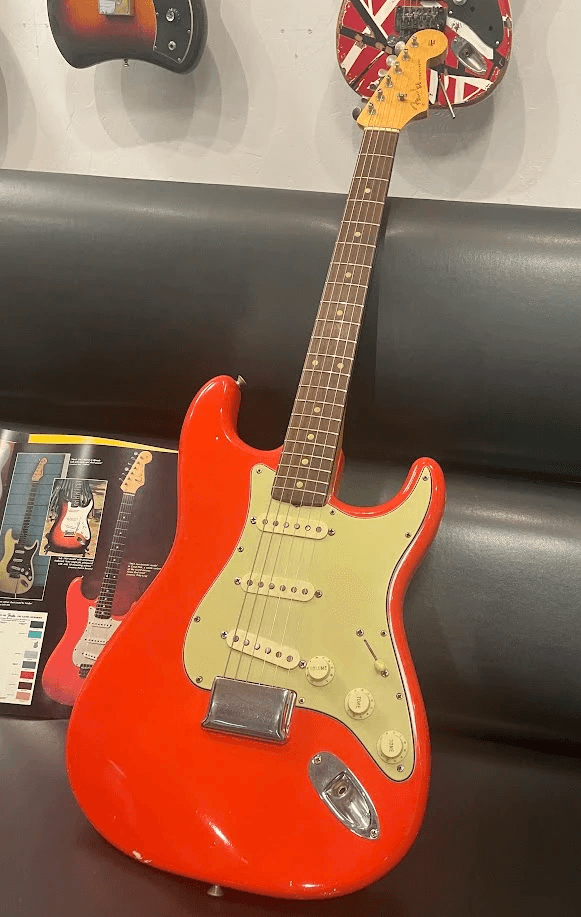
1962 Fender Stratocaster in Fiesta Red: Pre-CBS Custom Color with Slab Rosewood Transition
The 1962 Fender Stratocaster in Fiesta Red is one of the rarest and most desirable pre-CBS custom color Strats, pairing an early 1962 slab rosewood fingerboard with a factory Fiesta Red nitrocellulose finish. Originality, the custom color finish, and condition drive value. Edgewater Guitars buys vintage Fender Stratocasters nationwide with free expert appraisals and same-day cash offers. Call or text (440) 219-3607.
Last Updated: April 2026
What Makes the 1962 Fiesta Red Stratocaster Significant?
The 1962 Fender Stratocaster in Fiesta Red represents one of the most desirable combinations in vintage guitar collecting — a vibrant pre-CBS custom color finish on an instrument from the critical slab-to-veneer rosewood transition year, with hand-wound Formvar pickups, clay dot position markers, and peak pre-CBS manufacturing quality. The convergence of rare custom color, transitional-year features, and exceptional craftsmanship creates an instrument that commands extraordinary premiums in the vintage market.
What makes the 1962 Fiesta Red Stratocaster exceptional:
Fiesta Red Custom Color: One of the most iconic and desirable Fender custom colors — a vibrant orange-red DuPont automotive finish applied as a special-order option at 5% upcharge over standard sunburst, creating genuine rarity
Slab-to-Veneer Rosewood Transition: 1962 is THE critical transition year — early 1962 examples have thick slab rosewood fingerboards (approximately 4.8mm, flat bottom) commanding 20-30% premiums over late 1962 veneer rosewood (approximately 3mm, curved bottom)
Clay Dot Position Markers: Authentic clay dot inlays in rosewood fingerboard — a critical pre-CBS identification feature (pearl dots not introduced until approximately 1964-1965)
Hand-Wound Formvar Pickups: Pre-CBS single-coil pickups with Formvar-coated magnet wire, Alnico V magnets, and black bottom flatwork — the legendary pre-CBS Stratocaster voice
Three-Ply Pickguard: Celluloid nitrate 3-ply pickguard with 11 screws — the “mint green” guard that develops distinctive green tint with age
Peak Pre-CBS Quality: Built three years before CBS acquisition (January 1965) with exceptional materials, hand craftsmanship, and Leo Fender’s quality standards
Custom Color Authentication: Original Fiesta Red requires specific undercoat/primer verification — white primer standard under Fiesta Red, with the vibrant orange-red nitrocellulose showing characteristic aging and potential UV fading
Matching Headstock Rarity: Some Fiesta Red examples feature matching painted headstock face — adds 15-25% additional premium and is extremely rare
Collector Status: Custom color pre-CBS Stratocasters represent the upper tier of vintage Fender collecting — Fiesta Red is among the most recognized and sought-after colors in the palette
1962 Production Context: The 1962 Stratocaster occupies a unique position in Fender history as a double-transition year. The most significant change was the mid-year transition from thick slab rosewood fingerboard (introduced 1959) to thinner veneer rosewood — creating two distinct and differently valued configurations within the same model year. Early 1962 slab-board examples represent the final production of the thick rosewood specification, while late 1962 veneer-board examples establish the thinner construction that would continue through the pre-CBS era. This transition, combined with the rarity of custom color finishes (estimated 10-15% of total Stratocaster production received custom colors), makes a 1962 Fiesta Red slab-board Stratocaster an exceptionally rare and desirable instrument.
In Edgewater’s experience buying pre-CBS Fender guitars across Ohio and the Midwest, 1962 Fiesta Red Stratocasters are among the most extraordinary instruments we encounter — and among the most frequently undervalued by local shops and general buyers. The combination of custom color rarity, slab rosewood premium, clay dot authentication, and pre-CBS craftsmanship creates value that general guitar shops simply cannot recognize. We’ve evaluated Fiesta Red examples where the seller believed the guitar was “just an old red Strat” without understanding that the custom color alone commands 40-80% premiums over sunburst, that the slab rosewood adds another 20-30%, and that matching headstock (if present) adds yet another 15-25%. Many owners inherited these instruments from musicians who special-ordered them during the early 1960s and have no idea their family guitar is one of the most valuable pre-CBS Fender variants in existence.
If you own a 1962 Fender Stratocaster in Fiesta Red — or any pre-CBS custom color — you may possess an extraordinarily valuable vintage instrument. Edgewater Guitars provides free, no-obligation valuations with custom color authentication. Call (440) 219-3607 or visit our website for your free appraisal.
What Is a 1962 Fiesta Red Stratocaster Worth? (2026 Market Values)
Value by Condition and Configuration
Condition | Slab Board + Fiesta Red | Veneer Board + Fiesta Red | Slab + Matching Headstock | Sunburst (Comparison) |
|---|---|---|---|---|
Excellent (8-9/10) | Extraordinary tier | Ultra-premium tier | Museum tier | Premium tier |
Very Good (7/10) | Ultra-premium tier | Premium tier | Extraordinary tier | Upper-mid tier |
Good (6/10) | Premium tier | Upper-mid tier | Ultra-premium tier | Mid-tier |
Player Grade (5/10) | Upper-mid tier | Mid-tier | Premium tier | Lower-mid tier |
Value by Feature Premiums
Feature/Configuration | Premium/Impact | Notes |
|---|---|---|
Fiesta Red Custom Color | 40-80% premium | Over standard sunburst |
Matching Headstock | 15-25% additional | On custom color examples, extremely rare |
Slab Rosewood Fingerboard | 20-30% premium | Over veneer rosewood (early vs late 1962) |
Clay Dot Markers | Standard pre-CBS | Pearl dots indicate later production |
All-Original Condition | 70-150% premium | Over modified examples |
Original Hand-Wound Pickups | 35-55% premium | Over replaced pickups |
Unfaded Fiesta Red | 10-20% additional | Faded examples still valuable but unfaded commands premium |
Original Case | 10-20% premium | Brown Tolex with orange plush interior |
Refinishing | 50-70% reduction | Destroys custom color premium entirely |
Replaced Pickups | 25-40% reduction | Original Formvar essential |
Veneer Board Replacing Slab | 25-40% reduction | Destroys slab premium |
Neck Replacement | 40-60% reduction | Original neck essential |
Current Market Note (April 2026): Pre-CBS custom color Stratocasters have appreciated 80-120% over the past decade, with Fiesta Red examples showing exceptional growth. The combination of recognizable color, pre-CBS provenance, and genuine rarity creates demand that consistently outpaces supply. Slab-board Fiesta Red examples with matching headstock in excellent condition represent some of the most valuable production Stratocasters in existence — rivaling 1954 first-year and 1959 slab-board examples in collector significance.
What Affects the Value of a 1962 Fiesta Red Stratocaster?
Custom Color Authenticity: Original Fiesta Red verification is the single most critical value factor. Authentic Fiesta Red requires specific undercoat verification — white primer under Fiesta Red is standard. Check for original color through chips, wear areas, control cavity edges, and neck pocket. Refinished sunburst guitars repainted in Fiesta Red (extremely common fraud) are worth only refinished sunburst value — a fraction of authentic custom color pricing.
Slab vs Veneer Rosewood: 1962 is THE transition year. Early 1962 slab rosewood (approximately 4.8mm thick, flat bottom) commands 20-30% premiums over late 1962 veneer rosewood (approximately 3mm, curved bottom). Verify by measuring thickness at neck heel and checking bottom profile. This distinction can represent thousands of dollars in value difference.
Matching Headstock: Some custom color Stratocasters received matching painted headstock face — Fiesta Red on headstock face matching body color. Adds 15-25% premium and is extremely rare. Verify authenticity through aging consistency between headstock and body finish.
Finish Fading: Fiesta Red is moderately susceptible to UV fading — some examples fade to salmon or pinkish tones. Unfaded vibrant Fiesta Red commands 10-20% premiums over faded examples. However, faded original Fiesta Red still dramatically outvalues refinishing — even faded custom colors are extremely valuable.
Pickup Originality: Original hand-wound single-coil pickups with Formvar wire, Alnico V magnets, and black bottom flatwork essential. Replaced pickups reduce value 25-40%.
Clay Dot Markers: Authentic clay dot position markers confirm pre-CBS rosewood-era production. Pearl dots indicate later (1964-1965+) production — presence of pearl dots on claimed 1962 is a red flag.
Structural Integrity: Original neck with correct date stamp, original body without routing modifications, no headstock repairs. Headstock breaks reduce value 35-55%.
How 1962 Fiesta Red Compares to Other Custom Colors
Custom Color | Relative Rarity | Relative Value | Notes |
|---|---|---|---|
Shell Pink | Extremely rare | Higher | Rarest standard custom color |
Foam Green | Very rare | Similar to slightly higher | Very few surviving examples |
Surf Green | Very rare | Similar | Popular but scarce |
Fiesta Red | Rare | Baseline (extraordinary) | Iconic, most recognized custom color |
Lake Placid Blue | Rare | Similar | Strong collector following |
Sonic Blue | Moderately rare | Slightly lower | More examples survive |
Olympic White | Most common custom | Lower | Most produced custom color |
Candy Apple Red | Moderately rare | Slightly lower | Metallic finish, different character |
Daphne Blue | Rare | Similar | Beautiful but less iconic |
Dakota Red | Very rare | Similar to higher | Often confused with Fiesta Red |
Burgundy Mist | Rare | Slightly lower | Metallic, less vibrant |
Shoreline Gold | Rare | Slightly lower | Metallic gold |
How 1962 Compares to Other Years
Year | Key Difference | Relative Value | Why |
|---|---|---|---|
1954-1956 | Maple neck, earliest production | Higher | First-year and early production premium |
1957-1958 | Maple neck, V-profile, gold anodized option | Similar to higher | V-neck desirability |
1959-1961 | Slab rosewood established, clay dots | Similar | Comparable slab-board era |
1962 (early slab) | Slab rosewood, clay dots, 3-ply guard | Baseline | Final slab-board production |
1962 (late veneer) | Veneer rosewood, clay dots | 15-25% lower | Post-slab transition |
1963-1964 | Veneer rosewood, L-series serials | 15-30% lower | Later pre-CBS |
1965+ | CBS transition begins | 40-60% lower | CBS era |
Edgewater consistently pays 30-40% more than typical guitar shops for pre-CBS custom color Stratocasters. We specialize in Fiesta Red authentication, slab rosewood verification, matching headstock assessment, and custom color undercoat analysis. Get your free valuation by calling (440) 219-3607 or submitting photos through our website.
How to Identify an Authentic 1962 Fiesta Red Stratocaster
Serial Numbers
Range for 1962: Approximately 72000-93000 (stamped on four-bolt neck plate)
Location: Four-bolt neck plate on back of body
Important caveat: Fender serial numbers overlap between years. 1962 ranges can overlap with late 1961 and early 1963 production. Cross-reference with neck date stamp, pot codes, and physical features.
Neck Date Stamps
Location: Penciled or stamped on butt end of neck heel (visible when neck removed from body)
Format: Month-Year (e.g., “3-62” = March 1962, “10-62” = October 1962)
Critical for Slab vs Veneer Dating: Early 1962 neck dates (approximately January-June) indicate slab rosewood. Late 1962 dates (approximately July-December) indicate veneer rosewood. This is THE most important dating detail for 1962 Stratocasters.
Potentiometer Codes
Manufacturer: Stackpole (code 304)
How to decode:
First three digits: 304 (Stackpole)
Next two digits: Year (62 = 1962)
Last two digits: Week (01-52)
Expected codes: 304-6201 through 304-6252
Some early 1962 examples may have late 1961 pot codes (304-6140+) — pots manufactured weeks before guitar assembly. This is normal and doesn’t indicate wrong year.
Where to find: Inside control cavity (requires removing pickguard — 11 screws on 1962)
Fiesta Red Custom Color Authentication (CRITICAL)
What Is Fiesta Red?: DuPont automotive lacquer color (Fender code — check against known Fender custom color charts), a vibrant orange-red with translucent quality applied over nitrocellulose lacquer system.
Undercoat/Primer Verification:
White primer standard under Fiesta Red
Check visible primer through chips, wear areas, edge wear
Inspect inside control cavity, neck pocket, and tremolo cavity for color overspray patterns
Factory application shows specific masking patterns and spray characteristics
Aging Characteristics:
Original Fiesta Red may show UV fading over 64 years — fading to salmon, pinkish, or lighter orange-red tones (correct aging, not defect)
Unfaded examples stored away from light retain vibrant original color
Nitrocellulose checking patterns develop naturally (fine lines in finish)
Color should be consistent with 64-year aging of nitrocellulose lacquer
Authentication Methods:
Check undercoat through wear areas or chips — correct primer color essential
Inspect control cavity edges for original color application
Examine neck pocket for color overspray pattern (factory vs aftermarket)
Verify consistency of aging between body, headstock (if matching), and hardware areas
UV light examination can reveal modern refinish materials versus vintage nitrocellulose
Compare color and aging to known authentic Fiesta Red examples
Refinish Red Flags:
Wrong primer/undercoat color
Paint inside cavities that doesn’t match factory application patterns
Overspray on pickup routes or control cavity that appears aftermarket
Finish thickness inconsistent with vintage nitrocellulose (modern finishes thicker)
No checking on 64-year-old claimed original
Color tone wrong for aged Fiesta Red
Filled or extra screw holes under paint (indicating refinish over modified body)
CRITICAL WARNING: Refinished sunburst guitars repainted in Fiesta Red is one of the most common frauds in vintage Fender collecting. A genuine 1962 Fiesta Red Stratocaster can be worth 40-80% more than sunburst — creating enormous financial incentive for fraud. Professional authentication essential for any transaction involving claimed custom colors.
Slab vs Veneer Rosewood Identification (1962 Transitional)
Slab Rosewood (Early 1962):
Thick fingerboard approximately 4.8mm at thinnest point
Flat bottom (does NOT curve to conform to neck contour)
Appears thick and substantial when viewed from side
Clay dot position markers
Commands 20-30% premiums over veneer
Veneer Rosewood (Late 1962):
Thinner fingerboard approximately 2.5-3mm
Curved bottom (conforms to neck contour)
Appears thin when viewed from side
Clay dot position markers (same as slab)
How to Verify:
Feel thickness at neck heel — slab feels noticeably thicker
View from side — slab appears substantial, veneer thin
Cross-reference with neck date stamp — early 1962 = slab, late 1962 = veneer
Cross-reference with pot codes for production timing
Key Visual Identifiers
Body Wood: Alder (standard for sunburst and most custom colors)
Body Finish: Fiesta Red nitrocellulose lacquer over primer
Pickguard: Three-ply celluloid nitrate (ages to “mint green” tint), 11 screws
Neck: Maple with rosewood fingerboard (slab or veneer depending on production timing)
Neck Profile: Transitional — soft V to C-shape (varies by individual guitar)
Fret Markers: Clay dot position markers (NOT pearl — clay is matte, slightly rough texture)
Fingerboard Radius: 7.25”
Scale Length: 25.5”
Nut Width: 1-5/8” (1.625”)
Frets: 21 frets, small vintage nickel-silver wire
String Tree: Butterfly-shaped chrome
Headstock Logo: Spaghetti logo, gold decal
Headstock Size: Small pre-CBS headstock
Headstock Face: Natural (standard) OR matching Fiesta Red (rare premium option)
Tuners: Kluson Deluxe single-line stamp with plastic buttons
Pickups: Three single-coil, hand-wound Formvar, Alnico V, black bottom flatwork
Pickup Covers: White/off-white plastic (aged from original white)
Controls: One volume, two tone, three-way selector switch
Knobs: White plastic, numbered volume knob
Bridge: Six-saddle synchronized tremolo
Bridge Saddles: Stamped steel, “FENDER PAT. PEND.” marking
Neck Plate: Four-bolt chrome with serial number
Weight Range: Approximately 7-8.5 lbs
Case: Brown Tolex hardshell with orange plush interior (period-correct for 1962)
Red Flags: How to Spot Fake Fiesta Red
Most Common Fraud — Refinished Sunburst Repainted as Custom Color:
Wrong undercoat color (sunburst doesn’t have same primer system as custom colors)
Paint application inconsistent with factory spray patterns
Color in cavities or neck pocket doesn’t match factory application
Evidence of original sunburst under custom color (visible at wear points)
Finish thickness inconsistent (refinish over original adds thickness)
Wrong aging characteristics
Expert-level refinishes may fool casual inspection — professional authentication essential
Other Red Flags:
Pearl dot markers on claimed 1962 (should be clay dots)
Single-ply pickguard with 8 screws (should be 3-ply with 11 screws by 1962)
Large headstock (CBS era — 1962 has small pre-CBS headstock)
Enamel-wire pickups (should be Formvar for pre-CBS)
Gray bottom flatwork on pickups (should be black)
Modern bridge saddles without “PAT. PEND.” marking
Body routing inconsistent with 1962 specification
In Edgewater’s experience evaluating pre-CBS custom color Stratocasters, the most critical authentication issue by far is distinguishing genuine factory custom colors from refinished guitars repainted in custom colors. We’ve seen expertly refinished Fiesta Red guitars that fooled multiple owners and shops — only undercoat analysis, cavity inspection, and experienced hands-on evaluation revealed the refinish. The financial stakes are enormous — authentic 1962 Fiesta Red commands 40-80% premiums over sunburst, meaning the difference between genuine and refinished can represent tens of thousands of dollars. Professional authentication is essential for any custom color transaction.
Not sure if your Stratocaster has authentic Fiesta Red or genuine slab rosewood? Edgewater offers free custom color authentication — we inspect undercoat through wear areas, analyze cavity color patterns, verify slab vs veneer rosewood, confirm clay dot markers, and provide definitive determination. Call (440) 219-3607 or contact us through our website.
1962 Fender Stratocaster Specifications
Specification | Detail |
|---|---|
Body Wood | Alder |
Body Finish | Fiesta Red nitrocellulose lacquer (custom color) over primer |
Neck Wood | Maple with walnut skunk stripe |
Fingerboard | Rosewood — slab (early 1962, ~4.8mm, flat bottom) OR veneer (late 1962, ~3mm, curved) |
Fret Markers | Clay dot position markers |
Fingerboard Radius | 7.25” |
Scale Length | 25.5” |
Nut Width | 1-5/8” (1.625”) |
Neck Profile | Transitional soft V to C-shape |
Frets | 21 frets, small vintage nickel-silver wire |
Pickups | Three single-coil, hand-wound Formvar wire |
Pickup Magnets | Alnico V, staggered pole pieces |
Pickup Output | Approximately 5.7-6.2k ohms DC resistance |
Pickup Flatwork | Black bottom fiber |
Controls | One volume, two tone, three-way selector |
Potentiometers | 250k audio taper, Stackpole (304) |
Wiring | Cloth-covered throughout |
Pickguard | Three-ply celluloid nitrate (ages mint green), 11 screws |
String Tree | Butterfly-shaped chrome |
Bridge | Six-saddle synchronized tremolo, steel block |
Bridge Saddles | Stamped steel, “FENDER PAT. PEND.” |
Tuners | Kluson Deluxe single-line stamp, plastic buttons |
Headstock Logo | Spaghetti logo, gold decal |
Headstock Size | Small pre-CBS |
Headstock Face | Natural (standard) OR matching Fiesta Red (rare) |
Neck Plate | Four-bolt chrome with serial number |
Weight Range | Approximately 7-8.5 lbs |
Case | Brown Tolex hardshell, orange plush interior |
What Does a 1962 Fiesta Red Stratocaster Sound Like?
Pickup Specifications and Tonal Profile
Pickup type: Single-coil with staggered Alnico V pole pieces
DC Resistance: Approximately 5.7-6.2k ohms per pickup
Wire: Formvar-coated magnet wire, hand-wound
Magnets: Alnico V, staggered height
Flatwork: Black fiber bottom plate
Tonal character: The 1962 Stratocaster single-coils deliver classic pre-CBS tone — bright, articulate, dynamically responsive with exceptional clarity. The rosewood fingerboard (whether slab or veneer) adds warmth and complexity compared to earlier all-maple-neck Stratocasters. Neck pickup provides warm, full tone with rounded highs and woody resonance. Middle pickup offers balanced, glassy character. Bridge pickup delivers bright, cutting articulation with excellent note definition. In-between positions produce the iconic quacky, out-of-phase textures unique to three-pickup Stratocaster wiring.
How Construction Details Affect Tone
Slab Rosewood Fingerboard (Early 1962): Thick slab rosewood (approximately 4.8mm) adds noticeably warmer, fuller tonal contribution compared to thinner veneer rosewood — increased fingerboard mass enhances midrange warmth, sustain, and harmonic complexity. Many players and collectors consider slab rosewood the superior tonal specification.
Veneer Rosewood Fingerboard (Late 1962): Thinner veneer rosewood (approximately 3mm) contributes slightly brighter, more focused tone than slab board — less fingerboard mass means maple neck contributes more to overall voice. Still warmer than all-maple construction.
Fiesta Red Finish: Nitrocellulose lacquer over primer creates slightly different resonance characteristics than standard sunburst (which goes directly over wood stain). The primer layer adds minimal mass. After 64 years of aging, the thin nitro contributes to improved harmonic complexity.
Lightweight Alder Body: Premium early-1960s alder provides balanced frequency response. Lightweight examples (7-7.5 lbs) resonate more freely, enhancing sustain and harmonic richness.
Hand-Wound Formvar Pickups: Hand-winding creates subtle scatter in coil layering producing complex harmonics and dynamic response unmatched by machine-wound pickups. Formvar wire coating contributes specific warm character.
Notable Associations
Surf and Early Rock Era: The 1962 Stratocaster was the guitar of the surf music era — The Ventures, Dick Dale, and countless surf bands relied on Stratocaster clarity and tremolo expressiveness
British Invasion Influence: 1962 Stratocasters were among the American instruments discovered by British musicians who would reshape rock music — creating transatlantic demand
Studio Standard: By 1962, the Stratocaster was an established studio workhorse — the tonal versatility across five pickup positions made it indispensable for session work
Common Issues and Modifications That Affect Value
Refinished custom color (most critical): Genuine Fiesta Red repainted over refinished body, OR sunburst guitar refinished in Fiesta Red. Either scenario destroys custom color premium — reduces to refinished sunburst value (50-70% below authentic custom color). Professional authentication essential.
Replaced pickups: Original hand-wound Formvar pickups with Alnico V magnets and black bottom flatwork frequently replaced. Reduces value 25-40%.
Slab rosewood replaced or refingerboarded: Original slab rosewood fingerboard removed and replaced with veneer. Destroys slab premium (25-40% reduction). Verify thickness and bottom profile.
Neck replacement: Original neck with correct date stamp essential. Replaced necks reduce value 40-60%. Wrong fingerboard type for claimed year (veneer on claimed early 1962 slab-board guitar) indicates replacement.
Headstock repairs: Reduces value 35-55% even with expert repairs.
Tuner replacement: Original Kluson Deluxe tuners should be retained. Modern replacements reduce value 15-25%.
Pickguard replacement: Original 3-ply mint green celluloid with 11 screws should be retained. Replaced pickguards reduce value 10-20%.
Finish fading: UV fading of Fiesta Red reduces vibrancy but is acceptable aging — unfaded examples command 10-20% premiums but faded originals still dramatically outvalue refinishing. NEVER refinish faded Fiesta Red.
Electronics modifications: Wiring changes, pot replacement, 5-way switch conversion (original is 3-way). Reduce value 15-25%.
Bridge and tremolo modifications: Original synchronized tremolo with “PAT. PEND.” saddles should be retained. Hardtail conversion or modern bridge reduces value 15-30%.
Body routing modifications: Humbucker routes, enlarged pickup cavities. Reduce value 20-40%.
Refrets: Professional refrets with period-correct small vintage wire acceptable (10-15% impact). Modern jumbo frets reduce value 15-25%.
Matching headstock damage: If matching Fiesta Red headstock has been touched up, repainted, or damaged — affects premium significantly (10-20% reduction from intact matching headstock value).
Case condition: Original brown Tolex case with orange plush interior adds 10-20% to value. Missing or replaced case reduces accordingly.
In Edgewater’s experience evaluating 1962 custom color Stratocasters, the overwhelmingly most common and most costly issue is custom color fraud — refinished guitars passed as original custom colors. We’ve seen Fiesta Red refinishes ranging from amateur (easily detected) to expert-level (requiring detailed undercoat analysis and cavity inspection). The financial stakes are enormous — authentic vs refinished Fiesta Red can represent a difference of 40-80% of total instrument value. Always get professional authentication before buying or selling a claimed custom color Stratocaster.
Selling Your 1962 Fiesta Red Stratocaster: Your Options Compared
Selling Option | Typical Offer | Timeline | Fees/Costs | Risk Level | Best For |
|---|---|---|---|---|---|
Edgewater Guitars | 30-40% above shop offers | Immediate cash | None | Low — expert custom color authentication | Owners wanting fair value without hassle |
Local Guitar Shop | Wholesale pricing (lowest) | Same day | None direct, lowest price | Low | NOT recommended for custom colors — shops can’t authenticate |
Online Marketplace (Reverb, eBay) | Variable — potentially highest | Weeks to months | 5-15% fees + shipping + insurance | EXTREME — custom color authentication disputes, shipping damage on irreplaceable instrument | Only experienced vintage sellers |
Vintage Guitar Dealer | Premium for authenticated custom colors | Days to weeks | None if direct | Medium | Dealers with pre-CBS custom color expertise |
Auction House (Heritage, etc.) | Exceptional for museum-quality examples | 3-6 months | 15-25% buyer’s premium | Medium | Museum-quality custom colors with provenance |
Private Sale | Highly variable | Unpredictable | None | EXTREME — authentication burden, fraud liability | Sellers with established collector relationships |
Why Choose Edgewater Guitars
Custom Color Authentication Expertise: We verify authentic Fiesta Red through undercoat/primer analysis, cavity inspection, aging pattern assessment, and comparison to known authentic examples. This is THE most critical skill for custom color transactions — and the expertise most general buyers completely lack.
Slab Rosewood Verification: We measure fingerboard thickness and verify slab vs veneer construction — a 20-30% value distinction critical for 1962 transitional examples.
Matching Headstock Assessment: We evaluate matching headstock authenticity through aging consistency, paint application analysis, and color comparison.
Pre-CBS Pickup Authentication: We verify original hand-wound Formvar pickups through resistance measurement, wire type inspection, magnet verification, and flatwork examination.
Premium Valuations: We consistently offer 30-40% more than local guitar shops because we understand custom color premiums, slab rosewood values, and pre-CBS feature significance that general buyers miss entirely.
Immediate payment: No consignment, no auction waiting. Cash or bank transfer upon acceptance.
Geographic coverage: Ohio, Michigan, Pennsylvania, Indiana, West Virginia. We travel for exceptional pre-CBS custom color Stratocasters — these instruments deserve in-person evaluation.
Ready to find out what your Fiesta Red Stratocaster is worth? Get your free, no-obligation valuation with custom color authentication: Call (440) 219-3607 or visit edgewaterguitars.com.
Frequently Asked Questions About the 1962 Fiesta Red Stratocaster
Q: What is a 1962 Fiesta Red Stratocaster worth in 2026?
A: Value depends on slab vs veneer rosewood, matching headstock, originality, and condition. Early 1962 slab-board Fiesta Red with matching headstock in excellent original condition commands museum-tier pricing. Slab-board without matching headstock commands extraordinary tier. Veneer-board Fiesta Red commands ultra-premium tier. All dramatically higher than equivalent sunburst examples. Custom color premium alone adds 40-80% over sunburst.
Q: How can I tell if my Stratocaster’s Fiesta Red finish is original?
A: Check undercoat through wear areas or chips — white primer standard under Fiesta Red. Inspect control cavity and neck pocket for factory-consistent color application patterns. Verify aging consistency (64-year nitrocellulose should show checking). UV light examination can reveal modern refinish materials. Compare color and aging to known authentic examples. Professional authentication essential — refinished guitars passed as custom colors is the most common fraud in pre-CBS Fender collecting.
Q: What is slab rosewood and does my 1962 have it?
A: 1962 is the transition year. Early 1962 (approximately January-June) has slab rosewood — thick (approximately 4.8mm), flat bottom, feels substantial at neck heel. Late 1962 (approximately July-December) has veneer rosewood — thinner (approximately 3mm), curved bottom. Cross-reference with neck date stamp for precise dating. Slab commands 20-30% premiums over veneer.
Q: What are clay dots and why do they matter?
A: Clay dot position markers are matte, slightly rough-textured inlays used on pre-CBS rosewood fingerboard Stratocasters (1959-approximately 1964). Pearl dots (brighter, smoother, pearlescent) replaced clay approximately 1964-1965. Clay dots confirm pre-CBS rosewood-era production. Pearl dots on a claimed 1962 would be a red flag.
Q: Is faded Fiesta Red still valuable?
A: Yes — faded original Fiesta Red still dramatically outvalues refinishing. Fiesta Red fading (to salmon, pinkish, or lighter orange-red) is natural UV aging over 64 years and proves originality. Unfaded examples command 10-20% premiums over faded, but NEVER refinish faded Fiesta Red. Even heavily faded original custom color is worth far more than any refinish.
Q: What is a matching headstock?
A: Some custom color Stratocasters received matching paint on the headstock face — Fiesta Red on both body and headstock face. This was a premium feature, significantly rarer than standard natural headstock. Adds 15-25% premium. Authentication through aging consistency between headstock and body finish essential.
Q: How rare is a 1962 Fiesta Red Stratocaster?
A: Very rare. Custom colors were special-order options at 5% upcharge — estimated 10-15% of total Stratocaster production received custom colors. Fiesta Red was among the more popular custom colors but total numbers for any single year/color combination are quite limited. Early 1962 slab-board Fiesta Red with matching headstock represents an extremely rare configuration.
Q: Does Edgewater buy 1962 Fiesta Red Stratocasters?
A: Yes — Edgewater actively purchases pre-CBS custom color Stratocasters from all years. We provide free custom color authentication including undercoat analysis, cavity inspection, slab rosewood verification, pickup confirmation, and aging assessment. We offer premium pricing reflecting custom color significance. We serve Ohio, Michigan, Pennsylvania, Indiana, West Virginia and travel for exceptional custom color instruments.
Q: Could my 1962 Stratocaster be a different custom color that looks like Fiesta Red?
A: Possibly — Dakota Red is sometimes confused with Fiesta Red (slightly different hue). Candy Apple Red (metallic) looks different but can occasionally cause confusion. Each Fender custom color has specific characteristics and aging patterns. Professional evaluation distinguishes between colors and verifies authenticity.
Q: My family has a red Stratocaster from the 1960s but doesn’t know what color it is — what should I do?
A: Contact Edgewater for free evaluation. We identify specific Fender custom colors through color analysis, undercoat inspection, and aging assessment. Many families own custom color Stratocasters without realizing the significance — what appears to be “just a red guitar” could be a Fiesta Red, Dakota Red, or Candy Apple Red worth dramatically different amounts depending on color and authenticity.
Q: What is the difference between the 3-ply and single-ply pickguard?
A: 1962 Stratocasters have 3-ply celluloid nitrate pickguards with 11 mounting screws (changed from single-ply 8-screw in 1959). The 3-ply construction appears as layered material visible at edges — white/black/white layers. The celluloid ages to a distinctive “mint green” tint. Single-ply pickguard on a claimed 1962 indicates earlier production year or replacement.
Related Resources
Fender Serial Number Lookup Tool — Decode your Fender’s serial number
Pre-CBS Fender Stratocaster Dating Guide — Complete dating reference
Original Fender Pre-CBS Finishes — Finish authentication including custom colors
Pre-CBS Fender Stratocaster Pickups — Pickup authentication
Slab vs Veneer Rosewood Guide — Understanding fingerboard differences
1962 Fender Stratocaster Guide — Standard sunburst version
Sell Your Vintage Guitar to Edgewater — Get your free valuation
Recently Purchased: 1962 Fiesta Red Stratocaster Case Study
The Guitar: 1962 Fender Stratocaster in Fiesta Red with slab rosewood fingerboard — an exceptional all-original custom color example combining early 1962 slab-board specification with authentic factory Fiesta Red finish. The guitar featured verified original Fiesta Red nitrocellulose finish showing 64-year aging with moderate UV fading to salmon/orange-red tones and extensive fine checking throughout (confirms original — never refinished), white primer visible through small chip on lower bout edge (correct undercoat for Fiesta Red), natural headstock (no matching — standard configuration), slab rosewood fingerboard measuring 4.6mm thick at neck heel with flat bottom (confirmed slab construction), clay dot position markers (matte texture confirming clay, not pearl), original hand-wound single-coil pickups with Formvar wire, Alnico V staggered magnets, and black bottom flatwork (resistance readings 5.8k, 6.0k, 6.1k ohms), original 3-ply mint green pickguard with 11 screws showing appropriate celluloid aging, original Kluson Deluxe tuners with single-line stamps, original “FENDER PAT. PEND.” bridge saddles, original synchronized tremolo, original cloth-covered wiring. Neck date stamp “4-62” (April 1962 — firmly in slab-board production). Pot codes 304-6208, 304-6210, 304-6212 (Stackpole, weeks 8-12 of 1962 — consistent with early 1962 slab-board production). Serial number 78,234 on original four-bolt neck plate. No modifications, no refinishing, no replaced parts. Original brown Tolex case with orange plush interior included.
The Seller: Family in Cleveland, Ohio. The guitar had belonged to a father who special-ordered it from a Cleveland music store in 1962, requesting the Fiesta Red finish. He played in local bands through the 1960s-1970s before carefully storing the guitar. The family inherited the instrument during estate settlement.
The Transaction: Edgewater traveled to Cleveland for in-person evaluation. We verified authentic Fiesta Red through multiple methods: white primer visible through chip on lower bout (correct undercoat), control cavity inspection showing factory-consistent Fiesta Red overspray patterns, neck pocket examination revealing factory masking and color application consistent with original Fender custom color process, UV light examination confirming vintage nitrocellulose (not modern refinish materials), and aging pattern analysis showing 64-year fading and checking consistent with original finish. We confirmed slab rosewood through thickness measurement at neck heel (4.6mm — well above veneer threshold) and bottom profile inspection (flat — confirming slab). We verified clay dot markers (matte texture, not pearlescent). We authenticated all three pickups through resistance measurement, wire type verification (Formvar confirmed), magnet check (Alnico V staggered), and flatwork inspection (black bottom — correct for pre-CBS). Neck date “4-62” and pot codes (weeks 8-12 of 1962) consistently confirmed early 1962 slab-board production timing.
The Outcome: Our offer dramatically exceeded the family’s expectations. “Two guitar shops told us it was ‘a nice old red Strat — probably refinished’ and offered numbers that seemed low,” the daughter explained. “Edgewater immediately recognized it as Fiesta Red, not a refinish. They showed us the white primer through the chip, the factory spray patterns in the control cavity, and the correct aging patterns that prove it’s original. They measured the fingerboard thickness and showed us it’s the thick slab rosewood that commands premiums. They explained that the fading from vibrant red to salmon over 64 years actually PROVES it’s original — a refinish wouldn’t fade the same way. They used the neck date and pot codes to confirm this guitar was built in early 1962 during the slab-board era, making it among the final slab-board Stratocasters with a rare custom color. Their offer was more than five times the guitar shop quotes because they understood that an authentic 1962 Fiesta Red slab-board Stratocaster is one of the most desirable pre-CBS Fenders in existence.”
Edgewater Guitars specializes in purchasing pre-CBS custom color Fender instruments throughout Ohio, Michigan, Pennsylvania, Indiana, and West Virginia. We provide expert custom color authentication including Fiesta Red undercoat verification, slab rosewood confirmation, matching headstock assessment, and complete pre-CBS evaluation. We travel to you for exceptional custom color Stratocasters. Contact us today for your free, no-obligation valuation: [link] | (440) 219-3607.
Sell your 1962 Fender Stratocaster
Edgewater Guitars buys vintage Fender Stratocasters and other vintage Fenders nationwide. We give free, honest appraisals and fair same-day cash offers, with local pickup or insured nationwide shipping. Call or text (440) 219-3607 or request a free estimate.
How much is a 1962 Fender Stratocaster worth?
Value depends on originality, condition, finish, and whether the pickups and hardware are original. The most accurate way to find out is a free appraisal. Send a few photos and the serial number and we will give you an honest market assessment.
Where can I sell a 1962 Fender Stratocaster?
Edgewater Guitars buys them directly, nationwide, with same-day cash offers and no obligation. You can also date yours with our Fender serial number lookup.
See also: Vintage Fender Stratocaster Value Guide (1954-1966) for year-by-year prices and identification.