DATE :
1961 Gibson SG Special: The Birth of the Double-Cut Special — Les Paul Transition Year with Dual P-90 Power
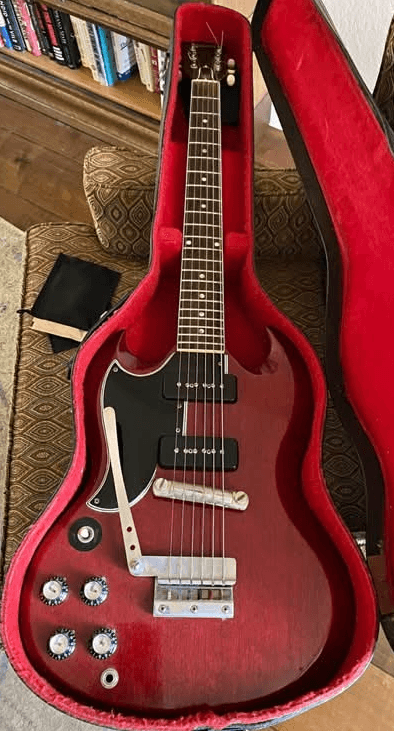
1961 Gibson SG Special: The Birth of the Double-Cut Special — Les Paul Transition Year with Dual P-90 Power
The 1961 Gibson SG Special is a double-cut solidbody from the Les Paul-to-SG transition year, with dual P-90 pickups and a fast, slim mahogany body. Value is driven by originality, finish, and whether the P-90s, tuners, and electronics are original and intact. Edgewater Guitars buys vintage Gibson electric guitars nationwide with free expert appraisals and same-day cash offers. Call or text (440) 219-3607.
Last Updated: June 2026
What Makes the 1961 Gibson SG Special Significant?
The 1961 Gibson SG Special is among the most historically loaded instruments in the entire Gibson catalog. This is the first year the Special model appeared in the new double-cutaway SG body shape — the pointed horn design that would define Gibson’s mid-price solidbody line through the decade and become one of the most recognizable guitar silhouettes in rock history. Before 1961, the Les Paul Special had been a single-cutaway slab mahogany instrument with two P-90 pickups. The 1961 model retained those two P-90 pickups and the slab mahogany construction but placed them in a body shape so radically different from what had come before that it barely resembled its predecessor.
The transition complexity of 1961 is what makes this year specifically significant to collectors and authenticators. Most 1961 SG Special instruments — like the Standard and Junior of the same year — still carried the Les Paul name on the truss rod cover, and some early examples retained other Les Paul design elements in transitional form. The instrument was simultaneously a Les Paul and not a Les Paul — Gibson was in the process of redesigning their entire solidbody line and the 1961 Special sits at the precise center of that redesign, one foot in the Les Paul era and one foot in the SG era that would define the decade.
The dual P-90 pickup configuration of the 1961 SG Special is its defining tonal and collectible characteristic. Two Soap Bar single-coils — one at the neck, one at the bridge — give the Special a tonal versatility that the single-pickup Junior cannot match, while the P-90’s raw, aggressive single-coil character distinguishes it clearly from the PAF humbucker-equipped Standard. The neck P-90 produces a warm, round, jazz-capable tone; the bridge P-90 delivers the cutting aggression that defines single-coil rock and blues. Together they cover more tonal ground than any other pre-CBS Gibson solidbody configuration at the same price point. In our experience buying early SG instruments across Ohio and the Midwest, 1961 SG Specials are among the most frequently undervalued early Gibsons we encounter — sellers who know they have an early SG often assume the Standard is the valuable model, unaware that the transition-year Special with its Les Paul designation carries its own significant collector premium.
What makes the 1961 SG Special distinctive:
First year of the SG double-cutaway body shape for the Special model — pointed horns, slim slab mahogany construction
Les Paul name on the truss rod cover for most 1961 production — the defining transition-year marker
Two P-90 Soap Bar pickups — neck and bridge positions — the dual single-coil configuration unique to the Special model
Slab mahogany body — no maple cap, no carved top, pure mahogany throughout
Tune-o-matic bridge and stop tailpiece — or vibrato tailpiece on some examples
Bound rosewood fingerboard with dot inlays — one step above the Junior’s unbound board
Cherry or TV Yellow finish — cherry dominant, TV Yellow rare and significantly more valuable
Serial numbers in the 1xxxx range on the back of the headstock
Slim, fast neck profile establishing the SG character
Two-pickup configuration with three-way toggle selector and independent volume and tone controls
If you own a 1961 SG Special, you may be sitting on a significant asset. Edgewater Guitars provides free, no-obligation valuations — call (440) 219-3607 or visit edgewaterguitars.com.
What Is a 1961 Gibson SG Special Worth? (2026 Market Values)
Value by Condition and Finish
The 1961 SG Special market in 2026 reflects both the Les Paul transition year premium and the growing appreciation for early SG production across all model lines. The Les Paul truss rod cover designation — present on most but not all 1961 examples — adds a specific collector dimension that elevates the 1961 above later SG Special years. TV Yellow examples represent the top of the market by a substantial margin. All-original cherry examples with Les Paul designation intact are the most commonly encountered premium-tier instruments.
Condition | Originality | Relative Value |
|---|---|---|
Excellent (8–9/10) | All original, TV Yellow, Les Paul cover, original case | Premium-plus tier |
Excellent (8–9/10) | All original, cherry, Les Paul cover, original case | Premium tier |
Very Good (7/10) | All original, Les Paul cover, no case | Strong tier |
Good (6/10) | Original pickups, some hardware changes | Mid-to-strong tier |
Good (6/10) | All original, no Les Paul cover | Mid-to-strong tier |
Player Grade | Some replacements, heavy wear | Mid tier |
Modified | Replaced pickups, refin, added routes | Entry-to-mid tier |
What Affects the Value of a 1961 SG Special?
Les Paul truss rod cover: The presence of the Les Paul designation on the truss rod cover is the single most important year-specific value marker on a 1961 SG Special. It adds a 20–30% premium over an equivalent instrument without the Les Paul designation, confirming early 1961 production and the transitional identity that collectors specifically seek.
Dual P-90 originality: Both P-90 pickups must be examined independently. Original 1961 P-90 Soap Bar pickups in both positions — neck and bridge — command a 35–50% premium over examples with one or both pickups replaced. The neck P-90 is more frequently replaced than the bridge on Special models — players who wanted a warmer neck tone sometimes substituted a humbucker, requiring routing enlargement.
Finish: TV Yellow examples carry a 50–70% premium over equivalent cherry examples. Original cherry nitrocellulose with appropriate fading toward warm transparent red is correct and desirable. Refinished examples lose 35–50% of value.
Vibrato tailpiece vs. stop tailpiece: Some 1961 SG Specials were factory-equipped with the side-pull Maestro vibrato rather than the stop tailpiece. Vibrato-equipped examples are rarer and carry a modest premium (10–15%) for the additional factory-original hardware — provided the vibrato is original and functional.
Neck integrity: Headstock breaks are the most common structural issue on all SG models. A clean unrepaired neck commands full value. Professionally repaired breaks reduce value by 25–40%.
Original case: The original brown or black hardshell case adds approximately 10–15% to value.
How 1961 Compares to Other Years
Year | Key Difference | Relative Value | Why |
|---|---|---|---|
1960 | Single-cutaway Les Paul Special body; same P-90 configuration | Higher for single-cut | Last single-cutaway year; pre-SG body; distinct collector category |
1961 (this post) | First SG body; Les Paul designation; transition year | Baseline — premium | First-year SG body plus Les Paul name: maximum transition value |
1962 | SG body fully established; Les Paul name removed | Similar to slightly lower | Loss of Les Paul designation reduces transition premium |
1963 | Patent number pickups standard; full SG identity | Lower | No transition premium; further from the Les Paul era |
1964 | SG Special at production maturity | Lower | Common year; no distinctive transitional features |
Edgewater Guitars consistently pays 30–40% more than typical guitar shops. Get your free valuation: edgewaterguitars.com or (440) 219-3607.
Recent Sales and Auction Results
TV Yellow 1961 SG Specials with Les Paul truss rod covers in all-original condition are among the rarest and most actively pursued early Gibson solidbodies — they appear at major auction infrequently and generate strong competitive bidding when they do. Cherry examples with Les Paul truss rod covers in excellent all-original condition sell at the strong-to-premium tier. Contact Edgewater for current market context specific to your instrument’s condition and features.
How to Identify an Authentic 1961 Gibson SG Special
Serial Numbers
Range for 1961: Approximately 1xxxx range — five or six digits beginning with 1, impressed into the back of the headstock
Location: Back of headstock, impressed (stamped into the wood)
Format: The transition from ink-stamped to impressed serial numbers was occurring in this period — some very early 1961 examples may still show ink stamps
Important caveat: Gibson serial number ranges overlap significantly between years. Always cross-reference with the Factory Order Number and pot codes.
Factory Order Number (FON)
Format for 1961: Batch letter followed by production number
Location: Inside the body — visible through the neck or bridge pickup routing cavity with a mirror and light
Importance: The FON helps confirm early versus late 1961 production — early FON batches are more likely to show the Les Paul truss rod cover designation
Potentiometer Codes
The SG Special has four potentiometers — two volume and two tone for the dual pickup configuration — all of which must be examined.
Primary manufacturers: Centralab (code 134) and CTS (code 137)
How to decode: Manufacturer code (3 digits) + year (2 digits) + week (2 digits)
Example: 134-1-22 = Centralab, 1961, week 22
Expected codes for 1961: Pots dated to 1960 or 1961 are correct. Pots from 1962 or later indicate modification.
Location: Inside the control cavity, accessible through the back of the body
Key Visual Identifiers
Body shape: Double-cutaway with pointed horns — the new SG profile. Both horns come to a sharp point with the treble-side horn slightly longer than the bass-side on the Special model.
Body construction: Slab mahogany — no carved top, no maple cap, uniform thickness of approximately 1-3/8”
Truss rod cover: Most 1961 SG Specials read “Les Paul” on the truss rod cover — the most visually distinctive transition-year marker. Some late 1961 examples read “Special” or have a plain cover.
Pickups: Two P-90 Soap Bar pickups — cream covers, rectangular with rounded ends, two mounting screws per pickup. Both neck and bridge positions filled.
Bridge: Tune-o-matic ABR-1 with stop tailpiece (standard) or side-pull Maestro vibrato (some examples)
Fingerboard: Bound rosewood with dot inlays — the binding distinguishes the Special from the unbound Junior fingerboard
Neck profile: Slim C — the new SG neck character, faster and thinner than contemporary Les Paul Standard necks
Headstock: Standard Gibson three-on-a-side with crown inlay
Finish: Cherry standard; TV Yellow rare
Pickguard: White or tortoiseshell, larger than the Junior’s guard, covering both pickup areas
Factory Markings and Stamps
Inside body: Factory Order Number — accessible through pickup cavities
Back of headstock: Impressed or ink-stamped serial number
Control cavity: Four pot codes — all must be checked
Neck heel: May show pencil assembly notations
Les Paul Truss Rod Cover Authentication
The “Les Paul” truss rod cover is the primary transition-year authentication marker and requires specific attention:
Font and style: The Les Paul designation on 1961 truss rod covers uses the same script style as other Les Paul model designations of the era — curved, flowing lettering
Cover material: Black plastic with pearl or white inlaid lettering — correct for the period
Wear pattern: Original truss rod covers show appropriate aging and wear at the adjustment slot and screw holes. A too-clean cover or one with modern-looking plastic material warrants scrutiny.
Replacement indicators: Later “Special” covers or plain covers installed as replacements are common — the original Les Paul cover was sometimes replaced when the instrument was serviced. A replaced cover reduces the transition-year premium by 15–20%.
Dual P-90 Authentication
Both pickups must be examined independently:
Cover aging: Original cream P-90 covers age toward off-white consistently across both pickups. Mismatched aging between neck and bridge pickup covers suggests one has been replaced.
DC Resistance: Approximately 7.5–8.5k ohms per pickup. Significantly different readings between the two pickups or between the measured values and this range suggest replacement or rewinding.
Bobbin construction: Black fiber flatwork visible on the underside of each pickup — consistent construction details between both pickups on an all-original example.
Routing dimensions: P-90 routing is narrower and shallower than humbucker routing. Enlarged cavity on either pickup position indicates conversion.
Lead wire: Cloth-covered braided shield on original pickups. Plastic insulation indicates a replacement.
Red Flags: How to Spot Fakes and Refinishes
Wrong body shape: The 1961 SG Special has the double-cutaway pointed horn body. Any claimed 1961 with a single-cutaway body is either a pre-1961 Les Paul Special or a misrepresented instrument.
Replaced Les Paul truss rod cover with “Special” cover: Common service replacement that reduces transition-year premium. Verify that the cover designation is consistent with the serial number and FON dating.
Humbucker conversion in either position: Enlarged pickup routing confirms conversion. Original P-90 routs are narrower and shallower.
Unbound fingerboard: The SG Special has a bound fingerboard. An unbound board indicates either a replaced neck from a Junior or a different model.
Block or trapezoid inlays: Dot inlays are correct for the Special. Other inlay styles indicate a different SG model or replaced fingerboard.
Refinished TV Yellow: Original TV Yellow nitrocellulose ages toward a warm cream-yellow. A bright, uniform yellow on a claimed 1961 warrants UV examination.
Pot date mismatch: Any pot dated 1962 or later in a claimed 1961 guitar indicates modification.
Plastic-insulated wiring: Original 1961 wiring used cloth-covered wire throughout.
In our experience evaluating 1961 SG Specials from the Ohio and Midwest region, the Les Paul truss rod cover is the most frequently misrepresented element — not through fraud, but through inadvertent replacement during service or repair. Players and technicians who serviced these instruments in the 1960s and 1970s frequently replaced a damaged or missing Les Paul cover with whatever was available — often a plain cover or a correct-model “Special” cover — without understanding the collector significance of the original designation. We verify the cover consistency with all other dating markers during every in-person evaluation.
Not sure if your 1961 SG Special has the original Les Paul cover or original P-90 pickups? Edgewater offers free authentication. Call (440) 219-3607 or visit edgewaterguitars.com.
1961 Gibson SG Special Specifications
Specification | Detail |
|---|---|
Body Wood | Slab mahogany — no maple cap, no carved top |
Body Thickness | Approximately 1-3/8” |
Neck Wood | Mahogany, glued set neck |
Fingerboard | Bound rosewood, approximately 12” radius |
Inlays | Dot inlays |
Neck Profile | Slim C — faster and thinner than contemporary Les Paul necks |
Nut Width | 1-11/16” (approximately 1.687”) |
Scale Length | 24.75” |
Frets | 22, medium vintage wire |
Pickups | Two P-90 Soap Bar — neck and bridge — cream covers, Alnico V magnets |
DC Resistance | Approximately 7.5–8.5k ohms per pickup |
Bridge | ABR-1 tune-o-matic with stop tailpiece (standard); side-pull Maestro vibrato (some examples) |
Tuners | Kluson Deluxe, single-ring, plastic oval buttons |
Controls | Two volume, two tone, three-way toggle switch |
Knobs | Black top hat style |
Pickguard | White or tortoiseshell, covers both pickup areas |
Truss Rod Cover | “Les Paul” (most examples); “Special” or plain (late examples) |
Finish | Nitrocellulose lacquer — cherry standard; TV Yellow rare |
Available Finishes | Cherry (standard); TV Yellow (rare) |
Weight Range | Typically 6.0–7.5 lbs |
Case | Brown or black hardshell case |
Original Retail Price | Approximately $175.00 (1961 catalog) |
What Does a 1961 Gibson SG Special Sound Like?
Pickup Specifications and Tonal Profile
Both positions — P-90 Soap Bar:
Pickup type: Single-coil
DC Resistance: Approximately 7.5–8.5k ohms per pickup
Magnet type: Alnico V
Bobbin material: Fiber
Potting: Lightly wax potted
The dual P-90 configuration of the 1961 SG Special produces one of the most tonally versatile vintage Gibson solidbody sounds. The neck P-90 — warm, round, and full — delivers a tone that approaches the smoothness of a humbucker without the compressed bandwidth, retaining a single-coil openness and dynamics that rewards touch-sensitive playing. The bridge P-90 is the opposite — raw, cutting, aggressive, with the upper-midrange bite and percussive attack that defines the Soap Bar in its natural habitat. The combination position, accessed via the three-way toggle’s middle setting, blends both pickups into a slightly hollow, slightly nasal midrange tone that is uniquely the SG Special’s own character.
The tonal contrast between neck and bridge P-90s on the 1961 Special is wider than the equivalent contrast on a PAF humbucker-equipped Standard — the P-90’s single-coil nature produces more extreme tonal swings between positions, giving the Special a versatility that its mid-market price point did not suggest. This is one reason the SG Special has maintained a devoted following among players who prioritize tonal range over the Standard’s smoother, more refined character.
How Construction Details Affect Tone
The slab mahogany body of the 1961 SG Special — no maple cap, no carved top — produces a fundamentally warmer and more resonant tonal character than the mahogany-maple Standard. Pure mahogany sustains with a woody warmth that reinforces the neck P-90’s natural fullness and adds depth to the bridge P-90’s aggression. The result is a P-90 sound with more body and warmth than a Telecaster-style single-coil while retaining the essential rawness that distinguishes the Soap Bar from the humbucker.
The slim body thickness of approximately 1-3/8” contributes the quick attack and tight response that defines the SG character across all models. Less wood mass means less acoustic resonance and faster decay than a thicker instrument — in practice this translates to a tight, immediate, responsive feel that many players prefer for rhythm playing and fast single-note work. The tune-o-matic bridge and stop tailpiece on standard-configuration examples provides a direct, coupling-efficient string anchoring that balances the body’s natural warmth with a defined attack.
Notable Recordings
The dual P-90 SG sound of the early 1960s appears in the work of players who defined the raw end of rock and blues during this period. The combination of two P-90s in an SG body — light, aggressive, responsive — suited the aggressive playing styles emerging from British blues and early hard rock. The tonal character of the neck P-90 clean and the bridge P-90 driven has defined specific sounds across blues, punk, and alternative music that trace directly back to instruments of this configuration.
Common Issues and Modifications That Affect Value
Headstock break or repair: The most structurally common issue across all SG models — the slim neck and angled headstock joint is inherently vulnerable. Even professionally repaired breaks reduce value by 25–40%.
Replaced Les Paul truss rod cover: Original Les Paul cover replaced with “Special” cover or plain cover during service. Value impact: 15–20% reduction from the transition-year premium. The replacement cover itself is not a fraud indicator — it was a common service substitution.
Replaced neck P-90: The neck pickup is more commonly replaced than the bridge on SG Specials — players seeking a warmer neck tone sometimes substituted a humbucker. Enlarged neck pickup routing confirms conversion. Value impact: 20–30% reduction for neck pickup replacement.
Replaced bridge P-90: Less common than neck replacement but still frequently encountered. Value impact: 20–30% reduction.
Both pickups replaced: The most value-impacting electronic modification. Value impact: 35–50% reduction. Original pickups retained and included in the sale partially offset the reduction.
Refinished cherry: Correct color refinish reduces value by 35–50%. Non-original color: 55–65% reduction.
Maestro vibrato replaced with stop tailpiece: Some vibrato-equipped examples had the vibrato removed and stop tailpiece studs installed. Value impact: 10–15% reduction; original vibrato retained and included partially offsets.
Replaced tuners: Kluson originals replaced with Grovers. Value impact: 10–15%; reversible if originals retained.
Refretted neck: Correct medium vintage wire: 5–10% reduction. Modern jumbo wire: 10–15% reduction.
Added routing: Any additional body routing beyond original pickup and control cavities. Value impact: 25–40% depending on extent.
In Edgewater’s experience with 1961 SG Specials, the combination of a replaced Les Paul truss rod cover and neck pickup replacement — both common — still leaves an instrument with the confirmed first-year SG body, correct bridge pickup, and overall construction that places it firmly in the transition-year category. Sellers who assume these modifications are catastrophic to value are frequently surprised by accurate market assessments.
Selling Your 1961 Gibson SG Special: Your Options Compared
Selling Option | Typical Offer | Timeline | Fees/Costs | Risk Level | Best For |
|---|---|---|---|---|---|
Edgewater Guitars | 30–40% above shop offers | Immediate cash | None | Low — expert authentication included | Owners wanting fair value without complexity |
Local Guitar Shop | Wholesale pricing (lowest) | Same day | None direct, but lowest price | Low | Convenience over value |
Reverb / eBay | Variable — potentially higher | Weeks to months | 5–15% platform fees + shipping | High — fraud, damage, disputes | Experienced sellers comfortable with risk |
Auction House | Variable | 3–6 months | 15–25% seller premium | Medium | TV Yellow or exceptional examples |
Private Sale | Variable | Unpredictable | None | High — authentication burden on you | Sellers with existing collector network |
The 1961 SG Special is an instrument where the transition-year complexity — the Les Paul designation, the first-year SG body, the dual P-90 configuration — creates meaningful information asymmetry between knowledgeable and general buyers. A local shop that primarily values SG models on Standard versus Special versus Junior criteria without accounting for the 1961 transition-year premium will consistently undervalue this instrument. Edgewater’s knowledge of early SG production history means our evaluations address the full range of factors that determine 1961 SG Special value accurately.
We travel anywhere in Ohio, Michigan, Pennsylvania, Indiana, or West Virginia for high-value instruments. Our process moves from first contact to cash in hand in 24–72 hours.
Ready to find out what your 1961 Gibson SG Special is worth? Get your free, no-obligation valuation: edgewaterguitars.com or call (440) 219-3607.
Frequently Asked Questions About the 1961 Gibson SG Special
Q: What is a 1961 Gibson SG Special worth in 2026? A: Value is driven by the Les Paul truss rod cover designation, dual P-90 originality, finish, and neck condition. TV Yellow examples with Les Paul cover in all-original excellent condition represent the premium-plus tier. All-original cherry examples with Les Paul cover occupy the premium tier. Contact Edgewater Guitars for a free valuation specific to your instrument.
Q: Why does the 1961 SG Special say Les Paul on the truss rod cover? A: The 1961 SG Special was introduced as a replacement for the Les Paul Special — Gibson’s mid-price single-cutaway solidbody. During the transition year of 1961 Gibson had not yet fully rebranded the new double-cutaway body under the SG name, and most instruments produced in 1961 across the Standard, Special, and Junior lines retained the Les Paul designation on the truss rod cover. This transition-year designation is the most historically significant and collector-relevant feature of the 1961 SG Special.
Q: How do I tell a 1961 SG Special from a 1962? A: The primary visual differentiator is the truss rod cover — most 1961 examples read “Les Paul” while 1962 examples read “Special.” Serial numbers and Factory Order Numbers provide supporting dating. Pot codes must also be examined — all four potentiometers should read 1960 or 1961 dates on a genuine 1961 instrument. The body shape is identical between the two years.
Q: What serial numbers cover 1961 Gibson SG Specials? A: Approximately 1xxxx range — five or six digits beginning with 1 — impressed into the back of the headstock. These ranges overlap between years — always cross-reference with the Factory Order Number and pot codes for confident dating.
Q: What is the difference between the SG Special and SG Standard? A: The SG Special has two P-90 Soap Bar single-coil pickups versus the Standard’s two PAF humbuckers. The Special has a bound but otherwise simpler fingerboard with dot inlays versus the Standard’s crown inlays. The Special typically has a tune-o-matic bridge with stop tailpiece versus the Standard’s vibrato options. The Special was Gibson’s mid-price model — above the Junior, below the Standard.
Q: Are TV Yellow 1961 SG Specials real or are they all refinishes? A: Genuine factory TV Yellow 1961 SG Specials exist and are documented but are substantially rarer than cherry examples. Authentication requires UV examination of the primer layer sequence, inspection of the yellow sealer undercoat consistent with original Gibson finishing, and verification that no refinish indicators are present. Edgewater authenticates TV Yellow claims at no charge.
Q: Does Edgewater Guitars buy 1961 Gibson SG Specials? A: Yes. We actively purchase 1961 SG Specials in all conditions — all-original with Les Paul cover, modified, TV Yellow, and player-grade examples. We pay 30–40% more than local guitar shops and provide immediate cash payment. Call (440) 219-3607 or visit edgewaterguitars.com.
Q: How does the dual P-90 SG Special sound compared to the PAF humbucker SG Standard? A: The P-90 Special is rawer, more aggressive, and more dynamically sensitive than the humbucker Standard. The P-90 produces more upper-midrange bite, more single-coil openness, and more sensitivity to pick attack dynamics. The Standard’s PAF humbuckers are warmer, smoother, and more compressed — more versatile across genres but less raw. The Special’s neck P-90 is warm and full; the bridge P-90 is cutting and aggressive — the contrast between positions is wider than the equivalent contrast on the Standard.
Q: Is a 1961 SG Special without the Les Paul truss rod cover still valuable? A: Yes — significantly so. The first-year SG body, dual P-90 configuration, and overall construction retain full historical significance regardless of truss rod cover designation. The Les Paul cover adds a specific transition-year premium of 20–30%, but its absence does not fundamentally diminish the instrument’s early SG identity or value.
Q: How long does it take to sell a vintage guitar to Edgewater? A: Typically 24–72 hours from initial contact to cash in hand. We provide a preliminary valuation promptly, arrange in-person evaluation for high-value instruments, and make an immediate cash offer with no obligation.
Related Resources
Useful next reads and tools for this guitar:
Sell your 1961 Gibson SG Special
Edgewater Guitars buys vintage Gibson electric guitars and other vintage Gibsons nationwide. We give free, honest appraisals and fair same-day cash offers, with local pickup or insured nationwide shipping. Call or text (440) 219-3607 or request a free estimate.
How much is a 1961 Gibson SG Special worth?
A clean, all-original 1961 Gibson SG Special’s value depends on originality, condition, finish, and whether the pickups, hardware, and electronics are original. Because Edgewater buys directly and resells, we can typically pay more than local shops or pawn stores. The most accurate way to find out is a free appraisal: send a few photos and the serial number and we will give you an honest market assessment.
Where can I sell a 1961 Gibson SG Special?
Edgewater Guitars buys them directly, nationwide, with same-day cash offers and no obligation. You can also date yours with our Gibson serial number lookup.