DATE :
1961 Fender Jazzmaster: The Tortoiseshell Era Begins — Slab Board Pre-CBS at the Dawn of Surf's Golden Age
1961 Fender Jazzmaster: The Tortoiseshell Era Begins — Slab Board Pre-CBS at the Dawn of Surf’s Golden Age
The 1961 Fender Jazzmaster opens the tortoiseshell era, a slab-board pre-CBS offset built for jazz players but embraced by the dawn of surf music. Original finish, the slab board, pickups, and overall condition are what move value most. Edgewater Guitars buys vintage Fender Jazzmasters nationwide with free expert appraisals and same-day cash offers. Call or text (440) 219-3607.
Last Updated: May 2026
What Makes the 1961 Fender Jazzmaster Significant?
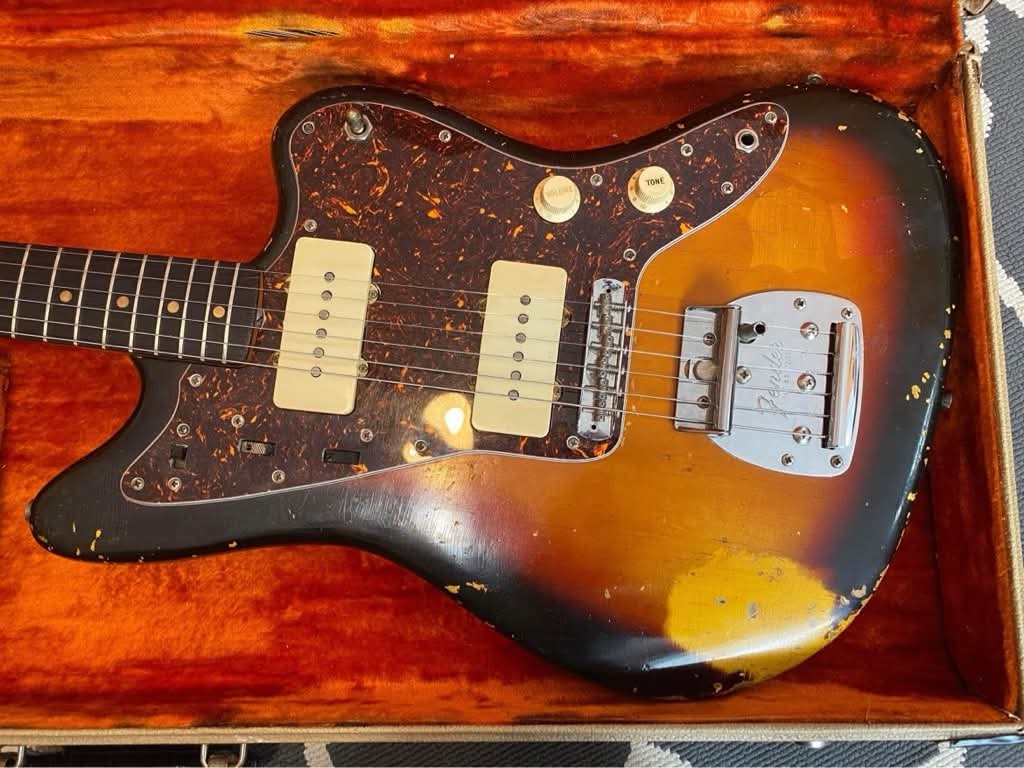
The 1961 Fender Jazzmaster marks the moment the instrument fully shed its jazz pretensions and began its transformation into the defining guitar of surf music — a cultural shift that would cement the Jazzmaster’s identity for the next six decades. By 1961 the tortoiseshell celluloid pickguard had become the dominant production configuration, replacing the gold anodized aluminum guard of 1958–1960 and giving the instrument the visual identity most closely associated with classic surf and early alternative recordings. The slab rosewood fingerboard continued at its most consistent production quality, clay dot markers remained standard, and the full dual-circuit system — rhythm and lead — was intact across all production.
What distinguishes 1961 specifically within the Jazzmaster timeline is a combination of fully resolved production consistency and cultural timing. The instrument had been in production long enough for Fender’s assembly team to have worked through the engineering refinements of the first years. The pickups were wound consistently, the tremolo system assembled reliably, the dual circuit wired correctly across the run. At the same time, the surf music movement was accelerating — Dick Dale had released “Let’s Go Trippin’” in 1961, widely considered the first surf rock single, and the Jazzmaster’s combination of powerful single-coil pickups, floating tremolo, and striking body design was at the center of the emerging sound.
The 1961 Jazzmaster also represents a specific collector opportunity that the market has increasingly recognized. For years, the pre-CBS offset models were undervalued relative to the Stratocaster and Telecaster — the conventional collector wisdom held that only the bolt-neck slab models truly mattered. That conventional wisdom has shifted dramatically in the past decade, and the 1961 Jazzmaster — with its slab rosewood fingerboard, tortoiseshell guard, clay dots, and full original circuit integrity — is now recognized as a genuinely significant pre-CBS instrument in its own right. In our experience buying pre-CBS Fender instruments across Ohio and the Midwest, 1961 Jazzmasters represent one of the strongest value-to-market-recognition ratios of any pre-CBS Fender model — sellers frequently underestimate what they have, and the gap between their expectations and accurate market value can be very significant.
What makes the 1961 Jazzmaster distinctive:
Tortoiseshell celluloid pickguard now the dominant production configuration — the visual identity most associated with classic Jazzmaster
Slab rosewood fingerboard at peak production consistency — flat-bottomed, approximately 4.8mm thick
Clay dot position markers throughout production
Full dual-circuit system intact — rhythm and lead circuits with independent controls
Wide Jazzmaster single-coil pickups — consistent wound character across 1961 production
Original floating tremolo system — rocking bridge, tremolo arm unit, lock button
Serial numbers in the 55,000–72,000 range on the neckplate
Custom colors available across full palette with sunburst as standard
Rounded C neck profile — approximately 0.84” at first fret, 0.90” at twelfth fret
Kluson Deluxe single-ring tuners
If you own a 1961 Jazzmaster, you may be sitting on a significant asset. Edgewater Guitars provides free, no-obligation valuations — call (440) 219-3607 or visit edgewaterguitars.com.
What Is a 1961 Fender Jazzmaster Worth? (2026 Market Values)
Value by Condition and Finish
The 1961 Jazzmaster market in 2026 reflects a maturing collector appreciation for pre-CBS offset models. Custom color examples in all-original condition represent the top tier by a significant margin. All-original sunburst examples in excellent condition with intact dual circuit and original tremolo system occupy the premium tier. The tortoiseshell pickguard — the dominant 1961 configuration — is itself a collector marker that adds modest premium over white guard examples from the same year.
Condition | Originality | Relative Value |
|---|---|---|
Excellent (8–9/10) | All original, custom color, original case | Premium-plus tier |
Excellent (8–9/10) | All original, sunburst, tortoiseshell guard, original case | Premium tier |
Very Good (7/10) | All original, no case | Strong tier |
Good (6/10) | Original electronics, some hardware changes | Mid-to-strong tier |
Player Grade | Some replacements, heavy wear | Mid tier |
Modified | Bypassed circuit, replaced tremolo, refin | Entry-to-mid tier |
What Affects the Value of a 1961 Jazzmaster?
Dual circuit integrity: The rhythm circuit is the most commonly bypassed or modified element on any pre-CBS Jazzmaster. An intact, fully functional, and original dual circuit — with correct pot codes, cloth wiring, and original capacitors — adds a meaningful premium. A bypassed circuit reduces value by 10–15%.
Custom color: Any documented factory custom color places a 1961 Jazzmaster at the top tier. Fiesta Red, Sonic Blue, and Blonde are the most actively sought. The Jazzmaster’s large body surface makes custom colors visually commanding in a way that generates disproportionate collector attention relative to smaller-body Fender models.
Tremolo system completeness: The floating tremolo system — bridge, arm unit, lock button, and all associated hardware — must be complete and original. Missing or replaced components reduce value proportionally. A complete, original, properly functioning tremolo system adds meaningful value.
Slab fingerboard condition: Shrinkage cracks in the thick slab rosewood board reduce value by 10–20% depending on severity. The Midwest climate is particularly hard on slab boards — many Ohio and Michigan instruments show at least hairline cracking.
Originality overall: All-original examples command a 40–60% premium over modified instruments.
Original case: The original grey or brown hardshell case with red or yellow interior adds approximately 10–15% to value.
Pickguard condition: The tortoiseshell celluloid guard ages with a characteristic amber-brown deepening and slight shrinkage. Original guards in good condition with appropriate aging are a specific authentication and value reference. Shrunken, cracked, or replaced guards reduce value modestly (5–10%).
How 1961 Compares to Other Years
Year | Key Difference | Relative Value | Why |
|---|---|---|---|
1960 | Anodized guard dominant; slab board; clay dots | Similar to slightly higher | Anodized guard premium over tort; otherwise same configuration |
1961 (this post) | Tortoiseshell guard dominant; slab board continues | Baseline | Classic Jazzmaster visual identity; peak slab consistency |
1962 | Slab-to-veneer transition begins mid-year | Similar | Last slab examples carry transition premium |
1963 | Full veneer year; L-series serials | Lower for veneer | Veneer board less sought than slab |
Edgewater Guitars consistently pays 30–40% more than typical guitar shops. Get your free valuation: edgewaterguitars.com or (440) 219-3607.
Recent Sales and Auction Results
Custom color 1961 Jazzmasters — particularly Fiesta Red and Blonde examples — have achieved increasingly strong results at Heritage Auctions and through specialist dealers as the pre-CBS offset market has matured. All-original sunburst examples in excellent condition with intact dual circuits sell at the strong-to-premium tier. The upward trajectory of the pre-CBS Jazzmaster market has been consistent and is broadly expected to continue as collector awareness expands further. Contact Edgewater for current market context specific to your instrument’s finish and condition.
How to Identify an Authentic 1961 Fender Jazzmaster
Serial Numbers
Range for 1961: Approximately 55,000–72,000, stamped on the neckplate
Location: Four-bolt neckplate
Important caveat: Serial number ranges overlap significantly between production years. Always cross-reference with the neck date stamp and pot codes. A number in this range is consistent with 1961 but does not confirm it independently.
Neck Date
Format: Pencil-written or rubber-stamped, month and year (e.g., “3-61” or “MAR 61”)
Location: Heel of the neck, visible only when the neck is removed from the body
What to look for: The stamp appears on the maple heel beneath the slab rosewood fingerboard. The slab board overhang at the heel is visible — the maple heel surface is partially obscured by the rosewood slab. Aging of the stamp should be consistent with the surrounding wood.
Potentiometer Codes
The Jazzmaster has more potentiometers than simpler Fender models — four in total across both circuits — and all must be examined.
Manufacturers: Stackpole (code 304) and CTS (code 137)
How to decode: Manufacturer code (3 digits) + year (2 digits) + week (2 digits)
Example: 304-0-42 = Stackpole, 1960, week 42 — appropriate for a guitar assembled in early 1961
Expected codes for 1961: Pots dated to 1960 or 1961 are correct across all four potentiometers. Any pot dated 1962 or later indicates modification.
Lead circuit pots: Volume and tone — accessible through the main control plate
Rhythm circuit pots: Dedicated volume and tone on the upper bout — accessible by removing the small rhythm circuit cover plate
Location note: Both circuits must be checked independently. It is common to find the lead circuit pots original and the rhythm circuit pots replaced, or vice versa.
Key Visual Identifiers
Fingerboard: Thick slab rosewood, flat-bottomed, approximately 4.8mm thick — confirmed by examining the heel end when the neck is removed. Square, flat underside is the definitive slab board marker.
Position markers: Clay dots — matte, slightly off-white, not pearl or celluloid. Smaller and less reflective than later pearl dots.
Pickguard: Tortoiseshell celluloid — the dominant 1961 configuration. Authentic 1961 tortoiseshell has aged toward amber-brown with slight shrinkage at edges. The celluloid material is distinctly different from modern reproduction tortoiseshell.
Pickups: Wide Jazzmaster single-coil, white covers, individual chrome-plated bezels — mounted floating above the pickguard surface
Rhythm circuit controls: Two small knurled knobs on the upper bout — one volume, one tone — with the sliding rhythm-lead selector switch. All controls should be functional and original.
Tremolo system: Original floating tremolo — rocking bridge on two posts, separate tailpiece tremolo arm unit, lock button on upper bout. All components should be examined individually.
String tree: Butterfly-style stamped metal
Tuners: Kluson Deluxe, single-ring, plastic oval buttons
Logo: Spaghetti-style gold with black outline
Neckplate: Four-bolt, no F-stamp
Factory Markings and Stamps
Control cavity: Body date pencil mark sometimes present
Neck pocket: May show pencil date consistent with neck heel stamp
Rhythm circuit cavity: The small upper-bout cavity for the rhythm circuit controls may show assembly dates or marks
Pickup cavities: Some examples retain assembly pencil dates
Underside of pickguard: Original tortoiseshell guards may show production stamps on the underside
Tortoiseshell Pickguard Authentication
The tortoiseshell celluloid pickguard of 1961 requires specific authentication attention:
Material: Celluloid — not acetate, not modern plastic. Original celluloid tortoiseshell has a specific smell when gently warmed, a slight translucency in thin areas, and a characteristic aging pattern that modern reproductions do not replicate.
Aging character: Original 1961 tortoiseshell has deepened and darkened over 65 years — the amber-brown tones are richer and more complex than new reproductions. Slight shrinkage at the edges and around screw holes is expected and correct.
UV reaction: Original celluloid tortoiseshell fluoresces differently under UV light than modern reproduction materials — a useful authentication tool when the surface aging is ambiguous.
Screw hole alignment: Original guards have specific screw hole spacing matched to the original body routing. Replacement guards from later production or aftermarket sources may show slightly different spacing.
Custom Color Identification
Custom color authentication on 1961 Jazzmasters follows the established pre-CBS Fender protocol:
Yellow sealer undercoat: Original Fender custom colors applied over a specific yellow sealer — visible at wear points, in the neck pocket, and under UV examination
Correct primer sequence: Distinctly different from refinish primer materials under UV examination
Matching headstock: Many 1961 custom color Jazzmasters have matching headstock color — a factory practice that is both a value marker and authentication reference
Aged finish character: Original 1961 nitrocellulose custom colors show more than 60 years of specific aging — Fiesta Red fading toward salmon, Sonic Blue yellowing toward seafoam, Blonde yellowing toward cream
Neck pocket bleed: Original custom color shows slight finish bleed into neck pocket from factory application
Red Flags: How to Spot Fakes and Refinishes
Veneer board on a claimed 1961: Veneer rosewood fingerboard was not introduced until late 1962. Any claimed 1961 Jazzmaster with a veneer board has a replaced neck or is not a 1961 instrument. Physical examination resolves this immediately.
Pearl or celluloid dots: Clay dots are correct for 1961. Bright pearl or celluloid dots indicate a replaced fingerboard or later instrument.
F-stamped neckplate: Not present on 1961 instruments. Any F-stamped plate indicates a replaced neckplate or CBS-era instrument.
Plastic-insulated wiring: Original 1961 Jazzmaster wiring used cloth-covered wire throughout both circuits. Plastic insulation in either circuit indicates replaced electronics.
Pot date mismatch: Any pot dated 1962 or later in a claimed 1961 instrument indicates modification. Check all four potentiometers — both circuits.
Non-functional rhythm circuit: A rhythm circuit that does not function correctly warrants investigation. The circuit may be bypassed, incorrectly wired, or have replaced components — each scenario affects value differently.
Wrong tremolo components: The floating tremolo system components have specific original specifications. Mustang tremolo bridges, aftermarket arm units, or incorrect lock buttons are non-original replacements.
Modern tortoiseshell guard: Reproduction tortoiseshell guards are common and widely available. Original 1961 celluloid tortoiseshell has specific aging characteristics — UV examination and material testing confirm authenticity.
Vivid unfaded custom color: Original 1961 nitrocellulose custom colors show more than 60 years of fading and aging. An unusually vivid finish warrants UV examination.
In our experience evaluating 1961 Jazzmasters from the Ohio and Midwest region, the dual circuit condition is the authentication and valuation point that most frequently surprises sellers. Many sellers assume a non-functional rhythm circuit is a minor issue; in fact, it is a primary value driver and its condition — original-but-failed, bypassed-by-player, or replaced — determines a meaningful portion of the instrument’s final valuation. We examine all four potentiometers and test the full circuit function during every in-person evaluation.
Not sure about your 1961 Jazzmaster’s circuit condition or authenticity? Edgewater offers free in-person authentication. Call (440) 219-3607 or visit edgewaterguitars.com.
1961 Fender Jazzmaster Specifications
Specification | Detail |
|---|---|
Body Wood | Alder |
Neck Wood | Maple with slab rosewood fingerboard |
Fingerboard | Slab rosewood, flat-bottomed, approximately 4.8mm thick, 7.5” radius |
Position Markers | Clay dots — matte, off-white |
Neck Profile | Rounded C, approximately 0.84” at 1st fret, 0.90” at 12th fret |
Nut Width | 1-5/8” (1.625”) |
Scale Length | 25.5” |
Frets | 21, narrow vintage wire |
Pickups | Two wide Jazzmaster single-coil, white covers, individual chrome bezels |
DC Resistance (typical) | Approximately 9.5–10.5k ohms per pickup |
Wire Type | Formvar-coated |
Magnet Type | Alnico V, flush pole pieces |
Tremolo | Jazzmaster floating tremolo — rocking bridge, tremolo arm unit, lock button |
Tuners | Kluson Deluxe, single-ring, plastic oval buttons |
Controls (Lead) | Volume, tone, 2-position pickup selector |
Controls (Rhythm) | Dedicated volume, dedicated tone — sliding rhythm-lead selector |
Pickguard | Tortoiseshell celluloid (dominant); white celluloid (some examples) |
Finish | Nitrocellulose lacquer — sunburst standard; full custom color palette |
Available Colors | Sunburst (standard); Fiesta Red, Sonic Blue, Blonde, Olympic White, Lake Placid Blue, Daphne Blue, Sherwood Green (custom order) |
Serial Number Range | Approximately 55,000–72,000 on neckplate |
Weight Range | Typically 7.5–9.0 lbs |
Case | Grey or brown hardshell case with red or yellow interior |
Original Retail Price | Approximately $329.50 (1961 catalog) |
What Does a 1961 Fender Jazzmaster Sound Like?
Pickup Specifications and Tonal Profile
Pickup type: Wide single-coil — larger coil aperture than Stratocaster pickups
DC Resistance: Approximately 9.5–10.5k ohms per pickup
Wire type: Formvar-coated
Magnet type: Alnico V, flush pole pieces
Potting: Unpotted
Mounting: Floating above pickguard surface in individual chrome bezels
The 1961 Jazzmaster pickup produces a tonal character that is simultaneously unmistakable and frequently misunderstood. The wider coil aperture captures a broader section of the string’s vibration — the result is a fuller, warmer fundamental than the narrower Stratocaster coil produces, with more low-midrange body and a slightly compressed, blooming quality to the attack that is the Jazzmaster’s signature sonic characteristic. The bridge pickup is warmer and more full-bodied than a Stratocaster bridge pickup; the neck pickup is round and rich in a way that approaches the warmth of a humbucker without the compressed bandwidth. The combination of both pickups produces a balanced, slightly nasal tone that defined the sound of early surf recordings.
The rhythm circuit — when intact and original — accesses both pickups simultaneously through a dedicated treble-cut capacitor with a darker, more compressed response than the lead circuit. Activated via the sliding selector on the upper bout, the rhythm circuit produces a warm, muted tone designed for chord playing behind a soloist — the jazz application Leo Fender originally intended. In a surf music context, the rhythm circuit’s warmer voice became a useful textural contrast to the lead circuit’s clarity.
How Construction Details Affect Tone
The slab rosewood fingerboard of 1961 continues to define the tonal character of the instrument relative to the veneer board examples that would follow in late 1962. The 4.8mm slab contributes density to the neck assembly and produces a slightly warmer, more rounded attack than the veneer board allows — reinforcing the Jazzmaster’s already-warm pickup character. The result is an instrument that trends warm across its entire tonal range, from the full-bodied bridge pickup through the rich neck position, with the slab board adding one more layer of warmth to the cumulative character.
The floating tremolo’s rocking bridge design contributes a specific bloom to the attack — the bridge rocks slightly forward when a string is struck, then returns, producing a quality of sustain that is softer in its initial decay than a fixed-bridge instrument. Players who set the bridge spring tension correctly find this system highly musical and expressive; the tremolo arm itself adds a gentle vibrato that, unlike a Stratocaster tremolo, does not pull the bridge out of its seating position when used.
The alder body provides the balanced, even frequency response that suits the Jazzmaster’s already-voiced tonal character — less mid-scoop than ash, more extended low end, contributing to the instrument’s characteristic warmth.
Notable Recordings
The 1961 Jazzmaster sound is the sound of surf music’s founding documents. Dick Dale’s “Let’s Go Trippin’” (1961) — widely cited as the first surf rock recording — captures the Jazzmaster’s powerful single-coil attack, its tremolo bloom, and its capacity for the fast alternate-picked lines that defined the surf style. The Ventures, whose Jazzmaster use in this period is well-documented, recorded “Walk Don’t Run” and other foundational surf recordings with this precise instrument configuration. The combination of the slab board warmth, the wide single-coil output, and the floating tremolo bloom is audible across these recordings and defines what “Jazzmaster sound” means to collectors and players worldwide.
Common Issues and Modifications That Affect Value
Bypassed rhythm circuit: The most universally common modification on pre-CBS Jazzmasters. Players who primarily used the lead circuit frequently bypassed the rhythm circuit to simplify the electronics. Value impact: 10–15% reduction. A correctly restored original circuit adds meaningful value back to a bypassed example.
Replaced tremolo components: The floating tremolo is the most mechanically complex element and the most frequently partially replaced. Individual component replacement — bridge only, arm unit only, lock button only — reduces value proportionally. Complete replacement with a Mustang tremolo or aftermarket unit: 20–30% reduction. Original complete tremolo system: significant positive value marker.
Replaced pickups: Original Jazzmaster single-coils are frequently replaced with Stratocaster pickups — a modification that fundamentally changes the instrument’s tonal character. Value impact: 20–30% reduction. Original pickups retained and included: reduces impact to approximately 10–15%.
Slab fingerboard cracks: Common in Midwest climate. Hairline shrinkage cracks across the rosewood grain: 10–15% reduction. Cracks extending into fret slots or previously repaired with inappropriate materials: 15–20% reduction.
Replaced or shrunken tortoiseshell pickguard: Original celluloid tortoiseshell guards shrink with age — severely shrunken or cracked guards reduce value by 5–10%. Replaced guards: 5–10% reduction.
Missing or replaced clay dots: Value impact: 5–10%; alters visual authentication profile.
Refinished body: Correct color refinish: 40–55% reduction. Non-original color: 55–70% reduction.
Custom color touch-up or overspray: 20–35% reduction depending on extent. UV examination required for detection.
Refretted neck: Correct vintage wire: 5–10% reduction. Modern fret wire: 10–15% reduction.
Headstock crack or repair: 25–40% reduction even with professional repair.
In Edgewater’s experience with 1961 Jazzmasters, the most consistently undervalued examples are those with bypassed rhythm circuits and replaced tremolo arms where everything else — pickups, slab board, clay dots, neck date, pot codes — is fully original. Sellers frequently accept low offers because the instrument “doesn’t work right” (the bypassed rhythm circuit confuses players unfamiliar with the dual circuit system) or because the tremolo arm is missing. These are addressable issues that do not define the instrument’s fundamental originality or historical value.
Selling Your 1961 Fender Jazzmaster: Your Options Compared
Selling Option | Typical Offer | Timeline | Fees/Costs | Risk Level | Best For |
|---|---|---|---|---|---|
Edgewater Guitars | 30–40% above shop offers | Immediate cash | None | Low — expert authentication included | Owners wanting fair value without complexity |
Local Guitar Shop | Wholesale pricing (lowest) | Same day | None direct, but lowest price | Low | Convenience over value |
Reverb / eBay | Variable — potentially higher | Weeks to months | 5–15% platform fees + shipping | High — fraud, damage, disputes | Experienced sellers comfortable with risk |
Auction House | Variable | 3–6 months | 15–25% seller premium | Medium | Custom color or exceptional examples |
Private Sale | Variable | Unpredictable | None | High — authentication burden on you | Sellers with existing buyer network |
The 1961 Jazzmaster sits in a particularly favorable position for sellers approaching Edgewater directly. The pre-CBS offset market has appreciated significantly over the past decade but that appreciation has not fully translated into awareness among the general guitar-owning public — sellers who inherited or stored a 1961 Jazzmaster are frequently working from outdated price expectations. Local shops that primarily serve the player market may not access the collector market that drives true pre-CBS Jazzmaster values, and the dual-circuit complexity and tremolo system can cause generalist buyers to undervalue an instrument on condition grounds that specialists recognize as addressable.
Our in-person evaluation process addresses every element of a 1961 Jazzmaster’s authenticity and condition — the dual circuit function, the tremolo system completeness, the slab board integrity, the custom color authentication — and builds our offer on accurate information. We travel anywhere in Ohio, Michigan, Pennsylvania, Indiana, or West Virginia for high-value instruments.
Ready to find out what your 1961 Fender Jazzmaster is worth? Get your free, no-obligation valuation: edgewaterguitars.com or call (440) 219-3607.
Frequently Asked Questions About the 1961 Fender Jazzmaster
Q: What is a 1961 Fender Jazzmaster worth in 2026? A: Value is driven by finish, dual circuit integrity, and overall originality. Custom color examples in all-original condition represent the top tier. All-original sunburst examples with intact tortoiseshell guard and functioning dual circuit in excellent condition occupy the premium tier. Player-grade and modified instruments sell at meaningful discounts. Contact Edgewater Guitars for a free valuation specific to your instrument.
Q: How is the 1961 Jazzmaster different from the 1960? A: The primary visual difference is the pickguard — the 1960 Jazzmaster featured the gold anodized aluminum guard through most of its production run, while the 1961 moved fully to tortoiseshell celluloid as the dominant configuration. Both years have slab rosewood fingerboards and clay dot markers. The 1960 anodized guard carries a modest premium over the 1961 tortoiseshell guard in the current market, but the two instruments are otherwise very similar in construction and value.
Q: What serial numbers cover 1961 Fender Jazzmasters? A: Approximately 55,000–72,000, stamped on the neckplate. These ranges overlap between production years — always cross-reference with the neck date stamp and pot codes for accurate dating.
Q: Why does the rhythm circuit matter for the value of a 1961 Jazzmaster? A: The rhythm circuit is the Jazzmaster’s most distinctive electronic feature and its condition is a primary value driver. An intact, fully functional, and original dual circuit — with correct pot codes, cloth wiring, and original capacitors across all four potentiometers — commands a meaningful premium. A bypassed circuit reduces value by 10–15% and is an authentication flag. The circuit condition also indicates how the instrument was used — a bypassed circuit suggests heavy player use, which may correlate with other wear.
Q: What is the floating tremolo system on a 1961 Jazzmaster? A: The Jazzmaster floating tremolo consists of a rocking bridge sitting on two posts — free to rock forward and back with string movement — combined with a separate tailpiece unit housing the tremolo arm and spring mechanism. A lock button on the upper bout locks the tremolo for string changes. The rocking bridge design allows the bridge to move with string vibration rather than resisting it, producing a specific bloom and sustain character distinct from the Stratocaster tremolo.
Q: What custom colors were available on the 1961 Jazzmaster? A: Documented custom color options for 1961 Jazzmaster production include Fiesta Red, Sonic Blue, Blonde, Olympic White, Lake Placid Blue, Daphne Blue, and Sherwood Green. Fiesta Red and Blonde are the most frequently encountered and most actively sought by collectors. All custom color claims require authentication — Edgewater provides this at no charge.
Q: How do I identify original Jazzmaster pickups versus Stratocaster replacements? A: Original Jazzmaster single-coil pickups are physically wider than Stratocaster pickups — the coil is broader and the pickup sits in individual chrome-plated bezels mounted floating above the pickguard. Stratocaster pickups installed as replacements are narrower and typically require modified bezel mounting or direct pickguard mounting. DC resistance on original Jazzmaster pickups reads approximately 9.5–10.5k ohms — higher than typical Stratocaster pickups.
Q: Does Edgewater Guitars buy 1961 Fender Jazzmasters? A: Yes. We actively purchase 1961 Jazzmasters in all conditions — all-original, custom color, player-grade, and modified. We pay 30–40% more than local guitar shops and provide immediate cash payment with no consignment. Call (440) 219-3607 or visit edgewaterguitars.com.
Q: How does a slab board 1961 Jazzmaster sound different from a veneer board 1962 or later instrument? A: The 4.8mm slab rosewood board adds meaningful density to the neck assembly, producing a slightly warmer, more rounded attack than the thinner veneer board allows. On the Jazzmaster — whose pickup design already trends warm — the slab board reinforces the instrument’s characteristic warmth. The veneer board allows more maple brightness through, producing a marginally more articulate and open sound. The difference is real but not dramatic — both are excellent instruments.
Q: Should I clean or restore my 1961 Jazzmaster before selling? A: No. Do not clean, polish, or attempt to restore any finish or hardware before professional evaluation. Original patina is a value-positive feature. Modern polishes damage nitrocellulose lacquer and some cleaning agents can harm the tortoiseshell celluloid guard. Present the instrument as-found — Edgewater evaluates it accurately in original condition.
Q: How long does it take to sell a vintage guitar to Edgewater? A: Typically 24–72 hours from initial contact to cash in hand. We provide a preliminary valuation promptly, arrange in-person evaluation for high-value instruments, and make an immediate cash offer with no obligation.
Related Resources
Useful next reads and tools for this guitar:
Sell your 1961 Fender Jazzmaster
Edgewater Guitars buys vintage Fender Jazzmasters and other vintage Fenders nationwide. We give free, honest appraisals and fair same-day cash offers, with local pickup or insured nationwide shipping. Call or text (440) 219-3607 or request a free estimate.
How much is a 1961 Fender Jazzmaster worth?
A clean, all-original 1961 Fender Jazzmaster’s value depends on originality, condition, finish, and whether the pickups and hardware are original. Because Edgewater buys directly and resells, we can typically pay more than local shops or pawn stores. The most accurate way to find out is a free appraisal: send a few photos and the serial number and we will give you an honest market assessment.
Where can I sell a 1961 Fender Jazzmaster?
Edgewater Guitars buys them directly, nationwide, with same-day cash offers and no obligation. You can also date yours with our Fender serial number lookup.