DATE :
1960 Gibson Les Paul Standard: The Final Year of the Original Sunburst with Slim Taper Neck
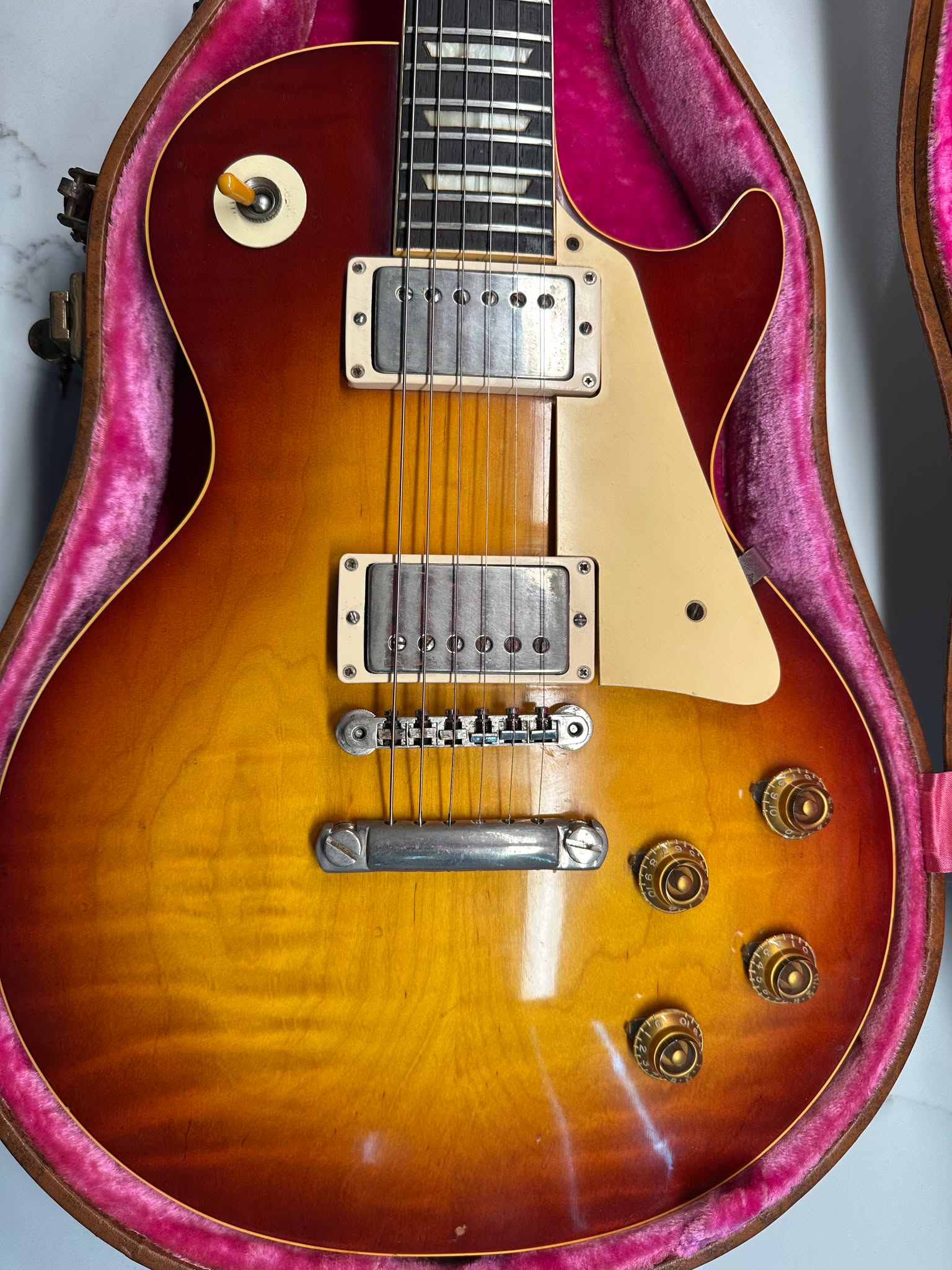
1960 Gibson Les Paul Standard: The Final Year of the Original Sunburst with Slim Taper Neck
Last Updated: May 2026
What Makes the 1960 Les Paul Standard Significant?
The 1960 Gibson Les Paul Standard is the last year of original Les Paul Standard production — the final chapter of the legendary 1958-1960 “Burst” trilogy before Gibson discontinued the model and replaced it with the SG body shape. With approximately 635 produced in 1960 (the highest production year of the three Burst years), the 1960 Standard features PAF humbuckers, cherry sunburst over figured maple, Brazilian rosewood fingerboard, and the distinctive “slim taper” neck profile that differentiates it from the chunkier 1958 and 1959 necks. While valued slightly below the mythical 1959, the 1960 Les Paul Standard remains one of the most valuable and sought-after electric guitars ever manufactured.
What makes 1960 extraordinary:
Final Original Production Year: Last Les Paul Standards before Gibson discontinued the model — replaced by the SG body in 1961. Production didn’t resume until 1968 reissue
PAF Humbuckers: Two original PAF pickups — rough sand-cast base plates, long Alnico magnets, hand-wound Formvar wire, 7.0-8.5k ohms. Same legendary pickups as 1958-1959
Slim Taper Neck Profile: Thinner, faster neck than 1958-1959 — the “60s neck” that became the template for modern Les Paul neck profiles. Many players specifically prefer the 1960 slim taper
Figured Maple Tops: More pronounced flame/figure than typical 1958 examples — improved book-matching and top selection
Cherry Sunburst Over Maple: Same iconic finish as 1958-1959 — aniline dye fading creates “lemon burst,” “honey burst,” or “tobacco burst” variations
Brazilian Rosewood Fingerboard: Premium Brazilian rosewood (CITES-restricted) with trapezoid pearl inlays
Long Neck Tenon: Deep neck-to-body joint providing enhanced sustain and resonance
Approximately 635 Produced: Highest of the three Burst years but still extremely rare
Bumble Bee Capacitors: Orange “bumble bee” capacitors (.022 mfd) in electronics cavity
ABR-1 Bridge with Retainer Wire: Period-correct ABR-1 tune-o-matic
The 1958-1960 Burst Hierarchy:
Year | Approximate Production | Neck Profile | Maple Tops | Relative Value |
|---|---|---|---|---|
1958 | ~434 | Chunky (“baseball bat”) | Plain to modest figure | Premium baseline |
1959 | ~643 | Medium chunky (ideal balance) | Best figure common | Highest (the Holy Grail) |
1960 | ~635 | Slim taper (thinnest) | Good to excellent figure | 15-25% below 1959 |
In Edgewater’s experience, 1960 Les Paul Standards are the most “accessible” Burst year — still commanding extraordinary pricing but typically 15-25% below equivalent 1959 examples. The slim taper neck profile divides collectors: some specifically seek 1960 for the faster neck, while others prefer 1959’s chunkier profile. Many 1960 Bursts have been misidentified as 1959s or vice versa — neck profile measurement and pot code verification are essential for accurate year identification.
Call (440) 219-3607 for free evaluation.
What Is a 1960 Les Paul Standard Worth? (2026 Market Values)
Value by Condition and Configuration
Condition | Figured Top | Plain Top | Modified |
|---|---|---|---|
Excellent (All-Original) | Extraordinary tier | Ultra-premium to extraordinary | Ultra-premium |
Very Good | Ultra-premium tier | Premium to ultra-premium | Premium |
Good | Premium tier | Upper-mid to premium | Upper-mid |
Player Grade | Upper-mid to premium | Mid to upper-mid | Mid-tier |
Value by Feature
Feature | Premium/Impact | Notes |
|---|---|---|
Original PAF Pickups (Verified) | 40-60% premium | THE most critical value component |
Heavily Figured Maple Top | 15-30% premium | Over plain tops |
Double White PAF Bobbins | 15-25% additional | Rarest bobbin configuration |
Zebra PAF Bobbins | 10-20% additional | Rare configuration |
All-Original Condition | 100-200% premium | Over modified |
Factory Bigsby | Modest premium | Factory-equipped examples documented |
Original Case | 10-20% premium | Brown/black hardshell with pink plush |
Faded Finish (“Lemon/Honey Burst”) | Correct and desirable | Never refinish faded examples |
Refinishing | 50-70% reduction | Catastrophic on Bursts |
PAFs Replaced | 40-60% reduction | Single largest value reduction |
Headstock Repair | 30-50% reduction | |
Converted to SG Pickup Routes | 30-50% reduction | Wrong routing |
How 1960 Burst Compares
Year | Key Difference | Relative Value |
|---|---|---|
1958 | Chunky neck, plainer tops common | Similar to 10% lower than 1960 |
1959 | Medium neck (ideal), best figure | 15-25% higher |
1960 | Slim taper, good figure | Baseline (extraordinary) |
1961 Les Paul/SG | SG body, “Les Paul” name, late PAFs | 50-70% lower |
How to Identify an Authentic 1960 Les Paul Standard
The Three Essential Authentication Points
1. PAF Pickups: Cover removal mandatory — rough sand-cast base plate, long Alnico magnets (~2.5”), plain enamel wire, hand-wound, 7.0-8.5k ohms, bumble bee capacitors in cavity
2. Slim Taper Neck Profile: Thinner than 1958-1959 — measurably slimmer at 1st and 12th fret positions. THE distinguishing feature from 1959
3. Serial Numbers and Pot Codes: Serial 0xxxx range (numbering restarted). Pot codes should read 137-60xx or 134-60xx (1960 dates)
Serial Numbers
Range: 0xxxx (five-digit, numbering restarted from zero — overlaps with other years)
Location: Ink stamped on back of headstock. Some have impressed numbers inside control cavity.
CRITICAL: 0xxxx serial range overlaps with multiple years — pot codes and physical features ESSENTIAL for accurate dating.
Potentiometer Codes
Expected: 137-6001 through 137-6052 or 134-6001 through 134-6052
Four pots: Two volume, two tone. All should show consistent 1960 dates.
Key Visual Identifiers
Body: Carved maple top on mahogany body (NOT slab — carved dish top)
Top: Figured maple (flame/quilted) with cherry sunburst
Finish: Cherry sunburst nitrocellulose — aniline dye fading creates unique patina
Pickups: Two PAF humbuckers (nickel covers)
Neck Profile: SLIM TAPER — thinner than 1958-1959
Fingerboard: Brazilian rosewood with trapezoid pearl inlays
Neck Tenon: Long tenon (deep joint into body)
Bridge: ABR-1 tune-o-matic with retainer wire
Tailpiece: Lightweight aluminum stop tailpiece
Headstock: 17-degree angle, “Les Paul Model” script, crown inlay
Truss Rod Cover: “Les Paul” in script
Capacitors: Orange “bumble bee” (.022 mfd)
Switch: Switchcraft toggle with “Rhythm/Treble” ring
Output: Switchcraft jack
Pots: Long-shaft 500k CTS
Weight: Typically 8-9.5 lbs (lighter than 1958 average)
Binding: Cream binding with fret nibs
1960 vs 1959 Identification (CRITICAL)
Feature | 1959 | 1960 |
|---|---|---|
Neck Profile | Medium chunky (fills hand) | Slim taper (thinner, faster) |
1st Fret Depth | ~0.870-0.900” | ~0.800-0.830” |
12th Fret Depth | ~0.960-1.000” | ~0.880-0.930” |
Pot Codes | 137-59xx | 137-60xx |
Serial | 9xxxx | 0xxxx |
Body Thickness | Standard | Slightly thinner (some examples) |
Neck measurement is the definitive test between 1959 and 1960 — combined with pot code verification.
Red Flags
Chunky neck on claimed 1960: Should be slim taper. Chunky = 1958-1959.
Smooth base plate under pickup covers: PAFs have ROUGH sand-cast.
Pot codes showing 1959 dates on claimed 1960: Wrong year.
SG body routes: 1960 = Les Paul body, NOT SG.
Patent number stamps on pickups: 1960 should have PAFs (sticker or no-sticker).
1960 Gibson Les Paul Standard Specifications
Specification | Detail |
|---|---|
Body | Carved maple top, mahogany back |
Top | Figured maple with cherry sunburst |
Finish | Cherry sunburst nitrocellulose (aniline dye) |
Neck | Mahogany, slim taper profile |
Neck Tenon | Long (deep body joint) |
Fingerboard | Brazilian rosewood, trapezoid pearl inlays |
Scale Length | 24 3/4” |
Nut Width | ~1 11/16” |
Headstock Angle | 17 degrees |
Neck Angle | ~5 degrees |
Frets | 22, with nibs at binding |
Pickups | Two PAF humbuckers (7.0-8.5k ohms) |
Capacitors | Orange “bumble bee” (.022 mfd) |
Controls | Two volume, two tone, Switchcraft toggle |
Bridge | ABR-1 with retainer wire |
Tailpiece | Lightweight aluminum stop |
Tuners | Kluson Deluxe double-ring |
Binding | Cream with fret nibs |
Weight | ~8-9.5 lbs |
Production | ~635 total |
What Does a 1960 Burst Sound Like?
PAF Through Carved Maple + Mahogany: The same legendary PAF voice as 1958-1959 — warm, complex, dynamically responsive with wide harmonic range. Hand-wound Formvar coils through carved maple top on mahogany body creates THE benchmark electric guitar tone.
Slim Taper Playing Experience: The thinner 1960 neck profile creates faster playing feel with easier fretting — many players prefer the 1960 neck for lead work. The reduced mass creates slightly different resonance transfer than chunkier 1959 necks.
66-Year Aging: PAF magnets, wood, and finish after 66 years produce tonal maturity — relaxed magnets, fully dried wood, thinned finish creating “opened up” character impossible in new instruments.
Common Issues
PAFs replaced: 40-60% reduction. THE most significant modification on any Burst.
Refinishing: 50-70% reduction. Faded sunburst is correct — never refinish.
Headstock repair: 30-50% reduction.
Tuner replacement: 15-25% reduction. Original Kluson double-ring essential.
Bridge/tailpiece replacement: 10-20% reduction.
Fret replacement: 10-15% reduction with correct wire.
Electronics modifications: 15-25% reduction.
Capacitor replacement: 10-15% reduction. Original bumble bees desirable.
Frequently Asked Questions
Q: What is a 1960 Les Paul Standard worth in 2026?
A: With verified PAF pickups and all-original condition, the 1960 commands extraordinary tier — among the most valuable production electric guitars. Figured tops command additional premiums. Typically 15-25% below equivalent 1959 examples due to collector preference for 1959 neck profile.
Q: What is the difference between 1959 and 1960 Bursts?
A: Neck profile is the primary distinction. 1959 has medium chunky profile (widely considered ideal). 1960 has slim taper (thinner, faster). Pot codes confirm year definitively. Both have PAFs, cherry sunburst, figured maple, Brazilian rosewood. Many players specifically prefer the 1960 slim taper.
Q: Why is 1960 less valuable than 1959?
A: Collector convention — the 1959 neck profile is considered the “ideal” balance of comfort and tone. However, the gap has narrowed as more players specifically seek the 1960 slim taper. Both years share identical PAFs, same construction, same materials. The value difference reflects neck preference more than quality difference.
Q: How many 1960 Les Paul Standards were made?
A: Approximately 635 — the highest of the three Burst years (1958: ~434, 1959: ~643, 1960: ~635). Despite being the “most common” Burst, 635 total production is still extraordinarily rare.
Q: Does Edgewater buy Les Paul Bursts?
A: Yes — free PAF authentication (cover removal, base plate inspection, magnet measurement), neck profile measurement, pot code verification, finish assessment. We recognize all three Burst years. Ohio, Michigan, Pennsylvania, Indiana, West Virginia. Call (440) 219-3607.
Related Resources
1958 Gibson Les Paul Standard
1961 Les Paul/SG Standard
Edgewater Guitars: OH, MI, PA, IN, WV. Contact us: request a free appraisal online | (440) 219-3607.
See also: Vintage Gibson Les Paul Standard Value Guide (1952-1960)