DATE :
1960 Gibson ES-335TD: The Dot Neck at Its Peak — PAF Humbuckers and the First Full Sunburst Year
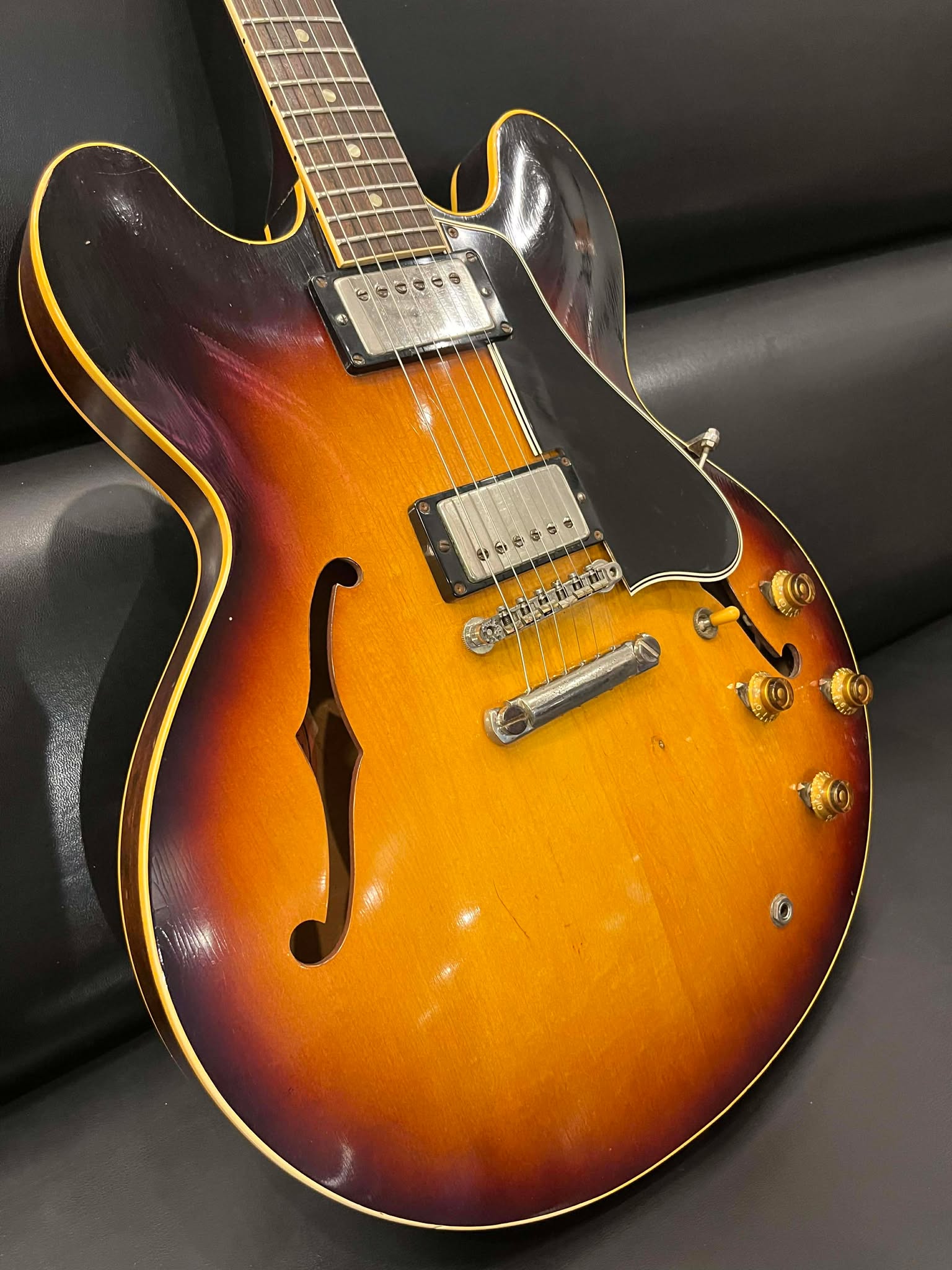
1960 Gibson ES-335TD: The Dot Neck at Its Peak — PAF Humbuckers and the First Full Sunburst Year
The 1960 Gibson ES-335TD was the dot-neck at its peak, a PAF-loaded semi-hollow from the model’s most coveted early years. Edgewater Guitars buys vintage Gibson ES-335s nationwide with free expert appraisals and same-day cash offers. Call or text (440) 219-3607.
Last Updated: June 2026
What Makes the 1960 Gibson ES-335TD Significant?
The 1960 Gibson ES-335TD occupies what many experienced collectors consider the single most desirable position in the entire ES-335 production timeline. It is a dot neck — the round dot inlay fingerboard configuration that defines the most collectible early ES-335 production — at a moment when every element of the instrument had been refined through two years of production into fully consistent, high-quality execution. The PAF humbuckers are intact and in their most mature early form. The construction details that define the original ES-335 concept — the thin semi-hollow body, the solid maple center block, the long pickguard, the Mickey Mouse ear cutaways — are all present and fully resolved. And the cherry finish that had debuted on the ES-335 in 1959 was now the dominant color alongside sunburst, giving the 1960 production run the visual identity most closely associated with the classic ES-335 in the collector imagination.
The 1960 ES-335 is often described as the sweet spot of the dot neck era — later than the first-year 1958 examples with their first-production variables, earlier than the 1962 examples where the transition to block inlays was beginning to be anticipated. The 1959 instruments carry a specific PAF premium as the first cherry examples and the year most associated with the pinnacle of Gibson’s pre-CBS production. The 1960 sits just below the 1959 in the collector hierarchy — not because the instruments are inferior, but because the 1959 carries a cultural cachet driven partly by its association with the Les Paul Standard’s legendary status in that same year. In pure construction and tonal terms, a 1960 ES-335 dot neck with original PAF pickups is the equal of the finest 1959 examples and is valued accordingly by players and collectors who evaluate instruments on their merits rather than their mythology.
The 1960 ES-335 is also the last full year before the transitional period of 1961–1962 during which the dot inlays were phased out in favor of block inlays and other production refinements began to appear. As the final complete dot neck year that carries no transitional complexity, the 1960 represents the original ES-335 concept in its most mature and fully resolved form. In our experience buying ES-335 instruments across Ohio and the Midwest, 1960 dot neck examples consistently generate the strongest buyer interest of any ES-335 year — the combination of PAF pickups, dot inlays, cherry or sunburst finish, and all-original construction places them at the apex of the semi-hollow electric guitar market.
What makes the 1960 ES-335TD distinctive:
Dot inlay fingerboard — the round dot markers that define the most collectible ES-335 production
PAF humbucker pickups — the “Patent Applied For” sticker humbuckers at their most mature expression
Last complete dot neck year with no transitional complexity — 1961 begins the block inlay transition
Cherry finish now fully established alongside sunburst — both are correct and desirable
Natural finish rare and significantly more valuable
Long pickguard extending below the bridge pickup — correct for dot neck production
Mickey Mouse ear cutaways — rounded, symmetrical cutaway profile
Stop tailpiece or Bigsby vibrato — both factory options
Serial numbers in the 0xxxx range (starting over) on the back of the headstock
Bound rosewood fingerboard, 1-11/16” nut width
ABR-1 tune-o-matic bridge without retainer wire on earlier examples; with retainer wire on later examples
If you own a 1960 ES-335, you may be holding one of the most significant vintage electric guitars ever made. Edgewater Guitars provides free, no-obligation valuations — call (440) 219-3607 or visit edgewaterguitars.com.
What Is a 1960 Gibson ES-335TD Worth? (2026 Market Values)
Value by Condition and Finish
The 1960 ES-335 market in 2026 operates at the very top of the vintage semi-hollow electric guitar hierarchy. Natural finish examples are the rarest and most valuable. Cherry examples follow closely — the rich, transparent cherry nitrocellulose of original 1960 production is one of the most beautiful vintage guitar finishes ever produced. Sunburst examples occupy the strong tier. All values are driven primarily by PAF originality and overall condition.
Condition | Finish | Relative Value |
|---|---|---|
Excellent (8–9/10) | Natural, all original PAFs, original case | Premium-plus tier |
Excellent (8–9/10) | Cherry, all original PAFs, original case | Premium tier |
Excellent (8–9/10) | Sunburst, all original PAFs, original case | Strong-plus tier |
Very Good (7/10) | Cherry or sunburst, all original, no case | Strong tier |
Good (6/10) | Original PAFs, some hardware changes | Mid-to-strong tier |
Good (6/10) | One PAF replaced, otherwise original | Mid tier |
Player Grade | Some replacements, heavy wear | Entry-to-mid tier |
Modified | Both PAFs replaced, refin, added routes | Entry tier |
What Affects the Value of a 1960 ES-335?
PAF pickup originality — both positions: The two PAF humbuckers are the most critical value driver. Original PAFs with Patent Applied For stickers, correct bobbin colors, Alnico magnets, and DC resistance in the 7.5–8.5k ohm range command a premium that is fundamental to the 1960 ES-335’s market position. Each original PAF intact adds substantial value; the presence of both original PAFs in an all-original 1960 ES-335 places the instrument in the highest tier of the vintage semi-hollow market.
Finish: Natural finish commands a 30–50% premium over equivalent cherry examples. Cherry commands a 15–25% premium over equivalent sunburst examples. Original finish integrity — correct aging, appropriate checking, no refinishing — is essential for full value in any color.
Dot inlay condition: Original dot inlays intact and unmodified are a primary authentication marker for pre-block-inlay ES-335 production. Missing or replaced dots reduce value by 5–10%.
Long pickguard originality: The long pickguard extending below the bridge is correct for 1960 dot neck production. A short pickguard (above bridge only) indicates either a replacement from a different era or a later production instrument. Original long pickguard: full value. Replaced or incorrect pickguard: 5–10% reduction.
Mickey Mouse ear cutaway profile: The rounded, symmetrical cutaway profile of the 1960 ES-335 distinguishes it from the pointed cutaways that would appear in 1963–1968 production. This profile is a dating reference and an aesthetic characteristic that many collectors prefer.
Stop tailpiece vs. Bigsby: Stop tailpiece examples are more common. Bigsby-equipped examples are rarer and carry a modest premium (10–15%) when the Bigsby is original and intact.
Original case: The original brown or black hardshell case adds approximately 10–15% to value.
How 1960 Compares to Other Years
Year | Key Difference | Relative Value | Why |
|---|---|---|---|
1958 | First year; stoptail standard; orange label | Higher for exceptional examples | First-year premium; unique features |
1959 | Cherry introduced; PAFs at peak; cultural cachet | Higher | 1959 mythology premium across all Gibson models |
1960 (this post) | PAFs mature; fully resolved dot neck; last complete dot year | Baseline | Peak dot neck production; slight discount to 1959 |
1961 | Dot inlays continue; transitional period approaching | Similar to slightly lower | Block inlay transition anticipated; transitional uncertainty |
1962 | Block inlays introduced mid-year; pointed cutaways | Lower for block examples; similar for remaining dot examples | Block inlay transition reduces dot neck premium |
1963 | Full block inlay year; pointed cutaways | Lower | Block inlays standard; no dot neck premium |
Edgewater Guitars consistently pays 30–40% more than typical guitar shops. Get your free valuation: edgewaterguitars.com or (440) 219-3607.
Recent Sales and Auction Results
All-original 1960 ES-335s in natural finish with original PAF pickups represent some of the highest-achieving semi-hollow electric guitar transactions at Heritage Auctions and Christie’s. Cherry examples in excellent all-original condition with original PAFs sell consistently at the premium tier. Sunburst examples in equivalent condition follow closely. The 1960 ES-335 dot neck market has been consistently strong and has shown a clear upward trajectory over the past decade as the dot neck era’s significance has become more broadly recognized. Contact Edgewater for current market context specific to your instrument.
How to Identify an Authentic 1960 Gibson ES-335TD
Serial Numbers
Range for 1960: Approximately 0xxxx range — the serial number sequence started over in 1960, so 1960 numbers begin with 0 again
Location: Back of headstock, ink-stamped or impressed
Format: Five or six digits beginning with 0 — e.g., “01234” or “09876”
Important caveat: The starting-over of the serial number sequence in 1960 creates overlap with very early 1950s numbers. Context — body style, construction, and hardware — resolves any ambiguity immediately. Always cross-reference with the FON and pot codes.
Factory Order Number (FON)
Format for 1960: Batch letter followed by production number
Location: Inside the body — visible through the f-holes with a mirror and light, or sometimes stamped on the back brace
Importance: The FON provides reliable production dating that supports serial number confirmation for 1960 instruments
Potentiometer Codes
The ES-335 has four potentiometers — two volume and two tone — all of which must be examined.
Primary manufacturers: Centralab (code 134) and CTS (code 137)
How to decode: Manufacturer code (3 digits) + year (2 digits) + week (2 digits)
Example: 134-0-22 = Centralab, 1960, week 22
Expected codes for 1960: Pots dated to 1959 or 1960 are correct. Pots from 1961 or later indicate modification.
Location: Inside the body — accessible through the f-holes or control cavity
Key Visual Identifiers
Dot inlays: Round dot position markers on a bound rosewood fingerboard — the defining visual characteristic of the pre-block ES-335. Dots are smaller and more understated than the block inlays of 1962 and later production.
Long pickguard: Extends below the bridge pickup — significantly longer than the short pickguard of block inlay production. The long guard is a primary dating reference for dot neck ES-335 instruments.
Mickey Mouse ear cutaways: Rounded, symmetrical cutaway horns on both sides — distinctly different from the pointed cutaways of 1963–1968 production.
PAF pickups: Two humbucker pickups with nickel-plated covers. Both positions should show consistent aging. The “Patent Applied For” sticker on the base plate of each pickup is visible when the pickup is removed.
ABR-1 bridge: The original tune-o-matic bridge — without the retainer wire on earliest 1960 examples; with retainer wire on later examples. The bridge saddles are individual threaded pieces, not the Nashville-style wider bridge of later production.
Crown headstock inlay: Mother of pearl crown inlay on the headstock — standard for ES-335 production throughout the dot neck era.
Kluson Deluxe tuners: Single-ring, plastic oval buttons — correct for 1960 production.
Label inside body: Orange label with serial number visible through the bass-side f-hole on early 1960 examples; transitioning to a white label through the year.
Finish: Sunburst, cherry, or natural — all correct. Original nitrocellulose shows appropriate aging and checking.
Neck profile: Slim C — the 1960 ES-335 neck is noticeably slimmer than the 1958–1959 examples, which had a more substantial C profile.
Factory Markings and Stamps
Inside body: FON visible through f-holes; label with serial number
Back of headstock: Ink-stamped or impressed serial number
Control cavity: Pot codes on all four potentiometers
PAF base plates: Patent Applied For sticker visible when pickups removed
PAF Humbucker Authentication — 1960 Specific
PAF sticker: Original “Patent Applied For” paper sticker on each pickup base plate — yellowed, aged, sometimes partially missing. Absence of sticker does not disqualify a PAF but requires additional construction verification.
Bobbin color: Double black most common; double cream and zebra less frequent but correct
DC Resistance: Approximately 7.5–8.5k ohms per pickup — natural hand-wound variation
Magnet type: Alnico II or Alnico V — both correct. Ceramic magnets indicate a non-original replacement.
Lead wire: Braided cloth-covered shield — plastic insulation indicates replacement
Cover patina: Nickel-plated covers showing consistent aging across both positions on an all-original example
Red Flags: How to Spot Fakes and Refinishes
Block inlays on a claimed 1960: Block inlays were not introduced until 1962. Any claimed 1960 ES-335 with block inlays has either a replaced fingerboard or is misrepresented.
Short pickguard on a claimed 1960: The short pickguard above the bridge only is a 1962 and later configuration. A short guard on a claimed 1960 indicates either a guard replacement or a misrepresented instrument.
Pointed cutaways on a claimed 1960: Pointed cutaways did not appear until 1963. Rounded Mickey Mouse ear cutaways are correct for 1960.
Ceramic magnet pickups: Indicate non-original replacement in either position.
Patent number designation on base plates: Genuine 1960 pickups are PAFs — patent number pickups on a claimed 1960 indicate replaced pickups.
Refinished finish: UV examination for any color. Cherry refinishes are common on faded or worn examples — original cherry has a specific transparent warmth that refinishes do not replicate convincingly.
Pot date mismatch: Any pot dated 1961 or later in a claimed 1960 guitar indicates modification.
Plastic-insulated lead wire: Original 1960 pickups use cloth-covered braided shield.
Wrong label: A white label in a claimed early 1960 example — early 1960 production used orange labels. Late 1960 instruments transition to white labels. Verify label type against FON and pot code dating.
In our experience evaluating 1960 ES-335 instruments from the Ohio and Midwest region, refinished cherry examples are the most frequently encountered authentication challenge. The original transparent cherry nitrocellulose of 1960 production fades and checks in specific ways — a refinished cherry is typically more opaque, more uniformly vivid, and lacks the depth and complexity of the original. UV examination and inspection of the finish layer sequence at the f-hole edges and under the pickguard resolve refinishing questions definitively.
Not sure if your 1960 ES-335 has original PAFs or original finish? Edgewater offers free authentication. Call (440) 219-3607 or visit edgewaterguitars.com.
1960 Gibson ES-335TD Specifications
Specification | Detail |
|---|---|
Body Construction | Thin semi-hollow — laminated maple top, back, and sides with solid maple center block |
Body Width | 16” |
Body Depth | Approximately 1-3/4” |
Neck Wood | Mahogany, glued set neck |
Fingerboard | Bound rosewood |
Inlays | Round dot position markers |
Neck Profile | Slim C — noticeably slimmer than 1958–1959 examples |
Nut Width | 1-11/16” (approximately 1.687”) |
Scale Length | 24.75” |
Frets | 22, medium vintage wire |
Neck Pickup | PAF humbucker — nickel-plated cover |
Bridge Pickup | PAF humbucker — nickel-plated cover |
DC Resistance | Approximately 7.5–8.5k ohms per pickup |
Bridge | ABR-1 tune-o-matic — nickel-plated |
Tailpiece | Stop tailpiece (standard) or Bigsby vibrato (factory option) |
Tuners | Kluson Deluxe, single-ring, plastic oval buttons |
Controls | Two volume, two tone, three-way toggle switch |
Knobs | Black top hat with nickel inserts |
Pickguard | Long single-ply black guard extending below bridge pickup |
Headstock Inlay | Mother of pearl crown |
Binding | Single-ply body binding; bound fingerboard and headstock |
F-holes | Bound f-holes |
Label | Orange (early 1960) transitioning to white (late 1960) |
Finish | Nitrocellulose lacquer — sunburst, cherry, or natural |
Available Colors | Sunburst (standard); cherry (standard); natural (rare) |
Weight Range | Typically 7.5–9.0 lbs |
Case | Brown or black hardshell case |
Original Retail Price | Approximately $349.50 (1960 catalog) |
What Does a 1960 Gibson ES-335TD Sound Like?
Pickup Specifications and Tonal Profile
Pickup type: PAF humbucking
DC Resistance: Approximately 7.5–8.5k ohms per pickup — hand-wound natural variation
Magnet type: Alnico II or Alnico V
Bobbin color: Double black, double cream, or zebra
Potting: Unpotted or very lightly potted
Cover: Nickel-plated
The PAF humbucker tonal character of the 1960 ES-335 is widely considered among the finest vintage guitar sounds ever produced. The combination of the mature PAF humbucker — warm, musical, with the natural harmonic complexity of hand-wound coils — with the semi-hollow ES-335 body produces a voice that is distinct from both the solidbody Gibson Les Paul and the fully hollow archtop. The center block eliminates the feedback issues of a fully hollow body while preserving some of the acoustic warmth and resonance that a solidbody cannot produce. The result is a guitar that can be played at high volume without uncontrolled feedback while retaining the warmth, bloom, and harmonic richness of a semi-hollow construction.
The neck PAF on the 1960 ES-335 delivers a warm, full, slightly compressed tone that is ideal for jazz chord-melody, blues lead lines, and the expressive single-note work that defines the instrument’s most celebrated recorded applications. The bridge PAF is clearer, more defined, and more articulate — with the characteristic humbucker balance between single-coil clarity and full-bandwidth warmth. The combination position produces a balanced, slightly scooped midrange voice that is the ES-335’s most versatile setting.
How Construction Details Affect Tone
The semi-hollow construction of the 1960 ES-335 is the defining tonal variable that distinguishes it from both fully hollow and solidbody instruments. The solid maple center block prevents the uncontrolled feedback resonance of a fully hollow body while allowing the wings of the body — the hollow chambers on either side of the center block — to contribute acoustic warmth and sustain. The result is a sustain character that is longer and more harmonically complex than a solidbody while being more controlled and feedback-resistant than a fully hollow archtop.
The slim C neck profile of 1960 — noticeably slimmer than the more substantial profiles of 1958–1959 — contributes a faster, more immediately responsive playing feel. Players who find the thicker early profiles fatiguing often specifically seek 1960 examples for the more accessible neck shape that retains the PAF tonal character of the earlier years.
The laminated maple body construction — top, back, and sides — provides a bright, clear tonal foundation that balances the PAF’s natural warmth. The combination of laminated maple body and mahogany neck creates a tonal balance that has been described as “the perfect meeting point between jazz warmth and rock clarity.”
Notable Recordings
The 1960 ES-335 tonal character is at the center of some of the most important recordings in the history of popular music. B.B. King’s use of ES-335 instruments defines the blues application — the warm neck PAF producing the singing, sustaining lead tone that became the definitive vocabulary of electric blues guitar. Chuck Berry’s use of ES-335 instruments documents the rhythm and rock and roll application. Alvin Lee’s use of a dot neck ES-335 at Woodstock is among the most documented performances of this instrument type and captures the full range of tonal capabilities — jazz warmth, blues sustain, and rock aggression — that the 1960 ES-335 delivers.
Common Issues and Modifications That Affect Value
Replaced PAF pickups: Each replaced PAF reduces value significantly — 25–35% per pickup. Both replaced: 45–55% reduction. Original pickups retained and included partially offset the reduction.
Refinished finish: The most common major modification on 1960 ES-335 instruments. Cherry refinishes particularly common on faded examples. Correct color refinish: 40–55% reduction. Non-original color: 55–70% reduction.
Replaced pickguard: Short guard replacing original long guard: 10–15% reduction. Original long guard is a dating reference and authenticity marker.
Replaced ABR-1 bridge: Nashville-style or modern bridge replacing original ABR-1: 8–12% reduction.
Replaced tuners: Kluson originals replaced with Grovers or Schallers: 10–15% reduction; reversible if originals retained.
Bigsby removal: Bigsby-equipped examples with the Bigsby removed and stop tailpiece installed: 10–15% reduction from all-original Bigsby configuration.
Refretted neck: Correct medium vintage wire: 5–10% reduction. Modern jumbo or wide fret wire: 10–15% reduction.
Replaced dot inlays: Missing or replaced dot position markers: 5–10% reduction; alters primary visual authentication marker.
Neck repair: Cracks, breaks, or repairs to the neck or headstock: 25–40% reduction depending on severity and repair quality.
Added routing or modifications to body: Any additional routing beyond original pickup and control cavities: 25–40% reduction.
In Edgewater’s experience with 1960 ES-335 instruments, the refinished cherry finish is the most consistently encountered major modification — and the one most frequently misrepresented as original. The specific transparent warmth of original 1960 cherry nitrocellulose is genuinely beautiful and age-specific — it cannot be convincingly reproduced. UV examination during our in-person evaluation resolves refinishing questions definitively and changes the valuation conversation on a meaningful number of instruments we evaluate.
Selling Your 1960 Gibson ES-335TD: Your Options Compared
Selling Option | Typical Offer | Timeline | Fees/Costs | Risk Level | Best For |
|---|---|---|---|---|---|
Edgewater Guitars | 30–40% above shop offers | Immediate cash | None | Low — expert authentication included | Owners wanting accurate PAF-era valuation |
Local Guitar Shop | Wholesale pricing (lowest) | Same day | None direct, but lowest price | Low | Convenience over value |
Reverb / eBay | Variable — potentially highest | Weeks to months | 5–15% platform fees + shipping | High — authentication disputes, shipping risk | Experienced sellers with collector network |
Auction House | Variable | 3–6 months | 15–25% seller premium | Medium | All-original natural or exceptional cherry examples |
Private Sale | Variable | Unpredictable | None | High — authentication burden on seller | Sellers with established collector connections |
The 1960 ES-335 is among the most valuable vintage guitars in the collector market, and the gap between an uninformed offer and an accurate PAF-era authentication-based valuation can be very significant. Edgewater’s evaluation of a 1960 ES-335 addresses every critical element — PAF sticker verification, bobbin color, resistance measurement, finish authentication under UV, pickguard originality, label type, and FON dating — before any offer is made. Our offer reflects the accurate configuration and condition of the specific instrument.
We travel anywhere in Ohio, Michigan, Pennsylvania, Indiana, or West Virginia for instruments of this significance. Our process moves from first contact to cash in hand in 24–72 hours.
Ready to find out what your 1960 Gibson ES-335 is worth? Get your free, no-obligation valuation: edgewaterguitars.com or call (440) 219-3607.
Frequently Asked Questions About the 1960 Gibson ES-335TD
Q: What is a 1960 Gibson ES-335 worth in 2026? A: Value is driven by PAF pickup originality, finish color and integrity, and overall condition. Natural finish examples with original PAFs in excellent condition represent the top tier. Cherry examples with original PAFs in excellent condition occupy the premium tier. Sunburst examples follow. Contact Edgewater Guitars for a free valuation specific to your instrument’s configuration.
Q: What is a dot neck ES-335 and why does it matter? A: Dot neck refers to the round dot position markers on the fingerboard of ES-335 instruments produced from 1958 through approximately 1962 — before the block inlays that replaced them. Dot neck ES-335 instruments are specifically associated with the PAF humbucker era and the original design intent of the instrument. They command a significant premium over block inlay examples, reflecting both the PAF pickup era they represent and the collector preference for the original aesthetic.
Q: How do I identify original PAF pickups in a 1960 ES-335? A: Remove each pickup and examine the base plate for the “Patent Applied For” paper sticker — yellowed and aged on original examples. Check bobbin color — double black, double cream, or zebra are all correct. Measure DC resistance — approximately 7.5–8.5k ohms with natural variation. Verify Alnico magnets and cloth-covered lead wire. Both pickups must be examined independently.
Q: What serial numbers cover 1960 Gibson ES-335 instruments? A: Approximately 0xxxx range — the serial number sequence started over in 1960. Cross-reference with the Factory Order Number inside the body and pot codes for confident dating.
Q: What is the difference between the 1960 ES-335 and the 1959? A: The primary differences are the neck profile — the 1960 has a noticeably slimmer C profile than the more substantial necks of 1958–1959 — and the label inside the body, which transitioned from orange to white during 1960. The PAF pickups, dot inlays, long pickguard, and fundamental construction are essentially continuous. The 1959 carries a cultural premium across all Gibson models; the 1960 is the equal in construction and tone.
Q: Does Edgewater Guitars buy 1960 Gibson ES-335 instruments? A: Yes. The 1960 ES-335 is among the most significant instruments we purchase. We buy all conditions — all-original PAF examples, partially modified instruments, and player-grade guitars. We pay 30–40% more than local guitar shops and provide immediate cash payment. Call (440) 219-3607 or visit edgewaterguitars.com.
Q: What finish colors are most valuable on a 1960 ES-335? A: Natural finish is the rarest and most valuable — commanding a 30–50% premium over equivalent cherry examples. Cherry commands a 15–25% premium over equivalent sunburst examples. All finishes are correct and desirable; the premiums reflect production rarity rather than aesthetic judgment.
Q: Is a 1960 ES-335 with a refinished cherry finish still valuable? A: Yes — significantly so. A refinished 1960 ES-335 with original PAF pickups, original hardware, and confirmed 1960 construction retains most of its historical significance. The refinish reduces value by 40–55% relative to an all-original example but does not eliminate the instrument’s fundamental identity. Contact Edgewater for a specific assessment.
Q: How does the 1960 ES-335 sound different from a solidbody Gibson? A: The semi-hollow construction of the ES-335 — hollow chambers on either side of a solid maple center block — produces a warmer, more resonant tone than a solidbody Gibson with the same PAF pickups. The acoustic contribution of the hollow chambers adds bloom, sustain, and harmonic complexity that a solidbody cannot replicate. The center block prevents the uncontrolled feedback of a fully hollow archtop while preserving the semi-hollow warmth.
Q: How long does it take to sell a vintage guitar to Edgewater? A: Typically 24–72 hours from initial contact to cash in hand. For a 1960 ES-335 we always arrange in-person evaluation — PAF authentication and finish verification must be conducted directly. From evaluation to cash in hand is typically same-day or next-day.
Related Resources
Gibson Serial Number Lookup Tool — edgewaterguitars.com/guitar-serial-number-lookup/gibson
The Definitive Gibson ES-335 Guide: Complete Year-by-Year Dating, Authentication & Value Reference — edgewaterguitars.com
Gibson ES-335, ES-345, and ES-355: Complete Year-by-Year Guide (1958–1966) — edgewaterguitars.com
Original Gibson PAF Pickups: The Holy Grail of Electric Guitar Electronics — edgewaterguitars.com
1959 Gibson ES-335: The Original Semi-Hollow Masterpiece That Defined an Era — edgewaterguitars.com
1961 Gibson ES-335: The Perfect Balance of Innovation and Tradition — edgewaterguitars.com
Sell Your Gibson Guitar: Complete 2026 Guide — edgewaterguitars.com
Sell Your Guitar to Edgewater — edgewaterguitars.com
Related posts: 1959 Gibson ES-335 | 1961 Gibson ES-335 | 1960 Gibson ES-345 | 1960 Gibson ES-355
Recently Purchased: 1960 Gibson ES-335TD Case Study
A seller in Cleveland, Ohio contacted Edgewater after finding a cherry ES-335 in its original case in a storage unit belonging to her late father’s estate. The guitar had been her father’s primary instrument through the early 1960s — he had played jazz professionally — and had been stored since approximately 1972. She had received one offer from a local vintage shop that she felt was too low given the guitar’s obvious age and quality.
We evaluated the instrument in person. The serial number fell in the 0xxxx range consistent with 1960 production. The FON visible through the bass-side f-hole confirmed mid-1960 production. The orange label inside the body supported early-to-mid 1960 dating. Both pickups were removed and individually examined — each base plate showed the “Patent Applied For” sticker in aged but intact condition. DC resistance measured 7.9k and 8.2k ohms for neck and bridge respectively. Both pickups had Alnico V magnets and cloth-covered lead wire with double-black bobbins. All four pot codes confirmed 1960 production. The long pickguard was original. The cherry finish was examined under UV — original finish confirmed with no refinishing or touch-up. The neck profile was the slim C characteristic of 1960 production. The Kluson tuners were original.
The one condition note was moderate play wear on the finish — checking and some finish loss at contact points consistent with professional use over approximately a decade. Our offer reflected the full authentication of original PAF pickups, original cherry finish, and all-original construction — adjusted proportionally for the player-grade finish wear. It significantly exceeded the local shop’s offer, which had discounted heavily for the wear without authenticating the PAF originality.
Edgewater Guitars specializes in purchasing premium vintage guitars throughout Ohio, Michigan, Pennsylvania, Indiana, and West Virginia. We travel to you for high-value instruments. Contact us today for your free, no-obligation valuation: edgewaterguitars.com | (440) 219-3607.
Sell your 1960 Gibson ES-335TD
Edgewater Guitars buys vintage Gibson ES-335s and other vintage Gibsons nationwide. We give free, honest appraisals and fair same-day cash offers, with local pickup or insured nationwide shipping. Call or text (440) 219-3607 or request a free estimate.
How much is a 1960 Gibson ES-335TD worth?
As a real reference point, Edgewater recently paid $38,000 for a clean, all-original 1960 ES-335TD. Condition, originality, and finish move that figure up or down, so the most accurate number for your specific guitar is a free appraisal. Send a few photos and the serial number and we will give you an honest assessment.
Where can I sell a 1960 Gibson ES-335TD?
Edgewater Guitars buys them directly, nationwide, with same-day cash offers and no obligation. You can also date yours with our Gibson serial number lookup.