DATE :
1960 Fender Jazzmaster: The Slab Board Offset at Full Stride — Pre-CBS Sophistication in Its Second Year
1960 Fender Jazzmaster: The Slab Board Offset at Full Stride — Pre-CBS Sophistication in Its Second Year
The 1960 Fender Jazzmaster is the slab-board offset at full stride, a pre-CBS sophisticate in its second year with wide, warm pickups and the upscale appointments Fender designed for jazz guitarists. Original finish, the slab board, pickups, and overall condition matter most when valuing one. Edgewater Guitars buys vintage Fender Jazzmasters nationwide with free expert appraisals and same-day cash offers. Call or text (440) 219-3607.
Last Updated: May 2026
What Makes the 1960 Fender Jazzmaster Significant?
The 1960 Fender Jazzmaster occupies a position in pre-CBS history that is both underappreciated and increasingly understood by the collector market. Introduced in 1958 as Fender’s most expensive and most sophisticated production guitar, the Jazzmaster entered its second full year of rosewood fingerboard production in 1960 as a fully resolved instrument — the teething issues of first-year production behind it, the design settled into confident manufacturing rhythm, and the full slab rosewood fingerboard configuration that defines the most collectible pre-CBS Jazzmasters firmly established as standard.
The Jazzmaster was designed to appeal to jazz players — hence the name — with a longer fingerboard radius, a floating tremolo system designed to maintain tuning stability under heavy use, and a sophisticated dual-circuit system that separated rhythm playing from lead playing with a dedicated circuit for each. In practice, jazz players largely ignored it in favor of archtop instruments, and the Jazzmaster found its primary audience among surf musicians and adventurous rock players who valued its distinctive tremolo, its powerful wide single-coil pickups, and its striking offset waist body. By 1960, that audience was growing, and the Jazzmaster was establishing the sonic identity that would define an entire genre.
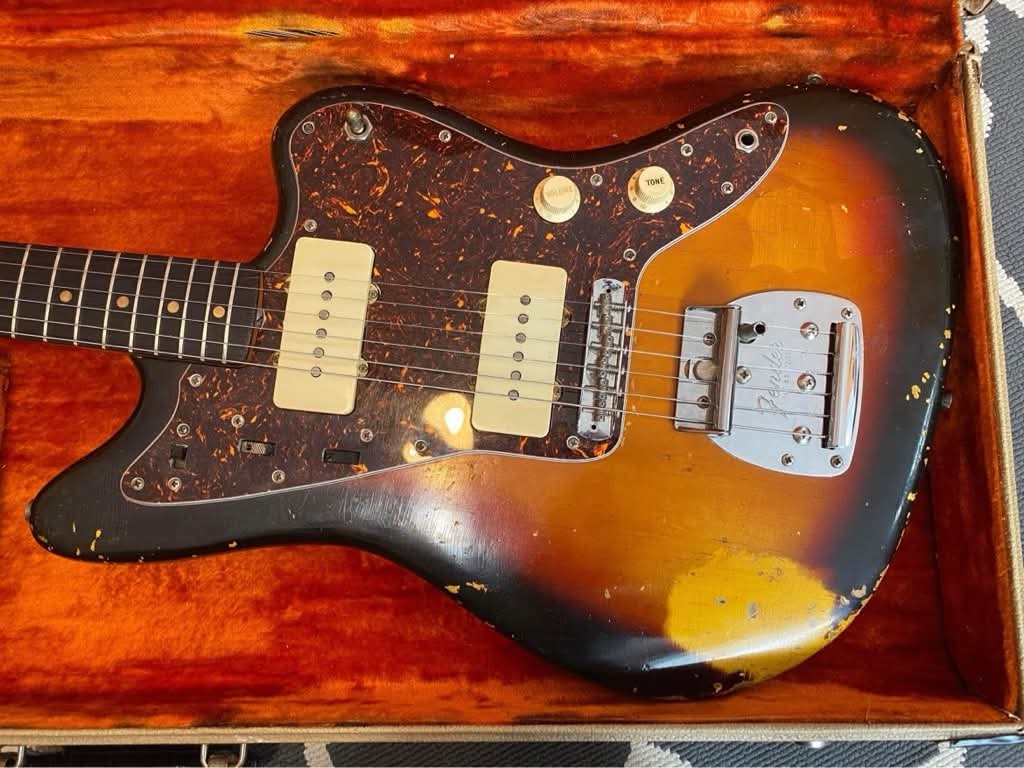
What makes the 1960 specifically significant is the intersection of the slab rosewood fingerboard — introduced in mid-1959 and now the full-year standard — with the clay dot markers, the anodized aluminum pickguard that defined early Jazzmaster production, and the full availability of custom colors that Fender was making increasingly accessible across its lineup. The 1960 Jazzmaster sits at the peak of the anodized guard era for this model — a configuration that produces a specific visual and tonal character that later celluloid guard instruments do not replicate. In our experience buying pre-CBS Fender instruments across Ohio and the Midwest, 1960 Jazzmasters are among the most undervalued pre-CBS Fenders relative to their actual historical significance and collector market trajectory.
What makes the 1960 Jazzmaster distinctive:
First full production year with slab rosewood fingerboard as standard — the thickest, tonally densest fingerboard configuration of the Jazzmaster run
Anodized aluminum pickguard — the gold anodized guard defines early Jazzmaster visual identity and is specific to 1958–1959 and portions of 1960 production
Clay dot position markers — matte, off-white, not pearl or celluloid
Full rhythm and lead circuit — the sophisticated dual-circuit system with dedicated rhythm volume and tone controls plus a separate lead circuit
Wide Jazzmaster single-coil pickups — physically larger than Stratocaster pickups, wound differently, with a distinctive tonal character
Floating tremolo system — the original Jazzmaster tremolo with lock button, designed for tuning stability under heavy use
Serial numbers in the 40,000–55,000 range on the neckplate
Sunburst standard finish; custom colors available
Tortoiseshell celluloid pickguard beginning to appear as the anodized guard transitions out
If you own a 1960 Jazzmaster, you may be sitting on a significant asset. Edgewater Guitars provides free, no-obligation valuations — call (440) 219-3607 or visit edgewaterguitars.com.
What Is a 1960 Fender Jazzmaster Worth? (2026 Market Values)
Value by Condition and Finish
The 1960 Jazzmaster market in 2026 has strengthened considerably relative to where it sat a decade ago — the instrument’s association with surf music, its increasing recognition among serious collectors, and the growing appreciation for pre-CBS Fender offset models have all contributed to rising valuations. Custom color examples represent the top of the market by a meaningful margin. Anodized guard examples in original condition carry a specific premium over tortoiseshell or white guard instruments from the same year.
Condition | Originality | Relative Value |
|---|---|---|
Excellent (8–9/10) | All original, custom color, anodized guard, original case | Premium-plus tier |
Excellent (8–9/10) | All original, sunburst, anodized guard, original case | Premium tier |
Excellent (8–9/10) | All original, sunburst, tortoiseshell guard, original case | Strong tier |
Very Good (7/10) | All original, either guard type, no case | Mid-to-strong tier |
Good (6/10) | Original parts, finish wear | Mid tier |
Player Grade | Some replacements, heavy wear | Entry tier |
Modified | Non-original pickups, refin, added routes | Significant reduction |
What Affects the Value of a 1960 Jazzmaster?
Pickguard type: The anodized aluminum pickguard is the single most visually distinctive feature of early Jazzmaster production and carries a 20–30% premium over equivalent tortoiseshell guard examples. Anodized guard production was transitioning in 1960 — both guard types appear — making confirmed original anodized examples especially sought after.
Custom color: Any documented factory custom color places a 1960 Jazzmaster at the top tier of the market. Blonde, Fiesta Red, and Sonic Blue are the most actively sought custom colors for this model. The Jazzmaster’s larger body surface makes custom colors visually striking in a way that commands disproportionate collector attention.
Originality: All-original examples command a 40–60% premium over modified instruments. The rhythm circuit components — the rhythm volume and tone controls plus the lead-rhythm selector — are frequently bypassed or modified, and all-original circuit integrity is a specific value driver.
Slab fingerboard condition: The thick slab rosewood board is prone to shrinkage cracking in low-humidity environments — common in Ohio and the Midwest. Intact, crack-free boards add meaningful value; boards with significant cracking reduce value by 10–20%.
Tremolo originality: The original Jazzmaster floating tremolo system — with its specific bridge, tremolo arm, and lock button assembly — is frequently replaced with Mustang tremolos or aftermarket units by players who prefer a different feel. An all-original tremolo system in correct working condition adds meaningful value.
Original case: The original grey or brown hardshell case with red or yellow interior adds approximately 10–15% to value.
How 1960 Compares to Other Years
Year | Key Difference | Relative Value | Why |
|---|---|---|---|
1959 | First full slab year; anodized guard standard; first rosewood examples | Similar to higher | First-year transition premium; some maple neck survivors |
1960 (this post) | Full slab year; anodized guard transitioning to tort; clay dots | Baseline | Peak anodized guard availability; fully resolved slab production |
1961 | Tortoiseshell guard becomes standard; slab board continues | Similar to slightly lower | Loss of anodized guard as standard reduces visual premium |
1962 | Slab-to-veneer transition begins mid-year | Similar | Last slab examples carry transition premium |
Edgewater Guitars consistently pays 30–40% more than typical guitar shops. Get your free valuation: edgewaterguitars.com or (440) 219-3607.
Recent Sales and Auction Results
Custom color 1960 Jazzmasters — particularly Blonde and Fiesta Red examples — have achieved strong results at Heritage Auctions and Gruhn Guitars in recent years as collector attention has expanded from the Stratocaster and Telecaster to the offset models. All-original sunburst examples with anodized pickguards in excellent condition sell at a strong tier. The trajectory of the pre-CBS Jazzmaster market has been consistently upward over the past decade and shows no indication of reversal. Contact Edgewater for current market context specific to your instrument.
How to Identify an Authentic 1960 Fender Jazzmaster
Serial Numbers
Range for 1960: Approximately 40,000–55,000, stamped on the neckplate
Location: Four-bolt neckplate
Important caveat: Serial number ranges overlap significantly between production years. Always cross-reference with the neck date stamp and pot codes. A number in this range is consistent with 1960 but does not confirm it.
Neck Date
Format: Pencil-written or rubber-stamped, month and year (e.g., “8-60” or “AUG 60”)
Location: Heel of the neck, visible only when the neck is removed from the body by removing the four neckplate screws
What to look for: The stamp appears on the maple heel beneath the slab rosewood fingerboard. Aging should be consistent with the surrounding wood.
Potentiometer Codes
Manufacturers: Stackpole (code 304) and CTS (code 137)
How to decode: Manufacturer code (3 digits) + year (2 digits) + week (2 digits)
Example: 304-9-38 = Stackpole, 1959, week 38 — appropriate for a guitar assembled in early 1960
Expected codes for 1960: Pots dated to 1959 or 1960 are correct for all circuits — both the lead circuit and the rhythm circuit have independent potentiometers that should be examined. Pots from 1961 or later indicate modification.
Location: The Jazzmaster has more potentiometers than a Telecaster or Stratocaster — the rhythm circuit has its own dedicated volume and tone controls in addition to the lead circuit controls. All pots should be examined and their codes cross-referenced.
Key Visual Identifiers
Fingerboard: Thick slab rosewood, flat-bottomed, approximately 4.8mm thick — the definitive 1960 fingerboard configuration. Visible as flat and square when the neck is removed.
Position markers: Clay dots — matte, slightly off-white, not pearl or celluloid
Pickguard: Gold anodized aluminum (earlier 1960 production) or tortoiseshell celluloid (later 1960 production) — both are correct for 1960; anodized guard commands a premium
Pickups: Wide Jazzmaster single-coil pickups — physically larger than Stratocaster pickups, with a distinctive rectangular shape and white covers, mounted in individual chrome-plated pickup bezels
Tremolo system: Original Jazzmaster floating tremolo — a rocking bridge on two posts with a separate tailpiece-mounted tremolo arm unit and a lock button on the upper bout
Rhythm circuit controls: Two small knurled knobs on the upper horn area — one volume, one tone — for the dedicated rhythm circuit, operated via the sliding rhythm-lead selector switch
Neck profile: Rounded C — consistent with the late 1950s and early 1960s Fender profile
Logo: Spaghetti-style gold with black outline — thin, script lettering
Neckplate: Four-bolt, no F-stamp
Factory Markings and Stamps
Control cavity: Body date pencil mark sometimes present
Neck pocket: May show pencil date consistent with neck heel stamp
Pickup cavities: Some examples retain assembly pencil dates
Underside of pickguard: The anodized guard may show production stamps or markings on the underside
Anodized Guard Authentication
The gold anodized aluminum pickguard is the most visually distinctive and collector-relevant feature of the early Jazzmaster and requires specific authentication attention:
Material: Anodized aluminum — firm, metallic, with a characteristic gold sheen that ages toward a slightly darker, more muted gold with decades of oxidation. Not plastic, not celluloid.
Aging character: Original anodized aluminum shows specific aging — slight darkening at edges, surface oxidation patterns consistent with decades of exposure. A guard that looks too bright or too uniform may be a replacement.
Screw hole alignment: Original guards have specific screw hole spacing matched to the original body routing. Replacement guards from later production years or aftermarket sources may show slightly different hole spacing.
Underside: The underside of the original anodized guard is bare aluminum — not painted or lined. Some replacement guards have additional materials on the underside.
Pickup bezels: The original chrome-plated pickup bezels are integrated with the original guard mounting system — their alignment with the guard is factory-matched on original instruments.
Custom Color Identification
Custom color authentication on 1960 Jazzmasters follows the established pre-CBS Fender protocol:
Yellow sealer undercoat: Original Fender custom colors applied over a specific yellow sealer layer — visible at wear points, in the neck pocket, and under UV examination
Correct primer sequence: UV examination reveals the original primer layer sequence — distinctly different from refinish primer materials
Matching headstock: Many 1960 custom color Jazzmasters have matching headstock color
Neck pocket bleed: Original custom color typically shows slight finish bleed into the neck pocket from original application
Aged finish characteristics: Original 1960 nitrocellulose custom colors show more than 65 years of specific aging — Fiesta Red fading toward salmon, Sonic Blue yellowing toward seafoam, Blonde yellowing toward cream
Red Flags: How to Spot Fakes and Refinishes
Veneer board on a claimed 1960: The curved veneer rosewood board was not introduced until late 1962. Any claimed 1960 Jazzmaster with a veneer fingerboard has a replaced neck or is not a 1960 instrument.
Pearl or celluloid dots: Clay dots are correct for 1960. Bright pearl or celluloid dots indicate a replaced fingerboard or a later instrument.
F-stamped neckplate: The CBS-era F-stamp was not present on 1960 instruments.
Plastic-insulated wiring: Original 1960 Jazzmaster wiring used cloth-covered wire throughout both the lead and rhythm circuits.
Pot date mismatch: Pots dated 1961 or later indicate modification. Note that the Jazzmaster has more pots than simpler Fender models — all must be checked.
Bypassed rhythm circuit: The rhythm circuit is frequently bypassed by players who find it unnecessary. A bypassed circuit reduces value by 10–15% and is an authentication flag — original circuits should be fully functional.
Non-original tremolo components: The floating tremolo system is complex and its components are frequently replaced individually. The bridge, tremolo arm assembly, and lock button should all be examined for originality.
Refin indicators: Non-original primer under UV, filled hardware holes, overspray on hardware — all standard refinish indicators apply.
In our experience evaluating 1960 Jazzmasters from the Ohio and Midwest region, the rhythm circuit bypass is the most frequently encountered modification — players who owned these instruments primarily as playing tools often found the rhythm circuit an unnecessary complication and bypassed it. The modification is audible and visible on inspection. We have also found that the anodized pickguard is frequently misidentified — sellers sometimes present tortoiseshell guard examples as anodized guard instruments without realizing the distinction, and occasionally vice versa.
Not sure what configuration your 1960 Jazzmaster has? Edgewater offers free authentication. Call (440) 219-3607 or visit edgewaterguitars.com.
1960 Fender Jazzmaster Specifications
Specification | Detail |
|---|---|
Body Wood | Alder (sunburst and custom colors) |
Neck Wood | Maple with slab rosewood fingerboard |
Fingerboard | Slab rosewood, flat-bottomed, approximately 4.8mm thick, 7.5” radius |
Position Markers | Clay dots — matte, off-white |
Neck Profile | Rounded C, approximately 0.84” at 1st fret, 0.90” at 12th fret |
Nut Width | 1-5/8” (1.625”) |
Scale Length | 25.5” |
Frets | 21, narrow vintage wire |
Pickups | Two wide Jazzmaster single-coil, white covers, individual chrome bezels |
DC Resistance (typical) | Approximately 9.5–10.5k ohms per pickup |
Tremolo | Jazzmaster floating tremolo — rocking bridge, separate tailpiece tremolo arm unit, lock button |
Tuners | Kluson Deluxe, single-ring, plastic oval buttons |
Controls (Lead) | Volume, tone, 2-position pickup selector switch |
Controls (Rhythm) | Dedicated volume, dedicated tone — accessed via sliding rhythm-lead selector on upper bout |
Pickguard | Gold anodized aluminum (early 1960) or tortoiseshell celluloid (later 1960) |
Finish | Nitrocellulose lacquer — sunburst standard; custom colors available |
Available Colors | Sunburst (standard); Fiesta Red, Sonic Blue, Blonde, Olympic White, Lake Placid Blue, Daphne Blue (custom order) |
Weight Range | Typically 7.5–9.0 lbs |
Case | Grey or brown hardshell case with red or yellow interior |
Original Retail Price | Approximately $329.50 (1960 catalog) — the most expensive Fender production guitar of its era |
What Does a 1960 Fender Jazzmaster Sound Like?
Pickup Specifications and Tonal Profile
Pickup type: Wide single-coil — physically larger than Stratocaster pickups
DC Resistance: Approximately 9.5–10.5k ohms per pickup — higher output than Stratocaster single-coils
Wire type: Formvar-coated
Magnet type: Alnico V, flush with pickup surface (not staggered)
Potting: Unpotted
Mounting: Individual chrome-plated bezels, floating above the pickguard surface
The Jazzmaster pickup is one of the most misunderstood vintage pickup designs in the pre-CBS Fender catalog. Its wider coil aperture — the physical width of the pickup relative to its height — captures a broader string vibration pattern than the narrower Stratocaster coil, producing a fuller, warmer fundamental with more low-midrange body. The result is a pickup that sounds simultaneously fuller and darker than a Stratocaster in the bridge position while retaining single-coil clarity and definition. The bridge pickup on a 1960 Jazzmaster is warm and full-bodied where a Stratocaster bridge pickup is bright and cutting — a fundamental character difference that defines the Jazzmaster’s musical identity.
The rhythm circuit — when intact and functional — accesses both pickups simultaneously through a separate tone capacitor with a dedicated treble-cut response curve. The result is a darker, warmer, more compressed tone designed for chord rhythm playing behind a soloist — the jazz application the instrument was originally designed for.
How Construction Details Affect Tone
The slab rosewood fingerboard of 1960 contributes the same warmth and density to the Jazzmaster’s tonal character that it contributes to the Telecaster and Stratocaster of the same era — a slight rounding of the upper-frequency attack and a fuller fundamental relative to the maple-neck instruments. On the Jazzmaster, whose pickup design already trends warmer than other pre-CBS Fenders, the slab board reinforces the instrument’s characteristic warmth rather than countering it.
The floating tremolo system’s rocking bridge design — in which the bridge rocks on two posts rather than being fixed — affects sustain in a specific way. The rocking motion allows the bridge to move with string vibration rather than resisting it, producing a bloom to the attack and a particular quality of sustain that differs from fixed-bridge instruments. Players who adjust the bridge spring tension carefully find this system highly responsive and musical; players who leave it unadjusted often find it unsatisfying.
The alder body contributes an even, balanced frequency response across the spectrum — less mid-scoop than ash, more extended low end, well-suited to the Jazzmaster’s warmer pickup character.
Notable Recordings
The Jazzmaster’s role in surf music is its most documented sonic context. Dick Dale, the self-described King of Surf Guitar, used a Jazzmaster in this era and the instrument’s combination of powerful pickups, tremolo system, and bright-but-full tonal character is directly audible in recordings like “Misirlou” (1962) and “Let’s Go Trippin’” (1961). The Ventures used Jazzmasters extensively in this period, and the clean, reverb-drenched tone of their recordings documents the 1960-era Jazzmaster sound with clarity. The slab board configuration of 1960 specifically contributes the warm, full-bodied character that makes Jazzmaster recordings from this period so immediately identifiable.
Common Issues and Modifications That Affect Value
Bypassed rhythm circuit: The most common modification on all pre-CBS Jazzmasters. The dual-circuit system is complex and players frequently bypassed the rhythm circuit entirely. Value impact: 10–15% reduction. A restored and functional rhythm circuit adds meaningful value to a bypassed example.
Replaced tremolo components: The floating tremolo is complex and its components — bridge, tremolo arm unit, lock button — are frequently replaced individually or entirely with Mustang tremolo units. Value impact: 15–25% for complete tremolo replacement; 8–15% for individual component replacement.
Replaced pickups: Original Jazzmaster single-coil pickups are frequently replaced with Stratocaster pickups — a modification that changes the instrument’s fundamental tonal character. Value impact: 20–30% reduction. Original pickups retained and included reduce impact to approximately 10–15%.
Replaced pickguard: The anodized aluminum guard is sometimes replaced with a more standard tortoiseshell or white celluloid guard. On an instrument where the original anodized guard is documented, replacement reduces value by 20–30%.
Slab fingerboard cracks: Common in the Midwest climate. Value impact: 10–20% depending on severity.
Missing or replaced clay dots: Value impact: 5–10%.
Refinished body: Correct color refinish: 40–55% reduction. Non-original color: 55–70% reduction.
Refretted neck: Correct vintage wire: 5–10% reduction. Modern fret wire: 10–15% reduction.
Headstock crack or repair: Reduces value by 25–40% even when professionally repaired.
Replaced neck: Reduces value by 35–50% even with a period-correct Fender replacement neck.
In Edgewater’s experience with 1960 Jazzmasters, the tremolo system condition is the most complex authentication challenge — the multiple components of the floating tremolo system each have specific original specifications, and partial replacement of individual components is common and sometimes difficult to detect without direct comparison to documented originals.
Selling Your 1960 Fender Jazzmaster: Your Options Compared
Selling Option | Typical Offer | Timeline | Fees/Costs | Risk Level | Best For |
|---|---|---|---|---|---|
Edgewater Guitars | 30–40% above shop offers | Immediate cash | None | Low — expert authentication included | Owners wanting fair value without complexity |
Local Guitar Shop | Wholesale pricing (lowest) | Same day | None direct, but lowest price | Low | Convenience over value |
Reverb / eBay | Variable — potentially higher | Weeks to months | 5–15% platform fees + shipping | High — fraud, damage, disputes | Experienced sellers comfortable with risk |
Auction House | Variable | 3–6 months | 15–25% seller premium | Medium | Custom color or exceptional examples |
Private Sale | Variable | Unpredictable | None | High — authentication burden on you | Sellers with existing buyer network |
The 1960 Jazzmaster is an instrument where market appreciation has outpaced general awareness — particularly among sellers who are not actively following the pre-CBS offset market. Local shops that do not specialize in pre-CBS Fenders may apply Telecaster or Stratocaster market logic to a Jazzmaster valuation and arrive at a figure that significantly underestimates the instrument’s actual market position. The anodized guard premium, the slab board configuration, and any custom color presence are all factors that require specific market knowledge to price accurately.
Edgewater operates in the full pre-CBS Fender market including the offset models. Our offers on 1960 Jazzmasters reflect current market conditions, not approximations from more familiar models. We travel anywhere in Ohio, Michigan, Pennsylvania, Indiana, or West Virginia for high-value instruments.
Ready to find out what your 1960 Fender Jazzmaster is worth? Get your free, no-obligation valuation: edgewaterguitars.com or call (440) 219-3607.
Frequently Asked Questions About the 1960 Fender Jazzmaster
Q: What is a 1960 Fender Jazzmaster worth in 2026? A: Value is driven by pickguard type, finish, and originality. Custom color examples with original anodized guard in all-original condition represent the top tier. All-original sunburst examples with anodized guard occupy the premium tier. Tortoiseshell guard examples and player-grade instruments sell at meaningful discounts. Contact Edgewater Guitars for a free valuation specific to your instrument.
Q: What is the anodized pickguard on a 1960 Jazzmaster? A: A gold anodized aluminum pickguard — a metal plate with an electrochemical surface treatment that produces a distinctive gold sheen. It was the standard Jazzmaster pickguard from 1958 through approximately mid-1960 before transitioning to tortoiseshell celluloid. Original anodized guards age toward a slightly darker, more muted gold and have a firm metallic feel distinctly different from celluloid or plastic guards.
Q: What is the dual circuit system on a 1960 Jazzmaster? A: The Jazzmaster has two completely independent electrical circuits — a lead circuit and a rhythm circuit — selected by a sliding switch on the upper bout. The lead circuit has a volume control, tone control, and two-position pickup selector. The rhythm circuit has its own dedicated volume and tone controls and accesses both pickups simultaneously through a separate tone capacitor with a darker, warmer response. The rhythm circuit was designed for jazz chord playing; the lead circuit for soloing.
Q: What serial numbers cover 1960 Fender Jazzmasters? A: Approximately 40,000–55,000, stamped on the neckplate. These ranges overlap between production years — always cross-reference with the neck date stamp and pot codes for accurate dating.
Q: How does the floating tremolo system work on a 1960 Jazzmaster? A: The Jazzmaster tremolo consists of a rocking bridge — sitting on two posts and free to rock forward and back — combined with a separate tailpiece unit that houses the tremolo arm and spring mechanism. A lock button on the upper bout locks the tremolo for string changes. The rocking bridge design allows the bridge to move with string vibration rather than resisting it, producing a specific bloom and sustain character.
Q: What are the Jazzmaster pickups and how do they differ from Stratocaster pickups? A: Jazzmaster pickups are wider single-coil units with a larger coil aperture than Stratocaster pickups. They read approximately 9.5–10.5k ohms DC resistance — higher output than Stratocaster pickups. The wider coil captures a broader string vibration pattern, producing a fuller, warmer fundamental with more low-midrange body. The bridge Jazzmaster pickup sounds warmer and fuller where the Stratocaster bridge pickup sounds brighter and more cutting.
Q: Does Edgewater Guitars buy 1960 Fender Jazzmasters? A: Yes. We actively purchase 1960 Jazzmasters in all conditions — all-original, custom color, player-grade, and modified. We pay 30–40% more than local guitar shops and provide immediate cash payment with no consignment. Call (440) 219-3607 or visit edgewaterguitars.com.
Q: Is the rhythm circuit important to the value of a 1960 Jazzmaster? A: Yes. An intact, functional, and original rhythm circuit adds meaningful value to a 1960 Jazzmaster. A bypassed circuit reduces value by 10–15%. The circuit’s originality — correct pot codes, cloth-covered wiring, original capacitor — is an authentication reference point as well as a functional and value consideration.
Q: What custom colors were available on the 1960 Jazzmaster? A: Documented custom color options for 1960 Jazzmaster production include Fiesta Red, Sonic Blue, Blonde, Olympic White, Lake Placid Blue, and Daphne Blue. Blonde is particularly associated with the Jazzmaster and is among the most sought-after custom color options for this model. All custom color claims require authentication.
Q: How long does it take to sell a vintage guitar to Edgewater? A: Typically 24–72 hours from initial contact to cash in hand. We provide a preliminary valuation promptly, arrange in-person evaluation for high-value instruments, and make an immediate cash offer with no obligation.
Related Resources
Useful next reads and tools for this guitar:
Sell your 1960 Fender Jazzmaster
Edgewater Guitars buys vintage Fender Jazzmasters and other vintage Fenders nationwide. We give free, honest appraisals and fair same-day cash offers, with local pickup or insured nationwide shipping. Call or text (440) 219-3607 or request a free estimate.
How much is a 1960 Fender Jazzmaster worth?
A clean, all-original 1960 Fender Jazzmaster’s value depends on originality, condition, finish, and whether the pickups and hardware are original. Because Edgewater buys directly and resells, we can typically pay more than local shops or pawn stores. The most accurate way to find out is a free appraisal: send a few photos and the serial number and we will give you an honest market assessment.
Where can I sell a 1960 Fender Jazzmaster?
Edgewater Guitars buys them directly, nationwide, with same-day cash offers and no obligation. You can also date yours with our Fender serial number lookup.